Indiana Infantry 30th RegimentBiblio.com

1.399 Ergebnisse
Best.-Nr. 0243396473.Gpaperback. Good. Access codes and supplements are not guaranteed with used items. May be an ex-library book. paperback
Best.-Nr. 1165870789.Ghardcover. Good. Access codes and supplements are not guaranteed with used items. May be an ex-library book. hardcover
1955Best.-Nr. 019944Aldershot: Gale & Polden Ltd. 1955 Undated c.1955. 12mo. original green cloth gilt edges a little rubbed; pp. ii 28 printed single-sided. with 'Drill for Waiters - 4 Div Officers mess Ex New Wine Guest Night - 17 August 1963' 2 p. single-sided roughlyfolded annotations loosely enclosed. A very good copy. . First Edition. Hard Cover. VG/None Issued. Gale & Polden Ltd. hardcover
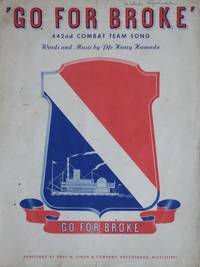
1944Best.-Nr. List2436Hattiesburg: Earl M. Finch 1944. Sheet music measuring 12 x 9 inches 4 pp. Signature of a Nabuko Hayashida on front cover. Slight tears at fold some toning two small pinholes very good overall quite attractive. Very Good. In Hawaii in May 1942 a battalion of Nisei volunteers was assembled for service in World War Two despite earlier failures of efforts to recruit Japanese-Americans due to the Army’s labeling of Nisei recruits as 4-C enemy aliens. Designated as the 100th Infantry Battalion they were deployed to North Africa in June 1943 integrating with the 34th Division in active combat. Their subsequent deployment to Italy in September 1943 exposed them to intense warfare earning them the moniker of the "Purple Heart Battalion" due to their notably high casualty rate. In January 1943 the U.S. War Department officially declared the establishment of the segregated 442nd Regimental Combat Team RCT which was comprised of Nisei volunteers originating from Hawaii and the mainland. The culmination of this initiative transpired in June 1944 when the 442nd RCT merged forces with the 100th Infantry Battalion in Europe subsequently absorbing the latter into its structure. The notable achievements of Nisei soldiers in combat operations prompted the reinstatement of the draft in January 1944 specifically targeting Nisei detainees to augment the ranks of the 442nd. Over time the 442nd RCT expanded to encompass the 2nd 3rd and 100th Battalions; the 522nd Field Artillery Battalion; the 232nd Engineering Company; the 206th Army Band; Anti-Tank Company; Cannon Company; and Service Company. Offered here is a very scarce piece of sheet music entitled “Go For Broke” which was written by the Hawaiian musician Harry Hamada reflecting the slogan of the 442nd and performed by Shelby and others during the war as part of efforts to boost morale. Hamada would feature in the 1951 movie “Go For Broke” as Masami alongside several other veterans of the 442nd. This publication of “Go For Broke” is from 1944 seven years before the movie’s release. The piece is dedicated to Colonel C.W. Pence. Hamada was a Hawaiian musician who performed with a band called the Shelby Hawaiians or the Shelby Serenaders. They performed as early as 1943. The Hattiesburg Mississippi merchant Earl M. Finch who ran an Army and Navy store close to Camp Shelby befriended Hamada and other members of the 442nd and acted as a sponsor for the group and eventually published this version despite his business being a dry goods merchant house and not a publishing house. The group with the support of Finch performed throughout the country to lift morale. At some point Hamada penned this composition likely in 1944 as we find no reference to it in 1943 articles and Finch published it - Hamada’s composition would become the theme song of the 442nd and Hamada would perform at the Halloran General Hospital in New York and the Walter Reed Hospital in Washington D.C. in 1944 likely performing this composition. Another composition called “Go For Broke” exists as well and it is unclear to what degree Hamada’s work caught on among the regiment. We find two records of Finch’s published version of the composition one listed as part of an online remembrance of the 442nd by the Smithsonian Institution https://americanhistory.si.edu/explore/stories/day-remembrance-70-years-after-executive-order-9066 which appears to have been on loan from the National Japanese American Historical Society and another copy held at Stanford though not listed in OCLC. Finch’s story is also interesting and is the subject of a remembrance on a 100th Battalion History page online https://www.100thbattalion.org/history/stories/earl-finch/. We find no copies listed in OCLC. Overall a very scarce piece of Japanese-American wartime history. Earl M. Finch unknown
1890Best.-Nr. 1410180Chicago: The Craig Press 1890. Hardcover. Octavo 129 pages. In Fair minus condition. Spine is red with gold print. Boards in red cloth gold print mitred edges; tattering to spine caps and corners blemishes toning shelf wear cocked spine. Text block has cracked hinges front flyleaf loose intermittent spine breaks light age toning to paper. Illustrated: b&w frontispiece and plates photographs with tissue guards. NOTE: Shelved in Netdesk Column Z. 1410180. FP New Rockville Stock. The Craig Press hardcover
Best.-Nr. 0483775797.Ghardcover. Good. Access codes and supplements are not guaranteed with used items. May be an ex-library book. hardcover
Best.-Nr. 0282408428.Gpaperback. Good. Access codes and supplements are not guaranteed with used items. May be an ex-library book. paperback
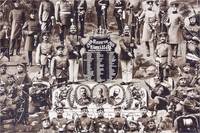
Best.-Nr. 3733807Metz Alsace-Lorraine German Empire: Gebrüder Notton Römerstr. 10 1908. Composite silver process photograph. Mount: 18¾ x 23½ inches. Image: 14¼ x 17¾ inches. Light rubbing to edges of mount with minor wear at bottom right; margins foxed; small mark at bottom extending faintly into image; very good. This is a rich and complex composite photograph from 1908 captioned with the words “Zur Erinnerung an Meine Dienstzeit” which translates to “In remembrance of my service time.” It was created for the 10th Company 8th Württemberg Infantry Regiment Grand Duke Frederick of Baden’s Regiment—possibly light infantry as in “Jäger infanterieregiment.” This regiment was based in Strasbourg in Alsace-Lorraine and served within the Imperial German Army. The surnames of these men are: Baibel Baierl Bauer Berger Jos. Burger Joh. Bumb Büchel Dirr Dirschedl Echtler Feibler Forster Fuchs Gaibl Ganslmeier Gundel Habender Hagl Haub Haüselmeier Herzog Hiemer Huber Jacob Janker Keim Kirchbauer Klemm Knott Kopp Kraus Kreckl Kübel Laubhardt Laubenbacher Lautner Lippert Maier Joh. Maier Seb. Merkel Miehling Moosburger Petermann Pfeilschifter Pflug Prior Rachl Rauschecker Ries Rommel Schmid Schmidt Schnabel Scholz Schraudolf Schweiber Stegmeier Sutter Ulm Weber Weindl Wenniger Wohlfarth Zieringer Zeilinger Zirngibl. The photograph presents a multitude of uniformed soldiers in a staged setting designed to resemble a military encampment or a gathering. The arrangement of soldiers is not casual but highly structured with officers shown with swords and details prominently positioned in the foreground. Many of the men are shown hoisting enormous beer steins with rather serious expressions. The photograph also features regimental flags and other military regalia which were symbols of pride and unity for the unit. The arrangement of soldiers in rows with some seated and others standing is typical of military portraiture of the time intended to display the order and discipline of the troops. The backdrop of the photograph features a bucolic scene a blend of a real outdoor setting and painted backdrops. This kind of photography allowed for the superimposition of studio-taken images onto a different background giving the impression that all individuals were present at a single location. Such methods were used to create cohesive unit photographs when it was not possible to gather everyone at once. The inclusion of phrases like “Mit Gott für König und Vaterland” With God for King and Fatherland reinforces the patriotic sentiment of the era and the soldiers’ commitment to their country and monarch. Other phrases such as “Die Well ist grofs Die Welt ist schön; Wer weifs ob wir uns wiedersehn!” “The world is big the world is beautiful; Who knows if we will see each other again!” reinforce the romanticism of military service. From a photographic history perspective the image represents the advancements in photo montage techniques at the turn of the 20th century. The image quality clarity and composition indicates that the photographers Gebruder Notton used a large-format camera which was capable of capturing detailed group portraits. A rather remarkable photograph encapsulating the military ethos of the German Empire during a period of intense nationalism and militarism leading up to the First World War. unknown
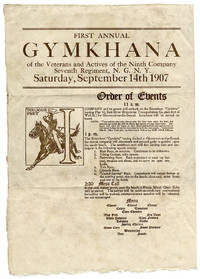
Best.-Nr. 3726497New York City 1907. Two-page program. Approx. 14 x 10 inches. Reverse bifolium. Laid paper; deckle edge along bottom. Folds; faint foxing; very good. Humorous fun-spirited program for the First Annual Gymkhana or field day held by the Ninth Company Company “I” of New York’s Seventh Regiment a National Guard equestrian unit. The late summer excursion took members of the regiment by boat from Manhattan to Glenwood-on-the-Sound Nassau County Long Island. In addition to a “Rhode Island Clam Bake” the complete menu is printed here—from “Clams! Clams! Clams!” to “Smoke” the day’s activities included various aquatic races and an assortment of traditional field events or picnic games—a parody of military and cavalry exercises. "The Steamboat “Cymbria” having docked at Glenwood-on-the-Sound themerrie companie will disembark and proceed gaily to gambol upon the sandy beach. The aquatic ones will don bathing suits and participate in the following aquatic events: 1. Boat Race en surprise. Conditions to be unknown. 3. Swimming Race. Each contestant to wear top hat coat trousers and shoes and to carry an open umbrella. 4. Tub Race. 6. “United Service” Race. Contestants will mount horses at the starting point ride to the beach dismount enter boats and row to the finish." At 4 o’clock there was a running of the “Porter House Stakes; for 10-year-olds and upward” a sham horse race: "A veterinary will be in attendance to administer “hop” beer in extreme cases. No horse will be left at the barrier if a hypodermic can prevent it. Eligible Starters: Pegasus Latrine…Rip Van Winkle Methuselah and Skelington i.e. skeleton. " Traditional picnic games followed: climbing a greased pole tug-of-war “Potato sack Race” catching a greased pig here “Lubricated Pork” “Reconnaissance Hamiltonian” finding a lemon in tall grass and an egg race. Tickets were $5.00: “Please send check immediately to Sergt. Palmer A. Paddock 196 Montague St. Brooklyn.” New York’s Seventh Regiment was comprised of members of New York’s social élite. The regiment was formed before the American Civil War; its ninth company—Company I—was a cavalry unit. A printed historiated initial is the sole illustration; it depicts a mounted charging cavalry soldier with saber and the regimental motto: “Toujours Prêt”—always ready. unknown
Best.-Nr. 3727709New York: Published for the Seventh Regiment Athletic Association by F.M. Crossett Co. “F” 156 Fifth Avenue 1896. 4 60pp. Program. 9½ x 6¾ inches. Color illustrated wrappers; stapled. Half tone illustrations from photographs; ads. Vertical center crease; rubbing to spine with some separation to wrappers at the head; still very good. Unrecorded 1896 program for New York’s Seventh Regiment’s annual annual athletic games competition held at the regiment’s Park Avenue armory. The illustrated program comprises a roster of the officers of the Seventh Regiment Athletic Association and the event’s floor committee; an outline of the regiment’s training practices; the order of the 30 track and field events; a floor-plan or map of the armory’s indoor parade floor indicating starting points and finish lines ; record times for each event; and a complete list of the officers and soldiers entered in each event and the regimental company to which each belonged. Half tone illustrations depict the Seventh Regiment Athletic Association’s officers the regimental line and its colors training exercises the Park Avenue Armory and the baseball teams of both the regiment and United States Military Academy West Point. Competitive events included runs some handicapped of various distances ranging from 75 yards to 1000 yards hurdle races an eight-lap relay race a shot putting event safety bicycle races and a running high jump competition. Less formally athletic events included a “Roman Chariot” race “Four men and driver the latter to appear in fancy costume” a sack race a potato race and a three-legged race. New York’s Seventh Regiment was comprised of members of New York’s social élite. The regiment was formed before the American Civil War assuming its present name in 1847 as the Seventh Regiment of Infantry National Guard New York State Militia. The color cover illustration depicts the regiment’s unit insignia comprising a circular blue garter inscribed with the motto “Pro Patria et Gloria” For Country and Glory the number “7” the initials “NG” National Guard on a field of red and a winged helmet hanging below. No copies in OCLC. unknown
Best.-Nr. 1020465506.Ghardcover. Good. Access codes and supplements are not guaranteed with used items. May be an ex-library book. hardcover
Best.-Nr. 1163803898.Gpaperback. Good. Access codes and supplements are not guaranteed with used items. May be an ex-library book. paperback
Best.-Nr. 1019588764.Ghardcover. Good. Access codes and supplements are not guaranteed with used items. May be an ex-library book. hardcover
1920Best.-Nr. 48301920 Paris Imprimerie R. Hermieu 1920 In-8° broché, couverture illustrée.
1923Best.-Nr. 53891923 Lyon - Paris B. Arnaud imp. c. 1923 In-4° demi-chagrin rouge, dos à nerfs orné, titre doré en plein, couvertures conservées. Reproductions photographiques in-texte.
Best.-Nr. 1474541852.Gpaperback. Good. Access codes and supplements are not guaranteed with used items. May be an ex-library book. paperback
1940Best.-Nr. 53679N. P.: Privately printed n. d. ca 1940. 1940. TEXAS WORLD WAR II. First edition. Stapled 6" x 9" brown printed wrappers with titles and unit insignia printed in black on the front and rear cover n. p. 39 pp. numerous illustrations from photographs. Camp Hulen was a military training camp near Palacios Texas operating from 1925 until 1946. At one time it supported the largest concentration of troops for field training in the U. S. military. In 1940 the War Department leased Camp Hulen from the Texas National Guard for antiaircraft training of National Guard units. At its peak the camp had facilities for 12000 military personnel. It continued as a training facility until 1944. The 197th Coast Artillery was one of these units. The oldest antiaircraft National Guard unit in the U.S. it was part of the New Hampshire National Guard. During World War II it was stationed in Australia as part of the defense against a feared Japanese invasion. This souvenir brochure shows group images of the various batteries making up the unit and its commanding officer. There are photographs of training exercises camp scenes recreation and social events including scenes from nearby Cuero and Palacious. Among the numerous images is a double page panoramic view of Camp Hulen in 1940. Also included is a history of the regiment and its unit. Very scarce with WorldCat locating only the copies at the United States War College and Yale. Faint evidence of a vertical crease to the front cover and minor wear to the top corner else a near fine copy of a scarce item. Privately printed, n. d. (ca 1940). unknown
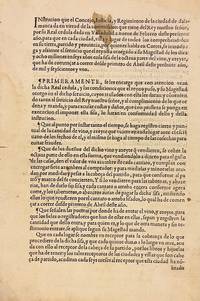
1601Best.-Nr. 3683Salamanca: S.n. 1601. First edition. Signed at foot by a municipal officer Diez de la Puente. One-page contemporary manuscript on p. 3 relating to the administration of the tax. Unbound as issued. Pinholes at gutter some edge chipping and small dents brown stain affecting the upper portion throughout. Otherwise a good well-preserved copy. First edition. Signed at foot by a municipal officer Diez de la Puente. One-page contemporary manuscript on p. 3 relating to the administration of the tax. Unbound as issued. 4 last 2 blank p. Unrecorded 1601 ordinance from Salamanca enforcing the Armada-era servicio de millones Spain’s foundational fiscal levy. Printed ordinance issued by the municipal council of Salamanca implementing the royal tax known as the servicio de los dieciocho millones. In accordance with the royal cédula of 9 February 1601 the Concejo Justicia y Regimiento instructs subordinate towns and villages to collect an eighth part of all wine and olive oil sold to be remitted through a chain of local receivers. The text regulates how wine and oil must be measured recorded and taxed forbids additional repartimientos and orders prompt transfer of funds to the city’s main treasury. Dated at Salamanca 10 March 1601 and naming four municipal commissioners appointed for its execution it represents the earliest stage of local enforcement of Philip III’s fiscal scheme transforming the national levy into a functioning municipal excise. A contemporary handwritten endorsement below the text signed by Diez de la Puente attests its execution. Accompanying the printed ordinance is a contemporary manuscript headed on p. 3 “Dudas que se ofrecen en la administración de las sisas” listing practical questions concerning the execution of the tax—registration and measurement of goods roles of administrators and receivers form of payment penalties and conditions of tax farming arrendamiento. The servicio de los dieciocho millones formed part of the broader system of millones taxes created by the Cortes of Castile to meet the Crown’s desperate financial needs after the prolonged wars of Philip II. The servicio de millones had first been introduced by royal request and approved by the Cortes on 4 April 1590 conceived to raise eight million ducats over six years to finance the royal expenditure associated with the Armada campaign against England and other military commitments. Rather than remaining temporary it evolved into a regular levy on six staple items—wine oil vinegar meat soap and tallow candles—collected through local sisas and eventually forming the backbone of Castile’s fiscal structure. By 1600–1601 under Philip III the scheme was renewed and expanded to eighteen million ducats its collection entrusted to municipal governments such as Salamanca’s Concejo Justicia y Regimiento. As described in Bartolomé Yun Casalilla’s Sobre la transición al capitalismo en Castilla this marked a transition from feudal income to a centralized fiscal system financed through municipal taxation embedding local economies within the machinery of the Habsburg war state. The present ordinance captures this process of consolidation—when the monarchy sought tighter control over municipal revenues demanded proper accounting and remittance of surpluses and aimed to prevent arbitrary over-taxation—reflecting both the fiscal strain and administrative centralization characteristic of early-seventeenth-century Spain. Reference: Yun Casalilla B. 1987. Sobre la transición al capitalismo en Castilla: Economía y sociedad en Tierra de Campos 1500–1830. Valladolid: Junta de Castilla y León Consejería de Educación y Cultura. . [S.n.] unknown
Best.-Nr. 1332421962.Gpaperback. Good. Access codes and supplements are not guaranteed with used items. May be an ex-library book. paperback
Best.-Nr. 133113174X.Gpaperback. Good. Access codes and supplements are not guaranteed with used items. May be an ex-library book. paperback
Best.-Nr. 1331082064.Gpaperback. Good. Access codes and supplements are not guaranteed with used items. May be an ex-library book. paperback
Best.-Nr. 1334110417.Gpaperback. Good. Access codes and supplements are not guaranteed with used items. May be an ex-library book. paperback
Best.-Nr. 0656225939.Ghardcover. Good. Access codes and supplements are not guaranteed with used items. May be an ex-library book. hardcover
Best.-Nr. 1332722105.Gpaperback. Good. Access codes and supplements are not guaranteed with used items. May be an ex-library book. paperback
Best.-Nr. 0332541762.Ghardcover. Good. Access codes and supplements are not guaranteed with used items. May be an ex-library book. hardcover