Mac Nab,Gustave Nadaud Théodore BotrelLivre Rare Book

1 363 résultats
réf. 5735recueil de 36 chansons de 4 pages, en un volume in 8 demi-toile rouge,titre doré.Chansons du Chat Noir,régiment de Sambre et Meuse,Titania.Pourquoi ne pas m’aimer,l’étoile d’Amour.Etc.par Théodore Botrel,Maurice Bosch, Paul Delmet, Mac Nab,Gaston Duthil,Gustave Goublier etc. Illustrations dont WILLETTE
1843réf. 25001Paris Amyot 1843 Fort In-8 XIV-468 pp ( 3 gravures deux fac simile ) 328- 338 pp , deux ouvrages reliés en un
1893réf. 026678St Louis: Nixon-Jones Printing Co 1893. First Edition. Octavo. Important first-hand observations of the Civil War in the West. Nevins calls the book "A very readable and reliable narrative by a member of the 15th Texas Cavalry who saw much service in the Western theater; the volume deserves more attention than it has heretofore received." Quite scarce. Bound in blue cloth decorated in blind spine lettering gilt edges spine ends and corners show some wear previous owner's name. Howes C597; Nevins I p.72. Nixon-Jones Printing Co unknown
réf. 2597716 August 1803; War Office Whitehall. See his entries in the Oxford DNB and History of Parliament. 1p foolscap 8vo. In fair condition aged and worn with small piece of paper torn away at foot of page resulting in some loss of text of slug also wear and a few nicks at head and a stain to one edge. Good firm signature ‘C Yorke’ and its surroundings unaffected. A printed form letter signed by Yorke as ‘Right Honble. the Pay-Master General / &c. &c. &c.’ and completed in a secretarial hand and addressed to ‘Gentlemen’. States that from 31 March 1803 Captain Henry Shelley of the 20th Regiment of Foot should be placed on the half pay of the 85th Regiment of Foot at the rate of five shillings a day in the room of ‘Captain Bent who exchanges’. 16 August 1803; War Office [Whitehall]. unknown
19918vo., First Edition, with photographs and maps in the text; original printed wrappers, a near fine copy.
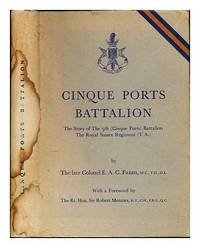
1971réf. 337852Chichester : Royal Sussex Regimental Association 1971. First Edition. Hardcover. Good cloth copy in a good if somewhat edge-torn with some loss and stained dust-wrapper now mylar-sleeved. Remains quite well-preserved overall; tight bright clean and strong. Includes previous owner's inscription. Physical description; xv 176 p. : ill. map port. ; 22 cm. Subjects; Cinque Ports Battalion. The Royal Sussex Regiment. British Military. Chichester : Royal Sussex Regimental Association hardcover
1971réf. 152436Chichester West Sussex: Royal Sussex Regimental Association 1971. Preface by Brigadier R. E. Loder Foreword by The Rt. Hon. Sir Robert Menzies. Pp. xvi176 frontispiece text illustrations mostly full page full page text map appendices index; demy 8vo; navy cloth spine lettered and ruled in gilt gilt insignia to upper board; dust wrapper lightly browned; book label of David Levine Sydney on upper pastedown some foxing mainly to outer leaves and edges; Royal Sussex Regimental Association Chichester West Sussex 1971. First edition. White p. 293. Royal Sussex Regimental Association unknown
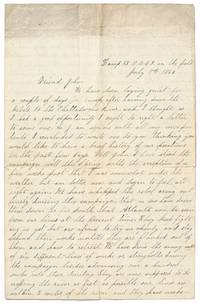
1864réf. 438776Atlanta Georgia 1864. Very Good. Autograph Letter Signed. Folio. 4pp. Partial splitting at the edges of one vertical and two horizontal folds about very good. A detailed and historically important long letter written in the field by Union soldier Harvey Rodgers just two weeks before he was killed at the Battle of Atlanta on July 22 1864. Rodgers was mustered into service in 1861 as a Corporal in the 54th Regiment Ohio Volunteer Infantry Zouaves Company A commanded by 1st Lt. Judson McCoy referred to as "Jud" in the letter. In the letter written to his "Friend John" on four easily legible folio pages Rodgers describes Confederate and Union Army maneuvers and skirmishes immediately after the Battle of Kennesaw Mountain fought from June 19 - July 2 1864 during the lead-up to the Battle of Atlanta which began on July 21st: ". Well John I have stood the campaign well this Spring . We have whipped the rebel army out finely . that is we have drove them so far South that Atlanta can be seen from our lines . I suppose you have heard about our making a charge on the 27th June . I do not wish to be in anymore such places . we lay in camp until the 2nd of July when our Division moved . very near due south of the Kennesaw mountain. That night Jud with our Company was on picket. We heard the cars very plain but did not think they the rebel army were evacuating the mountain and falling back . Next morning . We did not move forward until two o'clock when we advanced our lines two miles finding a small force of Cavalry in our front which we routed by charging them. The Regt. lost 1 killed 14 wounded ." He describes a second skirmish on July 4th at which his Company fought in support of the Union army's 16th Corps to advance Union lines and continues: ". On the 5th we were moved back again and brought further around on the right where we now lay. Our front lines are two miles further on. The rebels have a line of works between them and the Chattahoochee river . I expect we will have a pretty hard time before we get there and a hard time to cross the river ." The Battle of Atlanta commenced on July 21 1864. Both Harvey Rodgers and Union Maj. Gen. James B. McPherson were killed during the battle on July 22nd. Rodgers' letter thus ends poignantly: "Well John my time is fast rolling around now and I begin to think I will soon get home again. Only two months and 8 days more . Still in that short time there are many dangers to undergo. I may be called on to go into several more charges. Perhaps of some one not to come out alive . There has not more than half a dozen days passed since the 10th of May but what we have been under the sound of artillery. The troops appear to be pretty well worn out and wish for the campaign to close yet they all want to get into Atlanta first ." A compelling and ultimately heartbreaking eye witness account of General Sherman's Atlanta campaign during the summer of 1864. Longer quoted extracts from the letter are available. unknown
1864réf. 438776Atlanta Georgia 1864. Very Good. Autograph Letter Signed. Folio. 4pp. Partial splitting at the edges of one vertical and two horizontal folds about very good. A detailed and historically important long letter written in the field by Union soldier Harvey Rodgers just two weeks before he was killed at the Battle of Atlanta on July 22 1864. Rodgers was mustered into service in 1861 as a Corporal in the 54th Regiment Ohio Volunteer Infantry Zouaves Company A commanded by 1st Lt. Judson McCoy referred to as "Jud" in the letter. In the letter written to his "Friend John" on four easily legible folio pages Rodgers describes Confederate and Union Army maneuvers and skirmishes immediately after the Battle of Kennesaw Mountain fought from June 19 - July 2 1864 during the lead-up to the Battle of Atlanta which began on July 21st: ". Well John I have stood the campaign well this Spring . We have whipped the rebel army out finely . that is we have drove them so far South that Atlanta can be seen from our lines . I suppose you have heard about our making a charge on the 27th June . I do not wish to be in anymore such places . we lay in camp until the 2nd of July when our Division moved . very near due south of the Kennesaw mountain. That night Jud with our Company was on picket. We heard the cars very plain but did not think they the rebel army were evacuating the mountain and falling back . Next morning . We did not move forward until two o'clock when we advanced our lines two miles finding a small force of Cavalry in our front which we routed by charging them. The Regt. lost 1 killed 14 wounded ." He describes a second skirmish on July 4th at which his Company fought in support of the Union army's 16th Corps to advance Union lines and continues: ". On the 5th we were moved back again and brought further around on the right where we now lay. Our front lines are two miles further on. The rebels have a line of works between them and the Chattahoochee river . I expect we will have a pretty hard time before we get there and a hard time to cross the river ." The Battle of Atlanta commenced on July 21 1864. Both Harvey Rodgers and Union Maj. Gen. James B. McPherson were killed during the battle on July 22nd. Rodgers' letter thus ends poignantly: "Well John my time is fast rolling around now and I begin to think I will soon get home again. Only two months and 8 days more . Still in that short time there are many dangers to undergo. I may be called on to go into several more charges. Perhaps of some one not to come out alive . There has not more than half a dozen days passed since the 10th of May but what we have been under the sound of artillery. The troops appear to be pretty well worn out and wish for the campaign to close yet they all want to get into Atlanta first ." A compelling and ultimately heartbreaking eye witness account of General Sherman's Atlanta campaign during the summer of 1864. Longer quoted extracts from the letter are available. unknown books
1825réf. 7151EBErlangen, Carl Heyder, 1825. Klein-8°. 18 cm. 175 Seiten. Halblederband der Zeit mit goldgeprägtem Rückentitel auf rotem Lederschildchen und rotem Schnitt. [2 Warenabbildungen] (= Wahrhafte und merkwürdige Schicksale reisender Personen, als Denkmale einer göttlichen Vorsehung. 1. Bändchen).
1929réf. 2092902138200818Kyoto Regiment District General School Corps 1929. Soft Cover. Fine. Number of pages: 272 pages Size: A5 size Number of books: 1 volume Kyoto Regiment District General School Corps paperback
réf. 3744Belfort, Imprimerie Eugène Devillers, 1907, broché, 14x22 cm, 47 pages , 3 gravures hors texte, une carte dépliante.
1947réf. 1240501947 Société d'édition savoyarde, Thonon-les-Bains - 1947 - In-12, broché, couverture illustrée - 208 pages - Nombreuses reproductions photographiques et illustrations hors-texte en N&B - Carte dépliante in-fine
1864réf. 58358Various places including Methuen Lawrence Andover Boston and Lowell Massachusetts 1864-1865. modern calf antique with original gilt-lettered label "Company Clothing" laid down on front panel. Folio. Two pages list "Price of Clothing Camp & Garrison Equipage Year 1864." Following are 204 pages one to a soldier listing name company place and date of enlistment articles of clothing issued value itemized date of clothing issue and signature of soldier and witness. In some cases date of discharge desertion or demise is also noted. A "colored" under cook is also listed along with the soldiers. hardcover
1877réf. 8187Imprimeur C. Annoot-Braeckman 13,5 x 19,5 Gand 1877 Plaquette brochée, 87 pp. Planche dépliante in fine. Publication de la Revue Belge d'art et de sciences militaires. Couverture très piquée, mais bon intérieur, pages non coupées.(Home33)
1877réf. 8187Imprimeur C. Annoot-Braeckman 13,5 x 19,5 Gand 1877 Plaquette brochée, 87 pp. Planche dépliante in fine. Publication de la Revue Belge d'art et de sciences militaires. Couverture très piquée, mais bon intérieur, pages non coupées.(Home33)
réf. GF15424Manuscrit sur papier (18,5 x 29 cm) avec cachet de cire rouge signé, situé et daté : "à Montechevou au Comté de Montbéliard le 20 février 1678"
1775réf. 157951775 quelques trous d'usure, trace de pliage. certificat avec encadrements et armes de France, cachet de cire rouge, visa de la Gendarmerie de Saint- Pourçain. Metz 21 septembre 1775
1784réf. 5638Sarlouis, le 18 mars 1784. 1784 1 feuillet in-folio oblong ( 212 x 286 mm) imprimé à l'encre noire et completé à la main à l'encre brune, cachet de cire rouge du régiment et cachet humide rouge estompé; et au dos est rédigé et signé par l'intendant du régiment, le détail reçu par ce soldat. (salissures, traces de plis, défauts d'usage.)
réf. 13842(Document) Belley, 1850. 31.5 x 21.5 cm - feuillet simple imprimé sur les deux faces rempli manuellement pour le Sergent Dupominier Antoine, caporal de voltigeur... Trace de pliure sur le document et légères rousseurs.
réf. 99394Paris Plon 1916. 8° 48 S. m. zahlr. Abb. Geheft. Tadell. Text. franz. 010 Paris, Plon, 1916 unknown
réf. 11555Letter 'dated Cape Town May 10th 1797' on paper also with watermarked date '1797'. 2pp. 4to. Good on lightly-aged laid paper. Bower begins by stating that he is sending 'a Copy of a Letter which I have received from Dr Carm Smyth James Carmichael Smyth 1742-1821 of the Middlesex Hospital'. Smyth's son the future Sir James Carmichael-Smyth is 'a very fine handsome young man Lieut in the Engineers come out a Passanger sic in the same ship with us'. Bower and Smyth 'wisely went into the Boat which was lashed to the Stern Gallery to fish sharks which were following the ship - the Boat suddenly canted round in the slings upon which poor Smyth went plump into the sea'. Bower 'happened to catch hold of the Boat & by the dictate of instinct & fear together scrambled up again & got into the Stern Gallery'. The slings being 'foul' an attempt to lower the boat failed and 'poor Smyth was nearly exhausted when I jumpt from the great Cabin window & kept him up till we were both Pickt up'. Bower continues: 'I will thank you to tell his Dad that I think myself well rewarded for my Ducking by the satisfaction I derive from his Letter'. Dr Smyth has sent Bower 'a very fine field Glass' and Bower asks his father to 'tell Sandy to call on Dr Smyth if he goes to London he is a man of considerable eminence in his profession'. The doctor has 'exerted himself on my account for my promotion in the Army' and 'if he can serve either Graham or Sandy' Bower will think himself 'Greatly overpaid'. The Gentleman's Magazine of February 1800 pp.181-182 gives an unusually long entry on Captain Bower's death at 'the isle of Perrim on the Red Sea' praising his character and accomplishments. Letter 'dated Cape Town May 10th 1797', on paper also with watermarked date '1797'. unknown
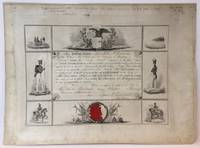
réf. 58705A collection of 11 items from the first organizational years of the National Guard unit which protected New York City in the early 19th century. The group consists of three brass cylinders each containing rolled manuscript documents related to the regiment; an oval metal box containing a pair of epaulettes from the 7th; a wallet style polished black leather military bag with a gilt emblem of the 7th National Guards on the front flap; and a partially printed document completed in manuscript acknowledging the service of a member of the regiment. New York 1816-1847. What became known as New York's Seventh Regiment was originally organized in April 1806 as a response to the threats from the British search and seizure policies in New York harbor. The regiment consisted of four companies comprising many of the merchants and tradesmen in the city. During the War of 1812 the unit by then designated the 2nd Battalion 11th Artillery manned the guns of the forts guarding New York harbor. After the war a military-weary New York saw a fall-off of interest in drilling and training by militias. The appointment in 1820 of Col. James Benedict to lead the Eleventh brought a renewed interest in organized training discipline and field exercises attention to uniforms and equipment and regular attendance at meetings. His order regarding the wearing of pantaloons over boots is reflected in one of the documents present here. By 1824 the Eleventh had been renamed "The National Guards" in honor of the Marquis de Lafayette and by 1826 it was redesignated "The Twenty-Seventh Regiment of the New York State Artillery." In addition to official parades and escorting of dignitaries the national Guards were used to maintain order in the city during public executions in the 1820s and were called out to help quell riots in the 1830s. A reorganization of all the militia units resulted in its new official designation as the Seventh Regiment in 1847. All of the material is in very good condition aside from some scuffing to the metal box. Each of the brass cylinders has an engraved label and the end of each one unscrews to reveal the rolled document inside. The metal box has a faint blind-stamp on the lid identifying it as having been produced by J.H. McLenney & Co. 141 Grand St. New York. The leather wallet is stamped in blind on the back "Ridabock & Co. New York." McKenney & Co. and its successor Ridabock & Co. were manufacturers and dealers in military goods. #6445. Itemized list of the collection: a The first cylinder engraved label reading "Roll of Honorary Members 1st Co. 7th Regt." The document inside dated June 23 1816 206 x 25 cm. consisting of 6 pages tipped together end-to-end records the "Bye laws for the Regulation of Capt. James Benedict's Company in the Eleventh Regiment NY State Artillery" including the establishment of a monthly meeting time regulations regarding attendance new members arms & equipment etc. It is signed by the three members of the Committee of Revisal Gilbert Hopkins Irad Hawley and Richard E. Purdy as well as approximately 77 members of the company. Damage to the lower corner of the document has resulted in the loss of several signatures; some chipping along the right margin of the scroll occasionally affecting a word or two. b The second cylinder engraved label reading "Roll of Company. 7th Regt. N.G.S.N.Y." Rolled inside are two separate documents. The first dated May 18 1821 90 x 20 cm. consisting of 3 pages tipped together end-to-end is a document signed by the members of the company commanded by Capt. Gilbert Hopkins 11th Regt 1st Brigade pledging to abide by a decision regarding the wearing of pantaloons over instead of under Boots on Parade signed by 67 members of the company. The second document is undated 22 x 20 cm. a single leaf approves an alteration to the by-laws regarding dunning members for non-attendance signed by 20 members. c The third cylinder engraved label reading "Roll of the first Company National Guards New York State Artillery" ownership name partially rubbed out but research shows it reads "Captain J.S. Cocks". The manuscript document records another revision of the by-laws this one from October 1826. Printed in block letters at the head of the document 184 x 23 cm. consisting of 5 pages tipped together end-to-end is the title "TWENTY-SEVENTH REGIMENT / NEW YORK STATE ARTILLERY / PRO PATRIA ET GLORIA / NATIONAL GUARDS." The text includes several modifications to various articles of the by-laws and is signed by the members of the Committee of Revisal Smith Spelman Thos. Jaycox and Thos. H. Locke along with 48 other members of the regiment. Some chipping to the margins of the document not affecting text; one long tear carefully repaired on verso touching some letters but all still legible. The ink from the block lettering has burned through the paper in spots. John Samuel Cocks 1813-1868 whose name is etched on the cylinder was elected captain of the First Company of the 7th Regiment in 1838 and resigned in 1845. During the Civil War he served as a Colonel with the 40th New York Infantry Mozart Regiment. A Successful New York businessman and member of the New York state legislature he died in Brooklyn in 1868. d The black metal box containing the epaulettes is moderately scuffed. There is a small metal handle on the lid and a clasp. The epaulettes rest on an oval post mounted inside the box. Each is braided and has a brass crescent on the shoulder dulled and a round emblem of red cloth with a contrasting black & gray striped cloth "7" affixed to it a gold button embossed with an eagle and two bars. The epaulettes show some wear particularly on the undersides where a metal plate denotes left and right shoulder pad with modest fraying to the edges. e The leather wallet has high polish; the ornamental lettering "NG7" on the front flap is bright the small leather loop clasp is worn but intact. f A partially printed document image size 21 x 31 cm. on a larger sheet 30 x 40 cm. completed in manuscript and dated October 14 1846. The text is surrounded by eight vignette illustrations six of men in uniform on horseback in ranks one of an eagle perched on a shield and the last of swords and cannons with a red wax seal over the middle partially chipped away. The document acknowledges the seven years service of John A. Hadden in Company 6 National Guard 27th Regiment and declares him to be exempt for the rest of his life from both jury service and further military service. Signed by two members of the regiment Andrew H. Brenner and Cyrus H. Loutrel. A few creases in the surface of the document which is a little soiled and has some later ink notes by Hadden in the upper margin. unknown
réf. 58705A collection of 11 items from the first organizational years of the National Guard unit which protected New York City in the early 19th century. The group consists of three brass cylinders each containing rolled manuscript documents related to the regiment; an oval metal box containing a pair of epaulettes from the 7th; a wallet style polished black leather military bag with a gilt emblem of the 7th National Guards on the front flap; and a partially printed document completed in manuscript acknowledging the service of a member of the regiment. New York 1816-1847. What became known as New York's Seventh Regiment was originally organized in April 1806 as a response to the threats from the British search and seizure policies in New York harbor. The regiment consisted of four companies comprising many of the merchants and tradesmen in the city. During the War of 1812 the unit by then designated the 2nd Battalion 11th Artillery manned the guns of the forts guarding New York harbor. After the war a military-weary New York saw a fall-off of interest in drilling and training by militias. The appointment in 1820 of Col. James Benedict to lead the Eleventh brought a renewed interest in organized training discipline and field exercises attention to uniforms and equipment and regular attendance at meetings. His order regarding the wearing of pantaloons over boots is reflected in one of the documents present here. By 1824 the Eleventh had been renamed "The National Guards" in honor of the Marquis de Lafayette and by 1826 it was redesignated "The Twenty-Seventh Regiment of the New York State Artillery." In addition to official parades and escorting of dignitaries the national Guards were used to maintain order in the city during public executions in the 1820s and were called out to help quell riots in the 1830s. A reorganization of all the militia units resulted in its new official designation as the Seventh Regiment in 1847. All of the material is in very good condition aside from some scuffing to the metal box. Each of the brass cylinders has an engraved label and the end of each one unscrews to reveal the rolled document inside. The metal box has a faint blind-stamp on the lid identifying it as having been produced by J.H. McLenney & Co. 141 Grand St. New York. The leather wallet is stamped in blind on the back "Ridabock & Co. New York." McKenney & Co. and its successor Ridabock & Co. were manufacturers and dealers in military goods. #6445. Itemized list of the collection: a The first cylinder engraved label reading "Roll of Honorary Members 1st Co. 7th Regt." The document inside dated June 23 1816 206 x 25 cm. consisting of 6 pages tipped together end-to-end records the "Bye laws for the Regulation of Capt. James Benedict's Company in the Eleventh Regiment NY State Artillery" including the establishment of a monthly meeting time regulations regarding attendance new members arms & equipment etc. It is signed by the three members of the Committee of Revisal Gilbert Hopkins Irad Hawley and Richard E. Purdy as well as approximately 77 members of the company. Damage to the lower corner of the document has resulted in the loss of several signatures; some chipping along the right margin of the scroll occasionally affecting a word or two. b The second cylinder engraved label reading "Roll of Company. 7th Regt. N.G.S.N.Y." Rolled inside are two separate documents. The first dated May 18 1821 90 x 20 cm. consisting of 3 pages tipped together end-to-end is a document signed by the members of the company commanded by Capt. Gilbert Hopkins 11th Regt 1st Brigade pledging to abide by a decision regarding the wearing of pantaloons over instead of under Boots on Parade signed by 67 members of the company. The second document is undated 22 x 20 cm. a single leaf approves an alteration to the by-laws regarding dunning members for non-attendance signed by 20 members. c The third cylinder engraved label reading "Roll of the first Company National Guards New York State Artillery" ownership name partially rubbed out but research shows it reads "Captain J.S. Cocks". The manuscript document records another revision of the by-laws this one from October 1826. Printed in block letters at the head of the document 184 x 23 cm. consisting of 5 pages tipped together end-to-end is the title "TWENTY-SEVENTH REGIMENT / NEW YORK STATE ARTILLERY / PRO PATRIA ET GLORIA / NATIONAL GUARDS." The text includes several modifications to various articles of the by-laws and is signed by the members of the Committee of Revisal Smith Spelman Thos. Jaycox and Thos. H. Locke along with 48 other members of the regiment. Some chipping to the margins of the document not affecting text; one long tear carefully repaired on verso touching some letters but all still legible. The ink from the block lettering has burned through the paper in spots. John Samuel Cocks 1813-1868 whose name is etched on the cylinder was elected captain of the First Company of the 7th Regiment in 1838 and resigned in 1845. During the Civil War he served as a Colonel with the 40th New York Infantry Mozart Regiment. A Successful New York businessman and member of the New York state legislature he died in Brooklyn in 1868. d The black metal box containing the epaulettes is moderately scuffed. There is a small metal handle on the lid and a clasp. The epaulettes rest on an oval post mounted inside the box. Each is braided and has a brass crescent on the shoulder dulled and a round emblem of red cloth with a contrasting black & gray striped cloth "7" affixed to it a gold button embossed with an eagle and two bars. The epaulettes show some wear particularly on the undersides where a metal plate denotes left and right shoulder pad with modest fraying to the edges. e The leather wallet has high polish; the ornamental lettering "NG7" on the front flap is bright the small leather loop clasp is worn but intact. f A partially printed document image size 21 x 31 cm. on a larger sheet 30 x 40 cm. completed in manuscript and dated October 14 1846. The text is surrounded by eight vignette illustrations six of men in uniform on horseback in ranks one of an eagle perched on a shield and the last of swords and cannons with a red wax seal over the middle partially chipped away. The document acknowledges the seven years service of John A. Hadden in Company 6 National Guard 27th Regiment and declares him to be exempt for the rest of his life from both jury service and further military service. Signed by two members of the regiment Andrew H. Brenner and Cyrus H. Loutrel. A few creases in the surface of the document which is a little soiled and has some later ink notes by Hadden in the upper margin. unknown books