Nuremberg War Trials StaffBiblio.com
125,701 results
ref. 68457175-6A M S Press Incorporated. Used - Good. Former library copy. Pages intact with minimal writing/highlighting. The binding may be loose and creased. Dust jackets/supplements are not included. Includes library markings. Stock photo provided. Product includes identifying sticker. Better World Books: Buy Books. Do Good. A M S Press, Incorporated unknown
1891ref. 1254742Washington D.C.: Government Printing Office 1891. 1st Edition . No Binding. Very Good. 18" x 29. Handcolored. Plate XCVII.From the Atlas to Accompany the Official Records of the Union & Confederate Armies 1861-1865.Single sheet double page suitable for framing Government Printing Office unknown
1891ref. 1254744Washington D.C.: Government Printing Office 1891. 1st Edition 1st Printing. No Binding. Very Good. 18" x 29. Handcoloredmap drawn by Allen Anderson. Plate XCIX.2 maps as shown; Single sheet double page suitable for framing Government Printing Office unknown
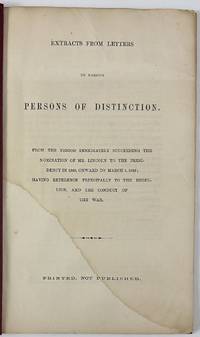
1863ref. 13393N.p.: Printed Not Published 1863. 48pp. Modern crimson wrappers. Large dampstain throughout first half of text text toned thereafter. Marginal pencil markings throughout including one notice of transposed lines on page 9. Overall good plus condition. A rare collection of letters by an anonymous author mostly sent to President Abraham Lincoln but also to Secretary of State William Seward Treasury Secretary Salmon Chase and other officials between October 25 1860 and February 19 1863. The author is a Unionist and a self-described "citizen" not a soldier though he has plenty to recommend to President Lincoln and others about how to prosecute the present war. He also refers to himself as "a cool observer outside the stifling atmosphere of Washington" though again he wastes no time in recommending actions and strategies for political and military improvements. The author was most certainly a political actor of some kind as he writes intimately and on friendly terms with Lincoln and others "You know my personal regard for you" to John J. Crittenden in early 1861. He writes long letters to his correspondents about a decidedly wide variety of issues including the future of slavery political intrigue the dissatisfaction of the public early in the war and more but mostly about troop levels troop movements officer appointments and other aspects and critiques of war strategy. A notable angle of the work is that the author's side of the correspondence and likely some of the return correspondence he mentions within the letters are possibly lost to history other than their presence here. The imprint reads simply "Printed Not Published" and does not include a place or date of publication. We have assumed the date of 1863 given the introductory note is dated March 8 1863. OCLC reports just six copies at Columbia the Huntington Library Harvard Brown the University of Chicago and the Abraham Lincoln Presidential Library. Printed, Not Published unknown
1855ref. 116394John Murray London. 1855. John Murray London. 1855. Hardback NO DW. Two volumes bound as one. 8vo size with smaller army list to rear. Half bound in black calf with marbled boards. Gilt ruling with gilt lettered title label. Corners and spine are rubbed. Page edges browned and end papers foxed. A very interesting clean copy. hardcover
1758ref. 1839London: Printed for J. Millan. 1758. Octavo. Smartly rebound in turn-of-the-twentieth-century dark-blue cloth with the Maxwell family crest in gilt to the upper board and with titles in gilt to the spine. Top edge gilt the others untrimmed. Contemporary ink ownership inscription to the front endpaper "Sir William Maxwell / of Monreith Bart.". Subsequent engraved armorial bookplate of Sir Herbert Maxwell 1845-1937 to the front pastedown. 176pp. A very good copy the binding square and firm the gilt bright. The contents with the original price blacked-out in old likely contemporary ink to the title page and the odd minor finger-mark to page edges are otherwise in very good order. An uncommon military register issued during the midst of the Seven Years' War 1756-1763 providing a list of all of the officers in the British army stationed both in Great Britain and its colonies organised by regiment including each individual officer's name rank and date of commission as well as details regarding pay and allowances. Provenance: The library of Monreith House seat of the Maxwell family. London: Printed for J. Millan. hardcover
1763ref. 1840London: Printed for J. Millan. 1763. Octavo. Contemporary full calf the spine with five raised bands the compartments ruled in gilt and with gilt floral devices red roan title label lettered in gilt. Red-speckled edges. Late nineteenth-century armorial bookplate of Sir Herbert Maxwell 1845-1937 to the front pastedown. Contemporary ink annotations scattered throughout. 242pp. with slightly erratic pagination but complete. An acceptable copy the binding with cracking to the front joint the upper board now held by cords only chipping to the spine ends and bumping to the corners. The contents with pp.11-14 a little loose are otherwise in good order. An uncommon military register issued at the close of the Seven Years' War 1756-1763 providing a list of all of the officers in the British army stationed both in Great Britain and its colonies organised by regiment including each individual officer's name rank and date of commission as well as details regarding pay and allowances. Notably the present copy has been annotated by a contemporary owner most probably a member of the Maxwell family noting the deaths promotions and demotions and sales of commissions of certain officers as well as changes of personnel within regiments. Provenance: The library of Monreith House seat of the Maxwell family. London: Printed for J. Millan. hardcover
1918ref. 232931918. Warren W. Heyser archive of 178 letters and envelopes chiefly 1918-1919 and spanning 1914 through the late 1920s addressed to Antoinette Mertz in Newark New Jersey. Many letters are written on Army and Navy Young Men's Christian Association "With the Colors" stationery; others are in commercial hotel envelopes from Pittsburgh Baltimore Buffalo Indianapolis Toledo Youngstown Cleveland and Cincinnati. The wartime letters place Heyser at Baltimore Camp Meade and Camp Zachary Taylor during the final year of American mobilization and its aftermath. From Baltimore in 1918 he writes "Sudden changes have overcast my life and to-day am now a member of army" adding "About 300000 leave here to-morrow for France" and "About 50000 men here. The camp is 5 miles square." From Camp Zachary Taylor also in 1918 he writes "Have been in this camp for about two weeks and find it the hardest camp of all" and describes field artillery training: "We arise at 5:15 A.M. and last period closes 8:45 P.M. and every minute is taken up and believe me we are kept on the jump." Heyser's Camp Meade letters describe depot-brigade processing recruit intake class mixture fatigue and preparation for overseas assignment. One 1918 letter states "A camp is like huge machinery. One part takes care of new men and about one months time they are assigned to permanent co's then sent over seas after few months in their regular co." Another reads "Must say though this is rather hard task to convert a citizen into a soldier and as soon as he is properly fit he is sent on and a new batch of about 100 come under my hand." A further Camp Meade letter notes "The drafters are rolling into these camps by the thousands" while a July 1918 letter records that "About 1/4 of men are absolutely filthy" and that "fellows from very best families in country university graduates are likewise to be found here." The correspondence also records wartime news and return from service. A 1918 Pittsburgh letter refers to the Eddystone Chemical Company explosion: "No is the town of Oakdale probably during the big Explosion of the Eddystone Chemical Co. No doubt you read same in paper this AM. Several hundred killed and 100 injured." After the armistice a 1919 Indianapolis letter reads "This is like a note from the dead" followed by "Am now back on home soil and soon as possible will be on my way." In another 1918 Camp Meade letter Heyser writes "However I sincerely hope your nephew never grows up to become a soldier in Uncle Sam's Army for such life is very far from representation.". unknown
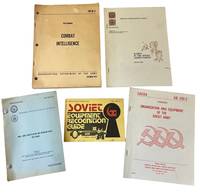
ref. 235111973. Cold War U.S. military instruction archive of government-produced manuals and intelligence studies showing how the Army trained soldiers to recognize enemy weapons report battlefield information and classify Soviet military power. The archive includes a U.S. Army field manual which explains how battlefield reports became military intelligence. The Soviet weapons guide was produced to teach soldiers how to identify AKM rifles RPG-7 launchers Sagger missiles SA-7 antiaircraft missiles mortars and antitank guns in the field. Major Mitzi D. Leibst's DIA study Women in the Soviet Armed Forces broadens the archive from weapons to manpower showing how U.S. intelligence counted Soviet women's military service as part of the enemy's total fighting capacity. Five U.S. Army and Defense Intelligence Agency manuals and studies on combat intelligence Soviet equipment recognition small arms identification Soviet force organization and women in the Soviet armed forces. Washington D.C.; Fort Monroe Virginia; Charlottesville Virginia; Fort Leavenworth Kansas; Department of the Army Defense Intelligence Agency U.S. Army Training and Doctrine Command U.S. Army Foreign Science and Technology Center and Combined Arms Combat Developments Activity 1973 to 1978. 1 United States Department of the Army. FM 30-5 Combat Intelligence. Washington D.C.: Headquarters Department of the Army 30 October 1973. Chapters cover intelligence functions collection processing dissemination order of battle counterintelligence maps and aerial imagery. Approximately 200 pages. 2 United States Army Training and Doctrine Command. TC 30-3 Soviet Equipment Recognition Guide. Fort Monroe Virginia: U.S. Army Training and Doctrine Command 11 April 1975. A soldier's pocket-style recognition guide using photographs cartoons role labels and specifications to teach Soviet weapons identification. 50 pages. 3 Johnson Harold E. Small Arms Identification and Operation Guide Free World. DST-1110H-163-76. Washington D.C.: Defense Intelligence Agency December 1976. A DIA intelligence product prepared by the U.S. Army Foreign Science and Technology Center and approved for public release with an August 1976 information cutoff. 316 pages. 4 Leibst Mitzi D. Women in the Soviet Armed Forces. DDI-1100-109-76. Washington D.C.: Defense Intelligence Agency March 1976. Prepared for the Ground Forces/MBFR Branch Soviet/Warsaw Pact Division the study identifies gaps in data on Soviet women's strength service and quality of service while compiling law history and personnel evidence. 19 Pages. 5 United States Army Combined Arms Combat Developments Activity. HB 550-2 Organization and Equipment of the Soviet Army. Fort Leavenworth Kansas: Threats Division Concepts Doctrine and Literature Directorate Combined Arms Combat Developments Activity 31 July 1978. Prepared to assist battle simulations and standardize Soviet-type organizational and equipment data. Approximately 60 pages. The archive records the practical underside of Cold War intelligence where enemy knowledge moved into manuals for soldiers analysts and training commands. Its strongest pairing is the DIA women's study and the Soviet Equipment Recognition Guide: one expands Soviet force analysis into gender law and manpower while the other teaches ordinary soldiers to identify enemy weapons in the field. Wrappers show toning handling wear staining creasing staple wear punch holes and light soil; interiors remain legible with tables captions illustrations photographs and institutional markings intact. Overall in good condition. The group preserves how U.S. military institutions taught personnel to recognize report and classify Soviet military power during the Cold War. unknown
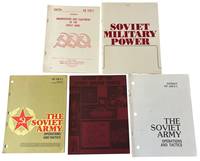
ref. 235101978. U.S. Army and Defense Department Soviet-threat instruction archive documenting late Cold War American intelligence on Soviet ground forces into battle-simulation tables field doctrine weapons comparisons and nuclear battlefield procedures. "Soviet Military Power" carrying Secretary of Defense Caspar W. Weinberger's printed preface shows Soviet tanks artillery helicopters SS-20 and ICBM and SLBM launchers bombers naval construction Afghanistan and technology acquisition. The technology-transfer passage offers one of the clearest Cold War intelligence arguments stating that "The communist countries are some of the National Technical Information Services' best customers" and that before the Soviet subscription was terminated in February 1980 the Soviets bought an estimated 80000 NTIS documents each year. Set beside Army manuals on Soviet organization antitank weapons SCUD-B missiles PT-76 tanks electronic warfare and nuclear battlefield doctrine the passage records an information war fought through public documents as much as espionage the same government warning of Soviet acquisition of American technical literature was producing its own unclassified guides to Soviet equipment and tactics for battle simulation officer training and operational planning. Archive of five U.S. government publications and extracts on Soviet military organization operations tactics weapons electronic warfare technology transfer and nuclear battlefield doctrine. The group consists of staple-bound punched and wrappered government manuals and reports with organizational charts contents pages doctrinal summaries weapons tables captions printed prefaces equipment photographs and restricted-distribution or field-manual markings. 1 United States Army Combined Arms Combat Developments Activity. HB 550-2 Organization and Equipment of the Soviet Army. Fort Leavenworth Kansas: Threats Division Concepts Doctrine and Literature Directorate Combined Arms Combat Developments Activity 31 July 1978. Approximately 70 pages. 2 Defense Intelligence Agency. Review of the Soviet Ground Forces. RSGF 1-80. Washington D.C.: Defense Intelligence Agency January 1980. 39 pages. 3 United States Department of Defense. Soviet Military Power. Washington D.C.: U.S. Government Printing Office 1981. 99 Pages. Approximately 55 pages. 4 United States Department of the Army. FM 100-2-1 The Soviet Army: Operations and Tactics. Washington D.C.: Headquarters Department of the Army 16 July 1984. Approximately 110 Pages. 5 United States Department of the Army. Extract FM 100-2-1 The Soviet Army: Operations and Tactics. Washington D.C.: Headquarters Department of the Army after 16 July 1984. Approximately 40 Pages. These materials come out of the most dangerous turn of the late Cold War the years when détente collapsed and the United States rearmed against an adversary it believed it was losing ground to. Afghanistan the failure of SALT II and the Reagan buildup hardened the conviction that American intelligence had undercounted Soviet strength and out of that conviction came an industry of threat assessment whose working products these are. This archive shows the American manufacturing knowledge of its enemy: Soviet organization armor and doctrine reduced to simulation tables at Fort Leavenworth codified into field manuals and repackaged as public argument under the Secretary of Defense's name. Containing many references to nuclear biological and chemical operations as routine doctrine while Soviet Military Power tallies the SS-20 ICBM and SLBM launchers aimed at the West. Working copies containing scattered annotations and highlighted portions in some. Overall in good condition. unknown
ref. SONG1799503216Used: Good unknown
ref. DADAX0520277708New unknown
ref. DADAX0230228917New unknown
ref. DADAX0333772008New unknown
ref. DADAX0333687043New unknown
ref. DADAX0313386625New unknown
ref. DADAX033363666XNew unknown
ref. DADAX0271058471New unknown
ref. DADAX0230362885New unknown
ref. DADAX023024131XNew unknown
ref. DADAX1241545812New unknown
ref. DADAX0230300669New unknown
ref. DADAX0230579523New unknown
ref. DADAX0230221262New unknown
ref. DADAX0520283791New unknown