119,747 results
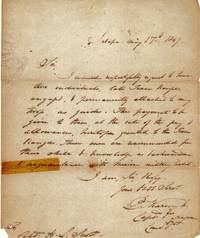
1847ref. 13139Jalapa Xalapa 1847. 1p. on thin paper. Old folds some toning small archival tape repairs to verso small chip to lower left corner trimmed close on bottom edge. Very good overall. An extraordinary correspondence from esteemed American military commander Stephen W. Kearny written from Jalapa during the American occupation of central Mexico. The document concerns the potential employment of two former Texas Rangers as guides and scouts for the United States Army. In singing the praises of two former Texas Rangers Kearny reflects the importance attached by regular Army officers to the Rangers' frontier experience and familiarity with conditions in the southwest and Mexico. Addressed to Captain Henry lee Scott aide-de-camp to his father-in-law General Winfield Scott Kearny's letter reads in most part: "Sir I would respectfully request to have two individuals late Texas Rangers engaged & permanently attached to my troop as guides. The payment to be given to them at the rate of the pay & allowance heretofore granted to the Texas Rangers. These men are recommended for their skill & knowledge as backwoodsmen & acquaintance with Mexican military habits. I am Sir Respectfully Your Obt. Servt. S.W. Kearny." At the time of writing the present letter Stephen Kearny stood as one of the most important military figures of the war. Having led the Army of the West in conquest of New Mexico and then played a central role in the American acquisition of California Kearny served with General Winfield Scott's forces in Mexico. Written from Jalapa only weeks after the capture of Veracruz and during the advance toward Mexico City Kearny's letter illustrates the continuing reliance of regular army officers upon the skills of irregular frontier forces such as the Texas Rangers. An attractive Mexican War document connecting Stephen W. Kearny Henry Lee Scott the American campaign in Mexico and the Texas Rangers. unknown
1718ref. 46350Crockett Houston Co. Texas Feb. 17th 1866. The writer laments "the wreck of his affairs" loss of his crops and library "and even the negroes" and hopes for news of a mutual friend; with the recipient's notation on the envelope "ratifying sale of land because I wrote him the facts & he orders a sale of the articles reserved from sale." . unknown
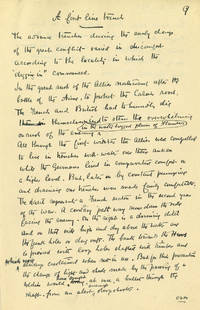
1919ref. 62781Np. ca. 1919. Prominent War Artist's Captions for His Battlefield Sketches The autograph manuscript of the substantive descriptive text for Villiers' battlefield illustrations as they were published in 1920 by George H. Doran & Co. The text of Gibbs's "Salute." to Villiers is not included here. A coversheet written in pencil in another hand on the blank verso of a half-sheet of Doran publicity copy notes the return of the manuscript "To Miss Scherer sp" and is dated "16/9/19." Villiers 1851-1922 was among the most widely-traveled and published of his generation of British war correspondents and artists. Beginning in 1867 with the declaration of war by Serbia against Turkey Villiers worked for The Graphic The Illustrated London News The Standard and other papers sending reports and drawings from the front lines of wars both major and minor on several continents. He was recipient of a number of awards including medals and decorations from Russia Romania Egypt and Serbia. He gave frequent illustrated lectures and is notable as the earliest war correspondent to take a motion picture camera into action. He is generally regarded as the model for Kipling's character Dick Hedlar in The Light That Failed. Among the subjects are "Burying the Dead" "An Air Fight over Ypres" "The First Poison Gas Cloud" "Within Fifteen Yards of the Huns" "The Hell of La Boiselle" "The Capture of Loos" "Fighting on the Face of the Waters" etc. Octavo 21.5 x 13.5 cm. Autograph manuscript in ink on rectos only with occasional corrections or revisions. Some rustmarks from an absent paperclip several leaves have marginal creases and chipping in only one instance affecting a word but generally very good. unknown
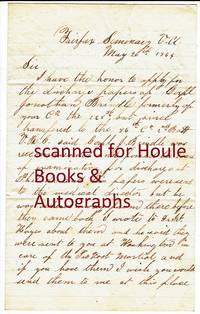
ref. 5009915" x 8" letter to Captain J.K. Murphy Fairfax Seminary hospital Virginia May 26 1864. 1 1/4 pages with integral leaf. Very good. In part: "Sir: I have the honor to apply for the discharge papers of Corpl. Jonathan Brindle formerly of your company - was recommended and passed the board of examination for discharge at Philadelphia and his papers were sent - but he was ordered away from there before they came back - ."
ref. 60370The letter reads: Washington DC Apl 51864 I have examined the new gun and saber shield invented by Crpl Moffett and would recommend its adoption for such veteran Rang who have been known to make and receive a casualty claim with saber I would not recommend it for any cavalry of less than two years service and constantly in the field US Grant Lt Gen unknown
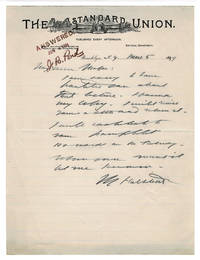
1894ref. 101010Brooklyn NY June 5 1894. 1894. Very good. - Over 40 words in pencil on 10-1/2 inch high by 8 inch wide "The Standard Union" newspaper stationery. Apologizing about a lecture the American newspaper editor and war correspondent Murat Halstead offers to contribute an essay to the American impressario and lecture manager James B. Pond's pamphlet "I will contribute to your pamphlet 100 words on McKelway. When you receive it let me know." Signed "M. Halstead". Folded for mailing with minor creases and slight darkening along the bottom edge. Very good. The American newspaper editor and magazine writer Murat Halstead 1829-1908 was a war correspondent during 3 wars. He started his career writing for "The Hamilton Intelligencer" and "The Roseville Democrat" at 18 years of age and went on to contribute to several other newspapers. He bought interest in the paper while working as a local reporter for Cincinnati's "Commercial". Halstead reported on several battles during the Civil War and was a war correspondent during the Franco-Prussian War. He took over controlling interest in the "Commercial" and became president of the company when the "Cincinnati Gazette" merged with his paper. Moving to Brooklyn in 1890 he edited the "Standard Union". He went to the Philippines as a war correspondent at the start of the Spanish-American War. The article which Halstead mentions in his letter is about St. Clair McKelway the editor of "The Brooklyn Daily Eagle". Halstead's own paper the "Standard Union" was also in Brooklyn. Brooklyn, NY, June 5, 1894.
1925ref. 36447Washington DC: April 9 1925. 1925. Very good. - Letter penned in black ink & filling all 4 sides of a sheet of letterhead folded once to form 4 black-bordered sides each 6-3/4 inches high by 5-1/8 inches wide. The address where Hoskins is staying is printed at the top. Signed "Reginald Hoskins". There is a light paper-clip mark to the top edge of each side & the recipient's "date answered" stamp is is on the first side at top right. Folded once for mailing. Together with a sample brochure promoting a previous Hoskins lecture tour. Also with a carbon copy of the recipient's reply. Near fine. Hoskins writes to J.B. Pond of the Pond Lecture Bureau following up on their discussion of a possible American lecture tour. He is about to leave for London and wonders if the financial arrangements will make it feasible for him to return for an extended tour. "I know that it is not easy to foresee with any certainty what sort of a success financially can be made and you quite understood my disinclination to return on an off chance." Major-General Sir Arthur Reginald Hoskins 1871-1942 was a senior British Army officer during the First World War. Hoskins served in the army from 1891 to 1923. Prior to World War I he saw active service In in the Dongola Expedition the Mahdist War the Second Boer War and the Somaliland Campaign. In September 1914 he was recalled from East Africa where he was acting as Inspector of the Kings Africa Rifles and joined the 8th Division then engaged on the Western Front. He was given command of the 8th Brigade in 1915 and in early 1916 was transferred to the East African Campaign. He became Commander-in-Chief of British Forces in East Africa in 1917 later serving as commander of the 3rd Lahore Division in Mesopotamia and Palestine for the remainder of the war. Washington, DC: April 9, 1925. unknown
ref. 66704May 9th 1833 - A. J." To the side in ink in another hand: "Answd 11th May." Above in a third hand in pencil: "file this with letter of Mrs. / Jane C. Washington of 4 Jany." Two other pencil notes relating to the action are below Jackson's endorsement. Jane Charlotte Blackburn Washington 1786-1855 the wife of John Augustine Washington nephew of George Washington had apparently written Jackson on behalf of a disciplined naval midshipman. Old fold lines as for mailing but very good. unknown
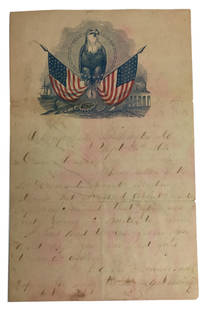
1862ref. 916131862. Poor. 20 cm x 25 cm single sheet folded to make 4 handwritten pages. Large patriotic color Illustration of a bald eagle with 2 U.S. flags occupies top third of first page of stationery. Two horizontal fold mark. Split halfway across on a fold on the last two pages. Pinkish color to much of the letter suggesting old damping. Ink quite faded and generally difficult to read. Many words are so indistinct that it was impossible for us to read them and some other words or phrases are just gone. Her letter is addressed to an otherwise unidentified cousin. Jones does not seem to show on standard lists of Civil War Nurses but the information in this letter suggests that she should. Here is our effort to transcribe this difficult-to-decipher letter: "Your letter of the 21st came to hand in due time but I had about made my mind that you was not going to write to me. I was glad to hear from you and hope that you will not fail to write again. I am well. Hoping you enjoy the same good blessing. We are situated on the same ground we occupied a part of last Fall and Winter. We have been here about four weeks. After spending the summer on the peninsula we are very glad to obtain old ground which seems almost like home. You want to know why I am in the hospital. It is not because I am sick but because others are sick and need care. I am what is termed nurse. My wages are $26.50 per month. The business is by no means delightful but I get along very well. We have got one fellow who is very sick I fear he will not recover. On the Peninsula my health became very poor but now I am well. I wish that I could hear that Grandmother is on the gain but fear I never shall. Tell hear I think of her nearly all of the time and and want to see but if I fail to see her I expect to see her in Heaven. I have wrote to your father. I presume he has received my last letter before now. I do not know that I can tell you anything about the war that would amount to anything more than you already know. As we are at present we are retired from the active field I am not as well posted as when we were aamid the turmoils of battle. I have not heard a battle sound since we came across the river. Apparently all seems quiet which seems good. top two lines at top of 4th page too indistinct to decipher My hospital service is every other day. Every other day and night. I have to work taking care of the sick of our regiment then I am idle twenty-four hours. . several lines gone or indistinct here and the I will have a chance to eat army rations wear army cloths and a few moremostly indistinct lines ." She ends the letter by requesting that her cousin write to her at Hospital 50th NY Engineer Regiment Washington D.C. Online information reports that the regiment composed mostly of men from New York and a small number from Pennsylvania lost by death 10 killed in action 7 from wounds received and 214 from disease and other causes. unknown
ref. 40474This Union officer served on the staff of Brigadier General James Shields whose troops faced Stonewall Jackson's Confederate troops in the Shenandoah Valley in June 1862 and later commanded the Second Louisiana Regiment Cavalry; he was a good friend of famed Irish soldier Miles W. Keogh 1840-76 killed in the Battle of the Little Bighorn who served under him in the Papal Army during the Italian rebellion in 1860 and who fought with him in the Battle of Port Republic; he's reported to have become enamored with famed Southern spy "Belle" Boyd" at one point and to have unwittingly revealed military secrets to her. Outstanding pencilled ANS 2pp recto and verso heavy stock 4" X 2½" card "Conrad's Bridge" Virginia n.d. ca. early June 1862. Addressed to "General" probably James Shields. Very good. Lightly age toned.In this remarkable small report Keily reports in a small tight but fairly legible hand to his commander that "Col. Carroll moves his comm'd. at p.m. and will push on as rapidly as possible some cannonading heard this morning in the direction of Harrisonburg I would respectfully submit that if the Infantry did not move rapidly enough to carry out your views at Wainesborough before Jacksons arrival there a reconnaisance composed of cavalry conducted cautiously might attain the object with a good Guide which we have procured I would be glad to undertake it -- respectfully" and signs off adding his rank "Capt. A.D.C" beneath. A rather light challenging to transcribe postscript reads "P.S. Just received information from a reliable source that Jackson has --- --- --- Train on the --- Pt. Republic Road." It's difficult to precisely date Keily's note but General Shields did write General McDowell on June 4 1862 that "Colonel Carroll. after a forced night's march reached Conrad's Bridge this morning at 5 o'clock which bridge he found burned" -- which likely dates Keily's letter from this date or shortly after. Whether Shields took Keily up on his offer to lead a cavalry reconnaissance is unclear. Shields 1810-79 is perhaps best remembered as the Illinois politician who almost fought a duel with Abraham Lincoln in 1842; he's also the only person in American history to serve as U.S. senator from three different states Illinois Minnesota and Missouri; as a brigadier general of volunteers in the Civil War his lackluster performance as commander of the 2nd Division of the V Corps in the Army of the Potomac during the crucial Valley Campaign caused him to resign his commission. On June 9th the Battle of Port Republic took place a costly Confederate victory in which Jackson's 6000 troops faced off 3500 Union troops losing just over 800 men to the Union's loss of just over 1000 men -- a battle at which Keily himself was severely wounded in the face while leading a charge of Ohio cavalry up a hill into a barrage of Confederate artillery fire. The following year after painful recuperation Keily ended up on the staff of General Charles P. Stone in New Orleans recruiting cavalry troops in that occupied state. Late in the war he was court-martialed for "conduct unbecoming an officer" but the charges were shown false and by the end of the war he was brevetted a brigadier general. Keily died from yellow fever in Louisiana at age 38 shortly after the war's end making his autograph material quite scarce -- and a choice war-date item such as this most desirable. This remarkable war-date communication sheds interesting light on Shields as commander during the disastrous Valley Campaign. unknown
ref. 20979This brigadier general survived the Civil War Spanish-American War Indian uprisings the Phillipine insurrection and World War One -- then died after tripping on a rug; when he wasn't fighting he was writing producing almost 60 novels about army life and frontier romance. ANS 1p heavy stock 4¼" X 3½" card Milwaukee WI n.y. Addressed to Stalham L. Williams Jr. Near fine. Minor mounting traces on verso. Thanks a correspondent for a "pleasant letter" and a "valued suggestion" -- clearly a book idea -- and continues: "Just now I am 'loaded to the guards' with work but in that indefinite future -- 'one of these days' -- I may be able to handle that subject 'without gloves." Bold and quite attractive. unknown
ref. 31476This quartermaster with the 28th Pennsylvania Infantry 1861-62 was later a captain and Adjutant Commissar of Subsistence until the war's end at which time he became personal secretary to Governor John W. Geary 1867-73 a former Union general -- and Lee's brother-in-law. ALS 2pp lettersheet 5" X 7 3/4" Harrisburg PA 1872 October 15. Addressed to George A. Lewis. Very good. Mild bit of soiling; minor mounting trace on blank 4th leaf. On ornate "Executive Chamber" letterhead Lee replies to a cryptic request. In part: "Your favor to the Governor is received. I am directed to say that he cannot give you the desired information By applying to Genl. Meigs Q.M. General U.S. Army you can probably ascertain when the book can be found." Boldly signed along with "Private Secretary." A handsome example neatly and legible penned. unknown
ref. 24798Supposedly the youngest soldier to enlist in the Civil War; others such as Johnny Clem born 1851 the "Union Drummer Boy of Chickamauga" were indeed younger although Clem did not carry a weapon until later was not officially mustered in and his wages were paid out of donations by the officers. Morefield's credentials therefore appear sound. ALS 1p 8" X 10" Elkhorn WI 1892 March 10. Addressed to W.E. Ambler. Near fine. Slight mailing folds. To a journalist or scholar researching Morefield's claim to fame Morefield transmits a photograph "Coppied from a tin tipe that I had taken soon after I Enlisted" not present. He agrees to "write up my Army Experience I dont know jest what you want do you want to know whare the Regiments went and What we went through I will say this much to you if it hendent of been for the Exposure of Camp life and picket duty and Rheumatism and diseases resulting from Rheumatism that I contracted while In the Army my Experience would been a good one." An intriguing very scarce item. unknown
ref. 28640Confederate brigadier general and Alabama senator 1877-1907. ALS 1p 7½" X 10" U.S. Senate Chamber letterhead Washington DC 1884 June 16. Addressed to "My Dear Major." Good. Slight age toning. Inquires about the whereabouts of the 21st and 22nd volumes of State Department statutes which should have been sent to him in DC but may have been directed to Selma Alabama. Pencilled draft of a response on the verso in unidentified hand. Uncommon. unknown
ref. 11395Cobb's letter dated from Philadelphia 7 June 1893. Cobb's letter is 1p. 4to typed in green. He states that he is 'collecting the autographs of prominent American editors' and that he would like to add Halstead's as 'it will not be complete without yours'. At the foot of the letter Halstead has written in a sprawling hand with smudged signature 'Perhaps the <enclosed> will serve. M. Halstead'. Pinned to the letter is the calling card of 'Mr. Murat Halstead.' with his signature 'M. Halstead' again slightly smudged beneath the name. Both items are lightly-aged but good. Accompanying the letter is an engraving of Halstead by Arthur Jule Goodman 1890. It is in good condition neatly attached to a paper mount. Cobb's letter dated from Philadelphia, 7 June 1893. unknown
1847ref. 35018February 6th 1847. 1847. Very good. - Letter penned in black ink & filling almost 3 sides of a sheet of light gray paper folded once to form 4 sides approximately 7-1/4 inches high by 4-5/8 inches wide. The letter has been mounted on a lightly larger sheet of cream-colored stiff paper. Signed "Anglesey" There are a few small ink smudges to the 2nd & 3rd sides. Very good. The letter is addressed to Scottish geologist Sir Roderick Murchison and concerns a publication which Murchison is proposing and how it would be funded. "Some Estimate of the probable cost of money and of time is called for from General Colby and when it is received you shall again hear from me." The reference is probably to General Thomas Frederic Colby a leading geographer who had been director of the Ordnance Survey. Henry Paget 1st Marquess of Anglesey 1768-1854 was a British army officer and politician. After serving as Member of Parliament for Carnarvon and then for Milborne Port he took part in the Flanders Campaign. During the Peninsula War he commanded the cavalry for Sir John Moore's army in Spain and at the Battle of Sahagun virtually destroyed a regiment of French cavalry. He led the charge of the heavy cavalry against Comte d'Erlon's column at the Battle of Waterloo losing part of one of his legs to a cannonball at the end of the battle. In later life he served as Master-General of Ordnance from 1846 to 1852. The Scottish geologist Sir Roderick sometimes as here spelled "Rhoderick" Impey Murchison 1st Baronet 1792-1871 was the first to describe and investigate the Silurian system. During the last decade of his life he chiefly investigated the Highlands of Scotland. Murchison was one of the founders and a president of the Royal Geographical Society and served on the Royal Commission on the British Museum. In 1855 he was appointed director-general of the British Geological Survey and director of the Royal School of Mines and the Museum of Practical Geology in Jermyn Street London. February 6th, 1847. unknown
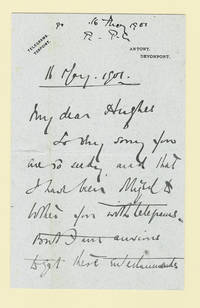
1901ref. 101174Antony / Devonport May 16 1901. 1901. Fine. - Over 135 words penned on four sides of 7 inch high by 4-3/8 inch wide "Antony / Devonport" stationery. In his letter addressed to "My dear Hughes" from his Antony House Estate in Cornwall the British Army Officer and Liberal Unionist Member of Parliament Sir Reginald Pole-Carew discusses arrangements for outdoor festivities "".I am anxious to get these entertainment done quickly as promised - and as there is a clever Conjuror whom I know in Plymouth now so seems a pity not to have the out of door's show while he is here and while this lovely weather lasts." He hopes Hughes can come as "Mother will be delighted to see you on Friday." In a postscript he agrees with Hughes that "the Band should be on the evening preceding the outdoors show" and ponders whether there is still time to arrange it. Signed "Reg Pole-Carew". Folded for mailing else fine. Celebrated as a military hero the British army officer and landowner Lieutenant-General Sir Reginald Pole-Carew 1849-1924 was commissioned into the Coldstream Guards in 1869. He served with Lord Roberts in the Second Anglo-Afghan War and in the Second Boer War. Promoted to Colonel he was given command of the 9th Brigade with the "local" rank of major-general and led during the Battle of Modder River. Appointed to command the Guards Brigade he later commanded the 11th Division of the South Africa Field Force and in 1903 became the General Officer Commanding the 8th Division in Southern Ireland. He served as a Liberal Unionist Member of Parliament for Bodmin. In February of 1901 the year of this letter Pole-Carew married Lady Beatrice Frances Elizabeth Butler the King and his family receiving them two days prior to their wedding to present Beatrice with wedding presents. Antony / Devonport, May 16, 1901.
ref. 38471This noted U.S. Treasury Department statistician was an entrepreneur who created a composite photograph of signers of the amendment abolishing slavery that proved quite popular; he was also an inventor archaeologist social reformer philanthropist and evangelist who created cartographic maps of Egypt and North Africa for the Oriental Topographical Corps. ALS 1p 8½" X 10 3/4" n.p. n.y. August 29. Addressed to Giles F. Ward in New York City -- possibly father of Giles F. Ward Jr. 1845-65 a lieutenant with the 12th New York Cavalry who was accidentally killed by a colleague while in North Carolina. Very good. Penned on ultra-thin onion-skin paper with occasional burn-through from heavily-inked letters. Reads in part: "I write this. to request that you will favor me with your own opinion freely expressed as to what the price of the Lincoln Cot should be the patent either on a joint stock operation or on sale in the other way you spoke of a simple sale of the right Please let me know what in your judgment it should be even though it be less than 1/10 the proposed figures" Boldly penned in rich brown ink. Powell and two others one of whose last name was Lincoln designed this specialized portable cot in 1862 and sought to interest the U.S. Army in providing it to the troops. A fascinating piece. unknown
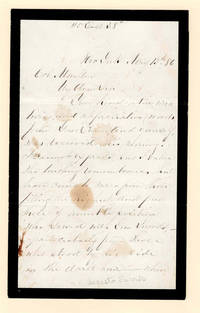
1886ref. 101466May 13th 1886. 1886. Very good. - Over 145 words penned on three sides of 7-3/4 inch wide 4-7/8 inch wide cream paper with an integral attached leaf each page framed with a black ink mourning border. The widow of General Thomas Sword thanks Colonel Marston for his "kind letter with loving and appreciative words from Gen. Crawford and yourself." "I cannot express our value of the touching remembrance that have come to me - from those filling the higher and lower walks of combined military & naval life with Gen. Swords & particularly from those who stood by his side in the dark hour when exposed to almost individual perils and held up his hands." Signed "C. Augusta Swords". There are some light brown stains to the first two pages and the top corner of the second leaf is chipped. Paper remnants likely from mounting adhere to the top right corner of the last blank page. Very good. The letter is probably addressed to Gilman Marston who served as a Colonel and later as a Brigadier General in the Civil War. Gen. Crawford to whom she refers is probably General Samuel W. Crawford. A veteran of the Mexican War and the Civil War General Thomas Swords 1806-1886 is the highest ranking veteran buried in the Piscatawaytown Burial Ground in Deison NJ. Then Captain Swords marched with Colonel Stephen Kearney from Kansas to Santa Fe New Mexico to capture the city during the Mexican War. He was chief quartermaster of the Department of the Cumberland and the Ohio during the Civil War and served at the battle of Chickamauga. He and his wife Charlotta Augustus Swords lived in New York City at the time of his death. May 13th, 1886.
ref. 15319Georgia senator and representative who resigned his seat in 1861 to join the Confederacy becoming Confederate secretary of state and then brigadier general; he fled to London for several years after the war to avoid arrest he returned and resumed practicing law -- though he never sought to regain citizenship. ANS 1p 5" X 3" n.p. n.d. Very good. Cryptic legal matter: "Browner has written me to file a bill against Burch -- you kindly offered to do it for me & I will be much obliged if you will do so immediately." Signed simply "Toombs." This item has been handsomely and archivally double matted together with a brass plaque and a large striking closeup photograph of a steel engraving of Toombs and framed in an ornate 1½" gilt frame overall dimensions 20½" X 16½". unknown
ref. 13011On letterhead of Morley's Hotel Trafalgar Square London WC. 24 March 1897. 1p. 12mo. In good condition with slight spotting to extremities laid down on leaf removed from autograph album. 'I am sorry that we have missed each other on the occasions you have called. My time is much occupied & it is difficult to fix an hour before 6 P.M. on Sunday when if you can manage to call once more I shall be delighted to see you & revive our mutual recollections of old days.' According to Schreiner's entry in the Oxford DNB 'During the closure of the Vaal River drifts in 1895 he helped to commit the Cape to possible war by drafting the ultimatum to the Transvaal republic; but he was appalled by the Jameson raid later that year and soon afterwards broke finally with Rhodes. Although he opposed ending the British South Africa Company's charter he chaired the Cape select committee which condemned Rhodes's conduct. In 1897 he gave evidence at the raid inquiry in London.' On letterhead of Morley's Hotel, Trafalgar Square, London, WC. 24 March 1897. unknown
1921ref. 050839Istanbul: Harbiye Nezâreti Ministry of War. H.: 1337 1921. No Binding. Very Good. Original manuscript autograph letter signed 'Ziya Kutnak' sent to Mustafa Hilmi Pasha. 27x17 cm. In Ottoman script. 1 p. It mentions 'Divân-i Harb azaligina tayîn'. i.e. Assignment to the Divan-i Harb membership. Divân-i Hârb was an assembly where high-ranking soldiers meet for work on war issues or war criminals. Çürüksulu Ziya Pasha or Ziya Kutnak is the last Minister of War in the Ottoman Empire. His father was Çürüksulu Osman Nuri Pasha who was Hedjaz Hijaz Governor. In 1908 he participated in military exercises in Russia. In 1911 he visited Rumelia with Sultan Mehmed Resad during Sultan's famous voyages to Rumelia. He was sent as a representative to the King of England ceremonies. He assisted the Turkish War of Independence during his war ministry. Mustafa Hilmi Pasha 1840-1922 was a general of the Ottoman Army. He was the son of Ibrahim Pasha Sarim. In the early 20th century he participated in the modernisation and unification of the Ottoman Army. In World War I he commanded the VI. Army Corps which was sent to participate in the campaign against Romania during the period October 1916 - February 1918. In the Turkish War of Independence he fought against French forces around Aleppo. He died in 1922 in Istanbul. Original text: "Erkân-i Divân-i Harbiye Meclisi olan tayinleri hususuna bi'ilânindan fî sene 7 Eylül 1337 tarihinde irâde-i seniyye-i cenâb-i pâdisâhî seref-müteallik buyurulmus olmakla hemen vazife-i cedidelerine mübâseret buyurmalari mütemennâdir efendim. Fî sene 14 Eylül 1337. Harbiye Nâziri Signature". Harbiye Nezâreti [Ministry of War]., [H.: [1]337] unknown
1919Very Good Turkish, Ottoman (1500-1928) Original manuscript autograph letter / correspondence signed 'Üçüncü Kafkas Firkasi Kumandan Vekili Avni'. 18x11,5 cm. In Ottoman script. 1 p. Full. It starts with 'Huve'. Dated 8/6/[13]35 AH = [1919 AD]. Written from Trabzon to Mühimme? Mintikasi levâzim reisi Yüzbasi Rafet Efendi. "1) 27 Tabur Kumandan Vekâleti'nde bulunan Yüzbasi Mehmed efendi ile mezunen terhisi kolordudan emir verilmistir. Mezkûr tabur kumandanligina vekâleten mühimme? mintika levâzim reisi Rafet Efendi tabi'kilinmistir. 2) 12. Alay Kumandanligina ve Yüzbasi Rafet Efendi'ye teblig kilinmistir. / Reply to Yaver Mustafa Efendi. An Ottoman army auttograph of Kafkas Army.
1909Very Good Turkish, Ottoman (1500-1928) Original manuscript autograph letter signed 'Gümüshane Mutasarrifi Celaleddin' and Nâib, Vekil-i muhasebeci, Vekil-i müdür-i tahrîrât, müftü, Vekil-i polis, and members. 1 p. Text has five lines. Letterhead 'Sûrâ-yi Devlet', blind stamped. Folio. (38x25 cm). In Ottoman script. Eight seals. Mahmud Celaleddin was Turkish Gümüshane district governor in the last Ottoman and early Republican period. Also he wrote his book called 'Mir'ât-i Hakikât'. Book describes the events of the last period of the Ottoman Empire and the first period of the Republic of Turkey. Rare.
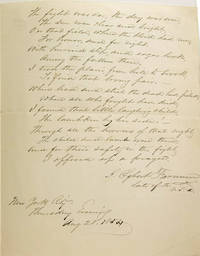
1854ref. 307508New York City 1854. 3 pp. pen and ink on bifolium. 8vo. Old folds very minor stain to edge of bottom right corner on first page not affecting text else fine. 3 pp. pen and ink on bifolium. 8vo. Romantic in a style befitting the era Farnum offers a graphic account of a a heart-wrenching scene from battle which he describes as "carelessly written but respectfully dedicated to Maria L. Green." Reading in part: ."Where hot and fiercest raged the fight Where lead came down like rain ~ Where bursting bombshells feeble light Discovered heaps of slain ~ I saw a little laughing sprite A joyous little dear Leading a pet lamb through the fight Without one though of fear. ~" Soldier express rider mercenary adventurer and notoriously hard drinking brawler John Egbert Farnum's 1824-1870 military career began in the Mexican American War where he served as a sgt. major in the 2nd Pennsylvania Infantry Regiment. He would go on to see action in the Crimean War and the jungles of Cuba and Nicaragua before enlisting as a major in the Union Army in 1861. Farnum fought gallantly in some of the bloodiest engagements of the American Civil War including Fredericksburg Chancellorsville and Gettysburg before his wounds forced him to retire from active service Farnum was shot 19 times and suffered two saber wounds. He was promoted to brevet brigadier general for his meritorious service. Despite his incredible war record Farnum is more often remembered for his involvement in the infamous voyage of the schooner Wanderer. Built as a luxury racing yacht the Wanderer was purchased by William Corrie in 1858 with the assistance of southern "fire eater" Charles A.L. Lamar. Corrie had the schooner refitted as a slave ship and along with Farnum who later claimed ignorance of the scheme and the ship's crew sailed to Africa and loaded 407 slaves aboard. They arrived off Jeckyll Island Georgia in November and were arrested for violating the 1807 Act Prohibiting the Importation of Slaves. Farnum was charged with piracy. He escaped jail but was recaptured and after a lengthy and sensational trial in which the President of the United States James Buchanan came to his defense he was acquitted of all charges. unknown books