Hospitality House, Jewish Welfare BoardMareMagnum

125,044 results
1917Picture Postcard. [1] page. 10 x 24 cm. Black and white card advertising for the Hospitality House of the Jewish Welfare Board, 47 Mount Vernon Street, Boston, Mass. 'Reading, Writing, Recreation, Pool and Billiard Rooms, Splendid Sleeping Quarters, Wholesome Food, Always at your Service'. Calling card photographs depict sailors in the Pool Room, and a street-level view looking northeast of the Hospitality House of the Jewish Welfare Board at 47 Mount Vernon Street. The sign over the entrance reads "West End Young Mens Hebrew Assn. " Subjects: Massachusetts - Boston (Mass. ) - Mt. Vernon Street - 47 Mt. Vernon Street Jewish Welfare Board Hospitality House. Light tear across edge of card, aged and soiled; otherwise clean. Good condition. (AMR-46-18)
1945Very Good Serbo-Croatian Original color lithographed print poster. Mounted on cardboard. Slight chip on the left corner, not loose. A good poster. 44x28 cm. In Serbo-Croatian. Artist signature: Kun, [Gleb?]. Red and black theme on the white surface. The peasant Serbian woman with her head and right hand raised to the sky is depicted. Antifastictika Fronta Zena [i.e. The Women's Antifascist Front] was a Yugoslav feminist and anti-fascist mass organization. The predecessor to several feminist front groups in the former Yugoslavia, and present-day organizations in the region, the "AFZ" was heavily involved in organizing and participating in the Partisans, the communist and multi-ethnic resistance to the Nazi occupation of Yugoslavia during World War II. It was formed by volunteers on 6 December 1942 in Bosanski Petrovac at the First National Conference of Women. In its early days, the organization was called the Antifascist Organization of Women (AOZ). In Croatia, the organization was named the Antifascist in front of women of Croatia. In Slovenia, there were a number of titles: Antifascist women association, Antifascist Front Women, Antifascist Front of Women. It was founded under the name of the Slovenian Antifascist Women Association. There was also a Slovenian Anti-Italian Women's Union. In Macedonia, it was called Antifascist front of women of Macedonia (Antifasisticki front na zenite na Makedonija). In Serbia, there was the Antifascist Front of Women of Serbia, including the Antifascist Front of Women of Vojvodina (based in Subotica). Before World War II, many women organizations advocated for peace, fighting against the different totalitarian forces that were growing across Europe. During the war, however, many women organized themselves within the antifascist movement and strengthened their position. This is confirmed by the first document of the Supreme Headquarters and the National Liberation Army volunteer Yugoslavia, which at that time was the supreme authority in the liberated territories. In various documents, it confirmed women's active and passive voting rights, which they already possessed prior to 1941, as outlined in the Constitution, but were not allowed to exercise. [.] Women began to massively involve the NOP as soldiers, medical staff, politicians, and MPs. Different female structures, which were established in 1941 under various names, have been associated in the wider areas, and as of 6 December 1942, held the first National Conference of Women. The conference was attended by 166 delegates from all over Yugoslavia, except for Macedonia, because they did not occur because of both distance and security concerns. Then the Conference founded the Antifascist Front of Women with the aim of mobilizing women for assisting new units, helping partisan government bodies, participation in armed and sabotage actions, and for the development of 'Brotherhood and Unity' among women. AFZ played an influential role in the Second World War, after the Invasion of Yugoslavia. The NLA attracted about two million women. In military units, there were 110 000 women. During the war, 2,000 women became officers. AFZ Committees were also responsible were collecting clothes for the NOV, caring about children, wounded soldiers, working as front-line nurses, and performing agricultural tasks. Of the 305,000 fallen soldiers between 1941-1945, 25000 were women, and of the 405,000 injured 40,000 were women. The issue of legal equality did not arise, because the women through their participation in the national liberation movement had arguably already achieved certain rights. All that after FOCA regulations on the principles of equality enshrined in the later constitutions "new" Yugoslavia, and various laws, the result of the struggle of women themselves in the feminist and anti-fascist women's organizations before the war, as well as their struggle during the war. [.].
1900Very Good French Original hand-colored complete set of postcards including 10 pieces depicted Joan of Arc's life and statue. Jeanne d'Arc, 1409-1431. Size: 45x27,5 cm. In French. Had colored. Including 10 pieces of standard sized postcards. It depicted Joan of Arc's statue in armor with depictions around her, which are hand-colored and contain scenes from her life. 1. Jeanna D'Arc dans sa prison. 2. Jeanne Darc blessee devant Paris. 3. Jeanne Darc acclamee. 4. Depart de Vaucouleurs 1422. 5. Jeanne Darc a Domremy 1423. 6. Jeanne Darc a Chinon. 7. Prise d'Orleans 1428. 8. Au Sacre de Charles VII Reims 1429. 9. Arrestation a Compiegne 1430. 10. Rounen 1431. No editor name and printed info. 'Made in France'. Slightly on margins. Minor fading on pictures. Otherwise a good set. Joan of Arc nicknamed "The Maid of Orléans" (French: La Pucelle d'Orléans), is considered a heroine of France for her role during the Lancastrian phase of the Hundred Years' War and was canonized as a Roman Catholic saint. She was born to Jacques d'Arc and Isabelle Romée, a peasant family, at Domrémy in northeast France. Joan claimed to have received visions of the archangel Michael, Saint Margaret, and Saint Catherine of Alexandria instructing her to support Charles VII and recover France from English domination late in the Hundred Years' War. The unanointed King Charles VII sent Joan to the Siege of Orléans as part of a relief army. She gained prominence after the siege was lifted only nine days later. Several additional swift victories led to Charles VII's consecration at Reims. This long-awaited event boosted French morale and paved the way for the final French victory. On 23 May 1430, she was captured at Compiègne by the Burgundian faction, a group of French nobles allied with the English. She was later handed over to the English and put on trial by the pro-English Bishop Pierre Cauchon on a variety of charges. After Cauchon declared her guilty, she was burned at the stake on 30 May 1431, dying at about nineteen years of age. In 1456, an inquisitorial court authorized by Pope Callixtus III examined the trial, debunked the charges against her, pronounced her innocent, and declared her a martyr. In the 16th century, she became a symbol of the Catholic League, and in 1803 she was declared a national symbol of France by the decision of Napoleon Bonaparte. She was beatified in 1909 and canonized in 1920. Joan of Arc is one of the nine secondary patron saints of France, along with Saint-Denis, Saint Martin of Tours, Saint Louis, Saint Michael, Saint Rémi, Saint Petronilla, Saint Radegund and Saint Thérèse of Lisieux. Joan of Arc has remained a popular figure in literature, painting, sculpture, and other cultural works since the time of her death, and many famous writers, playwrights, filmmakers, artists, and composers have created, and continue to create, cultural depictions of her. (Wikipedia).
1936Very Good Turkish Original color illustrated cover. Folio. (32 x 24 cm). In Turkish. 17, [1] p., color, and b/w ills. Anti-propaganda of Japan in 1936. An amazing cover illustration of Japanese anti-propaganda and USSR (Soviets). It's seen a yellow octopus wrapped around the world complete with its arms and with a treacherous smile on its face. A Japanese anti-propaganda. "Sari tehlike: Dünyayi kizil tehlikeden koruyacagim!" [i.e. Yellow hazard: I will protect the world from the Red hazard]. This great cover was illustrated by Cemal Nadir [Güler], (1902-1947). He was a Turkish cartoonist. Güler is the surname he assumed after the Surname Law of 1934. Cemal Nadir was born in Bursa, Ottoman Empire on 13 July 1902. His father Sevket was a calligraphist (Turkish: Hattat) employed in courts. After finishing high school, he began working as a sign painter in Bursa. He also created cartoons, and his first cartoon appeared in Diken (literally: "The Thorn") periodical. Although he moved to Istanbul and tried to be a full-time cartoonist, he could not make it and he returned to Bursa. The Alphabet Reform of 1929 gave Cemal Nadir a second chance to show his talent. When Turkey adopted the Latin alphabet replacing the Ottoman Turkish alphabet in Arabic script, all signboards were necessarily changed, and he worked hard to meet the demand. In the same year, he moved once more to Istanbul to work for the daily Aksam. Later, he also drew for the newspaper Son Posta, as well as for the satirical magazines such as Akbaba. During this period, he published the satirical magazine Amcabey. During World war II, he drew anti-Nazism cartoons in the daily Cumhuriyet. In 1946, the Republican People's Party (CHP) invited him to run for a seat in the parliament. However, he refused the invitation, he said that with political affiliation he would not be able to create cartoons. He used his conflicting cartoon characters to criticize the social problems of that time in the country. (Ak'la Kara ("Black and White")., Dede ile Torun ("The Grandpa and the Grandson")., Dalkavuk ("The Sycophant")., Yeni Zengin ("Nouveau riche")., Salamon).
1919Very Good Turkish, Ottoman (1500-1928) Original very attractive chromo-lithograph print of Soviet Tatarstan emblem. 24x17 cm. Bilingual in Tatar and Ottoman script. Eight paper-tapes on the extremities of paper. "Sekil 20" [i.e. Figure 20] written. It shows a peasant holding a sickle and a worker holding a pickaxe have joined their hands. The sun rises out of a wreath knitted with spikes and an arrow is drawn with a bow. Inside the wreath, "Tatar Sûrâlar Cumhuriyeti" is written in Arabic letters. In the lower part, hammer and sickle symbols stand out. Info about this emblem and its artist, and from which source it's taken couldn't be found. Litho.
1918Very Good Turkish, Ottoman (1500-1928) Paperback. Pictorial propaganda cover. Folio. (39 x 26 cm) In Ottoman script. 1821-1836 pp., ills. [PROPAGANDA COVER: OTTOMANS! PARTICIPATE IN THE LOAN THAT WILL MAKE OUR NAVY LIKE IRON!] Donanma. Donanma-yi Humayun'un haftalik gazetesidir. Istikbal denizlerdedir! No: 163-113. 20 April 1334. Extremely rare with pictorial folio-sized cover. Attractive and rare pictorial cover art called to participate in the loan that will make more powerful the Ottoman naval forces at the end of World War 1.
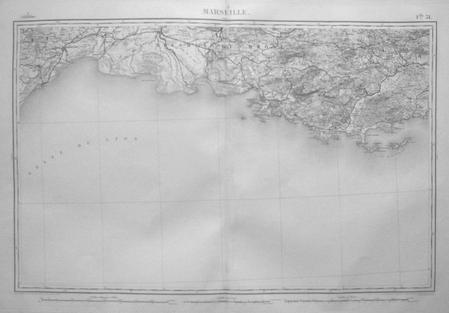
1875ref. LBW0395dParis, 1875. 525 x 820 mm.
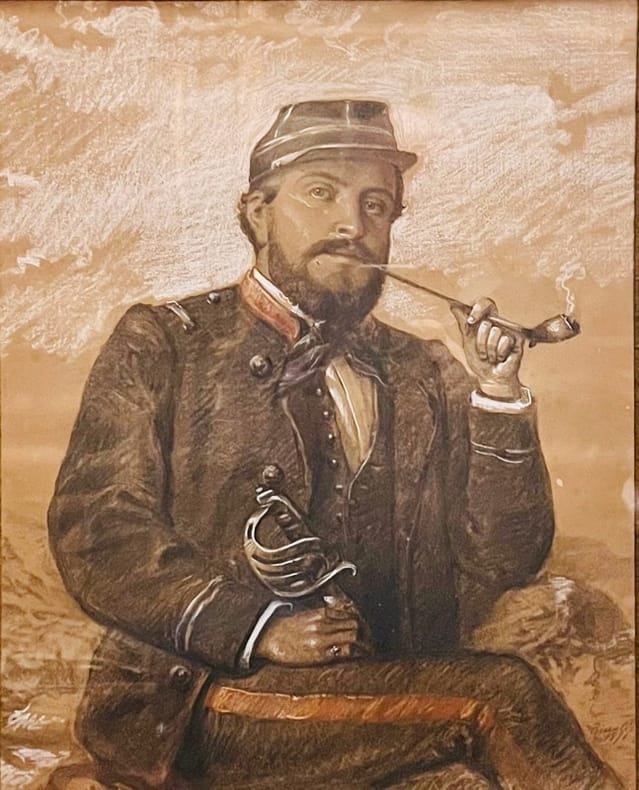
1871ref. 44734, , 1871. Fusain sur papier brun avec rehauts de gouache blanche et rouge (43 x 34 cm); sous verre, cadre de bois doré.
1915Fine German Original typescript letter signed 'Souchon', addressed to Capitan, lieutenant colonel Vasif (Wassif) Muhiddin Bey [Kasimpasali]. Wassif Bey was a ship commander of Hamidiye cruiser before Rauf Orbay. 27x21 cm. In German. 1 p. "Kommando der Flotte" letterhead with bilingual in German and Ottoman Turkish. 8 lines. Signed 'Souchon'. This letter includes an indication that it honors the Kaiser (Wilhelm II) with the Iron Cross medal for Commander of Haamidiye, Wassif Bey. "Seine Majestät der Kaiser und König haben Euer Hochwohlgeboren in Anbetracht Ihrer tatkraftigen Arbeit im Interesse der Kriegsbereitschaft und Kriegsbereitschaft und Kriegsbedürfnisse der Marine das Eiserne Kreuz 2. Klasse zu verleihen geruht.". [i.e. His Majesty the Emperor and King have deigned your High Wellbeing to give the Iron Cross 2nd Class to the Navy in view of your hard work in the interest of readiness for war needs.]. Wilhelm Anton Souchon was a German admiral in World War I. Souchon commanded the Kaiserliche Marine's Mediterranean squadron in the early days of the war. His initiative played a major part in the entry of the Ottoman Empire into World War I. Wilhelm Anton Souchon was born on 2 June 1864 in Germany to a family of Huguenot ancestry. In July 1914, hostilities erupted between the Austro-Hungarian Empire and the Kingdom of Serbia. Rear Admiral Souchon, a native of Leipzig, feared being trapped in the Adriatic Sea in the event of other nations joining in the conflict. Because of this, Souchon took his two ships, the battlecruiser Goeben and the light cruiser Breslau, into the western Mediterranean. When World War I began on 4 August 1914, he bombarded the French-Algerian ports of Bône and Philippeville. He successfully eluded British attempts to corner him (see Pursuit of Goeben and Breslau) and on 10 August 1914, his small squadron arrived at the Dardanelles. After two days of negotiations, he was allowed to take his ships to Istanbul where they were subsequently transferred officially into the Ottoman Navy. Souchon was appointed Commander-in-chief of the Ottoman Navy and served in this position until September 1917. This gesture by Germany had an enormously positive impact with the Turkish population. At the outbreak of the war, Winston Churchill caused outrage when he "requisitioned" without compensation two almost completed Turkish battleships in British shipyards, Sultan Osman I and Reshadieh, that had been financed by public subscription. These ships were commissioned into the Royal Navy as Agincourt and Erin, respectively. On 15 August 1914, in the aftermath of Souchon's daring dash to Constantinople, Turkey cancelled their maritime agreement with Britain and the Royal Navy mission under Admiral Limpus, and left by 15 September. The Dardanelles were fortified with German assistance and the Bosporus was secured by the presence of Goeben (now Yavuz Sultan Selim). On 27 September 1914, the Straits were officially closed to all international shipping. On 29 October 1914, Souchon's fleet launched the Black Sea Raid, a naval attack which brought the Ottoman Empire into World War I. His ships laid several sea minefields and shelled the Russian Black Sea ports of Sevastopol, Odessa, and others, destroying the Russian minesweeper, Prut, in the process. British naval units quickly retaliated on Turkish merchant ships off Izmir (Smyrna). On 2 November 1914, Russia declared war on the Ottoman Empire. On 5 November, Britain followed suit and on 12 November 1914, the Ottoman government officially declared war on the Triple Entente. For the next three years, Souchon attempted to reform the Ottoman Navy while conducting a number of raids on Russian shipping, ports, and coastal installations in the Black Sea. Promoted to vice admiral, Souchon was awarded the Pour le Mérite, Germany's highest military order, on 29 October 1916. In September 1917, Souchon returned to Germany. There he received command of the Fourth Battleship Squadron of the High Seas F
1945Very Good Italian Original typescript document signed by Seyh Süleyman Kaslioglu. 30x21 cm. In Italian. Sealed by 'Rhodes Müftülügü'. 1 p. "He was the leader of the Turkish Community in Rhodes, the mufti, clergyman. During the Second World War in 1943, Nazi Germany eventually invaded Greece and moved from there to the Aegean Islands. Thus, soon after, Rhodes fell into the hands of the Nazis. They were confiscating the property of the Jews living on the island and closing the synagogues. Under these circumstances, Süleyman Kaslioglu offered to keep the Torah and other Hebrew books he received from clergy and citizens in the Murad Reis Mosque. But most of the Jews were taken to the concentration camp. Of the 1673 Jews who went to Rhodes from the concentration camp, only 151 were able to return. Süleyman Kaslioglu delivered the books of the returnees years later.". (Source: Gündem Çesme: Rodos müftüsü ve bizim Ddiyanet Isleri Baskani by Sedat Kaya).
Chiavari, 1918, cartolina fotografica originale in b.n. di mm. 84x136. Sul verso: "Chiavari, 7 febbraio 1918. Nonno in esilio ai suoi cari".
1919Very Good English Original wrappers. 8vo. (22 x 12 cm). In English. 36 p. First edition of the scarce English translation of this journal written by the Russian Lieutenant Tverdokhlyebov during WW 1, and published for anti-propaganda purposes against the Armenians in the Ottoman Empire. It's described the publishing purpose of this book as "Certain passages of this journal show up the atrocities committed by the Armenians towards the Mussulmans. Those who do have further details on the oppression and iniquities so cruelly inflicted on the Turks may advantageously consult the memoirs of Lieutenant-Colonel Twerdo Khlebof, commander of the 2nd Russian Fortress Artillery Regiment at Erzeroum, recently published.".
1862Very Good French Original wrappers. 4to. (27 x 19 cm). In French. 235 p. A fine copy. First and only edition of this protocol text of the 1878 Treaty of San Stefano (Peace treaty of San-Stefano) signed between the Russian and Ottoman empires at the conclusion of the Russo-Turkish War of 1877-1878. It was signed at San Stefano, then a village west of Constantinople (present-day Istanbul), on 3 March [O.S. 19 February] 1878 by Count Nicholas Pavlovich Ignatiev and Aleksandr Nelidov on behalf of the Russian Empire and by Foreign Minister Saffet Pasha and Ambassador to Germany Sadullah Bey on behalf of the Ottoman Empire. Starting with the documents "Bases d'Armistice, signees an Andrinople le 19/31 Janvier 1878, entre la Russia et la Turquie" [i.e. Armistice bases, signed in Adrianople on January 19/31, 1878, between Russia and Turkey] and "Preliminaires de Paix conclus a San-Stefano, le 19 Fevrier / 3 MArs 1878" [i.e. Preliminaries of Peace concluded at San-Stefano, February 19 / March 3, 1878], with the treaty protocol text containing 50 articles in its entirety, provided for the establishment of an autonomous Principality of Bulgaria following almost 500 years of Ottoman rule in the Bulgarian lands. Bulgarians celebrate the day the treaty was signed, 3 March [O.S. 19 February] 1878, as Liberation Day. OCLC: 320195160, 962446088.
1923Very Good Russian Paperback. Demy 8vo. (22 x 15,5 cm). In Russian. 160 p., unnumbered b/w plates. Slightly chipped on extremities of wrappers. Faded gilded ills. on cover. Several small stains interior, on several pages. Interesting ex-library trace of a Russian bookseller in Contantinople (G. L. Pakhalova) on colophon with an ownership inscription in 1924. Otherwise a very good copy. Helmuth Maximilian Böttcher was the son of the writer Maximilian Böttcher. After attending the Königsstädtischer Realgymnasium in Berlin, Helmuth Maxmilian Böttcher studied law, economics and natural sciences at the universities in Berlin and Greifswald. He worked in the Prussian War Ministry during the WW1. Böttcher married a daughter of the industrialist Paul Reuss, founder of the Kyffhäuserhütte Artern and the Hörselwerke in Eisenach, with whom he had two daughters and a son. From 1924 to 1938 Böttcher was managing director of Hörselwerke, a company in Eisenach that specializes in the production of folding rules. After the Second World War Böttcher lived in the GDR, where his literary works were published at that time, but also had a residence in the Federal Republic. Towards the end of the 1950s he went to West Germany, where he lived in Sprendlingen in Hesse. Helmuth Maximilian Böttcher was the author of novels, short stories, plays and radio plays. Since the 1960s he has mainly published non-fiction books on cultural history and medical topics. (Wikipedia). Russian Edition was published in the same year, 1923 in Berlin. Only one institutional copy located in New York Public Library System NYPL according to OCLC: 70056062.
19808vo., First Edition, with photographs and facsimiles in the text; printed wrappers, wire-stitched as issued, a near fine copy. The sale comprises 58 lots from the collection of Colonel Alan Gandar Dower, among the finest letters and papers from the English Civil War to have been offered for sale at auction.
19744to., with full-page illustrations in the text; original illustrated wrappers, a very good copy. An important catalogue listing 383 items.
1869Very Good Turkish, Ottoman (1500-1928) Contemporary cloth bdg. Marbled boards. Roy. 8vo. (24 x 17 cm). In Ottoman script (Old Turkish with Arabic letters). 84 p. Slight marginal stains, wear on extremities. Overall a good copy. Hegira 1286 = Gregorian 1869. Lithographed edition. Extremely rare first edition of this poetic eyewitness and first-hand account of the Siege of Sebastopol (1854-1855) during the Crimean War by the allies with the support of the Imperial Ottoman and the Kingdom of Sardinia against the Russian army. It's the first and only work written by Rizâ'î (1819-1893), containing 2,163 epic couplets, in the style of the Ottoman mathnawis, qasidas, ghazals, marsiyah of Hussain, munajats and munajat al-ilâhîs. In the work, which tells of the events and battles within the Siege of Sebastopol are described in a striking style in chronological order, such as the alliance for the war and the navies' setting sail into the Black Sea, the Battles of Sevketil, Arpaçay, Kars, Ardahan, Sinop, Çatana, Kalafat, Matschin, Sahcha, Harsova, Silistra, Yergök, Kerç, Uzreket, etc. respectively. The poet places special highlights on the personalities of the commanders while describing these battles. The heroism of Laz begs [i.e. the chiefs and princes of Lazistan] such as Hasan Bey, Ali Bey, and Dede Aga are praised in many couplets. The Siege of Sevastopol lasted from October 1854 until September 1855, within the campaign known as Crimean War (1853-1856). The allies (French, Sardinia, Ottoman, and British) landed at Eupatoria on 14 September 1854, intending to make a triumphal march to Sevastopol, the capital of the Crimea, with 50,000 men. However, the 56-kilometer (35 mi) traverse took a long year of fighting against the Russians. The city of Sevastopol was the home of the Tsar's Black Sea Fleet threatening the Mediterranean Sea. The Russian field army withdrew before the allies could encircle it. The siege was the culminating struggle for the strategic Russian port in 1854-55 and was the final episode in the Crimean War. Özege 12245.; Library of Congress. Karl Süssheim Collection, no. 2233.; OCLC 933386528, 1030751787, 66733639.
1920Very Good Persian First Edition of this extremely rare bilingual tractate including Prince Reza Khan's thoughts on Anglo-Persian agreement in1919. Mirza Reza Khan also known as Prince Rezâ Arfa', was a diplomat and poet of the late Qajar period who serviced in Constantinople. During his years of service abroad Reza became acquainted with a number of European political leaders. He was reported to entertain Russian sympathies and was certainly instrumental in negotiating the first Russian government loan to Persia, in 1317 / 1900. Nevertheless, he also appears to have supported the Anglo-Persian Agreement of 1919. In 1332 / 1914 he served as minister of justice (wazîr-e 'adlîya) in Tehran for about a year. This agreement in 1919 was a provisional agreement made between the British and the Persian governments which, if ratified, would have granted the British a paramount position of control over the financial and military affairs of Iran. From the days when Napoleon conceived the idea of invading India with the help of Alexander I, the Tsar of Russia, Great Britain contemplated with apprehension the invasion of India by Russia via Persia and Afghanistan. Under the Anglo-Russian Convention of 1907 (q.v.), which divided Persia into rival spheres of influence, southern Persia was assigned to Britain while Russia controlled the northern portion. Later, according to the terms of "The Secret Treaties of Constantinople" of 18 March 1915, Constantinople was promised to Russia, and England was allowed to incorporate within her sphere of influence the neutral zone of Persia. (Source: Encyclopedia Iranica). Original wrappers. Slightly chipped on extremities and occasionally foxing on cover. Otherwise a very good copy. Roy. 8vo. (23 x 16 cm). Bilingual in Persian and Ottoman script. [34] p., 7-18 pp. text in Persian, 19-34 pp. translation to Ottoman Turkish, a portrait of Prince Mirza Riza Han with a printed signature and inscription, and facsimile litho page of his manuscript poem in his calligraphy. Turkish chapter is in nashkh, Persian chapter is in taliq script. Lithography. Not in OCLC.; Özege 25155.; TBTK 8061. First Edition. Extremely rare.
1940Original Wraps. 8vo. 35, [1] pages. 24 cm. Only edition. In Hebrew. An early publication from the Chemistry Department of Industrial Engineering from the Technion Institute in Haifa, a treatise on Inorganic Chemistry, written by one of the first chemistry professors at the Technion, Itzhak Kalugai, a writer not only of treatises of chemistry, but also of detailed histories of famous chemists. Subjects: Inorganic Chemistry. Chemistry Israel. OCLC lists 3 copies (Natl Libr Israel, Weizmann Inst, Israel Inst of Tech) , none outside Israel. Light edge wear to wraps, otherwise fresh. Good + condition. (HOLO2-105-33)
1895Very Good Turkish, Ottoman (1500-1928) Paperback. Folio. (33 x 24 cm). In Ottoman script (Turkish with Arabic letters), and bilingual text in French and Ottoman Turkish on the cover. [4] p. Paul Lange was a German musician, teacher, orchestra, and choir leader living and working in Istanbul. Lange "Europeanized" Turkish military music and was one of the pioneers to bring German and European classical music to the Ottoman capital in the years between 1880 and 1920. Lange was born in Kartzow, Prussia, the descendant of an old Prussian teacher family. He was trained at the teacher's college in Neuruppin to become a school teacher. He graduated from that college in 1879 with honors. Because of his high musical skills, he was then admitted to the "Royal Academic Institute for Church Music" in Berlin, where he received training as a church organist. In 1880, Lange moved to Constantinople, where he assumed a position as a music teacher at the German School (Alman Lisesi) as well as organist of the Chapel of the German Embassy. Subsequently, Lange also became a music teacher at various other institutes of higher education in Constantinople, including several Greek and Armenian high schools (lycées) as well as American colleges such as Robert College and American College for Girls. Lange became a successful piano teacher and subsequently also formed his private conservatory, which however had to declare bankruptcy after two years. He transformed an existing Italian orchestra into a large German-style symphony orchestra with which he conducted the first performances ever of Beethoven symphonies and Wagner operas in the Ottoman Empire, with enormous success. Finally, during his visit to Constantinople in 1898, Kaiser Wilhelm II, who had already appointed him a "Kaiserlicher Musikdirektor" in 1894, became aware of Lange and helped him gain a position as head of a naval military orchestra of the Ottoman Navy. Subsequently, he took over several other military ensembles, before finally being appointed Director of the Sultan's music after the revolution in 1908. Since then Lange carried the Ottoman Court title "Bey". As a member of the Ottoman court, Lange was allowed to stay in Istanbul by the Allied Military Administration when all other Germans and Austrians were deported from the city. When Lange died in Üsküdar, Ottoman Empire, in December 1919, he received a state funeral, and the British Embassy chaplain performed the funeral at Feriköy Protestant Cemetery. However, his widow and his youngest daughter, who had stayed with him in Istanbul, were deported to Germany only a few months later in May 1920. The German-American conductor Hans Lange (assistant of Arturo Toscanini in New York City, later conductor at the Chicago Symphony Orchestra, best known for numerous recordings with the Wagner soprano Kirsten Flagstad) was the oldest son of Paul Lange. Paul Lange was a close friend of fellow German lecturer, Dr. Friedrich Schrader, also a faculty member at Robert College in the 1890s.
1890Very Good Turkish, Ottoman (1500-1928) Paperback. Folio. (33 x 24 cm). In Ottoman script (Turkish with Arabic letters), and bilingual text in French and Ottoman Turkish on the cover. [4] p. Görög was a Hungarian composer of Hidîv [i.e. Khedive] Abbas Hilmi Pasha Anthem in Buselik, which was played in Egypt between 1892-1914. Not in OCLC. Extremely rare.
Very Good French Paperback. Folio. (33 x 24 cm). In French. [3], [1] p. With a fine decorative and illustrative borders in Art-Nouveau style. Jules Émile Frédéric Massenet was a French composer of the Romantic era best known for his operas, of which he wrote more than thirty. The two most frequently staged are Manon (1884) and Werther (1892). He also composed oratorios, ballets, orchestral works, incidental music, piano pieces, songs and other music. J. D. Andria is one of the best known music publishers among the Ottoman Empire mionrities. According to he documents in hand, it can be estimated that he began musical score publication in the year of 1904. Andria dealt with music publication at the address of Beyoglu, Istiklal Street (Near Agha Mosque) at 68 no. Andria also published four pieces of Turkish marche parties for piano as far as we know; besides his big sized west music works, which were published in general by him. Donizetti's 'Marche' is one of them as well besides Halit Recep Arman's, Milok's, and Orente's ones. It is known when publishing life of Andria ended. (Source: Musical publications from Ottoman Empire up today, 1876-1986.; BÜLENT ALANER).
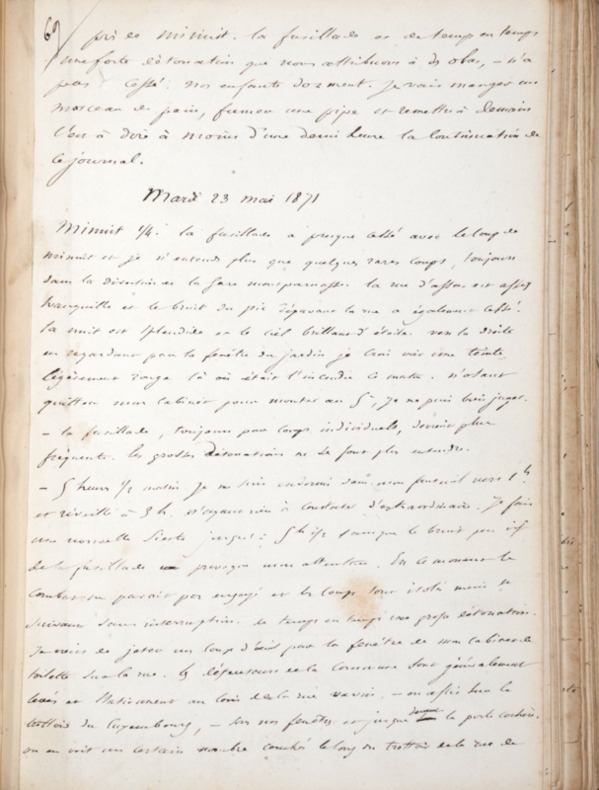
1871ref. 41289Paris, , 1871. In-8 manuscrit en belle page (15 x 21 cm) de (2)-131 ff. montés sur onglet à 30 lignes par page, demi-chagrin vert, dos à nerfs, titre doré (reliure de l’époque).
1895Very Good Turkish, Ottoman (1500-1928) Original handsome brown quarter leather binding with Ottoman lettered gilt to spine. Five raised bands to spine, separated from each other with lined gilt. Slight stains on the title page. Else a fine copy. Roy. 8vo. (23 x 16 cm). In Ottoman script (Old Turkish with Arabic letters). 99 p. Hegira: 1313 = Gregorian: 1895. Extremely rare first printed edition of this one of the earliest travel accounts, of an Ottoman admiral's early expeditions to the Indian Ocean, Arabian Sea, Red Sea, and Persian Gulf to counter Portuguese piracy and attacks on Muslim pilgrim ships, which describes the lands he has seen during his voyage from India to Constantinople by Sidi (Seydi) Ali Reis (1498-1563) sent by Sultan Suleiman the Magnificent covering the years 1553-1556. During these naval wars, after two marine battles against the Portuguese fleet and a great storm named The Elephant Typhoon (Tufan-i Fil) by the locals, Reis' remaining six galleys drifted to India. The fleet was unserviceable, resulting in his return home overland with 50 men. Reis then arrived at the royal court of the Mughal Emperor Humayun in Delhi, where he met the future Mughal emperor Akbar, who was twelve years old at the time. He returned to the Ottoman Land over Muslim states in South Asia; Afghanistan, Central Asia, and Iran. But he delayed his return because of the war between the Ottoman and the Safavid Empires in Iran. Finally, following the treaty of Amasya in 1555, he was able to return home and present his book of this narrative journey to the Sultan in 1557. This work offers an extensive insight into the Muslim situation in 16th century South and Central Asia and the Middle East, Islamic navigation, and Turkish - Portuguese relations as well as Persian, Afghan, and Indian geography, naval routes, flora, and fauna. Seydi Ali Reis, formerly also written Sidi Ali Reis and Sidi Ali Ben Hossein, was an Ottoman admiral and navigator. Known also as Katib-i Rumi, Galatali, or Sidi Ali Çelebi, he commanded the left wing of the Ottoman fleet at the naval Battle of Preveza in 1538. He was later promoted to the rank of fleet admiral of the Ottoman fleet in the Indian Ocean, and as such, encountered the Portuguese forces based in the Indian city of Goa on several occasions in 1554. Seydi was able to unite several Muslim countries on the coast of the Arabian Sea (such as the Makran Kingdom, Gujarat Sultanate, and Adal Sultanate) against the Portuguese. He is famous today for his books of travel such as the Mir'ât ül Memâlik [i.e. The Mirror of Countries], and his books of navigation and astronomy, such as the Mir'ât-i Kâinât (Mirror of the Universe) and the Kitâb ül Muhit: El Muhit fî Ilmi'l Eflâk ve'l Buhûr [i.e. Book of the Regional Seas and the Science of Astronomy and Navigation] which contain information on navigation techniques, methods of determining direction, calculating time, using the compass, information on stars, sun and moon calendars, wind and sea currents, as well as portolan information regarding the ports, harbours, coastal settlements and islands in the various regions of the Ottoman Empire. His books are translated into numerous languages including English, French, Italian, German, Greek, Arabic, Persian, Urdu, Russian, and Bengali, and are considered among the finest literary works dating from the Ottoman period. "When Sultan Suleiman had taken up his winter residence in Aleppo, I, the author of these pages, was appointed to the Admiralship of the Egyptian fleet and received instructions to fetch back to Egypt the ships (15 galleys), which some time ago had been sent to Basrah on the Persian Gulf. But, 'Man proposes, God disposes.' I was unable to carry out my mission, and as I realized the impossibility of returning by water, I resolved to go back to Turkey by the overland route, accompanied by a few tried and faithful Egyptian soldiers. I traveled through Gujarat, Hind, Sind, Balkh, Zabulistan, Bedakhshan, Khotlan, Turan, and Iran
1863pp. 268. BUT - Our copy lacks the first leaf (title page) and maybe some ads in the rear. Original cloth binding; rubbed. Moderate foxing. With the paper label of D.S. Von Nieda, Ephrata, PA. Mr. Von Nieda was the sole owner and operator of the Mountain Springs Hotel during its mid and late 19th century heyday. What remains of the hotel is listed on the National Register of Historic Places. Located in Ephrata, Pennsylvania, at the corner of East Main Street and Spring Garden Street. It was originally built in 1848 as a summer resort, capitalizing on its natural spring water, and hosted a variety of high-profile guests including several Presidents. A comprehensive trade manual for selling French wine and spirits; with an interesting Ephrata, Pennsylvania association. **PRICE JUST REDUCED! BOOZE 2