116,714 results
2014New English Paperback. Pbo. 4to. (28 x 22 cm). In Turkish. 103, [1] p. B/w and color ills. Objects, postcards, paints, letters, military costumes, photographs, war medals etc. and other materials related to Gallipoli Victory in 1915. Çanakkale Zafer Müzesi.
2009New English Paperback. Folio. (42 x 30 cm). In English and Turkish. [96] p., color maps. Çanakkale tahkimat haritasi. [= Fortifications maps of Gallipoli War]. Edited by Ahmet Tetik, Ayse Seven.
2011New English Paperback. Pbo. Roy. 8vo. (24 x 17 cm). In Turkish. 91 p., b/w ills. Gallipoli battlefields travel guide and Gallipoli, 1915 War. Çanakkale Savaslari ve savas alaninda gezi.
1976Very Good English Paperback. Pbo. Foolscap 8vo. (18 x 12 cm). In Turkish. 111 p., b/w plates. Gallipoli battlefields. Çanakkale savaslari harb sahalari ve abideleri.
2017Very Good Turkish Paperback. Cr. 8vo. (20 x 14 cm). In Turkish. 271 p., ills., map. Çanakkale raporu.
2013As New English Paperback. Pbo. Mint. Oblong small 4to. (20 x 23 cm). In Turkish. Color ills. 256 p. From sentences Gallipoli War Memorial Journal. Çanakkale Platosu Ani Defteri.
2015New English Original bdg. HC. 4to. (31 x 24 cm). In Turkish. 467, [3] p., color and b/w ills. Çanakkale Muharebeleri'nde 57. Piyade Alayi.
2008Fine English Paperback. Pbo. Roy. 8vo. (24 x 17 cm). In Turkish. 88, [7] p., ills. Çanakkale Ingiliz ordulari baskomutani Ian Hamilton'un Çanakkale Savaslari raporu. Prep. by Ahmet Altintas. Report of Gallipoli Campaign of General Sir Ian Standish Monteith Hamilton GCB, GCMG, DSO, TD was a senior officer in the British Army, who is most notable for commanding the Mediterranean Expeditionary Force during the Gallipoli Campaign.
2008New New Turkish Original bdg. Dust wrapper. 4to. (30 x 22 cm). In Turkish. 2 volumes set: (334 p.; 334 p.), b/w photographs. Çagdas Atatürk fotograflari. Hanri Benazus Koleksiyonu. 2 volumes set.
1942ref. 48810Tokyo: Tokyo Nichinichi Shimbunsha æ±äº¬æ—¥æ—¥æ–°èžç¤¾ 1942. First edition. Hardcover. g to vg. Oblong quarto. Unpaginated. 36 printed double-sided leaves. Housed in a tan cardboard slipcase with black lettering on the front cover and spine. Blue paper boards with embossed silver lettering and geometric decorative designs on the covers. Photo-illustrated title page. This scarce work is a striking piece of photographic propaganda displaying the power and glory of the Japanese Imperial Navy during WWII. Illustrated throughout with a total of 74 mostly full-page b/w collotype images including stunning aerial photography. The photobook is divided into two parts: the first one is concerned with naval training while the second part deals with the unfolding course of the war being a record of Japanese successes from Pearl Harbor Malaya New Guinea and other parts of South East Asia. This is one of the very first publications to have show and extended pictorial account of the bombing of Pearl Harbor including a number powerful and dynamic images two of the images seen to be illustrations. Includes also numerous b/w Soviet-style photographic plates of naval guns battleships submarines and military planes as well as photographs of operations in China Java Borneo Philippines New Guinea and other areas in Southeast Asia. None of the images are credited to a particular photographer but included is work by Matsugi Fujio and possibly Kimura Ihei. The beginning of the section contains a finely detailed illustrated map showing Japanese naval positions and battles across the pacific theater. Text and captions throughout in Japanese. Slipcase with some light scratches as well as minor age toning and smudges. Corners rubbed and lightly chipped. Binding with minor stains smudges and scratches to the covers. There is a small 1/2" stain on the upper right corner of the front cover. Edges lightly rubbed with the head of the spine lightly chipped. Interior covers and endpaper lightly damp-stained. Gutters of interior covers reinforced. Book block tight. pages throughout very clean. Slipcase in good binding in very good- interior in very good condition overall. Slipcase and binding protected in modern mylar. Tokyo Nichinichi Shimbunsha (æ±äº¬æ—¥æ—¥æ–°èžç¤¾) hardcover books
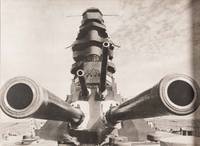
1942ref. 48810Tokyo: Tokyo Nichinichi Shimbunsha æ±äº¬æ—¥æ—¥æ–°èžç¤¾ 1942. First edition. Hardcover. g to vg. Oblong quarto. Unpaginated. 36 printed double-sided leaves. Housed in a tan cardboard slipcase with black lettering on the front cover and spine. Blue paper boards with embossed silver lettering and geometric decorative designs on the covers. Photo-illustrated title page. This scarce work is a striking piece of photographic propaganda displaying the power and glory of the Japanese Imperial Navy during WWII. Illustrated throughout with a total of 74 mostly full-page b/w collotype images including stunning aerial photography. The photobook is divided into two parts: the first one is concerned with naval training while the second part deals with the unfolding course of the war being a record of Japanese successes from Pearl Harbor Malaya New Guinea and other parts of South East Asia. This is one of the very first publications to have show and extended pictorial account of the bombing of Pearl Harbor including a number powerful and dynamic images two of the images seen to be illustrations. Includes also numerous b/w Soviet-style photographic plates of naval guns battleships submarines and military planes as well as photographs of operations in China Java Borneo Philippines New Guinea and other areas in Southeast Asia. None of the images are credited to a particular photographer but included is work by Matsugi Fujio and possibly Kimura Ihei. The beginning of the section contains a finely detailed illustrated map showing Japanese naval positions and battles across the pacific theater. Text and captions throughout in Japanese. Slipcase with some light scratches as well as minor age toning and smudges. Corners rubbed and lightly chipped. Binding with minor stains smudges and scratches to the covers. There is a small 1/2" stain on the upper right corner of the front cover. Edges lightly rubbed with the head of the spine lightly chipped. Interior covers and endpaper lightly damp-stained. Gutters of interior covers reinforced. Book block tight. pages throughout very clean. Slipcase in good binding in very good- interior in very good condition overall. Slipcase and binding protected in modern mylar. Tokyo Nichinichi Shimbunsha (æ±äº¬æ—¥æ—¥æ–°èžç¤¾) hardcover
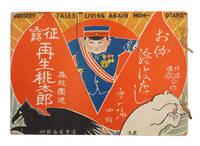
1905ref. 69050Tokyo. Meiji 38 i.e. 1905. Allegorical Russo-Japanese War Picture Book with America and Great Britain as Mother and Father of Japan A fascinating and exceedingly rare Japanese e-hon situating the classic myth of Momotaro in the context of the Russo-Japanese War with the United States and Great Britain depicted as the proud parents of heroic young Japan. The core tale of Momotaro describes an elderly couple who discover a large peach—to their surprise a boy who they name Momotaro lit. "Peach Boy" emerges. The couple raise him and soon discover that he possesses enormous strength and before long the boy sets off to pacify the vicious oni of the nearby island of Onigashima. Meeting friends in the form of a dog a monkey and a pheasant along the way Momotaro vanquishes his foe and brings back their riches which restore the health and fortunes of his adoptive parents. One of Japan's most enduring legends the character of Momotaro became increasingly tied in with the Japanese national self-image beginning in the 19th century. This delightfully illustrated version of the tale interestingly printed side-by-side with an original if not entirely accurate English translation was printed at the outset of the Russo-Japanese War. Researcher Nahoko Kahara describes its contents in her article on the Momotaro myth: "Since the Meiji period as Japan has engaged in foreign wars Momotaro has often been interpreted as a Japanese soldier. In 'Momotaro: The Revival of Russo-Japanese Warfare' 1904 published the year the Russo-Japanese War began the grandfather's name is "Eizo" for Eikoku i.e. England and the grandmother's name is "Oame." the "Ame" of "America". They are Westerners dressed in clothing featuring the British and American flags. Momotaro dressed in military uniform carries a bomb instead of millet dumplings and sets out to conquer the villainous 'Roske' Russia who bullies 'Oshina-chan' and 'Ocho-chan.'" After their home is attacked by the Russian devils Eizo and Oame are shown gleefully arming Momotaro with cannons rifles and blades. In the end the vanquished Russians beg Momotaro for forgiveness while his subordinates wave the Japanese flag and cry "Banzai!" Just as in the legend Momotaro returns to his old parents with the "precious things" given to him by the Russians and on the final page Oame and Eizo are depicted alongside their son with the flags of all three nations fly proudly in the background. While the war ended in victory for the Japanese they were appalled by the resulting peace treaty mediated by Theodore Roosevelt and the rosy view of "Mother America" put forth in this book quickly soured. The colophon states that this is apparently the fourth printing printed less than six months after the first though we locate no copy of any edition anywhere. Kahara's essay cites a later printing with the altered title "Momotaro: The Revival of Japan." A very rare and interesting piece of Japanese wartime publishing and intriguing evidence of Japanese attitudes towards America at the turn of the 20th century. Oblong booklet. Original illustrated wrappers string-tied. Rear wrapper lacking last leaf dampstained a few small closed tears faint tideline to upper edge throughout. Good. Nahoko Kahara "From Folktale Hero to National Symbol: The Making of Momotaro Paradigm in Japanese Modern Age" in Waseda Journal of Asian Studies Vol. 25 2004 pp.35-61. hardcover books
1905ref. 69050Tokyo. Meiji 38 i.e. 1905. Allegorical Russo-Japanese War Picture Book with America and Great Britain as Mother and Father of Japan A fascinating and exceedingly rare Japanese e-hon situating the classic myth of Momotaro in the context of the Russo-Japanese War with the United States and Great Britain depicted as the proud parents of heroic young Japan. The core tale of Momotaro describes an elderly couple who discover a large peach—to their surprise a boy who they name Momotaro lit. "Peach Boy" emerges. The couple raise him and soon discover that he possesses enormous strength and before long the boy sets off to pacify the vicious oni of the nearby island of Onigashima. Meeting friends in the form of a dog a monkey and a pheasant along the way Momotaro vanquishes his foe and brings back their riches which restore the health and fortunes of his adoptive parents. One of Japan's most enduring legends the character of Momotaro became increasingly tied in with the Japanese national self-image beginning in the 19th century. This delightfully illustrated version of the tale interestingly printed side-by-side with an original if not entirely accurate English translation was printed at the outset of the Russo-Japanese War. Researcher Nahoko Kahara describes its contents in her article on the Momotaro myth: "Since the Meiji period as Japan has engaged in foreign wars Momotaro has often been interpreted as a Japanese soldier. In 'Momotaro: The Revival of Russo-Japanese Warfare' 1904 published the year the Russo-Japanese War began the grandfather's name is "Eizo" for Eikoku i.e. England and the grandmother's name is "Oame." the "Ame" of "America". They are Westerners dressed in clothing featuring the British and American flags. Momotaro dressed in military uniform carries a bomb instead of millet dumplings and sets out to conquer the villainous 'Roske' Russia who bullies 'Oshina-chan' and 'Ocho-chan.'" After their home is attacked by the Russian devils Eizo and Oame are shown gleefully arming Momotaro with cannons rifles and blades. In the end the vanquished Russians beg Momotaro for forgiveness while his subordinates wave the Japanese flag and cry "Banzai!" Just as in the legend Momotaro returns to his old parents with the "precious things" given to him by the Russians and on the final page Oame and Eizo are depicted alongside their son with the flags of all three nations fly proudly in the background. While the war ended in victory for the Japanese they were appalled by the resulting peace treaty mediated by Theodore Roosevelt and the rosy view of "Mother America" put forth in this book quickly soured. The colophon states that this is apparently the fourth printing printed less than six months after the first though we locate no copy of any edition anywhere. Kahara's essay cites a later printing with the altered title "Momotaro: The Revival of Japan." A very rare and interesting piece of Japanese wartime publishing and intriguing evidence of Japanese attitudes towards America at the turn of the 20th century. Oblong booklet. Original illustrated wrappers string-tied. Rear wrapper lacking last leaf dampstained a few small closed tears faint tideline to upper edge throughout. Good. Nahoko Kahara "From Folktale Hero to National Symbol: The Making of Momotaro Paradigm in Japanese Modern Age" in Waseda Journal of Asian Studies Vol. 25 2004 pp.35-61. hardcover
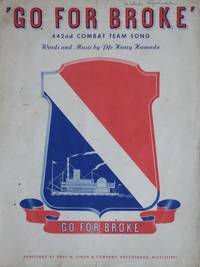
1944ref. List2436Hattiesburg: Earl M. Finch 1944. Sheet music measuring 12 x 9 inches 4 pp. Signature of a Nabuko Hayashida on front cover. Slight tears at fold some toning two small pinholes very good overall quite attractive. Very Good. In Hawaii in May 1942 a battalion of Nisei volunteers was assembled for service in World War Two despite earlier failures of efforts to recruit Japanese-Americans due to the Army’s labeling of Nisei recruits as 4-C enemy aliens. Designated as the 100th Infantry Battalion they were deployed to North Africa in June 1943 integrating with the 34th Division in active combat. Their subsequent deployment to Italy in September 1943 exposed them to intense warfare earning them the moniker of the "Purple Heart Battalion" due to their notably high casualty rate. In January 1943 the U.S. War Department officially declared the establishment of the segregated 442nd Regimental Combat Team RCT which was comprised of Nisei volunteers originating from Hawaii and the mainland. The culmination of this initiative transpired in June 1944 when the 442nd RCT merged forces with the 100th Infantry Battalion in Europe subsequently absorbing the latter into its structure. The notable achievements of Nisei soldiers in combat operations prompted the reinstatement of the draft in January 1944 specifically targeting Nisei detainees to augment the ranks of the 442nd. Over time the 442nd RCT expanded to encompass the 2nd 3rd and 100th Battalions; the 522nd Field Artillery Battalion; the 232nd Engineering Company; the 206th Army Band; Anti-Tank Company; Cannon Company; and Service Company. Offered here is a very scarce piece of sheet music entitled “Go For Broke” which was written by the Hawaiian musician Harry Hamada reflecting the slogan of the 442nd and performed by Shelby and others during the war as part of efforts to boost morale. Hamada would feature in the 1951 movie “Go For Broke” as Masami alongside several other veterans of the 442nd. This publication of “Go For Broke” is from 1944 seven years before the movie’s release. The piece is dedicated to Colonel C.W. Pence. Hamada was a Hawaiian musician who performed with a band called the Shelby Hawaiians or the Shelby Serenaders. They performed as early as 1943. The Hattiesburg Mississippi merchant Earl M. Finch who ran an Army and Navy store close to Camp Shelby befriended Hamada and other members of the 442nd and acted as a sponsor for the group and eventually published this version despite his business being a dry goods merchant house and not a publishing house. The group with the support of Finch performed throughout the country to lift morale. At some point Hamada penned this composition likely in 1944 as we find no reference to it in 1943 articles and Finch published it - Hamada’s composition would become the theme song of the 442nd and Hamada would perform at the Halloran General Hospital in New York and the Walter Reed Hospital in Washington D.C. in 1944 likely performing this composition. Another composition called “Go For Broke” exists as well and it is unclear to what degree Hamada’s work caught on among the regiment. We find two records of Finch’s published version of the composition one listed as part of an online remembrance of the 442nd by the Smithsonian Institution https://americanhistory.si.edu/explore/stories/day-remembrance-70-years-after-executive-order-9066 which appears to have been on loan from the National Japanese American Historical Society and another copy held at Stanford though not listed in OCLC. Finch’s story is also interesting and is the subject of a remembrance on a 100th Battalion History page online https://www.100thbattalion.org/history/stories/earl-finch/. We find no copies listed in OCLC. Overall a very scarce piece of Japanese-American wartime history. Earl M. Finch unknown books
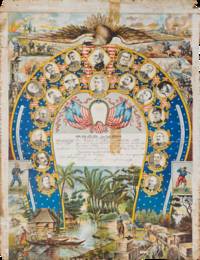
1901ref. List2860Likely San Francisco California 1901. 19 x 24 inch lithograph. Much staining and chipping; folded with tears; several tape repairs verso with some residue visible recto; quite attractive overall good plus. A broadside lithograph commemorating a soldiers’ service in the Philippine-American war. Images of generals are set in a large blue horseshoe and eagle design over a montage of scenes from the war. In the center is a service form and an empty horseshoe in which on examples of similar broadsides the soldiers’ photograph is affixed. The service form certifies that Everett W. Patton enlisted in 1899 and served in the 38th Regiment. Similar broadsides—though with some differences in design—have on the bottom margin a 1901 copyright to Herbert E. Ellsworth and the My Boys Publishing Company and attribute the lithograph to Sanborn Vail & Co. both in San Francisco. This margin is missing from this copy. Overall a vivid and attractive piece. unknown books
1901ref. List2860Likely San Francisco California 1901. 19 x 24 inch lithograph. Much staining and chipping; folded with tears; several tape repairs verso with some residue visible recto; quite attractive overall good plus. A broadside lithograph commemorating a soldiers’ service in the Philippine-American war. Images of generals are set in a large blue horseshoe and eagle design over a montage of scenes from the war. In the center is a service form and an empty horseshoe in which on examples of similar broadsides the soldiers’ photograph is affixed. The service form certifies that Everett W. Patton enlisted in 1899 and served in the 38th Regiment. Similar broadsides—though with some differences in design—have on the bottom margin a 1901 copyright to Herbert E. Ellsworth and the My Boys Publishing Company and attribute the lithograph to Sanborn Vail & Co. both in San Francisco. This margin is missing from this copy. Overall a vivid and attractive piece. unknown
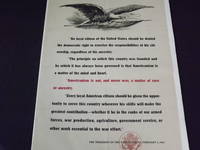
1943ref. 100607Wartime poster 27 ¾ x19 ¾ large eagle engraving at the top of the poster printed in red and black. Creases where folded. This rare U.S. Government wartime poster attempts to promote equality by reminding Americans that race and ancestry shouldn’t matter in our country. It reminds us that every American "should be given the opportunity to serve the country" and help the war effort. While this was certainly a noble goal this poster was printed at a time when our armed forces were still largely segregated. U.S. Government Printing Office: books
1943ref. 100607Wartime poster 27 ¾ x19 ¾ large eagle engraving at the top of the poster printed in red and black. Creases where folded. This rare U.S. Government wartime poster attempts to promote equality by reminding Americans that race and ancestry shouldn’t matter in our country. It reminds us that every American "should be given the opportunity to serve the country" and help the war effort. While this was certainly a noble goal this poster was printed at a time when our armed forces were still largely segregated. U.S. Government Printing Office:
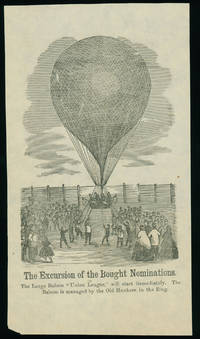
1864ref. 21986.04CIVIL WAR.Broadside "The Excursion of the Bought Nominations The Large Balloon 'Union League' Will Start Immediately. The Balloon is managed by the Old Hunkers in the Ring." 1864. 4 ¾ x 8 ½ in. Historical Background The Union League Club formed in New York in 1863 to support Union troops and cultivate civil devotion. Made up of prominent citizens in New York Philadelphia Brooklyn New Haven and Chicago the clubs raised money to provide for the U.S. Sanitary Commission and establish a group of political elites to sustain Union military efforts. The league favored a strong central government tariff protections and internal improvements. The "Old Hunkers" were the conservative branch of the New York state Democratic party in the mid-nineteenth century. They favored the status quo whether in business or on the contentious issue of slavery. The more progressive "Barnburner" faction stood in opposition to the old Hunkers and were against slavery strong state powers expanding the public debt and government subsidizing businesses. Though the Old Hunkers shared many similarities in terms of business philosophy with the Union League—especially that of strong central government power and infrastructure improvements—the disconnect between the two groups' stance on slavery makes this cartoon perplexing. Are the Old Hunkers carefully managing the political situation the balloon through the New York political machine note the capital "R" of Ring as in the infamous Tweed Ring Or are they setting the progressive Union Leaguers adrift books
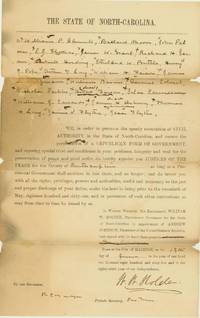
1865ref. 218141865. No binding. Fine. Archive of materials relating to the administering of loyalty oaths in North Carolina after the Civil War during presidential Reconstruction. 1865-1866. 21814.01. William H. Bagley Autograph Letter Signed as private secretary of Governor William Holden to William Barrow John Odom and others. Raleigh N.C. July 10 1865 1 p. quarto on State of North Carolina Executive Department lettersheet.Excerpt""Your Memorial . has been received at this office and the Governor directs me to say in reply that the matter therein referred to will be attended to at the earliest possible moment. This however cannot be done until the Enrolling Boards shall have accomplished their work in the different counties in administering the oath of amnesty to the people - separating the loyal from the disloyal. In the meantime the preservations of the Public peace will devolve upon the Justices of the Peace in the several counties who have the right on all occasions to control the Local Police and posses the power to increase the same to such a number as they may deem necessary to meet any emergency which may arise in which they may think is likely to arise .""21814.02 W.W. Holden Printed Letter Signed in Type as Provisional Governor to Col. David A. Barnes with matching cover addressed ""To the Clerk of the County Court of Northampton County Jackson N.C."" Entitled ""Directions for Qualifying Magistrates and Organizing the County Courts."" Raleigh N.C. July 8 1865 1 p. quarto on State of North Carolina Executive Department lettersheet.Excerpt"".If necessary you will call on the officers of the Local Police to notify the Justices to meet at the Courthouse on a day to be appointed by you. And said officers are hereby commanded to aid you in notifying the Justices to attend. When the Justices shall have assembled you will administer to them first the oath of amnesty; secondly the oath to be found in the Revised Code chapter 76 page 434 to maintain the Constitution of the State not inconsistent with the Constitution of the United States; thirdly the oath of office to be found in Revised Code chapter 76 page 441. No Justice or other officer who is included in any of the fourteen excluded classes of the President's amnesty proclamation will be permitted to take the oaths prescribed or enter on the performance of duty until a pardon shall have been received by him from the President. And the oath of amnesty is not to be administered to any one who is not disposed to take it willingly and cheerfully. If any Justice named in the commission hesitates to take the oath it will be your duty to withhold it from him . The Clerk will make a full and complete record on his books of the proceedings of the Justices a copy of which you will at once transmit to this office.""21814.03 W.W. Holden Printed Letter Signed in Type as Provisional Governor. September 15 1865 1 p. quarto on State of North Carolina Executive Department lettersheet.Excerpt""You are hereby directed to retain the Amnesty Oath books until further orders as they will be kept open to allow the people to take said oath up to the time of voting for Governor members of Congress & c.""21814.04 Manuscript Document Oath. Northampton County N.C. August 15 1865. 1 p.21814.05 Printed Document Oath of Allegiance 1865 unissued. 1 p.21814.06 W.W. Holden Partly Printed Document Signed appointing twenty-two men 2 of whom are identified as dead as Justices of the Peace. Raleigh N.C. June 19 1865. 1 p.Excerpt""WE in order to promote the speedy restoration of CIVIL AUTHORITY in the State of North-Carolina and ensure the perpetuation of a REPUBLICAN FORM OF GOVERNMENT and reposing special trust and confidence in your prudence integrity and zeal for the preservation of peace and good order do hereby appoint you JUSTICES OF THE PEACE for the County of Northampton as long as a Provisional Governor shall conti. See website for full description books
Toledo, Talleres Gráficos de Rafael Gómez Menor, 1947. 4to.mayor; 205 pp., 1 h., con 31 láminas aparte, con fotografías y reproducciones de documentos. Cubiertas originales.
1922ref. 105401Paris, Payot, coll. « Mémoires, études et documents pour servir à l’histoire de la Guerre mondiale » 1922 In-8 23 x 14,5 cm. Broché, couverture grise, titre en bleu-marine sur le dos et le premier plat, 191 pp., 48 gravures. Exemplaire en bon état avec accrocs en tête et en pied de dos.
1945ref. 7504Paris Plon 1945 In-12 246 pp, (.) Bonneval, Chartres, Paris. Partiellement débroché ; dos passé, ensemble frotté
ref. 244680Paris, Les Archives Espagnols [Imprimerie centrale], s.d. (1937) in-8, 34 pp., un f. n. ch., avec deux planches hors texte, broché.
ref. 11982Editions Raymond Schall. 1944. In-4°, reliure cartonnage. Couverture photographique. 27 pp. de texte + 130 pp. de photographies (dues en grande part à Raymond Schall).