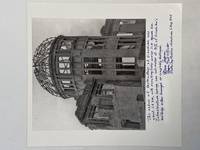
1945réf. 127651945. Jeppson Morris. Inscribed photograph of the Hiroshima Atomic Dome following the atomic bombing provides a quantified assessment of destruction written by the weapons officer responsible for arming the bomb aboard the Enola Gay on August 6 1945. As the individual who physically armed the device prior to release Morris Jeppson links technical execution of the mission with retrospective evaluation of its effects. His inscription records measured estimates of blast radius fire spread and infrastructure damage contributing to the historical record of how participants in the bombing articulated its scale and consequences in numerical terms. Jeppson Morris. Hiroshima Atomic Dome photograph. United States post-1945. Black-and-white photograph measuring approximately 9 x 8.5 inches inscribed in ink by Morris Jeppson. The inscription reads: "The radius of destruction of Hiroshima was about 1.6 km with resulting fires across 11.4 square km. Infrastructure damage was estimated at 90% of Hiroshima's buildings either damaged or completely destroyed. Morris Jeppson - Weapon Test Officer - Enola Gay Mission - Hiroshima 6 Aug. 1945." The image depicts the Atomic Dome one of the few surviving structures near the hypocenter paired with Jeppson's statistical summary of destruction integrating visual evidence with numerical interpretation. The Hiroshima bombing introduced a new scale of urban destruction defined by nuclear technology with immediate and long-term consequences for civilian populations and infrastructure. Jeppson's inscription reflects how participants in the mission communicated its impact through measurable data aligning with postwar efforts to document and understand the physical effects of atomic weapons. The combination of a landmark image of the Atomic Dome with a participant-authored damage assessment offers a primary source for the study of nuclear warfare urban devastation and the translation of technological force into quantifiable outcomes. Light handling wear; photograph remains clean with strong legible inscription. Overall very good. unknown
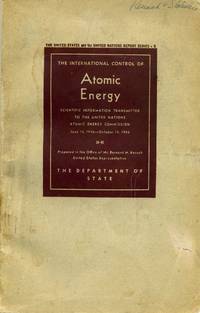
1946réf. 99751946. United States Department of State. The International Control of Atomic Energy: Scientific Information Transmitted to the United Nations Atomic Energy Commission June 14 1946 - October 14 1946 1946 constitutes one of the earliest formal U.S. government submissions to the United Nations Atomic Energy Commission outlining proposed mechanisms to regulate nuclear weapons following the atomic bombings of Japan. Issued in the immediate aftermath of World War II and within one year of the atomic bombing of Hiroshima the report presents a technical and policy framework focused on controlling fissile materials as the primary safeguard against proliferation. This copy bears a direct inscription by Theodore Van Kirk navigator of the Enola Gay on August 6 1945 linking the theoretical policy proposals of international governance with firsthand participation in the first operational use of atomic weapons. Van Kirk underscores a central conclusion of the report by writing: "As stated on p. 164 The best control measure for the prevention of atomic bomb manufacture are those intended to prevent the accumulation of the essential fissionable materials" followed by his identification: "Theodore Van Kirk - Navigator - Enola Gay 6 Aug. 1945." United States Department of State. The International Control of Atomic Energy: Scientific Information Transmitted to the United Nations Atomic Energy Commission June 14 1946 - October 14 1946. Washington D.C.: Department of State 1946. Softcover volume measuring approximately 6 x 9 inches 195 pages. The work compiles scientific data policy recommendations and diplomatic proposals submitted to the United Nations concerning the international management of atomic energy and the prevention of nuclear weapons development. The inscription appears on the title page in Van Kirk's hand directly referencing a specific passage within the text and reinforcing its central argument regarding material control. Produced during the earliest phase of postwar nuclear diplomacy the report aligns with U.S. efforts to establish international oversight of atomic energy before the escalation of Cold War arms competition. The presence of Van Kirk's annotation situates the document within both policy formation and military execution bridging governmental attempts at regulation with the lived experience of atomic warfare. Light wear to covers with minor handling; internally clean; inscription clear and legible. Overall very good condition. unknown
1969réf. 2090202120415462Ground Self-Defense Force Kaita City Stationed Forces Reunion 1969. Soft Cover. Fine. Number of books: 1 Ground Self-Defense Force Kaita City Stationed Forces Reunion paperback
1994réf. 2111902160306822Hiroshima Agata Shrine 1994. Soft Cover. Fine. The book is in fine condition. Hiroshima Agata Shrine paperback
1910réf. 2092902143900793Hakubunkan 1910. Soft Cover. Fine. Number of books: 1 book Hakubunkan paperback
1910réf. 2092902143800793Hakubunkan 1910. Soft Cover. Fine. Number of books: 1 book Hakubunkan paperback
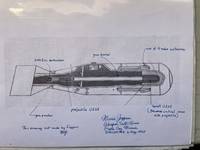
1945réf. 125771945. Jeppson Morris. Hand-annotated diagram of the "Little Boy" atomic bomb 1945 provides a direct technical interpretation of the weapon used in the bombing of Hiroshima by a participant who bridged both its development and deployment. As weapons officer aboard the Enola Gay and a scientist present at Los Alamos Laboratory Jeppson occupied a rare dual role linking the Manhattan Project's design phase with the operational execution of nuclear warfare. His annotations explain the internal structure and function of the uranium gun-type bomb offering a contemporaneous explanation of how critical mass was achieved and how the weapon was triggered. The document situates technical knowledge of nuclear fission within the lived experience of those responsible for its first use in warfare during World War II. Jeppson Morris. "Little Boy" atomic bomb diagram. United States 1945. One-page black-and-white printed diagram with extensive handwritten annotations and arrows in ink signed at lower margin "Morris Jeppson / Weapon Test Officer / Enola Gay Mission / HIROSHIMA 6 Aug. 1945." The annotations identify and explain key components including "target U235" "projectile 235" and the process by which the bomb "Becomes critical mass with projectile" along with labeled elements such as the "electric detonator" "gun barrel" and "one of 4 radar antennas." The markings function as a technical overlay to the printed schematic clarifying both structure and mechanism from the perspective of the officer responsible for in-flight arming and monitoring of the device. The atomic bombing of Hiroshima marked the first combat use of nuclear weapons and introduced a new phase of warfare defined by unprecedented destructive capacity and strategic implications. Jeppson's role in both the scientific and operational dimensions of the mission positions this document within the immediate transmission of specialized knowledge from laboratory to battlefield. His annotations provide insight into how participants understood and communicated the bomb's function contributing to the historical record of nuclear science military technology and the transformation of warfare at the end of World War II. Light handling wear; diagram remains clear with strong legible annotations and signature. Overall very good. unknown
1945réf. 129771945. Hecht Selig. Explaining the Atom signed and inscribed by Theodore Van Kirk framing the atomic bombing of Hiroshima within a longer intellectual history of atomic theory and modern physics. As navigator of the Enola Gay during the August 6 1945 mission Van Kirk contributed directly to the operational execution of nuclear warfare and his inscription frames that event as the culmination of developments beginning with ancient atomism and extending through 20th-century scientific breakthroughs. By referencing figures such as Democritus and Einstein alongside the Manhattan Project the inscription integrates scientific theory with wartime application offering a condensed narrative linking philosophical origins of atomic thought to its realization in military technology. Hecht Selig. Explaining the Atom. New York: Viking Press 1947. 205 pages. Hardcover with dust jacket. Signed and extensively inscribed on the inside title page by Theodore Van Kirk. The inscription reads: "'Page 9; In 400 B.C. Deocritus theoryed the existence of atoms. In 1905 Einstein theorized E=MC squared. In 1943 Oppenheimer heads the Manhattan Project. In 1945 our 'Enola Gay' crew drops the atomic bomb on Hiroshima - Theodore 'Dutch' Van Kirk Navigator - Enola Gay August 6 1945." The text presents a chronological sequence of scientific and historical developments culminating in Van Kirk's own role in the Hiroshima mission. Published in the immediate postwar period Explaining the Atom aimed to make atomic science accessible to a broad audience at a time when nuclear technology had reshaped global politics and warfare. Van Kirk's inscription reflects how participants in the atomic mission interpreted their actions within a broader scientific and historical continuum linking abstract theory to its most consequential application. The juxtaposition of popular scientific exposition with firsthand annotation from a mission participant offers a layered artifact for the study of nuclear history scientific communication and the integration of intellectual and military developments in the mid-20th century. Dust jacket shows moderate wear; volume itself remains clean and well-preserved with strong legible inscription. Overall very good. unknown
2020réf. BN676814De Gruyter 2020. 2020. Applications in Rigorous Quantum Field Theory De Gruyter Studies in Mathematics 34/2 Band 2 Applications in Rigorous Quantum Field Theory De Gruyter Studies in Mathematics 34/2 Band 2 Lörinczi József and Fumio Hiroshima De Gruyter unknown
1972réf. 2090202120101462㈱ Seibun-sha 1972. Soft Cover. Fine. Volume: 1 ㈱ Seibun-sha paperback
1972réf. 2090202120301461㈱ Seibun-sha 1972. Soft Cover. Fine. Volume: 1 ㈱ Seibun-sha paperback
1957réf. 56750Nagasaki Japan: Kawano Miwa June 1st Showa 32 1957. 8vo. 164 4 pp. Red cloth gilt lettering in Japanese on front cover & spine faint tidemark on upper front & back covers minor shelfwear still VG- copy inscribed by the author on ffep. to Mrs. Hildreth July 5 1959 w/ tipped-in typed note about the work. First edition of this exceedingly scarce personal memoir recounting the author’s experiences and survival of the dropping of the Atomic Bomb on Hiroshima in 1945 at the end of World War II. Kawano b. 1918 was originally a student at Doshisha University Theology Dept. and forced to leave school due to illness was inducted into the Japanese Army in Manchuria and after his discharge studied medicine at Nagasaki Medical University. While working as a medical student in Hiroshima at the time he received burns and severe radiation exposure from the blast. Subsequently he devoted himself to the medical treatment and relief of the injured in Hiroshima and Nagasaki and by 1958 was in the first class of neurosurgery residents at the Oregon School of Medicine now OHSU under Prof. George Austin. He later returned to Nagasaki in 1960 to found the Department of Neurosurgery in the Nagasaki University School of Medicine which had been entirely destroyed in 1945 by the Nagasaki Atomic Bomb drop. The campus had been located less than half a mile from the epicenter of the explosion with the entire facility reduced to ashes by the blast. Kawano devoted his considerable skills to studying the nuclear blast survivors including papers on Whiplash Injury and Headache 1967 study of Post-traumatic Chronic Headache 1965; 1968 changes in the capillaries in the Great Occipital Nerve as well as the increase of Cerebral Aneurysms 1963. No copies located in Worldcat or the National Diet Library; See: Hayashi Ushijima Matsuo Kitagawa Suyama & Nagata The 150th Anniversary of Nagasaki University School of Medicine: Recovery From the Atomic Disaster and Evolution of the Department of Neurosurgery Nagasaki University’s Academic Output Site Congress of Neurological Surgeons 2009. Kawano Miwa, hardcover
1928réf. 2082402113508719Not Available 1928. Soft Cover. Fine. Volume: 1 Not Available paperback
1989réf. 2090202122801579Not Available 1989. Soft Cover. Fine. Volume: 1 Not Available paperback
1978réf. 2090202120201212Hiroshima Prefecture 1978. Soft Cover. Fine. Volume: 1 Hiroshima Prefecture paperback
1978réf. 2090202120403333Hiroshima Prefecture 1978. Soft Cover. Fine. Number of books: 1 Hiroshima Prefecture paperback
1952réf. 2090202118103016Matsunaga Town Office Hiroshima Prefecture 1952. Soft Cover. Fine. The book is in fine condition. Matsunaga Town Office (Hiroshima Prefecture) paperback
1972réf. 2090202120401588Rinsen Bookstore 1972. Soft Cover. Fine. Number of books: 1 Rinsen Bookstore paperback
2000réf. 2090202120101456Not Available 2000. Soft Cover. Fine. Number of books: 5 Not Available paperback
2000réf. 2090202120301455Not Available 2000. Soft Cover. Fine. Number of books: 5 Not Available paperback
1980réf. KOS06800053TBD 1980. Soft Cover. Fine. KOS06800053 TBD paperback
1926réf. 2090202120415235Not Available 1926. Soft Cover. Fine. Number of books: 1 Not Available paperback
1945réf. 125481945. Van Kirk Theodore J. handwritten autograph letter signed 6 August 1945 provides a first-person account by the navigator of the B-29 Enola Gay addressing fears of blast damage and radiation exposure during the Hiroshima atomic bombing mission. As navigator on the aircraft that delivered the first deployed atomic weapon in warfare Van Kirk 1921-2014 occupied a critical operational role requiring precise calculations of speed altitude and distance to ensure both mission success and crew survival. This manuscript directly supports research into World War II strategic bombing the operational realities of the Manhattan Project and contemporary military understanding of radiation hazards at the moment nuclear weapons entered combat. His reflections reveal not only technical planning but also the limited scientific certainty conveyed to flight crews regarding the bomb's destructive and radiological effects. Van Kirk Theodore J. 6 August 1945. Two pages. Approximately 8.5 x 11 inches. In this holograph letter written in question-and-answer format Van Kirk addresses the risks anticipated by the crew: "Did you have any fears about the effects the atomic bomb would have on the Enola Gay and the crew Yes. The fact that the bombs shock waves might destroy or damage the airplane was a major concern." He recalls being advised by a scientist that "we think the airplane will be OK if you're 9 miles away when the bomb explodes" and explains that "it was to get speed and altitude - and therefore distance - that we stripped down our airplanes. We were 12 miles away when the bomb exploded." Regarding radiation he writes: "We were not greatly concerned. We were told that the mushroom shaped cloud was deadly radiation and to stay clear of it. Otherwise no equipment to protect from radiation. No crew members were affected." He signs "Sincerely / Theodore J 'Dutch' Van Kirk / Navigator - Enola Gay / 6 Aug. 1945." The manuscript preserves his phrasing underscoring the mixture of scientific briefing operational adaptation and residual uncertainty that characterized the mission. Composed retrospectively and dated to the day of the bombing the letter reflects how participants later articulated their understanding of radiation at a time when its long-term biological effects were not yet fully grasped by the broader public or as Van Kirk's statement suggests by operational crews. His emphasis on distance calculations and aircraft modification illustrates the intersection of scientific theory and practical military execution in August 1945 when strategic air power entered the nuclear age. The acknowledgment that no protective equipment was provided and that crews relied primarily on avoidance of the mushroom cloud contributes to the evidentiary record of early nuclear risk assessment within the U.S. Army Air Forces. Minor edge wear and light handling creases; ink strong and fully legible; paper clean. Overall very good to near fine condition. A substantive self-authored reflection on blast mechanics and radiation awareness at the inception of atomic warfare. unknown
1945réf. 125471945. Van Kirk Theodore J. handwritten autograph letter signed 6 August 1945 offers a first-person reflection by the navigator of the B-29 Enola Gay on the most perilous moments of the Hiroshima atomic bombing mission and the psychological atmosphere aboard the aircraft. Theodore "Dutch" Van Kirk 1921-2014 a central member of the three-man flight deck crew provides direct testimony concerning the uncertainty surrounding the bomb's force and the crew's fear that the detonation might destroy their own plane. The letter supports research in World War II military aviation the operational history of the Manhattan Project and the lived experience of nuclear warfare from the American aircrew perspective. By fore grounding danger doubt and immediate reaction Van Kirk's account contributes to the documentary record of how participants later interpreted the unprecedented destructive power they helped unleash. Van Kirk Theodore J. 6 August 1945. Two pages. Approximately 8.5 x 11 inches. In this holograph letter written in question-and-answer format Van Kirk records: "What do you think was the most dangerous moment during the mission Undoubtedly the seconds when and right after the bomb exploded. The question was 'will the bomb blow up or severely damage the airplane.' Thankfully we got far enough away so this did not happen." Addressing crew morale he continues: "Were your fellow crew members anxious about carrying out the mission There was some doubt in everyone's mind about the force of the bomb. Would it damage or even destroy the plane. I was all assuaged the moment the bomb exploded." He signs "Theodore J 'Dutch' Van Kirk / Navigator - Enola Gay / 6 Aug 1945." The manuscript preserves his phrasing and emphasis underscoring both technical calculation and personal apprehension at the moment nuclear warfare entered combat history. Although composed retrospectively and dated to the mission itself the letter reflects the sustained historical reckoning with the atomic bombings and the strategic doctrine that followed. Van Kirk's language centers not on political justification but on immediate survival revealing the acute awareness among crew members that the weapon's effects were not fully predictable even to those tasked with delivering it. Such testimony is especially significant given that only a small number of crew members had direct visual access to the detonation and experienced the shock wave firsthand. Light handling wear and minor edge creasing; ink bold and fully legible; paper clean. Overall very good to near fine condition. A substantive and self-authored statement documenting the perceived mortal risk faced by the Enola Gay crew at the threshold of the nuclear age. unknown
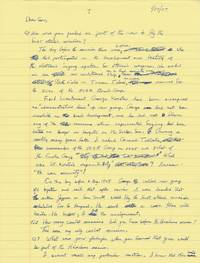
1945réf. 143931945. Jeppson Morris R. Autograph letter recounting his role in the Hiroshima atomic bombing mission written by the weapons test officer aboard the B 29 Enola Gay the aircraft that delivered the first atomic weapon used in warfare on 6 August 1945. Morris Jeppson served as the electronic officer responsible for the bomb's fuzing system and for arming the uranium bomb known as "Little Boy" shortly before it was released over Hiroshima. His recollections provide firsthand testimony concerning the selection of the mission crew the operational procedures followed aboard the aircraft and the technical responsibilities associated with the deployment of the atomic weapon during the closing days of World War II. Jeppson Morris R. Autograph Letter Signed. Three pages written on yellow lined paper composed as responses to a series of questions concerning the Hiroshima mission. The manuscript appears to be a draft with numerous corrections and annotations with both the questions and answers written in Jeppson's hand. Addressing how he was selected to fly on the mission Jeppson recounts: "The day before the mission there were 6 of us who had participated in the development and testing of the electronic fuzing system for atomic weapons. George called our group of 6 together and said it was decided that whether Jeppson or Lt. Leon Smith would fly the first mission scheduled for 6 August. He said a coin toss will decide. He tossed I got the assignment." When asked about his role aboard the aircraft Jeppson describes assisting Captain William Parsons in preparing the weapon after takeoff and monitoring the bomb's electronic fuzing system during the flight. He explains that shortly before the bombing run he entered the bomb bay and "replaced an electrical component plug in the bomb with a red coded plug that armed the bomb so that it would self detonate when it reached an elevation above ground of about 1800 feet." The letter concludes with reflections on the mission's perceived outcome noting that the detonation confirmed the operational success of the weapon's design. The Hiroshima bombing represented the first combat use of nuclear weapons and marked a decisive technological and political turning point at the end of World War II. Personnel involved in the Manhattan Project and the 509th Composite Group later became central witnesses to the development and deployment of atomic weapons. Jeppson's manuscript responses offer detailed technical and personal recollections concerning the operational procedures aboard the Enola Gay including the late decision to arm the weapon in flight and the responsibilities assigned to the crew members who developed the bomb's electronic fuzing system. The document provides insight into the internal mechanics of the Hiroshima mission as remembered by the officer who physically armed the weapon shortly before its release. Signed "Morris R. Jeppson" in a different pen. Light handling wear; overall excellent condition. A detailed firsthand account of the technical preparation and execution of the first atomic bombing mission. unknown