Theodore Van Kirk; Hiroshima Atomic BombBiblio.com
1.061 resultados
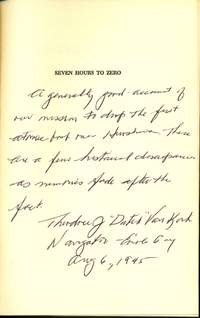
1945ref. 114571945. Marx Joseph L. Seven Hours to Zero. 1967 account of the planning and execution of the atomic bombing of Hiroshima containing a signed annotation by Theodore J. "Dutch" Van Kirk navigator of the B 29 bomber Enola Gay. The book addresses the events leading to the United States' use of atomic weapons against Japan on August 6 1945 the mission that introduced nuclear warfare into modern military history and contributed directly to the end of the Second World War in the Pacific. Van Kirk one of the three principal crew members aboard the aircraft that delivered the uranium bomb over Hiroshima inscribed the title page with a critical assessment of the narrative: "A generally good account of our mission to drop the first atomic bomb over Hiroshima. There are a few historical discrepancies as memories fade after the fact. Theodore J 'Dutch' Van Kirk Navigator Enola Gay August 6 1945." The inscription provides a firsthand comment by a participant whose navigational calculations guided the aircraft to its target during the mission. Marx Joseph L. Seven Hours to Zero. New York: Putnam 1967. Signed commentary by Theodore J. "Dutch" Van Kirk on the title page. Hardback with dust jacket. The volume presents a narrative reconstruction of the hours leading to the Hiroshima bombing and the military planning undertaken by the United States Army Air Forces during the closing phase of the Pacific War. Van Kirk's handwritten note identifies his role as navigator of the Enola Gay and directly addresses the historical accuracy of the work. The Hiroshima mission represented a turning point in twentieth century military and political history demonstrating the destructive capacity of nuclear weapons and initiating the nuclear age that shaped Cold War international relations. Theodore J. "Dutch" Van Kirk served as navigator under pilot Paul W. Tibbets and bombardier Thomas Ferebee during the mission determining the flight path that brought the aircraft over Hiroshima on the morning of August 6 1945. Inscribed copies of historical works by individuals directly involved in the atomic bombing provide documentary testimony from participants whose recollections and interpretations continue to influence debates over nuclear warfare military decision making and the closing stages of the Second World War. Light handling wear to dust jacket and boards consistent with age. Overall condition very good. unknown
1945ref. 117821945. Van Kirk Theodore J. "Atomic Bomb Explosion Over Hiroshima" signed statement recounting the August 6 1945 atomic bombing mission documents direct eyewitness testimony from the navigator of the Enola Gay the aircraft that delivered the first atomic bomb used in warfare. The document supports research into World War II air operations atomic warfare and firsthand participant narratives of the Hiroshima mission. As navigator Van Kirk occupied a central operational role in the execution of the flight and his account provides detailed observational evidence of the bombing sequence targeting and immediate visual aftermath. Van Kirk Theodore J. Signed statement titled "Atomic Bomb Explosion Over Hiroshima." 1 page. The typed document includes handwritten corrections and additions in blue ink by Van Kirk including the insertion "Over Hiroshima" in the title. The narrative records precise operational timing and targeting details stating: "Our plane was over Hiroshima at 0815 hours. The bomb fell away from the aircraft at 0915:17 Tinian time. It hit right on target on the Aioi Bridge in Hiroshima." Van Kirk further describes the visual effects immediately following detonation: "The first thing we saw was a big white cloud. It was probably 40000 feet already and around the base of that cloud the entire city of Hiroshima was covered with smoke and dust and you couldn't observe a thing down there." The statement also includes reflective commentary on the mission's intended strategic purpose noting pilot Paul Tibbets' assertion that the weapon could "shorten or end the war." Signed in full "Theodore J 'Dutch' Van Kirk." The document originates from one of the most consequential military actions of the twentieth century the atomic bombing of Hiroshima which marked the introduction of nuclear weapons into warfare and directly preceded Japan's surrender. As a participant-generated account it offers primary evidence of crew understanding mission execution and immediate perception of the bomb's effects complementing official military records and later historical analyses. The inclusion of precise times named targets and observational detail enhances its value for reconstructing the operational chronology of the mission. Light handling wear; otherwise well-preserved with clear text and signature. Overall very good condition. unknown
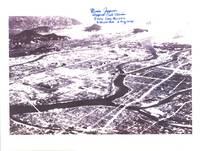
1976ref. 125641976. Jeppson Morris signed photograph of Hiroshima after the August 6 1945 atomic bombing linking the physical destruction of the city to a member of the Enola Gay mission crew. Jeppson served as assistant weaponeer aboard the B 29 and had responsibility for weapons testing and arming procedures associated with the "Little Boy" atomic bomb; shortly before the aircraft reached Hiroshima he removed its safety devices and inserted the arming plugs. The photograph therefore combines a post bombing view of Hiroshima with the autograph and mission identification of a participant directly involved in preparing the weapon for use. Black and white photograph 11 x 8 1/2 inches showing the devastated Hiroshima landscape after the atomic bombing. Few structures remain visible beyond foundations and other remnants while burned tree trunks stand amid the cleared terrain. Jeppson has signed and inscribed the image "Morris Jeppson - Weapons Test Officer - Enola Gay Mission- Hiroshima-6 Aug 1945" explicitly identifying his role aircraft target and mission date. The Enola Gay dropped the first atomic weapon used in combat over Hiroshima on August 6 1945. Jeppson's inscription gives the image direct association with the mission and preserves his own description of his position as "Weapons Test Officer" while contemporary institutional histories also identify him as assistant weaponeer to Captain William S. Parsons. The visible destruction provides a stark record of the consequences of the bombing while Jeppson's signed identification connects that aftermath to the personnel responsible for carrying and arming the weapon. Condition not stated. unknown
1945ref. 129721945. Field Marshall III publisher. The Chicago Sun August 7 1945 documents the first full day of American press coverage following the atomic bombing of Hiroshima and the sudden public disclosure of the secret wartime program that produced the weapon. The United States dropped the uranium bomb "Little Boy" on Hiroshima on August 6 and President Harry S. Truman announced its use the same day disclosing the existence of the atomic bomb and declaring that the release of atomic energy opened a new era in humanity's understanding of natural forces. The issue is particularly significant for showing how a mass-circulation American newspaper initially presented the bomb through three interconnected narratives: the destructive results of atomic science the formerly secret industrial infrastructure of the Manhattan Project and expectations for the peacetime uses of atomic power. It provides primary-source evidence for the study of Hiroshima World War II journalism the public revelation of the Manhattan Project nuclear technology and the opening of the atomic age. The Chicago Sun. Chicago: The Chicago Sun Tuesday August 7 1945. 22 pages printed recto and verso. Complete issue. The front page contains extensive atomic-bomb coverage including "Story of Our Secret Weapon"; "Scientists Tell Of Watching First Blast. Steel Tower is Vaporized; Cloud Rises 8 Miles"; and "Truman Visions New Era Powered by Atomic Force." A large photograph depicts an atomic-production facility at the Clinton Engineer Works at Oak Ridge Tennessee giving readers a first visual introduction to part of the immense industrial system that had operated under wartime secrecy. The Clinton Engineer Works served as the Manhattan Project's administrative headquarters and contained the K-25 S-50 and Y-12 facilities used in uranium-isotope separation; enriched uranium produced at Oak Ridge contributed directly to the Hiroshima weapon. The juxtaposition of the first atomic test industrial production Hiroshima and Truman's predictions for atomic energy illustrates how quickly American newspapers began constructing a public explanation for technology that had remained secret throughout most of the war. The August 7 date gives the issue considerable documentary immediacy: American readers were encountering the scale scientific origins industrial production and possible future applications of atomic energy almost simultaneously with learning of its use against a populated city. Truman's August 6 statement itself moved rapidly between military destruction and predictions that atomic energy might eventually supplement coal oil and hydroelectric power a dual framing closely echoed by the headlines preserved here. Oak Ridge's appearance on the front page is equally significant because the sprawling Tennessee installation had been created under extraordinary secrecy beginning in 1942 and encompassed several parallel processes for uranium enrichment. Light age toning and spotting with slight wear to edges; otherwise complete and well preserved. Very good. An unusually immediate newspaper record of the transition from a secret wartime weapons program to a publicly recognized atomic age published one day after Hiroshima and preserving the first explanations offered to American readers of the bomb its production and its anticipated consequences. unknown
1945ref. 107541945. Van Kirk Theodore J. "Dutch." Signed photograph of the Enola Gay documenting the B 29 Superfortress used in the first atomic bombing in warfare and bearing an inscription by its navigator. Van Kirk served as navigator aboard the B 29 Enola Gay during the August 6 1945 bombing of Hiroshima guiding the aircraft during its flight from Tinian to Japan and its return. The image supports research into World War II aviation the Manhattan Project atomic warfare and the commemorative culture through which mission participants later identified and interpreted the aircraft. The National WWII Museum confirms Van Kirk's position as navigator aboard the Enola Gay. Color photographic image of the Enola Gay undated. 6 by 12 inches. The aircraft is the primary subject although its viewpoint setting markings and whether it is shown in flight or on the ground are not specified in the supplied description. Van Kirk has inscribed the photograph in blue ink: "To recipient - best wishes and thanks - Dutch Van Kirk Navigator - Enola Gay Gang 6 Aug. 1945." The personalized salutation and informal phrase "Enola Gay Gang" identify the photograph as a later commemorative presentation rather than a contemporaneously inscribed wartime image. On August 6 1945 the Enola Gay departed Tinian carrying the uranium bomb known as "Little Boy" and released it over Hiroshima initiating the use of nuclear weapons in war. The aircraft and its crew subsequently became central to competing historical interpretations of military necessity civilian destruction technological change and the beginning of the atomic age. Van Kirk's full mission inscription connects the pictured aircraft directly to the navigator responsible for plotting its course and records the date through the language of a surviving participant. Blue-ink inscription remains bold and legible; no defects are reported. Near fine. A personally inscribed aircraft portrait joining the material history of the Enola Gay with the later commemoration of the Hiroshima mission. unknown
1945ref. 125531945. Van Kirk Theodore J. handwritten autograph letter signed 6 August 1945 provides a first-person account by the navigator of the B-29 Enola Gay addressing the operational risks of deploying the first atomic bomb and the crew's reaction to the magnitude of its detonation over Hiroshima. As navigator on the aircraft that carried out the 6 August 1945 mission Van Kirk 1921-2014 bore responsibility for the precise calculations necessary to deliver an unprecedented weapon under combat conditions. This manuscript supports research into World War II strategic air warfare the operational uncertainties surrounding the Manhattan Project's first use in combat and the technological anxieties inherent in deploying a weapon whose destructive capacity exceeded prior experience. His reflections illuminate both mechanical vulnerability and the psychological shock experienced by participants at the dawn of nuclear warfare. Van Kirk Theodore J. 6 August 1945. Two pages. Approximately 8.5 x 11 inches. In this holograph letter written in question-and-answer format Van Kirk considers the potential for catastrophic malfunction: "Could something have gone wrong during the flight or when the bomb was launched Of course - all kinds of things. We all know what can go wrong with airplanes even during pastime flying. The bomb could 'hang up' in the bomb bay and not launch cleanly. Therefore it would not fall as predicted and if not could cause damage or destroy the plane." Reflecting on the detonation itself he acknowledges: "Were the crew members surprised at the extent of the explosion Yes. The explosion was much greater than the test in New Mexico and much bigger than any of us could realize." He signs "Theodore J Van Kirk / Navigator - Enola Gay / 6 Aug. 1945." The manuscript preserves his language emphasizing both the technical fragility of the mission and the unforeseen scale of the weapon's destructive force compared to the Trinity test. Although composed retrospectively and dated to the day of the mission the letter contributes to the documentary record of how participants later described the uncertainties surrounding the first atomic combat deployment. Van Kirk's acknowledgment that the explosion exceeded expectations underscores the limited empirical frame of reference available even to trained officers briefed on the weapon's development. His discussion of bomb bay malfunction and aircraft vulnerability highlights the intersection of conventional aviation risk and revolutionary weapons technology in August 1945. Minor edge wear and light handling creases; ink strong and fully legible; paper clean. Overall very good to near fine condition. A substantive self-authored reflection on mechanical peril and the unprecedented scale of the first atomic explosion in warfare. unknown
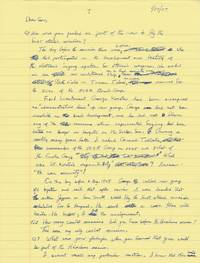
1945ref. 143931945. Jeppson Morris R. Autograph letter recounting his role in the Hiroshima atomic bombing mission written by the weapons test officer aboard the B 29 Enola Gay the aircraft that delivered the first atomic weapon used in warfare on 6 August 1945. Morris Jeppson served as the electronic officer responsible for the bomb's fuzing system and for arming the uranium bomb known as "Little Boy" shortly before it was released over Hiroshima. His recollections provide firsthand testimony concerning the selection of the mission crew the operational procedures followed aboard the aircraft and the technical responsibilities associated with the deployment of the atomic weapon during the closing days of World War II. Jeppson Morris R. Autograph Letter Signed. Three pages written on yellow lined paper composed as responses to a series of questions concerning the Hiroshima mission. The manuscript appears to be a draft with numerous corrections and annotations with both the questions and answers written in Jeppson's hand. Addressing how he was selected to fly on the mission Jeppson recounts: "The day before the mission there were 6 of us who had participated in the development and testing of the electronic fuzing system for atomic weapons. George called our group of 6 together and said it was decided that whether Jeppson or Lt. Leon Smith would fly the first mission scheduled for 6 August. He said a coin toss will decide. He tossed I got the assignment." When asked about his role aboard the aircraft Jeppson describes assisting Captain William Parsons in preparing the weapon after takeoff and monitoring the bomb's electronic fuzing system during the flight. He explains that shortly before the bombing run he entered the bomb bay and "replaced an electrical component plug in the bomb with a red coded plug that armed the bomb so that it would self detonate when it reached an elevation above ground of about 1800 feet." The letter concludes with reflections on the mission's perceived outcome noting that the detonation confirmed the operational success of the weapon's design. The Hiroshima bombing represented the first combat use of nuclear weapons and marked a decisive technological and political turning point at the end of World War II. Personnel involved in the Manhattan Project and the 509th Composite Group later became central witnesses to the development and deployment of atomic weapons. Jeppson's manuscript responses offer detailed technical and personal recollections concerning the operational procedures aboard the Enola Gay including the late decision to arm the weapon in flight and the responsibilities assigned to the crew members who developed the bomb's electronic fuzing system. The document provides insight into the internal mechanics of the Hiroshima mission as remembered by the officer who physically armed the weapon shortly before its release. Signed "Morris R. Jeppson" in a different pen. Light handling wear; overall excellent condition. A detailed firsthand account of the technical preparation and execution of the first atomic bombing mission. unknown
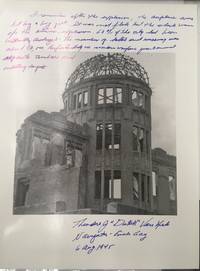
1945ref. 127381945. Van Kirk Theodore J. signed and inscribed photograph of the Hiroshima Atomic Dome created post-1945 represents a direct visual and textual reflection by the navigator of the B-29 Enola Gay on the devastation wrought by the first atomic bomb used in warfare. Theodore "Dutch" Van Kirk 1921-2014 responsible for navigation during the 6 August 1945 mission from Tinian here annotates an image of the ruined cityscape transforming a documentary photograph into a vehicle for personal recollection and justification. The item supports research into World War II memory culture strategic bombing doctrine and the ways in which atomic bomb participants publicly framed civilian casualties and the ethics of total war in subsequent decades. Van Kirk Theodore J. Inscribed photograph. 8 ½ x 11 inches. Black-and-white photograph depicting the Hiroshima Atomic Dome standing amid surrounding devastation the skeletal structure isolated against a flattened urban landscape. In ink Van Kirk writes: "I remember after the explosion the airplane was hit with a big jolt It was not flak but the shock wave effect of an atomic explosion. 60% of the city had been instantly destroyed. The number of killed and missing was 80000. Unfortunately in modern warfare you cannot separate civilian and military targets. - Theodore J. 'Dutch' Van Kirk Navigator - Enola Gay 6 August 1945." The inscription combines operational memory-the shock wave striking the aircraft-with statistical casualty figures and a broader statement about the nature of twentieth-century warfare. Signed within the text. Produced decades after the event and dated to the day of the mission the photograph reflects the enduring historical reckoning with Hiroshima's destruction and the moral arguments advanced by those who carried out the bombing. Van Kirk's juxtaposition of physical sensation in the aircraft with quantified urban devastation links technical execution to human consequence while his statement regarding the inseparability of civilian and military targets situates the image within debates over strategic bombing and nuclear ethics. Minor surface wear and light handling marks; image clear with strong tonal contrast; inscription bold and fully legible. Overall very good to near fine condition. A significant inscribed image uniting one of the most recognizable architectural remnants of Hiroshima with a candid reflection by a principal participant in the first atomic bombing mission. unknown
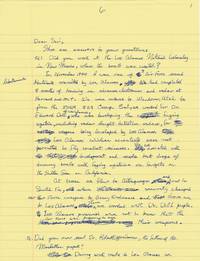
1945ref. 143891945. Jeppson Morris R. Autograph Letter Signed written after World War II a first person technical and eyewitness account by the weapons officer of the Enola Gay the B 29 aircraft that dropped the first atomic bomb on Hiroshima on 6 August 1945. As one of eight Army Air Forces second lieutenants recruited to support Los Alamos weapons development Jeppson occupied a rare operational position linking laboratory science to combat deployment. In the present two page letter written entirely in his hand in question and answer format he explains his recruitment after advanced electronics and radar training at Harvard and MIT and his assignment to the 509th Bomb Group at Wendover Utah. He describes working under Dr. Edward Doll of Los Alamos on the bomb's fuzing system including radar height detection noting that "Los Alamos civilian scientists were not permitted to fly combat missions" and recounts test drops of dummy bombs over the Salton Sea. His narrative situates him among the very small circle beyond senior scientists who understood the weapon's intended use as he was responsible for arming the fuzing system inside the bomb bay shortly before release over Hiroshima. Jeppson Morris R. Autograph Letter Signed. No place no date. Two pages on yellow lined paper written in ink signed "Sincerely Morris R. Jeppson." In response to a question about J. Robert Oppenheimer Jeppson recounts a May 1945 flight in which "The sole passenger was Dr. Oppenheimer. This very gracious man was smiling to visit with me and he answered my questions about where I should attend graduate school in nuclear physics after the war" recommending the University of California Berkeley. He emphasizes the strict compartmentalization of the Manhattan Project: "Because of very tight security restrictions neither of us ever mentioned nuclear weapons." The letter provides granular insight into the operational secrecy of the project the integration of military officers into laboratory development and the transition from experimental design to battlefield use at the close of World War II. Numerous corrections and annotations appear throughout reflecting careful retrospective clarification. Paper clean and fully legible signature strong. Overall condition: excellent. unknown
1945ref. 129771945. Hecht Selig. Explaining the Atom signed and inscribed by Theodore Van Kirk framing the atomic bombing of Hiroshima within a longer intellectual history of atomic theory and modern physics. As navigator of the Enola Gay during the August 6 1945 mission Van Kirk contributed directly to the operational execution of nuclear warfare and his inscription frames that event as the culmination of developments beginning with ancient atomism and extending through 20th-century scientific breakthroughs. By referencing figures such as Democritus and Einstein alongside the Manhattan Project the inscription integrates scientific theory with wartime application offering a condensed narrative linking philosophical origins of atomic thought to its realization in military technology. Hecht Selig. Explaining the Atom. New York: Viking Press 1947. 205 pages. Hardcover with dust jacket. Signed and extensively inscribed on the inside title page by Theodore Van Kirk. The inscription reads: "'Page 9; In 400 B.C. Deocritus theoryed the existence of atoms. In 1905 Einstein theorized E=MC squared. In 1943 Oppenheimer heads the Manhattan Project. In 1945 our 'Enola Gay' crew drops the atomic bomb on Hiroshima - Theodore 'Dutch' Van Kirk Navigator - Enola Gay August 6 1945." The text presents a chronological sequence of scientific and historical developments culminating in Van Kirk's own role in the Hiroshima mission. Published in the immediate postwar period Explaining the Atom aimed to make atomic science accessible to a broad audience at a time when nuclear technology had reshaped global politics and warfare. Van Kirk's inscription reflects how participants in the atomic mission interpreted their actions within a broader scientific and historical continuum linking abstract theory to its most consequential application. The juxtaposition of popular scientific exposition with firsthand annotation from a mission participant offers a layered artifact for the study of nuclear history scientific communication and the integration of intellectual and military developments in the mid-20th century. Dust jacket shows moderate wear; volume itself remains clean and well-preserved with strong legible inscription. Overall very good. unknown
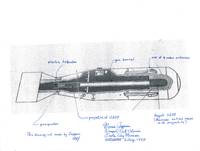
1945ref. 125791945. Jeppson Morris annotated "Little Boy" atomic bomb diagram signed in reference to the Hiroshima mission of August 6 1945 documents firsthand technical interpretation of the first nuclear weapon used in war. The sheet holds historical value for the study of the Manhattan Project atomic weapons deployment and the operational knowledge carried by members of the Enola Gay crew. Jeppson's role as Weapons Test Officer gives the document particular importance since the annotations do not merely identify the bomb after the fact but explain its mechanism from the perspective of a participant directly involved in its wartime use. Jeppson Morris. Annotated diagram of "Little Boy." 1 page. Black and white printed diagram with extensive handwritten notations and signature. The diagram shows the internal arrangement of the bomb's major components with Jeppson adding arrows and manuscript labels identifying the "target U235" the "projectile 235" the "electric detonator" the "gun barrel" and "one of 4 radar antennas." He further explains the bomb's operation in functional terms noting where the uranium projectile would strike and that it "Becomes critical mass with projectile." Signed at the bottom "Morris Jeppson / Weapon Test Officer / Enola Gay Mission / HIROSHIMA 6 Aug. 1945." The notations transform the printed diagram into a participant-marked technical document linking design terminology and mission-specific memory. The document is tied directly to the bombing of Hiroshima the event that introduced nuclear warfare and altered the political and military history of the twentieth century. Its interpretive value lies in the combination of technical content and eyewitness association: the sheet preserves not only a schematic of the bomb itself but also the language used by a mission participant to explain how the weapon functioned. That combination makes it useful for examining how atomic technology was understood by military personnel at the point where scientific development and combat deployment converged. Minor handling wear; otherwise well-preserved with clear manuscript annotations and signature. Overall very good condition. unknown
1945ref. 125471945. Van Kirk Theodore J. handwritten autograph letter signed 6 August 1945 offers a first-person reflection by the navigator of the B-29 Enola Gay on the most perilous moments of the Hiroshima atomic bombing mission and the psychological atmosphere aboard the aircraft. Theodore "Dutch" Van Kirk 1921-2014 a central member of the three-man flight deck crew provides direct testimony concerning the uncertainty surrounding the bomb's force and the crew's fear that the detonation might destroy their own plane. The letter supports research in World War II military aviation the operational history of the Manhattan Project and the lived experience of nuclear warfare from the American aircrew perspective. By fore grounding danger doubt and immediate reaction Van Kirk's account contributes to the documentary record of how participants later interpreted the unprecedented destructive power they helped unleash. Van Kirk Theodore J. 6 August 1945. Two pages. Approximately 8.5 x 11 inches. In this holograph letter written in question-and-answer format Van Kirk records: "What do you think was the most dangerous moment during the mission Undoubtedly the seconds when and right after the bomb exploded. The question was 'will the bomb blow up or severely damage the airplane.' Thankfully we got far enough away so this did not happen." Addressing crew morale he continues: "Were your fellow crew members anxious about carrying out the mission There was some doubt in everyone's mind about the force of the bomb. Would it damage or even destroy the plane. I was all assuaged the moment the bomb exploded." He signs "Theodore J 'Dutch' Van Kirk / Navigator - Enola Gay / 6 Aug 1945." The manuscript preserves his phrasing and emphasis underscoring both technical calculation and personal apprehension at the moment nuclear warfare entered combat history. Although composed retrospectively and dated to the mission itself the letter reflects the sustained historical reckoning with the atomic bombings and the strategic doctrine that followed. Van Kirk's language centers not on political justification but on immediate survival revealing the acute awareness among crew members that the weapon's effects were not fully predictable even to those tasked with delivering it. Such testimony is especially significant given that only a small number of crew members had direct visual access to the detonation and experienced the shock wave firsthand. Light handling wear and minor edge creasing; ink bold and fully legible; paper clean. Overall very good to near fine condition. A substantive and self-authored statement documenting the perceived mortal risk faced by the Enola Gay crew at the threshold of the nuclear age. unknown
1945ref. 121191945. Van Kirk Theodore "Dutch." Signed poster reproducing the navigator's log of the Enola Gay mission to Hiroshima documenting the flight chronology of the first atomic bombing used in warfare on August 6 1945. Van Kirk served as navigator aboard the B-29 commanded by Paul Tibbets and recorded the aircraft's route from Tinian Island to Japan and its return to base. By presenting successive navigational entries-including the notation "BOMB AWAY"-the poster provides a reproduced documentary account of the mission that initiated the nuclear age and supports research into World War II aviation the Manhattan Project atomic warfare and the continuing historical and ethical study of Hiroshima. The National WWII Museum identifies Van Kirk as the Enola Gay's navigator and preserves his oral testimony concerning the mission. Flight Log of the Enola Gay Atomic Bomb Mission to Hiroshima. Signed by Theodore "Dutch" Van Kirk. Publisher place date and dimensions not specified. The poster reproduces three pages of navigational-log entries progressing from takeoff through the aircraft's return to Tinian. Recorded events include the B-29's departure at 0245 Tinian time navigation toward Iwo Jima and the Japanese home islands and "BOMB AWAY" at 0915 corresponding to 0815 in Hiroshima. The Nuclear Museum records the surviving log as beginning shortly after the 0245 takeoff and concluding with the aircraft's landing at 1458 with all entries given in Tinian time. Van Kirk signed the poster in full in blue ink. The supplied description states that the reproduced pages were handwritten by Van Kirk but the poster itself should be distinguished clearly from the original August 6 1945 navigational log. The original log was offered by Heritage Auction Galleries in October 2007 with an estimate of $350000 to $400000 and realized $358500. Heritage described it as the log retained by Van Kirk after the mission and consigned directly by him while the present object is a later commemorative reproduction carrying his autograph. Its sequence of times and positions makes the poster a concise visual record of the operational stages through which the mission proceeded while Van Kirk's signature connects the reproduction directly to the airman responsible for navigation. Blue-ink signature and reproduced log images remain clear; no defects are reported. Near fine. A signed commemorative document presenting the flight chronology of the Enola Gay through the recorded observations of its navigator. unknown
2010ref. DADAX0739135570Lexington Books 2010-04-12. paperback. New. 6.32x0.59x9.38. Buy with confidence. Excellent Customer Service & Return policy. Lexington Books paperback
1979ref. BN620110Basic Books 1979. 1979. Hardcover. Hiroshima and Nagasaki : the Physical Medical and Social Effects of the Atomic Bombings Hiroshima and Nagasaki : the Physical Medical and Social Effects of the Atomic Bombings The Committee for the Compilation of Materials on Damage Caused by the Atomic Bombs in Hiroshima and Nagasaki. Basic Books hardcover
2020ref. BN676814De Gruyter 2020. 2020. Applications in Rigorous Quantum Field Theory De Gruyter Studies in Mathematics 34/2 Band 2 Applications in Rigorous Quantum Field Theory De Gruyter Studies in Mathematics 34/2 Band 2 Lörinczi József and Fumio Hiroshima De Gruyter unknown
ref. 030644531X.Ghardcover. Good. Access codes and supplements are not guaranteed with used items. May be an ex-library book. hardcover
1957ref. 56750Nagasaki Japan: Kawano Miwa June 1st Showa 32 1957. 8vo. 164 4 pp. Red cloth gilt lettering in Japanese on front cover & spine faint tidemark on upper front & back covers minor shelfwear still VG- copy inscribed by the author on ffep. to Mrs. Hildreth July 5 1959 w/ tipped-in typed note about the work. First edition of this exceedingly scarce personal memoir recounting the author’s experiences and survival of the dropping of the Atomic Bomb on Hiroshima in 1945 at the end of World War II. Kawano b. 1918 was originally a student at Doshisha University Theology Dept. and forced to leave school due to illness was inducted into the Japanese Army in Manchuria and after his discharge studied medicine at Nagasaki Medical University. While working as a medical student in Hiroshima at the time he received burns and severe radiation exposure from the blast. Subsequently he devoted himself to the medical treatment and relief of the injured in Hiroshima and Nagasaki and by 1958 was in the first class of neurosurgery residents at the Oregon School of Medicine now OHSU under Prof. George Austin. He later returned to Nagasaki in 1960 to found the Department of Neurosurgery in the Nagasaki University School of Medicine which had been entirely destroyed in 1945 by the Nagasaki Atomic Bomb drop. The campus had been located less than half a mile from the epicenter of the explosion with the entire facility reduced to ashes by the blast. Kawano devoted his considerable skills to studying the nuclear blast survivors including papers on Whiplash Injury and Headache 1967 study of Post-traumatic Chronic Headache 1965; 1968 changes in the capillaries in the Great Occipital Nerve as well as the increase of Cerebral Aneurysms 1963. No copies located in Worldcat or the National Diet Library; See: Hayashi Ushijima Matsuo Kitagawa Suyama & Nagata The 150th Anniversary of Nagasaki University School of Medicine: Recovery From the Atomic Disaster and Evolution of the Department of Neurosurgery Nagasaki University’s Academic Output Site Congress of Neurological Surgeons 2009. Kawano Miwa, hardcover
ref. 37672550-nnew. unknown
ref. 33622150-nnew. unknown
1946ref. 46889HMSO for Home Office and Air Ministry 1946. 8vo. First Edition with 24 plates on 12; original printed wrappers wire-stitched as issued wrappers lightly browned else a near fine copy. The first publicly available account in the UK. Particular consideration was given to the comparative resilience of UK defence measures. SCARCE. HMSO [for] Home Office and Air Ministry, unknown
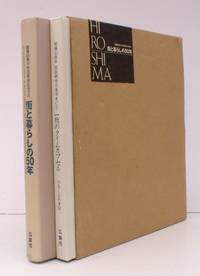
1996ref. 32567Hiroshima 1996. 2 vols. roy. 4to. First Edition text in Japanese Main Volume with many hundreds of coloured and monochrome photographs a number folding in the text CD Portfolio with coloured illustrated booklet and CD in oyster case; Main Volume in brown cloth upper board and backstrip lettered in blue CD Portfolio in white boards both volumes housed in publisher's card slip-case a near fine copy. SCARCE. Hiroshima, hardcover
1955ref. 374722World Assembly for Peace Helsinki 1955. Pamphlet. Good Condition. 5 pages. Unstapled pamplet as issued. Size: 18 x 26 cms. Category: Varied Books; Atomic & Nuclear. This item may require more postage than the rates shown for delivery outside the UK. If extra postage is required we will contact you before processing your order and you will be given the details and option to decline the extra cost. World Assembly for Peace unknown
ref. 53231089like new. unknown
ref. 37672550like new. unknown