1,307 results
2015ref. 2090202120412981Hiroshima Museum of Art 2015. Soft Cover. Fine. Number of books: 1 Hiroshima Museum of Art paperback
1985ref. 42354Berlin, Verlag Volk und Welt, 1968, 1970, 1985. 158, 112, 145, 143 Seiten , 19 cm, kartoniert
1996ref. 2090202120416010Hometown Hiroshima 21st Century Village Development School 1996. Soft Cover. Fine. Number of books: 1 Hometown Hiroshima 21st Century Village Development School paperback
1985Mm 130x210 Brossura originale di pp. 230 con 16 tavole b/n. Fioriture esclusivamente ai tagli e all'antiporta. Opera in buone condizioni. SPEDIZIONE IN 24 ORE DALL'ORDINE.
1952ref. 2090202120414216Kan'non koko 1952. Soft Cover. Fine. Number of books: 1 Kan'non koko paperback
1992ref. 2090202120409674Chugoku Shimbun 1992. Soft Cover. Fine. Number of books: 1 Chugoku Shimbun paperback
2009ref. 2080202102706853Nonburu-sha 2009. Soft Cover. Fine. Page size: 61 pages Size: A5 size Nonburu-sha paperback
2011ref. 2080202102706534Nonburu-sha 2011. Soft Cover. Fine. Page size: 60 pages Size: A5 size Nonburu-sha paperback
2010ref. 2080202102707189Nonburu-sha 2010. Soft Cover. Fine. Page size: 60 pages Size: A5 size Nonburu-sha paperback
1983ref. 2090202120407308Hiroshima City 1983. Soft Cover. Fine. Number of books: 1 Hiroshima City paperback
19948vo., First Edition; blue cloth, gilt back, a fine copy in unclipped dustwrapper. Declared unfit for active service, he reported the Battle of Normandy, the Liberation of Paris, the Battle of the Bulge, Kamikaze attacks on the British Pacific Fleet and Hiroshima.
2026ref. x-1032893141Taylor & Francis Ltd 2026. Paperback. New. 154 pages. 6.14x0.35x9.21 inches. Taylor & Francis Ltd paperback
1995ref. 2090202120406280Hiroshima City 1995. Soft Cover. Fine. Number of books: 1 Hiroshima City paperback
1992ref. 2092902137405482Gijutsu to ningen 1992. Soft Cover. Fine. Number of books: 1 book Gijutsu to ningen paperback
1959ref. 28869Frankfurt a. M., Berlin, Bonn, Verlag Moritz Diesterweg, 1959. 70 Seiten , 23 cm, kartoniert
1954ref. 2090502113702680Not Available 1954. Soft Cover. Fine. The book is in fine condition. Not Available paperback
1965ref. 2083002116201061Asahi Shoin Tsutomu Harada Hiroshima 1965. Soft Cover. Fine. The book is in fine condition. Asahi Shoin Tsutomu Harada (Hiroshima) paperback
1981ref. 2090202120415662Hiroshima Atomic Bomb Victims Association 1981. Soft Cover. Fine. Number of books: 1 Hiroshima Atomic Bomb Victims Association paperback
2009ref. 2090202120401168Hiroshima Keizai University Library 2009. Soft Cover. Fine. Number of books: 1 Hiroshima Keizai University Library paperback
ref. 2111902158405897Domesu shuppan N.A. Soft Cover. Fine. Size: 19cm B6 Domesu shuppan paperback
1989ref. 2090202120413761Domesu shuppan 1989. Soft Cover. Fine. Number of books: 1 Domesu shuppan paperback
1945ref. 221391945. Editor unknown. Atlanta Journal August 6 1945 records the first American newspaper cycle responding to the atomic bombing of Hiroshima a military and political event that introduced nuclear weapons into warfare and reshaped the final phase of World War II. The issue supports research into wartime journalism anti-Japanese racial language in the American press home-front reception of nuclear warfare and the public announcement of the atomic age; Hiroshima was bombed on August 6 1945 and President Truman's statement described the bomb as having "more power than 20000 tons of T.N.T." Atlanta Journal. Atlanta Georgia. August 6 1945. Final Home Edition. Number of pages and size not stated. Front-page headlines include "Atomic Power Bomb Loosed on Jap Cities" "Death Charge Equals 20000 Tons of TNT" and "Japs Fail to Scratch New Hornet in Terrific 14-month War Cruise." The headlines preserve the immediacy of American reporting on Hiroshima as well as the racialized wartime language used in mainstream newspapers during the Pacific War. General handling wear good overall. A same-day Southern newspaper issue documenting how the first use of atomic warfare entered American public consciousness through mass-circulation news. unknown
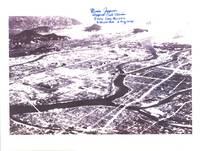
1976ref. 125641976. Jeppson Morris signed photograph of Hiroshima after the August 6 1945 atomic bombing linking the physical destruction of the city to a member of the Enola Gay mission crew. Jeppson served as assistant weaponeer aboard the B 29 and had responsibility for weapons testing and arming procedures associated with the "Little Boy" atomic bomb; shortly before the aircraft reached Hiroshima he removed its safety devices and inserted the arming plugs. The photograph therefore combines a post bombing view of Hiroshima with the autograph and mission identification of a participant directly involved in preparing the weapon for use. Black and white photograph 11 x 8 1/2 inches showing the devastated Hiroshima landscape after the atomic bombing. Few structures remain visible beyond foundations and other remnants while burned tree trunks stand amid the cleared terrain. Jeppson has signed and inscribed the image "Morris Jeppson - Weapons Test Officer - Enola Gay Mission- Hiroshima-6 Aug 1945" explicitly identifying his role aircraft target and mission date. The Enola Gay dropped the first atomic weapon used in combat over Hiroshima on August 6 1945. Jeppson's inscription gives the image direct association with the mission and preserves his own description of his position as "Weapons Test Officer" while contemporary institutional histories also identify him as assistant weaponeer to Captain William S. Parsons. The visible destruction provides a stark record of the consequences of the bombing while Jeppson's signed identification connects that aftermath to the personnel responsible for carrying and arming the weapon. Condition not stated. unknown
1945ref. 193451945. Van Kirk Theodore "Dutch." Signed poster reproducing the navigator's log of the August 6 1945 Enola Gay mission documents the flight that delivered the first atomic bomb used in warfare. Van Kirk served as navigator aboard the B-29 plotting the aircraft's course from North Field on Tinian to Hiroshima and back during a mission that initiated the wartime use of nuclear weapons and transformed military strategy international relations and public understanding of technological destruction. The National Museum of the United States Air Force records that the Enola Gay departed at 2:45 a.m. and released the uranium bomb known as "Little Boy" over Hiroshima later that morning. The poster provides a signed visual chronology for the study of World War II aviation operational navigation the Manhattan Project and the beginning of the nuclear age. Hiroshima Mission Navigator's Log of the Enola Gay. Issuer place and date of printing not identified. Poster reproducing three manuscript pages entirely in Van Kirk's hand; dimensions not supplied. The successive entries trace the mission from takeoff through navigation toward Japan the bombing run and the aircraft's return to base. The log records the 0245 departure the turn onto a 345-degree heading and the climb to 30800 feet with "BOMB AWAY" entered at 0915. These operational notations reduce the mission to headings altitudes times and navigational actions preserving the procedural language by which the crew recorded an event of extraordinary human consequence. Signed at the bottom "Theodore J. 'Dutch' Van Kirk Navigator-Enola Gay Hiroshima Aug. 6 1945." Because the three manuscript pages are photographically or mechanically reproduced the poster should not be described as Van Kirk's original wartime log; only the concluding inscription and signature are represented as original autograph material. The Enola Gay's release of "Little Boy" over Hiroshima marked the first use of a nuclear weapon in war; the bomb detonated approximately 1800 feet above the city. The reproduced entries offer an operational perspective distinct from later narrative accounts showing how the navigator organized the mission through timed observations and course calculations while leaving the destruction below largely outside the log's technical vocabulary. No creasing staining fading tears or edge losses are identified; reproduced manuscript images and Van Kirk's signed inscription remain clear near fine. Signed commemorative record joining the navigator's minute-by-minute flight chronology with direct identification by the last surviving member of the Enola Gay crew. unknown
1945ref. 125481945. Van Kirk Theodore J. handwritten autograph letter signed 6 August 1945 provides a first-person account by the navigator of the B-29 Enola Gay addressing fears of blast damage and radiation exposure during the Hiroshima atomic bombing mission. As navigator on the aircraft that delivered the first deployed atomic weapon in warfare Van Kirk 1921-2014 occupied a critical operational role requiring precise calculations of speed altitude and distance to ensure both mission success and crew survival. This manuscript directly supports research into World War II strategic bombing the operational realities of the Manhattan Project and contemporary military understanding of radiation hazards at the moment nuclear weapons entered combat. His reflections reveal not only technical planning but also the limited scientific certainty conveyed to flight crews regarding the bomb's destructive and radiological effects. Van Kirk Theodore J. 6 August 1945. Two pages. Approximately 8.5 x 11 inches. In this holograph letter written in question-and-answer format Van Kirk addresses the risks anticipated by the crew: "Did you have any fears about the effects the atomic bomb would have on the Enola Gay and the crew Yes. The fact that the bombs shock waves might destroy or damage the airplane was a major concern." He recalls being advised by a scientist that "we think the airplane will be OK if you're 9 miles away when the bomb explodes" and explains that "it was to get speed and altitude - and therefore distance - that we stripped down our airplanes. We were 12 miles away when the bomb exploded." Regarding radiation he writes: "We were not greatly concerned. We were told that the mushroom shaped cloud was deadly radiation and to stay clear of it. Otherwise no equipment to protect from radiation. No crew members were affected." He signs "Sincerely / Theodore J 'Dutch' Van Kirk / Navigator - Enola Gay / 6 Aug. 1945." The manuscript preserves his phrasing underscoring the mixture of scientific briefing operational adaptation and residual uncertainty that characterized the mission. Composed retrospectively and dated to the day of the bombing the letter reflects how participants later articulated their understanding of radiation at a time when its long-term biological effects were not yet fully grasped by the broader public or as Van Kirk's statement suggests by operational crews. His emphasis on distance calculations and aircraft modification illustrates the intersection of scientific theory and practical military execution in August 1945 when strategic air power entered the nuclear age. The acknowledgment that no protective equipment was provided and that crews relied primarily on avoidance of the mushroom cloud contributes to the evidentiary record of early nuclear risk assessment within the U.S. Army Air Forces. Minor edge wear and light handling creases; ink strong and fully legible; paper clean. Overall very good to near fine condition. A substantive self-authored reflection on blast mechanics and radiation awareness at the inception of atomic warfare. unknown