1257 risultati
1998rif. 2519Hiroshima Japan: Hiroshima City Museum of Contemporary Art 1998. 8.25" x 11.75" pp. 71 1 including multiple color illustrations from photography throughout text in the Japanese language. Illustrated blue wrappers are clean with very minor scuffing at corners. Text is crisp and bright. Very good. Catalog from the 5th annual Hiroshima Art Competition where artists using various mediums compete to capture the "Spirit of Hiroshima. Hiroshima City Museum of Contemporary Art unknown
1970rif. 2083002115705277Not Available 1970. Soft Cover. Fine. Number of books: 1 book Not Available paperback
2010rif. 2090202120413367Soshi-sha 2010. Soft Cover. Fine. Number of books: 1 Soshi-sha paperback
2010rif. 2091502135419244Soshisha August Library 2010. Soft Cover. Fine. Number of books: 1 Soshisha August Library paperback
1993rif. 2090202120414674Masuda Yoichi 1993. Soft Cover. Fine. Number of books: 1 Masuda Yoichi paperback
2014rif. x-4036356305Kaiseisha. 2014. Tankobon Softcover. New. Japanese language. 7.32x5.12x0.63 inches. Kaiseisha. paperback
rif. 2091502135500805Not Available N.A. Soft Cover. Fine. The book is in fine condition. Not Available paperback
1991rif. 2090202120415179Not Available 1991. Soft Cover. Fine. Number of books: 1 Not Available paperback
1993rif. 2090202120412154Hiroshima Historical Museum 1993. Soft Cover. Fine. Number of books: 1 Hiroshima Historical Museum paperback
1990rif. 2090202120410576Takuyukai Tamaki 1990. Soft Cover. Fine. Number of books: 1 Takuyukai Tamaki paperback
1994rif. 2090202120410657Sankichi Toge Memorial Project Committee 1994. Soft Cover. Fine. Number of books: 1 Sankichi Toge Memorial Project Committee paperback
2012rif. 2090202120414818Liaison Conference of Hiroshima Prefecture Cultural Group 2012. Soft Cover. Fine. Number of books: 1 Liaison Conference of Hiroshima Prefecture Cultural Group paperback
1987rif. 2091202133203462Keisuisha 1987. Soft Cover. Fine. Number of books: 18 books in total Keisuisha paperback
1993rif. 2090202120415854Keisuisha 1993. Soft Cover. Fine. Number of books: 1 Keisuisha paperback
1988rif. 2090202120415245Keisuisha 1988. Soft Cover. Fine. Number of books: 1 Keisuisha paperback
2009rif. 2090202120403929Not Available 2009. Soft Cover. Fine. Number of books: 1 Not Available paperback
1980rif. KOS06300175TBD 1980. Soft Cover. Fine. KOS06300175 TBD paperback
1978rif. 2090202120406414Hiroshima City Board of Education 1978. Soft Cover. Fine. Number of books: 1 Hiroshima City Board of Education paperback
1982rif. 2090202120406700Published by Hiroshima City Board of Education 1982. Soft Cover. Fine. Number of books: 1 Published by Hiroshima City Board of Education paperback
1996rif. 2110502150311125Hiroshima Prefectural Cultural Property Research Center 1996. Soft Cover. Fine. Volume: 1 Hiroshima Prefectural Cultural Property Research Center paperback
1945rif. 221391945. Editor unknown. Atlanta Journal August 6 1945 records the first American newspaper cycle responding to the atomic bombing of Hiroshima a military and political event that introduced nuclear weapons into warfare and reshaped the final phase of World War II. The issue supports research into wartime journalism anti-Japanese racial language in the American press home-front reception of nuclear warfare and the public announcement of the atomic age; Hiroshima was bombed on August 6 1945 and President Truman's statement described the bomb as having "more power than 20000 tons of T.N.T." Atlanta Journal. Atlanta Georgia. August 6 1945. Final Home Edition. Number of pages and size not stated. Front-page headlines include "Atomic Power Bomb Loosed on Jap Cities" "Death Charge Equals 20000 Tons of TNT" and "Japs Fail to Scratch New Hornet in Terrific 14-month War Cruise." The headlines preserve the immediacy of American reporting on Hiroshima as well as the racialized wartime language used in mainstream newspapers during the Pacific War. General handling wear good overall. A same-day Southern newspaper issue documenting how the first use of atomic warfare entered American public consciousness through mass-circulation news. unknown
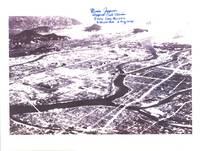
1976rif. 125641976. Jeppson Morris signed photograph of Hiroshima after the August 6 1945 atomic bombing linking the physical destruction of the city to a member of the Enola Gay mission crew. Jeppson served as assistant weaponeer aboard the B 29 and had responsibility for weapons testing and arming procedures associated with the "Little Boy" atomic bomb; shortly before the aircraft reached Hiroshima he removed its safety devices and inserted the arming plugs. The photograph therefore combines a post bombing view of Hiroshima with the autograph and mission identification of a participant directly involved in preparing the weapon for use. Black and white photograph 11 x 8 1/2 inches showing the devastated Hiroshima landscape after the atomic bombing. Few structures remain visible beyond foundations and other remnants while burned tree trunks stand amid the cleared terrain. Jeppson has signed and inscribed the image "Morris Jeppson - Weapons Test Officer - Enola Gay Mission- Hiroshima-6 Aug 1945" explicitly identifying his role aircraft target and mission date. The Enola Gay dropped the first atomic weapon used in combat over Hiroshima on August 6 1945. Jeppson's inscription gives the image direct association with the mission and preserves his own description of his position as "Weapons Test Officer" while contemporary institutional histories also identify him as assistant weaponeer to Captain William S. Parsons. The visible destruction provides a stark record of the consequences of the bombing while Jeppson's signed identification connects that aftermath to the personnel responsible for carrying and arming the weapon. Condition not stated. unknown
1945rif. 193451945. Van Kirk Theodore "Dutch." Signed poster reproducing the navigator's log of the August 6 1945 Enola Gay mission documents the flight that delivered the first atomic bomb used in warfare. Van Kirk served as navigator aboard the B-29 plotting the aircraft's course from North Field on Tinian to Hiroshima and back during a mission that initiated the wartime use of nuclear weapons and transformed military strategy international relations and public understanding of technological destruction. The National Museum of the United States Air Force records that the Enola Gay departed at 2:45 a.m. and released the uranium bomb known as "Little Boy" over Hiroshima later that morning. The poster provides a signed visual chronology for the study of World War II aviation operational navigation the Manhattan Project and the beginning of the nuclear age. Hiroshima Mission Navigator's Log of the Enola Gay. Issuer place and date of printing not identified. Poster reproducing three manuscript pages entirely in Van Kirk's hand; dimensions not supplied. The successive entries trace the mission from takeoff through navigation toward Japan the bombing run and the aircraft's return to base. The log records the 0245 departure the turn onto a 345-degree heading and the climb to 30800 feet with "BOMB AWAY" entered at 0915. These operational notations reduce the mission to headings altitudes times and navigational actions preserving the procedural language by which the crew recorded an event of extraordinary human consequence. Signed at the bottom "Theodore J. 'Dutch' Van Kirk Navigator-Enola Gay Hiroshima Aug. 6 1945." Because the three manuscript pages are photographically or mechanically reproduced the poster should not be described as Van Kirk's original wartime log; only the concluding inscription and signature are represented as original autograph material. The Enola Gay's release of "Little Boy" over Hiroshima marked the first use of a nuclear weapon in war; the bomb detonated approximately 1800 feet above the city. The reproduced entries offer an operational perspective distinct from later narrative accounts showing how the navigator organized the mission through timed observations and course calculations while leaving the destruction below largely outside the log's technical vocabulary. No creasing staining fading tears or edge losses are identified; reproduced manuscript images and Van Kirk's signed inscription remain clear near fine. Signed commemorative record joining the navigator's minute-by-minute flight chronology with direct identification by the last surviving member of the Enola Gay crew. unknown
1945rif. 125481945. Van Kirk Theodore J. handwritten autograph letter signed 6 August 1945 provides a first-person account by the navigator of the B-29 Enola Gay addressing fears of blast damage and radiation exposure during the Hiroshima atomic bombing mission. As navigator on the aircraft that delivered the first deployed atomic weapon in warfare Van Kirk 1921-2014 occupied a critical operational role requiring precise calculations of speed altitude and distance to ensure both mission success and crew survival. This manuscript directly supports research into World War II strategic bombing the operational realities of the Manhattan Project and contemporary military understanding of radiation hazards at the moment nuclear weapons entered combat. His reflections reveal not only technical planning but also the limited scientific certainty conveyed to flight crews regarding the bomb's destructive and radiological effects. Van Kirk Theodore J. 6 August 1945. Two pages. Approximately 8.5 x 11 inches. In this holograph letter written in question-and-answer format Van Kirk addresses the risks anticipated by the crew: "Did you have any fears about the effects the atomic bomb would have on the Enola Gay and the crew Yes. The fact that the bombs shock waves might destroy or damage the airplane was a major concern." He recalls being advised by a scientist that "we think the airplane will be OK if you're 9 miles away when the bomb explodes" and explains that "it was to get speed and altitude - and therefore distance - that we stripped down our airplanes. We were 12 miles away when the bomb exploded." Regarding radiation he writes: "We were not greatly concerned. We were told that the mushroom shaped cloud was deadly radiation and to stay clear of it. Otherwise no equipment to protect from radiation. No crew members were affected." He signs "Sincerely / Theodore J 'Dutch' Van Kirk / Navigator - Enola Gay / 6 Aug. 1945." The manuscript preserves his phrasing underscoring the mixture of scientific briefing operational adaptation and residual uncertainty that characterized the mission. Composed retrospectively and dated to the day of the bombing the letter reflects how participants later articulated their understanding of radiation at a time when its long-term biological effects were not yet fully grasped by the broader public or as Van Kirk's statement suggests by operational crews. His emphasis on distance calculations and aircraft modification illustrates the intersection of scientific theory and practical military execution in August 1945 when strategic air power entered the nuclear age. The acknowledgment that no protective equipment was provided and that crews relied primarily on avoidance of the mushroom cloud contributes to the evidentiary record of early nuclear risk assessment within the U.S. Army Air Forces. Minor edge wear and light handling creases; ink strong and fully legible; paper clean. Overall very good to near fine condition. A substantive self-authored reflection on blast mechanics and radiation awareness at the inception of atomic warfare. unknown
1945rif. 107541945. Van Kirk Theodore J. "Dutch." Signed photograph of the Enola Gay documenting the B 29 Superfortress used in the first atomic bombing in warfare and bearing an inscription by its navigator. Van Kirk served as navigator aboard the B 29 Enola Gay during the August 6 1945 bombing of Hiroshima guiding the aircraft during its flight from Tinian to Japan and its return. The image supports research into World War II aviation the Manhattan Project atomic warfare and the commemorative culture through which mission participants later identified and interpreted the aircraft. The National WWII Museum confirms Van Kirk's position as navigator aboard the Enola Gay. Color photographic image of the Enola Gay undated. 6 by 12 inches. The aircraft is the primary subject although its viewpoint setting markings and whether it is shown in flight or on the ground are not specified in the supplied description. Van Kirk has inscribed the photograph in blue ink: "To recipient - best wishes and thanks - Dutch Van Kirk Navigator - Enola Gay Gang 6 Aug. 1945." The personalized salutation and informal phrase "Enola Gay Gang" identify the photograph as a later commemorative presentation rather than a contemporaneously inscribed wartime image. On August 6 1945 the Enola Gay departed Tinian carrying the uranium bomb known as "Little Boy" and released it over Hiroshima initiating the use of nuclear weapons in war. The aircraft and its crew subsequently became central to competing historical interpretations of military necessity civilian destruction technological change and the beginning of the atomic age. Van Kirk's full mission inscription connects the pictured aircraft directly to the navigator responsible for plotting its course and records the date through the language of a surviving participant. Blue-ink inscription remains bold and legible; no defects are reported. Near fine. A personally inscribed aircraft portrait joining the material history of the Enola Gay with the later commemoration of the Hiroshima mission. unknown