232 results
19658vo., First Edition; handsomely bound in burgundy full morocco, sides with gilt frame border, back with raised bands ruled in gilt, second and fourth compartments lettered in gilt, all other compartments tooled in gilt, a most attractive copy ideal as a gift or for presentation. Elegant copy of the author's fourth novel.
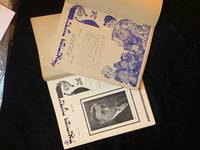
1957ref. 43419New York: Shalom-Alekhem folks shuln 1957. First edition. Original illustrated paper wrappers bound by year into later paper outer wrappers for each yearly volume 4to each issue contains 18 pages includes illustrations. 26 cm. In Yiddish. Title translates as "Children's Journal." All published copies of the famous Yiddish children's magazine Kinder Zhurnal from 1956 and 1957 during the Cold War. Six issues per year. "Kinder zhurnal a children's magazine was in existence from 1920 to 1981. Its first editor Shmuel Niger served from 1922 to 1948. The magazine published works by writers such as Mani Leib Aleph Katz Jacob Glatstein Kadia Molodowsky. Farlag Matones was established in 1925 as a publisher of children's books but became a leading publisher of Yiddish literature and of well-known authors such as Menahem Boraisha Jacob Glatstein Chaim Grade Moses Moyshe Leib Halpern Leibush Lehrer Isaac Bashevis Singer Hillel Zeitlin Aaron Zeitlin. Lippa Lehrer was the manager and leading figure of both organizations and was editor of Kinder zhurnal for a number of years." YIVO SUBJECTS: Children's literature Yiddish -- Periodicals. Children's literature Yiddish. OCLC: 10158059 Outer blank paper wrappers faded with light rusting to staples but issues themselves remain in Very Good Condition. YID-48-104-GGLEX-'cc. New York: Shalom-Alekhem folks shuln unknown
1996pp. viii, [2], 204. Extensive footnotes. Index. "A concise superbly documented study of the U.S. government's virtual dominance of the creation and the development of mass communication research. A chilling history of federal influence on finances, research topics and academic careers, it illuminates the political context of scholarship in the United States." - W.S. Solomon. "At last, a thoroughly researched, well-documented critical history of the relation between the U.S. government and the academic community in the creation and development of mass communication research. Enormously useful and clarifying." - J.W. Carey. Title #13 from the 'Forbidden Bookshelf', a list of controversial books disappeared by America's power brokers. Unmarked with average wear. A sound copy of this, the first paperback edition. Book
1959ref. 223101959. United States Army Intelligence School. Intelligence training archive. 1959-1963. This archive documents the institutional training system used by the U.S. Army Intelligence School at Fort Holabird during the Cold War outlining how personnel were instructed in reconnaissance mapping foreign intelligence analysis and counterintelligence operations. The material establishes a formal curriculum designed to prepare officers for intelligence work in the context of U.S.-Soviet conflict combining doctrinal interpretation of adversary systems with technical instruction in observation terrain analysis and operational planning. It provides primary evidence of how intelligence training integrated ideological framing with practical field methods. Archive of 13 instructional documents totaling approximately 459 pages issued between 1959 and 1963 including manuals technical booklets and training schedules. Titles include 1 Soviet Intelligence Systems Nov 1962 2 Observation and Description Jan 1961 3-5 Military Map Reading booklets 1959-1961 6 Interpretation of Highways Bridges and Transportation Facilities Oct 1961 7 USAINTS Library Guide Jan 1962 8 Operational Data on South Korea I Sep 1962 9 Nuclear Warfare II Jun 1963 10 Benelux Jul 1961 11 Solution of Dispersion Problems undated and 12-13 weekly training schedules June and July 1963. The manuals include diagrams and exercises on map reading identifying "recognition distance and direction" as core elements with annotated examples of azimuth calculation and grid use. Instructional material in Observation and Description includes facial and morphological diagrams distinguishing features such as "Vertical Forehead" and "Bushy" eyebrows for identification purposes. Soviet Intelligence Systems presents ideological analysis stating that Soviet security organs are "extensions of the Party's designs" and describing intelligence as "a pervasive force which envelops every sector of society." Infrastructure manuals include photographic examples of roads and bridges for field identification while the Library Guide outlines access systems and spatial organization of intelligence resources. Weekly schedules list training components such as report writing practical exercises and seminars alongside technical instruction in photography. Produced during a period of sustained Cold War tension these materials show how the U.S. Army formalized intelligence education by combining political interpretation of adversaries with standardized technical training. The emphasis on mapping surveillance and infrastructure analysis reflects preparation for both conventional and nuclear-era operations while the inclusion of regional studies such as South Korea and Benelux indicates geographic scope within global strategic planning. Minor rust to staples light edge toning and scattered manuscript annotations; occasional corner creases and small marginal tears not affecting text; overall very good. A cohesive archive of Cold War intelligence training preserving the instructional methods and analytical frameworks used by the U.S. Army in the early 1960s. unknown
19743 vols., 8vo., First Edition, with coloured endpaper maps in the second volume; original cloth (black/blue/blue respectively), gilt backs, first volume with red top (faded as often) else a near fine set set in unclipped dustwrapper. First issue (with coloured endpaper maps) of 'The Honourable Schoolboy'. Bright set of the most important and influential spy fiction trilogy of the Cold War. COMPLETE SETS ARE VERY SCARCE IN THIS CONDITION.
19743 vols., 8vo., First Edition, with coloured endpaper maps in second volume; handsomely bound in full crushed morocco (blue/green/red respectively), backs with raised bands ruled in gilt, second compartments lettered and ruled in gilt, all other compartments tooled in gilt, gilt tops, hand-made endpapers, ribbon markers, custom-made slip-cases, a most attractive set ideal as a gift or for presentation. First issue (with coloured endpaper maps) of 'The Honourable Schoolboy'. Elegant set of the most important and influential spy fiction trilogy of the Cold War. COMPLETE SETS ARE VERY SCARCE IN THIS CONDITION.
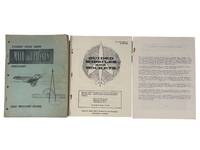
1950ref. 223721950. A rare instructional archive from the height of the Cold War arms and space races documenting the teaching strategies technical priorities and ideological frameworks used by the U.S. military to train service members in missile technology physics and emerging space policy. These materials reflect the growing importance of scientific education within the armed forces during the period of intense technological competition between the United States and the Soviet Union following the launch of Sputnik and the acceleration of missile and space programs. This archive includes three distinct publications produced by branches of the Department of Defense and the U.S. Air Force: a heavily illustrated USAF Preflight School "Math and Physics" Student Study Guide ca. late 1950s 244 pages; the DOD Fact Sheet 3-F on "Guided Missiles and Rockets" 29 April 1960 59 pages; and a striking early federal statement titled "Introduction to Outer Space" ca. late 1950s 11 pages intended to justify a national space program. Together these works reflect the militarized scientific culture of early Cold War America where soldiers were expected to master STEM fundamentals understand atomic missile classifications and absorb the ideological stakes of U.S. supremacy in space. The Preflight School Study Guide opens with a cartoon image of a smiling cadet pointing to a "Table of Contents" listing 20 core lessons including: "Velocity and Acceleration" "Vectors" "Electricity and Magnetism" and "Jet Engine Principles." Designed to bring young recruits up to speed on mathematical and physical foundations this booklet illustrates how the military systematized the transmission of civilian STEM knowledge through instructional cartooning step-by-step reviews and mechanical principles tied directly to aeronautics. The document also reflects broader efforts to professionalize enlisted men into a new technocratic class of Cold War airmen. The DOD Fact Sheet 3-F dated 29 April 1960 is a mimeographed technical manual that lists every operational missile and rocket then used by the Army Navy Air Force and Marine Corps. Each entry is meticulously typed and includes missile name type e.g. "surface-to-surface" speed launch weight prime contractor warhead type and guidance system. Key entries include the NIKE AJAX NIKE HERCULES REDSTONE PERSHING and POLARIS missiles. The NIKE AJAX is described as "the nation's first supersonic anti-aircraft guided missile. designed to intercept and destroy bomber aircraft regardless of evasive action." The HERCULES system is called "a major advance. capable of operation in an electronic countermeasures environment." These materials also serve as a record of U.S. procurement partnerships with Bell Labs Western Electric and Douglas Aircraft-illustrating the military-industrial complex in full effect. The third item titled "Introduction to Outer Space" is a pedagogical and ideological primer explaining the rationale behind federal investment in space exploration. Structured around four key justifications-scientific curiosity military defense national prestige and technological advancement-it declares: "The first of these factors is the compelling urge of man to explore. Most of the surface of the earth has now been explored and men now turn to the exploration of outer space as their next objective." This philosophical argument for militarized space policy also hints at early satellite surveillance goals: "The launching of satellites. can be done with the aid of new things: 1 it can look down at the earth and map out the terrain. 2 it can look out into space. and 3 it can look at the sun." Notably this text served as the basis for a widely distributed 1958 White House document under the Eisenhower Administration laying ideological groundwork for what would soon become NASA and the National Defense Education Act NDEA of 1958. Pages toned with some rusting to staples especially visible on "Introduction to Outer Space." Light wear to edges of math booklet. Overall very good condition. An outstanding and uncommon pedagogical archive documenting how the U.S. military trained its enlisted men to master missile and rocket technologies at the dawn of the space age while also advancing an explicitly ideological case for Cold War space supremacy. unknown