30 566 résultats
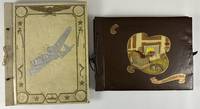
1945réf. 12886Various locations mainly Texas Oklahoma and Arkansas 1945. Two albums. Album I: 24 leaves illustrated with twenty-four original photographs over two dozen postcards mostly photographic original letters and military documents and a large quantity of ephemeral items. Folio. Contemporary cream cloth decoratively stamped on front board in gilt and silver string tied. Album II: 11 leaves illustrated with ninety-eight photographs in mounting corners six loose photos and a couple of ephemeral items. Oblong folio. Contemporary brown cloth decoratively stamped on front board in gilt yellow and red string tied. Overall minor wear. Very good condition. A pair of annotated vernacular photograph album / scrapbooks compiled by Lt. Erma J. Frazier and her mother during her wartime service in the U.S. Army Nurse Corps. Frazier served in the Nurse Corps at various hospitals in the Trans-Mississippi West at Camp Swift in Bastrop Texas; Fort Sam Houston in San Antonio Texas; Okmulgee Oklahoma; and Camp Robinson Arkansas. Frazier hailed from East Brady Pennsylvania and worked as a Registered Nurse at the nearby Kittanning Hospital before she entered military service. She enlisted in early 1945 and served throughout the conclusion of the Second World War. The present albums record her service time in unusual detail with a mixture of original photographs picture postcards original military documents a few manuscript letters and various ephemeral items. The first album was compiled by Frazier's mother who inscribes the first page: "I dedicate this book to my daughter Erma Jean Eberhart Frazier who entered the Armed Services on March 17 1945 as a 2nd Lt. in the Nurse Army Corps a Camp Swift Texas." This album focuses mainly on Frazier's time at Camp Swift and Okmulgee Oklahoma. This album contains the lion's share of the ephemera including a patch the floral corsage she wore on the day she left for service military paperwork and forms and various newspaper clippings. The military paperwork includes enlistment documents including her "Application for Appointment" a manuscript postcard from the director of the Red Cross describing Frazier as a "professional qualified for military service" Army documents on qualifications for nurses and more. Other ephemera includes letters and cards received by her at Camp Swift a page of five pressed "Flowers from Texas" each preserved in a small plastic bag shipping tags from packages of clothing sent home by Frazier a couple of church programs a page of ten small postcards from her visit to Austin a menu from Brooke General & Convalescent Hospital at Fort Sam Houston some greeting cards and so forth. The photographs include portraits of Frazier from 1943 and 1944 while a nursing student; eight pictures of Frazier and other soldiers at Camp Swift; and eight shots of Frazier fellow soldiers and their barracks and administration buildings at Okmulgee Oklahoma. The second album was compiled by Frazier herself who provides a manuscript title on the inside front cover: "Memories of the Army Nurse Corps." There are also two photographs inscribed in the first person "Me on arrival at G.G.H." and "side entrance to my barracks G.G.H.". This album is almost entirely comprised of captioned photographs particularly valuable for identifying numerous fellow soldiers serving with Frazier. The images emanate from the last three locations at which Frazier served which she lists on the inside front cover: Brooke General Hospital at Fort Sam Houston Glennon General Hospital in Okmulgee and Regional Hospital at Camp Robinson Arkansas. Perhaps Frazier felt her mother's album largely focused on Camp Swift sufficiently memorialized here time there. The photographs are presented in chronological order and include portraits of dozens of men and women with whom Frazier served or patients served by Frazier often accompanied by informative and sometimes humorous manuscript captions on the album leaves or directly on the images. The photos also picture the hospitals themselves and include a handful of images taken during leisure time on base. A unusually informative pair of World War II-era albums and scrapbooks preserving the service of a highly-qualified Army nurse from Pennsylvania serving in the American West during the last year of the war. unknown
1945réf. 12886Various locations mainly Texas Oklahoma and Arkansas 1945. Two albums. Album I: 24 leaves illustrated with twenty-four original photographs over two dozen postcards mostly photographic original letters and military documents and a large quantity of ephemeral items. Folio. Contemporary cream cloth decoratively stamped on front board in gilt and silver string tied. Album II: 11 leaves illustrated with ninety-eight photographs in mounting corners six loose photos and a couple of ephemeral items. Oblong folio. Contemporary brown cloth decoratively stamped on front board in gilt yellow and red string tied. Overall minor wear. Very good condition. A pair of annotated vernacular photograph album / scrapbooks compiled by Lt. Erma J. Frazier and her mother during her wartime service in the U.S. Army Nurse Corps. Frazier served in the Nurse Corps at various hospitals in the Trans-Mississippi West at Camp Swift in Bastrop Texas; Fort Sam Houston in San Antonio Texas; Okmulgee Oklahoma; and Camp Robinson Arkansas. Frazier hailed from East Brady Pennsylvania and worked as a Registered Nurse at the nearby Kittanning Hospital before she entered military service. She enlisted in early 1945 and served throughout the conclusion of the Second World War. The present albums record her service time in unusual detail with a mixture of original photographs picture postcards original military documents a few manuscript letters and various ephemeral items. The first album was compiled by Frazier's mother who inscribes the first page: "I dedicate this book to my daughter Erma Jean Eberhart Frazier who entered the Armed Services on March 17 1945 as a 2nd Lt. in the Nurse Army Corps a Camp Swift Texas." This album focuses mainly on Frazier's time at Camp Swift and Okmulgee Oklahoma. This album contains the lion's share of the ephemera including a patch the floral corsage she wore on the day she left for service military paperwork and forms and various newspaper clippings. The military paperwork includes enlistment documents including her "Application for Appointment" a manuscript postcard from the director of the Red Cross describing Frazier as a "professional qualified for military service" Army documents on qualifications for nurses and more. Other ephemera includes letters and cards received by her at Camp Swift a page of five pressed "Flowers from Texas" each preserved in a small plastic bag shipping tags from packages of clothing sent home by Frazier a couple of church programs a page of ten small postcards from her visit to Austin a menu from Brooke General & Convalescent Hospital at Fort Sam Houston some greeting cards and so forth. The photographs include portraits of Frazier from 1943 and 1944 while a nursing student; eight pictures of Frazier and other soldiers at Camp Swift; and eight shots of Frazier fellow soldiers and their barracks and administration buildings at Okmulgee Oklahoma. The second album was compiled by Frazier herself who provides a manuscript title on the inside front cover: "Memories of the Army Nurse Corps." There are also two photographs inscribed in the first person "Me on arrival at G.G.H." and "side entrance to my barracks G.G.H.". This album is almost entirely comprised of captioned photographs particularly valuable for identifying numerous fellow soldiers serving with Frazier. The images emanate from the last three locations at which Frazier served which she lists on the inside front cover: Brooke General Hospital at Fort Sam Houston Glennon General Hospital in Okmulgee and Regional Hospital at Camp Robinson Arkansas. Perhaps Frazier felt her mother's album largely focused on Camp Swift sufficiently memorialized here time there. The photographs are presented in chronological order and include portraits of dozens of men and women with whom Frazier served or patients served by Frazier often accompanied by informative and sometimes humorous manuscript captions on the album leaves or directly on the images. The photos also picture the hospitals themselves and include a handful of images taken during leisure time on base. A unusually informative pair of World War II-era albums and scrapbooks preserving the service of a highly-qualified Army nurse from Pennsylvania serving in the American West during the last year of the war. unknown books
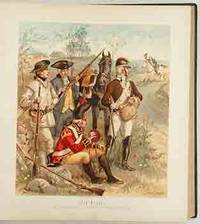
1889réf. 80-1454NY: Whitlock c. 1889 1889. Vol I: complete set of 44 color plates with Text. Original wrappers also present. 15x17". In sturdy archival storage box with metal hardware. List of plates available on request. Very Oversize. All Plates Very Good to Near Fine. Hardcover. Very Good. Illus. by Ogden H.A. Whitlock, c. 1889 Hardcover
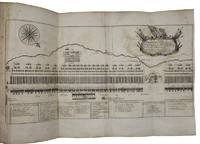
réf. AQ22662London: Sold by J. Oliver.and J. Sellar junior s.d. c.1686 Single engraved sheet folded vertically and housed in modern blue paper wrappers. Some old folds with occasional minor tearing offsetting and browning - especially to gutter. Short tear to the head of spine of the enclosing wrappers. A rare survival of a choice engraved plan of the annual military review of King James II's troops at Hounslow Heath in July 1686. The Restoration settlement of Charles II provided the King with just a small defensive military; a standing army in name only. This was expanded greatly during the 1660s and 1670s largely as a result of the Anglo-Dutch - and Franco-Dutch - wars. But the accession of his brother James II himself intent on expanding his armed presence in part out of necessity given the threat of rebellion as demonstrated by the efforts of the Duke of Monmouth in 1685 led to significant expansion of the English armed forces. Annual military manoeuvres and reviews were hosted at Hounslow Heath each summer between 1685 and 1688 in order to train this enlarged and increasingly professional force and in no small part to demonstrate the substantial military support that the King - always in a politically precarious position in relation to the Church Parliament and landed gentry despite apparent popularity amongst his subjects - could muster. The English puritan minister and journalist Roger Morrice noted in his diaries that several thousand visited the camp - the early-modern equivalent of the earlier chivalric tournament - represented by this engraving. It is perhaps therefore unsurprising that a number of commercial opportunities from prostitution to printing arose from the impressive and novel gathering. Whilst ESTC locates a single copy Oxford of this plan finely engraved for English print and map-seller's John Seller 1668–1698 and John Oliver OCLC adds a further example at Cambridge and reproductions have supposedly been made from an 'original in the Huntington Library' which we have been unable to locate other editions of the same view are also known. A broadside version of this prospect 'printed for and sold by Richard Palmer' - with letterpress titling and woodcut illustration - was also issued. Another also in broadside format and with a variant title with an exact date specified An exact prospect of his Majesty's forces as they are encamped on Hounslow Heath 19 July 1686 London 1686 bears the imprint of 'Walter Davis in Amen-Corner' is recorded by ESTC at three location Ashmolean BL and Oxford. ESTC R25579. Wing R25579. Dimensions: Sheet - 490 x 310 mm; Engraved area - 462 x 230 mm. Sold by J. Oliver...and J. Sellar junior, [s.d., c.1686?] unknown
1969réf. 2110502150414835Akita shoten 1969. Soft Cover. Fine. Number of books: 14 Akita shoten paperback
1889réf. 80-1454BNY: Whitlock c. 1889. 1889. Volume I in two parts: Complete set of 44 color plates in portfolio wth Text bound in matching volume. Olive cloth spines over Tan textured boards with gilt lettering. Plates 15x17". List of plates available on request. Plates all Fine. Minor abbrasion to front cover of portfolio. Very Oversize. Near Fine Set. Hardcover. Near Fine. Illus. by Ogden H.A. Whitlock, c. 1889. Hardcover
1945réf. 72-1529652nd Engineer Topo Bn 1945. 1945. 421p. annexes 22p. 36p. 66p. 146p. Photos. Maps. Annexes Directives issued by 12th Army Group 3d Army & XIX TAC Air force Report & Third Army planning for Overlord. Original acetate sheets between chapters. George Patton's Army in NW Europe. Not present Vol. II which contains the staff section reports. Very Oversize. 18 x 13 ½ x 2 ½ inches. New black cloth binder with screw posts. Fine copy. 1st. Hardcover. Fine. Book. 652nd Engineer Topo Bn, 1945. hardcover
1945réf. 61-1310US Army Dec. 1945 1945. Parts 1-6 in Three massive volumes. Recent black cloth binding with gilt spine lettering. Offset printing. Evidence of Yamashita's war crimes. 382 exhibits. Photos. Illustrations. Maps. Facsimilies of documents. Very heavy set. Near Fine Set. 1st. Hardcover. Near Fine. US Army, Dec. 1945 hardcover
réf. 238169Paris et Milan, 1800 - 1801 7 pièces en deux vol. in-8, demi-veau fauve, dos lisses ornés de dent-de-rat et filets dorés, pièces de titre crème, coins en vélin (reliure un peu postérieure). Des mouillures claires au premier volume.
1832réf. 41628Sans lieu, , 1832. Manuscrit in-4 (15 x 21,5 cm) de (110) ff., vélin ivoire rigide, dos lisse orné de filets dorés, pièce de titre en maroquin rouge, entièrement non rogné (reliure postérieure du XIXe siècle).
1843réf. P1-3DA Paris, Chez J. Delahaye Éditeur, 1843. 1er Volume , 1ere partie , Province d’Alger : I. XIV-(2f.)-80pp , illustré de 51 planches et 2 cartes coloriés aux contours , un frontispice teinté , un titre chromo lithographié en couleur . Plat cassé , dos frotté , tache sur les 18 premiers feuillets ( en s’amenuisant) , 6 planches brunies , 2 légèrement brunies , quelques rousseurs . 3eme Volume , 4eme partie : Province de Constantine : IV. (2f.)-42 pp , illustré de 16 planches , 1 planche brunie , quelques rousseurs . 5eme partie : Races algériennes, monnaies, flore d'Algérie : (2f.)-21-18-16-(1f.) , illustré de 3 planches (sur 6) de races algériennes dont 1 en couleurs (enfants) et 10 planches de botaniques en couleurs , 2 planches brunies dont une légèrement. Plats frottés avec manque de papier , dos frotté , manque au dos , coins usés plus 103 lithographies à deux teintes de vues et portraits dont 1 en double exemplaire, 2 cartes in fine qui correspondent aux planches des 1ere , 2eme et 3 partie. Importante mouillure en marge supérieure touchant parfois le haut de la lithographie, rousseurs (une douzaine de planches uniformément roussies), une planche volante. La partie lithographiée conserve toutefois assez fréquemment sa fraîcheur. In-folio à l’italienne, broché, couverture manquante. Au total un titre chromo lithographié compris dans la pagination et 133 planches lithographiées à fond teinté dont 1 en couleur , 2 cartes et 10 planches de flore à plusieurs sujets coloriés.
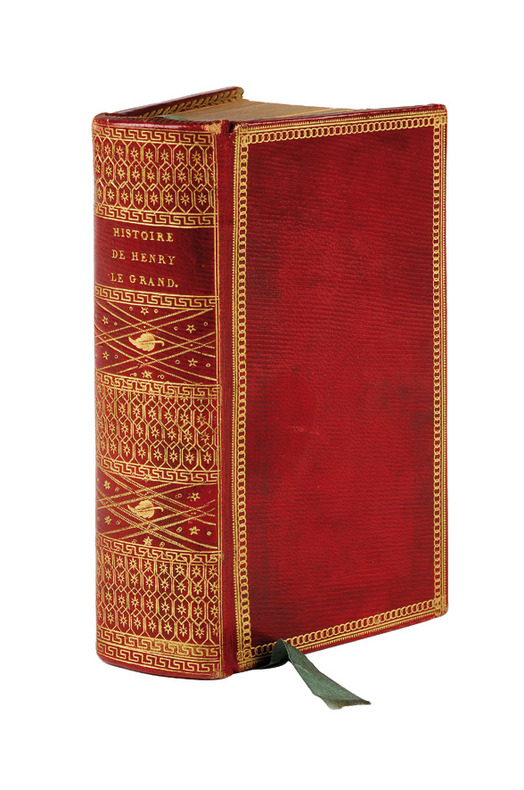
1664réf. 17474Amsterdam, Daniel Elsevier, 1664; in-12, maroquin rouge, dos lisse à faux nerfs dorés, entièrement décoré et doré «à la Bozérian», roulettes d'encadrement des plats, filet sur les coupes, roulette d'intérieur, tranches dorées (sort très probablement de l'atelier des Bozérian) ; (6) ff. y compris le frontispice gravé et le titre, 566 pp. , (10) ff. , le dernier blanc, Henry le Grand au Roy. Poème par Cassagnes.
réf. MC8Seventeen original manuscripts from ca. 20x335 cm 13 ¼ x 8 in to ca. 11x18 cm 7 ¼ x 4 ¼ in. Brown ink on watermarked laid and wove paper single leaves or bifoliums; one document on vellum; four printed forms are completed in manuscript. In all ca. 24 pp. of text. The vellum document with the official seal of the East India Company on the left margin. With two original envelopes ca. 95x21 cm 3 ¾ x 8 ¼ in and 7x165 cm 2 ¾ x 6 ½ in. Foldmarks and creases paper slightly age-toned one letter with tears on the margins but readable; one document with the upper right corner detached but present; overall a very good archive. Historically significant archive of early original manuscripts documenting the military service of Robert Butler a British officer of the East India Company’s Madras Native Infantry in the first third of the 19th century. Butler entered the service of the East India’s Company Army in the 1810s being appointed a Lieutenant of the 11th Regiment Madras Native Infantry in 1812 and achieved the rank of Lieutenant Colonel in the East Indies in 1855 The London Gazette. Tuesday February 6 1855 p. 435. Possibly he was the author of “Narrative of the Life and Travels of Serjeant B… Written by Himself” Edinburgh: David Brown 1823 describing the adventures of a young British soldier in India in the 1810s. The collection includes the original commission appointing Butler a lieutenant in the 11th Madras Native Infantry signed by the Governor of Madras Hugh Elliot originals and certified copies of the documents regarding his sick leave penalties for not reporting his return a subsequent pardon money loans payments and allowances from the Madras Native Infantry house renting near “Camp at Kulladghee” Kaladgi and a shipment of his order of “1 Linen surcingle 1 set of white tape headstall & reins 1 pale … saddlecloth with gold lace…” Overall a fascinating collection of early original manuscripts providing insight into the military service during the East India Company’s rule in India. A list of documents: 1 Elliot Hugh Governor of Madras in 1814-1820 Signed by. The Right Honourable Hugh Elliot Governor and Commander in Chief of the Fort and Garrison of Fort St. George and Town of Madraspatnam and of all the forces which are or shall be employed for the Service of the United Company of Merchants of England Trading to the East Indies <…> to R. Butler. Greeting. We reposing especial trust and confidence in your loyalty courage and good conduct do by these presents constitute and appoint you to be Lieutenant in the Eleventh Regiment of Native Infantry in the said United Company’s service and do give and grant you full power and authority to take your rank as Lieutenant in the Eleventh Regiment of Native Infantry in the said service from the twenty-third day of April One Thousand Eight Hundred and Twelve. <…>. Given under our hand and the seal of the said Compan in Fort St. George this Eighteenth Day of February <…> in the year of Our Lord One Thousand Eight Hundred and Fifteen. 2 Affidavit to be sworn to by a Subscriber Subaltern applying for Assistance from the Fund while resident in England on Sick Certificate. I Robert Butler Lieutenant <…> 11th Regt. M.N.I. do hereby make oath and declare that the income arising from my property my pay and all other sources does not exceed £ one hundred two <…> per annum; and that the sum of £48 forty-eight <…> per annum which I solicit from the Madras Military Fund is requisite to make my whole income equal to £ 140 per annum. And I do further make oath and declare that my Indian allowances have been paid up to the 1st of October 1820… <…> Sworn before me <…> this 5th day of August 1821… 3 Extract from General Orders by Government Dated Fort St. George 22d November 1825. Captain Robert Butler of the 21st Regiment of Native Infantry on this Establishment who proceeded to Europe on Furlough on the 1stof October 1820 not having reported his return to this Presidency until the 5thInstant or more than 5 years from the date of his Furlough the Honorable the Governor in Council notifies that Captain Butler <…> is hereby become incapacitated for returning his place in the regular Army until permission to that effect shall be received from the Honourable the Court of Directors <…> /A true extract/. Deputy Adj. Genl. of the Army. 4 Fort St. George 29 May 1826. Commander in Chief’s Office. To Captain Butler 21st Regt. Nat. Infry. A copy of the official letter to the Military Auditor General from the Military Department dated 23 May 1826. Leaf 2. Sir I am directed by the Honble the Governor in Council to transmit to you the annexed copy of a letter from the officiating Military Secretary to the Commander in Chief <…> and to convey to you authority for passing arrears of pay and allowances to Captain Butler <…> on his declaration on honor as to the date up to which he had received them… 5 Adjutant Genl. Office Fort Saint George 15 January 1827. To Captain Butler 21st Regiment Native Infantry. Sir with reference to the annexed extract from General Order by Government dated 12th Instant I have the honor by Order of His Excellency Commander in Chief to direct that you will join your Regiment forthwith… Extract <…> Letter dated 19th July 1826. “Being satisfied from the circumstances which have been brought to our notice that the Absence from India of Captain Robert Butler beyond the prescribed period of five years was occasioned by inevitable accident within the meaning of the 78thSection of the Act of the 33d Georg 3d Chap. 52 we have resolved to restore him to his rank in your Establishment which Resolution has received the approbation of His Majesty’s Commissioners for the affairs of India.” 6 Camp at Kulladghee 1 October 1829. I acknowledge to have received from Captain Robert Butler of the 21stRegiment N.I. the sum of /2000/ tow thousand rupees as a loan to enable me to complete the building of a new house which sum I promise to repay to Captain Robert Butler on his order. I also promise and engage to rent the house above alluded to to Captain Robert Butler on the following terms: 1st. That the monthly rent shall be fifty rupees and to commence from this date. 2nd. That the house shall be at my disposal at the end of each month provided I get a purchaser. 3rd. That I will not rent the house to any other Gentleman as long as Captn. Butler wishes to keep it <…> Matthw. Hobart Barrack Sergeant. A note by Butler underneath: My dear Gray Will you have the goodness to take charge if this document & act upon it as circumstances may require. Yours sincerely R. Butler. Camp at Kullafgee Oct. 31st 1820. A note by Gray on the next leaf: Camp Bagurattah 23 Feby. 1830. My dear Ley Having left Kullaghee I can no longer look after Butler’s interest in this document and shall feel much obliged if you will do so and act as circumstances may require until you hear farther from him or me. Sincerely yours Geo. Gray. To Captain J. M. Ley. 7 Camp at Kulladghee 5 October 1829. I hereby certify that Captain Robert Butler 21st Regt. N.I. is in a bad state of health. I recommend that for recovery thereof he be allowed to proceed to the Western coast for three months. S. A. Boyes Asst. Surgeon 21st Regt. N.I. 8 Camp at Kulladghee 21 October 1829. To Captain R. Butler 21st Regiment N.I. Sir As you are about to proceed on Sick Certificate to the Western Coast I have been directed by the Officer Commanding to furnish you Extract from G.O.C.C. of the 2nd of March 1827 and 23rd June 1829 for your information and guidance the receipt of which you will be pleased to acknowledge… 9 Kulladghee 1 November 1829. Received from Capt. Butler the sum of Rupees seven Annas eight and Pice six <…> on account of the 4th …. Also 12 books. 10 Pay Office Malabar & Kanara. Cannanore 29 December 1829. Statement. Paid to Captain R. Butler of the 21st Regiment N.I. in arrears for November and Dec. and advance for December 1829 January 1830 Rupees 753. Deducted Military Fund and Donation 42-2-8. Deposited this day in my Treasury 410-13-4… 11 Pay Office Malabar & Kanara. Cannanore 11 January 1830. To Captain R. Butler of the 21st Regiment N.I. Sir Herewith I have the honor to transmit you the Pay Certificate required for you &c… 12 Cannanore P.O. 11 January 1830. Memorandum. Paid to Captain R. Butler of the 11th Regiment N.I. the Amount of his deposit in this office. Rupees 410-13-4. Coins paid. 410 Surat Rs. ---- 410-8-; 16 Copper pice ----- 5-4; Rupees 410-13-4. 13 Adjutant General Office Fort St. George 13 January 1830. To Captain R. Butler 21st Regiment N.I. Sir The Commander in Chief has granted you Leave of Absence from your Corps and Station until the 1st July 1830… 14 Camp Bagreecoteeh 23 February 1830. “If Sergeant Hobart sells his house Capt. Ley to claim the amount due on Captain Butler’s mortgage which is now after deducting five month rent from October to February inclusive seventeen hundred and fifty Rupees 1750 Rs. and should the Sergeant only get 2200 for the house Capt. Gray authorizes Capt. L. to take 1200 in full of all demands against Segt. Hobart by Capt. Butler…” 15 Fort St. George 2 April 1830. Military Fund Office. To Captain R. Butler 21st Regiment N.I. Sir As requested in your letter of the 24th Ultimo I have the honor by desire of the Directors to transmit herewith a Statement of your account with the Military Fund exhibiting a balance due by you on account of Donation and Subscription amounting to Madras Rupees 64= 3= 4 which you will be pleased to put in a train of liquidation. <…> 16 Cannanore 11 June 1830. My dear Butler I had the pleasure of receiving your of the 9th & 10th last evening and this morning & I have now the pleasure of sending <…> the balance of your pay and a pay certificate. I have taken this course in consequence of having seen Mr. Maclean here this Mg. as you would not be able to obtain any money for an order on him during his absence. You seem to have forgot that yesterday was Sunday and that an office is opened before 10 on any day. <…> 17 Madras 1837. To Captain R. Butler. Sir We have the pleasure to advise you of our having shipped on your account on the Cutter Arrow the articles mentioned in the annexed statement <…> 1 box: 1 Linen surcingle; 1 set of white tape headstall & reins; 1 pale … saddlecloth with gold lace …. hardcover
réf. 51-3684Washington D.C.: Quartermaster General of the United States under authority of the Secretary of War circa 18890. Folio. 16 x 15 inches. 42 x 38cm. Original gilt morocco expertly restored by the artisan bookbiner Sasha Mosalov. Gilt edges and dentelles on the inside of the cover. Marbled eps. Text followed by 44 color lithograph plates with tissue guards numbered I-XLIV illustrating uniforms worn between 1774 and 1889OCLC Numbers: 198503454; 6323880; not exactlythe same. Washington, D.C.: Quartermaster General of the United States, under authority of the Secretary of War, circa 18890. unknown
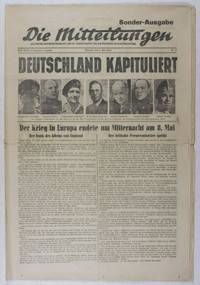
1945réf. 39196Germany: The 21st Army Group 1945. First edition. Softcover. vg. Folio 12 1/2 x 18 1/2". 8pp. Published by the 21st Army Group this special issue of "Die Mitteilungen" Information announces in bold letters and across its front page the capitulation of Nazi Germany. Featured in two columns and above the b/w photographic portraits of Field-Marshal Alexander Marshal Koniev Field-Marshal Montgomery King George VI General Eisenhower Marshal Zhukov and General Bradley are the victory speeches pronounced by King George VI and Prime Minister Winston Churchill. Of special interests are the announcement of Joseph Goebbels' death Page 2; the liberation of some of Europe's political military and religious leaders such as Leon Blum Paul Reynaud Edouard Daladier General Weygand General Gamelin Dr. Kurt von Schuschnigg Pastor Niemöller Belgian King Leopold III etc. Page 2; Information on Hitler's suicide Page 4; The San Francisco conference Page 5 and 8; article with four gruesome photographs on the liberation of the Death Camps Page 6; five b/w photographic portraits of the following allied statesmen: General de Gaulle Marshal Stalin Winston Churchill President Franklin Delano Roosevelt who died less than a month before Germany's capitulation and President Harry Truman Page 8. 'The 21st Army Group newspaper "Mitteilungen" was distributed as follows: Laer 700 copies; Greven 560 copies; Wunsdorf and Neustadt 1000 copies; Basthorst 500 copies; Celle 3000 copies; Lübeck 4000 copies; Bergen-Belsen camp 2500 copies' Extracts from War Diary of 14 Amplifier Unit & 19 Leaflet Unit. Folding mark at center. Tiny closed tear along spine. Minor age-toning. Text in German. Newspaper in overall very good condition. The 21st Army Group was a World War II British headquarters formation in command of two field armies and other supporting units consisting primarily of British and Canadian forces. Established in London during July 1943 under the command of Supreme Headquarters Allied Expeditionary Force SHAEF it was assigned to Operation Overlord the Western Allied invasion of Europe and was an important Allied force in the European Theatre. The 21st Army Group operated in Northern France Luxembourg Belgium the Netherlands and Germany from June 1944 until the end of the war in Europe in 1945. After the German surrender 21st Army Group was converted into the headquarters for the British zone of occupation in Germany. It was renamed the British Army of the Rhine BAOR on 25 August 1945 and eventually formed the nucleus of the British forces stationed in Germany throughout the Cold War. The 21st Army Group unknown
1945réf. 39196Germany: The 21st Army Group 1945. First edition. Softcover. vg. Folio 12 1/2 x 18 1/2". 8pp. Published by the 21st Army Group this special issue of "Die Mitteilungen" Information announces in bold letters and across its front page the capitulation of Nazi Germany. Featured in two columns and above the b/w photographic portraits of Field-Marshal Alexander Marshal Koniev Field-Marshal Montgomery King George VI General Eisenhower Marshal Zhukov and General Bradley are the victory speeches pronounced by King George VI and Prime Minister Winston Churchill. Of special interests are the announcement of Joseph Goebbels' death Page 2; the liberation of some of Europe's political military and religious leaders such as Leon Blum Paul Reynaud Edouard Daladier General Weygand General Gamelin Dr. Kurt von Schuschnigg Pastor Niemöller Belgian King Leopold III etc. Page 2; Information on Hitler's suicide Page 4; The San Francisco conference Page 5 and 8; article with four gruesome photographs on the liberation of the Death Camps Page 6; five b/w photographic portraits of the following allied statesmen: General de Gaulle Marshal Stalin Winston Churchill President Franklin Delano Roosevelt who died less than a month before Germany's capitulation and President Harry Truman Page 8. 'The 21st Army Group newspaper "Mitteilungen" was distributed as follows: Laer 700 copies; Greven 560 copies; Wunsdorf and Neustadt 1000 copies; Basthorst 500 copies; Celle 3000 copies; Lübeck 4000 copies; Bergen-Belsen camp 2500 copies' Extracts from War Diary of 14 Amplifier Unit & 19 Leaflet Unit. Folding mark at center. Tiny closed tear along spine. Minor age-toning. Text in German. Newspaper in overall very good condition. The 21st Army Group was a World War II British headquarters formation in command of two field armies and other supporting units consisting primarily of British and Canadian forces. Established in London during July 1943 under the command of Supreme Headquarters Allied Expeditionary Force SHAEF it was assigned to Operation Overlord the Western Allied invasion of Europe and was an important Allied force in the European Theatre. The 21st Army Group operated in Northern France Luxembourg Belgium the Netherlands and Germany from June 1944 until the end of the war in Europe in 1945. After the German surrender 21st Army Group was converted into the headquarters for the British zone of occupation in Germany. It was renamed the British Army of the Rhine BAOR on 25 August 1945 and eventually formed the nucleus of the British forces stationed in Germany throughout the Cold War. The 21st Army Group unknown books
1945réf. 62-188CGPO 1945. 1945. 4 volumes. Including Annexes 1-14. Folding Maps. Photos. Blue cloth. Very Heavy. Fine Set. Hardcover. Fine. GPO, 1945. Hardcover
1942réf. 238741942. World War II era photo album documenting men and women in military service civilian labor and domestic life from the early 1940s through 1961 centered on a network of relatives and friends identified through contemporary inscriptions. The strongest photographs date from the American mobilization of World War II placing Army and Navy service within the family relationships maintained by wives children parents and extended kin during wartime separation. A 1944 sequence from Frederick County Virginia extends the record beyond military service to men engaged in civilian construction work while later photographs follow the family into the postwar decades. Photo album containing approximately 160 silver gelatin photographs varying in size from 2 x 2 inches to 5 x 5.5 inches United States chiefly 1940s but ranging approximately from the 1930s to 1961. Named subjects include Wesley Stewart Mrs. Annie Stewart Mrs. Alice Stewart Esther Stewart Mae Orr Mary Orr Natalie Powell Daisy Neff and Frances and Dick Beard the latter identified in Texas. Several generations appear in yards beside houses and automobiles holding infants visiting relatives and posing in couples and family groups. Wartime photographs show men in U.S. Navy uniforms a man in Army uniform with a woman in civilian dress and a young woman repeatedly photographed in an enlisted Women's Army Corps uniform including with two young girls and informally with a child. The album also contains young women carrying books outside a brick institutional building a graduation portrait and a 1944 Frederick County sequence in which men work among heavy timbers at an active construction site. Later photographs record automobiles children and relatives through the 1950s and into 1961. Handwritten inscriptions establish relationships among the subjects and preserve the language through which photographs circulated within the family including "your wife Mae Orr" "Mrs. Annie Stewart" and "Esther Stewart." The photographs of the uniformed woman belong to the first generation of American women admitted to Army service on a mass scale. Congress created the Women's Army Auxiliary Corps in May 1942 and converted it into the Women's Army Corps in 1943 bringing women into the Army itself; approximately 210000 women served in the WAC during World War II at home and overseas. WAC personnel filled clerical communications transportation technical administrative and other noncombat assignments while the album's photographs of young women with books and at graduation record education as another route into the expanding public and professional lives of wartime women. The family's presence in Frederick County situates part of the album in Virginia's northern Shenandoah Valley an agricultural and market region centered on Winchester whose wartime labor demands drew civilian workers and late in the war German prisoners of war into its important orchard economy. The album continues after demobilization through graduation marriage children automobiles travel and domestic life into 1961. Moderate wear throughout including water staining and discoloration fading occasional creasing and cracking surface wear and wear to the album covers and mounts; individual photographs vary in preservation. Overall in fair to good condition. unknown books
1919réf. 59006401Washington: U.S. War Department - General Staff G-3 1919. Bound in one half brown leather over gray boards. five raised bands gilt still bright. Tabs for 93 divisions from 1917-1918 with 4-5 pp. per division. Lists no. of enlisted men officers headquarters generals casualties etc. Exceedingly rare. Approximately 400 leaves. Contains charts no maps in this volume. States Copy No. 41. First Edition. Hard Cover. Very Good /No Jacket. 4to - over 9¾" - 12" tall. U.S. War Department - General Staff G-3 Hardcover
1919réf. 59006401Washington: U.S. War Department - General Staff G-3 1919. Bound in one half brown leather over gray boards. five raised bands gilt still bright. Tabs for 93 divisions from 1917-1918 with 4-5 pp. per division. Lists no. of enlisted men officers headquarters generals casualties etc. Exceedingly rare. Approximately 400 leaves. Contains charts no maps in this volume. States Copy No. 41. First Edition. Hard Cover. Very Good /No Jacket. 4to - over 9¾" - 12" tall. U.S. War Department - General Staff G-3 Hardcover books
1746réf. 72601746 Paris, Coustelier [puis] Merigot & Piget, 1746-1747. 2 volumes in-4, Edition originale . Superbe reliure d'poque plein veau granité, dos orné, pièces de titre rouges et de tomaison brunes, coupes décorées, tranches rougesCette compilation brillante et très populaire des relations de Grelot, Busbecq, Belon, Rycaut, Maillet, etc., est particulièrement recherchée pour son illustration, dessinée par François Boucher et Noël Hallé et gravée sur cuivre par Claude-Augustin Duflos. Celle-ci se compose de deux frontispices et de vingt-huit planches hors texte de vues, scènes de mœurs et costumes turcs, dont un grand panorama à quatre volets du sérail de Constantinople, auxquelles s'ajoutent vingt fleurons et vignettes des mêmes artistes. Le tome II appartient à la seconde émission, coiffée d'un titre de relais rajeuni d'un an à l'adresse de Mérigot et Piget. Bel exemplaire en reliure de l'époque,
Very Good Turkish, Ottoman (1500-1928) Original 110 autograph letters (ALS) and several autograph postcards with almost all their original envelopes, one signed cabinet photograph, and one photograph album including Pertev Pasha's funeral photos which shows many famous politicians and soldiers beside his daughter Nevin Demirhan [Bengisu] and his wife Leman Demirhan. Various sizes. All material in Ottoman script. Most of letters addressed to his daughter Mrs. Nevin. His funeral album includes one newspaper clipping contains his short life, six newspaper obituaries, 20 b/w photos, of his funeral and famous people attending the funeral, one telegraph of condolences by Kazim Orbay, (1886-1964) and his wife Mrs. Orbay. Sait Pertev Demirhan, (1871-1964), was a Turkish soldier and politician. He is a graduate of Erkân-i Harbiye. He was an author, intellectual, Erkân-i Harbiye School teacher, 6. Army chief of staff, Harbiye Undersecretariat, 3rd Army Chief of Staff, 1st Corps and 4. Corps Commands, Military Schools Inspector, Member of History and Geography Councils, Member of Military Appeals Court, a deputy of Erzurum. He was the son of Yanyali Mustafa Pasha. He graduated from Harbiye as a staff captain (1892). In 1894 he was sent to Germany to advance his military education. After being a colonel, he was appointed to the Staff School as a teacher (1904). He was sent to the Russian-Japanese War as an observer. So, he written a book titled 'Japonlarin asil kuvveti: Japonlar niçin ve nasil yükseldi?' [i.e. The principal power of Japan: Why and how did Japan rise?] printed in 1937 in Turkish. He returned to Istanbul in 1906 and was promoted to "Pasha", and was appointed as the 6th Army Chief of Staff. He participated in the Balkan Wars (1912-1913) and was on the Caucasian front during the First World War. He was sent to Vienna as a military diplomat. Upon his return, he moved to Anatolia to participate in the Turkish War of Independence. He died in Moda district of Kadiköy. A fine and rare collection.
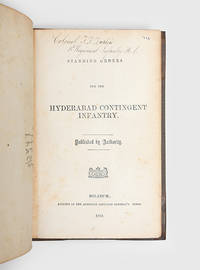
1879réf. 195729Bolarum: Printed at the Assistant Adjutant General's Press 1879. A commandant's copy First edition of this rare piece of militaria the copy of Colonel later Lieutenant-General Thomas Trevor Turton commandant 5th Infantry Hyderabad Contingent. Only a small number of copies were printed - two to each regiment and one to each battery in addition to those for senior officers - and we have traced none in institutional libraries or in commerce. Turton 1830-1904 commissioned into the 47th Regiment Native Infantry in 1848 and served in the Indian Army for the next four decades. In 1855 shortly after the formation of the Hyderabad Continent Infantry he saw action in its campaign against the Rohillas. Having become second-in-command of the 5th Infantry in 1867 he was promoted to lieutenant-colonel in 1874 and took overall command the same year. The text is annotated by Turton in several places in one case on a tipped-in slip to incorporate revisions to the standing orders one from May 1881 notes that "on no account are orderlies furnished to staff or other officers to appear out of uniform at any time while on duty" p. 41. A letterpress addendum is tipped in opposite page 56. Turton's printed ownership label and neat contemporary inscription are on the front cover or title page. Kaul's union catalogue cites a single copy of an edition with the same title from 1889 but does not record this edition. Octavo 205 x 132 mm. Recent dark half calf dark purple spine label original blue printed card wrappers bound in binder's ticket of Period Bookbinders Bath. Small 20th-century ink numerical notation at head of title page. Light browning and foxing internally as expected: a very good copy. Kaul 859 for 1889 edition. unknown
1939réf. 192368Edinburgh: 1939-45. Digging for victory A small but evocative collection tracing the war work of the artist Mary Paton who served with the Women's Land Army in Scotland throughout the Second World War. The highlight of the collection is a pair of standard-issue corduroy breeches made by Redman Bros in January 1943. Other than a couple of small oil stains to the right inner thigh they are well-preserved and have been supplemented with non-standard leather reinforcing patches to the inner knees. Two certificates in the collection are addressed to "Frances M. R. Paton" the full name of Mary Paton 1920-1990 who studied at the Edinburgh College of Art before and after the war and later lived in Aberdeenshire. A letter of thanks records her service as having lasted from 11 October 1939 to 10 October 1945 while the two WLA armbands show her service at 3 1/2 and 5 1/2 years respectively. The collection also includes two enamelled WLA lapel badges and a silver gelatine photograph showing a young woman with "Mave. Freiburg '37" inscribed on the verso. Together eight items: one pair of corduroy breeches with leather reinforcing patches two certificates 241 x 190 mm written and printed on rectos only two WLA brassards 83 x 347 mm one silver gelatine photo 86 x 57 mm two WLA brass and enamel badges 35 x 24 mm. One certificate with storage folds overall in very good condition. hardcover
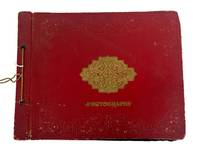
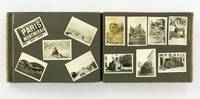
réf. 140779Very Good. A commercial photograph album 225 × 320 mm containing 163 snapshot photographs mainly 57 × 70 mm or 64 × 90 mm loosely mounted behind photo-corners on 24 leaves mainly on the rectos with captions regularly throughout the album. A postcard-format studio portrait of the compiler is attached to the front pastedown and he has identified himself in a number of photographs. In one snapshot he is standing with former German Olympic boxer Hans Schönrath 1902-1945 who has signed the photograph in ink. Cord-bound boards covered with coarsely-woven multi-coloured fabric; extremities a little rubbed and bumped with minor wear to some corners; patterned tissue-guards occasionally chipped and torn; minimal signs of age and use including a few loose snapshots - and only a handful appear to be no longer present; overall in excellent condition. The portrait has a personal inscription on the verso unfortunately not fully identifying the subject. The snapshots are basically in chronological order with the first group captioned 'R.A.D. 1937'. 'The Reichsarbeitsdienst RAD or National Empire Labour Service had its origins with the formation of a volunteer labour force that was created to off-set the high unemployment before the Nazis came to power. Work camps were set up to house these volunteers sponsored by the government administration in 1931. Under Hitler's leadership service in the RAD was obligatory for all males of 17-25 years of age for a period of six months from 26 June 1935' Imperial War Museum. Next follows a period of military training at Neuhammer; a number of photographs in this part of the album suggest the young man may have had training as a chef. There are about 40 photographs of the young man working or training in camps in barracks or at ease. The majority of the photographs depict the unstoppable and destructive course of the German army as it embarks on the occupation of Czechoslovakia fortifications captured tanks and aircraft military parades in the presence of Herman Goering and Sudetenland the invasion of Poland deployed troops destroyed or burning buildings demoralised civilians and more military parades and finally the invasion of France massive destruction of buildings fortifications bridges French aircraft and tanks; a crashed Messerschmitt Bf 109; captured British soldiers. unknown