[MAP - OTTOMAN ARMY].Biblio.com
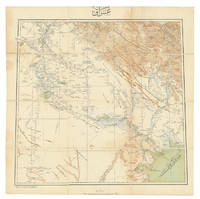
1915réf. ABC_47201Istanbul: Erkan-i Harbiye-i Umumiye 1915. Colour-lithographed map of Iraq Kuwait and southwestern Iran 65.5 x 66 cm in black brown blue and green at a scale of 1:1000000 dissected into 12 sections and mounted on contemporary cloth. First edition of the first accurate Ottoman general map of Central and Southern Iraq Kuwait and Khuzestan southwestern Iran; the authoritative map used by the Ottoman army for strategic planning during the "Mesopotamia Campaign" where Ottoman-German forces mounted a unexpectedly strong resistance to Britain's invasion of Iraq in World War I. Examples of the present map were used by Ottoman commanders who oversaw the successful Ottoman-German defence of Baghdad at the Battle of Ctesiphon 22-25 Nov. 1915 as well as the capture of the main British army at the Siege of Kut-al-Amara 7 Dec. 1915-29 April 1916. It shows the tip of the Gulf and the Tigris and Euphrates vallies including Kuwait most of Iraq and Khuzestan province in southwestern Iran. Mountain ridges are rendered in brown with rivers and marshes in blue permanent bodies of water in green and parallels and meridians at every degree ranging from about 43.5 to 49.5°E longitude and 29 to 34°N latitude. With the text entirely in Ottoman Turkish the map is based on the British War Office's "Lower Mesopotamia between Baghdad and the Persian Gulf" 1911 which was itself in part based on Ottoman sources. Both maps were dramatically superior in all respects to previous efforts forming the culmination of over three generations of reconnaissance capped by critical late-breaking discoveries.Some light stains in the margins and the lower-right quadrant but generally in good condition. Very rare. [Erkan-i Harbiye-i Umumiye], hardcover
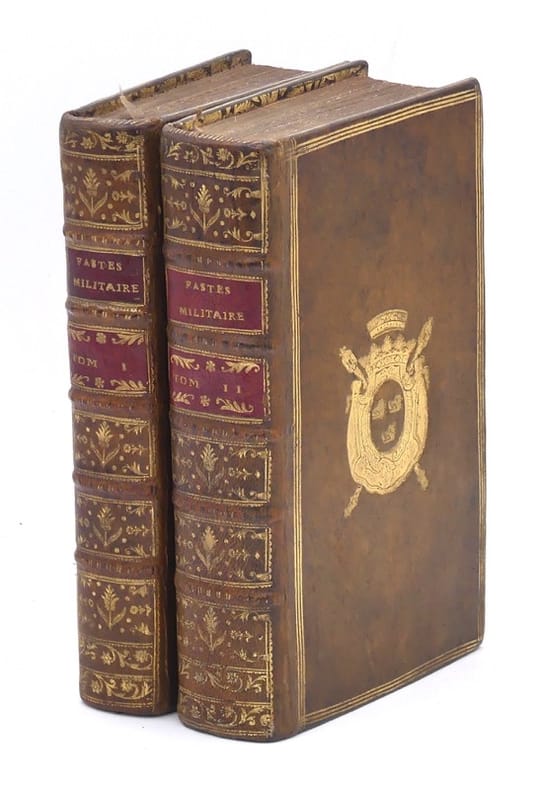
1777Ensemble de 15 volumes de format in 4° carré; reliure uniforme de l'époque en demi veau fauve richement orné; illustré de 179 planches gravées et numérotées (sur 193). Le volume XII est entièrement consacré à la vie de Confucius avec de superbes planches. Célèbre et monumentale histoire de la Chine dans tous ses aspects, militaires, agricoles, religieux, géographiques, généalogiques... Une encyclopédie sur la Chine à l'usage des Européens. Notre exemplaire ne comprend pas les planches hors texte des T. I et II; sauf le portrait frontispice du Tome I et présente donc 152 planches hors texte sur 166; ou 179 planches numérotées sur 193. Les tomes III à XV sont bien complets . Quelques petits défauts de reliure et travaux de vers intérieurs principalement en marge. Deux volumes de suppléments parurent en 1814. Curieuse signature manuscrite "Montgolfier" sur chaque page de titre. Voir les photos.
réf. 10650Paris, Lambert, Valade et chez l’auteur, 1779. Deux volumes in-12 (164 x 96 mm), 2 ff. n ch., 12 pp., 499 pp. ; 2 ff. n ch., 687 pp., 4 pp. n. ch. Maroquin vert olive, triple filet doré sur les plats, armes au centre, dos à nerf orné de motifs dorés, filet doré sur les coupes, roulette sur les chasses, tranches dorées, gardes de papier décoré d'un semis alterné d'étoiles et de points dorés, mors légèrement frottés, charnière fendue sur 2 cm en pied du second volume et infime manque de cuir à la coiffe de queue, petite auréole sur la page de titre (reliure de l’époque).
réf. 209185La Haye, veuve Van Duren, 1760 in-4 oblong (20 x 27 cm), [32] ff. n. ch. de texte (titre, avertissement, journal des opérations) dans un bel encadrement de guirlande, 49 cartes chiffrées 1-56 (certaines planches regroupent plusieurs numéros, à savoir : 18-19-20-21 / 39-41 / 50-51), et enfin 4 dépliants (ordre de bataille de l'armée du maréchal d'Estrées ; carte des limites des Hanovriens ; plan du château d'Harbourg ; carte des cantonnements de l'armée du comte de Clermont), veau fauve marbré, dos lisse cloisonné et fleuronné, armes en pied, pièce de titre cerise, encadrement de simple filet à froid sur les plats, double filet doré sur les coupes, tranches rouges (reliure de l'époque). Restaurations aux coins et aux coiffes.
1621réf. 65315Siena, H. Gori, 1621. Qu.-4°. Mit rad. illustr. Titel, einer rad. Portraittafel, einem rad. ganzs. Portrait, 54 blattgr. Radierungen. 2 Bll., 315 (recte 321) (1) S., Ldr. d. Zt. m. goldgepr. Eckfleurons, Rückenverg., goldgepr. Rückenschild, Stehkantenverg. u. Rotschnitt.
1941réf. 2110502150407699Tsuru shobo 1941. Soft Cover. Fine. Volume: 1 Tsuru shobo paperback
2000réf. 2080502106406404Kuresushuppan 2000. Soft Cover. Fine. The book is in fine condition. Kuresushuppan paperback
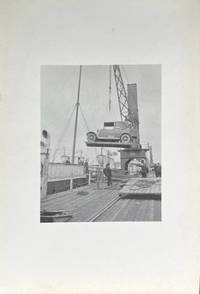
1912réf. 59779Horsham West Sussex & Haymarket London UK: H.W.C. James A. Sinclair & Co. Ltd. 1912. Two vols. Oblong 8vo. 8.5 x 5 in. 64; 69 leaves unnumbered. including 2 calligraphic titles 63 & 68 platinum print matte finish photographs w/ images sized from 2 x 3 in. up to 3.25 x 3.75 in. on 4.75 x 7 in. prints all expertly hinged at gutter margin a few w/ pencil annotations on versos occasional light toning from the platinum salt emulsions coating the papers. Uniformly bound in striking full green morocco bindings by Zaehnsdorf gilt ruling on covers gilt inner dentelles 5 raised bands on spines title lettering ownership & dating in gilt a.e.g. marbled endpapers very slight shelfwear incremental rubbing at corners still a NF set. An exceptional pair of automobile travel albums composed of platinum print photographs by Dr. E. Stevens apparently presented to fellow Royal Photographic Society member and platinum photograph enthusiast H.W. Child. The motor car was a grey 1912 35 CWT Delaunay-Belleville depicted in 15 of the images bore the GB License Plate of BP1945 registered in 1912 to Charles Stevens c/o Dr. Stevens of Sarcelles Horsham West Sussex July 4 1912. The Delaunay-Belleville in the Brass Era was one of the most expensive and prestigious touring cars for travelers and enthusiasts whose owners at the time included Evalyn Walsh McLean original owner of the Hope Diamond as well as Mann who traveled “Round the World” in 1912 in a similar model. The intrepid travelers clearly intended to photograph and put their new motor through its paces traveling about 3000 miles. The album opens with photos of the auto loaded at Portsmouth and by ferry to Le Havre and then driving down through Normandy Alencon Le Mans Tours Bordeaux and onto Biarritz. The tour extended across the Pyrenees into Spain visiting San Sebastian followed by drives to Pau Lourdes Toulouse Narbonne and then along the South of France into Italy. The drive was not without pitfalls as they suffered punctured tires with two different images showing repairs one with a crowd as well as the photo waiting for a massive rock slide of giant boulders fallen onto the roadway and being removed by wooden wheelbarrows. They continued their tour across the Alps into Switzerland with views of the travelers at a Swiss border station and then capturing scenic vistas and driving onto Salzburg & Linz. One of the images captures advertising and awning of a “Buchdruckerei” specializing in photographic books supplies and photo albums. At that point the motorists had reached the most Eastern point and drove along the Danube route crossing overland to the river Necker Heidelberg and finally into the Netherlands with visits of Amsterdam Haarlem often with picturesque images capturing the Dutch in their iconic wooden shoes windmills canals and even electric railways. One particular image documents the “Art Store” selling Volendam silver & brass and antiques. The final image shows the car being loaded back on the steamship to England from Rotterdam. The platinum photographs were processed by James A. Sinclair & Co. Ltd. at 34 Haymarket in London specializing in photographic prints & equipment and at the time the Platinum prints were Alfred Stieglitz’s process of choice celebrating the images for their aesthetic qualities and permanence. As the Platinum prints were printed direction on coated paper with platinum salts the image was absorbed directly into the paper creating a softer and less-detailed image which was quite durable. Dr. Stevens fl. 1910-1918 who during World War I served as surgeon with the Royal Army Medical Corps joined the Royal Photographic Society in 1915 and exhibited three of his photographs presumably from this excursion including “In the Paese” “Making Port Concarneu” and “Santa Maria della Pace Lago di Como.” Child b. 1859 was a very successful merchant who by 1897 was also an active member of the Royal Photographic Society Platinum print enthusiast and automobile traveler as well. He exhibited several times with the RPS often appearing in their exhibitions from 1898-1915 the last being “Citadel and Church Dinant” shot in 1914 and displayed as an Autochrome. See: Ordinary Members The Photographic Journal Vol. 41 January 1917 pp. 32 41; Exhibition Catalogue of 1898 43rd Annual Exhibition of the Royal Photographic Society 1898; 44th 1899; 45th 1900; 47th 1902; 60th 1915. H.W.C., James A. Sinclair & Co., Ltd., hardcover
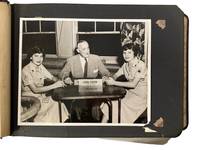
1950réf. 231531950. WACKorean War Women's Army Corps photo album compiled by Sgt. Elizabeth Adamek of Cairnbrook PA ca. early to mid 1950s extensively recording enlisted women in post-1948 U.S. Army administrative operations at Camp Zama Japan during the Korean War period. Elizabeth Adamek later Elizabeth Adamek Pierce 1932-2016 served approximately twenty years in the United States Army as an administrative assistant and instructor including service in Japan and the Korean Theater during the Korean War. Adamek is shown several times in uniform with her twin sister Cpl. Cristania Adamek indicating the sisters served in the WAC around the same time period. This album documents postwar U.S. Army overseas base administration showing how clerical labor recordkeeping and office management were carried out by WAC personnel during the Korean War. Images of Hill and fellow servicewomen engaged in office work reveal women's roles in the Army's daily bureaucratic and logistical functions while stationed abroad. A comprehensive primary-source documentation of the operational role of women within permanent peacetime Army structures following the formal establishment of the Women's Army Corps in 1948. Photo archive of approximately 240 silver gelatin photographs from Camp Zama Japan and the United States circa early to mid 1950s. The album is housed in a Japanese lacquer-style postbound binding with black paper leaves containing a mixture of small snapshot prints deckle-edge photographs and larger mounted images. The visual content centers on Hill frequently shown in WAC uniform posed in front of barracks administrative buildings and landscaped areas as well as inside office environments seated at desks surrounded by stacked files paperwork and card index systems. Several images explicitly depict clerical workspaces including a servicewoman operating a typewriter beside filing drawers reinforcing the administrative function of WAC personnel. A clearly legible building sign reads "Camp Zama 8030th Army Unit APO 50" situating the album within a specific military unit structure. Additional photographs include formal military reviews with officers and dignitaries group portraits of uniformed women before display walls and social scenes in dining facilities and clubs. Off-duty life is extensively documented through images of Japanese urban streets market stalls rail platforms commercial signage shrine gateways temple architecture zoo enclosures and landscaped gardens alongside recreational scenes such as swimming roadside travel and barracks exteriors collectively illustrating both the operational and social dimensions of overseas Army life. Adamek is posed throughout the album with a romantic partner one Sgt. Kidder whose service at Camp Zama is also documented extensively. The album captures the workings of U.S. Army overseas base administration demonstrating the process by which women in the Women's Army Corps sustained military infrastructure through administrative labor. Camp Zama functioned as a major logistical and support installation during the Korean War era and the photographs provide insight into the women that maintained its operations while also recording the social networks and cultural encounters experienced by American service personnel in postwar Japan. Elizabeth Adamek Pierce's obituary in The Oklahoman indicates she was honorably discharged from the US Army in 1971 after which she relocated to Oklahoma City and worked in an administrative role with the OKC Police Department. Adamek was a member of the Civil Air Patrol the VFW Post 1335 and a volunteer at Tinker Air Force Base in Oklahoma City. Light edge wear and chipping to album leaves occasional corner wear scattered fading and softness to prints and general handling wear to the binding; overall good condition. A cohesive and well-identified visual record of women's military service in the U.S. Army in East Asia. unknown
1950réf. 231531950. WACKorean War Women's Army Corps photo album compiled by Sgt. Elizabeth Adamek of Cairnbrook PA ca. early to mid 1950s extensively recording enlisted women in post-1948 U.S. Army administrative operations at Camp Zama Japan during the Korean War period. Elizabeth Adamek later Elizabeth Adamek Pierce 1932-2016 served approximately twenty years in the United States Army as an administrative assistant and instructor including service in Japan and the Korean Theater during the Korean War. Adamek is shown several times in uniform with her twin sister Cpl. Cristania Adamek indicating the sisters served in the WAC around the same time period. This album documents postwar U.S. Army overseas base administration showing how clerical labor recordkeeping and office management were carried out by WAC personnel during the Korean War. Images of Hill and fellow servicewomen engaged in office work reveal women's roles in the Army's daily bureaucratic and logistical functions while stationed abroad. A comprehensive primary-source documentation of the operational role of women within permanent peacetime Army structures following the formal establishment of the Women's Army Corps in 1948. Photo archive of approximately 240 silver gelatin photographs from Camp Zama Japan and the United States circa early to mid 1950s. The album is housed in a Japanese lacquer-style postbound binding with black paper leaves containing a mixture of small snapshot prints deckle-edge photographs and larger mounted images. The visual content centers on Hill frequently shown in WAC uniform posed in front of barracks administrative buildings and landscaped areas as well as inside office environments seated at desks surrounded by stacked files paperwork and card index systems. Several images explicitly depict clerical workspaces including a servicewoman operating a typewriter beside filing drawers reinforcing the administrative function of WAC personnel. A clearly legible building sign reads "Camp Zama 8030th Army Unit APO 50" situating the album within a specific military unit structure. Additional photographs include formal military reviews with officers and dignitaries group portraits of uniformed women before display walls and social scenes in dining facilities and clubs. Off-duty life is extensively documented through images of Japanese urban streets market stalls rail platforms commercial signage shrine gateways temple architecture zoo enclosures and landscaped gardens alongside recreational scenes such as swimming roadside travel and barracks exteriors collectively illustrating both the operational and social dimensions of overseas Army life. Adamek is posed throughout the album with a romantic partner one Sgt. Kidder whose service at Camp Zama is also documented extensively. The album captures the workings of U.S. Army overseas base administration demonstrating the process by which women in the Women's Army Corps sustained military infrastructure through administrative labor. Camp Zama functioned as a major logistical and support installation during the Korean War era and the photographs provide insight into the women that maintained its operations while also recording the social networks and cultural encounters experienced by American service personnel in postwar Japan. Elizabeth Adamek Pierce's obituary in The Oklahoman indicates she was honorably discharged from the US Army in 1971 after which she relocated to Oklahoma City and worked in an administrative role with the OKC Police Department. Adamek was a member of the Civil Air Patrol the VFW Post 1335 and a volunteer at Tinker Air Force Base in Oklahoma City. Light edge wear and chipping to album leaves occasional corner wear scattered fading and softness to prints and general handling wear to the binding; overall good condition. A cohesive and well-identified visual record of women's military service in the U.S. Army in East Asia. unknown books
1945réf. 9000C1945. (ca. 31,5 x 23 cm). 2 S. (Fraktur). Original-Zeitung im kleinen Format, beidseitig bedruckt, mit Titel im oberen Bereich. Papier gebräunt und gefaltet, sonst wohlerhalten. Altersentsprechend guter Zustand.
1942réf. 47-408Camp Lee 1942-1945. 1942. 6 vols. bound in red cloth. "A Training Aid to Officers & Instructors". Early issues are mimeographed later printed on glossy paper. Photos. Illustrated. Ex. Lib. VERY GOOD SET. Hardcover. Very Good. Camp Lee, 1942-1945. Hardcover
1936réf. 2080502106917695Not Available 1936. Soft Cover. Fine. The book is in fine condition. Not Available paperback
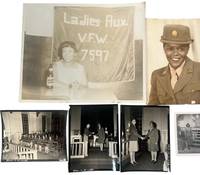
1945réf. 235821945. African American women's military photograph archive 1945 documenting the admittance of African American women into military service through the Women's Army Corps with racially segregated assignments to units and institutions reflecting both the expansion of wartime opportunities and the persistence of official segregation in the United States. Notably three images feature 8th Service Command uniform insignia associated with African American contributions to the Army Service Forces ASF in the American South and Southwest during WWII. Operating under Jim Crow laws the command's Black service members faced segregated living conditions while performing essential logistical duties vital to the overall Allied war effort. The photographs By 1945 fewer than ten thousand Black women had served in the WAC a small fraction of the more than 150000 women who entered the corps during the war making photographic documentation of their service comparatively uncommon. The images move between military ceremony portraiture and veterans' organizational life preserving evidence of Black women's participation in institutions from which they had long been excluded and the pervasive nature of war time segregation into ceremonies and collectives for veterans. Photo archive of 6 silver gelatin and sepia toned photographs ranging from approximately 3 x 5 to 8 x 10 inches United States circa 1945. The photographs show African American women in U.S. Army uniforms including a formal portrait of a smiling servicewoman in dress uniform and cap; a snapshot of a uniformed woman posed outside military housing or barracks; and three official large format photographs depicting a military ceremony attended by an audience composed largely of Black women in uniform. One image records a presentation of an award likely for "good conduct" by a male officer to a female service member while another shows two women shaking hands on a stage before assembled personnel. "8svc-13-45-2287" appears on one of the official photographs likely indicating military photographic documentation produced in 1945. An additional photograph depicts a woman seated before a banner reading "Ladies Aux. V.F.W. 7597" linking the group to The New Murray Bell VFW Post 7597 and its Ladies Auxiliary located in Farrell Pennsylvania which historically served as an important hub for Black veterans and their families. Named in honor of Murray Bell a Black soldier from Farrell the post was established as a segregated space where African American veterans of foreign wars and their spouses could find community support and advocacy during an era when mainstream veterans' organizations routinely excluded them. The archive includes documentation of the closing year of World War II when African American women served in segregated Women's Army Corps units at training centers hospitals administrative installations and overseas assignments while confronting restrictions that mirrored the broader racial order of the United States. Their service preceded President Truman's Executive Order 9981 of 1948 which formally initiated the desegregation of the armed forces. Photographs of Black women in uniform from this period remain considerably less common than images documenting white WAC personnel. The group records uniforms rank structure military ritual and African American female participation in institutions operating under segregation at the moment the wartime military establishment was beginning to confront demands for racial equality. Scattered fading and minor curling to smaller prints; several photographs with edge wear and age toning. Overall in good condition. unknown
1945réf. 235821945. African American women's military photograph archive 1945 documenting the admittance of African American women into military service through the Women's Army Corps with racially segregated assignments to units and institutions reflecting both the expansion of wartime opportunities and the persistence of official segregation in the United States. Notably three images feature 8th Service Command uniform insignia associated with African American contributions to the Army Service Forces ASF in the American South and Southwest during WWII. Operating under Jim Crow laws the command's Black service members faced segregated living conditions while performing essential logistical duties vital to the overall Allied war effort. The photographs By 1945 fewer than ten thousand Black women had served in the WAC a small fraction of the more than 150000 women who entered the corps during the war making photographic documentation of their service comparatively uncommon. The images move between military ceremony portraiture and veterans' organizational life preserving evidence of Black women's participation in institutions from which they had long been excluded and the pervasive nature of war time segregation into ceremonies and collectives for veterans. Photo archive of 6 silver gelatin and sepia toned photographs ranging from approximately 3 x 5 to 8 x 10 inches United States circa 1945. The photographs show African American women in U.S. Army uniforms including a formal portrait of a smiling servicewoman in dress uniform and cap; a snapshot of a uniformed woman posed outside military housing or barracks; and three official large format photographs depicting a military ceremony attended by an audience composed largely of Black women in uniform. One image records a presentation of an award likely for "good conduct" by a male officer to a female service member while another shows two women shaking hands on a stage before assembled personnel. "8svc-13-45-2287" appears on one of the official photographs likely indicating military photographic documentation produced in 1945. An additional photograph depicts a woman seated before a banner reading "Ladies Aux. V.F.W. 7597" linking the group to The New Murray Bell VFW Post 7597 and its Ladies Auxiliary located in Farrell Pennsylvania which historically served as an important hub for Black veterans and their families. Named in honor of Murray Bell a Black soldier from Farrell the post was established as a segregated space where African American veterans of foreign wars and their spouses could find community support and advocacy during an era when mainstream veterans' organizations routinely excluded them. The archive includes documentation of the closing year of World War II when African American women served in segregated Women's Army Corps units at training centers hospitals administrative installations and overseas assignments while confronting restrictions that mirrored the broader racial order of the United States. Their service preceded President Truman's Executive Order 9981 of 1948 which formally initiated the desegregation of the armed forces. Photographs of Black women in uniform from this period remain considerably less common than images documenting white WAC personnel. The group records uniforms rank structure military ritual and African American female participation in institutions operating under segregation at the moment the wartime military establishment was beginning to confront demands for racial equality. Scattered fading and minor curling to smaller prints; several photographs with edge wear and age toning. Overall in good condition. unknown books
1945réf. 058417652nd Engineer TOPO Bn. nice two-volume set; very large oblong; original edition . Very Good. Soft cover. 1st Edition. 1945. 652nd Engineer (TOPO) Bn. paperback
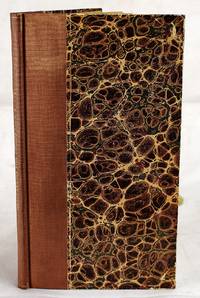
1793réf. 2201040008Philadelphia: : Printed by E. Oswald no. 156 Market-Street south between Fourth and Fifth-Streets. M DCC XCIII 1793. Hardcover. Good. Von Steuben's Revolutionary War Manual on Drill was written at George Washington's urging. It remained an important guide for the American military through the War of 1812 Rebound in early 20th century 1/2 cloth over marbled boards. Hardcover. Good binding and cover. Foxing. 48 p. ; 22 cm. 8vo. Evans 26358. ESTC W21724. Prepared by Friedrich von Steuben in 1779 as inspector general of the Continental Army; adopted nationally by the Uniform Militia Act of 1792. 'Washington asked Steuben to serve temporarily as inspector general and to begin his duties by instructing the soldiers in the long-neglected subjects of discipline and drill. To the amazement of the Americans who were unaccustomed to officers acting as drillmasters Steuben initially formed a model company which he personally instructed with the aid of a translator. By April Steuben had acquired four assistant inspectors and had extended drill instruction to the whole army. Lacking adequate drill manuals Steuben wrote daily lessons in which he greatly simplified and softened Prussian methods to fit the immediate needs and free-spirited ways of the American soldiers . The transformation that Steuben wrought in the training of the Continental army greatly impressed Washington and other observers. In May 1778 Congress acting at Washington's recommendation officially appointed Steuben inspector general of the army with the rank and pay of major general.' ANB online. Philadelphia: : Printed by E. Oswald, no. 156, Market-Street, south, between Fourth and Fifth-Streets., M, DCC, XCIII hardcover
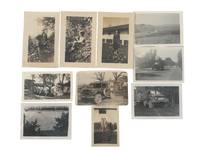
1945réf. 225281945. Women History World War II WWII Women's Army Corps photo archive documenting women's military service during World War II and the expansion of women's logistical and technical roles within the United States Army. The photographs record daily activity surrounding Women's Army Corps personnel including ambulance operation vehicle maintenance military training environments and informal moments of rest and recreation. Established in 1943 Women's Army Corps enabled women to enter the Army in noncombat roles that were essential to wartime mobilization including clerical work communications mechanics and medical transport. The images document this institutional transformation through scenes of uniformed women working with military vehicles operating ambulances and participating in the broader infrastructure of wartime military camps. One photograph shows a WAC standing in full service uniform before a low administrative building while others depict women outdoors in wooded settings during moments of leisure illustrating both the disciplined and personal dimensions of wartime service. Archive of 20 gelatin photographs created during the 1940s depicting Women's Army Corps personnel military vehicles and associated Army training activities. Photographs measure approximately 3.5 x 5 inches. The photographs show WAC members in both uniform and off duty settings including outdoor portraits and camp scenes. Several images focus on military ambulances and transport vehicles bearing visible Army markings such as "U.S. ARMY 432621" and "AMB-34." Verso inscriptions provide firsthand commentary on military duties and equipment including one caption reading "This is my new AMBULANCE hope you like it sis. safe & OK" and another written beside an ambulance photograph noting "good old Baker 5 kept me from walking." Operational scenes include soldiers crouched behind sandbags with a handwritten note identifying personnel as "Eselinger Conrad Palmer Carvey Boss." Other photographs document the broader military environment surrounding WAC activity including a drill or parade ground and a large motor pool with rows of Army trucks one marked "U.S. Army 008909" positioned in front of a multi story barracks. Additional annotated images identify fellow servicemen and technical details of equipment including "Hines Gallop and myself. Gallop is a jeep driver from North Carolina" and another describing "my radio on right fender" while one photograph is labeled simply "motor pool." Women's Army Corps personnel served throughout the United States and overseas during World War II performing essential logistical and administrative work that supported Allied military operations. Ambulance drivers such as the woman referenced in the captions transported wounded soldiers during training exercises and operational deployments and were often responsible for maintaining their own vehicles in field conditions. WAC members later served across European theaters including England France and Italy after the Allied landings in 1944 contributing to the wartime medical evacuation system that moved casualties from combat zones to field hospitals and rear medical facilities. Light edge wear mild surface handling and faint silvering to some prints; overall very good condition. These photographs document both the operational infrastructure of wartime motor transport and the presence of women within that system illustrating how the mobilization of female personnel expanded the technical and logistical capacities of the U.S. Army during the global conflict. unknown
1945réf. 225281945. Women History World War II WWII Women's Army Corps photo archive documenting women's military service during World War II and the expansion of women's logistical and technical roles within the United States Army. The photographs record daily activity surrounding Women's Army Corps personnel including ambulance operation vehicle maintenance military training environments and informal moments of rest and recreation. Established in 1943 Women's Army Corps enabled women to enter the Army in noncombat roles that were essential to wartime mobilization including clerical work communications mechanics and medical transport. The images document this institutional transformation through scenes of uniformed women working with military vehicles operating ambulances and participating in the broader infrastructure of wartime military camps. One photograph shows a WAC standing in full service uniform before a low administrative building while others depict women outdoors in wooded settings during moments of leisure illustrating both the disciplined and personal dimensions of wartime service. Archive of 20 gelatin photographs created during the 1940s depicting Women's Army Corps personnel military vehicles and associated Army training activities. Photographs measure approximately 3.5 x 5 inches. The photographs show WAC members in both uniform and off duty settings including outdoor portraits and camp scenes. Several images focus on military ambulances and transport vehicles bearing visible Army markings such as "U.S. ARMY 432621" and "AMB-34." Verso inscriptions provide firsthand commentary on military duties and equipment including one caption reading "This is my new AMBULANCE hope you like it sis. safe & OK" and another written beside an ambulance photograph noting "good old Baker 5 kept me from walking." Operational scenes include soldiers crouched behind sandbags with a handwritten note identifying personnel as "Eselinger Conrad Palmer Carvey Boss." Other photographs document the broader military environment surrounding WAC activity including a drill or parade ground and a large motor pool with rows of Army trucks one marked "U.S. Army 008909" positioned in front of a multi story barracks. Additional annotated images identify fellow servicemen and technical details of equipment including "Hines Gallop and myself. Gallop is a jeep driver from North Carolina" and another describing "my radio on right fender" while one photograph is labeled simply "motor pool." Women's Army Corps personnel served throughout the United States and overseas during World War II performing essential logistical and administrative work that supported Allied military operations. Ambulance drivers such as the woman referenced in the captions transported wounded soldiers during training exercises and operational deployments and were often responsible for maintaining their own vehicles in field conditions. WAC members later served across European theaters including England France and Italy after the Allied landings in 1944 contributing to the wartime medical evacuation system that moved casualties from combat zones to field hospitals and rear medical facilities. Light edge wear mild surface handling and faint silvering to some prints; overall very good condition. These photographs document both the operational infrastructure of wartime motor transport and the presence of women within that system illustrating how the mobilization of female personnel expanded the technical and logistical capacities of the U.S. Army during the global conflict. unknown books
réf. 245232Paris, Morier, s.d. (1870) in-folio carré, titre, 59 planches lithographiées et coloriées sur papier teinté, montées sur onglets, demi-chagrin rouge à la Bradel à coins, dos orné (reliure de l'époque). Qqs épid. au dos.
réf. 226402A Amsterdam, Chez Zacharie Chatelain et Fils, 1753 7 vol. in-4, [6]-XXIV-C-[5]-242, [4]-XXII-[2]-336-[19], [4]-XXIV-[6]-314, [4]-25-[6]-368-[22], [4]-XXVIII-414, [4]-LXIV-478-[18] et [8]-XII-273 pp., deux frontispices, 4 cartes dépl. et 131 pl. généralement dépl., veau fauve, dos à nerfs orné, tranches rouges (reliure vers 1820). Qqs usures.
1788réf. AMO-24644 forts volumes in-4 (27 x 21,5 cm) de (10)-XLIV-522, (3)-566-(4), (3)-710-(6) et (3)-560-(1) pages. Portrait de Frédéric le Grand en frontispice du premier volume (gravé par H. Marais en 1788 d'après A. Graf). Exemplaire bien complet des 59 tableaux dépliants (ou non) qui se trouvent à leur place intercalés dans les volumes (les feuillets de placement des tableaux sont présents en tête de chaque volume). Le tome III contient un planche symbolique hors-texte gravée par Ransonnette "Grand Ordre de Monsieur" (p. 489). Cartonnage plein papier à la colle bleu à l'imitation des cartonnages de l'époque. Entièrement non rogné, cartonné sur brochure, pièces de titre imprimées sur papier (modernes), étuis cartonnés de papier à la colle (un fond d'étui fêlé, sans gravité). Ensemble en superbe état. Intérieurs généralement d'une très grande fraîcheur. Quelques cahiers légèrement teintés ou avec quelques rousseurs. Sans l'atlas in-folio vendu séparément et contenant 10 cartes sur double page, dressées par Mentelle et gravées par Pierre François Tardieu, 93 planches de tactique non signées. « Cette importante étude, fort bien documentée, sur la Prusse est le résultat d’une vaste enquête » ; « C’est une œuvre conçue par Mirabeau selon son plan, d’après sa conception de l’histoire économique et philosophique », il « fondait de grands espoirs sur cet ouvrage pour établir sa réputation d’écrivain et obtenir enfin un emploi digne de son talent, de son origine et de son ambition. » (H. Aureille, Bibliographie de Mirabeau.). On y trouve d'intéressantes informations sur l'organisation militaire de la Prusse, sa législation, son administration et son économie, ainsi qu'un certain nombre de considérations sur la population. Les données statistiques sur les habitants de la Prusse s'y trouvent en grand nombre. On y trouve également de l'économie-politique, les productions agricoles et les richesses naturelles, les manufactures, le commerce, la constitution civile et politique, les revenus et dépenses, le système militaire (tactique) et la religion. Le premier volume s'ouvre sur une délicate et reconnaissante épître "à mon père" (Mirabeau père). Mirabeau a été aidé pour cet ouvrage par Jakob Mauvillon (1743-1794), physiocrate allemand. On accusé Mirabeau de n'avoir rédigé que quelques passages et préambules de l'ouvrage, le gros du travail revenant à Mauvillon. La correspondance échangée entre Mirabeau et Mauvillon prouve le contraire. Mirabeau était non seulement à l'origine de cet important ouvrage mais encore le maître d'oeuvre et principal rédacteur (certaines études récentes présentent toutefois Mauvillon comme le nègre de Mirabeau pour cet ouvrage). Jean-Charles Laveaux (1747-1829), professeur de langue française à Bâle, puis professeur de littérature française à Stuttgart et à Berlin, à la demande de Frédéric le Grand, a participé à la documentation historique pour cette histoire de la monarchie prussienne. Provenance : Exemplaire offert par Mirabeau à Nicolas Frochot (1761-1828). Attesté par un petit billet autographe (non signé) par Nicolas Frochot et daté de Paris le 4 avril 1790 présent en tête du premier volume. Frochot y remercie M. le comte de Mirabeau de l'envoi qu'il lui a fait de son ouvrage sur la monarchie prussienne. "Comme il a été bien entendu entre nous que je ne lui vendais pas le petit Cicero de amicitiâ, et que d'ailleurs j'aurais dans ce cas un retour considérable à lui donner. J'accepte ce cadeau non comme un prix d'échange du petit traité de l'Amitié mais comme un don que je m'honorerai toujours de tenirde celle de l'auteur. (en haut du billet il est écrit de la main même de Frochot : Copie de mon billet de remerciement à M. le comte de Mirabeau). Très émouvant billet quand on sait que Nicolas Frochot s'est lié d'une réelle amitié avec Mirabeau qui fit de lui son exécuteur testamentaire. Élu député des États généraux le 25 mars 1789, il est chargé de rédiger les cahiers de doléances du tiers état de sa province, avant de siéger à la Constituante (il se lie à Mirabeau à ce moment là). Il est l'auteur du titre VII de la Constitution, publié sous le titre De la souveraineté nationale dont l'exercice n'est pas constamment délégué. D'abord administrateur de la Côte-d'Or, il est emprisonné sous la Terreur. Libéré à la suite de la chute de Robespierre, il occupe divers postes administratifs avant d'être élu député de la Côte-d'Or en décembre 1799. Quelques mois plus tard, le 22 mars 1800 (1er germinal an VIII), nommé préfet de la Seine par Bonaparte, il démissionne de son mandat de député. Il devient ainsi le premier Préfet de la Seine et de Paris (Étienne Mejan lui est adjoint comme secrétaire général de la préfecture). Il propose de nombreuses réformes à caractère social (prisons, hôpitaux, Mont-de-piété et service des enfants abandonnés), qu'il ne parvient toutefois pas à mettre totalement en application. Il réalise les premiers embellissements et aménagements de voirie décidés par Napoléon, dont la numérotation des immeubles. Il fait percer de nouvelles rues, voies, ponts et marchés. Il fait acheter des terrains, hors des limites du Paris de l'époque, qu'il fait transformer en 4 cimetières : cimetière du Père-Lachaise, cimetière de Montmartre, cimetière du Montparnasse et cimetière de Passy. Il est mis en retraite en 1812, à la suite de la Conspiration de Malet. Il est nommé comte d'Empire. Conseiller d'État honoraire sous la première Restauration, il se rallie à Napoléon qui le nomme préfet des Bouches-du-Rhône durant les Cent-Jours. Il est destitué lors de la deuxième Restauration pour être remplacé par le comte de Vaublanc. Il se retire alors définitivement de la vie publique. (source : wikipédia). Nous pensons que Nicolas Frochot a été gratifié de cette exemplaire sous forme brochée, tel que paru. Un cartonnage a sans doute été donné ensuite à cet ouvrage par Frochot. Le présent cartonnage est à l'imitation du premier. Mirabeau meurt tout juste un an après la rédaction de ce billet de remerciement (2 avril 1791). Bel exemplaire de cet important ouvrage, offert par Mirabeau à Nicolas Frochot, son ami et exécuteur testamentaire.
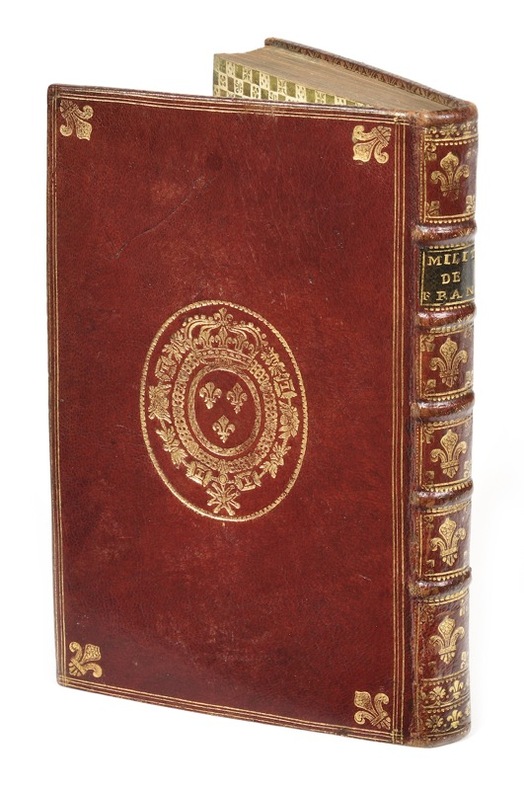
réf. 10689Paris, chez l’auteur, Quillau, Briasson & Jaillot, 1734. In-12 (167 x 102 mm), VIII pp., 200 pp. Maroquin rouge, triple filet doré d’encadrement sur les plats, fleur de lys en écoinçon, armes de la maison royale de France au centre, dos à nerfs orné, fleur de lys en caisson et en écoinçon, pièce de titre en maroquin vert foncé, roulette dorée sur les coupes et les chasses, tranches dorées sur marbrures, gardes de papier dominoté de petits carrés dorés alternés de petits motifs dont la fleur de lys, petite tache sombre sur le premier plat (reliure de l’époque).
réf. 235037[Paris], Dépôt de la Guerre, 1817 - 1818 grand in-folio, demi-veau vert moucheté, dos à nerfs orné (reliure postérieure).
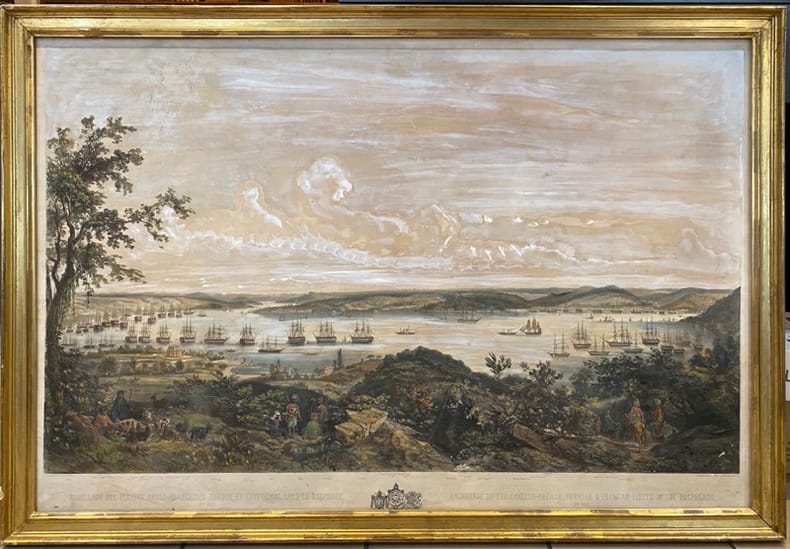
réf. 210664A Constantinople, A. Percheron et J. Schranz, Paris, Imp. de Jacomme & Cie, (1854) 89 x 129 cm, lithographie en deux tons, mise en coloris de l'époque, en feuille, sous cadre doré ancien. Sans verre.