29 026 résultats
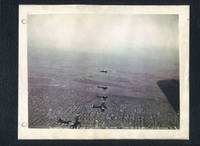
1923réf. 42800Mitchel Field Long Island NY: U.S. Army Air Service 1923-1925. 1923-1925. Archive of 57 original aerial photographs from the 8th & 14th Photographic Sections Air Service during the Aerial Mapping Survey of New York City and vicinity and the Northeast. 57 original photos mounted on thick card stock 10" x 8". 53 have identifications of place and Air Service Photo section at lower fore-edge of the images and all are printed on glossy photographic stock with some sepia-toned. The images encompass planes in formation over New York views of Manhattan the Statue of Liberty a factory fire in Jersey City Fort Ticonderoga the Zeppelin hanger at Lakehurst New Jersey Albany Philadelphia Hartford Exeter NH numerous Air Fields a scarce series of photos for the Jan. 24th 1925 Eclipse of the Sun and more. The Air Service was created by executive orders of President Wilson in May 1918 during World War I and would eventually expand to nearly 200000 personnel and 2000 aircraft by the end of the war producing planes as well as carrying out operations by aerial reconnaissance photo sections dirigibles balloons and fixed wing aircraft. By 1923 the peacetime cutbacks had slashed the Air Service down to just under 10000 men and 1450 aircraft including 15 photographic sections encompassing the above mentioned 8th and the 14th commanded from 1920 to 1925 by Brig. General Billy Mitchell. Mitchell campaigned tirelessly and bitterly until his court-martial at the end of 1925 to establish the Air Service as a separate military wing independent from the Army and Navy. To aid this mission he authorized a number of publicity stunts to emphasize the modernity and ability of the Air Service including aerial mapping projects speed and altitude records in cross country flying scientific projects and most famously the first flight around the world. The Air Service set up support facilities around the world for the fliers and in April 1924 sent four aircraft named Seattle Chicago Boston and New Orleans west beginning from Seattle Washington and led by Major General Mason Patrick Chief of Air Service. Two of the images in this collection show the two surviving Douglas World Cruisers which on Sept. 8 1924 stopped over in New York One of the photos shows a formation including the New Orleans flown by Lieutenants Eric Nelson and John Harding. They would complete the circumnavigation on Sept. 28 1924 in Seattle nearly 3 weeks later after these photos. The earliest of the dated photos shows 5 DH-4Bs flying in formation on November 20 1923 over Manhattan. The DH-4Bs set records of flying aloft through aerial refueling. The images dated July through November 1924 by the 8th Photo Section during their Aerial Survey mapping projects include Hartford Bridgeport and New Haven CT; Air Port in Boston MA; Fairgrounds at Brockton MA; Exeter NH; Providence and Connecticut Island RI; as well as 2 photos of a Nov. 1924 fire in the industrial section near the docks in Jersey City NJ showing tugboats nearby as well as smoke billowing above the factories damaged by the fire. Images by the 14th Photo Section include the airfield and hangar Lakehurst Naval Air Station NJ which was the home of the ZR-3 Los Angeles dirigible and would later be the site of the Hindenburg disaster; 3 photos of Mitchell Field Long Island NY; landing fields in Van Cortland Park Bronx NY; Governors Island; 2 photos of Roosevelt Field and downtown Albany at Albany NY; aerial views of the Statue of Liberty lower Manhattan including nice images of the Manhattan and Brooklyn Bridges; Fort Ticonderoga; Niagara Falls; Philadelphia; and photographs mapping the area around Mt. Mansfield Vermont. Of particular interest are the series of 11 photographs showing the sequence of the total solar eclipse on Jan. 24th 1925 over Connecticut. The skies were cloudy but 12 planes the ZR-3 Los Angeles dirigible and many scientists and men with special cameras and instruments recorded the event. Ten of the photographs here are marked in stages for the eclipse and an additional separate initial view that is marked Eclipse of the Sun 14th Photo Section Air Service U.S.A. This collection offers an excellent historical record of the early years of U.S. aviation as well as views of the Northeast during the 1920's. All of the images are quite crisp with almost no fading and have two small holes at the left gutter margin where they were apparently stored originally in a two- ring binder. Minor bumping and chipping to some corners of the boards. A few images have lifted at the corners and a couple have very minor loss one with creasing to center of image though not affecting the quality of the image. A remarkable collection of a scarce series of aerial photographs taken by the 8th and 14th Photographic Sections of the U.S. Army Air Service. U.S. Army Air Service, 1923-1925. hardcover
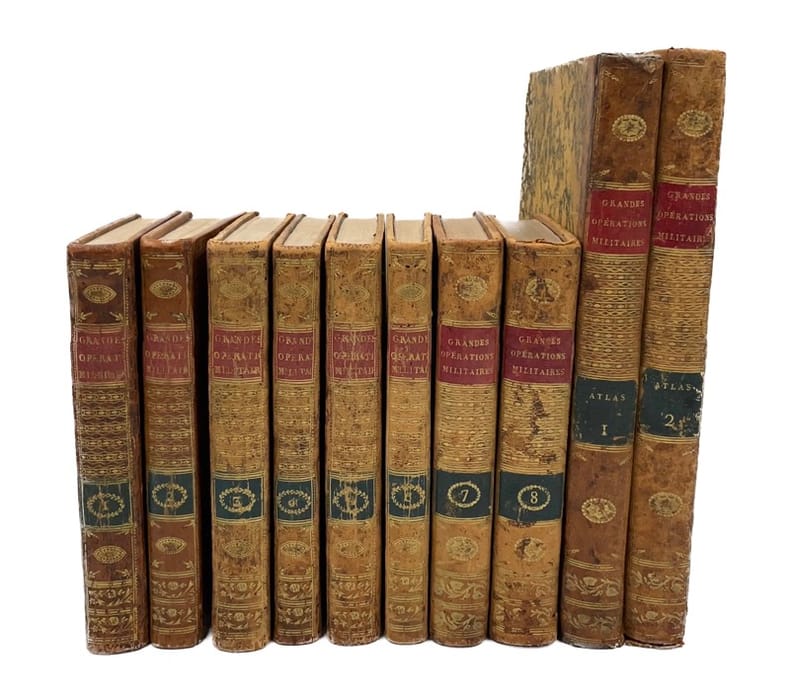
réf. 216299Paris, E. Bernard, 1890-[1893] 11 parties en 15 vol. grands in-8 de texte ; 5 vol. in-folio d'atlas, demi-chagrin Bradel bordeaux, dos fleuronné, pièces de titre vertes, têtes rouges (reliure de l'époque). Nombreuses pièces de titre manquantes. Épid.
réf. 189178S.l., s.d. in-4, 6 planches finement aquarellées, de 21,5 x 28 cm, avec sujets dans une large bordure citron, légendées en allemand (sauf la dernière, en français), en feuilles sous chemise de chagrin azur à recouvrements de toile et lacets, dos lisse muet (reliure moderne). Bon exemplaire.
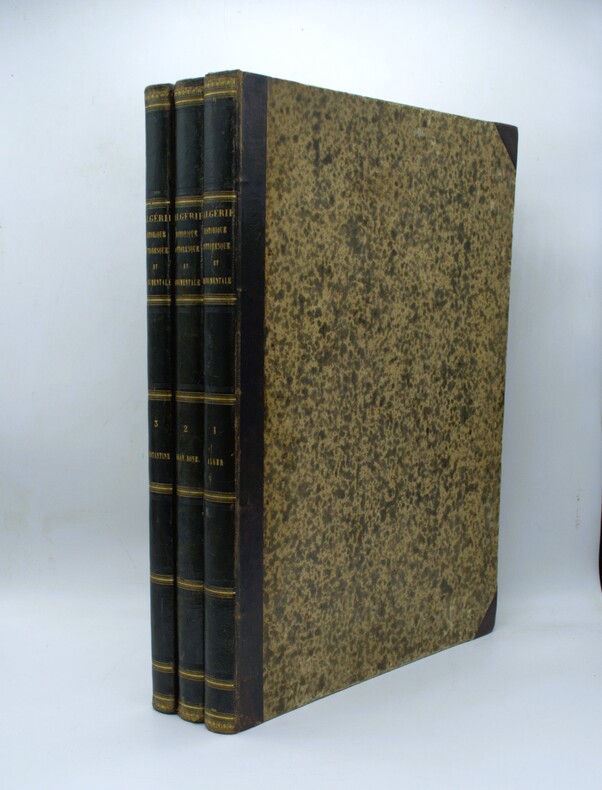
1843réf. PHO-2292Paris, Chez J. Delahaye Éditeur, 1843. Cinq parties reliées en 3 volumes in-folio demi basane brune à coins, dos lisse cloisonné de filets or, titre doré (Koenig). Quelques planches roussies, comme toujours, petites rousseurs.
(ca. 31,5 x 23 cm). 2 S. (Fraktur). Original-Zeitung im kleinen Format, beidseitig bedruckt, mit Titel im oberen Bereich. Papier gebräunt und gefaltet, sonst wohlerhalten. Altersentsprechend guter Zustand. Sehr interessante Zeitung aus den letzten Tagen des Zweiten Weltkriegs. Aus dem Inhalt: Sowjets bei Fehrbellin geworfen / Die Schicksalsfrage / Eine Stunde mit kampfbewährten Hitlerjungen / Dem "Stalin"-Panzer überlegen / Das Bollwerk der Sechzehnjährigen / Triumph der Beharrlichkeit. Die Zeitung für die Soldaten der Wehrmacht und weitere versuchte auch in der aussichtslosesten Situation - wenige Tage vor dem Suizid Hitlers und der folgenden Kapitulation - noch zu mobilisieren. Die Rede ist hier überall von Entschlossenheit zum Kampf und von vorgeblich neuen Erfolgen in der Abwehr des Feindes. Über solche tendenziösen Meldungen geht der Text "Die Schicksalsfrage" noch hinaus. Dieser berührt sehr gut den gesteigerten Fatalismus bei Teilen der hitlertreuen deutschen Bevölkerung in den letzten Kriegsmonaten. Es heißt hier: 'Die Sirenenklänge des Agitationsjuden, wie: "es würde schon nicht so schlimm werden", wenn Deutschland die Waffen niederlegte, oder: es handele sich ja nur um einen "Krieg gegen die Nazis", verfangen schon längst nicht mehr bei dem deutschen Volk Adolf Hitlers. Auf der anderen Seite ist man ja im Gegnerlager unvorsichtig genug gewesen, besonders im letzten Jahr, die Katze vorzeitig aus dem Sack zu lassen. Sie haben ja oft und zynisch offen genug in die Welt hinausposaunt, was sie mit uns, dem deutschen Volk, im Falle eines Sieges der Alliierten - lies Weltjuden - vorhaben. Angefangen mit den hysterischen Entmannungs- und Sterilisationsplänen des Juden Kaufmann aus Neuyork, über die bolschewistischen Sibiriendeportationspläne, bis zu den Absichten, aus Deutschland eine ewige Wüste zu machen [...]." Auch ein Zeugnis des propagandistischen Eifers bis zum letzten Moment ist der kleinere Schlusstext "Triumph der Beharrlichkeit". Hier wird eingangs auf ein Zitat Friedrichs den Großen im Siebenjährigen Krieg referiert: '"Deutschland befindet sich zur Stunde in einer furchtbaren Krisis. Mir ward die Aufgabe zuteil, ganz allein für seine Freiheiten, seine Rechte und seine Religion einzustehen [...]"'. Später heißt es dann: "Was für die preußische Geschichte gegolten hat, gilt heute für die des Großdeutschen Reiches. Auch damals stand der Feind tief im Land und verwüstete Städte und Dörfer, auch jener Krieg kostete Blut und Opfer, brachte Tränen und Verzweiflung. Ueber allem aber triumphierte schließlich eine durch nichts zu erschütternde Beharrlichkeit. So und nich' anders ist es auch heute! / Daran wollen wir denken / Danach wollen wir handeln!". Auf die Propaganda-Kompanie "Eichkater" geht die Zeitung "Frontnachrichten" der Kriegsjahre zuvor zurück. Hier handelt es sich um eine Zeitung der Kompanie aus den letzten Kriegstagen. Ob diese Zeitung in weiteren Ausgaben bis Kriegsende erschien scheint fraglich. Es handelt sich nach unseren Recherchen um eine mehr als seltene Publikation der letzten Kriegstage, welche auch in Archiven so gut wie unauffindbar scheint. Äußerst seltene Archivalie und historisches Dokument aus letzten Tagen des NS-Staats!
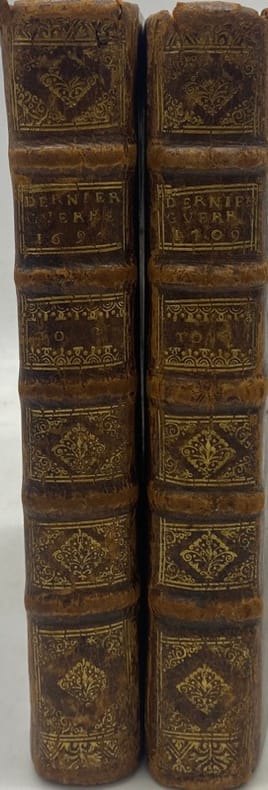
réf. 216041S.l., s.d. (1726) 2 vol. in-4, titre, 155 ff., ff. 47-49 reliés par erreur après 51, avec 12 tableaux dépliants hors texte ; titre, 137 ff. (avec de nombreuses erreurs de chiffrage), avec 29 pièces dépliantes hors texte, manuscrites ou imprimées, écriture moyenne et d'une lisibilité variable (environ 30 lignes par page), basane brune granitée, dos à nerfs cloisonnés et fleuronnés, tranches mouchetées de rouge (reliure de l'époque). Dos légèrement frottés.
réf. 225247S.l., s.d. (1820) in-4 oblong (26 x 33 cm), un portrait de Napoléon gravé en noir en médaillon, et 11 aquarelles sur papier contrecollé, signées et datées, mais non légendées, demi-veau Bradel violine, dos muet, plat de toile gaufrée (rel. un peu postérieure). Aquarelles détachées des onglets.
réf. 233862Paris, Alexandre Jombert Jeune (de l'Imprimerie de François Ambroise Didot l'aîné), 1783 2 parties en un vol. in-4, [7] ff. n. ch. (faux-titre, titre, dédicace, table), 116-60 pp., un feuillet non chiffré (approbation et privilège), avec une belle vignette en-tête héraldique en couleurs, et 11 très belles planches dépliantes insérées sur le mode de collettes summitales, très finement gravées et colorisées par Louis-Martin Bonnet, sous serpentes, légendées chacune d'un feuillet de texte ; exemplaire dans lequel il y a interversion alternante des ff. 33-34 à 39-40 de la première partie, sans manque, veau fauve écaille, dos lisse orné, tranches marbrées (reliure de l'époque). Mors restaurés.
réf. 209874La Haye, Hendrik Hond, 1632 in-folio, [4] ff. n. ch. (titre gravé avec grande figure allégorique, dédicace aux Etats des Provinces-Unies, au lecteur, privilège et table des planches), 21 pp., puis pp. 21-65, [2] pp. n. ch. de table des matières, avec 26 figures gravées dans le texte (dont une avec collette dépliante), et 10 planches hors texte (9 à double page ou en dépliant montrant les différents cantonnements de l'armée, un plan à simple page entre les pp. 64 et 65, non signalé à la table des figures), réparation de papier angulaire f. 39-40, veau blond à l'imitation, dos à nerfs orné de caissons dorés, grand encadrement de guirlande, pointillé, triple filet dorés avec larges décors floraux en écoinçon sur les plats, double filet doré sur les coupes, tranches dorées, dentelle dorée en encadrement sur les contreplats (Ch. Weill, Orléans).
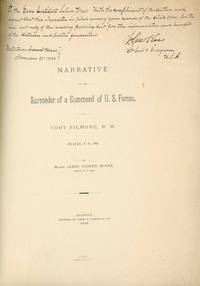
1886réf. 47058Boston: Printed By John A. Lowell & CO. 1886. 1886. First edition. 11" x 8 3/4" Original plain stapled wrappers 32 pp. introductory maps index. Third edition according to Howes M125 and the only edition with maps. He also notes 300 copies printed but only a few have been on the rare book market. AE locates only the 1960 Houston edition and only one copy of the 1886 edition in 1922. Eberstadt’s had a copy of the 1886 edition in 1954. In our copy there is a long presentation note to Essex Institute Salem Mass.: "With the compliments of the author and request that this narrative be filed among your records of the Civil War for the use not only of the reading public but for the information and benefit of the Historian and future generations." Graff 2621. Nicholson p.586. Nevins I p.126: "Important only because it recounts a singular and unknown event in an isolated region." Tis book includes eye-witness accounts of the battle at Old Mesilla the first clash in the far west between Union and Confederate forces. In July 1861 Texas Confederates hit the Union outpost at Fort Filmore 40 miles north of El Paso. Under the command of Major Isaac Lynde the fort was surrendered after very little resistance and McKee a young Union surgeon privately published this bitter account. The first edition was printed in very small quantities for friends. This edition is the best edition and a well written account. McKee added an index and two maps not found in the first or second editions. All are very rare. A faint library stamp to the top corner of the front cover minor chipping and nicks to the cover fore-edges else a near fine tight copy. Printed By John A. Lowell & CO., 1886. unknown
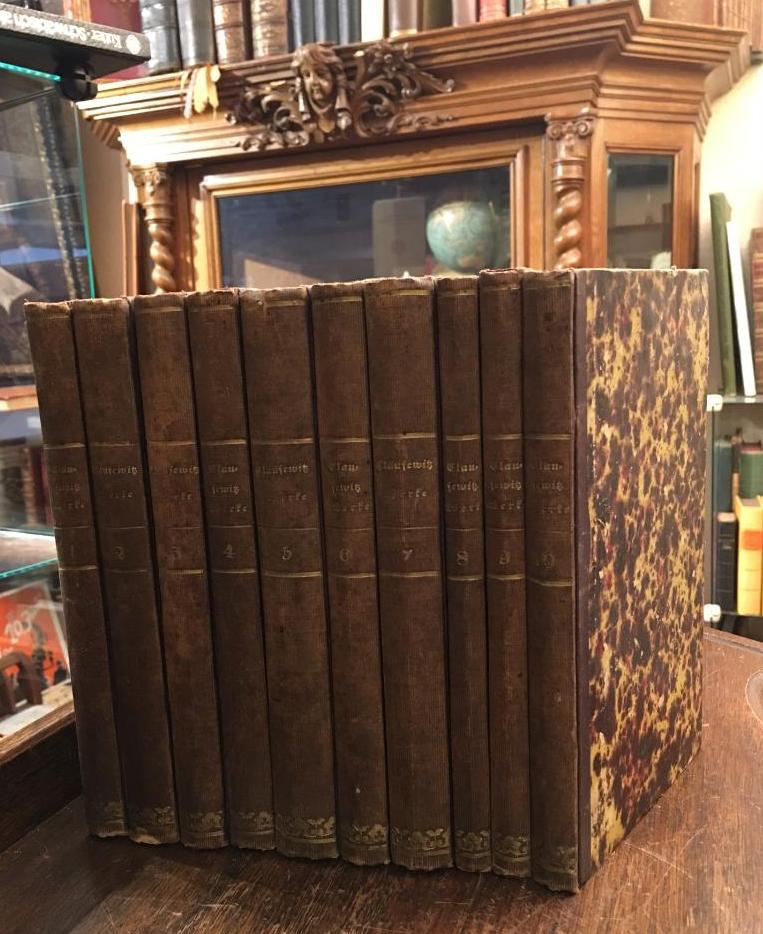
1857réf. 51098ABBerlin, Ferd. Dümmler's Verlagsbuchhandlung, 1857-1863. 8° (21x14), XXIV,318 S., 1 Bl.; VI,386 S.; VI,330 S.; (VI),297 S., mit mehrfach gefalteter lit Karte; (IV),463 S.; VI,339 S.; XII,404 S., mit 1 mehrfach gefalteten gestochenen Karte und 1 mehrfach gefalteten Tab.; VI,194 S.; XX,235 S.; VIII,296 S., einheitl marmor Hlnbde d.Zt mit goldRTitel, 10 Bände in 10 [so komplett], [4 Warenabbildungen] 2. Aufl. unveränderter Abdruck kleiner Besitzvermerk, teils etwas stockfleckig, gelegentliche Marginalie von alter Hand, gute gepflegte Exemplare,
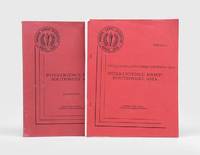
réf. 179352Washington DC & Arlington Virginia: Specialized Skill Training Department Marine Corps Institute 1998 & 1991. Preparing the USMC for desert warfare A scarce set of training and examination manuals with exercise questions completed by an unknown marine. They are a basic introduction designed to familiarize the corps with desert warfare terrain and the cultures and histories of the Middle East. We have traced no records of a two-volume set. The US army had little experience of desert warfare prior to the Gulf War 1990-91. "For many years US doctrine failed to address desert warfare. During World War II US forces suffered heavy losses in the opening phase of the North Africa Campaign 1942-43. Stung by these defeats American forces learned quickly and fared somewhat better later. After the war American military doctrine focused on the defence of Europe and desert warfare was again ignored" Chambers p. 212. Brief is a 10-lesson course "designed to familiarize the student with the terrain weather climate physical environment armed forces and the geopolitical and sociopolitical influences which apply to military operations in the area" p. i. It covers four units: "Introduction" "Military and Paramilitary Forces" "Terrorism" and "Culture Economics and History". Each unit is illustrated and includes a set of exercise questions which in this copy have been filled in. Readings was to be consulted alongside the Culture Economics and History unit of Brief. The 27 articles are mostly by Westerners such as John Bulloch Bruce Kuniholm Edward Mortimer William Polk and Maxime Rodinson. The Lebanese academic Fouad Ajami is an exception as is Palestine-US historian Rosemarie Said Zanian Edward Said's sister. The articles explain Saddam's actions in Iraq the history of Islam the Iranian Revolution Saudi Arabia's oil industry US policy in Palestine and many other crucial areas. Readings is the 1991 first edition of which only six copies are listed on WorldCat in American military institutions. Brief is the 1998 reissue listed with no known locations. 2 vols octavo. Illustrations maps and tables throughout. Original red paper wrappers. Brief: front wrapper lettered in black stapled without rear wrapper; Readings: spine and front wrapper lettered in black. Exercise questions in Brief sometime completed in pen answer key to Unit II exercises excised and loosely inserted answer key to Unit IV exercises missing. Wrappers creased and a little scratched light abrasions to wrapper edges of Readings old adhesive remains to p. 1 of Readings contents bright: a very good set. John Whiteclay Chambers The Oxford Companion to American Military History 2000. unknown
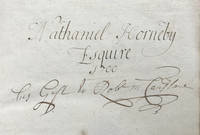
1697réf. 57867PEACETIME ARMIES ENABLE ABSOLUTISM - AN IMPORTANT DEBATE WITH ENDURING IMPLICATIONS - GIFTED BY A JACOBITE LONDON BANKER TO AN IRISH LANDOWNER Collection of 5 items bound together on the issue of a Standing Army being:- TRENCHARD John An Argument shewing that a Standing Army is inconsistent with a Free Government and absolutely Destructive to the Constitution of the English Monarchy. London: Printed in the Year: 1697 4to. iv numbered v in error 30 2 advertisement & blankpp. . bound with MOYLE Walter The Second Part of an Argument shewing that a Standing Army is inconsistent with a Free Government and absolutely destructive to the Constitution of the English monarchy. With remarks on the late published list of King James's Irish forces in France. London: Printed in the Year: 1697 4to. 27 1 blankpp. . bound with SOMERS John A Letter ballancing the Necessity of keeping a Land-Force in times of Peace: with the Dangers that may follow on it. London: Printed in the year: 1697 4to. 2 blank 2 title 16pp. complete with preliminary blank . bound with TRENCHARD John A Letter from the Author of the Argument against a Standing Army to the Author of the Balancing Letter. London: Printed in the Year: 1697 4to. 15 1 blankpp. . bound with FLETCHER Andrew A Discourse concerning Militia's and Standing Armies with relation to the Past and Present Governments of Europe and of England in particular. London: Printed in the Year: 1697 4to. 2 30pp. The five items bound together in contemporary mottled calf decorative blind tooled panels on sides marbled endpapers very small stain at outer top corner of the last two items small piece of shaved calf repair to the calf skin prior to binding flaked away near upper edge of rear board else a fine fresh copy. Contemporary signature on title of first item "Natt. Horneby" and inscribed on a preliminary blank leaf in a calligraphic hand "Nathaniel Horneby/ Esquire/ 1700" and below that probably at a slightly later date "his gift to Robt. Mc Causland". 1 Trenchard: ESTC r509611 WING T2110. This issue has a press-figure dagger only on leaf B1v and an advertisement on final leaf. Signature C2 is under the "ere is" of "there is". This edition is rare with ESTC locating 5 copies only 2 in B.L. 2 in Oxford & 1 other. See ESTC R16216 for another edition. Wing does not distinguish between the editions. 2 Moyle ESTC r177336 WING M3030 ESTC notes "The first part entitled An argument shewing that a standing army is inconsistent with a free government was written by John Trenchard and Walter Moyle. It is often thought Trenchard also assisted in the second part; however attributed solely to Moyle by BM Wing". 3 Somers ESTC r11547 WING S4642 4 Trenchard ESTC r16213 There are 2 printings this one line 8 of title page has: 'Balancing'; there is no press-figure on p. 7; p. 15 has additional paragraph beginning: "Now Sir if a Parliament should subject all the Lands .". WING T2113 5 Fletcher ESTC r5238 WING F1294 Following his invasion of England in 1688 the Glorious Revolution William of Orange became King William III and reigned jointly with his wife Mary. The English parliament's Bill of Rights of 1689 established a constitutional monarchy with extensive restrictions on the royal prerogative. One of those restrictions was that the Sovereign could not raise a standing army during peacetime without parliamentary consent. While William opposed such constraints he accepted them and chose not to engage in a conflict with Parliament. In the following years William was much engaged in European wars that ended with the Treaty of Ryswick in 1697. The wars now over parliament to the king's displeasure decided to reduce the size of the army to 10000 men and later to 7000. The ideological and political significance of the issue was argued out in a series of pamphlets of which these five are probably the most important on both sides of the issue. "The pamphlets . had a powerful effect upon the immediate controversy of 1697-99. The anti-army tracts moreover played a vital role in the formulation of an anti-army attitude which lived on in eighteenth century England and was transmitted along with many other ideas in liberal and republican seventeenth political thought to the American colonies. . Against the peacetime army were principally John Trenchard Walter Moyle Andre Fletcher of Saltoun the Rev. Samuel Johnson and John Toland. Arguing for the king's proposal were chiefly the lord chancellor John Somes and Daniel Defoe . Outstanding among the men who opposed the army was John Trenchard who may be regarded as the leader of the pamphleteers" Schwoerer. Trenchard 1662 - 1723 educated at T.C.D. studied law in London and was a man of considerable wealth through inheritance and marriage. From initial support of the 1689 Revolution he became disenchanted with William and used his wide knowledge of sixteenth and seventeenth century republican political thought to oppose what he judged to be a potentially dangerous power grab by the monarchy. His Argument written in conjunction with Moyle the first pamphlet in this collection launched the debate and determined its parameters. Moyle's Second Part continued their argument. Somers apparently without great conviction argued for retention of a standing army and Trenchard in turn wrote a riposte. Fletcher of Saltoun 1655 - 1716 Scottish writer patriot and politician had returned from European exile with William of Orange in 1688 but terminated his support when he judged that William also King of Scotland was only interested in using the country to help fight foreign wars. He like the other anti-army writers argued that history indicated a direct relationship between absolutism and a peacetime army. He perceived a decay in liberty around 1500 a product of economic and social changes that produced luxury and an abandonment of an old frugal military way of life. Such circumstances allowed defence of the realm to slip into the hands of princes who eliminated ancient rights and freedoms. England the last bastion of liberty faced following 'all the other kingdoms of Europe' along this path unless she avoided a standing army in peacetime. Trenchard and his supporters the group of Whig religious political and economic reformers later sometimes Commonwealth men through their writings promoted republicanism in Britain. However while they were rejected in Britain their ideas were widely influential in British colonial America and on Republicanism in the United States. Nathaniel Hornby or Horneby a London goldsmith and banker served as a Commissioner of Excise 1683 to 88 and in 1691. From the Restoration in 1660 to 1683 the state's excise was farmed out to investors willing to pay the government for the right to collect taxation. In 1683 a new group of Commissioners was chosen to be more efficient in collection than the foregoing. The Revolution of 1688/89 overturned the leadership of the excise branch and only 2 of the 7 Commissioners in office in Feb. 1688 survived a purge in April 1689 with most removed for political reasons. In 1684 when a remodelled department was considered "Sir John Somers whose influence was rising as the Whigs ascended recommended dismissal for virtually all of the commissioners. In particular he singled out Nathaniel Nornby and Thomas Aram who 'were such avowed Jacobites that there was nothing to be said for them'" Krenzke. Nathaniel Hornby perhaps to provide himself with a bolt-hole far from London in the early 18th century rented a house and farm at Muff now Eglinton in Co. Londonderry from Ireland richest commoner and Speaker of the Irish parliament William Conolly himself a head tenant of the London Grocer's Company. Robert McCausland lived at Fruit Hill now Drenagh only a few miles from Muff and near Limavady. That estate was bequeathed to him on his death by William Conolly in 1729 and thereafter alternate eldest sons in the family were named Conolly. Modern McCausland family sources state that Robert was married to a daughter of Conolly but the latter was officially at least childless. Conolly did however support the families of his siblings which may be the connection. Evidently it was as neighbours that a rich London Jacobite banker came to know McCausland and present him with an important collection of pamphlets flagging the perils of creeping central power. From the inscription both men perceived the pamphlets as significant both in themselves and as a gift. Lois G. Schwoerer 'The Literature of the Standing Army Controversy 1697-1699' Huntington Library Quarterly vol. 28 no. 3 1965 p. 187-212 John Krenzke Change in Brewing. Industrialization of the London Beer Brewing Trade 1400-1760. hardcover
1944réf. 62-187N.P. 1944 or 1945 1944. Probably published in Germany at war's end. Complete 7 Volume set. Including all 20 Annexes. Folding Maps. Photos. Original blue cloth. Oversize. This set belonged to LT. Col. J. S. Stom Thurmond. He served on the Army staff as Public relations Officer during the later part of the war in NW Europe. He is not listed on the staff for the period covered by this set. His name & military address are both hand written & rubber stamped on the flyleaf. In later life Thurmond was of course the long term Senator from South Carolina. Each volume has a mylar jacket with the last owner's shelf label. Fine Set. Hardcover. Fine. N.P., 1944 or 1945 Hardcover
réf. 221827S.l., s.d. (vers 1860) in-4, titre (détaché), 202 pp., couvertes d'une écriture fine, régulière, extrêmement soignée (environ 25 lignes par page), présentant aussi des notes infra-paginales de la même main, des biffures et ajouts au crayon de bois semblent postérieurs à la rédaction, de même que quelques ajouts marginaux à l'encre d'une autre main, demi-chagrin Bradel bouteille, dos muet orné de filets à froid, encadrements de filets à froid sur les plats de toile chagrinée, titre poussé en lettres dorées au centre du plat supérieur, tranches jaunes (reliure de l'époque). Plat supérieur un peu taché.
réf. 239499S.l., 1914 - 1917 7 carnets in-16, in-12 ou in-8, [759] ff. n. ch. [Cahiers II-VII] ; 287 pp., avec 2 ff. différents chiffrés 167-68 [Cahier VIII], percaline ou toile noire, le tout dans une grande boîte (33 x 23 cm) de demi-toile verte (reliures de l'époque).
réf. 203897S.l. [Saumur], A. Degouy, s.d. (1835) in-folio, [4]-7 pp. de texte sur deux colonnes (titre gravé, préliminaires), puis pagination multiple, avec 16 planches lithographiées hors-texte ; exemplaire dans lequel la grande figure centrale des planches a été soigneusement mises en couleurs (les sujets l'entourant à chaque fois en marge restant en noir), demi-maroquin vert à coins,dos lisse orné de deux grands fers romantiques (rel. un peu postérieure). Rousseurs et papier parfois bruni.
réf. 239762À Paris, Chez Magimel, 1811-1816 8 vol. in-8 et 2 atlas in-4, nombreux tableaux dépliants h.-t. représentant les ordres de batailles, rehauts de couleurs à certaines cartes, basane fauve, dos lisse orné (reliure de l'époque). Petites usures.
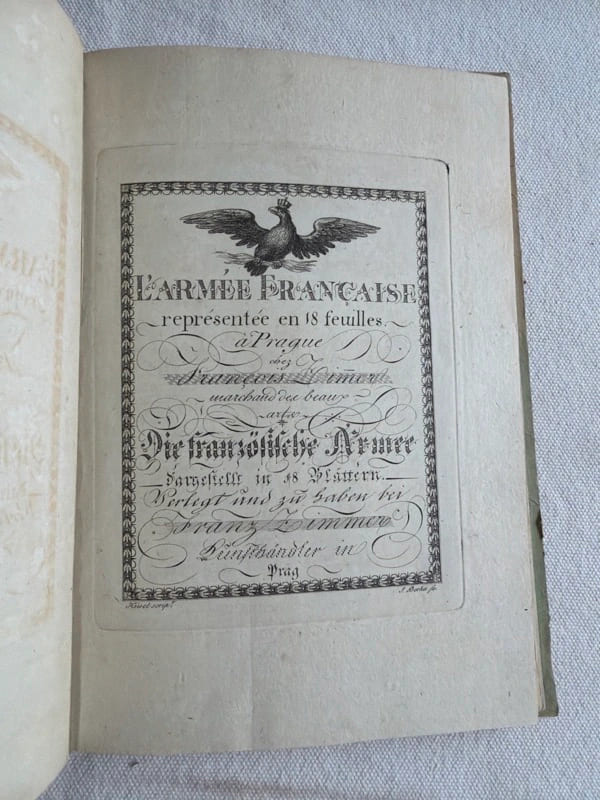
réf. 235036Prague, Franz Zimmer, s.d. (1812) petit in-4, cartonnage vert d'eau à la Bradel, titre dans un cartouche contrecollé sur le premier plat (reliure de l'époque). Dos et une partie des plats décolorés, planches 8 et 14 un peu plus courtes en pied.
réf. 217709Paris, Société des Éditions Militaires, 1929-1931 4 vol. in-4, maroquin rouge, plats mosaïqués de listels de maroquin bleu, blanc et rouge, filets dorés, dos orné de même, listel de maroquin bleu et filet doré d’encadrement intérieur, garde de tabis rouge, tranches dorées (Charles Benoit).
réf. 222956S.l., s.d. (vers 1812) 4 parties en 2 forts vol. in-folio, titre, 623 pp., [2] ff. n. ch. de table ; 147 pp., 345 pp., 405 pp., [5] ff. n. ch. de table, le tout couvert d'une écriture fine, élégante et très lisible (environ 30 lignes par page), avec de nombreuses collettes, quelques illustrations dans le texte, et 12 planches hors texte (dont 5 imprimées, 7 manuscrites), demi-basane fauve granitée à coins, dos lisses ornés de filets et dents-de-rat dorés, pièces de titre cerise, tranches mouchetées de rouge (rel. de l'époque). Charnières en parties fendues, nombreuses épidermures, manques de cuir au vol. II.
réf. 172777(1800) , 28 pp. in-4 en cahier.
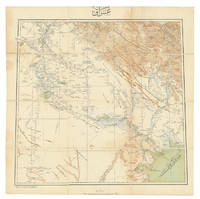
1915réf. ABC_47201Istanbul: Erkan-i Harbiye-i Umumiye 1915. Colour-lithographed map of Iraq Kuwait and southwestern Iran 65.5 x 66 cm in black brown blue and green at a scale of 1:1000000 dissected into 12 sections and mounted on contemporary cloth. First edition of the first accurate Ottoman general map of Central and Southern Iraq Kuwait and Khuzestan southwestern Iran; the authoritative map used by the Ottoman army for strategic planning during the "Mesopotamia Campaign" where Ottoman-German forces mounted a unexpectedly strong resistance to Britain's invasion of Iraq in World War I. Examples of the present map were used by Ottoman commanders who oversaw the successful Ottoman-German defence of Baghdad at the Battle of Ctesiphon 22-25 Nov. 1915 as well as the capture of the main British army at the Siege of Kut-al-Amara 7 Dec. 1915-29 April 1916. It shows the tip of the Gulf and the Tigris and Euphrates vallies including Kuwait most of Iraq and Khuzestan province in southwestern Iran. Mountain ridges are rendered in brown with rivers and marshes in blue permanent bodies of water in green and parallels and meridians at every degree ranging from about 43.5 to 49.5°E longitude and 29 to 34°N latitude. With the text entirely in Ottoman Turkish the map is based on the British War Office's "Lower Mesopotamia between Baghdad and the Persian Gulf" 1911 which was itself in part based on Ottoman sources. Both maps were dramatically superior in all respects to previous efforts forming the culmination of over three generations of reconnaissance capped by critical late-breaking discoveries.Some light stains in the margins and the lower-right quadrant but generally in good condition. Very rare. [Erkan-i Harbiye-i Umumiye], hardcover
1777Ensemble de 15 volumes de format in 4° carré; reliure uniforme de l'époque en demi veau fauve richement orné; illustré de 179 planches gravées et numérotées (sur 193). Le volume XII est entièrement consacré à la vie de Confucius avec de superbes planches. Célèbre et monumentale histoire de la Chine dans tous ses aspects, militaires, agricoles, religieux, géographiques, généalogiques... Une encyclopédie sur la Chine à l'usage des Européens. Notre exemplaire ne comprend pas les planches hors texte des T. I et II; sauf le portrait frontispice du Tome I et présente donc 152 planches hors texte sur 166; ou 179 planches numérotées sur 193. Les tomes III à XV sont bien complets . Quelques petits défauts de reliure et travaux de vers intérieurs principalement en marge. Deux volumes de suppléments parurent en 1814. Curieuse signature manuscrite "Montgolfier" sur chaque page de titre. Voir les photos.
réf. 10650Paris, Lambert, Valade et chez l’auteur, 1779. Deux volumes in-12 (164 x 96 mm), 2 ff. n ch., 12 pp., 499 pp. ; 2 ff. n ch., 687 pp., 4 pp. n. ch. Maroquin vert olive, triple filet doré sur les plats, armes au centre, dos à nerf orné de motifs dorés, filet doré sur les coupes, roulette sur les chasses, tranches dorées, gardes de papier décoré d'un semis alterné d'étoiles et de points dorés, mors légèrement frottés, charnière fendue sur 2 cm en pied du second volume et infime manque de cuir à la coiffe de queue, petite auréole sur la page de titre (reliure de l’époque).