32 388 résultats
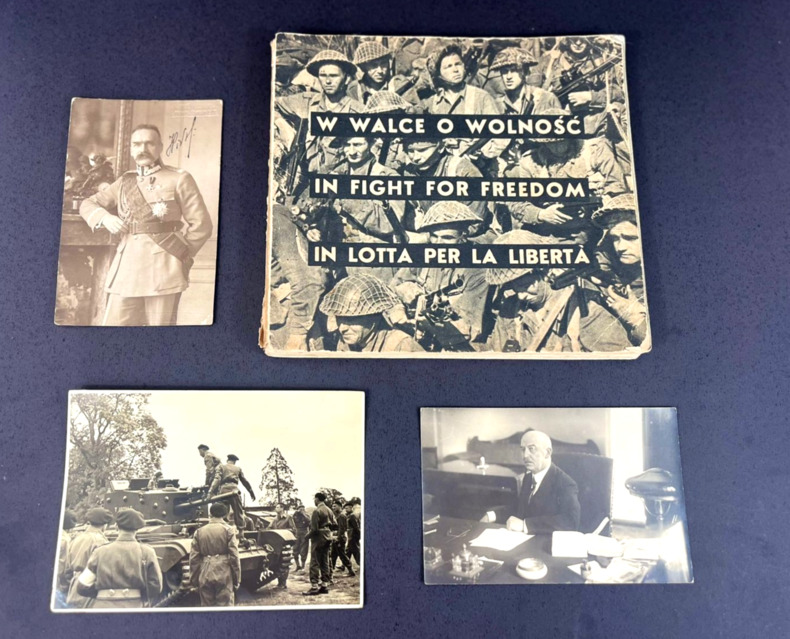
1945réf. 517This is a set which belonged to Janusz Gluchowski, a high-ranking Polish military officer at the time of the WW2. The set contains three original B&W pictures. First one: undated postcard showing Marshal Jozef Pilsudski, signed by himself in black ink, 8.5 x 13.5 cm, with two embossed mentions above and below. Second picture: undated postcard showing Poland President Gabriel Narutowicz, with a written mention on the back. Third picture: 11 x 15.5 cm photograph. General Tadeusz Bór-Komorowski inspecting a British Cromwell tank, accompanied by Polish officers of the 3rd Armored Regiment (3 puk pancerny). The image was captured during an official ceremony in the city of Kelso, Scotland, in the immediate post-war period, on June 15, 1945. The scene shows the General in an observation position, climbing onto the tank while surrounded by Polish soldiers. The tank corresponds to a British model widely used by Polish forces in exile during the Western European campaign. On the reverse, the following handwritten inscriptions appear: VI 1945, Kelso. N. Wódz gen. Bór-Komorowski dokonuje inspekcji 3 p. panc. N. Wódz w towarzystwie bryg. puku na czogu." / June 15, 1945, Kelso The book is an illustrated three-languages (Polish, English and Italian) set commemorating the struggles of the Polish II Corps. Edited by Wyda Rererat [Referat] Kultury i Prasy Kresowej Dywizji Piechoty in Rome, 1945. Oblong book of 21 x 19 cm, unpaginated (144 pp.). Cover detached. Endpapers and first page show Janusz Gluchowski's stamp. In publisher's photographically illustrated wrappers. Each page contains a photographic image or a photomontage accompanied with a short text in three languages. Front cover shows some wear and tear, the binding is a bit loose - we would advise having this book bound. The Polish II Corps was a major tactical and operational unit recruited from Polish deportees in the Soviet Gulags in 1943. First they fought in the Middle East, and in 1944 February they were transferred to Italy and as independent part of the British Army to fight in the Italian campaign, in the battles of Monte Cassino and Ancona and also the Battle of Bologna during the final offensive in Italy in 1945. The book goes through the story of Poland and the later established Polish II Corps, starting with the German and Soviet occupation in 1939. It shows the deportation of Poles to forced labour to the Gulag and, after the Polish-Russian Military Agreement in 1941, the establishment of the Polish Army on Soviet soil, also their military training and their fights in various battles. Janusz Julian Gluchowski was a Major General in the Polish Army during the Second Polish Republic. He was born on August 6, 1888, in Bukowa. He fought in the Polish Legions in World War I, the Polish-Ukrainian War, the Polish-Soviet War, and the invasion of Poland by Nazi Germany, Slovakia, and the Soviet Union in 1939, which culminated in the start of World War II. In his adolescence, he attended high school in Czstochowa. In 1905, he became a member of the Combat Organization of the Polish Socialist Party and was wounded in the hand during an attack near Czstochowa. To avoid arrest by the Russian authorities, he left for Belgium, where he studied at the University of Liège. He returned to divided Poland around 1910 and settled in Austrian Galicia. In 1912 he graduated from the Officers' School of the Riflemen's Association in Stroza, near Krakow. In the early hours of August 1914, he commanded a platoon in Oleandria and was Wadysaw Belina-Pramowski's representative during the legendary attack of the so-called Seven Lancers of Belina (Uaska siódemka). On August 6th, together with the First Cadre Company, he left Krakow and marched to Miechów. In October 1914 he was promoted to Lieutenant (Poruchik) and, in November 1916, to Rittmeister (Cavalry Master). Until 1917 he served in the First Uhlan Regiment of the Polish Legions. After the Oath Crisis (Kryzys przysigowy) he was interned first in Fort Beniaminów and later in Werl. Released in October 1918, he went to Lublin, where, in early November, he formed the Third Ulan Regiment (later renamed the Seventh Ulan Regiment of Lublin). Along with his unit, he fought in the Polish-Soviet War. On May 29, 1920, he was promoted to Polkovnik. He was transferred in July 1920 to Eastern Galicia, taking command of the First Cavalry Brigade, fighting against the Soviets in Galicia and Volhynia. After the war, he remained in this position until 1925, when he was transferred to the Fourth Cavalry Brigade. Promoted to Brigadier General on March 16, 1927. Appointed commander of the Center for Higher Military Studies on June 4, 1930, and three years later, after the death of General Stanislaw Tessaro, he was appointed commander of Military District X in Przemyl. In October 1935, he became Deputy Minister of Military Affairs. In the early days of the 1939 invasion of Poland, Gluchowski ordered General Walerian Czuma to prepare the defense of Warsaw. In mid-September 1939, he fled to Romania. After his escape, he managed to travel to the Middle East and, in January 1941, received orders to go to London. In October 1941, he was appointed Commander of the Training Brigade stationed in Scotland. On September 23, 1943, he was appointed commander of all Polish Army units stationed in Great Britain, except the First Independent Parachute Brigade, which remained under the authority of the Commander-in-Chief. He was promoted to Major General on June 1, 1945. He decided not to return to Soviet-occupied Poland and remained in Great Britain. He frequently criticized the Soviet regime and the Soviet occupation authorities in postwar Poland. Furthermore, he was one of the founders and president of the Jozef Pilsudski Institute in London. He was, therefore, an active member of the Polish community in Great Britain. He was president and honorary member of several Polish veterans' organizations. He died on June 11, 1964, in London, England.
réf. 218204Lieux divers, 1809-1811 in-8 et in-4,
1839réf. 252PARIS. J. CORREARD, EDITEUR D’OUVRAGES MILITAIRES. 1839. IN-8 BROCHE (15 X 22,5 X 0,5 CENTIMETRES ENVIRON) DE (4) + 60 PAGES, COUVERTURE ORANGE IMPRIMEE EN NOIR. ACCOMPAGNE DE SON ATLAS (34 X 25 X 1 CENTIMETRES), RELIURE A BRADEL DE L’EDITEUR, CARTONNAGE ORANGE, TITRE IMPRIME EN NOIR, DE (4) PAGES ET 10 PLANCHES, DONT UNE EN COULEURS. EDITION ORIGINALE ET UNIQUE, RARISSIME AVEC SON ATLAS (INCONNUE DE TULARD). QUELQUES DEFAUTS EXTERIEURS, SINON BON EXEMPLAIRE.
réf. 235011À Paris, chez Antoine Boudet, 1744 11 vol. in-12, basane brune, dos à nerfs orné, tranches rouges (rel. de l'époque). Qqs épid. sur les plats.
1540réf. 003398Gaetano, in Venetia In-12 (15,5 x 11 cm), 1 bl., titre avec encadrement, 2 ff., 4 ff., 1 bl., 87 ff. numérotés, 1 bl., reliure demi-vélin crème, titre manuscrit au dos (reliure ancienne).
1592réf. 8-0-539Leiden, Platin, 1592. kl 8°(18x13cm), Titelvignette, mit Kupfern und Faltplan, 8 Bll., 320 S., 480 S., 31 Bll., Pergamenteinband d. Zt. mit spanischen Kanten
réf. AQ28162s.i.: s.n. s.d. c. 1875 Manuscript on paper. 98 leaves. Paper watermarked 1875. Contemporary red half-morocco red buckram boards ruled and lettered in gilt. Rubbed and marked. Marbled endpapers hinges exposed typed bookseller's description pasted to verso of FFEP first leaf detached. A Victorian manuscript copy in at least two unidentified hands of the general military order for several British Regiments during the campaign in Scotland 1745-46 including according to a later manuscript note to verso of FFEP those of Lieutenant Archibald Campbell of the 3rd Regiment of Dragoons who was aide-de-camp to General Bland and served under 'Butcher' Cumberland at the Battle of Culloden. Campbell's military order books have seemingly never been published; the originals are preserved at the National Army Museum NAM 1968-07-228. . Oblong 8vo. [s.n.], [s.d., c. 1875] hardcover
réf. AQ11379s.i. Portugal: s.n. 1815 In two volumes. 47pp 3 the remainder blank; 12 blank leaves with alphabetized tabs 35ff 41ff the remainder blank with some newspaper clippings relating to WW1 tipped in at end. A printed broadside 'Instructions to Cashiers of Military Chests' is pasted to the FEP of each volume. Contemporary reverse calf with attractive black morocco gilt lettering-pieces to upper board of each volume marbled endpapers. Rubbed and marked with some loss to calf at edges and bumping to corners. A fascinating pair of early nineteenth-century manuscripts albeit sparsely filled consisting of the details of substantial payments made on behalf of the British Army in Portugal and corresponding transfers between military chests and pay offices in Almeida and Lisbon during the tumultuous months of 1815 which saw Napoleon's return from exile in Elba the Hundred days rule and the final defeat of his French army at the Battle of Waterloo. The day book records money received and paid out and in some cases the circumstances such as receipts and instructions from various pay offices and military figures including 'Mr Commissary General Murray' and 'Ac Comm'y Gn. St Remy' - with the vast majority of the payments made to Portuguese individuals - whilst the ledger the corresponding folios of which are referenced to each payment in the day book in red ink contains double-entry debit and credit accounts. As the printed instructions notes the day book therefore includes 'every Circumstance relating to the Military Chest which may be in the least Degree important at the Time or which the Day of its Occurrence' whilst the ledger 'consists of a General Cash Account and of as many other separate Accounts as there are Species of Coin Bullion or Paper Money to be accounted for'. . Folio. [s.n., 1815] unknown
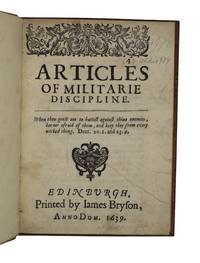
1639réf. AQ22724Edinburgh: Printed by James Bryson 1639. 16pp. Modern blind-ruled tree-calf contrasting black morocco lettering-piece T.E.G. Marbled endpapers trimmed occasionally affecting pagination and signature. Recently dispersed from the Cottlesloe Military Library 'probably the most extensive private collection of early printed books focused on military matters' with the bookplate of Thomas Francis Fremantle 3rd Lord Cottesloe 1862-1965 to FEP. The sole edition of the articles of conduct for the army of 16000 men raised by the Covenanters and commanded by Alexander Leslie first Earl of Leven c. 1580-1661 at the outset of the First Bishops' Wars. The articles besides the expected regulations regarding behaviour towards superior officers and prohibitions concerning desertion reflect the religious reformation championed by the Covenanter authorities. The ecclesiastical social order of the army was structured to mirror the hierarchy of the Church. A 'Kirke Session' applied to each regiment in order to censure 'profainers of the sabbath swearers and drunkards especially such as shall be found drinking in time of prayers of divine service'. Infantrymen were expected to remain celibate whilst in service prostitutes were forbidden in camp and those found to have committed rape were to be executed. ESTC S100228 STC 21904.5. First edition. Quarto. Printed by James Bryson unknown
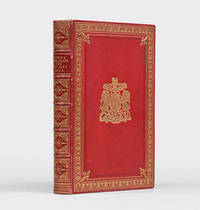
1857réf. 112005London: John W. Parker & Son 1857. Rather spectacularly "choice" "extra gilt" large paper copy of the Queen's Regs. "Her Majesty has been pleased to give her approbation to the following Regulations and Orders. they are applicable to all stations at which the troops may be serving; and General officers employed on the Staff and commanding officers of regiments are responsible that they are invariably adhered to. every officer in Her Majesty's service is to provide himself with a copy of these Regulations and Orders and to make himself perfectly acquainted with them" Preface. A highly unusual presentation of this basic handbook we have never encountered another similar. Octavo 267 x 175 mm. Tables to the text. Contemporary full crimson hard-grain morocco presentation binding title gilt to the spine low flat bands with gilt dotted roll compartments elaborately gilt concentric panelling in gilt and blind to the boards fleur-de-lys cornerpieces large block of the Royal Arms to the centre of both boards all edges gilt floral roll to edges and turn-ins pale cream surface paper endpapers. A little light shelf-wear corners bumped but overall very good indeed an extremely handsome copy. hardcover
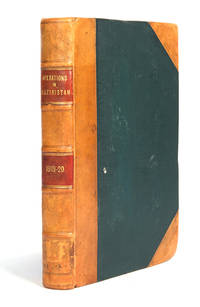
1921réf. 97075Calcutta: Superintendent Government Printing India 1921. Hardcover. Very Good. Half bound calf leather on dark blue cloth. Banded spine with red leather title and date panels. Marked " Confidential Serial No 1830" An extremely scarce copy of this detailed account of the army operation in Waziristan. The book is fully illustrated with monochrome plates and detailed maps and plans see photographs for details. 2 full fold out maps in pocket to rear. Copy belonged to Capt. H. Schofield The Welch Regiment. Copy belonged to Capt. H. Schofield of the Welch Regiment and is dated Razwack Sept. 1923. Superintendent Government Printing India hardcover
réf. 115601Calcutta Superintendent Government Printing India 1921. . First edition; 8vo 25 x 16.5 cm; complete with 32 photogravure plates including frontispiece 16 of which folding 4 of which large panoramic views 8 folding panoramas sketched on the spot 7 folding maps 3 of which loose in rear pocket 2 of which large coloured 75x92cm & 77x64cm previous ownership inscription to both endpapers with underlining to a few passages wide tear to margin of p97-8 not affecting text; typical contemporary half calf green cloth boards gilt morocco lettering pieces to spine remains of a shelf mark to spine extremities slightly rubbed from use binding tight due to quantity of maps and plates a very good copy; x 187 1pp. The scarce official account of the Waziristan campaign 19191920 and the preceding 1917 conflict with copious views and maps of the scarcely traversed terrain and landscape of Waziristan including Jandola Palosina Kotkai Kaniguram Barari Tangi Ahnai Tangi and Badergoi Valley. Also included are twelve Appendices detailing the units of the British forces in 1917 and 1919 the terms delivered to the Waziris and Mahsuds lists of British casualties and approximate numbers of the different specific tribes of the Mahsuds and Waziris involved in the conflict. In 1919 the short-lived Third Anglo-Afghan War concluded with the British ceding legal control of Afghan foreign affairs in return for the recognition by the Afghans of the Durand Line. Despite this a rumour spread amongst the Waziri and Mahsud tribesmen that the British intended to cede their territory to the British. They quickly conducted a series of raids against neighbouring settlements in the North-West Frontier in late 1919 causing over 400 casualties. Major-General Sir Andrew Skeen led the British response against the Tochi Waziris and Mahsuds in November of 1919. The campaign a took over 12 months due to the inexperience of the British units mainly comprised of light Indian divisions. The decisive eight-day battle of Ahnai Tangi involving the stand of the 2nd/5th Gurkhas immortalised in several paintings broke the Mahsud offensive and quickly resulted in a calming of violence and allowed the British to deliver their terms of control. Despite the apparent British victory the 1919-1920 campaign led to a change of policy in Waziristan. Britain decided to station permanent garrisons and have a much closer relationship with the irregular military units used. A large number of the locally raised troops had defected to the Waziris and Mahsuds during the campaign and it was hoped these measures would prevent further desertion. Britain also attempted a road construction effort in the region but this was seen as invasive and caused further conflict up to 1924. This copy was used by a member of the 1st Battalion of The Royal Scots during the time they were station in Secunderabad Hyderabad between 1922 and 1925. Calcutta, Superintendent Government Printing, India, 1921. hardcover
1945réf. 62-188DGPO 1945. 1945. Volumes 1 2 & 4 of four volumes. Includes Annexes 1-3 and 9 to 14. Folding Maps. Photos. Blue cloth. Very Heavy. Copy of Col. John W.McDonald dated 1946. Fine Set. Hardcover. Fine. GPO, 1945. hardcover
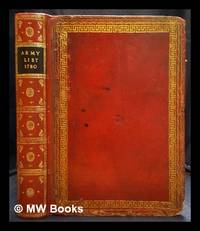
1780réf. 400384War-Office 1780. 1st edition. Hardcover. Good copy in gilt-blocked leather. Generalized wear to some of the boards with edges roughly rubbed. Remains a well-preserved set overall; tight bright clean and strong. Physical Description; 371 i.e. 330 86 i.e. 80 pages ; 33 cm. Notes; Spine title: Army list. Added title page: List of the officers of the several regiments and corps of militia. Subjects; Armed Forces Officers. Grande-Bretagne. Army Officiers Registres. Great Britain. Great Britain Militia Registers. Great Britain. Army. Great Britain. Army Officers Registers. Great Britain Royal Marines. Great Britain. Royal Marines Officers RegistersMilitia. Registers Lists. War-Office hardcover
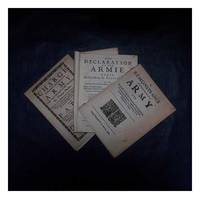
1647réf. 413058London : Printed for B.A. ; Printed by the appointments of the Officers ; Printed for Laurence Chapman 1647. First Edition. Softcover. Good set of pamphlet copies; edges slightly nicked and dust-toned as with age. Remain surprisingly well-preserved overall; bright and clean. Physical description; 3 pamphlets dis-bound as issued: paged and unpaged 8; 14 7 pages ; 18 cm. Notes; Full titles: A Remonstrance of the representations of the army for redresse of the grievances of the kingdom : With certain remedies humbly remonstrated to the Parliament for the setling of the kingdome in peace Iune 21. 1647 --- The Declaration of the armie under his Excellency Sir Thomas Fairfax as it was lately presented at Saffron-Walden in Essex unto Major-Generall Skippon.and Colonell Fleetwood members of the House of Commons and Commissioners there for the Parliament. by Colonell Whaley.and Major Disborow with the names of two hundred thirty more Commission-Officers annexed; which declaration is to manifest and set forth to them they being Members of Parliament and of the Army the Armies reall love and diligent care to discharge that duty for which they were raised as will manifestly appeare in time to all that wish well to mercy peace and justice 1647 --- A Charge delivered in the name of the Army under the command of His Excellency Sir Thomas Fairfax unto the commissioners of Parliament with the Army at S. Albans June 14. 1647. : and by them sent up to the Parliament against several members of the Honorable House of Commons. Also a paper delivered to the said commissioners of Parliament June 15. from his Excellency Sir Tho: Fairfax and the Army under his command of some farther humble proposals and desires to the Honorable Houses of Parliament. Printed and published by the appointment of his Excellency Sir Tho: Fairfax and the officers and soldiers of the Army under his command. St. Albans June 17 1647. Signed by me John Rushworth. Subjects; Petitions Resolutions. England and Wales. Army ; Early works to 1800. Great Britain History Civil War 1642-1649 ; Early works to 1800. Great Britain Politics and government 1642-1649 ; Early works to 1800. England and Wales. Parliament Expulsion ; Early works to 1800. Impeachments England ; Early works to 1800. London : Printed for B.A. ; Printed by the appointments of the Officers ; Printed for Laurence Chapman paperback
1848réf. 15976Frankfurt o. V., 1848. 156 S. Gr. 8° Groß-Oktav Kart.
réf. 13240Paris MARCILLY XVIIIème Ensemble de trois Canons, estampes en gravure en taille douce colorée à la main polychrome portant un texte en latin imprimé à l'encre noire avec illustrations se rapportant à l'iconographie et aux instructions liturgiques(collées sur carton enveloppé de papier vieux rose). Le canon central est Pliant et de forme rectangulaire horizontale (format déplié : 38 cm de haut x 61 cm de large - Format plié : 21,6 cm de large x 38 de haut), les deux autres de forme rectangulaire verticale (format : 24,8 cm de large x 33,4 cm de haut), Le canon central est composé de trois espaces scandé par un décor (décoré à la main) aux guirlandes de fleurs et Anges avec aux pieds des personnages bibliques avec leurs attibuts : MOÏSE et sa Table de la Loi, Saint-MARC assis sur un Lion avec un livre ouvert, Un Aigle avec Saint-JEAN l'évangéliste, Saint-LUC assis sur un Boeuf, Saint-PIERRE tenant ses Clefs à la Main, Saint MATTHIEU et son Ange, Saint-PAUL et son Epée, Saint-LAURENT en habit de Thuriféraire avec son brule-encens etc... avec des Anges dans la partie supérieure. Le canon dit du Dernier Evangile : le texte en latin est encadré à gauche et à droite de 2 Colonnes sculptées avec motif floral en couleurs surmontés chacune d'un Ange tenant une guirlande de feuilles verte au dessus du texte avec une Urne dorée au centre. Le canon dit du Lavabo présente le même type de mise en scène, avec au pied du texte en latin un Livre, une Croix d'or et un Brule-Encens représenté au lieu d'un Agneau Pascal blanc; l'ensemble est trés beau et les couleurs trés fraîches peintes à la main sont resplendissantes, le coin droit du canon central est fortement écorné sans que cela ne touche à aucun moment à la gravure, petites traces de coulures de cire, montrant bien que cet Autel Portatif à servi, sans date (XVIIIème) sans lieu ni nom d'Editeur ( peut être Paris Marcilly, rue saint Jacques n° 21, Imprimeur Editeur),
réf. 17280Lyon, Guillaume Rouillé, 1569. 2 ouvrages en 1 vol. in-8, 296-[8] pp. [suivi de:] [8]-145-[7] pp. (insolation du dos, petits frottements ou épidermures, trous de vers, quelques petites taches éparses, rousseurs, N3 et N4 reliés dans le désordre
1719réf. 62171Nürnberg, Christoph Riegel, 1719. Qu.-8°. Mit gest. Frontispiz u. 416 Abbildungen auf 55 Kupfertafeln. 7 Bll., 263; 400; 302; 72 S., Ldr. d. Zt. a. 3 Bünden.
1592réf. 20710Leiden, Plantin für Raphelengius, 1592. 8 Bll., 1 gef. Tab., 320 SS.; 8 Bll., 480 SS. mit vielen, teils ganzseitigen Holzschnitten, 16 Bll. Index. 8°, Holzdeckelbd. d. Zt. mit blindgepr. Schweinslederbezug, 2 Schließen und Blauschnitt.
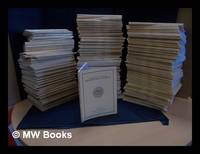
1961réf. 373411London: The Society for army Historical Research 1961. First Edition. Softcover. Fine set in the original stiff-card wrappers. Particularly and surprisingly well-preserved; tight bright clean and especially sharp-cornered. Physical description; 181 issues 6 special issues 17 bulletins 2 indexes. Contents; Journals: v. XXXIX: n. 160: Dec. 1961 ; v. XLI: n. 165: Mar. 1963 ; v. XLI n. 168: Dec. 1963 ; v. XLIII n. 174: June 1965 ; v. XLIV: n. 178: June 1966 ; v. XLIV: n. 179: Sep. 1966 ; v. XLV: n. 181: Spring 1967 ; v. XLV: n. 184: Winter 1967 ; v. XLVI: n. 185: Spring 1968 ; v. XLVI n. 188: Winter 1968 ; v. XLVII: n. 189: Spring 1969 ; v. XLVII: n. 190: Summer 1969 ; v. XLVIII n. 195: Autumn 1970 ; v. XLIX: n. 200 Winter 1971 ; v. L: n. 201: Spring 1972 ; v. L.: No. 204: Winter 1972 ; v. LI: n. 205: Spring 1973 ; v. LII: n. 211: Autumn 1974 ; v. LIII: n. 216: Winter 1975 ; v. LIV: n. 217: Spring 1976 ; v LIV:n. 219: Autumn 1976 ; v. LIV: n. 220: Winter 1976 ; v. LV: n. 222: Summer 1977 ; v. LVII: n. 229: Spring 1979 ; v. LVII n. 230: Summer 1979 ; v. LVII: n. 231: Autumn 1979 ; v. LVII: n. 232: Winter 1979 ; v. LVIII: n. 233: Spring 1980 ; v. LVIII: n. 234: Summer 1980 ; v. LVIII: n. 235: Autumn 1980 ; v. LVIII: n. 236: Winter 1980 ; v. LVIV: n. 237: Spring 1981 ; v. LIX: n. 238: Summer 1981 ; v. LIX: n. 239: Autumn 1981 ; v. LIX: n. 240: Winter 1981 ; v. LX: n. 241: Spring 1982 ; v. LX: n. 242: Summer 1982 ; v. LX: n. 243: Autumn 1982 ; v. LX: n. 244: Winter 1982 ; v. LXI: n. 245: Spring 1983 ; v. LXI n. 246: Summer 1983 ; v. LXI: n. 247: Autumn 1983 ; v. LXI: n. 248: Winter 1983/4 ; v. LXII: n. 249: Spring 1984 ; v. LXII: n. 250: Summer 1984 ; v. LXII: n. 251: Autumn 1984 ; v. LXII: n. 252: Winter 1984 ; v. LXIII: n. 253: Spring 1985 ; v. LXIII: n. 254: Summer 1985 ; v. LXIII: n. 255: Autumn 1985 ; v. LXIII: n. 256: Winter 1985 ; v. LXIV: n. 257: Spring 1986 ; v. LXIV: n. 258: Summer 1986 ; v. LXIV: n. 259: Autumn 1986 ; v. LXIV: n. 260: Winter 1986 ; v. LXV: n. 261: Spring 1987 ; v. LXV: n. 262: Summer 1987 ; v. LXV: n. 263: Autumn 1987 ; v. LXV: n. 264: Winter 1987 ; v. LXVI: n. 265: Spring 1988 ; v. LXVI: n. 266: Summer 1988 ; v. LXVI: n. 267: Autumn 1988 ; v. LXVI: n. 268: Winter 1988 ; v. LXVII: n. 269: Spring 1989 ; v. LXVII: n. 270: Summer 1989 ; v. LXVII: n. 271: Autumn 1989 ; v. LXVII: n. 272: Winter 1989 ; v. LXVIII: n. 273: Spring 1990 ; v. LXVIII: n. 274: Summer 1990 ; v. LXVIII: n. 275: Autumn 1990 ; v. LXVIII: n. 276: Winter 1990 ; v. LXIX: n. 277: Spring 1991 ; v. LXIX: n. 278: Summer 1991 ; v. LXIX: n. 279: Autumn 1991 ; v. LXIX: n. 280: Winter 1991 ; v. LXX: n. 281: Spring 1992 ; v. LXX: n. 282: Summer 1992 ; v. LXX: n. 282: Autumn 1992 ; v. LXX: n. 284: Winter 1992 ; v. LXXI: n. 285: Spring 1993 ; v. LXXI: n. 286: Summer 1993 ; v. LXXI: n. 287: Autumn 1993 ; v. LXXI: n. 288: Winter 1993 ; v. LXXII: n. 289: Spring 1994 ; v. LXXII: n. 290: Summer 1994 ; v. LXXII: n. 291: Autumn 1994 ; v. LXXII: n. 292: Winter 1994 ; v. LXXIII: n. 293: Spring 1995 ; v. LXXIII: n. 294: Summer 1995 ; v. LXXIII: n. 295: Autumn 1995 ; v. LXXIII: n. 296: Winter 1995 ; v. LXXIV: n. 297: Spring 1996 ; v. LXXIV: n. 298: Summer 1996 ; v. LXXIV: n. 299: Autumn 1996 ; v. LXXIV: n. 300: Winter 1996 ; v. LXXV: n. 301: Spring 1997 ; v. LXXV: n. 302: Summer 1997 ; v. LXXV: n. 303: Autumn 1997 ; v. LXXV: n. 304: Winter 1997 ; v. LXXVI: n. 305: Spring 1998 ; v. LXXVI: n. 306: Summer 1998 ; v. LXXVI: n. 307: Autumn 1998 ; v. LXXVI: n. 308: Winter 1998 ; v. 77: n. 309: Spring 1999 ; v. 77: n. 310: Summer 1999 ; v. 77: n. 311: Autumn 1999 ; v. 77: n. 312: Winter 1999 ; v. 78: n. 313: Spring 2000 ; v. 78: n. 314: Summer 2000 ; v. 78: n. 315: Autumn 2000 ; v. 78: n. 316: Winter 2000 ; v. 79: n. 317: Spring 2001 ; v. 79: n. 318: Summer 2001 ;v. 79: n. 319: Autumn 2001 ; v. 79: n. 320: Winter 2001 ; v. 80: n. 321: Spring 2002 ; v. 80: n. 322: Summer 2002 ; v. 80: n. 323: Autumn 2002 ; v. 80: n. 324: Winter 2002 ; v. 81: n. 325: Spring 2003 ; v. 81: n. 326: Summer 2003 ; v. 81: n. 327: Autumn 2003 ; v. 81: n. 328: Winter 2003 ; v. 82: n. 329: Spring 2004 ; v. 82: n. 330: Summer 2004 ; v. 82: n. 331: Autumn 2004 ; v. 82: n. 332: Winter 2004 ; v. 83: n. 333: Spring 2005 ; v. 83: n. 334: Summer 2005 ; v. 83: n. 335: Autumn 2005 ; v. 83: n. 336: Winter 2005 ;v. 84: n. 338: Summer 2006 ; v. 84: n. 339: Autumn 2006 ; v. 84: n. 340: Winter 2006 ; v. 85: n. 341: Spring 2007 ; v. 85: n. 342: Summer 2007 ; v. 85: n. 343: Autumn 2007 ; v. 85: n. 344: Winter 2007 ; v. 86: n. 345: Spring 2008 ; v. 86: n. 345: Spring 2008 ; v. 86: n. 346: Summer 2008 ; v. 86: n. 347: Autumn 2008 ; v. 86: n. 348: Winter 2008 ; v. 87: n. 349: Spring 2009 ; v. 87: n. 350: Summer 2009 ; v. 87: n. 351: Autumn 2009 ; v. 87: n. 352: Winter 2009 ; v. 88: n. 353: Spring 2010 ; v. 88: n. 354: Summer 2010 ; v. 88: n. 355: Autumn 2010 ; v. 88: n. 356: Winter 2010 ; v. 89: n. 357: Spring 2011 ; v. 89: n. 358: Summer 2011 ; v. 89: n. 359: Autumn 2011 ; v. 89: n. 360: Winter 2011 ; v. 90: n. 361: Spring 2012 ; v. 90: n. 363: Summer 2012 ; v. 90: n. 363: Autumn 2012 ; v. 90: n. 364: Winter 2012 ; v. 91: n. 365: Spring 2013 ; v. 91: n. 366: Summer 2013 ; v. 91: n. 367: Autumn 2013 ; v. 91: n. 368: Winter 2013 ; v. 92: n. 369: Spring 2014 ; v. 92: n. 370: Summer 2014 ; v. 92: n. 371: Autumn 2014 ; v. 92: n. 372: Winter 2014 ; v. 93: n. 373: Spring 2015 ; v. 93: n. 374: Summer 2015 ; v. 93: n. 375: Autumn 2015 ; v. 93: n. 376: Winter 2015 ; v. 94: n. 377: Spring 2016 ; v. 94: n. 378: Summer 2016 ; v. 94: n. 379: Autumn 2016 ; v. 94: n. 380: Winter 2016 ; v. 95: n. 381: Spring 2017 ; v. 95: n. 382: Summer 2017 ; v. 95: n. 383: Autumn 2017 ; v. 95: n. 384: Winter 2017 ; v. 96: n. 385: Spring 2018 ; Special Publications:: No. 12: A Journal of Marlborough's Campaigns During The War of The Spanish succession 1704-1711 by John Marshall Deane ; Special Publication: No. 13: Nobles Gentlemen and the Profession of Arms in Restoration Britain 1660-1688 by John Childs ; Special Publications No. 14: .By Dint of Labour and Perseverance.by Stephen Wood ; Special Publication No. 15: The British Army in cape Colony: Soldiers' Letters and Diaries 1806-58 by Peter B. Boyden ; Special Publication No. 16: Victorians at War: new perspectives edited by Ian F.W. Beckett ; Full Dress Sabretaches of the British Amry by William Y. Carman ; The Bulletin: v. XXXX: n. 158 Nov. 1989 ; v. 43: n. 172: May 1993 ; v. 44: n. 173: Aug. 1993 ; v. 44: n. 174: Nov. 1993 ; v. 44: n. 175: Feb. 1994 ; v. 44: n. 176: May 1994 ; v. 45: no. 177 Aug. 1994 ; v. 45 n. 178: Nov. 1994 ; v. 45: n. 179: Feb. 1995 ; v. 45: n. 180: May 1995 ; v. 46: n. 181 Aug. 1995 ; v. 46: n. 182: Nov. 1995 ; v. 46: n. 183 Feb. 1996 ; v. 47: n. 185: Aug. 1996 ; v. 48 n. 191: Feb. 1998 ; v. 50: n. 200: May 2000 ; v. 54: n. 213: Aug. 2003 ; Index: vols.: XXXI-XXXV: 1980-1985 ; Index: vols. 41-45: 1990-1995: nos. 161-180 ; Subjects; Journal of the Society for Army Historical Research. Military Journals. British Military. London: The Society for army Historical Research paperback
réf. 76086aafBâle - Zurich, Manissadjian & Co., Chromotypie par Froese & Co, s.d., vers 1910, in-folio, 17 feuilles de papier épais avec 16 planches en couleurs (chromolithogr.), texte au versos, pages de garde spéciales ‘enfants avec un drapeau suisse’, pts. fentes à l’int. dans les charnières, reliure en demi-toile de l’éditeur, plat devant illustré en couleurs, frotté aux bords, coiffes légèrement touchées, exemplaire néanmoins en très bon état.
1759réf. 1274001759 De l'Imprimerie de Cl. Lequatre à Montargis - 1759 (Première édition) - 2 vol in-4 - Demi veau de l'époque, 5 nerfs, titre, tomaison et fleurons/caissons en doré (reliures usagées à restaurer). - 457 + 424 + 617 pages - Complet des 20 gravures en noir & blanc pour la plupart rempliées répartties sur chacun des deux volumes - Toutes tranches rouges
1946réf. 62-189GPO 1946. 1946. 3 Volumes. Including Annexes 1-14. Folding Maps. Photos. Blue cloth. Exlib. No exterior markings. Rubber stamps inside. Each volume has a maylar jacket with the last owner's shelf label. Near Fine Set. Hardcover. Near Fine. GPO, 1946. Hardcover
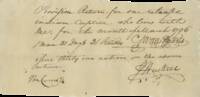
1796réf. Cat327United States 1796. One small slip signed "C. Swan PMG U.S." with additional authorization by J. Haskell. Measuring appx. 3 ½ x 7 ½ inches. Near Fine. In the 1790s ongoing conflicts between the United States and Native nations produced large numbers of captives taken in raids and only gradually returned through negotiation exchange and treaty. The U.S. Army was responsible not only for recovering these individuals but for housing and provisioning them while their status was resolved. Offered here is a concise U.S. Army ration return issued by Caleb Swan documenting subsistence for "one released Indian captive who lives with me" calculated at "1 Man 31 Days 31 Rations" for March 1796. Swan appointed paymaster of the army in 1792 and attached to General Anthony Wayne's Legion was responsible for overseeing pay and provisions in the field. The document gains significance from Swan's earlier experience. Before becoming paymaster he had traveled through the southern frontier-particularly among the Muscogee Creek Nation-where he encountered firsthand the system of captivity produced by years of raiding along the Georgia border. Captives both Black and white were often absorbed into Native communities sold or retained under local customs and U.S. officials struggled to secure their return.1 By 1796 Swan appears on the other side of that process. The present return shows that he himself had custody of a "released" captive likely an American who had been held in a Native community. The individual was residing with Swan and being fed at government expense. This comes immediately after Swan's presence at the Treaty of Greenville which formally ended major fighting in the Northwest and included provisions for the return of prisoners. The Treaty of Greenville specifically required the mutual return of prisoners with Native captives held by the United States released immediately and American captives to be delivered within ninety days backed by the detention of chiefs as hostages. This places Swan's 1796 ration return squarely in the aftermath of the administrative effort for restoring frontier captives. 1 Andrew K. Pressley A Southern Underground Railroad: Black Georgians and the Promise of Spanish Florida and Indian Country University of Georgia Press 2024.