32 625 résultats
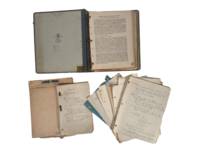
1945réf. 193511945. Witmer Richard L. Caribbean Coastal Artillery officer training archive circa 1940s documents the instructional framework and operational doctrine taught to U.S. Army Coast Artillery officers during World War II with particular emphasis on antiaircraft defense chemical warfare preparedness and logistical coordination in domestic coastal defense. This archive belonged to Captain Richard L. Witmer of York Pennsylvania an officer in the 87th Regiment of the Caribbean Coastal Artillery Command of the US Army during WWII. Its contents include 385 printed and manuscripts pages of notes lessons assignments and documents primarily from Witmer's education in officer academy.Witmer served as an officer in the 87th Regiment of the Caribbean Coastal Artillery Command a unit tasked with protecting Gulf Coast installations against aerial and maritime threats during a period of heightened concern over Axis attack on the continental United States. His notes record formalized military instruction alongside personal synthesis of tactical principles including his definition of tactics as the "Science of placing weapon so as to carry out mission" and his articulation of defensive priorities such as "Make provision to guard against a surprise" and "Take advantage of terrain for all round defense." The archive includes detailed engagement with antiaircraft gunnery where Witmer identifies primary targets as "Bombers Observation planes" and emphasizes the need for "continuous instantaneous and accurate data" and "volume of fire" demonstrating the technical and strategic demands placed on officers responsible for air defense. Witmer Richard L. Caribbean Coastal Artillery officer training archive. United States: U.S. Army Coast Artillery Corps circa 1940s. Archive comprises approximately 385 pages of manuscript and typed material primarily organized within a ring binder accompanied by three small notebooks and approximately fifteen loose leaves. Contents include notes instructional outlines assignments and technical summaries covering antiaircraft artillery ordnance ballistics supply systems transportation logistics and mess operations. Numerous pages feature hand-drawn diagrams graphs and marginal annotations. Sections devoted to weapons systems describe characteristics of artillery including "40 mm - Easily operated" "37 mm - Accurate fire" "50 cal - Rugged" and "30 cal - Simple & Rapid Min. of men." Additional material addresses chemical warfare including references to mustard gas and Lewisite with Witmer posing operational questions such as "Would the combat efficiency of my men remain high in the event of chemical attack" A formal evaluation included in the archive notes his promotion stating that he "has demonstrated outstanding ability and fitness for promotion by performing the duties of a gun battery officer" citing his leadership of an antiaircraft range section. Produced during the expansion of U.S. defensive infrastructure in World War II this archive aligns with the strategic role of the Coast Artillery Corps in safeguarding domestic installations prior to the consolidation of air defense under later Cold War military structures. The detailed instructional content reflects the Army's investment in technical specialization particularly in response to the increasing threat of aerial warfare and the lingering memory of chemical weapons deployment in World War I. Witmer's materials preserve the pedagogical methods used to train officers in integrated defense systems combining mechanical knowledge tactical planning and command responsibility. The subsequent dissolution of the Coast Artillery Corps in 1950 underscores the transitional nature of this material within the evolution of U.S. military organization. Light wear to covers with minor fading internal pages well preserved and legible with occasional handling wear; overall very good condition. unknown books
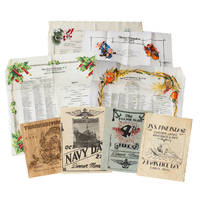
1929réf. 186831929. U.S. Army and Navy holiday dinner menus and related materials 1929 to 1945 document organized communal life ceremonial observance and institutional identity within the American military across the interwar and World War II periods. The group includes menus for Independence Day Thanksgiving Armistice Day and Navy Day situating the material within official holiday programming that reinforced morale and unit cohesion during both peacetime training and global conflict. The presence of menus from the 189th Field Artillery at Fort Sill in 1940 and later examples from the U.S.S. Pine Island including those produced at Sasebo Japan places the archive within the geographic expansion of U.S. military operations from domestic bases to overseas occupation zones. The inclusion of named rosters and autograph signatures connects these printed artifacts to specific service members documenting how collective identity and hierarchy were formalized and commemorated through shared meals. Archive of eight original military holiday dinner menus and four printed cloth napkins. United States and Japan 1929 to 1945. Menus measure approximately 7 x 5.5 inches and are printed in paper wrappers with illustrated covers. The earliest menu issued for the 189th Field Artillery at Fort Sill Oklahoma Thanksgiving 1940 includes an ornamental napkin a printed roster of personnel multiple autograph signatures and a "wooden certificate" voucher redeemable within the Cherokee Strip region. Additional menus originate from the U.S.S. Pine Island for Independence Day Navy Day and Armistice Day observances including examples produced at the Sasebo naval base in Japan. Menus list standardized holiday meals including roast turkey baked ham potatoes and pie. The archive also includes four cloth napkins from the 70th Service Squadron dated 1929 to 1931 each approximately 14 x 14 inches printed with thematic imagery such as turkeys cornucopias and holly leaves and bearing full rosters of personnel organized by rank. The 70th Service Squadron was stationed at March Field California a major Army Air Corps training installation during this period. Military holiday menus functioned as both practical documents and ceremonial objects recording foodways hierarchy and unit composition while reinforcing institutional traditions across dispersed service environments. The continuity of menu design and meal structure across years and locations reflects standardized provisioning practices while the inclusion of rosters and signatures preserves individual participation within collective settings. The presence of materials spanning prewar Army Air Corps units and wartime naval operations including occupation-era Japan provides a longitudinal view of military culture across a period of rapid organizational and geopolitical change. Light wear consistent with handling; overall very good condition. unknown
1929réf. 186831929. U.S. Army and Navy holiday dinner menus and related materials 1929 to 1945 document organized communal life ceremonial observance and institutional identity within the American military across the interwar and World War II periods. The group includes menus for Independence Day Thanksgiving Armistice Day and Navy Day situating the material within official holiday programming that reinforced morale and unit cohesion during both peacetime training and global conflict. The presence of menus from the 189th Field Artillery at Fort Sill in 1940 and later examples from the U.S.S. Pine Island including those produced at Sasebo Japan places the archive within the geographic expansion of U.S. military operations from domestic bases to overseas occupation zones. The inclusion of named rosters and autograph signatures connects these printed artifacts to specific service members documenting how collective identity and hierarchy were formalized and commemorated through shared meals. Archive of eight original military holiday dinner menus and four printed cloth napkins. United States and Japan 1929 to 1945. Menus measure approximately 7 x 5.5 inches and are printed in paper wrappers with illustrated covers. The earliest menu issued for the 189th Field Artillery at Fort Sill Oklahoma Thanksgiving 1940 includes an ornamental napkin a printed roster of personnel multiple autograph signatures and a "wooden certificate" voucher redeemable within the Cherokee Strip region. Additional menus originate from the U.S.S. Pine Island for Independence Day Navy Day and Armistice Day observances including examples produced at the Sasebo naval base in Japan. Menus list standardized holiday meals including roast turkey baked ham potatoes and pie. The archive also includes four cloth napkins from the 70th Service Squadron dated 1929 to 1931 each approximately 14 x 14 inches printed with thematic imagery such as turkeys cornucopias and holly leaves and bearing full rosters of personnel organized by rank. The 70th Service Squadron was stationed at March Field California a major Army Air Corps training installation during this period. Military holiday menus functioned as both practical documents and ceremonial objects recording foodways hierarchy and unit composition while reinforcing institutional traditions across dispersed service environments. The continuity of menu design and meal structure across years and locations reflects standardized provisioning practices while the inclusion of rosters and signatures preserves individual participation within collective settings. The presence of materials spanning prewar Army Air Corps units and wartime naval operations including occupation-era Japan provides a longitudinal view of military culture across a period of rapid organizational and geopolitical change. Light wear consistent with handling; overall very good condition. unknown books
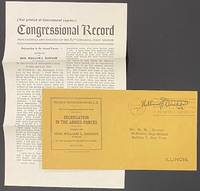
1951réf. 186401951. Dawson William L. African American congressman from Chicago and World War I veteran of the segregated 366th Infantry Regiment House of Representatives speech delivered April 13 1951 addressing segregation in the United States armed forces during the early years of the Cold War. Dawson served in Congress for nearly three decades and became the first African American to chair a congressional committee. His speech was delivered during a critical period in the history of American civil rights and military policy following President Harry Truman's 1948 Executive Order 9981 directing the desegregation of the armed forces. Debates in Congress during the early 1950s addressed the pace and implementation of integration and Dawson used the floor of the House to argue that racial segregation contradicted the principles for which American soldiers fought. Dawson William L. "Segregation in the Armed Forces." Speech of Hon. William L. Dawson of Illinois in the House of Representatives April 13 1951. Congressional Record 82nd Congress First Session. Single printed sheet measuring approximately 6 x 9 inches preserved with original mailing envelope. The printed text reproduces Dawson's remarks opposing segregation within the military establishment. In the speech Dawson declared: "If there is one place in America where there should not be segregation that place is in the armed services among those who fight for this country." He continued with a broader appeal to constitutional ideals and national unity: "I would give up this life of mine to preserve this country and every American in it white or black. Deny to me today if you will all that American citizenship stands for I will still fight to preserve our Nation knowing that someday under the Constitution of the United States all of these restrictions will be removed and that we will move forward before the world as one people American people joined in a democracy which shall set the pattern for all the world." Dawson's remarks formed part of the ongoing political struggle over civil rights and military policy during the early Cold War. The Korean War had begun the previous year and questions about equality within the armed forces remained under active debate as the military implemented Truman's desegregation order. Dawson's own wartime service in a segregated unit during World War I informed his critique of racial discrimination within the military establishment. As a senior African American political leader in Congress his advocacy contributed to broader legislative and political pressure supporting the continued dismantling of segregation in the armed forces. Minor wear consistent with age; overall condition very good. unknown
1951réf. 186401951. Dawson William L. African American congressman from Chicago and World War I veteran of the segregated 366th Infantry Regiment House of Representatives speech delivered April 13 1951 addressing segregation in the United States armed forces during the early years of the Cold War. Dawson served in Congress for nearly three decades and became the first African American to chair a congressional committee. His speech was delivered during a critical period in the history of American civil rights and military policy following President Harry Truman's 1948 Executive Order 9981 directing the desegregation of the armed forces. Debates in Congress during the early 1950s addressed the pace and implementation of integration and Dawson used the floor of the House to argue that racial segregation contradicted the principles for which American soldiers fought. Dawson William L. "Segregation in the Armed Forces." Speech of Hon. William L. Dawson of Illinois in the House of Representatives April 13 1951. Congressional Record 82nd Congress First Session. Single printed sheet measuring approximately 6 x 9 inches preserved with original mailing envelope. The printed text reproduces Dawson's remarks opposing segregation within the military establishment. In the speech Dawson declared: "If there is one place in America where there should not be segregation that place is in the armed services among those who fight for this country." He continued with a broader appeal to constitutional ideals and national unity: "I would give up this life of mine to preserve this country and every American in it white or black. Deny to me today if you will all that American citizenship stands for I will still fight to preserve our Nation knowing that someday under the Constitution of the United States all of these restrictions will be removed and that we will move forward before the world as one people American people joined in a democracy which shall set the pattern for all the world." Dawson's remarks formed part of the ongoing political struggle over civil rights and military policy during the early Cold War. The Korean War had begun the previous year and questions about equality within the armed forces remained under active debate as the military implemented Truman's desegregation order. Dawson's own wartime service in a segregated unit during World War I informed his critique of racial discrimination within the military establishment. As a senior African American political leader in Congress his advocacy contributed to broader legislative and political pressure supporting the continued dismantling of segregation in the armed forces. Minor wear consistent with age; overall condition very good. unknown books
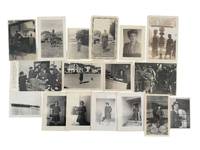
1944réf. 218341944. Women's History Military History Photography Unidentified photographer Women's Army Corps photographs mid 1940s document female military service during World War II and provide direct visual evidence of women's roles within the U.S. Army following the formal incorporation of the Women's Army Corps in 1943. The images record administrative work training routines and social life among enlisted servicewomen situating WAC personnel within the broader wartime expansion of women's participation in military infrastructure. The archive supports research into gendered labor in the armed forces wartime mobilization and the institutional integration of women into military systems. United States including Fort Lee Virginia and Westfield Massachusetts mid 1940s. Archive of 17 silver gelatin photographs ranging from approximately 3.5 x 2.5 inches to 5.5 x 3.5 inches with manuscript annotations on several versos identifying locations and contexts. The photographs depict WAC servicewomen in uniform engaged in administrative duties formation drills and off duty activities. One image shows a woman seated at a desk beneath a clock with a nameplate reading "M.V. Ramsey WAC" with visible chevrons indicating rank while others show groups gathered around mess tables standing in inspection formation or marching in coordinated drills. Outdoor scenes include annotated locations such as "Flattop - Ft. Lee Va." and "Taken in Westfield a suburb of Springfield" as well as a roadside photograph showing two servicewomen beneath directional signage indicating distances to nearby Massachusetts cities. Several portraits focus on individual women posed in multiple settings near military installations suggesting personal documentation of service life. The archive situates WAC service within the broader reorganization of the U.S. military during World War II when women assumed clerical logistical and support roles essential to sustaining wartime operations. Training centers such as Fort Lee and regional encampments in Massachusetts functioned as key sites for integrating women into military systems while maintaining structured discipline and hierarchy. These photographs document both institutional expectations and informal camaraderie among servicewomen illustrating how gender roles were renegotiated within military contexts during the war. Light curling and minor surface creasing to some photographs; most remain well preserved with strong tonal clarity. Overall very good condition. A cohesive photographic record of women's military service and daily life within the Women's Army Corps during World War II. unknown
1944réf. 218341944. Women's History Military History Photography Unidentified photographer Women's Army Corps photographs mid 1940s document female military service during World War II and provide direct visual evidence of women's roles within the U.S. Army following the formal incorporation of the Women's Army Corps in 1943. The images record administrative work training routines and social life among enlisted servicewomen situating WAC personnel within the broader wartime expansion of women's participation in military infrastructure. The archive supports research into gendered labor in the armed forces wartime mobilization and the institutional integration of women into military systems. United States including Fort Lee Virginia and Westfield Massachusetts mid 1940s. Archive of 17 silver gelatin photographs ranging from approximately 3.5 x 2.5 inches to 5.5 x 3.5 inches with manuscript annotations on several versos identifying locations and contexts. The photographs depict WAC servicewomen in uniform engaged in administrative duties formation drills and off duty activities. One image shows a woman seated at a desk beneath a clock with a nameplate reading "M.V. Ramsey WAC" with visible chevrons indicating rank while others show groups gathered around mess tables standing in inspection formation or marching in coordinated drills. Outdoor scenes include annotated locations such as "Flattop - Ft. Lee Va." and "Taken in Westfield a suburb of Springfield" as well as a roadside photograph showing two servicewomen beneath directional signage indicating distances to nearby Massachusetts cities. Several portraits focus on individual women posed in multiple settings near military installations suggesting personal documentation of service life. The archive situates WAC service within the broader reorganization of the U.S. military during World War II when women assumed clerical logistical and support roles essential to sustaining wartime operations. Training centers such as Fort Lee and regional encampments in Massachusetts functioned as key sites for integrating women into military systems while maintaining structured discipline and hierarchy. These photographs document both institutional expectations and informal camaraderie among servicewomen illustrating how gender roles were renegotiated within military contexts during the war. Light curling and minor surface creasing to some photographs; most remain well preserved with strong tonal clarity. Overall very good condition. A cohesive photographic record of women's military service and daily life within the Women's Army Corps during World War II. unknown books
1945réf. 76270Washington D. C.: U. S. Army. Very Good. 1945. First Edition. Paperback. Softcover mounted on black wooden board with screw posts. Oblong elephant folio 18" x 12 3/4" with backing board a slight bit larger . One of 182 copies of the formally classified history of the Third Army produced by the Third U. S. Army Headquarters and the XIX Tactical Command. Classified as Secret when first published but later declassified. Volume 1 The Operations contains a monthly accounting of overall army operations in the European theater commanded by Lt. Gen. George S. Patton. Volume 2 "Staff Section Reports " not available at present is a compilation of general and special staff sections operations reports. The volume offered here "The Operations " combines narratives of specific operations with data on movements casualties and loss of materiel supplemented with maps and supporting documents. Condition is very good or better. There are some creases on the front wrap along with a signature of the former owner Maj. L. V. Frisch. Interior pages are clean and unblemished. Each section in the book is introduced by a clear acetate page. Scarce in its original edition though available in various electronic forms. 421 pp. Plus annexes 22 pp 36 pp. 66 pp and 146 pp. Large bulky and heavy--may require special shipping arrangements. . U. S. Army paperback
1945réf. 78-1955Raritan Arsenal 1945. 1945. 488p. Photos. Line drawings. "Pershing Tank" Large Wraps. Fine Copy. Paperback. Fine. Book. Raritan Arsenal, 1945. Paperback
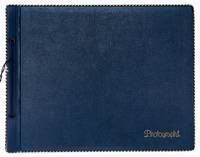
réf. 58086Manilla 1945. Oblong 4to. 26 x 34 cm. 38 leaves of black paper. Album of string-bound navy-blue leatherette containing 44 black & white photos of the Liberation of the Philippines and 5 semi-nudes approximately 9 x 11.5 cm each four to a leaf across 10 leaves one leaf with photographs to recto and verso remainder blank. The majority of the photographs display gruesome scenes of violence death and destruction. Excellent condition. The Philippines campaign Battle of the Philippines or the Liberation of the Philippines code named Operation Musketeer I II and III was the American Mexican Australian and Filipino campaign to defeat and expel the Imperial Japanese forces occupying the Philippines during World War II. The Japanese Army overran all of the Philippines during the first half of 1942. The liberation of the Philippines commenced with amphibious landings on the eastern Philippine island of Leyte on October 20 1944. The United States and Philippine Commonwealth military forces were progressing in liberating territory and islands when the Japanese forces in the Philippines were ordered to surrender by Tokyo on August 15 1945 after the dropping of the atomic bombs on mainland Japan and the Soviet invasion of Manchuria. [Manilla, 1945.] hardcover
2009réf. 100055954Economica 2009 15x24x4cm. 2009. Broché.
1918réf. 11652Washington: Government Printing Office 1918. First Edition. Original cloth. Octavo. 96 pages. Near Fine. Bound in coarse tan cloth over boards with title printed in black on upper board. Contemporaneous prior owner name in ink on front pastedown. Fold-out plans tables photographs. Scarce Confidential manual on the weaponry associated with U. S. Army aircraft and pilots in World War I. Sections on the Marlin the Lewis and the Vickers aircraft machine guns synchronizing gears machine gun sights bombs bomb-release mechanism bomb sighting ammunition pyrotechnics and small arms. Three fold-out plates one of which is a detailed and colored schematic of the Lewis machine gun. Notice on the first page warns that this book ".is issued for the instruction and guidance of all concerned and contains information of military importance none of which may be copied printed or published under any conditions." Only 16 copies located in OCLC. Government Printing Office unknown
réf. DADAX2854953614New unknown
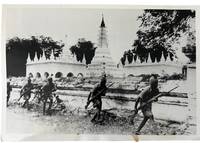
1914réf. 234921914. British Indian Army photo archive spanning both World Wars depicting colonial recruitment military training the Indian Air Force military ceremonies and Burma-front service into the final decades of British rule in India circa 1914-1945. The British Indian Army was the largest non-conscript force in history: roughly 1.3 million men were recruited during the First World War and 2.5 million during the Second. Indian troops were deployed to the Western Front Mesopotamia East Africa and Egypt during the First World War and to North Africa Italy the Middle East and Burma during the Second. British power in India had grown from East India Company conquest in the eighteenth century passed to Crown rule after the 1857 uprising and was nearing collapse during the time which these press photographs document. The Quit India movement the 1943 Bengal famine wartime censorship and anti-colonial organizing made British authority increasingly untenable even as Indian troops mobilized in record numbers. The archive records the last colonial wartime mobilizations of India before independence in 1947 and Partition remade the subcontinent. Photo archive of 31 silver gelatin photographs and four real-photo postcards various sizes ranging from 4 x 2" to 10 x 6.5 inches India France and Burma circa 1914-1945. The four French-printed real photo postcards date to the First World War and document Indian Expeditionary Force service: "1914 - Soldats anglais et indiens / Indian and English soldiers" showing a horse-drawn carriage driven by an Indian man with three uniformed soldiers seated inside; "1914 Indian Army - Attelage de Guerre / War Team" depicting a military draught team; "Indian Army Conveyer" showing an Indian soldier with four pack donkeys; and a 1919 postcard documenting the arrival of a British detachment at a colonial camp. A formal group portrait of approximately nineteen Sikh soldiers in khaki service dress and regulation dastaars stands before a row of tents at a North-West Frontier camp. Sikh troops fought throughout both World Wars in their turbans the only major military force to refuse steel helmets on religious grounds. The remaining photographs 1940-1945 document Sikh Gurkha Punjabi and other Indian troops in khaki drill tunics shorts puttees regulation turbans dastaars kullahs slouch hats pith helmets steel helmets and web belts carrying rifles at the shoulder or raised in training exercises. The combination of regulation turbans with British-style khaki uniforms was standard British Indian Army dress formally accommodating Sikh and other religious traditions within Empire military regulation. A vernacular view captioned "Some of our boys at camp Ksli India" records ten uniformed men wading through a knee-high river with rifles held across their shoulders. Troops march past Buddhist stupas in Burma kneel in brush with bayoneted rifles fire from jungle cover operate a field telescope behind sandbags and sit beside motorcycles and jeeps on a rough military road. One photograph carries the studio stamp of Mela Ram & Son Peshawar a leading early-twentieth-century North-West Frontier military photographer. Press captions identify "Punjab's in India join army" "Gurkhas open fire during a training exercise" "British troops in India prepare for Burma campaign" "Indian troops in Burma" "Burma advance" "Viceroy presents Victoria crosses to Indian heroes" "Tunisia Day celebrated in Calcutta" "Troops on the parapet of Matta Post watching the bombardment" North-West Frontier July 1940 "Supreme Commander" and "Services Sweetheart" the last identifying Miss Joy Thompson of Bombay and Sgt. A. Pickles of Leeds. British India entered both world wars by imperial decision. The same years that produced the photographs in this archive also produced the Quit India arrests of 1942 the Bengal famine of 1943 and intensified military recruitment across a country already moving toward independence. The archive preserves official publicity press distribution and soldier-level record-making from a colonial army fighting for Britain while British authority in India was approaching its end. Creasing surface wear fading caption-label remnants press stamps and occasional abrasions; overall very good condition. unknown
1914réf. 234921914. British Indian Army photo archive spanning both World Wars depicting colonial recruitment military training the Indian Air Force military ceremonies and Burma-front service into the final decades of British rule in India circa 1914-1945. The British Indian Army was the largest non-conscript force in history: roughly 1.3 million men were recruited during the First World War and 2.5 million during the Second. Indian troops were deployed to the Western Front Mesopotamia East Africa and Egypt during the First World War and to North Africa Italy the Middle East and Burma during the Second. British power in India had grown from East India Company conquest in the eighteenth century passed to Crown rule after the 1857 uprising and was nearing collapse during the time which these press photographs document. The Quit India movement the 1943 Bengal famine wartime censorship and anti-colonial organizing made British authority increasingly untenable even as Indian troops mobilized in record numbers. The archive records the last colonial wartime mobilizations of India before independence in 1947 and Partition remade the subcontinent. Photo archive of 31 silver gelatin photographs and four real-photo postcards various sizes ranging from 4 x 2" to 10 x 6.5 inches India France and Burma circa 1914-1945. The four French-printed real photo postcards date to the First World War and document Indian Expeditionary Force service: "1914 - Soldats anglais et indiens / Indian and English soldiers" showing a horse-drawn carriage driven by an Indian man with three uniformed soldiers seated inside; "1914 Indian Army - Attelage de Guerre / War Team" depicting a military draught team; "Indian Army Conveyer" showing an Indian soldier with four pack donkeys; and a 1919 postcard documenting the arrival of a British detachment at a colonial camp. A formal group portrait of approximately nineteen Sikh soldiers in khaki service dress and regulation dastaars stands before a row of tents at a North-West Frontier camp. Sikh troops fought throughout both World Wars in their turbans the only major military force to refuse steel helmets on religious grounds. The remaining photographs 1940-1945 document Sikh Gurkha Punjabi and other Indian troops in khaki drill tunics shorts puttees regulation turbans dastaars kullahs slouch hats pith helmets steel helmets and web belts carrying rifles at the shoulder or raised in training exercises. The combination of regulation turbans with British-style khaki uniforms was standard British Indian Army dress formally accommodating Sikh and other religious traditions within Empire military regulation. A vernacular view captioned "Some of our boys at camp Ksli India" records ten uniformed men wading through a knee-high river with rifles held across their shoulders. Troops march past Buddhist stupas in Burma kneel in brush with bayoneted rifles fire from jungle cover operate a field telescope behind sandbags and sit beside motorcycles and jeeps on a rough military road. One photograph carries the studio stamp of Mela Ram & Son Peshawar a leading early-twentieth-century North-West Frontier military photographer. Press captions identify "Punjab's in India join army" "Gurkhas open fire during a training exercise" "British troops in India prepare for Burma campaign" "Indian troops in Burma" "Burma advance" "Viceroy presents Victoria crosses to Indian heroes" "Tunisia Day celebrated in Calcutta" "Troops on the parapet of Matta Post watching the bombardment" North-West Frontier July 1940 "Supreme Commander" and "Services Sweetheart" the last identifying Miss Joy Thompson of Bombay and Sgt. A. Pickles of Leeds. British India entered both world wars by imperial decision. The same years that produced the photographs in this archive also produced the Quit India arrests of 1942 the Bengal famine of 1943 and intensified military recruitment across a country already moving toward independence. The archive preserves official publicity press distribution and soldier-level record-making from a colonial army fighting for Britain while British authority in India was approaching its end. Creasing surface wear fading caption-label remnants press stamps and occasional abrasions; overall very good condition. unknown books
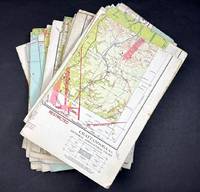
1943réf. H40789Washington DC: Army Map Service US Army 1943. Very good. Group of 49 folding maps produced by the Army in 1942-1943 motivated by Pearl Harbor to give the US armed forces the most up to date information to help defend American cities against air raids with information on airfields commercial and municipal airports auxiliary fields seaplane bases where applicable anchorage mooring conditions lighting facilities information on radio stations beacons rotating and flashing airways restricted airways high explosive areas etc. Most of the maps measure about 45 x 24 inches some as much as 49 inches wide. In mainly very good condition a handful with more soil wear and occasionally light numerical pencil notations. The maps are of US cities and their surrounding regions and the regions all have letter-number codes which we have listed along with each map's dimensions. We have in no particular order: Washington DC T-9 35 x 24" New Orleans O-6; 44.5 x 24"; Roswell NM Q-4; 48 x 24.5"; Kansas City T-6; 44.5 x 24"; Sioux City IA V-5; 44 x 24"; Albuquerque R-4; 48 x 24" good only with a few tears and some rumpling that could possibly be ironed out; Savannah GA Q-8; 49 x 24"; San Antonio TX O-5; 46.5 x 24"; Lincoln NE U-5; 44.5 x 24"; Austin TX P-5; 49 x 24"; Beaumont TX P-6 49 x 24" with some light soil rumpling and a few pencil notations; New York U-9 45 x 24"; Aberdeen South Dakota W-5; 42 x 24" with "Property of Lt. Theodore J. Williams Nav. Crew #104" written in ink in marginal legend area below the map; Norfolk VA R S-9 42 x 26"; Winston-Salem NC S-8 47.5 x 24"; Denver T-4; 45.5 x 24"; Jacksonville P-8 35 x 24"; Dallas Q-5 49 x 24" with light wear and soil some minor pencil notes; Little Rock R-6; 47.5 x 24" with light wear and rumpling; Del Rio TX O-4 42.5 x 24"; Douglas AZ P-3 49 x 24.5"; El Paso P-4 49 x 24.5"; Salina Kansas T-5 45.5 x 24"; Tulsa S-6 34 x 24" with light wear and soil; Charlotte R-8 45 x 24"; Detroit V-8 42 x 24"; Milwaukee V-7 45 x 24"; Cheyenne U-4 45 x 24"; Duluth X-6 44 x 24"; Twin Cities W-6 45 x 24.5"; Green Bay W-7 48.5 x 24"; Salt Lake City 4U-3 4.5 x 24"; Cleveland U-8 edition of May 1947 45 x 24"; New York U-9 edition of May 11 1944 45 x 24" with some wear and general soil; Huntington WV T-8 45 x 24"; Orlando O-8 36 x 24"; Nashville S-7 46 x 24"; Dubuque V-6 42 x 24"; Mobile P-7 49 x 24"; Birmingham Q-7 April 1940 49 x 24" with some wear splitting pencil notes soil; another copy dated April 5 1945 same dimensions light wear; Casper WY V-4 44 x 24" some wear soil pencil notes; Des Moines U-6 43.5 x 24" with some wear loss etc.; Cincinnati T-7 47.25 x 24"; Miami N-8 43.75 x 28"; Mobile P-7 49 x 24" with light wear and some numeric pencil notes; Wichita S-5 45.5 x 24"; Corpus Christi N-5 48 x 24"; Cleveland U-8 Feb. 5 1942 45 x 24"; Oklahoma City R-5 47.25 x 24"; and last but not least Chattanooga R-7 48 x 24" light wear. A brief survey of what maps are currently for sale online shows dealers pricing them anywhere from $20 to $150 apiece but no one has a substantial lot of them and we have some great maps in this group! Army Map Service, US Army unknown
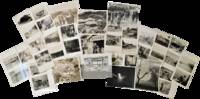
1945réf. 189141945. U.S. Army and Navy photographs of Okinawa 1945 document the immediate aftermath of the Battle of Okinawa and the establishment of American control over a strategically critical island at the close of the Pacific War. The images place American troops within the Okinawan interior and along coastal installations following the April 1945 landings including the secured Yontan airfield a primary objective of the invasion. The archive records the physical destruction resulting from one of the war's most intensive campaigns alongside scenes of civilian movement and return situating the photographs within the transition from active combat to military occupation. Archive of 37 black and white silver gelatin photographs. Okinawa Japan circa 1945. Photographs measure approximately 3.75 x 4.5 inches to 7 x 10.5 inches with brief handwritten captions on verso. Images depict American troops in villages farmland and near shrines as well as at Yontan airfield. Several photographs show destroyed aircraft including a crashed Japanese plane and associated debris along with damaged infrastructure and equipment. Naval activity is represented through images of American ships in harbor and offshore including a landing ship dock LSD transport vessel. An aerial photograph shows a harbor with multiple wrecked ships and flattened industrial areas. One image documents a column of civilians carrying belongings captioned "civilians returning to homes." The Battle of Okinawa fought from April to June 1945 resulted in extensive military and civilian casualties and widespread destruction of the island's infrastructure. The subsequent American occupation transformed Okinawa into a major U.S. military base in the western Pacific a status it retained even after reversion to Japanese administration in 1972. These photographs document both the operational objectives of the invasion and the conditions encountered in its aftermath including the displacement and return of local populations. The archive provides material for examining military strategy occupation practices and the impact of large-scale warfare on civilian landscapes in the Pacific theater. Light wear consistent with handling; overall very good condition. unknown
1945réf. 189141945. U.S. Army and Navy photographs of Okinawa 1945 document the immediate aftermath of the Battle of Okinawa and the establishment of American control over a strategically critical island at the close of the Pacific War. The images place American troops within the Okinawan interior and along coastal installations following the April 1945 landings including the secured Yontan airfield a primary objective of the invasion. The archive records the physical destruction resulting from one of the war's most intensive campaigns alongside scenes of civilian movement and return situating the photographs within the transition from active combat to military occupation. Archive of 37 black and white silver gelatin photographs. Okinawa Japan circa 1945. Photographs measure approximately 3.75 x 4.5 inches to 7 x 10.5 inches with brief handwritten captions on verso. Images depict American troops in villages farmland and near shrines as well as at Yontan airfield. Several photographs show destroyed aircraft including a crashed Japanese plane and associated debris along with damaged infrastructure and equipment. Naval activity is represented through images of American ships in harbor and offshore including a landing ship dock LSD transport vessel. An aerial photograph shows a harbor with multiple wrecked ships and flattened industrial areas. One image documents a column of civilians carrying belongings captioned "civilians returning to homes." The Battle of Okinawa fought from April to June 1945 resulted in extensive military and civilian casualties and widespread destruction of the island's infrastructure. The subsequent American occupation transformed Okinawa into a major U.S. military base in the western Pacific a status it retained even after reversion to Japanese administration in 1972. These photographs document both the operational objectives of the invasion and the conditions encountered in its aftermath including the displacement and return of local populations. The archive provides material for examining military strategy occupation practices and the impact of large-scale warfare on civilian landscapes in the Pacific theater. Light wear consistent with handling; overall very good condition. unknown books
réf. 91917aafImagerie d’Epinal - Pellerin & Cie, imp.-édit (Déposé), s.d. vers 1870, 197x60 cm, planche en très grand format (assemblage de 3 feuilles), gravée sur bois imprimée en noir sur papier et coloriée au pochoir, une feuille, roulée, bon état.
réf. 91923aafImagerie d’Epinal - Pellerin & Cie, imps.-édits (Déposé), s.d. vers 1870, 197x60 cm, planche en très grand format (assemblage de 3 feuilles), gravée sur bois imprimée en noir sur papier et coloriée au pochoir, une feuille, roulée, déchirures au pied de l’image sans perte sinon bon état.
réf. 91922aafImagerie d’Epinal - Pellerin & Cie, imps.-édits (Déposé), s.d. vers 1870, 235x60 cm, planche en très grand format (assemblage de 3 feuilles), gravée sur bois imprimée en noir sur papier et coloriée au pochoir, une feuille, roulée, qqs pt. manques et déchirures aux bords sinon bon état.
réf. CSP-1750Chez le graveur Carra, Genève, 1949. Portfolio (42x30 cm).16 pages de texte avec 2 gravures originales + 17 gravures originales. En feuilles sous couverture cartonnée en excellent état protégé par un étui cartonné. L'étui est légèrement usé. Il a été tiré sur papier auvergne à la main demi-Jésus des Papeteries Favier à Lagat 210 exemplaires, dont 30 exemplaires numéroté 8 à 37 et signé par l'artiste, celui-ci porte le numéro 16, exemplaire nominatif au Capitaine d'artillerie A. Baumgartner.
1856réf. MITpoUNI14Philadelphia: Henry Carey Baird & London: Trübner & Co. 1856. 1856. folio. pp. xx 1 leaf 11-428. 25 plates 1 double-page 2 folded. original blind-stamped cloth spine ends damaged edges & corners frayed tears in 1 plate repaired no loss. ownership entry of American industrial metallurgist and academic Cyril Stanley Smith. The reports the majority of which were submitted by W.Wade as superintendent of weapons casting and experiments conducted at the government foundries date from March 1844 to July 1855. Including pp. 305-322 Description of the testing machine hydrometer and other instruments designed by Wade employed in testing metals 1854 plates 12-21. Other reports were written by George Bomford T.J.Rodman and L.A.B.Walbach. Philadelphia: Henry Carey Baird & London: Trübner & Co., 1856. hardcover
19572 vols., 8vo., First Edition, with portrait frontispieces, 9 maps in the text, and front and rear endpaper maps in the second volume; handsomely bound in full crushed morocco (red/blue respectively), sides with gilt frame borders, backs with raised bands, second and fourth compartments lettered in gilt, all other compartments tooled in gilt, gilt tops, hand-made endpapers, ribbon markers, a most attractive set ideal as a gift or for presentation. A SPLENDID SET. By common consent the greatest CIGS in the history of the British Army, Alanbrooke occupied a unique position at the heart of Britain's efforts in WWII. Scarcely a man to pull punches, he provides a blow-by-blow account of how the war was waged and won, sparing no-one from politicians to generals of virtually every Allied nation. Enser, pp.199, 474 respectively.
2 tomes reliés en un volume In-4, 341-92p. Illustré en tout de 111 planches hors texte coloriées à la main, à savoir 89 planches de décorations et 8 planches de costumes dans le premier volume; 11 planches de décorations et 3 planches de costumes dans le supplément. Premier plat de la reliure taché, minime accroc en tete, autrement très bel exemplaire.