32 623 résultats
1806réf. 2628PARIS. A PARIS. BASSET, MD D’ESTAMPES. 1806. GRANDE CARTE ENTOILEE, GRAVEE EN NOIR, LIMITES REHAUSSEES EN COULEURS, REPLIEE DE 120 X 100 CENTIMETRES ENVIRON, COMPOSEE DE 28 PLANCHES DE 25 X 17 CENTIMETRES. PREMIER TIRAGE RARE. DANS SON ETUI CARTONNE D’ORIGINE, COULEUR SAUMON, POURTOURS ENCADRES D’UNE DENTELLE DOREE, TITRE DORE SUR ETIQUETTE BLEUE AU CENTRE DU PLAT SUPERIEUR. PETITS DEFAUTS EXTERIEURS SUR L’ETUI, SINON CARTE EN TRES BEL ETAT.
réf. 242915Paris, Magimel, an IX - 1800 2 parties en un fort vol. in-4, [4] ff. n. ch., XXXII pp., 103 pp. (avec interversion typographique des f. 59-60 et du f. 61-62), 502 pp., avec 6 grands tableaux dépliants hors texte, une carte, broché sous couverture d'attente de papier bleuté, non coupé. Dos un peu défraîchi, petit travail de ver en marge intérieur n'altérant pas la lecture, carte détachée.
réf. 215715Nancy, Paris, Berger-Levrault, 1914-1932 3 vol. grand in-8, LXI-487 pp., VIII-358 pp. et VII-288 pp., 6 planches (dont 4 portraits), croquis in-t., 7 tableaux, 9 croquis et 2 cartes dépliants, demi-chagrin mandarine, dos lisse, filets à froid, couv. cons. (Montécot). Dos un peu passé. Bon exemplaire.
réf. 210033Paris, H. Fournier, 1836 2 vol. in-8, XVI-440 pp. et 449 pp., avec un portrait-frontispice lithographié d'après un dessin de l'auteur, demi-veau gris, dos à nerfs orné de filets dorés (reliure de l'époque). Qqs rousseurs. Ex-libris Bibliothèque de Mr Laplagne Barris. Bon exemplaire.
1835réf. 111617P., Anselin, 1835-1846, 7 vol. pt in-4°, 904, 1053, 987, 1030, 954 et 1058 pp, texte sur 2 colonnes, 6 volumes de texte et un atlas de 113 planches, reliures demi-chagrin vert bouteille, dos lisses à faux nerfs à froid, titres et caissons ornés dorés, double filet doré sur les plats, tranches mouchetées (rel. de l'époque), un coin lég. abîmé au tome III, qqs rousseurs, bel exemplaire. Rare complet des planches annoncées
réf. 141169Paris, Administration, 1851-1853 7 vol. petit in-4, nbses planches et cartes h.-t., demi-basane verte, dos lisses, filets dorés et à froid (reliure de l'époque). Rousseurs.
1797réf. 9999in-folio, oblong, 1 p. ; pouvoir donné à M. Aimerel pour s'occuper des affaires du Roi à Paris et organiser la circulation du courrier entre lui et le Conseil qu'il a établi à Paris. "Donné sous notre seing et notre sceau ordinaire le cinq avril mil sept cent quatrevingt dix-sept", signé Louis, sceau.
réf. 244825Paris, Leroy, 1913 fort gr. in-4, III-314 pp., index et biblio., toile écrue (reliure moderne).
réf. 209645Paris, Charles Gosselin, 1838-1846 36 tomes en 18 (sur 19) vol. in-8, demi-basane bouteille, dos lisses ornés de filets, pointillés et chaînettes dorés (reliure de l'époque). Coins et coupes frottés, rousseurs.
réf. 171510Paris, typographie de Firmin Didot frères, 1845 in-folio, [2]-18 pp. de texte, avec 12 planches lithographiées sur fond teinté, sous serpentes, broché sous couverture imprimée de l'éditeur. Couverture défraîchie, dos maladroitement renforcé.
réf. 207948Paris, Dumaine, 1882 grand in-4, VII-120 pp., 8 planches en chromolithographie, 2 planches en couleurs de tabliers de timbale et de banderolles de trompette, 47 tableaux en couleurs d'uniformes et de drapeaux, demi-toile grenue bleue, plats cartonnés bleus, le premier illustré d'une large composition dorée (rel. de l'éditeur). Qqs rousseurs mais bon exemplaire.
1901réf. 6224Valence, Jules Créas et Fils, 1901 ; grand in-4 ; demi-chagrin bleu pétrole, dos à quatre nerfs plats décorés d'une roulette de losanges dorés, caisson central à deux grands décors de rinceaux, feuilles et fleurs stylisés, reliés par une chainette, dorés, caissons de tête et de queue décorés de fleurons d'encadrement dorés, auteur et titre dorés sur les plats, tête dorée, plats conservés (reliure de l'épqoue) ; (8) pp., (1) f. blanc, 402, (2) pp., couverture illustrée en couleurs, page de titre imprimée en rouge et noir et armes de Bercheny en bleu ; (6) ff. de poèmes hors-pagination, 34 planches hors-texte dont 5 en couleurs (dont 1 par Job et 1 par David de Sauzéa), 9 bandeaux dont 1 par Caran d'Ache, 7 dessins in-texte, 39 lettrines historiées humoristiques et 25 culs-de-lampe également humoristiques ; les bandeaux, lettrines et culs-de-lampe sont imprimés de toutes les couleurs.
1775réf. 25271Paris Imprimerie royale 1775 in-4 dérelié
réf. 223123Paris, Paul Roulleau, 1953 in-4, 42 planches, 2 ff. de texte, en feuilles sous couverture rempliée.
réf. 214147Paris, Administration, 1840 6 tomes en 12 vol. petit in-4, demi-basane maroquinée rouge, dos lisse orné (reliure de l'époque). Qqs rousseurs, parfois plus prononcées.
réf. 220068Paris, Corréard, 1856 petit in-4, 151 planches, bradel demi-percaline verte à coins (rel. de l'époque). Ex-libris Merillon et Roger Magadoux.
réf. 222977Strasbourg, Fischbach, 1914 gr. in-4, pagination multiple, ill. in-t., planches en couleurs, demi-chagrin brun, dos à nerfs (reliure de l'époque). Accroc à la coiffe, petits frottements sur les coiffes, mors et nerfs. Coins émoussés. Ex-libris Gal Taufflieb et Roger Magadoux.
réf. 10025Manuscrit in-folio de 4 pp., signé et entièrement de la main de Jean-Baptiste Teste.
réf. 210469Paris, Laumette, 1890 2 vol. gr. in-4, XII-426 pp., 19 planches, nbses ill. in-t., demi-maroquin bleu à coins rouge, dos à nerfs orné et mosaïqué, premiers plats ornés, tête dorée, sous emboîtage (reliure de l'époque). Dos un peu passé. Quelques rousseurs.
1754réf. 8-0-337Paris, Prault u. Jombert, 1754. gr. 4°, mit 2 gest. Titelvign., 11 gest. Vign. (Militärszenen) und 25 gefaltenen Kupfern v. Dheulland, 2(w), 27 Bll., 443 S., 2 Bll., 4 S., 204 S., Ldr. d. Zt. mit reicher Rückenvergoldung
First English edition, 4to, x, [11]-28pp., with errata slip pasted to terminal leaf, 31 engraved plates containing maps and plans (5 of which are folding), all with some element of hand-colouring, plate 21 with a loose engraved errata overlay, some foxing and light browning, contemporary half calf, marbled boards, slight splitting to upper joint, rubbed at head of spine and corners. In the 'Editor's Preface to the German and French Editions,' Frederick the Great's strategic prowess as displayed in these Instructions is described thus: "Here Frederic [sic] fully displays the art, by which he was so constantly victorious:?the manner of misleading the Enemy respecting the real point of attack?even the art of rapidly passing from the defensive to the offensive state, keeping in view all the chances of success. By these principles, peculiarly his own, he was enabled often to accomplish great actions with small comparative means."
2014Huge book is in excellent condition, flawless, as new. Binding is solid and square, covers have sharp corners, exterior shows no blemishes, text/interior is clean and free of marking of any kind. Dust jacket shows the slightest signs of shelf wear only, no tears. 12 12" x 9", 510 pages on heavy paper, lavishly illustrated throughout in color and b&w, with photos, architectural drawings, floorplans, layouts, interior designs, notes, prints, etc. Contents include: Metal: a revolution in furniture design, Partnership with Le Corbusier and Pierre Jeanneret for furniture and home furnishings, Photography, The militant years, Prefabricated leisure architecture, Public exhibitions and social engagement, after the break with the Rue de Sevres Studio.
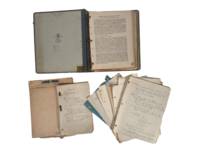
1945réf. 193511945. Witmer Richard L. Caribbean Coastal Artillery officer training archive circa 1940s documents the instructional framework and operational doctrine taught to U.S. Army Coast Artillery officers during World War II with particular emphasis on antiaircraft defense chemical warfare preparedness and logistical coordination in domestic coastal defense. This archive belonged to Captain Richard L. Witmer of York Pennsylvania an officer in the 87th Regiment of the Caribbean Coastal Artillery Command of the US Army during WWII. Its contents include 385 printed and manuscripts pages of notes lessons assignments and documents primarily from Witmer's education in officer academy.Witmer served as an officer in the 87th Regiment of the Caribbean Coastal Artillery Command a unit tasked with protecting Gulf Coast installations against aerial and maritime threats during a period of heightened concern over Axis attack on the continental United States. His notes record formalized military instruction alongside personal synthesis of tactical principles including his definition of tactics as the "Science of placing weapon so as to carry out mission" and his articulation of defensive priorities such as "Make provision to guard against a surprise" and "Take advantage of terrain for all round defense." The archive includes detailed engagement with antiaircraft gunnery where Witmer identifies primary targets as "Bombers Observation planes" and emphasizes the need for "continuous instantaneous and accurate data" and "volume of fire" demonstrating the technical and strategic demands placed on officers responsible for air defense. Witmer Richard L. Caribbean Coastal Artillery officer training archive. United States: U.S. Army Coast Artillery Corps circa 1940s. Archive comprises approximately 385 pages of manuscript and typed material primarily organized within a ring binder accompanied by three small notebooks and approximately fifteen loose leaves. Contents include notes instructional outlines assignments and technical summaries covering antiaircraft artillery ordnance ballistics supply systems transportation logistics and mess operations. Numerous pages feature hand-drawn diagrams graphs and marginal annotations. Sections devoted to weapons systems describe characteristics of artillery including "40 mm - Easily operated" "37 mm - Accurate fire" "50 cal - Rugged" and "30 cal - Simple & Rapid Min. of men." Additional material addresses chemical warfare including references to mustard gas and Lewisite with Witmer posing operational questions such as "Would the combat efficiency of my men remain high in the event of chemical attack" A formal evaluation included in the archive notes his promotion stating that he "has demonstrated outstanding ability and fitness for promotion by performing the duties of a gun battery officer" citing his leadership of an antiaircraft range section. Produced during the expansion of U.S. defensive infrastructure in World War II this archive aligns with the strategic role of the Coast Artillery Corps in safeguarding domestic installations prior to the consolidation of air defense under later Cold War military structures. The detailed instructional content reflects the Army's investment in technical specialization particularly in response to the increasing threat of aerial warfare and the lingering memory of chemical weapons deployment in World War I. Witmer's materials preserve the pedagogical methods used to train officers in integrated defense systems combining mechanical knowledge tactical planning and command responsibility. The subsequent dissolution of the Coast Artillery Corps in 1950 underscores the transitional nature of this material within the evolution of U.S. military organization. Light wear to covers with minor fading internal pages well preserved and legible with occasional handling wear; overall very good condition. unknown
1945réf. 193511945. Witmer Richard L. Caribbean Coastal Artillery officer training archive circa 1940s documents the instructional framework and operational doctrine taught to U.S. Army Coast Artillery officers during World War II with particular emphasis on antiaircraft defense chemical warfare preparedness and logistical coordination in domestic coastal defense. This archive belonged to Captain Richard L. Witmer of York Pennsylvania an officer in the 87th Regiment of the Caribbean Coastal Artillery Command of the US Army during WWII. Its contents include 385 printed and manuscripts pages of notes lessons assignments and documents primarily from Witmer's education in officer academy.Witmer served as an officer in the 87th Regiment of the Caribbean Coastal Artillery Command a unit tasked with protecting Gulf Coast installations against aerial and maritime threats during a period of heightened concern over Axis attack on the continental United States. His notes record formalized military instruction alongside personal synthesis of tactical principles including his definition of tactics as the "Science of placing weapon so as to carry out mission" and his articulation of defensive priorities such as "Make provision to guard against a surprise" and "Take advantage of terrain for all round defense." The archive includes detailed engagement with antiaircraft gunnery where Witmer identifies primary targets as "Bombers Observation planes" and emphasizes the need for "continuous instantaneous and accurate data" and "volume of fire" demonstrating the technical and strategic demands placed on officers responsible for air defense. Witmer Richard L. Caribbean Coastal Artillery officer training archive. United States: U.S. Army Coast Artillery Corps circa 1940s. Archive comprises approximately 385 pages of manuscript and typed material primarily organized within a ring binder accompanied by three small notebooks and approximately fifteen loose leaves. Contents include notes instructional outlines assignments and technical summaries covering antiaircraft artillery ordnance ballistics supply systems transportation logistics and mess operations. Numerous pages feature hand-drawn diagrams graphs and marginal annotations. Sections devoted to weapons systems describe characteristics of artillery including "40 mm - Easily operated" "37 mm - Accurate fire" "50 cal - Rugged" and "30 cal - Simple & Rapid Min. of men." Additional material addresses chemical warfare including references to mustard gas and Lewisite with Witmer posing operational questions such as "Would the combat efficiency of my men remain high in the event of chemical attack" A formal evaluation included in the archive notes his promotion stating that he "has demonstrated outstanding ability and fitness for promotion by performing the duties of a gun battery officer" citing his leadership of an antiaircraft range section. Produced during the expansion of U.S. defensive infrastructure in World War II this archive aligns with the strategic role of the Coast Artillery Corps in safeguarding domestic installations prior to the consolidation of air defense under later Cold War military structures. The detailed instructional content reflects the Army's investment in technical specialization particularly in response to the increasing threat of aerial warfare and the lingering memory of chemical weapons deployment in World War I. Witmer's materials preserve the pedagogical methods used to train officers in integrated defense systems combining mechanical knowledge tactical planning and command responsibility. The subsequent dissolution of the Coast Artillery Corps in 1950 underscores the transitional nature of this material within the evolution of U.S. military organization. Light wear to covers with minor fading internal pages well preserved and legible with occasional handling wear; overall very good condition. unknown books