31.730 risultati
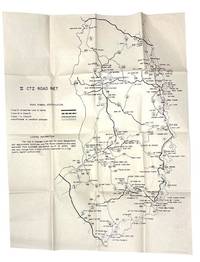
1967rif. 96222Saigon: Printed by 569th Engr. Co. Topo Corps 1967. Near Fine. Single folded sheet. 74 x 39 cm. English text. The map displays towns and connecting roads QL1 QL 14 QL 19 QL 21 LTL 79 etc. in the II Corps Tactical Zone Central Highlands and Central Coastal lowlands in Vietnam. Dan Pek U.S and ARVN army base at top left; Phan Thiet at bottom center. This map may have been in some Vietnam-related military publications. Printed by 569th Engr. Co. (Topo) (Corps) unknown books
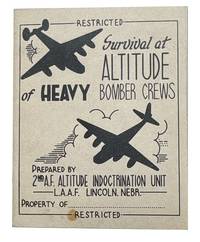
1944rif. 96024Loincol Nebraska: Repro. Dept. L.A.A.F. 1944. illustrations 5 52p. plus a few As and Bs. Softcover in original wrapper Stapled. Restricted. Uncommon. Repro. Dept., L.A.A.F. unknown books
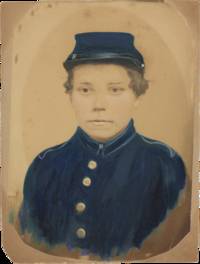
rif. List3122United States N.d. Overpainted albumen photograph measuring approximately 6 ¾ x 8 ½ inches mounted on heavy cardstock. Slight marginal wear; excellent to Near Fine. An overpainted albumen photograph portrait of an unknown Union Army soldier who appears to be quite young dressed in Union fatigues. Though boys under 18 were not supposed to be able to enlist many did so anyway with some estimating that around 200000 underage boys joined the Union Army all told.1 Despite General Order 73 which ordered that "no discharges will be granted to volunteers . on the grounds of minority" so many families tried to get their underaged sons back from the Army that the New York Times called it an "epidemic"2. Nonetheless the brave child drummer boy or soldier became an iconic image of the Union cause.1 1 Frances M. Clarke and Rebecca Jo Plante "Why the Union Army Had So Many Boy Soldiers" Smithsonian Magazine January 17 2023 https://www.smithsonianmag.com/history/why-the-union-army-had-so-many-boy-soldiers-180981458/. 2 "The Plea of Infancy an Epidemic" The New York Times August 27 1861 3. unknown books
1865rif. 95059New Orleans: Duncan & Co. Stationer's and Booksellers 124 Camp Street 1865. Very Good. Partly printed receipt dated November 7 1865. Approximately 13 x 20 cm. Property owned by individual listed on back side. Taxing white property owners in Louisiana to support education of African Americans was probably the primary method of funding education for African Americans in Union-controlled Louisiana since African Americans were too poor for their taxes to support such schools. This receipt is signed by a Captain Sheridan on behalf of the Provost Marshall. After the end of the Civil War the newly created Freedmen's Bureau would replace this Board of Education for Freedmen in the Army's Department of the Gulf. Efforts to seize and redistribute property from defeated Confederates to those formerly enslaved were thwarted by President Andrew Johnson. We doubt that the Freedmen's Bureau had authority to continue this property tax. Duncan & Co., Stationer's and Booksellers, 124 Camp Street unknown books
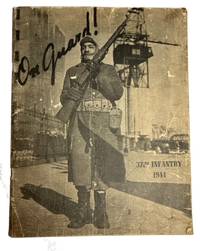
1944rif. 90244n.p. 1944. 1st ed. Paperback. Good. photos 54p. Softcover in original wrapper. 28cm. Cover rather scuffed and soiled with about one-half of rear panel with an extensive but not showing through brown stain. Rather heavy vertical crease. Moderate browning soiling and other wear. Well-worn but basically sound. Scarce item about this African Amnerican military unit. The 371st and 372d Infantry Regiments were seconded to the 157th Infantry division of the French Army in 1918 during World War I and were involved in significant military action as part of the France's "Red Hand Division. The 372d was reconstituted in the National Guard in 1925 until World War II. The Regiment was not attached to a Division and served stateside and in the territory of Hawaii during World War II. Colonel Edward Orval Gourdin a double Harvard graduate undergraduate and law school and a silver medalist at the 1924 Olympics was the Regiment's commanding officer during World War II. He was later the first African American appointed as a Massachusetts Superior Court judge in 1951 and had achieved the rank of Brigadier General when he retired from the National Guard in 1959. The original owner of this book was a Staff Sergeant in the Regiment. Signed on first blank page by 14 individuals -- most seem to be fellow NCOs. paperback books
1942rif. 92761Saint Louis: Everett Schneider Co. Lithographers 1942. Hardcover. Very Good. photos 105p. Blue cloth. White plastic comb binding. 28 cm. Title-page detached. Devotes one page three photos to the first African American Aviation Squadron unit number not given to be located at Scott Field where the emphasis was on training in radio communication. This copy belonged to a white airman whose Radio Operators Course certificate is laid in on the page with his photo. 30 or so names and addresses of other airmen on the autograph pages at the end. There are no individual photos of the African American airmen perhaps because they had not completed their training before this book was published. Everett Schneider Co., Lithographers hardcover books
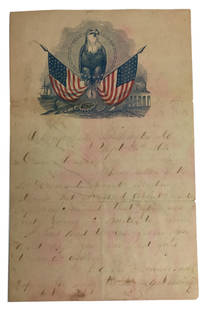
1862rif. 916131862. Poor. 20 cm x 25 cm single sheet folded to make 4 handwritten pages. Large patriotic color Illustration of a bald eagle with 2 U.S. flags occupies top third of first page of stationery. Two horizontal fold mark. Split halfway across on a fold on the last two pages. Pinkish color to much of the letter suggesting old damping. Ink quite faded and generally difficult to read. Many words are so indistinct that it was impossible for us to read them and some other words or phrases are just gone. Her letter is addressed to an otherwise unidentified cousin. Jones does not seem to show on standard lists of Civil War Nurses but the information in this letter suggests that she should. Here is our effort to transcribe this difficult-to-decipher letter: "Your letter of the 21st came to hand in due time but I had about made my mind that you was not going to write to me. I was glad to hear from you and hope that you will not fail to write again. I am well. Hoping you enjoy the same good blessing. We are situated on the same ground we occupied a part of last Fall and Winter. We have been here about four weeks. After spending the summer on the peninsula we are very glad to obtain old ground which seems almost like home. You want to know why I am in the hospital. It is not because I am sick but because others are sick and need care. I am what is termed nurse. My wages are $26.50 per month. The business is by no means delightful but I get along very well. We have got one fellow who is very sick I fear he will not recover. On the Peninsula my health became very poor but now I am well. I wish that I could hear that Grandmother is on the gain but fear I never shall. Tell hear I think of her nearly all of the time and and want to see but if I fail to see her I expect to see her in Heaven. I have wrote to your father. I presume he has received my last letter before now. I do not know that I can tell you anything about the war that would amount to anything more than you already know. As we are at present we are retired from the active field I am not as well posted as when we were aamid the turmoils of battle. I have not heard a battle sound since we came across the river. Apparently all seems quiet which seems good. top two lines at top of 4th page too indistinct to decipher My hospital service is every other day. Every other day and night. I have to work taking care of the sick of our regiment then I am idle twenty-four hours. . several lines gone or indistinct here and the I will have a chance to eat army rations wear army cloths and a few moremostly indistinct lines ." She ends the letter by requesting that her cousin write to her at Hospital 50th NY Engineer Regiment Washington D.C. Online information reports that the regiment composed mostly of men from New York and a small number from Pennsylvania lost by death 10 killed in action 7 from wounds received and 214 from disease and other causes. unknown books
1945rif. 90693Wurzburg Germany 1945. Good. Published in Wurzburg Germany. photos 4p. Printed on newsprint. 37 cm. Moderately browned. A tear and a chip in upper margin have been repaired or reinforced with tranparent adhesive paper tape. Later slanted horizontal fold. Articles include reports on arrival of 60 reinforcements from the U. S. A. and the operations of their "Scheme Section." The 4th page "Our Pin-Up Page feature 6 fully clad women mostly wives and a sister. OCLC does not list this publication. unknown books
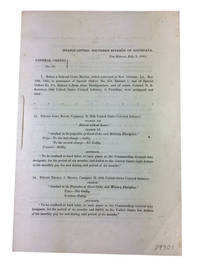
1865rif. 89901New Orleans 1865. Very Good. 9p. Tied softcover pamphlet. No separate wrapper. 21 cm. Modest spotting and soil. Colonel N. B. Bartram 20th U. S. Colored Infantry was President of this General Court Martial which convened on May 29 1865 and before which 22 soldiers appeared all but 3 of whom served in various the United States Colored Infantry -- one of the exceptions served in the 18th New York Cavalry and the other two served in the 1st New Orleans Volunteers. Charges ranged from Conduct to the Prejudice of Good Order and Military Discipline to Riotous and Mutinous Conduct. The sentence for the latter was that Private John F. Thompson be "confined at hard labor with ball and chain attached to his left leg weighing thirty-two 32 pounds chain two feet long . for the period of two years and forfeit . the whole of his monthly pay for and during the remaining and unexpired term of his enlistment." Two soldiers were found not guilty and two others facing multiple charges were found guilty of only some of the charges. All other soldiers were found guilty. An officer in the 1st New Orleans Volunteers was only given a reprimand after he used his sword to strike an enlisted man because of circumstances which are detailed at some length. Additionally page 7 includes the results of a separate military commision convened with Major M. Maloney as President on March 24 1865 to deal with three civilians -- all three were found not guilty. unknown books
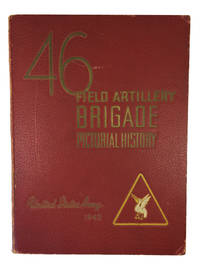
1942rif. 88061Atlanta: Army Press 1942. Hardcover. Good. photos 134p. Red cloth. 31cm. Cover scuffed and worn along joints and other extremities. Contents sound A pictorial history of the stateside training and organization of this segregated unit for African Americans. Separate sections are devoted to the 350th 351st and 353rd Field Artillery Regiments and the 46th Tank Destroyer Battalion. Army Press hardcover books
1958rif. 83556Washington: GPO 1958. Paperback. Near Fine. ii 104p. Wrapper. 23cm. Technical Manual No. 30-548. GPO paperback books
rif. 68521n.p. n.d. post-WWII. Paperback. Very Good. photos 17p. Softcover in original wriginal wrapper. 22 cm. Pages numbered on one side with photos on unnumbered facing pages. paperback books
1946rif. 57553n.p.: Printed by AG Printing Plant 1946. Paperback. Near Fine. photos 60p. plus 4 blank leaves at end. Original wrapper. 28cm. The 8th Army was heavily involved in the liberation of the Philippines from Japanese occupation. Laid in are two related typed letters to Colonel Brunke who was head of the 8th Army's Historical Section. Printed by AG Printing Plant paperback books
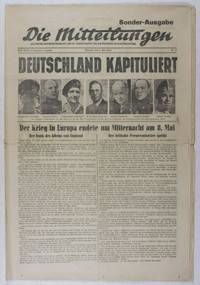
1945rif. 39196Germany: The 21st Army Group 1945. First edition. Softcover. vg. Folio 12 1/2 x 18 1/2". 8pp. Published by the 21st Army Group this special issue of "Die Mitteilungen" Information announces in bold letters and across its front page the capitulation of Nazi Germany. Featured in two columns and above the b/w photographic portraits of Field-Marshal Alexander Marshal Koniev Field-Marshal Montgomery King George VI General Eisenhower Marshal Zhukov and General Bradley are the victory speeches pronounced by King George VI and Prime Minister Winston Churchill. Of special interests are the announcement of Joseph Goebbels' death Page 2; the liberation of some of Europe's political military and religious leaders such as Leon Blum Paul Reynaud Edouard Daladier General Weygand General Gamelin Dr. Kurt von Schuschnigg Pastor Niemöller Belgian King Leopold III etc. Page 2; Information on Hitler's suicide Page 4; The San Francisco conference Page 5 and 8; article with four gruesome photographs on the liberation of the Death Camps Page 6; five b/w photographic portraits of the following allied statesmen: General de Gaulle Marshal Stalin Winston Churchill President Franklin Delano Roosevelt who died less than a month before Germany's capitulation and President Harry Truman Page 8. 'The 21st Army Group newspaper "Mitteilungen" was distributed as follows: Laer 700 copies; Greven 560 copies; Wunsdorf and Neustadt 1000 copies; Basthorst 500 copies; Celle 3000 copies; Lübeck 4000 copies; Bergen-Belsen camp 2500 copies' Extracts from War Diary of 14 Amplifier Unit & 19 Leaflet Unit. Folding mark at center. Tiny closed tear along spine. Minor age-toning. Text in German. Newspaper in overall very good condition. The 21st Army Group was a World War II British headquarters formation in command of two field armies and other supporting units consisting primarily of British and Canadian forces. Established in London during July 1943 under the command of Supreme Headquarters Allied Expeditionary Force SHAEF it was assigned to Operation Overlord the Western Allied invasion of Europe and was an important Allied force in the European Theatre. The 21st Army Group operated in Northern France Luxembourg Belgium the Netherlands and Germany from June 1944 until the end of the war in Europe in 1945. After the German surrender 21st Army Group was converted into the headquarters for the British zone of occupation in Germany. It was renamed the British Army of the Rhine BAOR on 25 August 1945 and eventually formed the nucleus of the British forces stationed in Germany throughout the Cold War. The 21st Army Group unknown books
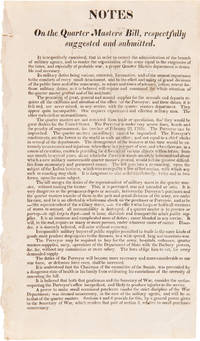
1811rif. 38950Washington 1811 or 1812. Reorganizing the Way the Army is Provisioned on the Eve of the War of 1812 An interesting unofficial handbill relating to the U.S. Army Quartermaster Department on the eve of the War of 1812 with references to the impending war with Britain Indian business and the Barbary powers. In 1811 Congress introduced "A Bill for the Establishment of a Quarter-Master's Department" which the anonymous author of the present document notes "merges the duties of the superintendent of military stores in the quarter master without naming the former." The author urges Congress to keep separate the military office of the Quartermaster from the civil positions of the Army Purveyor. Dbd. Soft vertical fold. Light offsetting from a different document near title else very good. unknown books
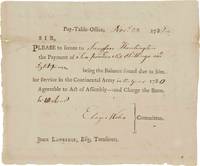
1782rif. 68281N.p. but Hartford Nov 22 1782. Pay for a New Hampshire Soldier A partially printed form accomplished in manuscript authorizing a payment of ten pounds six shillings and eight pence to one Sampson Huntington for his service to the Continental Army in 1780. Sampson Huntington was a private in the 8th company of the 2nd N. Hampshire Regiment under Captain John Dennet. The Continental Army was constantly behind in paying its soldiers so the fact that Huntington was being paid only two years late made him one of the lucky ones. He remained in that unit at least through 1781 however so likely had a bit longer to wait for the following year's pay. Eleazer Wales who signed and likely filled out this document was a citizen of Hartford and was elected commissioner of accounts by Congress on February 3 1778. While he resigned that position out of frustration in 1780 it would appear that he was still lending his analytical mind to the Revolution on behalf of the Pay-Table Office in 1782. Light soiling and edge wear. Very good. unknown books
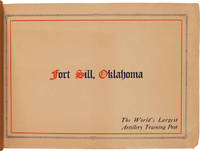
1918rif. 57357Fort Sill OK. ca. 1918. Original Photos from the Early Days of the Artillery Training School at Fort Sill A rare commercially produced photo album rendered unique by the addition of thirty original photographs of the U.S. Army Artillery Training School in Fort Sill Oklahoma at the end of World War I. The first section begins with a printed one-page "Short History of the Fort Sill Military Reservation" and consists of mounted photographs in printed frames with printed captions. This printed portion of album is divided into three parts with individual titles: "Fort Sill Oklahoma: The World's Largest Artillery Training Post"; "Medicine Park: Southwest Oklahoma's Pleasure Resort"; and "Some Views of the Comanche and Apache Indians." The second section of the album consists of blank pages for personal photographs here filled with thirty photographs with occasional manuscript captions supplied by an unnamed Army corporal. In addition to photographs of camp buildings artillery emplacements and scenery in and around Fort Sill the album features a number of photographs of the 1918 Victory Day Parade as well as a "pageant" held at the fort where members of the Comanche and Kiowa tribes participated in reenactments of the early frontier days at the fort. Fort Sill was also the birthplace of U.S. combat aviation in 1915 and a few photographs show some of the earliest military planes. The personal photos at the rear of the album include a number of individual soldiers a handful of alternate views of parades and events and the owner's actual cloth uniform stripes pasted to the final page. A rare and interesting look at the early days of a major American military base at the conclusion of World War I. OCLC records two copies of a similar souvenir album which also covers Camp Doniphan but does not locate the present version anywhere. Forty-one mounted photographs with printed captions and an additional thirty original mounted photographs some with manuscript captions most about 2½ x 4½ inches plus pasted-in corporal's stripes on final album leaf. Oblong quarto. Original printed thick wrappers with wrapper title "Souvenir from Fort Sill Oklahoma" tied with string. Spine ends chipped edge wear to wrappers. Photographs lightly faded occasional adhesive residue or paper defects particularly in latter half. Overall very good. hardcover books
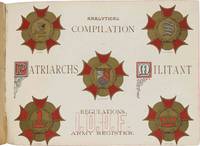
1892rif. 31753Cincinnati Oh.: Cohen & Co. 1892. With Beautiful Chromolithographs An incredibly extensive compilation of rules and regulations for the Patriarchs Militant of the fraternal organization known as the Independent Order of Odd Fellows I.O.O.F. Included are military rosters ceremonial procedures and organizational by-laws. The forty handsome chromolithographic plates depict all manner of military insignia dress and uniform. 4xiv269pp. plus addendum of forty chromolithographic plates. Portrait. Oblong octavo. Original pebbled cloth gilt. Worn at spine ends and corners. Front hinge cracked. Internally clean save for a few pencil emendations. A very good copy. hardcover books
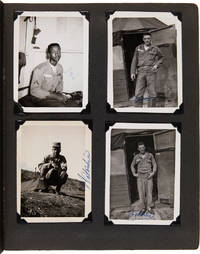
1960rif. 57626Tokyo and surroundings. ca. 1960. An African-American Soldier in Japan in the 1960s An album of charming vernacular photographs assembled by a young African-American soldier on a United States Army base near Tokyo in the period between the Korean and Vietnam wars. The majority of the photos are impromptu portraits or scenes from camp life depicting the soldier and his diverse group of White Asian-American and African-American comrades. Many of the soldiers are identified by a surname written in ink on the photograph and a number of the images show soldiers of different races associating together. In addition to pictures of himself and his friends our photographer has captured a number of Japanese tourist scenes including the Kamakura Daibutsu zen gardens around the city festivals and processions nature scenes and more. Laid into the rear of the album are a number of smaller personal or family photos with some identifying notes including an ink note on one labelled "me" the same person appears in many of the military photos in the album. There are also a few flyers for Tokyo nightclubs and a handful of names and addresses for soldiers in his unit. An interesting look at the daily life of American soldiers in Japan in the early '60s. 186 mounted photographs and postcards on 32 leaves plus eleven loose photographs and five printed flyers. Images vary from 2½ x 1¾ inches to 10 x 7½ inches. Quarto photograph album. Original green velvet with origami crane stitched in gilt on front board a.e.g. Boards lightly rubbed and stained. Album leaves almost entirely loose from binding several photographs loosely laid in. The images themselves very crisp and clean. hardcover books
1898rif. 80937St. Louis MO: A. Whipple Printer. Very Good. 1898. Softcover. This item is soft-bound in tan wrappers with black printing on the upper cover. The covers show soiling/toning and edge-wear. The staple binding is solid. The contents are bright and clean. . A. Whipple, Printer paperback books
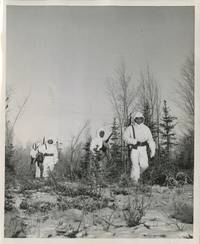
1954rif. List3873Washington D.C.: Department of Defense 1954. Photograph measuring 8 x 10 inches. With caption manuscript and later sticker verso. Slight damage to edges; excellent. A 1954 Department of Defense press photograph of Alaska Native soldiers of the Alaska National Guard on winter patrol wearing white camouflage and moving through snowy brush. The period caption refers to the men as an "Eskimo Patrol" training "among the frozen wastes of Alaska" language typical of midcentury military publicity but also pointing to the specific role of Alaska Native soldiers in Arctic defense. The photograph belongs to the early Cold War history of Alaska as a strategic military frontier. During World War II the Alaska Territorial Guard had drawn thousands of Alaska Native volunteers from coastal and interior communities to watch for invasion protect transportation routes and serve as the Army's local "eyes and ears." After the war that model continued in the Alaska Army National Guard's Scout units whose members operated from villages across northern and western Alaska and helped observe the Bering Sea coastline during the Cold War. The image is useful as a record of Indigenous participation in the military infrastructure of Arctic surveillance. Alaska Native guardsmen brought local knowledge winter mobility and village-based observation to a defense system that also included radar stations air bases communications sites and ground observers. . Department of Defense unknown books
2008rif. 232860Skyhorse 2008-06-17. Hardcover. Good. 5x0x8. Clean has a good binding no marks or notations light wear to the hardcover some staining to the edges hb. LF Skyhorse hardcover books
rif. 38684SONG SHEET THE ARMY AND NAVY FOR EVER. New York: Charles Magnus circa 1860s. Colored illustrated letter-sheet 8 x 5 inches. Wolf American Song Sheets 64a. Three ten-line stanzas of patriotic verse. The top half of the page is a colored illustration showing victorious Union army and navy men raising the stars and stripes over a Confederate fort with cheering soldiers and sailors all round and Union ships firing cannon. Evidence of removal at the corners of the blank leaf. Fine. 38684. unknown books
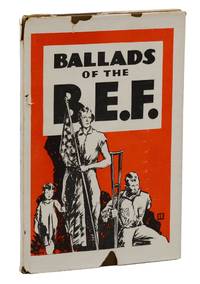
1932rif. 140947479New York: Coventry House 1932. First edition. First edition. 47 pp. Bound in publisher's brown cloth with paper title label. Near Fine with slight lean to spine in a Good example of the rare dust jacket with some chips to edges and along gutters and wear. Seldom seen in jacket. A collection of music for the Bonus Army AKA the Bonus Expeditionary Force as they called themselves a group of World War I veterans who marched on Washington seeking the bonuses the government had promised them for their services but had never paid. It didn't end well: in 1932 President Hoover would have them gassed shot at and charged by the military under MacArthur. This particular collection of songs was produced anonymously by the Communist Party USA looking to piggyback on the cause of the Bonus Army whose exact politics remain the subject of debate amongst historians to this day. Similar to IWW songbooks these are parodies of well-known songs with political sometimes bitterly humorous lyrics. Illustrated. Coventry House unknown books
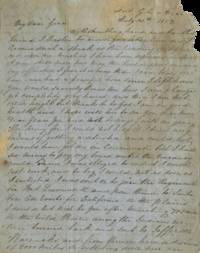
1852rif. List3713This item is currently on reserve; please contact dealer for more details. Fort Gibson Indian Territory 1852. Single two-page letter measuring 9 ¾ x 7 ¾ inches postmarked Fort Gibson. Damage to upper right corner intersecting with text; repairs with archival tape; with small portion of text continued on cover missing. Very good minus. A letter from James Johnson at Fort Gibson to his wife Grace in New York dated July 30 1852. Johnson had left home in search of work trying "every means of getting a station"; he "would have got one in Cincinnati but I had no money to pay my board until the vacancy would occur" and was therefore "obliged to enlist I could not work and to beg I could not." He had apparently stopped writing to his wife due to shame but she had discovered his enlistment anyway. He details his service: "As soon as I enlisted I was sent on to join the Regiment in Fort Leavenworth and from thence to Santa Fe en route for California. On the plains I could not write to you. After marching 700 miles on the Wild Prairie among the Indians we were turned back and sent to Jefferson Barracks and from thence here a distance of 2000 miles. On settling down here . I had every opportunity of writing to you but I could not bring myself to do it". This itinerary places Johnson's service with the "Army of the Frontier" a term for US Army activity protecting Euro-American settlers and participating in the Indian Wars which would drive Indigenous tribes off their land. Fort Gibson in particular located within Indian Territory played a significant role in the program of Indian removal with tribes there under the Army's control including the Cherokee Muscogee and Seminole. The content of Grace Johnson's objection to her husband's service and the cause of his shame over it are not entirely clear from the letters but they are felt intensely: Johnson laments that he could not save "myself from disgrace and suffering and the accusation of my own conscience" and remarks of "William John" apparently a deceased child that "I feel content he is out of this sinful world lest any of his fathers sins should fall upon him". Though he does state that he "would not feel half as I do" if he were without a family the guilt and shame seem to center as much around the military service as around the family abandonment. He closes his letter with a plea to Grace to help him leave the army: "Dear Grace you can get me out of the army any time you like if you take the proper steps by going to a lawyer and I will give you every assistance in my power for when I enlisted I enlisted as a married man and had 3 children". The letter reflects the sentiment that though above begging enlisting in the army was a shameful last resort for those who could not obtain civilian jobs. Of interest to historians of economic enlistment and public sentiment regarding the US Army in the midcentury. books