32 388 résultats
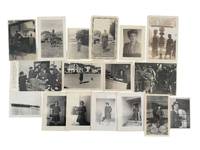
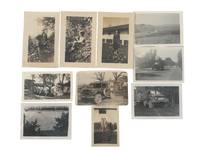
1945réf. 225281945. Women History World War II WWII Women's Army Corps photo archive documenting women's military service during World War II and the expansion of women's logistical and technical roles within the United States Army. The photographs record daily activity surrounding Women's Army Corps personnel including ambulance operation vehicle maintenance military training environments and informal moments of rest and recreation. Established in 1943 Women's Army Corps enabled women to enter the Army in noncombat roles that were essential to wartime mobilization including clerical work communications mechanics and medical transport. The images document this institutional transformation through scenes of uniformed women working with military vehicles operating ambulances and participating in the broader infrastructure of wartime military camps. One photograph shows a WAC standing in full service uniform before a low administrative building while others depict women outdoors in wooded settings during moments of leisure illustrating both the disciplined and personal dimensions of wartime service. Archive of 20 gelatin photographs created during the 1940s depicting Women's Army Corps personnel military vehicles and associated Army training activities. Photographs measure approximately 3.5 x 5 inches. The photographs show WAC members in both uniform and off duty settings including outdoor portraits and camp scenes. Several images focus on military ambulances and transport vehicles bearing visible Army markings such as "U.S. ARMY 432621" and "AMB-34." Verso inscriptions provide firsthand commentary on military duties and equipment including one caption reading "This is my new AMBULANCE hope you like it sis. safe & OK" and another written beside an ambulance photograph noting "good old Baker 5 kept me from walking." Operational scenes include soldiers crouched behind sandbags with a handwritten note identifying personnel as "Eselinger Conrad Palmer Carvey Boss." Other photographs document the broader military environment surrounding WAC activity including a drill or parade ground and a large motor pool with rows of Army trucks one marked "U.S. Army 008909" positioned in front of a multi story barracks. Additional annotated images identify fellow servicemen and technical details of equipment including "Hines Gallop and myself. Gallop is a jeep driver from North Carolina" and another describing "my radio on right fender" while one photograph is labeled simply "motor pool." Women's Army Corps personnel served throughout the United States and overseas during World War II performing essential logistical and administrative work that supported Allied military operations. Ambulance drivers such as the woman referenced in the captions transported wounded soldiers during training exercises and operational deployments and were often responsible for maintaining their own vehicles in field conditions. WAC members later served across European theaters including England France and Italy after the Allied landings in 1944 contributing to the wartime medical evacuation system that moved casualties from combat zones to field hospitals and rear medical facilities. Light edge wear mild surface handling and faint silvering to some prints; overall very good condition. These photographs document both the operational infrastructure of wartime motor transport and the presence of women within that system illustrating how the mobilization of female personnel expanded the technical and logistical capacities of the U.S. Army during the global conflict. unknown books
1945réf. 214301945. WWII era Women's Army Corps photo archive documenting servicewomen including two African Americansand four partially identified individuals. Creation of the WAC in 1942 marked the first permanent institutional incorporation of women into the U.S. Army placing female personnel into administrative communications intelligence and logistical roles across both domestic bases and overseas commands. One photograph identified on the verso as "Gynnie Polly Corsica '45" provides additional documentation of Black women serving overseas in segregated Army units during the final year of the war. Archive of 18 silver gelatin photographs from W.W.II. Photographs measure approximately 3 x 2 inches to 6 x 3.5 inches. The images depict American servicewomen in a range of wartime contexts including official uniform portraits informal snapshots and scenes taken in European cities damaged by combat. Several photographs show women wearing standard WAC dress uniforms with garrison caps and enlisted insignia while others depict personnel wearing British style battledress associated with American administrative units stationed in Europe. One photograph shows three uniformed personnel two women and one man standing at attention before a formal government building likely in Britain. Another image places a uniformed American servicewoman before the gilded equestrian statue of Joan of Arc in Paris a landmark associated with Allied presence in liberated France. Additional photographs depict ruined urban landscapes with bombed churches and collapsed structures suggesting scenes from Germany or France shortly after liberation. A photograph inscribed "Chattanooga Tenn." shows a woman standing in civilian clothing at the entrance of a home indicating a stateside context connected to the servicewoman's life before or after deployment. Another photograph labeled "Ann & Lillie Mother" shows two women standing outside a residence likely relatives of one of the servicewomen. Women's military service expanded rapidly during World War II as the War Department created organizations such as the Women's Army Corps and the Navy's WAVES to address labor shortages across the armed forces. Overseas deployments placed WAC personnel in newly liberated European cities and military headquarters throughout the Allied command structure. Light toning minor edge wear and occasional handling marks. Overall very good condition. Although African American women served within segregated units their participation in overseas assignments including Mediterranean theater postings marked a significant shift from earlier military policy which had typically limited Black women's service to domestic assignments within segregated support units. unknown books
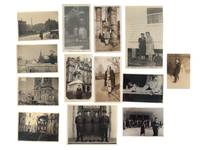
1944réf. 218341944. Women's History Military History Photography Unidentified photographer Women's Army Corps photographs mid 1940s document female military service during World War II and provide direct visual evidence of women's roles within the U.S. Army following the formal incorporation of the Women's Army Corps in 1943. The images record administrative work training routines and social life among enlisted servicewomen situating WAC personnel within the broader wartime expansion of women's participation in military infrastructure. The archive supports research into gendered labor in the armed forces wartime mobilization and the institutional integration of women into military systems. United States including Fort Lee Virginia and Westfield Massachusetts mid 1940s. Archive of 17 silver gelatin photographs ranging from approximately 3.5 x 2.5 inches to 5.5 x 3.5 inches with manuscript annotations on several versos identifying locations and contexts. The photographs depict WAC servicewomen in uniform engaged in administrative duties formation drills and off duty activities. One image shows a woman seated at a desk beneath a clock with a nameplate reading "M.V. Ramsey WAC" with visible chevrons indicating rank while others show groups gathered around mess tables standing in inspection formation or marching in coordinated drills. Outdoor scenes include annotated locations such as "Flattop - Ft. Lee Va." and "Taken in Westfield a suburb of Springfield" as well as a roadside photograph showing two servicewomen beneath directional signage indicating distances to nearby Massachusetts cities. Several portraits focus on individual women posed in multiple settings near military installations suggesting personal documentation of service life. The archive situates WAC service within the broader reorganization of the U.S. military during World War II when women assumed clerical logistical and support roles essential to sustaining wartime operations. Training centers such as Fort Lee and regional encampments in Massachusetts functioned as key sites for integrating women into military systems while maintaining structured discipline and hierarchy. These photographs document both institutional expectations and informal camaraderie among servicewomen illustrating how gender roles were renegotiated within military contexts during the war. Light curling and minor surface creasing to some photographs; most remain well preserved with strong tonal clarity. Overall very good condition. A cohesive photographic record of women's military service and daily life within the Women's Army Corps during World War II. unknown books
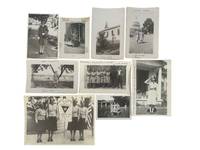
1943réf. 220591943. Women's Army Corps service photographs dated 1943 to 1944 document the participation of enlisted women in U.S. Army support operations during World War II with particular attention to transportation training environments and stateside military life. The images identify individual service members including Hilda Goble described in captions as an "ambulance driver during War II" and Abbie E. Bachelder situating named women within the broader expansion of female labor following the establishment of the Women's Army Corps in 1942. These photographs support research into women's military service wartime labor structures and the integration of women into logistical and medical support roles essential to the functioning of the U.S. Army during the war. Archive consists of 9 original silver gelatin photographs most approximately 3 x 5 inches several with scalloped or deckled edges and period ink captions identifying subjects and dates. Two portraits show Hilda Goble in full uniform standing before a porch and saluting each inscribed "Hilda Goble Ambulance driver during War II" documenting her role in transporting injured personnel within military systems. A group photograph captioned "Ambulance Driver Team War II Hilda Goble" depicts seven uniformed women indicating coordinated service within ambulance units. Additional images include a portrait labeled "Abbie E Bachelder / June - 1944" showing a uniformed WAC posed before a landscape of barracks buildings and another dated 1943 identifying Bachelder outside a wooden structure. A photograph captioned "Oct 29 - 1944 / Reims" shows two women identified as Roberta and Abbie posed on the grounds of the U.S. Capitol indicating travel or official assignment within government contexts. Other photographs depict WAC personnel standing near a military chapel and within training or hospital environments while one image titled "Marine Corps Wives of America - Hdqtrs Chap 1" shows four women beneath an organizational banner documenting affiliated civic or support networks connected to military service. These images documents the Women's Army Corps expantion to meet wartime labor demands assigning women to clerical transportation medical and logistical roles across domestic and overseas installations. The presence of ambulance drivers within the archive demonstrates the direct involvement of women in medical transport and support infrastructure while scenes at the U.S. Capitol and organized groups indicate both official recognition and the development of social and institutional networks among servicewomen. Light edge wear and minor creasing with one photograph showing tape residue; images otherwise clear with captions legible; overall very good condition. This archive provides a concentrated visual record of named WAC personnel and their roles within the operational and social framework of the U.S. Army during World War II. unknown books
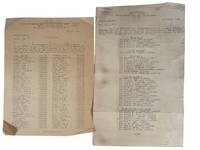
1943réf. 220421943. U.S. Army issuer Special Orders documents 1943-1944 documenting the mobilization assignment and promotion of women in the Women's Army Corps during World War II. The archive illuminates a system of military recruitment training allocation and hierarchical advancement revealing how women were enlisted processed and promoted within a gender segregated military structure.These documents show the mechanisms by which the Army expanded its personnel base to include women formalizing their roles through standardized orders logistical coordination and rank progression. U.S. Army. Special Orders. Southern New York Recruiting and Induction District and APO 501 Services of Supply 1943-1944. U.S. Army's mobilization of women for wartime service documents. This archive highlighting how gender and race intersected within a segregated military structure. Five pages of typed military orders documenting the enlistment and rank advancements of dozens of women into the Women's Army Corps WAC during World War II during a critical and unprecedented phase of American military expansion. These internal "Special Orders" were issued from U.S. Army Headquarters one from the Southern New York Recruiting and Induction District dated 28 September 1943 3 pages and the other from APO 501 Services of Supply Special Troops dated 25 August 1944 2 pages. The first document-marked "RESTRICTED"-lists 161 women who have "been enlisted this date as Privates in the WAC AUS UP without delay for New York N.Y. to Daytona Beach." These orders formalize the transfer of recruits to basic training at the Second WAAC Training Center in Florida a site where both Black and white women were trained in segregated units. Typed names include "KENNEDY DOROTHY R." "RAY RITA T." "ROBERTS ROSA" and "ROSS GRACE". The document also makes note that "the QMC will issue six 6 meal tickets to one hundred and sixty one 161 WACs" revealing both the scale and logistical efforts involved in transporting and sustaining the newly enlisted women. It is signed by R.C. Burgess 1st Lt. WAC AUS WAC adjutant and includes careful routing for distribution and duplication. The second document issued nearly a year later reflects the internal promotion structure within the WAC. It includes detailed lists of women being promoted across multiple ranks-from Private to Private First Class Technician Third through Fifth Grades and up to Master Sergeant. It begins: "Upon recommendation of the Chiefs of Section. the following temporary promotions are announced in WAC Service Unit USA SOS APO 501." Among those promoted: "Sgt HELEN P. SUTTON" "T/5 HELEN E. SHROOP" "Pvt DOROTHY R. KENNEDY" again appearing from the earlier enlistment list and "Sgt MARGARET H. STERLING" named Master Sergeant. The appearance of some of these women in both documents indicates successful progression within the ranks underscoring the opportunities for women-albeit within a racially stratified command-for advancement and formal recognition. Edges of the paper show chipping and creasing Minor staining to the lower half of the 1944 document. All text remains fully legible. Overall very good condition. A compelling and tangible record of women's military service during World War II. These documents record the expansion and institutionalization of women's military service during World War II when the WAC became a central component of U.S. Army personnel strategy. The inclusion of detailed enlistment lists and promotion orders demonstrates how women were incorporated into existing military systems while operating within segregated units shaped by prevailing racial policies. The progression of individuals across documents illustrates continuity of service and advancement opportunities within constrained structures. Edge wear chipping and creasing with minor staining to the 1944 document; text fully legible; overall very good condition. A concentrated administrative record of women's wartime service and the operational systems governing their roles. unknown books
1947réf. 28740Washington DC: United States Army Air Forces. Very Good. ca.1947. First Edition. Hardcover. no dust jacket probably as issued light external soiling a little darkening to the spine. charts maps A massive catalog of all and I do mean all the photo-technical data related to the photography both still and motion picture both black & white and color of "Operation Crossroads" the first two post-World War II nuclear bomb tests conducted at Bikini Atoll in the South Pacific in July 1946. The first test took place on July 1 and was nicknamed "Able Day"; the second on July 25 was "Baker Day." The names were directly taken from the first two letters of the Joint Army/Navy Phonetic Alphabet. The stated purpose of the tests was to assess the level of damage that the massive explosions would inflict on naval vessels of various kinds that were stationed in the vicinity; all humans were evacuated from the ships although a large number of small animals were placed on board thousands of rats; hundreds of goats pigs and mice; and even a few dozen guinea pigs in order to measure the effects on them of the radiation emitting from the blasts. Short version: not good. The two tests were designed to measure the effects of two different kinds of explosions: the Able bomb was an "air burst" detonated 520 above the surface; the Baker bomb was suspended beneath a landing craft and detonated 80 feet underwater. The stated purpose of this catalog was "to provide a systematically-combined record of photography available from the two operations for study measurement and analysis purposes." The bulk of its 756 pages is devoted to reproductions of the three data sheets that documented each roll of film that was shot: 1 the "Film Data Sheet" giving the technical specs of the camera and a summary of its coverage; 2 the "Time and Position Data Sheet" with detailed data on each individual exposure; and 3 the "Aircraft Track and Position Chart" a map of Bikini Atoll with the positions of each camera-carrying aircraft plotted thereon. Those aircraft by the way were essentially drones operated by radio remote control and the cameras were automatic so that no humans needed to be too close to the blasts. There are also at the beginning of both the Able and Baker sections abstracts of the contents of each roll of film. Example: "This roll shows phenomena from fireball through development of mushroom cloud in a series of exposures made in rapid succession 3 per second." Although the volume itself was apparently not classified neither was it a U.S. Government Printing Office issue intended for wide circulation; it's stated in a couple of places that "a limited number of additional copies of this publication are available" and informs the reader where to procure them. Its obvious purpose was to facilitate the users' ability to locate the film footage or still photography needed for purposes of their own analysis and it's likely that a certain level of security clearance was required. There is however this note among the introductory matter: "All data and sheets pertaining to Able Day Sortie H and bomb carrying aircraft have been deleted from this catalog and will be found in a classified addendum." Keeping wraps on info about the plane that actually dropped the Able bomb I can understand but I wonder what the deal was with "Sortie H" A small amount of the film footage documented here was incorporated into the official U.S. Government documentary film of the events called "Operation Crossroads: Able and Baker Day Tests Bikini Atoll Summer 1946" released in 1949. One would hope that all this photography has been preserved in the National Archives -- maybe even the stuff from the mysterious "Sortie H." The present volume is quite rare with OCLC recording just three copies: at the Smithsonian Institution in Washington DC; the Air University Library at Maxwell AFB in Montgomery Alabama; and at the Phillips Research Site Technical Library which was merged in 1997 into the Air Force Research Laboratory at Wright-Patterson AFB in Ohio the OCLC link however is dead -- the latter two of which I suspect are not readily if at all accessible by the public. NOTE by the way that there is no actual photography reproduced in this book: it's strictly a non-visual catalog. . United States Army Air Forces hardcover books
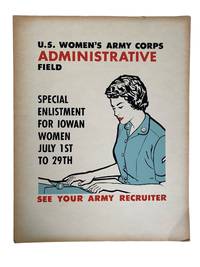
1944réf. 207311944. Archive of two items related to the Women's Army Corps W.A.C. 1 The WAC Officer: A Guide to Successful Leadership. Washington: United States Government Printing Office 1944. A February 1945 pamphlet distributed by the War Department. 2 U.S. Women's Army Corps poster. Poster reads: US Women's Army Corps Administrative Field Special Enlistment For Iowan Women July 1st to 29th See Your Army Recruiter. 11" x 14.75". Depicts a young woman in military dress typing on a typewriter to represent the openings in the Administrative division of the Women's Army Corps. The WAC was a great source of pride for many women during WWII as it allowed them to patriotically contribute to their country's war efforts. The WAC during WWII were trained to handle auxiliary functions for the military as switchboard operators mechanics drivers stenographers armorers to maintain and repair smalls arms & heavy weapons which they unfortunately weren't allowed to use and many other war-time support operations. Uncommon. In very good condition overall. unknown books
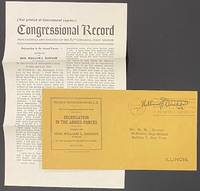
1951réf. 186401951. Dawson William L. African American congressman from Chicago and World War I veteran of the segregated 366th Infantry Regiment House of Representatives speech delivered April 13 1951 addressing segregation in the United States armed forces during the early years of the Cold War. Dawson served in Congress for nearly three decades and became the first African American to chair a congressional committee. His speech was delivered during a critical period in the history of American civil rights and military policy following President Harry Truman's 1948 Executive Order 9981 directing the desegregation of the armed forces. Debates in Congress during the early 1950s addressed the pace and implementation of integration and Dawson used the floor of the House to argue that racial segregation contradicted the principles for which American soldiers fought. Dawson William L. "Segregation in the Armed Forces." Speech of Hon. William L. Dawson of Illinois in the House of Representatives April 13 1951. Congressional Record 82nd Congress First Session. Single printed sheet measuring approximately 6 x 9 inches preserved with original mailing envelope. The printed text reproduces Dawson's remarks opposing segregation within the military establishment. In the speech Dawson declared: "If there is one place in America where there should not be segregation that place is in the armed services among those who fight for this country." He continued with a broader appeal to constitutional ideals and national unity: "I would give up this life of mine to preserve this country and every American in it white or black. Deny to me today if you will all that American citizenship stands for I will still fight to preserve our Nation knowing that someday under the Constitution of the United States all of these restrictions will be removed and that we will move forward before the world as one people American people joined in a democracy which shall set the pattern for all the world." Dawson's remarks formed part of the ongoing political struggle over civil rights and military policy during the early Cold War. The Korean War had begun the previous year and questions about equality within the armed forces remained under active debate as the military implemented Truman's desegregation order. Dawson's own wartime service in a segregated unit during World War I informed his critique of racial discrimination within the military establishment. As a senior African American political leader in Congress his advocacy contributed to broader legislative and political pressure supporting the continued dismantling of segregation in the armed forces. Minor wear consistent with age; overall condition very good. unknown books
1899réf. 185571899. Wagner Arthur L.; Kelley Assistant Adjutant-General; Jerrold J.D. The United States Army and Navy: From the Era of the Revolution to the Close of the Spanish-American War 1899 presenting a comprehensive late nineteenth-century account of American military development with direct relevance to the study of warfare institutional organization and expansion of U.S. military power. The work surveys major conflicts including the Revolutionary War Mexican War Indian Wars and Spanish-American War situating the latter within a period of overseas engagement and changing strategic priorities. It also provides detailed treatment of military structure including administrative divisions pay systems and operational organization within the Army alongside parallel developments in the Navy. Naval sections address earlier conflicts such as the War of 1812 and engagements with Tripoli and France as well as contemporary actions including Manila Bay and Santiago de Cuba reflecting the emergence of the United States as a naval power at the close of the nineteenth century. Wagner Arthur L.; Kelley; Jerrold J.D. The United States Army and Navy: From the Era of the Revolution to the Close of the Spanish-American War; with Accounts of Their Organization Administration and Duties. Akron Ohio: The Werner Company 1899. First edition. Oblong folio measuring approximately 18 x 13.5 inches illustrated with 43 full-color lithographic plates on heavy stock comprising 25 army subjects and 18 navy subjects each accompanied by descriptive text on protective tissue guards. The plates depict soldiers officers and marines in uniform battlefield scenes and naval vessels including battleships and cruisers providing visual representation of personnel equipment and engagements across multiple conflicts. Single oblong folio volume in dark blue cloth with gilt title on the front board. Light wear to edges of spine and boards; text and plates clean and well-preserved; overall very good condition. A large-format illustrated survey of United States military history and organization at the close of the nineteenth century. unknown books
1912réf. 381342Washington: Government Printing Office 1912. Hardcover. Very Good. First edition. Multiple House Documents 62d Congress 2d Session 1911-1912 bound in a four volume set. Thick octavos. Each volume contains numerous folding topographical maps and plates. Complete as issued in the original publisher's cloth. The cloth bindings are moderately toned and soiled with light dampstaining at some page margins good or better overall. Contains detailed topographical and engineering surveys of important rivers and harbors throughout the country and including Kauai Hawaii. Prepared under the direction of the Secretary of War by the US Army Corps of Engineers. A scarce complete set with the folding maps in very good condition. Government Printing Office hardcover books
1890réf. 60870New York: G.P. Putnam's Sons 1890. First Edition. Small octavo. Publisher's gilt-pictorial cloth; vi1-176pp. Slight external wear including some mild rubbing to cloth at spine ends. Internally tight and sound with some marginalia to Contents page and some ink graffiti to rear blanks and endpapers. Early ownership signature "Helen Madzik" to front pastedown. Easily Very Good. Huggins a Medal of Honor winner served more than 40 years in the Army retiring in 1903 as a Brigadier General. The title work is a long narrative poem heavy on Native American symbolic elements with a Great Plains setting. G.P. Putnam's Sons unknown books
1974réf. 47958Helsinki: Comisión Internacional para la Investigación de los Crímenes de la Junta Militar en Chile n.d. ca. 1974. First Edition. Octavo; 42 leaves printed on rectos only loosely housed as issued in cream printed card chemise. Light wear to chemise extremities else Fine. List of forty-two members of the Chilean junta beginning with Pinochet and his top officials after which proceding alphabetically from Luis Alarcón Gacitua to Luis Vidal providing a list of crimes committed during the regime. Though described as the first such list this appears to be complete and all published. We find no copies separately catalogued in OCLC as of March 2020. Comisión Internacional para la Investigación de los Crímenes de la Junta Militar en Chile unknown books
1939réf. 46634Shanghai: Nishimura Company 1939. Edition not stated. Quarto 26.5cm; black simulated leather stamped in red and gilt in brown paper slipcover; unpaginated photo-illustrated plates w/ rice paper overlays. Wear minor scuffs and soiling to boards; toning and foxing intermittent throughout text especially on overlays; some overlays creased or torn. Slipcover worn and chapped with abrasions and two large one repaired tears across front panel. Photo-illustrated pastedowns and endpapers. Very Good in Good slipcover. All text in Japanese with some obsolete/antiquated kana/kanji oriented right to left. This is a privately-issued commemorative yearbook-type photo album shashin-cho published on behalf of the Imperial Japanese Army medical forces during the Second Sino-Japanese War 1937-1945. Specifically it was produced for those who served under military physician captains/commanding officers Nobuo Isa and Tetsuo Fukaya who were stationed in or near Shanghai at the time. By July 1939 the Imperial Japanese Army was beginning to feel the impact of its own mounting casualties and costs; the Chinese Red Army would launch a major offensive later that November. While the Japanese occupation of Shanghai was notably brutal there is little evidence of violence in this album. However some photographs do depict the aftermath of battle with ruined buildings and soldiers being treated for injuries. Other subjects are mundane in nature: Staff and group portraits hospitals and other facilities physicians at work company events and ceremonies. Also includes photographs of Shanghai and a fold-out map of the Hangzhou Bay area. Apparently not cataloged in OCLC or available commercially as of November 2019. Nishimura Company unknown books
1919réf. 34793Washington DC: Navy Department Commission on Training Camp Activities 1919. First Edition. Oblong 12mo 10x13.5cm.; publisher's dark blue staple-bound card wrappers; 298pp.; chiefly musical scores two full-page photographic illus. linocuts by John Held throughout. A hint of toning to wrapper extremities else Very Good to Near Fine. Collection of patriotic songs with illustrations by a young John Held signed in image either "JH" or "J. Held" but otherwise unattributed to him. The noted Jazz Age cartoonist had already had work published in Vanity Fair though after the United States entered World War I he worked for Naval Intelligence in Central America as an illustrator and cartographer. Navy Department Commission on Training Camp Activities unknown books
1828réf. 354309Washington 1828. 8pp. plus folding table. Dbd. Minor dampstaining. Very good. 8pp. plus folding table. Dbd. A synopsis of a plan to establish a pension fund to aid the families of officers with a table of current funds and interest. A nice early occupational insurance item. Scarce. OCLC locates only two copies. OCLC 7982977 unknown books
réf. acs1367Dayton Ohio: Morningside House Inc. n.d. Facsimile 75. This book is printed on Glatfelter acid-free paper. Facsimile of the New Haven: Yale University Press 1910 edition. Royal octavo burgundy cloth hardcover gilt lettering 528 pp. Fold-out maps throughout; rear envelope with fold-out maps. Fine As New; complete with all maps present. Morningside House, Inc., n.d. Facsimile 75. This book is printed on Glatfelter acid-free paper. Facsimile of the New Haven hardcover books
1908réf. acs1369New York: Cupples & Leon Company 1908. First Edition 2nd Issue. Howes C532 Six Guns 456. Octavo red cloth hardcover portrait of Buffalo Bill decorating upper cover gilt lettering 259 pp ads. Cupples & Leon Company, 1908. First Edition, 2nd Issue. Howes C532, Six Guns 456. hardcover books
1903réf. acs1442Philadelphia: J. B. Lippincott Company 1903. Howes L451. Octavo maroon cloth hardcover gilt lettering 698 pp. Bookplate; otherwise Fine. Photographs gladly provided upon request. From Preface: After the surrender of the Confederate armies engaged in the war between the States General Lee undertook to write of the campaigns of the Army of Northern Virginia while under his command and asked such assistance as I could give in supplying reports dispatches and letters of his the originals of which had been lost or destroyed. Under the impression that they could not be put to better use such as were in hand were packed and sent. He gave up the work and after a few years his death made it impossible that the world should receive the story of the Confederate campaigns in Virginia from the noble mind that controlled them. Possibly had I not expected our commander to write I should have written myself a decade or so earlier. But the world is now better prepared to receive the account of events as the records show them. While I am so constituted temperamentally as to have viewed the great struggle then as I view it now I do not know what others might have so regarded it at the earlier periods to which I refer. I believe that now more fully than then the public is ready to receive in the spirit in which it is written the story which I present. It is not my purpose to philosophize upon the war but I cannot refrain from expressing my profound thankfulness that Providence has spared me till such time as I can see the asperities of the great conflict softened its passions entering upon the sleep of oblivion only its nobler -- if less immediate -- results springing into virile and vast life. I believe there is to-day because of the war a broader and deeper patriotism all Americans; that patriotism throbs the heart and pulses the being as ardently of the South Carolinians as of the Massachusetts Puritan; that the Liberty Bell even now as I write on its Southern pilgrimage will be as reverently received and as devotedly loved in Atlanta and Charleston as in Philadelphia and Boston. And to stimulate and evolve this noble sentiment all the more what we need is the resumption of fraternity the hearty restoration and cordial cultivation of neighborly brotherly relations faith in Jehovah and respect for each other; and God grant that the happy vision that delighted the soul of the sweet singer of Israel may rest like a benediction upon the North and the South upon the Blue and the Gray. J. B. Lippincott Company, 1903. Howes L451. hardcover books
1964réf. acs1457New York: McGraw-Hill Book Company 1964. First Edition stated. Octavo navy blue cloth hardcover gilt lettering red labels with five star emblem uncut full-color photo. illus. frontis. viii. 438 pp. Fine in a Very Good mylar protected dust jacket with light edgewear. From dust jacket: Written in his own hand and finished only weeks before his death Reminiscences by General Douglas MacArthur spans more than half a century of modern history. These pages show a man whose unique vantage piont at the center of the stage enabled him to illuminate major controversies of our time and whose views and ideas -- never before published in full -- are now bound to bring new and unexpected reappraisals to the conflicts in which he himself was the central figure. McGraw-Hill Book Company, 1964. First Edition, stated. hardcover books
réf. v2as639Live Oak Press 2004. Second Edition. Signed and inscribed by the Author. Octavo blue cloth hardcover gilt letters viii 244 pp. Very Good with light foxing age darkened spotting in a Fine dust jacket. From dust jacket: Upon being dropped into Salerno Italy on September 14 1943 PFC Ernest Deal and the rest of the 505th Parachute Infantry Regiment are ambushed by German artillery. But this ambush only begins Fox Company’s stranger journey into the aferlife. PFC Deal awakens to a strange set of conditions and dreams where he realizes that he is being transported through the night sky by an armor-clad woman on of all things a flying horse. He comes to learn that she is a Valkyrie and that he is being transported to a place called Valhalla. Deal and Fox Company are soon forced into battles for survival under conditions for which they were never trained. They find themselves fighting in places with strange names such as Cannae and Rourke’s Drift and also on war elephants next to a river called the Hydaspes. And perhaps the strangest occurrence of all -- Deal finds himself in love. hardcover books
réf. vot874Algonquin Books of Chapel Hill 1991. Octavo black cloth & boards hardcover xv 353 pp. Fine in a Fine dust jacket. From dust jacket: It was our “most unmilitary war” a near disaster for the fledgling United States of America. Begun in ignorance of the military facts of life it was fought catch-as-catch-can with raw troops incompetent officers and appallingly inadequate logistics. American soil was invaded along three frontiers the national capital was occupied and burned and the secession of the New England states loomed as a definite possibility. In Amateurs to Arms! the distinguished military historian Colonel John R. Elting shows how the young republic fought and almost lost its “Second War for Independence” and how it was saved by the handful of amateur soldiers and sailors who survived mastered their deadly new professions and somehow battled Great Britain to a standstill along our wilderness borders and across the high seas. This latest volume in Algonquin Books’ Major Battles and Campaigns series takes up the military developments of “Mr. Madison’s War” in succession beginning with the first stumbling U. S. efforts to invade Canada. Elting describes the planning and preparations -- or lack of them -- for campaigns in the North Northwest and South tells how they were fought and analyzes the battlefield performance of both sides. The odds against the American fighting forces -- woefully unrealistic preparation and expectations British military might a feckless Congress and administration the treason of too many of their fellow citizens who fed and praised their enemy -- were overwhelming. Yet as Colonel Elting demonstrates our troops in the field endured -- and because they did so did the United States of America. Sixteen specially prepared maps numerous illustrations and a descriptive bibliography help complement Colnel Elting’s lively narrative and make Amateurs to Arms! the definitive military study of a too-little-remembered war. hardcover books
1974réf. 84832Winters: Konocti Books 1974. First edition. Single long sheet folded twice 8 1/2 x 5 1/2 inches closed. Fine. Poems memorializing SLA members Camilla Hall and Patricia “Mizmoon” Soltysik killed in the 1974 shoot-out with LA police. Winters: Konocti Books unknown books
1927réf. vita5904Saint Paul: J. E. Haynes Publisher 1927. Octavo black cloth hardcover gilt letters top edge red plates fold-out map at rear vii 356 pp. Good with hinges starting. Contents: The Name “Yellowstone”; The Indian and the Yellowstone; The Trader and Trapper; John Colter; Early Knowledge of the Yellowstone; Bridger and His Stories; Renolds’ Expedition; The Gold-seeker; Discovery; The National Park Idea -- Its Origin and Realization; Why So Long Unknown; Later Explorations; The Park Names; Administrative History of the Park; Hostile Indians in the Park; Experiences of the Radersburg Tourists; Experiences of the Helena Tourists; Lost in the Wilderness; Boundaries and Topography; Geological History of the Park; The Rocks of the Park; Geysers; Hot Springs and Kindred Features; The Climate of the Park; Fauna of the Yellowstone; Flora of the Yellowstone; Forests of the Yellowstone; The Flowers of the Yellowstone; The Park Road System; Administration of the Park; A Tour of the Park -- Preliminary; A Tour of the Park -- North Boundary to Mammoth Hot Springs; A Tour of the Park -- Norris Geyser Basin to Lower Geyser Basin; A Tour of the Park -- Lower Geyser Basin to Upper Geyser Basin; A Tour of the Park -- Upper Geyser Basin to Yellowstone Lake Hotel; A Tour of the Park -- Yellowstone Lake to the Grand Canyon of the Yellowstone; a Tour of the Park -- Grand Canyon to Tower Falls -- Mt. Washburn; A Tour of the Park -- Tower Falls to the Mammoth Hot Springs; Appendix: Mountain Ranges Peaks Buttes Ridges Hills; Mountain Passes; Lakes; Streams; Waterfalls; List of Prominent Geysers; Biographical Notes. J. E. Haynes, Publisher, (1927). hardcover books
1882réf. vita5905New York: Fords Howards & Hulbert 1882. Octavo illustrated navy blue cloth hardcover silver and gilt letters and illustrations 454 pp. Good; upper hinge starting still clean & tight wear to tips of spine light rubbing to covers. Fords, Howards, & Hulbert, (1882). hardcover books
réf. vas639Live Oak Press 2004. Second Edition. Octavo blue cloth hardcover gilt letters viii 244 pp. Fine in a Fine dust jacket. From dust jacket: Upon being dropped into Salerno Italy on September 14 1943 PFC Ernest Deal and the rest of the 505th Parachute Infantry Regiment are ambushed by German artillery. But this ambush only begins Fox Company’s stranger journey into the aferlife. PFC Deal awakens to a strange set of conditions and dreams where he realizes that he is being transported through the night sky by an armor-clad woman on of all things a flying horse. He comes to learn that she is a Valkyrie and that he is being transported to a place called Valhalla. Deal and Fox Company are soon forced into battles for survival under conditions for which they were never trained. They find themselves fighting in places with strange names such as Cannae and Rourke’s Drift and also on war elephants next to a river called the Hydaspes. And perhaps the strangest occurrence of all -- Deal finds himself in love. hardcover books