31 730 résultats
1944réf. 521693New York: Harper & Brothers 1944. Hardcover. Fine/Near Fine. First American edition. Foreword by General Sir Bernard Montgomery. Small light stain on top edge else a fine copy in near fine dust jacket with a touch of toning on the spine. 27 "poems by officers and soldiers of the British Eighth Army all written under fire in the midst of one of the greatest campaigns of this war- while Rommel was retreating across the Western Desert." from the dust jacket. Harper & Brothers hardcover books
1920réf. 388632Fontainebleau France: Ecole Militaire de l'Artillerie 1920. Hardcover. Very Good. First edition. Quarto. 525pp. Half cloth and marbled paper-covered boards gilt-stamped spine label. Text in French. Pages are toned a few light color pencil markings hinges are cracked but still snug about very good. A detailed battle history of World War I for soldiers in training at the French Military Academy at Fontainebleau. Contemporary owner's inscription on front fly: "R. Heard Ecole Militaire de L'Artillerie Fountainebleau May 1921." Very scarce in the trade. (Ecole Militaire de l'Artillerie) hardcover books
1875réf. 1359789Washington DC: Government Printing Office 1875. Hardcover. Quarto 2 v-lix 2 3-567 pages. In Good condition. Bound in contemporary three-quarter calf in brown cloth and gilt titling to spine. Boards show large scratches to covers and areas of discoloration to cloth covers. Text block has light age toning to pages. Text block edges marbled. Plates intact and present as indicated. Previous owner bookplate to inside front pastedown: "Mr. G. N. Whittington". Marbled end papers. MF Consignment. 1359789. Special Collections. Government Printing Office hardcover books
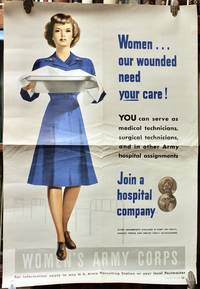
1945réf. 16951WashingtonD.C. United States Army Recruiting Publicity Bureau 1945 First edition. Full text as follows: "Women…our wounded need your care! You can serve as medical technicians surgical technicians and other Army hospital assignments. Join a hospital company. Other assignments available at Army Air Forces Ground Forces and Service Forces installations. Text printed in blue black and gray. Some creasing. A very good bright and clean copy of this uncommon item encouraging women to serve in Army hospital assignments. Broadside 17" x 25". . With full-color printed illustration of a woman medical technician in uniform carrying a tray of medical instruments. Also with two medals printed in bronze bearing the emblems of the U.S. Army Medical Corps. The Women's Army Corps evolved from the Women's Auxiliary Army Corps a civilian organization of women working with the United States Army when Congress granted military status to its members in 1943. Forty percent of WAC members were assigned to positions as weather observers radio and control tower operators and aerial photograph analysts. Many other women worked as cryptographers medical technicians and mechanics. As the war entered its last two years and as the WAC fought for further inclusion in the ranks of the Army more women were enlisted in roles previously reserved for men Yellin Our Mothers' War pp. 114-116. United States Army Recruiting Publicity Bureau books
1946réf. 2545San Antonio: C. Ekmark 1946. Very good. Panoramic photograph 8 x 52.25 inches. Very minor wear. A dramatic panoramic image capturing the 23rd Infantry Battalion of the Second Infantry Division while training at Camp Swift Texas in the wake of the Second World War. Four large groups of soldiers are ranged across the photograph with the officers in the middle-front of the image all standing in front of three long rows of jeeps and military transport trucks. Camp Swift located just west of Austin in Bastrop County can be seen in the far background. "During World War II Camp Swift reached a maximum strength of 90000 troops and included at different times the 95th 97th and 102d Infantry divisions the 10th Mountain Division the 116th and 120th Tank Destroyer battalions and the 5th Headquarters Special Troops of the Third Army. Swift was the largest army training and transshipment camp in Texas. It also housed 3865 German prisoners of war. After the war much of the site was returned to former owners. The government retained 11700 acres as a military reservation. That land housed parts of the Texas National Guard a medium-security federal prison and a University of Texas cancer research center" - Handbook of Texas online. The photographer Carl John Ekmark of San Antonio was a noted and somewhat prolific chronicler of military life throughout the Lone Star State. C. Ekmark unknown books
1946réf. 2543San Antonio: C. Ekmark Photo 1946. Good plus. Panoramic photograph 8 x 48.25 inches. Minor staining and soiling light creasing. A vivid yardlong image capturing the "special troops" of the Second Infantry Division while training at Camp Swift Texas in the wake of the Second World War. Seven groups of soldiers are ranged across the photograph with the band in the middle all posed in front of a long line of tanks transport trucks and half-tracks. Camp Swift located just west of Austin in Bastrop County can be seen in the far background. "Special troops" are a unit of the special forces designed to provide command and control of a larger Army unit among other duties. "During World War II Camp Swift reached a maximum strength of 90000 troops and included at different times the 95th 97th and 102d Infantry divisions the 10th Mountain Division the 116th and 120th Tank Destroyer battalions and the 5th Headquarters Special Troops of the Third Army. Swift was the largest army training and transshipment camp in Texas. It also housed 3865 German prisoners of war. After the war much of the site was returned to former owners. The government retained 11700 acres as a military reservation. That land housed parts of the Texas National Guard a medium-security federal prison and a University of Texas cancer research center" - Handbook of Texas online. The photographer Carl John Ekmark of San Antonio was a noted and somewhat prolific chronicler of military life throughout the Lone Star State. C. Ekmark Photo unknown books
1946réf. 2544San Antonio: C. Ekmark 1946. Very good plus. Panoramic photograph 8 x 43.5 inches. Very minor wear. A striking panoramic image capturing the 37th Field Artillery Battalion of the Second Infantry Division while training at Camp Swift Texas in the wake of the Second World War. Five groups of soldiers are ranged across the photograph posed amidst six large cannons with the officers in the middle all standing in front of three long rows of jeeps transport trucks and one airplane at the center. Camp Swift located just west of Austin in Bastrop County can be seen in the far background. "During World War II Camp Swift reached a maximum strength of 90000 troops and included at different times the 95th 97th and 102d Infantry divisions the 10th Mountain Division the 116th and 120th Tank Destroyer battalions and the 5th Headquarters Special Troops of the Third Army. Swift was the largest army training and transshipment camp in Texas. It also housed 3865 German prisoners of war. After the war much of the site was returned to former owners. The government retained 11700 acres as a military reservation. That land housed parts of the Texas National Guard a medium-security federal prison and a University of Texas cancer research center" - Handbook of Texas online. The photographer Carl John Ekmark of San Antonio was a noted and somewhat prolific chronicler of military life throughout the Lone Star State. C. Ekmark unknown books
1893réf. 76097Washington: Adjutant General's Office 1893. Unbound. Near Fine. May 15 1893 issue. Unbound single sheet; near fine with the upper edge a bit worn. An amendment to admission rules for the Army and Navy General Hospital in Hot Springs Arkansas. Adjutant General's Office unknown books
1893réf. 76095Washington: Adjutant General's Office 1893. Unbound. Fine. May 19 1893 issue. Unbound single sheet; fine. Instructions regarding medical inspections of new recruits. Adjutant General's Office unknown books
1893réf. 76094Washington: Adjutant General's Office 1893. Unbound. Near Fine. May 20 1893 issue. Unbound folded sheet; near fine with outer edge rubbed. Instructions regarding flags of truce. Adjutant General's Office unknown books
1893réf. 76100Washington: Adjutant General's Office 1893. Unbound. Fine. May 3 1893 issue. Unbound single sheet; fine. Details of officer promotion. Adjutant General's Office unknown books
1893réf. 76099Washington: Adjutant General's Office 1893. Unbound. Fine. May 6 1893 issue. Unbound single sheet; fine. Modification of a rule regarding enlisted men and target practice. Adjutant General's Office unknown books
1893réf. 76096Washington: Adjutant General's Office 1893. Unbound. Fine. May 18 1893 issue. Unbound single sheet; fine. Text of an act extending the time for the construction of the Big Horn Southern Railroad. Adjutant General's Office unknown books
1908réf. 1405160Washington D.C.: Departement of War 1908. Hardcover. Oblong Quarto 127 Plates. In Very Good minus condition. Bound in quarter red Morocco over black pebble-grained cloth boards with gilt lettering and ribbon ties on the edges. Boards show moderate fraying and rubbing to corners with some discoloration along extremities and modest cracking to spine. Plates lightly age-toned. An Extensive visual record of U.S Army uniforms as of October 11908 produce for official reference within the Department of War. Complete as issued with certain plates intentionally omitted during publication as noted on the preliminary leaf. Note: Shelved in Netdesk Office atop of Case 1. 1405160. FP New Rockville Stock. Departement of War hardcover books
1944réf. 69223Monroe: Army Air Force Instructor's School 1944. Paperback. Good. Paperback. 40pp. Foxed throughout staples rusted wraps foxed edgeworn and rubbed else an about very good complete example. Army Air Force Instructor's School paperback books
1867réf. 20057Washington: Government Printing Office 1867. FIRST EDITIONS. First work with 178 figures; second with 5 photographic plates; third with 1 plate and errata slip. 5 heliotype plates and 1 engraved plate. Contemporary half morocco over boards worn on edges all edges marbled; a portion of pages 323/324 of first section torn away affecting text though a photocopy is included otherwise interior excellent. First editions of these three catalogues. The catalogue of the surgical section was edited by Alfred Woodhull 1837-1921. J.J. Woodward 1833-1884 edited the medical section and Edward Curtis 1838-1912 edited the microscopical section. Thousands of specimens are described nearly all the aftermath of the Civil War. Mostly human specimens the name and rank of the donor is noted as well as a brief summary of the context in which the injury or illness leading to death or amputation occurred. The catalogues also include comprehensive collections of surgical instruments medical artifacts including prosthetics and battlefield medical supplies and historical documents related to military medicine. The surgical section contains descriptions of over 4700 specimens “varying from cranium to tumors graphically detailing the wounds suffered by thousands of soldiers during the Civil War. The attending physician’s name is listed with each case. Many of these descriptions are specifically related to injuries which are further enumerated in the Medical and Surgical History of the War of the Rebellion” Rutkow. That catalogue is also significant because it is “the first publication that actually gives an idea as to the number and type of photographs taken by or for army physicians” during the war Burns. The third part contains a plate depicting an “Apparatus for Microphotography” and five plates depicting photographs of tissue specimens taken with this apparatus. The editors of the second and third parts Edward Curtis and Joseph Woodward performed the autopsy on Abraham Lincoln. Curtis was an early pioneer of photomicrography. The Army Medical Museum was founded in 1862 by U.S. Army Surgeon General William A. Hammond as a center for the collection of specimens for research in military medicine and surgery. Hammond directed medical officers in the field to collect "specimens of morbid anatomy.together with projectiles and foreign bodies removed" and to forward them to the newly founded museum for study. During and after the war Museum staff took pictures of wounded soldiers showing the effects of gunshot wounds as well as results of amputations and other surgical procedures. The information collected was compiled into six volumes of The Medical and Surgical History of the War of the Rebellion published between 1870 and 1883. Burns Early Medical Photography in America 1839-1883 New York 1983; Rutkow. The History of Surgery in the United States 1775-1900 San Francisco 1988. Government Printing Office unknown books
1919réf. JC8726n.p.: Frank L. Armstrong 1919. Paperback. Very Good. Staple-bound illustrated wraps; 12mo; pp. 27 handwritten text and illustrations in facsimile. Inscribed by the author on the FFEP: "Best Wishes to Ralph Lewando. Frank L. Armstrong July 1942." Lewando was a violinist and composer and music critic for the Pittsburgh Press. Covers a little rubbed; tiny closed tear at fore-edge of front cover; text block tanned. A scarce little self-published item from a Pittsburgh based WWI soldier. OCLC locates just 5 copies. Frank L. Armstrong paperback books
1993réf. 107340Nashville:: Battery Press. Near Fine. 1993. Hardcover. 0898391903 . Black and white photographs throughout. A reprint of the 1946 edition. Near fine in green cloth. No dust jacket as issued. . Battery Press, hardcover books
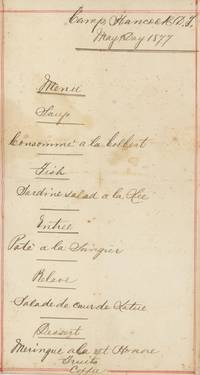
1877réf. List2842Bismarck Dakota Territory 1877. 4 x 8 inches. Folded some stains and foxing excellent. Camp Hancock in what is now Bismarck North Dakota was built in 1872 as facilities for US troops. The troops were stationed there to guard supplies equipment and crews as the Northern Pacific Railway was constructed through the area. In 1877 it became a quartermaster depot and signal office. Offered here is a menu for the Camp’s May Day celebration in 1877 presenting five courses of French-style fare. unknown books
1945réf. 188278Muzzleburst 1945-01-01. Paperback. Good. 0x0x0. Covers worn. Has a good binding. Will illustrated with plates for each chapter. History following the unit from California to the end of the war in Germany. Scarce unit history pamphlet. Muzzleburst paperback books
1969réf. 592481New York: Cowles Book Company 1969. Hardcover. Near Fine/Fine. First edition. 242pp. Illustrated with black and white plates. Shadow from tape removal on the boards else near fine in a fine dust jacket. Cowles Book Company hardcover books
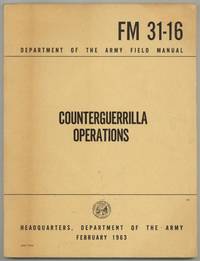
1963réf. 592690Washington D.C.: Headquarters Department of the Army 1963. Softcover. Very Good. First edition. Small quarto. 124pp. Illustrated with diagrams. Printed wrappers. Modest edgewear and soiling slight toning on front cover very good. Headquarters, Department of the Army unknown books
1962réf. 563539Washington D.C.: U.S. War Office 1962. Softcover. Very Good. First edition. Forward by Elvis J. Stahr Jr. Quarto. 141pp. Heavily illustrated. Small inked note on cover modest general wear one set of leaves carelessly opened causing a couple of marginal chips very good or better. Heavily illustrated book introducing the concept of Special Forces with many contributors. U.S. War Office unknown books
1944réf. 17880Washington DC: Recruitment Publicity Bureau of the US Army 1944 First edition. Uncommon. . Original wrappers depicting blonde woman in WAC uniform working on a map. . Quarto. 7.75 in. x 8.25 in. . With photographic reproductions on every page. There is some toning to back cover. Staples are rusted. A very good copy. This printed booklet promotes the Women's Army Corps to potential recruits. The first leaf introduces the WAC woman: "She has enlisted for the duration. Her hands and her ability contribute to a swifter victory." They describe a why a woman becomes a WAC member: "Because she shares a peaceful world she knows she must share the fight to help restore the peace we have lost." The booklet includes full-page photos of different roles for which WAC members can be trained such as Code Clerk Topographical Draftsman Bookbinder Artist Mimeograph Operator and more. Short biographies and photos for real WAC women are featured. For example the biography for a bookbinder is: "Preservation of vital Army records by binding notes memoranda and other papers into book form is the assignment of Private First Class Martha L.H. Healan at the Field Artillery School. Private Healan whose home is in Gainesville Georgia was an inspector in a wearing apparel factory in civilian life. She learned bookbinding in the WAC." Recruitment Publicity Bureau of the US Army, books
2009réf. 1398857Washington D.C.: The Washington Ballet 2009. First Edition. Hardcover. Thin quarto unpaginated. In Very Good condition in a Very Good dust jacket. Spine black with white lettering. Dust jacket protected in mylar covering no price printed. Minor shelfwear and soiling. Edgewear to head of jacket. Text block clean. Signed flat by Septime Webre on the title page. Shelved front table. 1398857. Shelved Dupont Bookstore. The Washington Ballet hardcover books