29.029 risultati
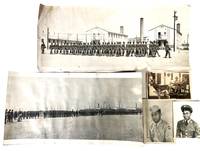
1941rif. 193561941. Partially identified Black Airmen photographs and Tuskegee Airmen signatures. African American airmen associated with the United States Army Air Forces during the World War II era document the struggle the struggle of entry into military aviation during a period when the armed forces remained racially segregated. This archive contains sixteen items including photographs of Black airmen in uniform and autographs of Tuskegee Airmen the pioneering African American pilots and support personnel trained beginning in 1941 after federal pressure forced the Army Air Corps to open limited aviation training opportunities to Black candidates. Five original photographs of African American airmen in Army Air Forces or early U.S. Air Force uniforms and nine signed note cards bearing the signatures of Tuskegee Airmen veterans. The archive also includes a contemporary pamphlet and photograph of a monument commemorating the Tuskegee Airmen. Signatures appear on white unlined cards measuring approximately 5 x 3 inches and include Claude Platt of the 301st Fighter Squadron and an Army primary flight instructor Charles A. Lane Jr. of the 99th Fighter Squadron Charles McGee of the 302nd Fighter Squadron Luther E. McIlwain Eldridge Williams of the 332nd Fighter Wing Leroy Bowman of the 301st Fighter Squadron Edward E. Tillman of the 477th Bombardment Group Utota Knox of the 302nd Fighter Squadron and Curtis C. Robinson of the 99th Fighter Squadron. The five photographs include two panoramic images measuring approximately 8 x 15 inches and 8 x 17.5 inches and three smaller photographs measuring roughly 3 x 5 inches. One panorama shows a large formation of troops assembled in ranks with a band and flag bearers present with African American personnel grouped separately from white soldiers and women within the formation. A second panorama shows approximately four dozen Black airmen marching in formation near a military installation. The smaller photographs depict African American airmen wearing service uniforms with airman caps and winged shoulder insignia; one image bears the inscription "To Mother - From Son in the service" while another real photo postcard shows a Black airman posing with a Black woman seated in a prop carriage behind a decorative mule annotated with "me" above the woman and the initials "T.B." above the man. The Tuskegee Airmen program began in 1941 when the U.S. Army Air Corps initiated training for African American pilots at Tuskegee Army Air Field in Alabama following federal directives requiring the military to allow limited Black participation in aviation roles. Units such as the 99th Fighter Squadron and the 332nd Fighter Group became the most visible African American flying units during World War II flying escort and combat missions in the European theater while operating within a segregated military structure. Their service challenged long standing claims that African Americans were unsuited for combat aviation and became a major milestone in the broader campaign for racial equality in the armed forces. The experience of these aviators and the public recognition of their accomplishments contributed to growing pressure for the desegregation of the military culminating in President Harry S. Truman's 1948 order ending official racial segregation in the armed forces. Five photographs ranging from approximately 3 x 5 inches to panoramic formats up to about 8 x 17.5 inches accompany nine signed note cards. One panoramic photograph shows slight water staining and a fold at the left corner; the remaining photographs and signatures remain well preserved. Overall condition very good. The material preserves visual documentation of African American participation in military aviation alongside signatures of several Tuskegee Airmen who served in fighter and bomber units during the war. unknown books
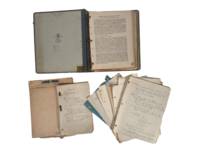
1945rif. 193511945. Witmer Richard L. Caribbean Coastal Artillery officer training archive circa 1940s documents the instructional framework and operational doctrine taught to U.S. Army Coast Artillery officers during World War II with particular emphasis on antiaircraft defense chemical warfare preparedness and logistical coordination in domestic coastal defense. This archive belonged to Captain Richard L. Witmer of York Pennsylvania an officer in the 87th Regiment of the Caribbean Coastal Artillery Command of the US Army during WWII. Its contents include 385 printed and manuscripts pages of notes lessons assignments and documents primarily from Witmer's education in officer academy.Witmer served as an officer in the 87th Regiment of the Caribbean Coastal Artillery Command a unit tasked with protecting Gulf Coast installations against aerial and maritime threats during a period of heightened concern over Axis attack on the continental United States. His notes record formalized military instruction alongside personal synthesis of tactical principles including his definition of tactics as the "Science of placing weapon so as to carry out mission" and his articulation of defensive priorities such as "Make provision to guard against a surprise" and "Take advantage of terrain for all round defense." The archive includes detailed engagement with antiaircraft gunnery where Witmer identifies primary targets as "Bombers Observation planes" and emphasizes the need for "continuous instantaneous and accurate data" and "volume of fire" demonstrating the technical and strategic demands placed on officers responsible for air defense. Witmer Richard L. Caribbean Coastal Artillery officer training archive. United States: U.S. Army Coast Artillery Corps circa 1940s. Archive comprises approximately 385 pages of manuscript and typed material primarily organized within a ring binder accompanied by three small notebooks and approximately fifteen loose leaves. Contents include notes instructional outlines assignments and technical summaries covering antiaircraft artillery ordnance ballistics supply systems transportation logistics and mess operations. Numerous pages feature hand-drawn diagrams graphs and marginal annotations. Sections devoted to weapons systems describe characteristics of artillery including "40 mm - Easily operated" "37 mm - Accurate fire" "50 cal - Rugged" and "30 cal - Simple & Rapid Min. of men." Additional material addresses chemical warfare including references to mustard gas and Lewisite with Witmer posing operational questions such as "Would the combat efficiency of my men remain high in the event of chemical attack" A formal evaluation included in the archive notes his promotion stating that he "has demonstrated outstanding ability and fitness for promotion by performing the duties of a gun battery officer" citing his leadership of an antiaircraft range section. Produced during the expansion of U.S. defensive infrastructure in World War II this archive aligns with the strategic role of the Coast Artillery Corps in safeguarding domestic installations prior to the consolidation of air defense under later Cold War military structures. The detailed instructional content reflects the Army's investment in technical specialization particularly in response to the increasing threat of aerial warfare and the lingering memory of chemical weapons deployment in World War I. Witmer's materials preserve the pedagogical methods used to train officers in integrated defense systems combining mechanical knowledge tactical planning and command responsibility. The subsequent dissolution of the Coast Artillery Corps in 1950 underscores the transitional nature of this material within the evolution of U.S. military organization. Light wear to covers with minor fading internal pages well preserved and legible with occasional handling wear; overall very good condition. unknown books
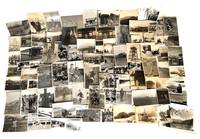
1947rif. 196441947. 11th Airborne Division paratroopers photographed during the early American occupation of Japan document airborne training and daily military life within one of the most distinguished U.S. Army airborne units of the Second World War. More than two hundred photographs dating primarily from 1947 depict members of the 11th Airborne Division conducting parachute jump training weapons drills and daily base activities while stationed in Japan after the end of the Pacific War. The photographs appear to have been assembled by a soldier identified through accompanying material as Jeff C. Wall likely assigned to a military government team in Yamagata Prefecture. The images capture the division during the transitional period between wartime combat service in the Pacific and the emerging American military presence in East Asia that characterized the early Cold War. Archive contains 217 Silver Gelatin photographs ranging from approximately 2.25 x 2.5 inches to 4.75 x 6.5 inches depicting paratroopers of the 11th Airborne Division in Japan. The archive includes twelve photographs documenting parachute jump training sequences from aircraft exit through descent and landing as well as several images of fully equipped paratroopers lined up before boarding troop carrier aircraft. Numerous photographs show soldiers around transport planes and other aircraft on base airfields. Additional images depict artillery and machine gun training exercises paratroopers assembled outside a command building displaying the slogan "Shape Up or Ship Out" and informal scenes of soldiers gathered around barracks or posing in groups. The photographs also record elements of base life including an enlisted men's club ticket associated with the Yamagata Military Government Team women service personnel including a nurse playing cards with soldiers and views of the surrounding Japanese landscape. Approximately fifteen photographs show Mount Fuji and nearby terrain around the camp in northern Japan. The 11th Airborne Division earned distinction during World War II through its combat operations in the Pacific theater particularly during the campaign for Luzon in the Philippines in 1945 where the division conducted airborne assaults and participated in the liberation of Manila. Units of the division also carried out a well known raid that freed Allied prisoners from the Los Baños internment camp. Following Japan's surrender in 1945 the division became part of the U.S. occupation force tasked with maintaining security and administrative control across parts of Japan. The 1947 photographs document airborne training and routine service during this occupation period when American military forces remained stationed throughout the country while the geopolitical tensions of the emerging Cold War began reshaping U.S. global military deployments. In later years the division was reassigned to Alaska where its airborne operations in Arctic environments led to the nickname "Arctic Angels." Minor handling wear typical of vernacular military photographs. Overall condition very good. unknown books
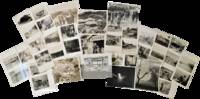
1945rif. 189141945. U.S. Army and Navy photographs of Okinawa 1945 document the immediate aftermath of the Battle of Okinawa and the establishment of American control over a strategically critical island at the close of the Pacific War. The images place American troops within the Okinawan interior and along coastal installations following the April 1945 landings including the secured Yontan airfield a primary objective of the invasion. The archive records the physical destruction resulting from one of the war's most intensive campaigns alongside scenes of civilian movement and return situating the photographs within the transition from active combat to military occupation. Archive of 37 black and white silver gelatin photographs. Okinawa Japan circa 1945. Photographs measure approximately 3.75 x 4.5 inches to 7 x 10.5 inches with brief handwritten captions on verso. Images depict American troops in villages farmland and near shrines as well as at Yontan airfield. Several photographs show destroyed aircraft including a crashed Japanese plane and associated debris along with damaged infrastructure and equipment. Naval activity is represented through images of American ships in harbor and offshore including a landing ship dock LSD transport vessel. An aerial photograph shows a harbor with multiple wrecked ships and flattened industrial areas. One image documents a column of civilians carrying belongings captioned "civilians returning to homes." The Battle of Okinawa fought from April to June 1945 resulted in extensive military and civilian casualties and widespread destruction of the island's infrastructure. The subsequent American occupation transformed Okinawa into a major U.S. military base in the western Pacific a status it retained even after reversion to Japanese administration in 1972. These photographs document both the operational objectives of the invasion and the conditions encountered in its aftermath including the displacement and return of local populations. The archive provides material for examining military strategy occupation practices and the impact of large-scale warfare on civilian landscapes in the Pacific theater. Light wear consistent with handling; overall very good condition. unknown books
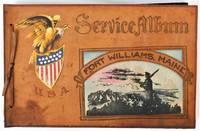
1934rif. 189891934. Photograph album 1934-1940 documenting the service of a U.S. Army soldier stationed at Fort Benning Georgia; Fort Williams Maine; and additional locations across the northeastern United States Many photos captioned with names of fellow soldiers friends and placenames. This Album has relevance to the study of interwar military life mechanization and training practices prior to American entry into the Second World War. The images include multiple views of tanks such as the Mark VIII Renault Ford 3-ton and Christie models reflecting the transitional development of armored warfare during the interwar period. Scenes at Doughboy Stadium at Fort Benning evoke the continued presence of World War I memory within military culture while the broader sequence of photographs captures routine service camaraderie and movement across training posts. Captioned images identify fellow soldiers and locations and autograph pages at the beginning of the album preserve personal inscriptions humor and social connections within the unit. Additional photographs include landscapes from New York Vermont and Maine as well as personal images of acquaintances situating the soldier's experience within both military and civilian contexts. Photograph album containing 149 black and white silver gelatin photographs most measuring approx 2.5 x 3.5 inches with a few larger prints including examples measuring approximately 7 x 5 inches. The photographs are mounted in a suede-bound "Service Album" measuring approximately 11 x 7 inches with many images captioned in manuscript identifying individuals and locations. The content includes military equipment soldiers group portraits training environments and personal snapshots reflecting both formal and informal aspects of Army life during the late 1930s. The 149 photographs are mounted in the album with minimal losses; pages generally well preserved. Light wear consistent with handling; overall very good condition. A cohesive visual record of U.S. Army service and evolving military technology in the years immediately preceding World War II. unknown books
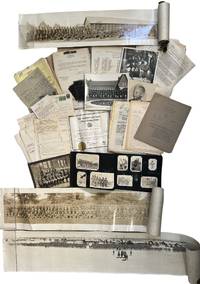
1917rif. 190211917. WWINational GuardWWII Primary-source archive documenting U.S. Army transportation command operations supporting Allied logistics following the Normandy landings centered on the development of Cherbourg as a critical supply hub. Assembled from the career of Lieutenant Colonel George C. Sullivan the collection spans World War I mobilization through World War II and into postwar reserve service with particular emphasis on mid-twentieth-century military infrastructure and coordination. The archive comprises hundreds of pages of official documents correspondence and service records alongside a substantial photographic component including large-format panoramic rolls depicting assembled training formations and unit organization at scale. Together the materials provide detailed evidence of the administrative and logistical systems that sustained Allied operations in Europe situating individual service within broader frameworks of wartime transportation supply distribution and postwar military restructuring. Archive comprises hundreds of pages of military documents dated primarily from the 1940s through the 1950s; three panoramic photographic rolls from World War I service; one photograph album containing 83 photographs from 1917-1918; four loose photographs; and three letters dated 1945-1948. The World War I album depicts training at Fort Sill Oklahoma mounted artillery drills including a three-inch field gun mounted cavalry movement across desert terrain doughboy uniformed infantry and a Peace Parade in Lawton Oklahoma in November 1918. Sullivan's own written service summary records his federal call-up transfers promotion to corporal commissioning and discharge in December 1918. The panoramic rolls measuring approximately 44 to 56 inches in length show large assembled formations at Camp Cody New Mexico and officer training at Camp Taylor Kentucky including the 25th Battery Central Officers Training School. World War II and postwar materials include commendations transfer requests rosters promotion records certificates and administrative correspondence. A 1949 silver gelatin photograph of Headquarters Company 371st Support Group summer training personnel includes a roster naming forty-eight officers among them First Lieutenant Catherine M. Henry documenting the integration of women officers in postwar reserve structures. Sullivan's World War II documentation centers on transportation command responsibilities essential to sustaining Allied operations in Normandy and the rapid development of Cherbourg as a logistical hub following D-Day. The archive traces the evolution of the United States Army from early twentieth-century National Guard mobilization to logistics work in World War II. Postwar papers reflect Sullivan's continued reserve duty into the mid-1950s and his civilian engagement in the sale of military surplus goods in Seattle Washington illustrating the reintegration of career officers into postwar commercial life. Documents generally clean and legible with occasional edge wear; panoramic photographs show some cracking but remain intact; photograph album well preserved; loose photographs with light handling wear. Overall very good condition. Extensive archive chronicling four decades of a United States Army officer's career. unknown books
1951rif. 191891951. African American U.S. Army soldiers photographed during the early Korean War era document Black military service during the first years following the formal desegregation of the United States armed forces. Twenty photographs dating from approximately 1950 to 1952 depict African American soldiers in uniform at military bases and in field conditions associated with Korean War deployment. Several images also show Black and white soldiers posing together providing visual documentation of the Army during the first phase of racial integration ordered by President Harry S. Truman through Executive Order 9981 in 1948. Inscriptions on several photographs including one signed portrait reading "Joe Moddin 1951" identify individual servicemen and record personal messages written during active service. Twenty black and white photographs depicting African American soldiers in U.S. Army uniforms during the early 1950s. Photographs include scenes of soldiers standing with military trucks traveling along roads in Korea and posing with fellow servicemen at military installations where barracks structures are visible in the background. Several images show troops operating or stationed in rough winter terrain consistent with Korean War conditions. Three photographs contain extended inscriptions on the verso dated December 1951 and January 1952. Another photograph is a portrait image signed and dated "Joe Moddin 1951." The images collectively portray daily military life including group portraits transportation scenes and base environments during wartime deployment. The Korean War fought between 1950 and 1953 became the first major conflict in which the United States attempted to implement racially integrated military units following Truman's desegregation order. African American soldiers had served in segregated formations throughout World War II and their wartime service contributed to growing national pressure to dismantle racial segregation within the armed forces. By the early years of the Korean War the Army began integrating many units in training and field operations bringing together soldiers of different racial backgrounds in combat and support roles. Historians estimate that roughly 600000 African Americans served in the armed forces during the Korean War and Black servicemen accounted for a significant portion of U.S. casualties during the conflict. These photographs provide ground-level visual documentation of soldiers serving during the transitional period when formal military segregation was being dismantled but integration remained uneven in practice. Twenty photographs. Minor handling wear typical of mid twentieth century vernacular photographs. Overall condition very good. unknown books
1927rif. vita5904Saint Paul: J. E. Haynes Publisher 1927. Octavo black cloth hardcover gilt letters top edge red plates fold-out map at rear vii 356 pp. Good with hinges starting. Contents: The Name “Yellowstone”; The Indian and the Yellowstone; The Trader and Trapper; John Colter; Early Knowledge of the Yellowstone; Bridger and His Stories; Renolds’ Expedition; The Gold-seeker; Discovery; The National Park Idea -- Its Origin and Realization; Why So Long Unknown; Later Explorations; The Park Names; Administrative History of the Park; Hostile Indians in the Park; Experiences of the Radersburg Tourists; Experiences of the Helena Tourists; Lost in the Wilderness; Boundaries and Topography; Geological History of the Park; The Rocks of the Park; Geysers; Hot Springs and Kindred Features; The Climate of the Park; Fauna of the Yellowstone; Flora of the Yellowstone; Forests of the Yellowstone; The Flowers of the Yellowstone; The Park Road System; Administration of the Park; A Tour of the Park -- Preliminary; A Tour of the Park -- North Boundary to Mammoth Hot Springs; A Tour of the Park -- Norris Geyser Basin to Lower Geyser Basin; A Tour of the Park -- Lower Geyser Basin to Upper Geyser Basin; A Tour of the Park -- Upper Geyser Basin to Yellowstone Lake Hotel; A Tour of the Park -- Yellowstone Lake to the Grand Canyon of the Yellowstone; a Tour of the Park -- Grand Canyon to Tower Falls -- Mt. Washburn; A Tour of the Park -- Tower Falls to the Mammoth Hot Springs; Appendix: Mountain Ranges Peaks Buttes Ridges Hills; Mountain Passes; Lakes; Streams; Waterfalls; List of Prominent Geysers; Biographical Notes. J. E. Haynes, Publisher, (1927). hardcover books
1882rif. vita5905New York: Fords Howards & Hulbert 1882. Octavo illustrated navy blue cloth hardcover silver and gilt letters and illustrations 454 pp. Good; upper hinge starting still clean & tight wear to tips of spine light rubbing to covers. Fords, Howards, & Hulbert, (1882). hardcover books
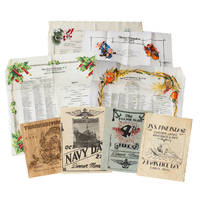
1929rif. 186831929. U.S. Army and Navy holiday dinner menus and related materials 1929 to 1945 document organized communal life ceremonial observance and institutional identity within the American military across the interwar and World War II periods. The group includes menus for Independence Day Thanksgiving Armistice Day and Navy Day situating the material within official holiday programming that reinforced morale and unit cohesion during both peacetime training and global conflict. The presence of menus from the 189th Field Artillery at Fort Sill in 1940 and later examples from the U.S.S. Pine Island including those produced at Sasebo Japan places the archive within the geographic expansion of U.S. military operations from domestic bases to overseas occupation zones. The inclusion of named rosters and autograph signatures connects these printed artifacts to specific service members documenting how collective identity and hierarchy were formalized and commemorated through shared meals. Archive of eight original military holiday dinner menus and four printed cloth napkins. United States and Japan 1929 to 1945. Menus measure approximately 7 x 5.5 inches and are printed in paper wrappers with illustrated covers. The earliest menu issued for the 189th Field Artillery at Fort Sill Oklahoma Thanksgiving 1940 includes an ornamental napkin a printed roster of personnel multiple autograph signatures and a "wooden certificate" voucher redeemable within the Cherokee Strip region. Additional menus originate from the U.S.S. Pine Island for Independence Day Navy Day and Armistice Day observances including examples produced at the Sasebo naval base in Japan. Menus list standardized holiday meals including roast turkey baked ham potatoes and pie. The archive also includes four cloth napkins from the 70th Service Squadron dated 1929 to 1931 each approximately 14 x 14 inches printed with thematic imagery such as turkeys cornucopias and holly leaves and bearing full rosters of personnel organized by rank. The 70th Service Squadron was stationed at March Field California a major Army Air Corps training installation during this period. Military holiday menus functioned as both practical documents and ceremonial objects recording foodways hierarchy and unit composition while reinforcing institutional traditions across dispersed service environments. The continuity of menu design and meal structure across years and locations reflects standardized provisioning practices while the inclusion of rosters and signatures preserves individual participation within collective settings. The presence of materials spanning prewar Army Air Corps units and wartime naval operations including occupation-era Japan provides a longitudinal view of military culture across a period of rapid organizational and geopolitical change. Light wear consistent with handling; overall very good condition. unknown books
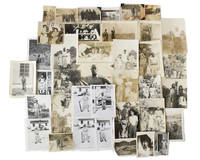
1940rif. 186881940. African American MilitarySegregation African American soldiers' photograph archive from the 1940s and 1950s documenting Black military service in the Philippines and Korea during the transition from segregated World War II units to the early implementation of desegregation under President Harry S. Truman's 1948 Executive Order 9981. 38 images showing African American servicemen stationed in Southeast Asia and East Asia at a time when U.S. global military invention was further complicated by racial segregation and gradual integration. The archive reflects the lived experience of Black soldiers deployed abroad in the immediate postwar period illustrating their service within the American imperial presence in the Philippines following its 1946 independence and during the outbreak of the Korean War in 1950. Archive of thirty-eight vernacular silver gelatin black and white photographs with sepia tone 1940s to 1950s most measuring approximately 5 x 3 inches with minor size variation. The majority of images depict African American soldiers in what appear to be predominantly all-Black units consistent with pre-1948 segregation policies while one snapshot shows a racially mixed unit encamped in snow likely Korea suggestive of early desegregation implementation. Several photographs portray soldiers stationed in the Philippines amid dense jungle foliage and village settings socializing with local residents and posing with women; one captioned image identifies three well-dressed soldiers as "Kee" of Youngstown "Haynes" of Philadelphia and "Borom" of Gary Indiana pictured with three Asian women. Additional images include formal and informal portraits soldiers standing guard on base with helmet and rifle and scenes of leisure and camaraderie that complicate narratives of isolation and discrimination. The archive spans the crucial transitional years between World War II segregation Philippine independence in 1946 and the Korean War era when approximately 600000 African Americans served in the armed forces and the implementation of Executive Order 9981 unfolded unevenly across units. The photographs track gradual emergence of integrated units mirroring broader civil rights struggles unfolding on the American home front. They also document the role of Black soldiers on U.S. military bases in the Philippines and in early Cold War Asia offering material evidence of African American participation in postwar American global intervention. Minor edge wear and occasional slight bends with light surface handling visible on several prints; images remain clear and well defined. Overall condition very good. A substantial visual record of African American military life abroad during the pivotal transition from segregation to integration in the United States Army. unknown books
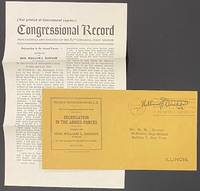
1951rif. 186401951. Dawson William L. African American congressman from Chicago and World War I veteran of the segregated 366th Infantry Regiment House of Representatives speech delivered April 13 1951 addressing segregation in the United States armed forces during the early years of the Cold War. Dawson served in Congress for nearly three decades and became the first African American to chair a congressional committee. His speech was delivered during a critical period in the history of American civil rights and military policy following President Harry Truman's 1948 Executive Order 9981 directing the desegregation of the armed forces. Debates in Congress during the early 1950s addressed the pace and implementation of integration and Dawson used the floor of the House to argue that racial segregation contradicted the principles for which American soldiers fought. Dawson William L. "Segregation in the Armed Forces." Speech of Hon. William L. Dawson of Illinois in the House of Representatives April 13 1951. Congressional Record 82nd Congress First Session. Single printed sheet measuring approximately 6 x 9 inches preserved with original mailing envelope. The printed text reproduces Dawson's remarks opposing segregation within the military establishment. In the speech Dawson declared: "If there is one place in America where there should not be segregation that place is in the armed services among those who fight for this country." He continued with a broader appeal to constitutional ideals and national unity: "I would give up this life of mine to preserve this country and every American in it white or black. Deny to me today if you will all that American citizenship stands for I will still fight to preserve our Nation knowing that someday under the Constitution of the United States all of these restrictions will be removed and that we will move forward before the world as one people American people joined in a democracy which shall set the pattern for all the world." Dawson's remarks formed part of the ongoing political struggle over civil rights and military policy during the early Cold War. The Korean War had begun the previous year and questions about equality within the armed forces remained under active debate as the military implemented Truman's desegregation order. Dawson's own wartime service in a segregated unit during World War I informed his critique of racial discrimination within the military establishment. As a senior African American political leader in Congress his advocacy contributed to broader legislative and political pressure supporting the continued dismantling of segregation in the armed forces. Minor wear consistent with age; overall condition very good. unknown books
1899rif. 185571899. Wagner Arthur L.; Kelley Assistant Adjutant-General; Jerrold J.D. The United States Army and Navy: From the Era of the Revolution to the Close of the Spanish-American War 1899 presenting a comprehensive late nineteenth-century account of American military development with direct relevance to the study of warfare institutional organization and expansion of U.S. military power. The work surveys major conflicts including the Revolutionary War Mexican War Indian Wars and Spanish-American War situating the latter within a period of overseas engagement and changing strategic priorities. It also provides detailed treatment of military structure including administrative divisions pay systems and operational organization within the Army alongside parallel developments in the Navy. Naval sections address earlier conflicts such as the War of 1812 and engagements with Tripoli and France as well as contemporary actions including Manila Bay and Santiago de Cuba reflecting the emergence of the United States as a naval power at the close of the nineteenth century. Wagner Arthur L.; Kelley; Jerrold J.D. The United States Army and Navy: From the Era of the Revolution to the Close of the Spanish-American War; with Accounts of Their Organization Administration and Duties. Akron Ohio: The Werner Company 1899. First edition. Oblong folio measuring approximately 18 x 13.5 inches illustrated with 43 full-color lithographic plates on heavy stock comprising 25 army subjects and 18 navy subjects each accompanied by descriptive text on protective tissue guards. The plates depict soldiers officers and marines in uniform battlefield scenes and naval vessels including battleships and cruisers providing visual representation of personnel equipment and engagements across multiple conflicts. Single oblong folio volume in dark blue cloth with gilt title on the front board. Light wear to edges of spine and boards; text and plates clean and well-preserved; overall very good condition. A large-format illustrated survey of United States military history and organization at the close of the nineteenth century. unknown books
1909rif. 553425Washington D.C.: Ordnance Department U.S. Army 1909. Hardcover. Very Good. First editions. Small octavo. 18 volumes totaling approximately 230pp. 10 volumes contain a chart one fold-out and three contain fold-out graphs. Bound with wrappers into black clothcovered boards with spine gilt and page edges sprinkled red. Several volumes with ownership stamps or signatures or inked or stamped notes on the cover. A clean sammelband save for a large dampstain on the front endpapers causing light rippling on the first 30 pages or so and unobtrusive occasional staining at the very top of the gutter one fold-out graph with about ¼ missing and occasional small chips or tears on the wrappers; altogether very good. A bound series of Army-issued instructional pamphlets dating from 1898 to 1909 which were distributed to manufacturers of smokeless powders guncotton Ballistite Cordite etc. to instruct them on the specifications required by the U.S. Army. The pamphlets range in length anywhere from six to 30 pages. The earliest pamphlet stands out as it is comprised primarily of mimeographed pages from specifications written for three earlier contracts one from 1895 and two from 1897 and is the only volume in the collection constructed in this manner. We suspect that before these specifications were made more generalized in these frequently updated pamphlets they were written out contract by contract. Three of the pamphlets contain the owner signature of Odus Creamer Horney on the front wrapper. Horney was in charge of the building and launching of the Army's first smokeless powder factory starting in 1907 while in command of the Picatinny Arsenal in New Jersey. The collection contains two titles that eventually combine into one. Specifications for Smokeless Powders for Cannon later titled Specifications Governing the Manufacture of Smokeless Powder for Cannon and Standard Methods of Chemical Tests of Nitrocellulose and of Smokeless Powder for Cannon eventually combine into Official Methods for Examination of Nitrocellulose and of Smokeless Powder for Cannon and Specifications Governing Manufacture of the Same for about a year before the title was changed to No. 405 Instructions to Bidders and Specifications Governing the Manufacture Test and Inspection of Nitrocellulose and of Smokeless Powder for Cannon. A complete list of each title and a brief description is available upon request. As a collection this chronicles the evolution of the criteria required by the US Army for the manufacture of smokeless powders when that technology was still quite new in terms of use. OCLC locates four individual pamphlets but we could not find a similar example of this expansive collection. Ordnance Department, U.S. Army hardcover books
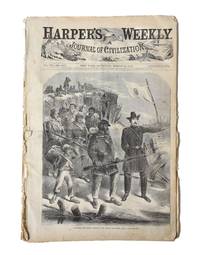
1863rif. 181951863. Harper's Weekly: A Journal of Civilization. New York: March 14 1963. Vol. VII - No. 324. 15 pages. 16" x 11" inches. This edition of the Harper's Weekly portrays on its cover a black Union Army recruit who is being trained to use the Minie rifle a weapon widely used in the Civil War. Former slaves and freedmen alike flocked the Union Army after Lincoln issued the Emancipation Proclamation in 1862 which had a provision allowing for the first Black units to be formed. Has a two page spread illustration of a Black unit charging into a Confederate line amidst a chaotic battle scene. A brief article gives several examples of bravery and cunning displayed by Black units thus far and predicts "that with proper drill and training the negroes will be the steadiest rank and file in the world." Harper's Weekly was published from 1857 to 1916 and was one of the most extensive sources of coverage on the American Civil War. Pages delicate; nearly separated from fold line. Browning and light soiling throughout but text and illustrations are clear. In good condition overall. unknown books
rif. vas639Live Oak Press 2004. Second Edition. Octavo blue cloth hardcover gilt letters viii 244 pp. Fine in a Fine dust jacket. From dust jacket: Upon being dropped into Salerno Italy on September 14 1943 PFC Ernest Deal and the rest of the 505th Parachute Infantry Regiment are ambushed by German artillery. But this ambush only begins Fox Company’s stranger journey into the aferlife. PFC Deal awakens to a strange set of conditions and dreams where he realizes that he is being transported through the night sky by an armor-clad woman on of all things a flying horse. He comes to learn that she is a Valkyrie and that he is being transported to a place called Valhalla. Deal and Fox Company are soon forced into battles for survival under conditions for which they were never trained. They find themselves fighting in places with strange names such as Cannae and Rourke’s Drift and also on war elephants next to a river called the Hydaspes. And perhaps the strangest occurrence of all -- Deal finds himself in love. hardcover books
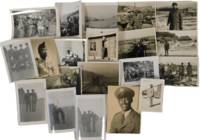
rif. 17320WWII-era photographs measuring 11.5" x 7.25" Multiple locations undated Ca. 1940s. With 67 photographs ranging in size from 3.5" x 2.5" to 5" x 4" of a serviceman and multiple generations of his family. Photo Album. U.S. Army Training Camp and Domestic Life in the American South circa 1940s. Oblong photograph album containing approximately estimate based on images shown original black-and-white vernacular photographs most snapshot size corner-mounted to black paper leaves. Circa 1940-1945. This photo album documents the intertwined military and domestic life of a white American serviceman during the World War II era combining images of U.S. Army training facilities with scenes of rural Southern family life. The military photographs depict a cantonment landscape of low wooden barracks dirt roads telephone poles and regimented formations of soldiers assembled outdoors. One sequence shows uniformed men standing in formation across an open parade ground while others capture military transport vehicles-open troop carriers filled with soldiers-moving through base streets lined with identical wood-frame buildings. Individual portraits show a soldier in full uniform posed formally in front of barracks and beside mid-1940s automobiles suggesting pride in service and upward mobility through military affiliation. A small chapel with a steeple appears prominently underscoring the role of religion in wartime military culture. Another building features an exterior metal slide descending from a second-story opening-likely part of a training or emergency drill structure-emphasizing the regimented preparedness of wartime camps. Interwoven with these military scenes are intimate images of domestic life: a woman and uniformed soldier standing together on the steps of a clapboard house; a couple tending a vegetable garden beside a brick home; a man seated in a wooden rocking chair reading a newspaper on a brick porch; and several rural outdoor scenes including hunting practice cooking over an open fire and resting beside a parked automobile in a wooded clearing. One photograph shows a small brick utility structure with a cupola and central doorway possibly a pump house or guard building with a suited man posed formally in its doorway-an image that contrasts sharply with the utilitarian wooden barracks of the training camp. A sequence labeled "Camp" partially visible in the images depicts a married couple posing with a wooden sign in a wooded recreational setting indicating leisure travel or stateside furlough during wartime. The album thus captures the dual identity of the mid-century American serviceman: disciplined soldier within the expanding military-industrial system and family member rooted in agrarian and small-town America. Historically the photographs reflect the rapid expansion of U.S. Army training installations in the early 1940s following mobilization after 1940 and especially after the United States' entry into World War II in December 1941. Temporary wooden cantonments-often constructed quickly and economically-became defining features of Southern and Southwestern landscapes. The imagery of standardized housing blocks troop transports and parade formations corresponds with this wartime infrastructure boom. Simultaneously the domestic photographs illustrate gender roles and social norms of the era: women appear primarily in domestic or garden settings while men are shown in uniform hunting or performing outdoor labor. The album therefore offers institutional collectors insight into the lived experience of wartime mobilization rural domestic culture and the social fabric of white middle- and working-class America during the WWII home-front era. As a cohesive vernacular record rather than an official military archive the album provides valuable visual evidence of how national service reshaped everyday landscapes and identities. Condition: Photographs are corner-mounted to black paper leaves; overall clean with minor silvering and light surface wear typical of mid-century snapshots. Album binding shows expected handling wear along edges but remains intact. Very good overall condition. unknown books
1917rif. 60792bdNew York: Military Publishing Co. 1917. 16mo blue cloth hardcover 254 pp i pp. Plates. Good; front joing beginning bookplate former owner inscription. Military Publishing Co., (1917). hardcover books
1914rif. 416823Washington: Government Printing Office 1914. Hardcover. Very Good. Later printing. 24mo. Approximate measurements are: 5 3/4" x 4 1/2". Gilt-stamped blue cloth. Pages age-toned cloth mildly soiled spine lightly sunned very good. Government Printing Office hardcover books
1969rif. 2481glsWashington: Headquarters Department of the Army 1969. DA Pamphlet 550-7. Quarto softbound viii 319 pp. Three large fold-out maps in rear pocket 29 color maps most folding 4 black & white maps. Very Good. Headquarters, Department of the Army, 1969. DA Pamphlet 550-7. paperback books
1836rif. 2129glsNew York: Wiley and Long 1836. Octavo string-bound wrappers 30 pp. Top leaf loose neat former-owner signature soiling to wrappers. “Sir:-- / When one charged with the responsible duties of a legislator forgets the nature of the trust which he holds for the Commonwealth and instead of consulting the common interests alone endeavors to procure the enactment of laws of a purely local tendency which whilst they momentarily affect one portion of the country favorable bear at the same time prejudicially upon others and in the end become of permanent disadvantage to the whole -- when one vested with the authority of a statesman narrows down his views to the attainment of some object of petty ambition instead of following out an enlarged and liberal system of policy by “giving up to party what was meant for mankind” -- when one clothed in the invulnerable armor of a representative of the people’s sovereignty becomes so lost to a proper sense of the dignified attitude in which he has been placed by his constituents as under cover of the aegis of their majesty to let fly with an irresponsible and unsparing hand the shafts of personal invective against individuals or classes of his fellow citizens there is a point where neither the exercise of charity which supposes honest motives in all nor the forbearance to which even the prejudices of well meaning ignorance are entitled nor the respect of silence due to those whose power is thus abused and misdirected can longer be classed as virtues; and that point is when wrong-headedness the result at first of ignorance is perservered in through sheer obstinancy in spite of the weight of testimony of the most respectable and impartial witnesses against the errors and folly of such a course. With your career sir as a legislator and a statesman I have nothing to do. That is a subject which must rest of examination in the hands of your legitimate judges your own constituents. Wiley and Long, 1836. hardcover books
1911rif. 381165Washington: Government Printing Office 1911. Hardcover. Very Good. First edition. Two volumes. 62d Congress 1st Session 1911. 1. Portfolio House Document No. 76: 19pp. stapled and 31 large folding maps numbered 0-30. Complete as issued in cloth portfolio with cloth tie. Light soiling to the portfolio box and topedge of the folded maps very good. 2. Octavo House Document No. 81: 55pp. and 10 large folding maps and charts numbered 1-10. Complete as issued in cloth also very good. Each volume with a shelf numbered spine. A topographical and engineering survey and report prepared under the direction of the Secretary of War by the U.S. Army Corps of Engineers. A handsome set scarce in the trade. Government Printing Office hardcover books
1912rif. 381334Washington: Government Printing Office 1912. Hardcover. Very Good. First edition. House Document No. 391 62d Congress 2d Session 1911-1912. Octavo. 278pp. 10 large folding maps and 1 chart. Complete as issued in the original publisher's cloth. Light soiling to the boards about near fine. An extensive survey of the upper or northern section of the proposed continuous inland waterway from Boston to the Rio Grande. Prepared under the direction of the Secretary of War by the US Army Corps of Engineers. A nice copy scarce in the trade with the folding maps in fine condition. Government Printing Office hardcover books
1921rif. 381472Washington: Government Printing Office 1921. Softcover. Very Good. First edition. Two volumes: the 1913 topographical and engineering survey and the 1921 Federal Power Commission report undertaken to determine the feasibility of constructing a hydroelectric power plant at Great Falls on the Potomac River now a protected National Park. The 1913 survey was issued as House Document No. 1400 62d Congress 3d Session. Portfolio. 143pp. 1 folding chart bound in linen cloth wrappers and 64 loose folding maps and plans complete as issued in the original publisher's cloth portfolio box with cloth tie. Moderate soiling to the portfolio very good. Prepared under the direction of the Secretary of War by the US Army Corps of Engineers. The 1921 report was issued as Senate Document No. 403 66th Congress 3rd Session. Quarto. 179pp. 28 numbered folding maps folding color chart and plates. Also complete as issued in the original publisher's cloth. A very good or better set scarce in the trade with the many folding maps in the portfolio and bound volume in fine condition. Government Printing Office unknown books
1913rif. 381466Washington: Government Printing Office 1913. Hardcover. Very Good. First edition. House Document No. 229 63d Congress 1st Session 1913. Octavo. 74pp. 14 large folding maps. Complete as issued in the original publisher's cloth. Light soiling to the boards about near fine. An extensive survey of the lower or southern section of the proposed continuous inland waterway from Boston to the Rio Grande. Prepared under the direction of the Secretary of War by the US Army Corps of Engineers. A nice copy scarce in the trade with the folding maps in fine condition. Government Printing Office hardcover books