TURGOTLivre Rare Book

186 résultats
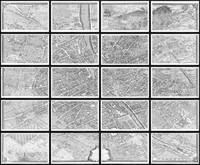
réf. 41228Chalcographie du Louvre, Musée Impérial. XIXème siècle.Cachet sec dans la pliure de la planche 1.Reproduction fidèle de l'édition originale de 1734-1739.In-plano de 20 planches sur onglets. Planche d'assemblage de l'édition originale. BE.Reliure moderne,demi-cuir blond à coins avec pièce de titre en maroquin brun sur le 1er plat; caractères dorés.Carte d'assemblage avec quelques rousseurs. Sur 5 planches, une tache à l'extrémité de la marge médiane.Coins un peu frottés.Mors fragiles,légèrement ouverts.
1791réf. 21429Paris: Pierre-Samuel Dupont 1791. 19th-century half calf gold-tooled spine. 8vo. With a small woodcut decoration on the title page. First separate edition of a revolutionary treatise on the relations between the American colonies and the colonising countries by the French economist Anne Robert Jacques Turgot 1727-1781. He explains his theory that the colonising countries should withdraw from the colonies on a friendly basis allowing the colonies to have their own government and trade with other countries independently. If the colonising countries would grant the colonies independence they could still have the benefit of trading and settling there. Turgot had composed the treatise already in 1776 at the request of King Louis XVI who solicited his ministers' opinions regarding the proper French policy toward the American Revolution. It was first published as Reflexions rédigées. in Mazzei's Recherches historiques et politiques 1788.A very good copy with only a few small spots.l Goldsmith 14728; Kress B2230; Sabin 97456. Pierre-Samuel Dupont, unknown
1755réf. 127430London i.e Paris: Fletcher Gyles 1755. Turgot's first work First edition in French of the second part of Tucker's Reflections on the Expediency of a Law for the Naturalization of Foreign Protestants 1752 translated by Turgot in his first published piece on economics. Tucker wrote the first part of his tract in 1751 in support of Robert Nugent's bill to relax British naturalisation laws against foreign protestants a bill which had had a stormy passage and subsequently failed. It was in the present second part published the following year in which Tucker "developed the established theory that a concentrated industrious population generated economic success. The opposition to the naturalization bill was generated he believed by both bigotry and entrenched monopolistic vested self-interest" ODNB. Turgot's translation of this part of the treatise was appended with his own notes which are significant for several reasons: "in the first place because several of this notes once more reveal at this still early stage of his career the tremendous importance of free competition and free trade in the development of Turgot's economic thought. Further they reveal the fact that thanks to Gournay Turgot's economics came under the influence of English economics to a far greater extent than that of his French contemporaries who were followers of Quesnay" Groenewegen The Economics of A. R. J. Turgot p. xiv. Turgot is also known to have later translated another of Tucker's works on trade wars but his translation was not published and is now lost. Duodecimo 185 x 107 mm. Uncut in original marbled wrappers. Housed in a custom blue cloth box blue morocco label to spine. Half-title present. 20th-century bookplate to inner front cover. Spine backing absent possibly as issued the expected fraying around peripheries. A remarkable survival in the original state in exceptional condition. ESTC T135323. hardcover
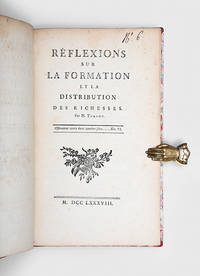
1788réf. 172184No place: no printer 1788. Wealth in the ancien regime First edition in book form of Turgot's most substantial work a milestone in the history of economic thought and a major influence on Adam Smith. Réflexions is a wide-ranging study of the production and distribution of wealth in the ancien régime drawing on Turgot's experience as chief administrator of Limoges. While the work shares several concepts with the Wealth of Nations including the division of labour Turgot goes beyond Smith in his absolute insistence on minimal government intervention in market forces. Turgot's conclusions that land is the source of wealth accord with those of the physiocrats; it was only his repugnance to all "sects" that kept him from the inner circle of the school. The editor of this posthumous edition is unknown although Condorcet and Du Pont are known to have republished several of Turgot's major economic writings at this time. The Réflexions were written in 1766 and serialized in the Ephémérides du Citoyen from 1769 to 1770. Octavo 195 x 119 mm. Engraved vignette to title page head- and tailpieces. Recent red quarter morocco smooth spine lettered in gilt marbled paper sides. Small ink numerals to half-title and title page. Slight bowing to boards minor browning and foxing to endpapers and contents: a very good copy. Einaudi 5772; En français dans le texte 165; Goldsmiths' 13536; INED 4362; Kress B.1506; Mattioli 3673. hardcover
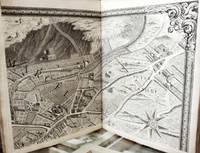
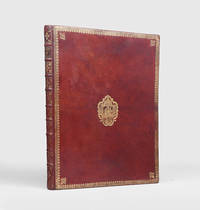
1739réf. B3268Paris: Michel Turgot c. 1739. A fine copy plates are generally very clean and crisp and the atlas is in superb period binding. Edition: First Edition. Binding: recent red full morocco with the coats of arms of Paris. Notes: This is the most beautiful and celebrated plan of the city of Paris. Turgot’s maps were designed and engraved with scroll borders to the extreme edges so that the entire twenty plates could be assembled to form one complete map of Paris 8 ½ x 10 ½ feet. Each arrondissement is shown from a birds-eye view; not only are the streets named and portrayed in detail but all of the houses hotels churches monuments private gardens and city parks are delineated in panoramic perspective such that the architectural ornamentation of the buildings can be identified. Size: Tall folio 560 x 455 mm Illustration: Complete with 20 double-page engraved panoramic maps and double-page index plan. References: Berlin Katalog 2506; Boutier 219 Pages: P. 21 double-page plates. Category: Book Atlas & Cartography; Book Europe France; Book Plate Books General; Michel Turgot unknown
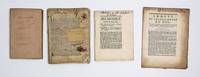
1762réf. 1417642Limoges; Bordeaux; Paris; Angoulême: L. Barbou; Chez Jean Chappuis; du Pont; Claude Rézé 1762-1791. Other. Nineteen documents between 4 and 56 pages long. In Good condition or better. Items are generally unbound parchment with autograph or typed text. Anne Robert Jacques Turgot was a prominent Enlightenment-era French economist and statesman who is known today for his influential and early advocacy of economic liberalism. Serving as Intendant of Limoges and later as Controller-General of Finances under Louis XVI Turgot pioneered administrative reforms to modernize France's tax structure and stimulate their agricultural industry. This collection of nineteen manuscripts letters and printed documents which span a period of nearly 30 years trace the path of Turgot's career from his early defense of religious freedom in Le Conciliateur through his time as Intendant of Limoges. Further this collection features correspondence with administrative figures such as Deflesselle and Duvergier the latter of whom played a role in secretly financing the American Revolution. Shelved in Room F Box 1. CONTENTS: 1 single-sheet ALS from Turgot to a Monsieur Duvergier. In Very Good condition. Dated September 30 1775 this letter states that a Monsieur Duvergier "shall pay the sum of one hundred pounds in livres and certifies this promise to return the said amount." This may well be the Duvergier son Vergennes who less than one year later would be involved with Beaumarchais' clandestine funneling of funds to the American Revolutionaries. Shows expected moderate age toning with some small scattered adhesive stains on the reverse side and in the bottom margin. Small grouping of closed punctures in near the bottom edge. Item is creased across the center. Signed in black ink "Turgot" in black ink. Housed in a mylar archival sleeve with an accompanying typed translation of the letter. 1 folded sheet ALS from Turgot to a Monsieur Deflesselle 3 pages. In Very Good minus condition. Dated March 14 1775. Turgot writes from Versailles to Deflesselle a local administrator in Paris regarding new research on cattle disease then ravaging the French countryside. Deflesselle is identified in an accompanying early 20th-century catalogue entry as one of the first victims de la Revolution. Moderately age toned and foxed. Signed in black ink "Turgot" on the third page. Housed in a mylar archival sleeve with an accompanying typed translation of the letter. 1 folded sheet unsigned autograph letter in Turgot's hand addressed to a Monsieur Caillard two pages plus address leaf. In Very Good condition. Turgot writes to Caillard from Limoges where he was serving as intendant. Caillard a Secretary to Comte de Boisgelin a Minister of France to Parma was at this time residing in Turgot's Paris residence on the Rue de la Chaise. Moderately age toned and faintly wrinkled/creased. Some faint pencil marginalia on the first page. Remnants of original wax seal on the address leaf with a small closed tear near one of the pieces. Housed in a mylar archival sleeve with an accompanying typed translation of the letter. 12 typed reports written by Turgot while Intendant in Limoges 1762-1771. Generally in Very Good condition with one item report dated June 10 1762 in Good condition. These reports concern general bureaucratic and administrative matters related to Limoges dealing mostly with the collection of taxes but also maintaining accurate census data communicating with the clergy and coordinating clerks among other items. In the 48-page June 10 1762 report - the largest report by far - Turgot lays out his goals for reforming the tax system in his district. Many of these items are signed by Commissaire de Tailles a Limoges Monsieur Thomas Thoumas. Items show light age toning and foxing some with shallow open tears at the corners or soiling along edges. The June 10 1762 report is disbound with heavier age toning and soiling creasing in the bottom corners ink marginalia throughout and ink and pencil doodling on the last page; a small note is affixed to the first page. All items are housed in a new mylar archival sleeve. Arrest du Conseil D'Etat du Roi . Du 13 Septembre 1774. Published in Bordeaux by Chez Jean Chappuis. Single octavo signature 8 pages. In Very Good condition. This document details a ruling of the king to establish the free trade of grain and flour. Moderately age toned and faintly creased with some scattered foxing. Contemporary ink inscription in the top margin of the first page lists the date and briefly summarizes the contents. Mémoire Présenté au Conseil en 1766 Par M. Turgot Intendant de la Généraité de Limoges . Published by L. Barbou in Limoges. Quarto 2 29 pages. In Very Good condition. This document written and presented by Turgot in 1766 concerns the excess of taxes in Limoges and the public outrage surrounding them. Moderately age toned sparsely foxed throughout. Some moderate rubbing wear along the edges. Le Conciliateur ou Lettres d'Un Ecclesiastique a un Magistrat sur les Affaires Présentes. Published by du Pont in Paris in 1791. Octavo 56 pages. In Very Good condition. The third edition first edition published in 1754 of Turgot's passionate defense of religious freedom and the separation of church and state. Disbound pamphlet in 20th-century paper wraps. Some smudging to the cover of the wraps. Lightly age toned and sparsely foxed. First page shows brown pencil numbering "13" in the top margin and a pencil note on the edition in the bottom margin with a paper label adhered overtop. Mémoire Signifié Pour Berthelemy Grelon Bourgeois demandeur & accusateur. CONTRE le Sier Ducongé de Fontbrune . Published in 1769 in Angoulême by Claude Rézé. Octavo 11 pages. Side-sewn pamphlet. This appears to be the lawsuit in Angoulême that prompted in part Turgot's writing "Paper on Lending at Interest". Turgot is referenced at several points in the testimony as "Monseiur l'Intendant". Moderately age toned with sparse light foxing. Some light wear at the corners. Contemporary ink inscription in the top margin of the first page reads: "Attribution a. M. l'intendant de Limoges." Shelved in room F box 2. 1417642. Special Collections - Upstairs. L. Barbou; Chez Jean Chappuis; du Pont; Claude Rézé unknown
1762réf. 1417642Limoges; Bordeaux; Paris; Angoulême: L. Barbou; Chez Jean Chappuis; du Pont; Claude Rézé 1762-1791. Other. Nineteen documents between 4 and 56 pages long. In Good condition or better. Items are generally unbound parchment with autograph or typed text. Anne Robert Jacques Turgot was a prominent Enlightenment-era French economist and statesman who is known today for his influential and early advocacy of economic liberalism. Serving as Intendant of Limoges and later as Controller-General of Finances under Louis XVI Turgot pioneered administrative reforms to modernize France's tax structure and stimulate their agricultural industry. This collection of nineteen manuscripts letters and printed documents which span a period of nearly 30 years trace the path of Turgot's career from his early defense of religious freedom in Le Conciliateur through his time as Intendant of Limoges. Further this collection features correspondence with administrative figures such as Deflesselle and Duvergier the latter of whom played a role in secretly financing the American Revolution. Shelved in Room F Box 1. CONTENTS: 1 single-sheet ALS from Turgot to a Monsieur Duvergier. In Very Good condition. Dated September 30 1775 this letter states that a Monsieur Duvergier "shall pay the sum of one hundred pounds in livres and certifies this promise to return the said amount." This may well be the Duvergier son Vergennes who less than one year later would be involved with Beaumarchais' clandestine funneling of funds to the American Revolutionaries. Shows expected moderate age toning with some small scattered adhesive stains on the reverse side and in the bottom margin. Small grouping of closed punctures in near the bottom edge. Item is creased across the center. Signed in black ink "Turgot" in black ink. Housed in a mylar archival sleeve with an accompanying typed translation of the letter. 1 folded sheet ALS from Turgot to a Monsieur Deflesselle 3 pages. In Very Good minus condition. Dated March 14 1775. Turgot writes from Versailles to Deflesselle a local administrator in Paris regarding new research on cattle disease then ravaging the French countryside. Deflesselle is identified in an accompanying early 20th-century catalogue entry as one of the first victims de la Revolution. Moderately age toned and foxed. Signed in black ink "Turgot" on the third page. Housed in a mylar archival sleeve with an accompanying typed translation of the letter. 1 folded sheet unsigned autograph letter in Turgot's hand addressed to a Monsieur Caillard two pages plus address leaf. In Very Good condition. Turgot writes to Caillard from Limoges where he was serving as intendant. Caillard a Secretary to Comte de Boisgelin a Minister of France to Parma was at this time residing in Turgot's Paris residence on the Rue de la Chaise. Moderately age toned and faintly wrinkled/creased. Some faint pencil marginalia on the first page. Remnants of original wax seal on the address leaf with a small closed tear near one of the pieces. Housed in a mylar archival sleeve with an accompanying typed translation of the letter. 12 typed reports written by Turgot while Intendant in Limoges 1762-1771. Generally in Very Good condition with one item report dated June 10 1762 in Good condition. These reports concern general bureaucratic and administrative matters related to Limoges dealing mostly with the collection of taxes but also maintaining accurate census data communicating with the clergy and coordinating clerks among other items. In the 48-page June 10 1762 report - the largest report by far - Turgot lays out his goals for reforming the tax system in his district. Many of these items are signed by Commissaire de Tailles a Limoges Monsieur Thomas Thoumas. Items show light age toning and foxing some with shallow open tears at the corners or soiling along edges. The June 10 1762 report is disbound with heavier age toning and soiling creasing in the bottom corners ink marginalia throughout and ink and pencil doodling on the last page; a small note is affixed to the first page. All items are housed in a new mylar archival sleeve. Arrest du Conseil D'Etat du Roi . Du 13 Septembre 1774. Published in Bordeaux by Chez Jean Chappuis. Single octavo signature 8 pages. In Very Good condition. This document details a ruling of the king to establish the free trade of grain and flour. Moderately age toned and faintly creased with some scattered foxing. Contemporary ink inscription in the top margin of the first page lists the date and briefly summarizes the contents. Mémoire Présenté au Conseil en 1766 Par M. Turgot Intendant de la Généraité de Limoges . Published by L. Barbou in Limoges. Quarto 2 29 pages. In Very Good condition. This document written and presented by Turgot in 1766 concerns the excess of taxes in Limoges and the public outrage surrounding them. Moderately age toned sparsely foxed throughout. Some moderate rubbing wear along the edges. Le Conciliateur ou Lettres d'Un Ecclesiastique a un Magistrat sur les Affaires Présentes. Published by du Pont in Paris in 1791. Octavo 56 pages. In Very Good condition. The third edition first edition published in 1754 of Turgot's passionate defense of religious freedom and the separation of church and state. Disbound pamphlet in 20th-century paper wraps. Some smudging to the cover of the wraps. Lightly age toned and sparsely foxed. First page shows brown pencil numbering "13" in the top margin and a pencil note on the edition in the bottom margin with a paper label adhered overtop. Mémoire Signifié Pour Berthelemy Grelon Bourgeois demandeur & accusateur. CONTRE le Sier Ducongé de Fontbrune . Published in 1769 in Angoulême by Claude Rézé. Octavo 11 pages. Side-sewn pamphlet. This appears to be the lawsuit in Angoulême that prompted in part Turgot's writing "Paper on Lending at Interest". Turgot is referenced at several points in the testimony as "Monseiur l'Intendant". Moderately age toned with sparse light foxing. Some light wear at the corners. Contemporary ink inscription in the top margin of the first page reads: "Attribution a. M. l'intendant de Limoges." Shelved in room F box 2. 1417642. Special Collections - Upstairs. L. Barbou; Chez Jean Chappuis; du Pont; Claude Rézé unknown books
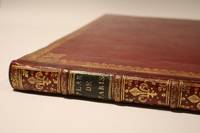
réf. LCS-A76Exemplaire imprimé sur papier fort, orné de brillantes épreuves, revêtu d’une reliure de Padeloup aux armes de la ville de Paris. S.l., 1739. In-folio relié en maroquin rouge, plats ornés d’une roulette fleurdelisée, fleurs-de-lys aux angles, armoiries au centre, dos à nerfs orné de fleurs de lys de différentes tailles, d’étoiles et de filets dorés, coupes décorées, roulette intérieure fleurdelisée, tranches dorées. Reliure de l’époque. 558 x 443 mm.
1739réf. 48765Paris 1739. First Edition. Hardcover. Very Good. Turgot's Monumental Plan of Paris With Excellent Provenance. Elephant Folio 56.5 x 45.5 cm. A magnificent and complete example of the celebrated Plan de Paris commonly known as the Turgot Map housed in a handsome contemporary red Morocco binding with gilt borders spine compartments and bands. The arms of the city of Paris are gilt-stamped to both boards. Neatly rebacked; light rubbing and minor scuffing to the leather. Internally excellent: the sheets are remarkably bright clean and free from repair or loss with only some very faint marginal staining and a couple of spots throughout and the large folding spread with some light discolouration to a couple of the folded corners. Includes the full set of 20 engraved sheets with sheets 18 and 19 joined at the center and folded as issued. The title appears within the ornate cartouche on the key map. A small bookseller's ticket from the famed French antiquarian Pierre Berès is affixed to the upper fore-edge corner of the front paste-down. This is a superbly preserved example of one of the most extraordinary cartographic accomplishments of the 18th century. Commissioned in 1734 under the direction of Michel Étienne Turgot then Prévôt des Marchands Provost of the Merchants of Paris and a senior official in Louis XV's administration the map was designed to glorify the French capital as the political cultural and architectural heart of the kingdom. Louis Bretez a skilled draftsman and member of the Royal Academy of Painting and Sculpture was granted exclusive access to the interiors courtyards and rooftops of the city. Working in a dramatic bird's-eye axonometric perspective Bretez rendered the streets gardens landmarks and even individual buildings in intricate three-dimensional detail. The engravings were executed by Claude Lucas and the full project was completed in 1739 resulting in a masterwork of urban representation. Unlike conventional maps the Turgot Plan was conceived not merely as a geographic tool but as a grand artistic vision: part city portrait part political statement. It remains an unrivaled view of Paris under the Ancien Régime just decades before the French Revolution would transform the urban and social landscape. Widely distributed across France and to the royal courts of Europe the Turgot Map was intended to impress dignitaries scholars and ambassadors alike with the power and refinement of the French capital. Today complete copies in such fine condition are exceedingly scarce. This example with its contemporary binding and provenance would be a great addition for any serious collection of cartography Parisiana or French Enlightenment-era printing. Provenance: A Montreal family purchased from Christie's Canada with Montreal Book Auctions 1970. The Property of the Hon. Madame Georges P. Vanier. With a letter from the auction house and a letter from Parisian dealer Pierre Beres addressed to the buyer confirming this as the copy he sold to General Charles de Gaulle to present to the Governor General Vanier. hardcover
réf. 54315Paris: 1734-39. FIRST EDITION. 20 original engraved double page sheets each c. 52 x 80 cm here presented as 20 framed panels each measuring c. 56 x 85 cm giving a total wall space of 280 x 340 cm. A fascinating and colossal view of Paris and amongst the greatest city views of all time. Turgot's map of Paris is possibly the most ambitious urban mapping ever undertaken. This map shows the whole of 18th century Paris and offers an expansive perspective on the city before Baron Georges Eugène Haussmann's 19th-century redesign. Turgot who held the mayor-like office of Prevôt des Marchands de Paris commissioned Louis Bretez and Claude Lucas to produce this map. Oriented to the east on an axonometric projection this map is best understood as an aerial view where in every building window tree shadow and park are shown from an equidistant aerial perspective. In order to produce the thousands of sketches and surveys required to complete this map Bretez was issued a permit to enter every building in Paris. It took the team nearly five years of exhaustive sketching and surveying to assemble this masterpiece. A Monumental Achievement With unprecedented access to the properties of Paris and an official mandate Bretez achieved outstanding detail and accuracy. The buildings of Paris are presented as one would have seen them at the time. The Louvre the Tuileries Garden Notre Dame Cathedral and the Champs Élysées can all be easily recognised. The Bastille the flashpoint of the French Revolution which would start 58 years later is depicted as well. Michel-Etienne Turgot 1690-1751 Louis XV's Prévot des Marchands commissioned this plan in 1734 from Louis Bretez a sculptor painter and perspective specialist who used the conventional bird's-eye representation isometric projection. The stunning result shows maps with great and decorative detail being an important record of the architecture and gardens of Baroque Paris the world capital at the time. This was the last major example of this type of plan. Turgot was chief of the municipality of Paris as provost of merchants the equivalent of today's mayor. He was the father of the famous economist and statesman Anne-Robert-Jacques Turgot whom history remembers chiefly as an early advocate for economic liberalism. Turgot was motivated to commission a map of Paris by his will to champion the reputation of the city for Parisian provincial or foreign elites. As such he asked Louis Bretez a French architect cartographer and professor of perspective who belonged to the Royal Academy of Painting and Sculpture to draw up the plan of Paris and its suburbs. Over his two years of work 1734-1736 Bretez was granted access to all the houses and gardens he needed to visit in order to take the relevant measurements. Paris: 1734-39 unknown
1739réf. 186707Paris: Turgot 1739. A magnificent bird's-eye view of Enlightenment Paris - "both comprehensive and unique" First edition of this famous map "a major record of the architecture and gardens of Paris of the period of much documentary interest to historians and archaeologists today" Millard. Like a number of copies encountered this one is handsomely bound in period red morocco with the gilt arms of Paris on the covers. Turgot 1690-1751 mayor of Paris and father of the Physiocrat Anne Robert Jacques Turgot presided over the improvement of the city in the 1730s and became president of the Grand Conseil in 1741. In 1734 he commissioned Louis Bretez professor of perspective at the Académie de Saint-Luc and the printmaker Claude Lucas to design and engrave this map. "The ambitious project received a highly conservative interpretation. In the face of new developments in geometry that were being applied to map-making Bretez chose to continue the conventional system of bird's-eye representation. The Plan de Paris is the last major example of this type of view-plan. It provides an unnatural 'forced' perspective in which all the buildings of Paris including civic structures churches and even private houses with heir courts and gardens are represented in three-dimensional quarter view. In addition the plan is oriented not to the north but to the east so that the viewer can see the portals of the churches which are turned toward the west. The resulting plan is the most regular of this system. Although it is not an accurate map it does provide a knowledge of the state of Paris in 1734 that is both comprehensive and unique" Millard. Folio 554 x 430 mm. Engraved folding key map and 20 detailed maps by Claude Lucas after Louis Bretez on heavy laid paper all double-page and mounted on stubs maps 18 and 19 incorporating title within a cartouche joined and folding all except the key map within an ornamental border. Contemporary red morocco spine with nine raised bands compartments with gilt paired fillet frames enclosing fleur-de-lys cornerpieces and central motif olive green label sides with border of fleur-de-lys and palmettes fleur-de-lys cornerpieces large coat of arms of Paris within a rococo cartouche gilt edge roll and turn-ins Placard pattern marbled endpapers gilt edges. Joints refurbished a couple of wormholes to spine a few old abrasions and marks to covers internally some finger-soiling toning and foxing but overall very good. Millard French 39. hardcover