1858rif. 34613Paris Imprimerie Impériale 1858 In-8 Fort Avec un Envoi d'Auteur à Monsieur Labat. Rousseurs sur tout l'ouvrage, avec le prospectus de parution de l'ouvrage. couvertures en état moyen, dos présent mais fragile, petits manques de papier. VI-430 pp
rif. 012486Révérend Père Augustin Colombel (1833-1905), missionnaire jésuite en Chine, père de l'astronomie moderne en Chine à qui on doit la construction de l'observatoire de Shanghai. L.A.S., 6 juillet 1890, 4p in-8. A sa soeur Marie-Thérèse Colombel (1839-1912), baronne Richerand : « Ma bien chère sour, Merci toujours pour tes bonnes lettres. Elles me disent assez que vous aimez toujours le Bon Dieu, que le Bon Dieu vous aime, c'est tout ce que j'ai besoin de savoir. Si dans les détails que tu me donnes je ne vois pas cela, ils me feraient de la peine. Mais non, tout ce que tu me dis de toi et des tiens dit que vous l'aimez, que vous le servez et je vous en aime davantage. Continue donc à me parler bien au long de chacun. Ta fille devient grande. La mère St Dominique m'en dit du bien. Vous vous préoccupez de son mariage. Je prie bien souvent pour que le Bon Dieu lui donne un bon mari. Lui seul connait l'avenir. C'est à toi qu'il a remis le soin de chercher sa volonté pour ta fille. Adresse-toi donc à lui dans la prière. Tu as sans doute autour de toi des Pères, des prêtres qui connaissent Amélie, qui te connaissent, demande-leur conseil. Je vois avec joie que cette chère enfant veut avant tout un mari qui aime et serve le Bon Dieu. Dis-lui bien que je prie avec vous pour cette affaire. Et ton Augustin ? Il a dû aller encore passer quelques semaines au régiment, je pense. Comment s'y comporte-t-il ? S'y tient-il bien ? en Chrétien ? Quelles idées en rapporte-t-il ? Il me disait qu'il voulait être soldat...? Est-ce sérieux ? A la distance où je suis, je ne peux en juger. Il peut se faire que oui. Il y a des raisons de croire que non. Là encore, c'est auprès du Bon Dieu que tu pourras trouver conseil. Ecris-moi longuement sur eux tous. Et Emmanuel...? Le voyez-vous souvent ? Sa mère se dévoue bien pour lui. Je suis heureux de la voir près du collège, j'espère que les Pères suppléeront un peu à l'absence de notre cher Henri. Il y a aussi plusieurs Lauras au collège. Tes enfants les voient-ils quelques-fois ? Avez-vous gardé quelques relations avec eux ? Si j'allais à Paris, je ne verrais que des figures nouvelles et pourtant j'aime bien tous ces chers enfants dont j'espère presque jusqu'au nom. Parle-moi d'eux-tous. Je suis heureux de te voir aller chez les Dames auxiliatrices. Elles sont excellentes. La mère St Paul peut te parler de Shanghai, elle en reçoit souvent des nouvelles. Il y a aussi rue de la Barouillère deux jeunes religieuses qui viennent d'ici. Je serais heureux que ta fille put faire connaissance avec elles. Elles sont à peu près de son âge et nées à Shanghai. Je leur ai fait bien souvent le catéchisme. Ici ces bonnes mères font toujours beaucoup de buis. Il y a deux mère chinoises appliquées à la visite des malades, elles baptisent beaucoup d'enfants chez les païens. Nous avons baptisé chez elles mercredi dernier un jeune homme protestant dont j'avais baptisé moi-même la femme et l'enfant. Prie souvent pour leurs ouvres. Adieu chère soeur, je vous embrasse tous bien fort. Ton frère Augustin. Merci pour les semaines religieuses, les annales &... Où en est l'église de Montmartre ? Il y a je crois un album où on a réuni les dessins faits pour son bulletin, il se vent à l'église même. Donne-le moi... Je pourrai m'imaginer un pèlerinage à Montmartre. Le souvenir qui m'en reste c'est d'y être allé avec notre père, Xavier et Henri. J'avais 6 ou 7 ans. Je me souviens d'un moulin à vent qu'il y avait là. » Belle lettre familiale. Cette lettre a été publié avec quelques autres sur le blog du Bibliomane Moderne le 14 octobre 2021. Elles apportent un éclairage particulièrement intéressant sur le développement des missions jésuites en Chine et à Shanghai en particulier. [242]
rif. 012487Révérend Père Augustin Colombel (1833-1905), missionnaire jésuite en Chine, père de l'astronomie moderne en Chine à qui on doit la construction de l'observatoire de Shanghai. L.A.S., Shanghai, 7 août 1890, 4p in-8. A sa soeur Marie-Thérèse Colombel (1839-1912), baronne Richerand : « Ma chère Marie, Le mois d'août à toujours été un de mes mois favoris. Le 1er, anniversaire de ma naissance, le 14 celle de Henri, le 28 celle de Xavier. Puis on y faisait la fête, celle de notre mère, celle d'Aline. Le 15 passait pour notre fête à tous parce que nous nous appelons tous Marie. J'ai trois noms, Augustin le 28, Marie le 15, Louis le 25. Aussi pendant ce mois les souvenirs pour la famille abondent. J'ai commencé hier la neuvaine de l'Assomption, tu en as une bonne part. Oui le Bon Père Rathanys (?) est mort. Je l'ai assisté dans ses derniers moments. C'est une perte pour nous, mais le Bon Père sera plus heureux au ciel. Je suis heureux de voir que tu t'occupes de nos Pères de la rue Lafayette. Je me rappelle qu'une fois pendant les vacances, maman m'emmena chez eux, elle leur portait une douzaine de paires de bas parce qu'elle avait vu que l'un d'eux avait des bas percés. Je pense bien comme toi que cette maison aura des difficultés. Les allemandes s'éparpillent dans Paris. Ils fuirent ce quartier-là. Dès lors le but premier de cette ouvre viendra à manquer, où bien il faudra trouver d'autres ouvres à faire là ou bien il faudra se retirer. Le Pauvre Père de Bigand doit avoir bien des inquiétudes. C'est dans cette maison que Henri à commencer à pratiquer la médecine. Ce que tu me dis de ses processions à Paris me semble bien vrai. Les hommes y manquent. Ils y manquent comme simples fidèles, ils y manquent comme représentants des corps constitués, gouvernement, armées... En un mot il manque à ces processions une représentation de la nation. Ce n'es plus un culte national. C'est un culte public où on retrouver encore le Clergé, l'Eglise, puis avec elle la vie privée, les femmes, les mères, les enfants mais on n'y voit plus la vie publique, sociale. Aussi le Bon Dieu ne bénit-il pas les affaires publiques. [...] La mère St Dominique te prie de recommander partout son ouvre aux prières des bonnes âmes. Prie pour elle à Montmartre à Ste Geneviève. Mets-y des cierges pour nous. Adieu chère sour, je t'aime plus que tu ne peux penser, bien plus que je ne peux dire. Je vous embrasse tous. Ton frère Augustin. » Belle lettre familiale dans laquelle on voit que la diffusion de Drumont s'est faite jusqu'en Chine ! Cette lettre a été publié avec quelques autres sur le blog du Bibliomane Moderne le 14 octobre 2021. Elles apportent un éclairage particulièrement intéressant sur le développement des missions jésuites en Chine et à Shanghai en particulier. [242]
rif. 012488Révérend Père Augustin Colombel (1833-1905), missionnaire jésuite en Chine, père de l'astronomie moderne en Chine à qui on doit la construction de l'observatoire de Shanghai. L.A.S., Shanghai, 4 septembre 1890, 4p in-8. A sa soeur Marie-Thérèse Colombel (1839-1912), baronne Richerand : « Ma bien chère sour, C'est, je crois, le 4 septembre 70 que vous autres parisiens vous avez proclamé la R.F. et depuis la France l'a adoptée et, quoiqu'on en dise, les autres peuples la considèrent avec de grands yeux, sans savoir ce que deviendra cette nouvelle invention. Sera-t-elle le marchepied d'un trône, sera-t-elle la tempête qui s'étendra sur l'Europe entière, le monde entier peut-être ? Sera-t-elle le noyau d'une république universelle comme les avancées (?) le disent...? Dieu le sait, seul il le sait je crois. Les fr[anç]ais ne sont plus assez chrétiens pour mériter la bénédiction de Dieu, les aidera-t-il dans leur politique tout humaine ? Mais Dieu a promis son secours à l'Eglise, elle est certaine de durer toujours. Dieu a suscité des Empereurs et s'est servi d'eux pour son Eglise, puis des Rois... Empereurs et Rois ont bien mal répondu aux avances de Dieu, Dieu s'est retiré, ils tombent. Et maintenant, qu'est-ce que Dieu suscitera pour soutenir son Eglise ? Ici je m'arrête, je ne me sens pas l'esprit de prophétie. Mais j'ai confiance que le Bon Dieu tirera le bien du mal, que son Eglise trouvera toujours les secours qui lui seront nécessaires. Et en pratique tenons-nous toujours bien près d'Elle, pressons-nous sur son seul par la Foi, d'abord, par l'obéissance à tous ses commandements, par la pratique de ses sacrements et avec cela nous serons certains de recevoir notre part de la durée perpétuelle que Dieu lui a promise. Voila presque un sermon à propos de mal date. Tu vois où j'en suis en politique, c'est le cléricalisme à outrance, mais pas dans le sens commun. Oui j'ai reçu tous tes livres. Merci, merci et encore merci. Les Carmélites m'ont demandé le B. Verboyre, elles l'ont lu au réfectoire et viennent de me le renvoyer. Nos Pères de notre collège m'ont pris le général de Sonis et le lisent aussi au réfectoire, enfin la m. St Dominique m'a pris le dernier, la Campagne du Cassini pour le faire lire à ses sours. Tu vois que tes livres servent. Pour moi, je les lis tous, mais trop vite. En trois jours j'ai eu fini le général de Sonis et les autres encore plus vite. Ils sont très bien surtout le Gl. Il est consolant de voir que le Bon Dieu donne encore de tels hommes à la France même quand elle est en République. Je te prie de m'envoyer encore un ou deux livres. Je voudrais avoir les Confessions de St Augustins et les Soliloques du même saint. Mais en français. Je voudrais les faire lire, on ne les a pas ici. Je pense que tu trouveras cela facilement. Et encore, mais pour moi-même cette fois. J'ai vu le titre d'un livre, "Le culte de la croix avant J.C." par l'abbé Ansault. Je ne sais ce que c'est mais moi-aussi je crois retrouver en Chine des traces fort anciennes du culte de La Croix. Peut-être trouverais-je dans ce livre quelque-chose qui soit dans le courant de mes idées. Enfin, il se publie à Paris une "Revue des Religions". Le P. Delaporte te dira ce que c'est. Envoie m'en deux ou trois numéros comme spécimen. Tu vois ma chère sour que j'abuse de tes aumônes. Je crois que ta charité me le pardonnera et que le Bon Dieu t'en récompensera. Adieu, je vous embrasse tous bien fort. Ton frère Augustin. » Cette lettre a été publié avec quelques autres sur le blog du Bibliomane Moderne le 14 octobre 2021. Elles apportent un éclairage particulièrement intéressant sur le développement des missions jésuites en Chine et à Shanghai en particulier. [242]
rif. 012490Révérend Père Augustin Colombel (1833-1905), missionnaire jésuite en Chine, père de l'astronomie moderne en Chine à qui on doit la construction de l'observatoire de Shanghai. L.A.S., Shanghai, 30 octobre 1890, 3p 1/4 in-8. A sa soeur Marie-Thérèse Colombel (1839-1912), baronne Richerand : « Ma bien chère sour, Je viens te demander une bonne ouvre, je te prie d'y mettre tout ton cour. Nous avons ici pour consul général Mr Wagner. Ce bon monsieur nous a rendu bien des services, il a souvent mis toute son autorité et ses meilleurs soins au règlement de nos affaires et le Bon Dieu y a ajouté quelquefois souvent le succès. Nous lui devons donc de la reconnaissance. De plus Mr Wagner est tout spécialement bon pour moi. Je suis souvent intermédiaire entre lui et monseigneur, et j'ai moi-même bien des rapports avec lui pour les affaires de mes paroissiens. Et en tout cela j'ai trouvé chez Mr Wagner la plus grand bienveillance. Or Mr Wagner a ici même une nombreuse famille. Sa femme est prise d'une maladie du fois et elle est obligée de fuir nos climats. Elle va partir samedi prochain par la malle pour Paris où elle consultera les médecins et se soignera le temps nécessaire. Madame Wagner emmène avec elle une grande fille de l'âge de la tienne, une autre de 15 ans et son dernier fils de 8 ou 9 ans. Je te prie donc instamment de tâcher de les voir, le plus souvent que tu pourras. Il y a là un devoir de reconnaissance de ma part, mais aussi une bonne ouvre à faire. Cette bonne dame est très bonne mais les longs séjours que la carrière de son mari lui ont imposés en pays étrangers l'ont deshabituée de la confession. Je crains que si elle venait à mourir à Paris, elle n'ait personne auprès d'elle pour lui parler des sacrements. Les deux filles sont venues communier dimanche pour obtenir la bénédiction de Dieu sur leur voyage. J'ai été demander hier à Mr Wagner où descendait sa femme. Il n'y a rien encore d'assuré, ils chercheront à Paris. J'ai donné ton adresse, Mr Wagner m'a dit que sa femme irait te voir dès son arrivée. Lui-même lui écrira par le ministère des affaires étrangères où Mme Wagner ira prendre ses lettres, là on saura son adresse. Le P. Fournade a nos lettre par la même voie, il pourrait donc aussi l'y savoir. Si 10 ou 15 jours après la réception de cette lettre, tu n'as pas vu Mme Wagner, prie le P. Fournade de savoir son adresse et va la voir. Il y a là un bonne ouvre à faire. Cette bonne Dame est sans famille, sans parents à Paris, tu pourras lui rendre service. Que ta fille rende aux deux siennes tous ceux qu'elle pourra. Si tu fais connaissance avec elles, tu pourras y envoyer Mme Colombel et son fils, et la mère St Paul &... Mr Maignot nous est revenu. Il m'a fait vos commissions. Ta fille a reçu des couleurs. Tu sais ce que sont devenus tes livres, on en finit actuellement la lecture au réfectoire chez les mères. Elles t'en remercient bien. Adieu chère et bonne sour, je vous embrasse tous bien fort. Ton frère, Aug. M. Colombel s.j. » Cette lettre a été publié avec quelques autres sur le blog du Bibliomane Moderne le 14 octobre 2021. Elles apportent un éclairage particulièrement intéressant sur le développement des missions jésuites en Chine et à Shanghai en particulier. [242]
1871rif. 5815Nellore: March 17 1871. Very good. Broadside 8.25 x 5 inches. Old horizontal folds minor toning. An unrecorded broadside calling a meeting of the General Committee of the Jaffna Auxiliary Bible Society JABS at the Wesleyan Mission House in Jaffna in March 1871. The Jaffna Auxiliary Bible Society is an arm of the British & Foreign Bible Society focused on distributing Bibles and engaging in scriptural education within the Jaffna district of Sri Lanka. In the present broadside the secretary of the JABS Thomas Good writes from Nellore and lays out the business of the meeting in six line items. The meeting is meant to include Devotional Exercises a reading of the minutes from the last meeting "Brief Verbal Reports of Bible Work" sub-committee reports a reading of a paper by Rev. L. Spaulding on the "best method of doing Bible Work" and a discussion of said paper. Original materials held by institutions relating to the Jaffna Auxiliary Bible Society are almost exclusively either their printings of various Books of the Bible into Tamil or later annual reports. Ephemera from the society's work in Sri Lanka is almost nonexistent. March 17 unknown
1871rif. 5815Nellore: March 17 1871. Very good. Broadside 8.25 x 5 inches. Old horizontal folds minor toning. An unrecorded broadside calling a meeting of the General Committee of the Jaffna Auxiliary Bible Society JABS at the Wesleyan Mission House in Jaffna in March 1871. The Jaffna Auxiliary Bible Society is an arm of the British & Foreign Bible Society focused on distributing Bibles and engaging in scriptural education within the Jaffna district of Sri Lanka. In the present broadside the secretary of the JABS Thomas Good writes from Nellore and lays out the business of the meeting in six line items. The meeting is meant to include Devotional Exercises a reading of the minutes from the last meeting "Brief Verbal Reports of Bible Work" sub-committee reports a reading of a paper by Rev. L. Spaulding on the "best method of doing Bible Work" and a discussion of said paper. Original materials held by institutions relating to the Jaffna Auxiliary Bible Society are almost exclusively either their printings of various Books of the Bible into Tamil or later annual reports. Ephemera from the society's work in Sri Lanka is almost nonexistent. March 17 unknown books
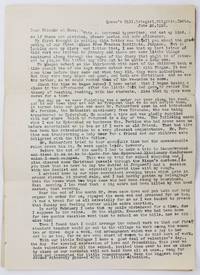
1926rif. 4568Queen's Hill Kotagiri Nilgiris India: June 26 1926. Very good. 5pp. typed on plain folio sheets. Old folds minor wear. An informative and entertaining correspondence by Kate M. French written while serving as a missionary teacher at the Preston Institute in Jangaon India. Writing to "Friends at Home" French opens by reporting that the school year started well "except for two of the boys whose mother was ill with Plague" the mother subsequently died. French also mentions students getting stung by scorpions a cobra snake killed by the headmaster of the school making valentines for the entire school on Valentine's Day and much more. French also recounts the comings-and-goings of various officials to her mission writes in detail about her attendance at a "teachers' institute" composed of teachers from "the American Methodist the English Wesleyan the American Mennonites and our own" details the school's commencement at the end of the term and more. The local plague is mentioned several times in French's letter. She mentions her own inoculation against the plague. She also records that "before long we learned that there had been several deaths from plague in our town. We had nearly all our Christians innoculated some time before and Mrs. Rutherford at once had the stragglers attended to those who had fever when the doctor was innoculating and one or two who were not very strong and would only be done if the disease came near." Shortly thereafter French notes that "people are leaving town on account of the plague." An interesting letter from an American woman teaching at a mission in India in the midst of the Roaring Twenties. June 26 unknown
1926rif. 4568Queen's Hill Kotagiri Nilgiris India: June 26 1926. Very good. 5pp. typed on plain folio sheets. Old folds minor wear. An informative and entertaining correspondence by Kate M. French written while serving as a missionary teacher at the Preston Institute in Jangaon India. Writing to "Friends at Home" French opens by reporting that the school year started well "except for two of the boys whose mother was ill with Plague" the mother subsequently died. French also mentions students getting stung by scorpions a cobra snake killed by the headmaster of the school making valentines for the entire school on Valentine's Day and much more. French also recounts the comings-and-goings of various officials to her mission writes in detail about her attendance at a "teachers' institute" composed of teachers from "the American Methodist the English Wesleyan the American Mennonites and our own" details the school's commencement at the end of the term and more. The local plague is mentioned several times in French's letter. She mentions her own inoculation against the plague. She also records that "before long we learned that there had been several deaths from plague in our town. We had nearly all our Christians innoculated some time before and Mrs. Rutherford at once had the stragglers attended to those who had fever when the doctor was innoculating and one or two who were not very strong and would only be done if the disease came near." Shortly thereafter French notes that "people are leaving town on account of the plague." An interesting letter from an American woman teaching at a mission in India in the midst of the Roaring Twenties. June 26 unknown books
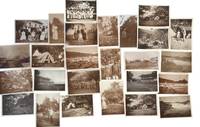
1912rif. 236551912. American Protestant mission photo archive depicting schools Western and African Christian workers in Portuguese Angola 1912 to 1914 recording the local life missionary presenceand infrastructure extending Western religious and educational authority. Dated inscriptions identify "missionaries and native workers" in 1912 and a "boys school" in 1914 while another photograph is captioned "At the Quanza" the historical English spelling of Angola's Kwanza River. Protestant missions had operated in Angola since the late nineteenth century establishing schools training African evangelists and teachers and creating networks that could compete with Portuguese colonial institutions for influence over language education and community allegiance. We believe the se are American Protestant missionaries because the language of the captions itself sounds North American. One phrase especially stands out: "Our force" That wording was commonly used by North American Protestant missionaries to describe their combined European and African staff. British missionaries more often wrote "our staff" "our workers" or "the mission staff." Likewise the informal captions "Hopefuls" "Sit down rest a while" resemble private North American missionary albums more than official British mission records. Photo archive of 27 photographs seven silver gelatin and and twenty laser-printed photographs all large format ranging from 7 x 5 to 7 x 4 inches Portuguese Angola circa 1912 to 1914. Formal portraits show European missionaries with Angolan personnel before stuccoed mission buildings including a large group captioned "Missionaries and native workers 1912" and a smaller portrait captioned "Our force 1912." School photographs depict boys girls and younger children arranged in rows with European instructors; one verso reads "Boys school 1914" while an individual portrait of two neatly dressed boys is titled "Hopefuls." Mission compounds include long veranda buildings fenced grounds thatched dwellings tents cooking equipment folding furniture and temporary encampments occupied by missionaries and local residents. Several photographs record travel and subsistence away from the station: missionaries pose beside rapids captioned "At the Quanza" rest in wooded country prepare meals outside canvas tents exchange food or supplies with African residents and occupy a mixed camp of tents and thatched structures. Other images show a fruiting orange grove men and women gathering fruit a landscape identified as "The lumbermen's camp" mission residents seated among dense vegetation river scenery village buildings and African children and adults photographed at schools settlements and work sites. Verso captions also include "Down for the night" and "Sit down rest a while" language that frames travel camp life and mission expansion through the photographer's informal record of daily activity. Portuguese rule in Angola remained uneven in the early twentieth century particularly beyond coastal administrative centers and mission stations often supplied education printing agricultural instruction medical care and religious training where the colonial state maintained little permanent infrastructure. Schools were central to this expansion. Literacy and teacher training enabled missionaries to circulate Christian texts while African instructors and evangelists carried teaching and worship into communities that European personnel could not reach directly. The photographs expose the racial hierarchy of this arrangement through clothing spatial placement and captioning: European missionaries are named collectively as the directing body while Angolan colleagues are reduced to categories such as "native workers" even when formal group portraits present them as teachers clergy assistants or institutional staff. Agricultural scenes the lumber camp mission residences school groups and mobile tent sites further demonstrate how evangelization depended upon land food production transport construction and locally recruited labor rather than preaching alone. Protestant educational networks later produced generations of Angolan teachers clergy writers and political organizers while Portuguese authorities repeatedly regarded independent mission schooling and African language literacy as potential challenges to colonial control. Light surface wear occasional creasing and fading scattered stains and adhesive or paper residue on several versos; captions remain legible. Overall in good condition. unknown
1912rif. 236551912. American Protestant mission photo archive depicting schools Western and African Christian workers in Portuguese Angola 1912 to 1914 recording the local life missionary presenceand infrastructure extending Western religious and educational authority. Dated inscriptions identify "missionaries and native workers" in 1912 and a "boys school" in 1914 while another photograph is captioned "At the Quanza" the historical English spelling of Angola's Kwanza River. Protestant missions had operated in Angola since the late nineteenth century establishing schools training African evangelists and teachers and creating networks that could compete with Portuguese colonial institutions for influence over language education and community allegiance. We believe the se are American Protestant missionaries because the language of the captions itself sounds North American. One phrase especially stands out: "Our force" That wording was commonly used by North American Protestant missionaries to describe their combined European and African staff. British missionaries more often wrote "our staff" "our workers" or "the mission staff." Likewise the informal captions "Hopefuls" "Sit down rest a while" resemble private North American missionary albums more than official British mission records. Photo archive of 27 photographs seven silver gelatin and and twenty laser-printed photographs all large format ranging from 7 x 5 to 7 x 4 inches Portuguese Angola circa 1912 to 1914. Formal portraits show European missionaries with Angolan personnel before stuccoed mission buildings including a large group captioned "Missionaries and native workers 1912" and a smaller portrait captioned "Our force 1912." School photographs depict boys girls and younger children arranged in rows with European instructors; one verso reads "Boys school 1914" while an individual portrait of two neatly dressed boys is titled "Hopefuls." Mission compounds include long veranda buildings fenced grounds thatched dwellings tents cooking equipment folding furniture and temporary encampments occupied by missionaries and local residents. Several photographs record travel and subsistence away from the station: missionaries pose beside rapids captioned "At the Quanza" rest in wooded country prepare meals outside canvas tents exchange food or supplies with African residents and occupy a mixed camp of tents and thatched structures. Other images show a fruiting orange grove men and women gathering fruit a landscape identified as "The lumbermen's camp" mission residents seated among dense vegetation river scenery village buildings and African children and adults photographed at schools settlements and work sites. Verso captions also include "Down for the night" and "Sit down rest a while" language that frames travel camp life and mission expansion through the photographer's informal record of daily activity. Portuguese rule in Angola remained uneven in the early twentieth century particularly beyond coastal administrative centers and mission stations often supplied education printing agricultural instruction medical care and religious training where the colonial state maintained little permanent infrastructure. Schools were central to this expansion. Literacy and teacher training enabled missionaries to circulate Christian texts while African instructors and evangelists carried teaching and worship into communities that European personnel could not reach directly. The photographs expose the racial hierarchy of this arrangement through clothing spatial placement and captioning: European missionaries are named collectively as the directing body while Angolan colleagues are reduced to categories such as "native workers" even when formal group portraits present them as teachers clergy assistants or institutional staff. Agricultural scenes the lumber camp mission residences school groups and mobile tent sites further demonstrate how evangelization depended upon land food production transport construction and locally recruited labor rather than preaching alone. Protestant educational networks later produced generations of Angolan teachers clergy writers and political organizers while Portuguese authorities repeatedly regarded independent mission schooling and African language literacy as potential challenges to colonial control. Light surface wear occasional creasing and fading scattered stains and adhesive or paper residue on several versos; captions remain legible. Overall in good condition. unknown books
1914xiv, 403 p. "A record of missionary work among the Indian tribes of the Northern Pacific Coast of our country and of the wonderful transformation in character and conditions which the introduction of the blessed Gospel has brought about." - Preface. List of illustrations includes twenty-seven black and white plates, two of which (at pages 144 and 208) are not present, although there is no evidence they ever were. New front and back endpapers applied over originals. Narrow opening in binding at half-title page. Somewhat above-average wear to maroon cloth covered boards adorned with gilt lettering and photo of author. LOWTHER 1611, TOURVILLE 1128, AMTMANN 3501, RICKS p.75, SMITH 2135, MATTHEWS 295, TOD & CORDINGLEY p.85. Book
1899112 Pages. Features: Adventures of Louis De Rougemont - part IX; Holy Week Procession in Seville (includes photos of Nazarene's in costumes similar to those of Klansmen); My Texan Elopement -John H. Jones impersonates Miss Sally Steddem; A Naturalist in Cannibal-Land - adventures of Captain H. Cayley-Webster in the cannibal islands of the South Seas (with photos of Cayley-Webster); Jinkers and Jinkering - photo-illustrated article shows how buildings are moved by horses and oxen in Western New South Wales; My Klondike Mission - Lilian Agnes Oliver of Chicago set out for the Klondike to raise money to support her invalid husband - a photo-illustrated account; Through Pygmy-Land - Part I - photo-illustrated article by Albert B. Lloyd; The Heroes of Niagara - a series of graphic narratives, each illustrated by a photo of the hero and his apparatus; "Dago" - eminent actor Kyrle Bellew relates a remarkable mining incident - with photos; The Martyrs of Ku-Cheng - photo-illustrated article on the slaughter of Christian missionaries in the interior of China and the decapitating retribution; My First Leopard - by Walter H. Bone; Round the World in a Home-Made Boat - Joshua Slocum and the 'Spray'; Wolves in a Blizzard - Mr. and Mrs. E. Howard in North-West Canada; My Cycle Ride to Khiva - part II - an account of a remarkable bicycle ride across the deserts of Kara-kum and Kizil-kum by Robert L. Jefferson, F.R.G.S.; Attacked by Leeches - W. Harcourt-Bath describes a horrible jungle; Incredible photos of dozens of prisoners on treadmill in the great prison of Rangoon; Photo of dead Armenian heroes in Samsoun; and more. Average wear. Complete and intact. Few pencil markings. A sound vintage copy of this wonderful issue. Book
rif. 012484Révérend Père Augustin Colombel (1833-1905), missionnaire jésuite en Chine, père de l'astronomie moderne en Chine à qui on doit la construction de l'observatoire de Shanghai. L.A.S., Nankin, 1er avril 1888, 3p in-8. A sa soeur Marie-Thérèse Colombel (1839-1912), baronne Richerand : « Ma bien chère sour, Alleluia ! C'est le jour de Pâques que je t'écris. Nos pauvres chrétiens sont venus en grand nombre. Les païens encore plus pour voir. Que le Bon Dieu leur ouvre donc les yeux du coeur ! Oui, je reçois tes annales catholiques, très fidèlement. Je t'en remercie mille fois, elles font grand plaisir à moi et à tous les pères qui sont autour de moi. Puis quand nous les avons bien lues, elles sont reliées en volume et gardées dans notre bibliothèque. De ce que tu m'envoies aujourd'hui : 1° La revue du monde catholique, très bien. Je l'ai lue en entier, les pères mes voisins la lisent, envoie nous la pendant quelques mois. Les journaux quotidiens sont trop détaillés pour nous, nous ne pouvons les lire, mais les revues mensuelles ou bimensuelles sont notre affaire. Nos pères de Paris en publient une maintenant, envoyez-nous la. Je la désire beaucoup. 2° Les mystères de la franc-maçonnerie dont tu m'envoies les 2 dernières livraisons font plaisir aux pères qui m'entourent, si tu m'envoies la suite, tu me feras plaisir. 3° Les contes chinois ne sont pas forts. C'est mal traduit et mal choisi. On aurait pu trouver bien mieux. Adieu ma chère Marie. Priez beaucoup pour notre pauvre Chine. Je vous embrasse tous. Ton frère Augustin. » Joli témoignage autour des missions. Cette lettre a été publié avec quelques autres sur le blog du Bibliomane Moderne le 14 octobre 2021. Elles apportent un éclairage particulièrement intéressant sur le développement des missions jésuites en Chine et à Shanghai en particulier. [242]
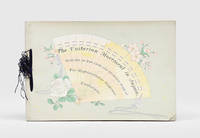
1900rif. 178748Tokyo: Japan Unitarian Mission 1900. First edition first printing. This window onto Japan's Westernization in the wake of the Meiji Restoration surveys the mission's history and work as well as its ambitious book distribution program which disseminated 100000 pamphlets in 1899. Landscape octavo. Tissue-guarded halftone frontispiece illustrations in text. Original illustrated green card wrappers purple thread musubi toji binding front cover lettered in black. Covers a little marked small tear at lower tip of front cover contents clean: very good. unknown
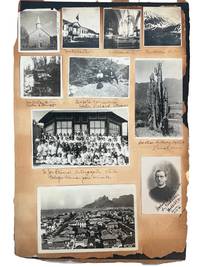
1930rif. 236691930. American Catholic missionary photograph album documenting the expansion of religious infrastructure across Peru Brazil Argentina Chile Colombia and Mexico during the 1930s and early 1940s showing how churches schools workshops sacramental programs women's committees and transport networks extended ecclesiastical authority into local communities. The photographs center on named clerical staff local populations across South America and the religious and educational infrastructure produced by mission activity: churches under construction children gathered for instruction and First Communion women's sewing and relief programs parish congregations and Indigenous populations classified and presented through missionary categories. Archive of approximately 200 primarily silver gelatin photographs ranging from 1.5 x 3 to 8 x 9 inches. The Peru photographs show Father Anthony Hollik seated with children dressed for a sacramental occasion; clergy and laymen traveling with horses and heavily loaded trucks through mountain terrain; large parish groups gathered before wooden mission buildings and a stucco church; women holding infants outside elevated wooden structures; rural families agricultural landscapes and a man carrying a seated woman in a wooden chair also reproduced on a printed sheet captioned "Carrying Mother to Church." A portrait inscribed "Andrew H. F. Auwele the South American missionary Hollik Peru Lima 2.12.36" identifies Hollik and dates one phase of the work to 1936. Specific educational and religious sites include the sign "Colegio Elementar 1934 Boqueirão"; a Santa Ursula school group in Lima; a girls' school at Antofagasta; a church under construction at the bishop's residence in Boa Vista Brazil; a new "Taller de Barrio" chapel in Resistencia Argentina; a women's clothing exhibition identified as another "Taller de Barrio"; First Communion groups; churches and civic processions in Frutillar Chile; and the church at Tepotzotlán Estado de México. German captions identify Toba people in Chaco and Formosa including a young woman described as a chief's daughter and a group labeled as chiefs while another photograph records First Communions at La Escondida in August 1940. Named clergy and contacts include Father Richard Struve at Boquete Colombia; Father Bernard Hagedorn holding a camera; Rev. William A. Heim and Bishop William Turner in Buffalo New York; Father May Strains in Brazil; and Professor Anton Bruer of the Philosophical Theological Academy in Paderborn Germany. Other photographs show views of Resistencia the Río Negro Reserva Ipanema Boquete and Lima. Interwar Catholic missions expanded through schools chapels workshops sacramental instruction and charitable programs designed to draw local populations into permanent parish structures. The album records that program in practice across Latin America from school groups and church construction to suburban workshops intended to become chapels First Communions in industrial settlements and missionary captions that classify Toba subjects through imposed ethnic and hierarchical categories. Its photographs show how Catholic institutions pursued religious authority cultural assimilation and social reorganization through architecture schooling charity and ritual. Most photographs remain in very good condition and most captions remain wholly legible. The photographs are adhered to unbound album leaves with heavy wear tonal variation tears losses and missing edges; a few laser printed duplicates are included. Overall in good condition. A photographic record of the institutional methods by which Catholic missions sought to reshape education worship and community life across Latin America. unknown
1930rif. 236691930. American Catholic missionary photograph album documenting the expansion of religious infrastructure across Peru Brazil Argentina Chile Colombia and Mexico during the 1930s and early 1940s showing how churches schools workshops sacramental programs women's committees and transport networks extended ecclesiastical authority into local communities. The photographs center on named clerical staff local populations across South America and the religious and educational infrastructure produced by mission activity: churches under construction children gathered for instruction and First Communion women's sewing and relief programs parish congregations and Indigenous populations classified and presented through missionary categories. Archive of approximately 200 primarily silver gelatin photographs ranging from 1.5 x 3 to 8 x 9 inches. The Peru photographs show Father Anthony Hollik seated with children dressed for a sacramental occasion; clergy and laymen traveling with horses and heavily loaded trucks through mountain terrain; large parish groups gathered before wooden mission buildings and a stucco church; women holding infants outside elevated wooden structures; rural families agricultural landscapes and a man carrying a seated woman in a wooden chair also reproduced on a printed sheet captioned "Carrying Mother to Church." A portrait inscribed "Andrew H. F. Auwele the South American missionary Hollik Peru Lima 2.12.36" identifies Hollik and dates one phase of the work to 1936. Specific educational and religious sites include the sign "Colegio Elementar 1934 Boqueirão"; a Santa Ursula school group in Lima; a girls' school at Antofagasta; a church under construction at the bishop's residence in Boa Vista Brazil; a new "Taller de Barrio" chapel in Resistencia Argentina; a women's clothing exhibition identified as another "Taller de Barrio"; First Communion groups; churches and civic processions in Frutillar Chile; and the church at Tepotzotlán Estado de México. German captions identify Toba people in Chaco and Formosa including a young woman described as a chief's daughter and a group labeled as chiefs while another photograph records First Communions at La Escondida in August 1940. Named clergy and contacts include Father Richard Struve at Boquete Colombia; Father Bernard Hagedorn holding a camera; Rev. William A. Heim and Bishop William Turner in Buffalo New York; Father May Strains in Brazil; and Professor Anton Bruer of the Philosophical Theological Academy in Paderborn Germany. Other photographs show views of Resistencia the Río Negro Reserva Ipanema Boquete and Lima. Interwar Catholic missions expanded through schools chapels workshops sacramental instruction and charitable programs designed to draw local populations into permanent parish structures. The album records that program in practice across Latin America from school groups and church construction to suburban workshops intended to become chapels First Communions in industrial settlements and missionary captions that classify Toba subjects through imposed ethnic and hierarchical categories. Its photographs show how Catholic institutions pursued religious authority cultural assimilation and social reorganization through architecture schooling charity and ritual. Most photographs remain in very good condition and most captions remain wholly legible. The photographs are adhered to unbound album leaves with heavy wear tonal variation tears losses and missing edges; a few laser printed duplicates are included. Overall in good condition. A photographic record of the institutional methods by which Catholic missions sought to reshape education worship and community life across Latin America. unknown books
1929[iv]-vii, [1], [2]-282 p. 19.5 cm. Memoirs of an Anglican missionary at Fort Vermillion and Dunvegan in the Peace River district of Northern Alberta, 1876-1891. Tight and square. Gift greetings upon front free endpaper. Foxing to fore-edge, less-so on bottom edge. Moderate wear to publisher's fire engine red cloth lettered in black. No dust jacket. A sound copy. Wallace p.80, Peel [2e] 3135, Wetherell 9-26. Book
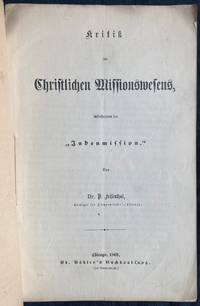
1869rif. 43448Chicago: Ed. Bühler's Buchhandlung 1869. paperback. 1st edition. Original printed paper wrappers 12mo 26 pages. 22cm. In German. Title translates as "A Critique of Christian Missionary Activities in Particular the 'Jewish Mission.'" Singerman 2126. Leading Chicago Reform Rabbi Bernard Felsenthal here pushes back against Christian attempts to convert Jews to Christianity. Felsenthal 1822-1908 was born in Bavaria and ordained in America by David Einhorn serving the Zion-Gemeinde of Chicago starting with its formation in 1864. Felsenthal was among the first American Reform leaders to favor participation in the Zionist Congress at Basel in 1897 against overwhelming opposition from his Reform colleagues. SUBJECTS Descriptor:Missions to Jews. Christianity and other religions -- Judaism. Judaism -- Relations -- Christianity. Proselytizing -- Illinois -- Chicago. Missions aupre`s des Juifs. Christianisme -- Relations -- Judai¨sme. Judai¨sme -- Relations -- Christianisme. Prose´lytisme -- Illinois -- Chicago. Christianity. Interfaith relations. Judaism. Missions to Jews. Proselytizing. Missions to Jews OCLC: 475232105. Light wear to wrappers with expert repair to margin of upper corner; somewhat dusty small name stamp on blank reverse of title page tiny owner stamp on rear wrapper "ex-libris Tobias Schanfaber;" see en.wikipedia.org/wiki/Tobias_Schanfarber internally bright about Very Good- Condition B AMR-67-9-DRXBGGF-'le. Chicago: Ed. Bühler's Buchhandlung unknown
1881rif. 5494Beawar Rajasthan 1881. Good plus. Three letters totaling 12pp. Old folds with a few minor separations. Some toning. A group of three interesting letters that reflect the work of Scottish missonary Williamson Shoolbred and local convert Chaukas Ram in Beawar Rajasthan. Shoolbred was sent to India in 1858 by the Mission Board of the United Churches of Scotland and opened a school in Beawar in early 1860.The yearly letters each two pages in Hindi are from Ram who became Shoolbred's fellow teacher and are both translated into English by Shoolbred on the following two pages of the bifolium. Ram's letters from 1880 and 1881 report on his experience converting to Christianity discuss his teaching at the school detail his life in Rajasthan talks about the hardships of rural farming etc. and are addressed to the teachers and children of the Sydney Place Sabbath School in Glasgow. Shoolbred's standalone letter dated November 28 1881 is addressed to the superintendent at the school and offers more detail about their conversion efforts and encourages more responses from the children to Ram's letters. With great details on this otherwise little known missionary outpost in western India. unknown
1881rif. 5494Beawar Rajasthan 1881. Good plus. Three letters totaling 12pp. Old folds with a few minor separations. Some toning. A group of three interesting letters that reflect the work of Scottish missonary Williamson Shoolbred and local convert Chaukas Ram in Beawar Rajasthan. Shoolbred was sent to India in 1858 by the Mission Board of the United Churches of Scotland and opened a school in Beawar in early 1860.The yearly letters each two pages in Hindi are from Ram who became Shoolbred's fellow teacher and are both translated into English by Shoolbred on the following two pages of the bifolium. Ram's letters from 1880 and 1881 report on his experience converting to Christianity discuss his teaching at the school detail his life in Rajasthan talks about the hardships of rural farming etc. and are addressed to the teachers and children of the Sydney Place Sabbath School in Glasgow. Shoolbred's standalone letter dated November 28 1881 is addressed to the superintendent at the school and offers more detail about their conversion efforts and encourages more responses from the children to Ram's letters. With great details on this otherwise little known missionary outpost in western India. unknown books
1975rif. 2412050448xbvkHoniara, British Solomon Islands Protectorate, printed by the Government Printer, 1971-1975. Detailed collation: I. Annual titlepage, v pages 'Index', 224 pages (Issue #1-#4 individually paginated [16 p. in total], Issue 5 starts with p. 17, then onwards to p. 224). / II. Annual titlepage, xiii pages 'Index', 245 pages. / III. Annual titlepage, xi pages 'Index', 200 pages. / IV. Annual titlepage, x pages 'Index', 245 pages. / V. Annual titlepage, xi pages 'Index', 196 pages. - 'Publisher's' titled greyblue halfcloth bindings with yellow thick cardboard-panels; 8vo.(ca. 20,5 x 14 x 9 cm; ca. 2,5 kg.).
1799rif. 55036London Printed By S. Gosnell For T. Chapman N. 151 Fleet Street 1799. First Edition. Hardcover. Very Good Solid Copy With Light Wear At Extremities Clean Contents With Occasional Tanning To Pages First Fep Has Corner Excised And Presentation Text Dates July 1870 Two Folding Maps With Stains And Closed Tears At Folds Maps and Pllantes And proximate Leaves Some Some Toning And Foxiing Mostly Clean with Some Occasional Foxing and Soiling A Couple of Short Closed Marginal Tears. Quarto Half Calf and Wrapped Corners Gilt Lettered And Decorated Marbled Boards And End Papers. Illustrated With Maps Charts And Views Drawn by Mr. William Wilson And Engraved By The Most Eminent Artists. Preliminary Discourse On The Geography And History of The South Sea Islands And An Appendix Including Details Never Before Published ON the Natural And Civil State Of Otaheite TAhiti An Account Of The First Missionary Voyage To The South Pacific including Tahiti Tonga Fiji and The Marquesas. The Ship Duff was Commanded By Captain James Wilson; Appendix By A Committee Appointed For The Purpose By The Directors Of The Missoinary SocietyThis is the large Paper issue Mentioned Sabin 49480 London, Printed By S. Gosnell, For T. Chapman, N. 151, Fleet Street hardcover
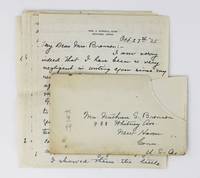
1925rif. 5493Okayama 1925. Very good. 15pp. Old fold lines minor wear. With original envelope. Lengthy letter written by Mrs. C. Burnell Olds to a friend and donor back in Connecticut Mrs. Nathan S. Bronson. Okayama is located to the west of Osaka and Kyoto in the southern portion of the country; Mrs. Olds was born to a missionary family stationed in Japan and had worked in that country since 1903. In her letter Olds relates her current round of activities the ways in which Mrs. Bronson's funds have been of great use and the other activities she observes and participates in within the local community. She opens recounting a visit to the True Beauty Girls' School to which Mrs. Bronson has donated. She writes "The fact that an American woman was willing to give to a non-Christian school way over here in Japan has made a great impression here in Okayama." She goes on to discuss the building of a new church by some "earnest young men" briefly noting that they still need money to furnish the church. "We are very anxious to start some kind of social work here -- if possible to open an amusement hall where young men can come to have a good time in a good way -- with good women. There is no such place in our city and how many evil resorts there are." She relates further activities an endless stream of clubs and activities and teaching efforts for the Lord closing with family news. An interesting missive chock full of information on a local missionary's efforts in 1920s Japan. unknown
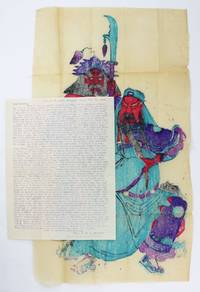
1928rif. 6054Shanghai China: February 24 1928. Very good. 1p. plus colored woodblock print 21.5 x 12.5 inches. With original envelope. Old folds minor wear. Mimeographed fundraising letter sent by Reverend H.G.C. Hallock to a supporter in Vermont. Henry Galloway Comingo Hallock 1870-1951 was a West Virginia native who studied at Princeton Theological Seminary. He moved to China as a Presbyterian missionary and teacher in 1905 where he taught Sunday School served as a pastor and also taught theology at St. John's University in Shanghai. He survived war disease famine and a Japanese prison during World War II; he died in China in 1951. One thing that set Hallock apart was his inclusion of local Chinese woodblock prints with his fundraising letters which today have become desirable collectibles. Such a print is present here showing the God of War Wu-ti. His letter opens discussing the print: "Wars in China suggest sending you 'Wu-ti' the Chinese god-of-war. . The general idea about Wu-ti is that he delights in war. That is not the Chinese idea of him. . Officials and scholars worship him as the ideal of loyalty soldiers do it to make them brave and protect them in battle and the people worship him to protect them from war's horrors. He's called 'Peace Bringer Protector Great God of Loyalty.' But he makes not peace nor protects nor makes loyal so is a failure. He's also called 'Warrior Prince.' As to that name he's a great success! There are lots of wars." He goes on to discuss the many conflicts which are like "a real Chinese puzzle" noting that it's not the people of China who are at issue or fault. "Recently I have received letters from America suggesting that since 'China has altogether gone to the bad and the Chinese are absolutely impossible' and since our 'work among them has gone for nothing' then I should 'quit and come home.' I hope you don't think thus. The masses of Chinese tho reminding me of 'dumb driven cattle' are still friendly as ever. The war-lords the Nationalists the Reds the bandits wars and evil propaganda are disturbing elements; but they are NOT China nor the Chinese. . The troubles in China have come from a fiercely aggressive and 'noisy minority' who make the great mass of Chinese suffer untold hardships." He goes on to defend the Christian work being done in China as of great benefit to the people. February 24 unknown