3.088 resultados
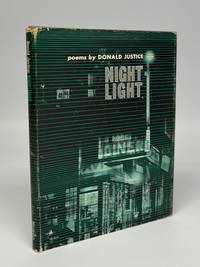
1967ref. 12774Middletown CT: Wesleyan University Press 1967. First Edition. Hardcover. Near fine/very good. Squarish octavo 77pp. A crisp clean copy near fine in the publisher's grey cloth just a touch shaken and with the spine a tinge cocked. In a very good dust jacket with some light rubbing along the extremities. A presentation copy with a pleasing association SIGNED and INSCRIBED by Justice to fellow poet Mark Strand and his then-wife Antonia in the year of publication: "This copy is for Mark & Antonia who kept the light on. Don Justice March 1967." Laid in is a postcard postmarked in August of 1970 from Justice to Strand: "Aug 22. Dear Mark--Went to the horse races Monday decided to apply my new irrational 'system' of betting my age in perfectas & in the very 1st race on which I did so 45 came in paying $269.80 for $2. Today is our 23rd wedding anniversary--fantastic! Perhaps I should switch to betting 23 now. I might as well amuse myself if possible--I don't seem to be able to concentrate on any 'work' here: it's climate & family I think. Love Don." On pp. 40-41 there are some light pencil edits to the poem "The Missing Person" likely in either Justice's or Strand's hand. A meaningful presentation copy with some correspondence that sheds light on Justice's life in the years following the publication of his fourth book of poetry. Wesleyan University Press hardcover
1978ref. McClatchy-338Atheneum New York 1978 First printing. A fine copy in a fine jacket. A clean copy with price $6.95 intact on front flap. Comes with archival-quality jacket protector. This book came from the library of poet and literary critic J.D. McClatchy from his estate in Stonington Connecticut. This copy is SIGNED and inscribed by Strand to McClatchy "Sandy" on the half-title page. ASSOCIATION copy. Inscribed by Authors. 1st Edition. Hardcover. Fine/Fine. Atheneum, New York hardcover
1990ref. 140948332New York: Alfred A. Knopf 1990. Uncorrected proof. Very Good. Mark Strand's personal copy of the uncorrected proof issued before the first edition. Signed by him on the title page. viii 63 4 pp. Bound in publisher's off-white wraps lettered in black. Very Good with light edge wear faint soiling and foxing to covers with pen correction made at first leaf to "moons of light"; a creased portion of "Orpheus Alone" from another book laid-in at rear. A small collection of poems by the Pulitzer-winning poet. Provenance: from the estate of the late poet bookseller and publisher Charles Seluzicki who wound up with a number of books from Strand's library. Alfred A. Knopf unknown
1990ref. 140948332New York: Alfred A. Knopf 1990. Uncorrected proof. Very Good. Mark Strand's personal copy of the uncorrected proof issued before the first edition. Signed by him on the title page. viii 63 4 pp. Bound in publisher's off-white wraps lettered in black. Very Good with light edge wear faint soiling and foxing to covers with pen correction made at first leaf to "moons of light"; a creased portion of "Orpheus Alone" from another book laid-in at rear. A small collection of poems by the Pulitzer-winning poet. Provenance: from the estate of the late poet bookseller and publisher Charles Seluzicki who wound up with a number of books from Strand's library. Alfred A. Knopf unknown books
1950ref. 203264New York: Oxford University Press 1950. First edition. Cloth. Slight lean; some rumples from dampness; near vg in rubbed duast jacket with a handful of chips and short tears. 4to 248pp; original cloth. Signed by Strand in blue ink on the dedication page scarce thus. Oxford University Press unknown
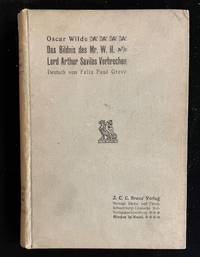
1903ref. 013011Minden in Westf: J. C. C. Burns 1903. 1st Edition Thus. Hardcover. Very Good. First German translation of Wilde's short story "The Portrait of Mr. W. H." first published in Blackwood's Magazine in 1889. It was later added to the collection Lord Arthur Savile's Crime and Other Stories 1891. The story is about an attempt to uncover the identity of Mr. W. H. the enigmatic dedicatee of Shakespeare's sonnets. which has led to speculation of the Bard's bisexuality. From the library of famous American art collector lawyer and bibliophile John Quinn 1870 - 1924 with his book plate designed by Yeats on the pastedown. 8vo gray cloth printed in black. 8 L 136. Art-Nouveau style endpapers. Book ticket from The Burrows Brothers Company Cleveland Ohio bottom rear pastedown. Covers moderately soiled slight lean to spine solid binding clean internals. Prelims include publisher's descriptions of its other Wilde titles. Scarce edition with a unique provenance. J. C. C. Burns hardcover books
1926Telephone Talk was the glossy bimonthly publication of the British Columbia Telephone Company. It was written by employees for employees to present information of interest to those engaged in the plant, traffic, commercial, operating, accounting and other departments of the service. Each issue is replete with black and white photos and information on topics such as: company, industry and technological news, traffic levels, expansion plans, personnel announcements, publicity and social events, deaths, weddings, lists of exchanges, and more. As such, these issues serve as a vital preserve of rare and fascinating British Columbia history. This volume covers topics including: Great photo of cable-pulling gang; The progress of the phone in greater Vancouver; New record set by Vancouver installers; Cartridge fuses defend against foreign currents; Providing phone facilities is a co-operative task; New Kerrisdale exchange being equipped; How a switchboard lamp is made; William Buckle and Splicing; Construction/splicing in Vancouver; A Switchboard Plug and Cord Explains its troubles; Where the cables end when they crawl out of the sea; Chilliwack's first telephone agent, John McCutcheon, passes away; Nice photo of Granville and Hastings; Nice photo of Richmond Road and area near Victoria; Operator training - 8 pages with nice photos; Peter Grant helped equip Canada's first common battery office; Nanaimo and New West. offices to be expanded; Preparing the pay cheques; George P. Kelly - installed 80' poles; More trunks in Vancouver; Lightning damage on mainland; Repeaters aid voice currents on long journeys; automatic typewriters - chief repeaterman William Faulkes; New Kerrisdale office; Bar Graph of growth of the B.C. system; Statement of Development: # of phones in operation in towns across the province; Victoria and Vancouver to be united by new route; how the phone bill was paid 20 years ago; Kootenays get service; The service application; High tension hazards; draughting the system; Mr. C.E.S. Fisher; Operator Grant gets a phone in her home; Arithmetic is paramount in traffic man's life; Phone shattered by lightning strike; Kamloops now connected to coast; Despatching yellow cabs from 'seymour 4000'; New Carlton office; plant garage serves many cars; new Langley office; Long Kamloops feature with many photos; Grouse Mountain yields to phone's advance - long article with many photos; and more. Half-leather binding. Average wear overall with the exception of backstrip which shows significant wear and is loose along back edge. Ink stamp of company executive E.P. LaBelle upon top edge of text else unmarked. Binding intact. Book
1999ref. SONG0792358473Springer 1999-08-31. 1999. hardcover. Used: Good. 6.14x1.56x9.21. Buy with confidence. Excellent Customer Service & Return policy. Springer hardcover
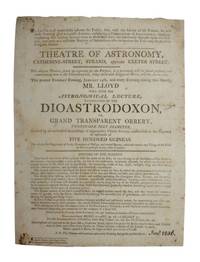
1806ref. AQ32322London: T. Burton Printer 1806. Single leaf broadside. Browned with spotting to edges evidence of prior mounting to verso. An early nineteenth-century playbill advertising an astronomical lecture presented at the Theatre of Astronomy Catherine-Street by 'Mr. Lloyd' presented using an orrery or a mechanical model of the solar system which was allegedly 'twenty-one feet' in diameter. Although little is known of the performer the publication of the corresponding A syllabus of a course of lectures on astronomy 1805 two years prior by one R.E. Lloyd has speculatively linked him to Oxford University. The practice of exhibiting astronomical phenomena in this way was pioneered by English inventor Adam Walker 1731-1821 whose eidouranion a 27-foot diameter mechanical projection device was often used as an accompaniment to his astronomical lectures delivered at the Royal Theatre London and the London Lyceum in the 1780s. Mr Lloyd's orrery advertises a mechanical display of 'the diurnal and annual motion of the Earth and moon round the Sun' followed by the exciting promise that 'a Comet will descend in a parabolic curve from the top of the Theatre' in an exclusive view 'of that exquisitely refined relation between celestial and sublunary nature'. . Dimensions 200 x 270 mm. [T. Burton, Printer] unknown
1975ref. 022988The University of Texas at Austin 1975. Book. Fine. Soft cover. Signed by Authors. 1st Edition. One of only 295 copies. This copy is signed by Borges on the title page. The University of Texas at Austin Paperback
1971ref. 12193Cambridge: Halty Ferguson 1971. Limited Edition. Hardcover. Very good. 12mo 29pp. A very good copy in the publisher's cream cloth. Faintly offset on the front board inner hinges a touch shaken but a sound example. A magnificent presentation copy SIGNED by Strand on the half-title page with a full page whimsical drawing and inscribed to the translator and fellow poet Willis Barnstone and his wife Helle: "For Willis and Helle with love from your old friend--Mark Strand." The drawing is a profile of a man with an arrow pointing to his face with clouds above his head. One of 1000 copies printed; the edition was not signed. Halty Ferguson hardcover
1990ref. 204551Iowa City IA: The Windhover Press 1990. First edition. Softcover. Copy U from only 26 lettered copies. A collection of 18 poems with two woodcut illustrations by Neil Welliver along with two loose prints of the same images. An as new copy in gray wrappers with Japanese clasp holders. Signed by both Strand and Welliver on the limitation page. Includes the original receipt and mailing container from the publisher. One of the more attractive books from this fine press. The Windhover Press unknown
1990ref. 204551Iowa City IA: The Windhover Press 1990. First edition. Softcover. Copy U from only 26 lettered copies. A collection of 18 poems with two woodcut illustrations by Neil Welliver along with two loose prints of the same images. An as new copy in gray wrappers with Japanese clasp holders. Signed by both Strand and Welliver on the limitation page. Includes the original receipt and mailing container from the publisher. One of the more attractive books from this fine press. The Windhover Press unknown books
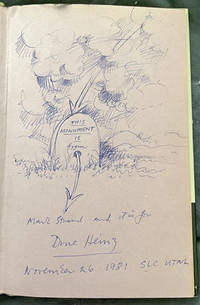
1978ref. 022033New York: The Ecco Press 1978. First Edition. Hardcover. Fine in a Fine dustwrapper. This copy INSCRIBED and SIGNED by the author on the front endpaper incorporating an ORIGINAL DRAWING by the poet to actress and philanthropist Drue Heinz: "This monument is from/Mark Strand and it is for/Drue Heinz/November 26 1981 SLC Utah." Heinz was the publisher of the literary magazine THE PARIS REVIEW 1993 to 2007 and co-founded Ecco Press the publisher of this volume. The inscription and drawing take up the entire page. Laid in is a printed poem card "Some Strophes from Paradise" with a cover illustration by Neil Welliver published by Boss Books in 1993 that is also SIGNED by the poet. The Ecco Press hardcover books
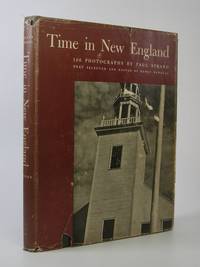
1952ref. 518051Lausanne Switzerland: La Guilde du Livre 1952. Softcover. Fine/Fine. First edition. Text by Claude Roy. Photographs by Paul Strand. Quarto. Pictorial jacket over unprinted stiff wrappers. 128pp. Illustrated throughout with 75 heliogravure plates by Strand. Text in French. A fine copy in fine dust jacket and in the publisher's unprinted glassine; the glassine has a short tear at the crown else fine. An attractive copy seldom encountered in fine condition. Roth. The Book of 101 Books p.136. La Guilde du Livre unknown
1952ref. 518051Lausanne Switzerland: La Guilde du Livre 1952. Softcover. Fine/Fine. First edition. Text by Claude Roy. Photographs by Paul Strand. Quarto. Pictorial jacket over unprinted stiff wrappers. 128pp. Illustrated throughout with 75 heliogravure plates by Strand. Text in French. A fine copy in fine dust jacket and in the publisher's unprinted glassine; the glassine has a short tear at the crown else fine. An attractive copy seldom encountered in fine condition. Roth. The Book of 101 Books p.136. La Guilde du Livre unknown books
1964ref. 69660Iowa City: Stone Wall Press 1964. First edition limited to 225 copies this no. 19; 8vo pp. 53 3; original red cloth gilt-stamped spine without the publisher's slipcase. Near fine copy from the library of Kim Merker. Berger Printing & the Mind of Merker 16: "Mark was a student at the Writers Workshop at the time." This is his first book. Stone Wall Press unknown
1964ref. 69660Iowa City: Stone Wall Press 1964. First edition limited to 225 copies this no. 19; 8vo pp. 53 3; original red cloth gilt-stamped spine without the publisher's slipcase. Near fine copy from the library of Kim Merker. Berger Printing & the Mind of Merker 16: "Mark was a student at the Writers Workshop at the time." This is his first book. Stone Wall Press unknown books
1938ref. 234231938. Labor Organizing United Auto Workers and CIO labor photograph archive documenting strike action union leadership and collective bargaining negotiations during the expansion of organized labor in the American automobile industry 1938-1949. The archive traces the period immediately following the 1935 Wagner Act when unions gained federal legal protection for collective bargaining but still faced violent resistance from corporations police departments and municipal governments. Several scenes connect directly to the years surrounding the 1937 Battle of the Overpass in Dearborn when Ford security men beat UAW organizers attempting to distribute union literature outside the River Rouge complex and to the broader wave of sit-down strikes and factory shutdowns that forced General Motors Chrysler and eventually Ford into formal negotiations with the UAW. The captions identify senior labor figures including Walter Reuther R. J. Thomas George Addes and Richard T. Leonard establishing the archive as documentation not merely of rank-and-file unrest but of the institutional consolidation of the UAW-CIO into one of the most powerful industrial unions in the United States. The material also records how labor disputes extended beyond factory gates into courts city halls state legislatures and police jurisdictions revealing the political dimensions of industrial unionism during the New Deal and early Cold War years. Photo archive of 12 Large silver gelatin press photographs one large panorama measuring 9.5 x 16.5 inches 11 press photos ranging from 6 x 8 inches to 8 x 10 inches primarily Detroit Dearborn South Gate and Atlantic City circa 1938-1949. A large-format scene dated 1939 records tear gas and street violence during a UAW strike at the Fisher Body plant with clouds of gas spreading across trolley tracks as helmeted police advance toward crowds of fleeing workers and spectators. Another image shows hundreds of demonstrators carrying a massive American flag through downtown Detroit toward City Hall during protests following clashes between union pickets and police at Federal Screw Works; the verso caption notes approximately forty injuries and references accusations of "police brutality" raised before city council. Additional photographs show UAW-CIO officials seated at conference tables negotiating contracts and appearing in municipal hearing rooms beneath desk microphones and courthouse lighting. Captions identify figures including Walter Reuther George Addes and R. J. Thomas while a 1940 Dearborn caption records the arrest of union leaders for distributing handbills asserting workers' rights under the National Labor Relations Act. South Gate strike scenes outside a General Motors facility show workers carrying placards demanding a thirty percent wage increase while Rev. Louis R. Loe conducts prayer services along the picket line. Convention and leadership photographs from Atlantic City and Washington document labor leaders gathered under the authority of Samuel Gompers and later CIO leadership structures linking local strike activity to national labor organization. The archive illustrates the transformation of the automobile industry from one of the nation's most violently anti-union industrial sectors into the center of postwar collective bargaining power. Ford Motor Company resisted union recognition longer than General Motors or Chrysler relying on private security forces local police cooperation labor espionage and anti-handbill ordinances to suppress organizing inside and outside its plants. Several captions directly reference these legal confrontations including arrests tied to leaflet distribution and disputes over municipal authority to restrict labor organizing in public space. By the late 1940s many of the same figures shown here were negotiating contracts that established wage standards pensions grievance procedures and health benefits that reshaped industrial employment across the United States. Creasing edge wear scattered minor losses adhesive residue and newsroom markings to versos; images remain clear and intact overall. Overall good condition. unknown
1938ref. 234231938. Labor Organizing United Auto Workers and CIO labor photograph archive documenting strike action union leadership and collective bargaining negotiations during the expansion of organized labor in the American automobile industry 1938-1949. The archive traces the period immediately following the 1935 Wagner Act when unions gained federal legal protection for collective bargaining but still faced violent resistance from corporations police departments and municipal governments. Several scenes connect directly to the years surrounding the 1937 Battle of the Overpass in Dearborn when Ford security men beat UAW organizers attempting to distribute union literature outside the River Rouge complex and to the broader wave of sit-down strikes and factory shutdowns that forced General Motors Chrysler and eventually Ford into formal negotiations with the UAW. The captions identify senior labor figures including Walter Reuther R. J. Thomas George Addes and Richard T. Leonard establishing the archive as documentation not merely of rank-and-file unrest but of the institutional consolidation of the UAW-CIO into one of the most powerful industrial unions in the United States. The material also records how labor disputes extended beyond factory gates into courts city halls state legislatures and police jurisdictions revealing the political dimensions of industrial unionism during the New Deal and early Cold War years. Photo archive of 12 Large silver gelatin press photographs one large panorama measuring 9.5 x 16.5 inches 11 press photos ranging from 6 x 8 inches to 8 x 10 inches primarily Detroit Dearborn South Gate and Atlantic City circa 1938-1949. A large-format scene dated 1939 records tear gas and street violence during a UAW strike at the Fisher Body plant with clouds of gas spreading across trolley tracks as helmeted police advance toward crowds of fleeing workers and spectators. Another image shows hundreds of demonstrators carrying a massive American flag through downtown Detroit toward City Hall during protests following clashes between union pickets and police at Federal Screw Works; the verso caption notes approximately forty injuries and references accusations of "police brutality" raised before city council. Additional photographs show UAW-CIO officials seated at conference tables negotiating contracts and appearing in municipal hearing rooms beneath desk microphones and courthouse lighting. Captions identify figures including Walter Reuther George Addes and R. J. Thomas while a 1940 Dearborn caption records the arrest of union leaders for distributing handbills asserting workers' rights under the National Labor Relations Act. South Gate strike scenes outside a General Motors facility show workers carrying placards demanding a thirty percent wage increase while Rev. Louis R. Loe conducts prayer services along the picket line. Convention and leadership photographs from Atlantic City and Washington document labor leaders gathered under the authority of Samuel Gompers and later CIO leadership structures linking local strike activity to national labor organization. The archive illustrates the transformation of the automobile industry from one of the nation's most violently anti-union industrial sectors into the center of postwar collective bargaining power. Ford Motor Company resisted union recognition longer than General Motors or Chrysler relying on private security forces local police cooperation labor espionage and anti-handbill ordinances to suppress organizing inside and outside its plants. Several captions directly reference these legal confrontations including arrests tied to leaflet distribution and disputes over municipal authority to restrict labor organizing in public space. By the late 1940s many of the same figures shown here were negotiating contracts that established wage standards pensions grievance procedures and health benefits that reshaped industrial employment across the United States. Creasing edge wear scattered minor losses adhesive residue and newsroom markings to versos; images remain clear and intact overall. Overall good condition. unknown books
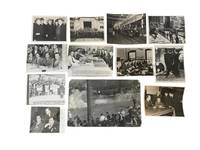
1945ref. 233441945. Women's LaborUnion Organizing Women telephone workers on strike press photo archive documenting labor organization picket lines arrests and union settlement efforts in New York Brooklyn Chicago Seattle St. Louis and Cleveland 1945-1950. The images illustrate the postwar labor conflict in the American telephone industry as women workers fought for better wages pensions union recognition and working conditions. The group records labor action through formal union voting publicity picketing mass walkouts police intervention and settlement. The archive highlights women at the center of the labor organizing process showing the workforce that staffed operator positions and other telephone company roles acting collectively during the major strike wave that followed World War II. Photo archive of 9 silver gelatin press photographs ranging from 6 x 7 to 8 x 10 inches New York Brooklyn Chicago Seattle St. Louis Cleveland and related U.S. locations 194New York5-1950. The photographs show women carrying and preparing strike placards leaving telephone company headquarters in a St. Louis walkout gathering on broad city steps with signs lining sidewalks outside company buildings sitting with placards reading "N.F.T.W. ON STRIKE" and smiling from inside a police wagon after arrest on an Ohio Federation of Telephone Workers picket line. Several images preserve highly specific labor text: placards call for "$12 per week" a "Union Shop" and a "Decent Pension" while another denounces the "union busting tactics of the Bell System." One image shows a woman tearing up a strike placard beside a noticeboard stating that the FLLTW and the company had reached an agreement and that the proposed strike had been called off. Versos retain typed caption strips credit and usage stamps editorial markings and filing notes identifying scenes such as a New York vote on whether traffic employees of the New York Telephone Company would strike on April 16 1945; Brooklyn strike cancellation at American Telephone and Telegraph on March 7 1946; Chicago women preparing picket signs on April 5 1947; Seattle workers and pickets outside a telephone building on April 7 1947; coffee served to women strike pickets at St. Alphonsus Hall that same evening; and later Cleveland newsroom handling marked November 10 1950. These photographs date to a time of broad labor upheaval of the mid 1940s and early 1950s when wartime employment rising prices and postwar contract battles pushed workers across the United States into repeated strikes. The telephone industry depended heavily on women as operators traffic workers and clerical employees and this archive shows those women as the visible organizers voters and public faces of labor activism in one of the country's largest communications networks. The images document five years of telephone strikes across several cities and through multiple stages of escalation and resolution. Moderate edge wear scattered creasing surface handling wear editorial markings stamps caption remnants and some toning or staining to versos; overall good condition. A concise multi-city record of women's labor militancy in the postwar telephone industry with strong evidence of how strike action operated inside a national communications system. unknown
1945ref. 233441945. Women's LaborUnion Organizing Women telephone workers on strike press photo archive documenting labor organization picket lines arrests and union settlement efforts in New York Brooklyn Chicago Seattle St. Louis and Cleveland 1945-1950. The images illustrate the postwar labor conflict in the American telephone industry as women workers fought for better wages pensions union recognition and working conditions. The group records labor action through formal union voting publicity picketing mass walkouts police intervention and settlement. The archive highlights women at the center of the labor organizing process showing the workforce that staffed operator positions and other telephone company roles acting collectively during the major strike wave that followed World War II. Photo archive of 9 silver gelatin press photographs ranging from 6 x 7 to 8 x 10 inches New York Brooklyn Chicago Seattle St. Louis Cleveland and related U.S. locations 194New York5-1950. The photographs show women carrying and preparing strike placards leaving telephone company headquarters in a St. Louis walkout gathering on broad city steps with signs lining sidewalks outside company buildings sitting with placards reading "N.F.T.W. ON STRIKE" and smiling from inside a police wagon after arrest on an Ohio Federation of Telephone Workers picket line. Several images preserve highly specific labor text: placards call for "$12 per week" a "Union Shop" and a "Decent Pension" while another denounces the "union busting tactics of the Bell System." One image shows a woman tearing up a strike placard beside a noticeboard stating that the FLLTW and the company had reached an agreement and that the proposed strike had been called off. Versos retain typed caption strips credit and usage stamps editorial markings and filing notes identifying scenes such as a New York vote on whether traffic employees of the New York Telephone Company would strike on April 16 1945; Brooklyn strike cancellation at American Telephone and Telegraph on March 7 1946; Chicago women preparing picket signs on April 5 1947; Seattle workers and pickets outside a telephone building on April 7 1947; coffee served to women strike pickets at St. Alphonsus Hall that same evening; and later Cleveland newsroom handling marked November 10 1950. These photographs date to a time of broad labor upheaval of the mid 1940s and early 1950s when wartime employment rising prices and postwar contract battles pushed workers across the United States into repeated strikes. The telephone industry depended heavily on women as operators traffic workers and clerical employees and this archive shows those women as the visible organizers voters and public faces of labor activism in one of the country's largest communications networks. The images document five years of telephone strikes across several cities and through multiple stages of escalation and resolution. Moderate edge wear scattered creasing surface handling wear editorial markings stamps caption remnants and some toning or staining to versos; overall good condition. A concise multi-city record of women's labor militancy in the postwar telephone industry with strong evidence of how strike action operated inside a national communications system. unknown books
2013ref. SBBI-mon0000157290Waywiser 2013. paperback. Good. Our good condition books are generally good for reading but not for gifting or collecting. They could have imperfections such as creasing fanning inscriptions margin notes yellowing staining on edge or cover or pages bumps scuffs etc etc sometimes multiple of these. It's a wide category that encompasses anything that isn't almost-new down to anything that is slightly better than poor. We would NOT recommend gifting Good books - these should be considered reading copies. Our books are dispatched from a Yorkshire former cotton mill. We list via barcode/ISBN so please note that the images are stock images and may not be the exact copy you receive furthermore the details about edition and year might not be accurate as many publishers reuse the same ISBN for multiple editions and as we simply scan a barcode or enter an ISBN we do not check the validity of the edition data when listing. If you're looking for an exact edition please don't order at least not without checking with us first although we don't always have time to check. We aim to dispatch prompty the service used will depend on order value and book size. We can ship to most countries see our shipping policies. Payment is via Abe only. Waywiser paperback
1997ref. Atlantic-9780824797485CRC Press 1997. 1. Hardcover. New. CRC Press hardcover
1997ref. Atlantic-9780824797485CRC Press 1997. 1. Hardcover. New. CRC Press hardcover