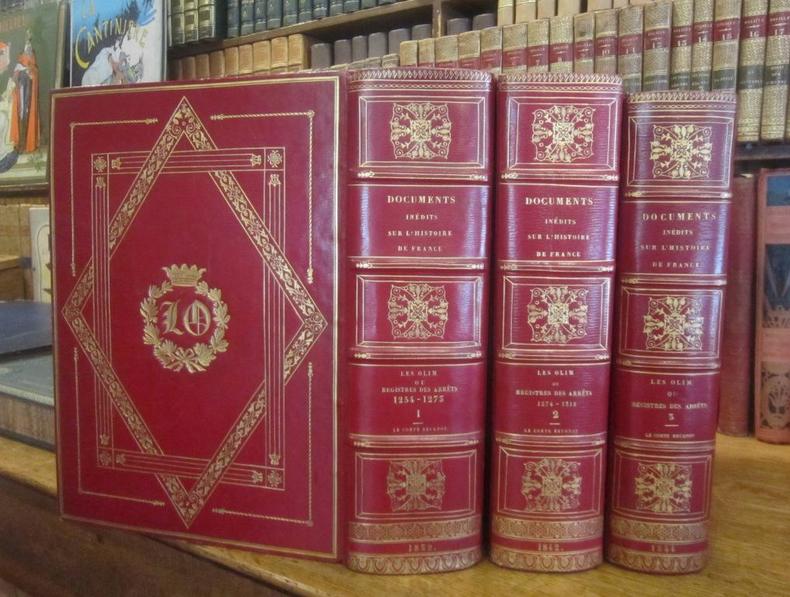
BEUGNOT (Comte)Livre Rare Book
3 628 résultats
1839réf. 001064Paris Imprimerie Royale 1839
réf. 067-Ao.J. Kupferstich, um 1503, auf Bütten mit Wasserzeichen: Kleines Stadtwappen mit einem Spitzturm und zwei Zinnentürmen (vgl. Meder 275, um 1560/80). 18,5:12,1 cm. Literatur: Bartsch 100; Meder 97, f (von g). - Mit dem Monogramm in der Platte. Mit ca. 1 cm breitem Rändchen um die Plattenkante. - Guter, tiefschwarzer Abdruck mit feinen Kratzern, schwach fleckig und mit winziger Nadelspur. Dieser Kupferstich entstand in einer Zeit, in der sich Dürer ganz besonders in die Arbeit mit dem Grabstichel vertiefte und die unterschiedlichen Materialoberflächen zu gestalten suchte. Provenienz: Verso Sammlervermerk von 1861.
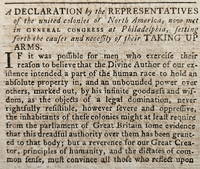
1775réf. 3823The complete text of the Causes and Necessity of their Taking Up Arms appears on pages 2 and 3 of the newspaper. The Second Continental Congress convened in Philadelphia on May 10 1775 only about seven months after the First Continental Congress had adjourned. But with the battles at Lexington and Concord occurring in April 1775 hostilities had begun and the Congress needed to act. The action was the issuance on July 6 of the "Causes and Necessity of Taking Up Arms" a pivotal founding document that laid out the colonies' justification for war while making it clear that it was a defensive action and not a declaration of independence. An initial draft of the Causes was rejected by the Congress as being too harsh. Thomas Jefferson and John Dickinson produced the new draft which the Congress approved. In the end the Causes was a masterful blend of airing grievances and reaching out for reconciliation while also clearly stating that independence was on the table if necessary. While the British Parliament was the primary intended audience of the Causes it was also critical that the document satisfy the strongly divided Congress itself. At the time there was extreme tension between those advocating for independence and those in favor of a peaceful reconciliation. The final document provided enough justification to satisfy both sides - and allowed the journey to nationhood to continue to the next watershed moment the Declaration of Independence just a year later. In addition to the important publication of the Causes this issue of the Virginia Gazette includes a brief mention debunking a report of an engagement in the days following that at Bunker Hill. It also prints "General Gage's false and audacious account of the late battle near Boston Bunker Hill." As an aside it should be noted that during 1775 there were three newspapers all named the Virginia Gazette and all published concurrently in Williamsburg. They are easily distinguished by their respective publishers Pinkney in the case of the offered newspaper. A rare and important paper very nicely preserved. Reference: Brigham History and Bibliography of American Newspapers 1690 1820 noting holdings only at Library of Congress and New York Historical Society. Condition: Disbound; untrimmed. Expected age toning. Small ink blot in masthead and a spot of foxing to the first leaf. Overall a very good example. ICN 7811. John Pinkney