Shields, Carolyn M,Biblio.com

5 182 résultats
réf. 47812017like new. unknown
réf. 11628147like new. unknown
réf. 17845706like new. unknown
réf. 1313083151.Gpaperback. Good. Access codes and supplements are not guaranteed with used items. May be an ex-library book. paperback
réf. 1527968022.Ghardcover. Good. Access codes and supplements are not guaranteed with used items. May be an ex-library book. hardcover
réf. 0425148831.Gmass_market. Good. Access codes and supplements are not guaranteed with used items. May be an ex-library book. unknown
réf. 697504478Springer . Papeback. New. pp. xlviii 848 Springer unknown
réf. 650410187Rowman & Littlefield Publishers Incorporated . Hardback. New. pp. 208 Revised Edition Rowman & Littlefield Publishers, Incorporated hardcover
réf. 614958201Pomegranate Communications Incorporated . Other. New. pp. 272 Index Pomegranate Communications, Incorporated unknown
réf. 64639992Cambridge University Press CUP . Hardback. New. pp. xxiii 318 3 Maps Cambridge University Press CUP hardcover
réf. ria9781835952795_inpHardcover. New. New Book; Fast Shipping from UK; Not signed; Not First Edition; N/A hardcover
réf. 21786Orbit Books. Fifth Edition. Hardcover . Fine/Fine. Binding is square tight and solid. Pages are clean unmarked and not bent. First edition thus. Orbit Books hardcover
réf. A9798895306130Hardback. New. The U.S. military has long relied upon technological superiority to ensure its dominance in conflict and to underwrite U.S. national security. In recent years however technology has both rapidly evolved and rapidly proliferated—largely as a result of advances in the commercial sector. This development has threatened to erode the United States’ traditional sources of military advantage. The Department of Defense DOD has undertaken a number of initiatives to arrest this trend. This book provides an overview of selected emerging military technologies including: directed energy weapons; hypersonic weapons and lethal autonomous weapons. hardcover
réf. B9781572337053Hardback. New. Phillis Wheatley was the first African American to publish a book. Born in Gambia in 1753 she came to America aboard a slave ship the Phillis. From an early age Wheatley exhibited a profound gift for verse publishing her first poem in 1767. Her tribute to a famed pastor “On the Death of the Rev. Mr. George Whitefield” followed in 1770 catapulting her into the international spotlight and publication of her 1773 Poems on Various Subjects Religious and Moral in London created her an international star. Despite the attention she received at the time history has not been kind to Wheatley. Her work has long been neglected or denigrated by literary critics and historians. John C. Shields a scholar of early American literature has tried to help change this perception and Wheatley has begun to take her place among the elite of American writers. In Phillis Wheatley and the Romantic Age Shields contends that Wheatley was not only a brilliant writer but one whose work made a significant impression on renowned Europeans of the Romantic age such as Samuel Taylor Coleridge who borrowed liberally from her works particularly in his famous distinction between fancy and imagination. Shields shows how certain Wheatley texts particularly her “Long Poem” consisting of “On Recollection” “Thoughts on the Works of Providence” and “On Imagination” helped shape the face of Romanticism in the late eighteenth and nineteenth centuries. Phillis Wheatley and the Romantic Age helps demolish the long-held notion that literary culture flowed in only one direction: from Europe to the Americas. Thanks to Wheatley’s influence Shields argues the New World was influencing European literary masters far sooner than has been generally understood. hardcover
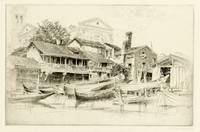
1926réf. 4991926. Superb. Etching on watermarked antique handmade FJ Head paper 9 1/2 x 14 3/4 inches 240 x 373 mm; sheet 14 x 18 1/4 inches 355 x 463 mm full margins. Signed and dated in pencil lower margin. Edition of 97. A magnificent silvery impression with extremely minor almost invisible mat tone. Fletcher 177 Illustrated: Page 160 Arms Dorothy Noyes "Hilltowns and Cities of Northern Italy". The Boat Builders Yard in San Trovaso is a historic 17th-century gondola repair and building yard in Venice Italy. It's one of the few remaining such workshops in Venice where skilled artisans traditionally craft and maintain the iconic black gondolas used on the city's canals. The yard is a significant landmark located next to the Church of San Trovaso. Born in 1887 in Washington DC John Taylor Arms studied at Princeton University and ultimately earned a degree in architecture at the Massachusetts Institute of Technology in 1912. With the outbreak of W.W.I Arms served as an officer in the United States Navy and it was during this time that he turned his focus to printmaking having published his first etching in 1919. His first subjects were the Brooklyn Bridge near the Navy Yard and it was during his wartime travel that Arms created a series of extraordinarily detailed etchings based on gothic cathedrals and churches he visited in France and Italy the plate for Guardians of the Spire was created in 1921. He used what was available to him namely sewing needles and a magnifying glass to create the incredibly rich and fine detail that his etchings are known for. Upon his return to New York after the war Arms enjoyed a successful career as a graphic artist created a series of etchings of American cities and published Handbook of Print Making and Print Makers Macmillan 1934. He served as President of the Society of American Graphic Artists and in 1933 was made a full member of the National Academy of Design. Arms died in Fairfield Connecticut in 1953. unknown
réf. B9798991606714Hardback. New. hardcover
réf. 49888324-nnew. unknown
réf. 1772840831.Ghardcover. Good. Access codes and supplements are not guaranteed with used items. May be an ex-library book. hardcover
réf. 8659762like new. unknown
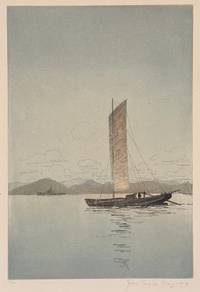
1919réf. 9281919. Superb. Aquatint with hand coloring in watercolor on watermarked laid Arches paper 8 1/16 x 5 9/16 inches 206 x 142 mm full margins. Signed titled dated and numbered 22/40 in pencil lower margin. From the fourth state of 4 consisting of a total of 80 impressions only 40 of which have hand coloring in watercolor. In superb condition with light toning and archival tape tabs at the top right and left corners and lower right corner on the verso well outside of the image area. Printed by Frederick Reynolds. Fletcher 23. Paper: Arms was typical of the artists of this period - he was obsessed with paper a mania for collecting paper that could/would improve an edition. The quantity he left after his death distributed by his wife to fellow artists witnesses his love for finely made paper -paper interesting because of texture color distinctive weave. The earliest paper known to have been used by Arms came from a Baptismal Register Kirchen Ordnung The Reformed Church Middletown Dauphin County Pennsylvania 1708 bought in a bookshop in Philadelphia. His early prints 1915-1919 evidence paper taken from old books with gilded edges. Some prints appear on stationary from the Cisalpine Napoleonic Italy still bearing the estampe of the office or department; others carry penned ink page numbers taken from old ledgers of the Eighteenth Century-all beautiful shades of grey blue and green handmade ribbed and otherwise. Some of his color aquatints were printed on full sheets of heavy chine or Japanese vellum giving a sense of luxury in the richness of the stock and the width of the margins. There was a myriad of modern papers gleaned in England France Italy and the United States. William Dolan Fletcher John Taylor Arms a Man for All Time: The Artist and His Work. Sign of the Arrow Eastern Press 1982. p. 15. unknown
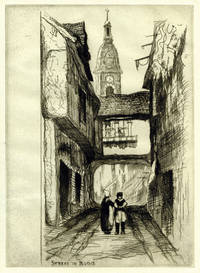
1927réf. 8751927. Excellent. Etching with drypoint on fine F.J. Head Japon laid paper 6 7/8 x 4 15/16 inches 175 x 126 mm full margins. Edition 96. In excellent condition with paper tape remnants at the top right and left corners verso. Fletcher 204; Demonstration series #18. Born in 1887 in Washington DC John Taylor Arms studied at Princeton University and ultimately earned a degree in architecture at the Massachusetts Institute of Technology in 1912. With the outbreak of W.W.I Arms served as an officer in the United States Navy and it was during this time that he turned his focus to printmaking having published his first etching in 1919. His first subjects were the Brooklyn Bridge near the Navy Yard and it was during his wartime travel that Arms created a series of extraordinarily detailed etchings based on gothic cathedrals and churches he visited in France and Italy the plate for Guardians of the Spire was created in 1921. He used what was available to him namely sewing needles and a magnifying glass to create the incredibly rich and fine detail that his etchings are known for. Upon his return to New York after the war Arms enjoyed a successful career as a graphic artist created a series of etchings of American cities and published Handbook of Print Making and Print Makers Macmillan 1934. He served as President of the Society of American Graphic Artists and in 1933 was made a full member of the National Academy of Design. Arms died in Fairfield Connecticut in 1953. unknown
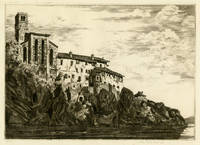
1931réf. 10331931. Good. Etching on antique laid Japon paper 10 x 14 13/16 inches 254 x 377 mm full margins. Signed in pencil and inscribed "Ed. 100" from a total edition of 128. Third state of three. Number 22 from the Italian Series. In good condition with scattered light surface soiling and archival paper tape hinges at the top right and left corners verso. A beautiful impression of this extremely scarce image. Fletcher 238iii/III Illustrated: Page 138 Arms Dorothy Noyes "Hilltowns and Cities of Northern Italy.". Born in 1887 in Washington DC John Taylor Arms studied at Princeton University and ultimately earned a degree in architecture at the Massachusetts Institute of Technology in 1912. With the outbreak of W.W.I Arms served as an officer in the United States Navy and it was during this time that he turned his focus to printmaking having published his first etching in 1919. His first subjects were the Brooklyn Bridge near the Navy Yard and it was during his wartime travel that Arms created a series of extraordinarily detailed etchings based on gothic cathedrals and churches he visited in France and Italy the plate for Guardians of the Spire was created in 1921. He used what was available to him namely sewing needles and a magnifying glass to create the incredibly rich and fine detail that his etchings are known for. Upon his return to New York after the war Arms enjoyed a successful career as a graphic artist created a series of etchings of American cities and published Handbook of Print Making and Print Makers Macmillan 1934. He served as President of the Society of American Graphic Artists and in 1933 was made a full member of the National Academy of Design. Arms died in Fairfield Connecticut in 1953. Paper: Arms was typical of the artists of this period - he was obsessed with paper a mania for collecting paper that could/would improve an edition. The quantity he left after his death distributed by his wife to fellow artists witnesses his love for finely made paper -paper interesting because of texture color distinctive weave. The earliest paper known to have been used by Arms came from a Baptismal Register Kirchen Ordnung The Reformed Church Middletown Dauphin County Pennsylvania 1708 bought in a bookshop in Philadelphia. His early prints 1915-1919 evidence paper taken from old books with gilded edges. Some prints appear on stationary from the Cisalpine Napoleonic Italy still bearing the estampe of the office or department; others carry penned ink page numbers taken from old ledgers of the Eighteenth Century-all beautiful shades of grey blue and green handmade ribbed and otherwise. Some of his color aquatints were printed on full sheets of heavy chine or Japanese vellum giving a sense of luxury in the richness of the stock and the width of the margins. There was a myriad of modern papers gleaned in England France Italy and the United States. -William Dolan Fletcher A Man For All Times p. 15. unknown
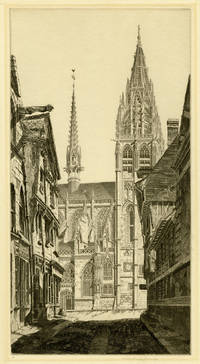
1931réf. 10361931. Superb. Etching on watermarked antique laid J Whatman Japon paper 14 1/2 x 7 5/8 inches 368 x 195 mm full margins. Signed dated and inscribed "II" in pencil in the lower margin. One of only 26 impressions of the second state of 2 printed in 1931. With the John Taylor Arms ink stamp in black ink in the lower-center margin. Fletcher 241 II; French Church Series No. 31. This magnificent etching was awarded the Mrs. Henry F. Noyes Prize Society of American Etchers 1931; the Carle Blenner Best Entry Prize New Haven Paint and Clay Club 1950; and the Best Print Annual Exhibition Arts and Crafts Association Meridan Connecticut 1952. Paper: Arms was typical of the artists of this period - he was obsessed with paper a mania for collecting paper that could/would improve an edition. The quantity he left after his death distributed by his wife to fellow artists witnesses his love for finely made paper -paper interesting because of texture color distinctive weave. The earliest paper known to have been used by Arms came from a Baptismal Register Kirchen Ordnung The Reformed Church Middletown Dauphin County Pennsylvania 1708 bought in a bookshop in Philadelphia. His early prints 1915-1919 evidence paper taken from old books with gilded edges. Some prints appear on stationary from the Cisalpine Napoleonic Italy still bearing the estampe of the office or department; others carry penned ink page numbers taken from old ledgers of the Eighteenth Century-all beautiful shades of grey blue and green handmade ribbed and otherwise. Some of his color aquatints were printed on full sheets of heavy chine or Japanese vellum giving a sense of luxury in the richness of the stock and the width of the margins. There was a myriad of modern papers gleaned in England France Italy and the United States. - William Dolan Fletcher A Man For All Times p. 15. unknown
réf. B9781019430545Hardback. New. hardcover
1938réf. 12631938. Superb. Etching with aquatint on cream wove paper 1 3/4 x 5 inches 178x 127 mm full margins. Signed dated and inscribed "Ed. 150" in pencil lower margin. Second state of 3 before the addition of drypoint and the ornament on the reredos. Although this impression is inscribed with an edition number of 150 in the artist's hand Fletcher states an edition of 204 impressions of the second state before the added ornamentation on the reredos. Printed by David Strang. With an unidentified accession number written in pencil on the verso 73.27993. No. 21 from the Minature Series; No. 3 from the Brooch Series. Fletcher 316A. unknown