Sington, Derrick; Weidenfeld, ArthurMareMagnum

4159 resultados
1942260 pages. Index. List of main sources. Black and white photographic plates. Organizational chart of the German Broadcasting Company (RRG) in 1942 and its links to the Ministry of Propaganda. Organizational chart of the Ministry of Public Enlightenment and Propaganda in 1942. "The first complete account of the gigantic propaganda organization of the Third Reich. Reveals and describes: The inner workings of the Nazi propaganda organization; The network of Party speakers; The German radio's war effort; The Nazi press system; The German stage and screen in 1942; Propaganda for the armed forces; The men in control. Access to unique German documentary material and an intimate knowledge of German wartime broadcasting and of the Nazi press have enabled the authors to paint a full-length picture of Hitler's political warfare machine." - dust jacket. Printed to wartime standard, apparently without a front free endpaper. Unmarked with average wear and soiling to publisher's canary yellow cloth. Average wear and half-inch of loss to decorated orange dust jacket at top of spine. Binding sound. A quality vintage copy of this vital and incisive wartime study. KEHR & LANGMAID 2950. Book
191432 pages. This issue is twice as long as previous issues due to its blockbuster treatment of "The Case of Belgium" with reproductions of documents incriminating to Belgium. Features: The (New York) "Times" in Despair; Irish Home Rule Bill; Government Control of Public Utilities, by Frank Koester; "I Protest", by Clara Viebig - one of the foremost novelists of Europe; We Demand Real Neutrality; What is an American German?, by Representative Richard A. Bartholdt of Missouri; The Case of Belgium - In the light of official reports found in the secret archives of the Belgium Government after the occupation of Brussels with facsimiles of the documents - a major article; cartoon shows a German dog being taken before an English firing squad; England's Embarrassment is Ireland's Opportunity; and more. Unmarked. Average wear. Binding intact. A sound copy. Magazine
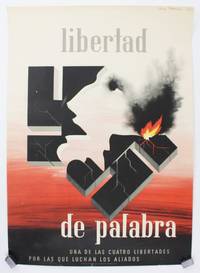
1942ref. 4754Washington DC: El Coordinador de Asuntos Interamericanos 1942. Very good. Pictorial lithograph 20 x 14.25 inches printed in red gray yellow and black. Minor surface wear mild creasing light dust-soiling a few pinholes. A rare poster issued by the Office of the Coordinator of Inter-American Affairs CIAA during World War II attempting to sway public opinion in Latin America to the Allied side. The CIAA was established by executive order in July 1941 in order to distribute news advertising film reels and more to and from Latin America to counter Italian and German propaganda campaigns in the region. The text of the present poster translates from the Spanish as "Freedom of Speech. One of the four freedoms for which the Allies are fighting." The central image features an open-mouthed face breaking open a large swastika which is itself on fire. A mildly subtle message that free speech destroys fascism. The poster was designed by noted Russian-American graphic designer and photographer Alexey Brodovitch whose printed credit appears at top right; Brodovitch is most well-known for his art direction of Harper's Bazaar from 1934 to 1958. A powerful visual display with only one copy reported in OCLC at MOMA though we also find two other institutional holdings at the United States Holocaust Museum and the Hoover Institute. El Coordinador de Asuntos Interamericanos unknown books
1942ref. 4754Washington DC: El Coordinador de Asuntos Interamericanos 1942. Very good. Pictorial lithograph 20 x 14.25 inches printed in red gray yellow and black. Minor surface wear mild creasing light dust-soiling a few pinholes. A rare poster issued by the Office of the Coordinator of Inter-American Affairs CIAA during World War II attempting to sway public opinion in Latin America to the Allied side. The CIAA was established by executive order in July 1941 in order to distribute news advertising film reels and more to and from Latin America to counter Italian and German propaganda campaigns in the region. The text of the present poster translates from the Spanish as "Freedom of Speech. One of the four freedoms for which the Allies are fighting." The central image features an open-mouthed face breaking open a large swastika which is itself on fire. A mildly subtle message that free speech destroys fascism. The poster was designed by noted Russian-American graphic designer and photographer Alexey Brodovitch whose printed credit appears at top right; Brodovitch is most well-known for his art direction of Harper's Bazaar from 1934 to 1958. A powerful visual display with only one copy reported in OCLC at MOMA though we also find two other institutional holdings at the United States Holocaust Museum and the Hoover Institute. El Coordinador de Asuntos Interamericanos unknown
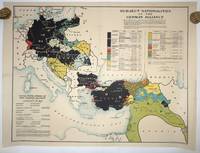
1917ref. 28118London: Stanford's Geographical Establishment 1917. First printing. Map. Fine condition. A large format map illustrating the geopolitics of Europe after W.W.I. Intended to persuade viewers about the threat presented by the Central Powers of Germany Austro-Hungary Bulgaria and Turkey it color-codes them in black to emphasize the danger they might pose to the fledgling League of Nations. The solution is stated on the map which quotes from the Allies' war aims as articulated to President Wilson in 1916: "The civilized world knows that the aims of the Allies include-the reorganization of Europe guaranteed by a stable settlement based alike upon the principle of nationalities and on the right which all peoples whether small or great have to the enjoyment of full security and free economic development." The efforts to secure the peace in Europe dictated the division of nations cultures and tribes has continued to plague the world for over 100 years sellers' opinion. These groups include Greek pockets within Turkey Armenians in three pockets and Kurds Arabs which includes Jewish Colonies in Palestine. Also of note and marked on the map are the "Expropriations of the German Ansiedelungs Commission" an 1886 German proclamation that allowed Prussian settlers to appropriate Polish sovereign land. Printed at The Dangerfield Printing Co. Ltd. OCLC 9876563; Persuasive Maps: PJ Mode Collection #1188. Color lithograph 28" x 36 1/2". Backed on acid free linen supporting some tiny closed splits along the central & one other fold with one triangle of added margin not affecting the map. Very bright color and overall in very good condition. Stanford's Geographical Establishment unknown
1941ref. ZEIT1004München, Zentralverlag der NSDAP 1939 - 1941. 4°. Blätter teilweise randgebräunt, 8 Blätter mit geringem Insektenfraß außerhalb der Darstellung (am unteren Rand), einige leicht fleckig. Vorhanden sind: 08. -14.Okt. u. 03. - 30.12.1939. = 5 Bl. / Jänner - August 1940 = 23 Bl.; Folge 33 - 52 1940 = 20 Bl. / Folge 2 - 4, 6 - 31, 34 - 38, 52, 53 1941. = 36 Bl. Mit Zitaten von: Adolf Hitler, Hermann Göring, Baldur von Schirach, Carl von Clausewitz, Peter Rosegger, Walter Darré, Friedrich II., Ernst Moritz Arndt, Jean Paul u.A.
1773ref. 664L4Romae: Sacra Congregatio de Propaganda Fide 1773. Leather. Very Good. 7" by 4.5". None. A very scarce example of the Tibetan Alphabetum issued by the Sacra Congregatio de Propaganda Fide. The Alphabetum series was one of the first to print the script of different languages. Written in Latin and Tibetan. A first thus of this work. 'The Alphabetum' was created as a reference text for Catholic missionaries who travelled worldwide to promote God's message. The Sacra Congregatio de Propaganda Fide printing press was established by The Vatican in 1622. The press held the largest collection of printing types from languages and scripts worldwide. They quickly produced these booklets of exotic languages which included Arabic Greek Iberian Syrian among many other languages. Presented in a handy pocket sized format the Alphabetums were a marvel of printing at the time. It demonstrated printing of characters not seen by western audiences. Ex library stamps contemporary to the work to the rear of title page for Biblioth Regia Berolinensi. With the vignette seal of the Congregation. This work includes the Lord's prayer the Ave Maria the Apostles' creed and the Ten commandments in Tibetan and Latin. The Tibetan Alphabetum was the first time that there was a western publication on the Tibetan language. It is based on information sent back by missionaries from the Capuchin mission at Lhasa. The work was first published under the name 'Alphabetum Tibetanum' and it would appear that this 1773 printing is the first time that the work appeared under the title 'Alphabetum Tangutanum sive Tibetanum'. The folding plate is provided in facsimile. An important work in print development and language education. In a half calf binding with marbled boards. Damage to the head of spine and to the outer corner to the bottom of both boards. Loss to the leather resulting in the minor damage and loss to the bottom corner of pages not affecting text. Contemporary library stamp to the verso of title page and contemporary inscription to the head of title page 'Ax J 6'. Pages are bright and clean. Very Good Sacra Congregatio de Propaganda Fide hardcover
1832ref. 14389Paris, Fonrouge, 1832-1833. 4 pièces reliées en 1 vol. in-folio, demi-maroquin vert à petits coins, dos lisse orné, bandeaux fleurdelisés en tête et en pied, filets dorés sur les plats (reliure de l'époque).
ref. 2885Paris chez l'auteur le 30 avril 1896 XLI; 194p avec 2 tableaux généalogiques reliure toile exemplaire numéroté 652 des 1100 exx 12x 185cm. THIS IS THE ORIGINAL ITEM NO REPRINT - unknown
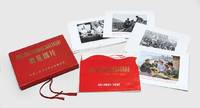
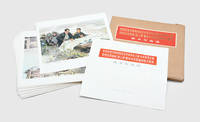
ref. 158705Shanghai: Zhongguo renmin jiefangjun Shanghai jingbei qu 1971. The only traceable complete copy Sole edition first printing rare complete set of this portfolio celebrating the political economic and cultural role of the People's Liberation Army in the Cultural Revolution issued to Shanghai cadres responsible for creating pop-up propaganda exhibitions. Institutionally we have traced only the incomplete copy in the Tate's Martin Parr Collection. The 'May Seventh Directive' is the name given to a letter sent by Mao to Marshal Lin Biao in 1966 calling for the army to become an ideological bastion of the unfolding Cultural Revolution. By 1971 the directive had become a hallowed statement of the movement's guiding principles as well as the inspiration for the May Seventh Cadre Schools where party members who had politically erred could find redemption through a daily diet of manual labour and the study of Mao's writings. Sets of this portfolio were used in community spaces schools and workplaces to display the ethos of the directive. The posters are divided into four sections two of which invoke the spirit of Daqing and Dazhai the period's most important economic models: "Political Strides Forward - Mao Zedong Thought Nurtures and Renews"; "Study Dazhai - Triumph Over Nature with an Iron Will"; "Study Daqing - Make Revolution Through Self-Reliance"; and "Power in Unity - the Army and the People Stand Shoulder to Shoulder to Form a New Great Wall". Landscape quarto: 80 posters each 222 x 228 mm loose as issued with tissue guard. With 71 plates 20 colour after propaganda photographs gilt facsimile of Mao's calligraphy 8 decorative posters of text variously in red purple white and gilt captions printed in red. Housed in original folding red cloth portfolio with red string ties front panel lettered in gilt. Posters bright small closed tears at upper corners of title leaf old paper repairs on verso occasional cockling and creasing several small tidemarks and light toning at edges upper margin of second poster horizontally creased. A very good set indeed in the well-preserved case with gilt bright light rubbing and a little soiling especially to base. hardcover
1736In folio. pp (2), 38, un rame al frontespizio “dominicus muratori inv. et delin. Vincen. Franceschini scul.”, nel testo da indisegni di Muratori e incisi da Rossi, Limpach, Allet, 6 vignette incise su rame come testatine e finalini e un capolettera. Contiene gli elogia a Maria Clementina in diverse lingue: ebraico, graco, arabo, siriaco, armeno, caldaico, copto, polacco, gotico, illirico, ecc ecc. Legatura in piena pelle con cornice dorata ai piatti e decorazioni in oro al dorso.
1940ref. 1715961940. SOVIET PROPAGANDA. L'novodstvo khlopkovodstvo i sakharnaya svekla: Tsvetnye tablitsy. Cultivation of Flax Cotton and Sugar Beet: Colorful Tables. 4 25 34 ills. Oblong folio 335 x 240 mm. in original cloth portfolio. N.p.: Izd. Narkomzema 1940. A handsome piece of unintentional book illustration. While the illustrations are largely botanical in nature the overall effect is more of an illustrated book than a tedious tome extolling Soviet agricultural prowess. Extremely rare with no listing on OCLC. hardcover books
1940ref. 1715961940. SOVIET PROPAGANDA. L'novodstvo khlopkovodstvo i sakharnaya svekla: Tsvetnye tablitsy. Cultivation of Flax Cotton and Sugar Beet: Colorful Tables. 4 25 34 ills. Oblong folio 335 x 240 mm. in original cloth portfolio. N.p.: Izd. Narkomzema 1940. A handsome piece of unintentional book illustration. While the illustrations are largely botanical in nature the overall effect is more of an illustrated book than a tedious tome extolling Soviet agricultural prowess. Extremely rare with no listing on OCLC. hardcover
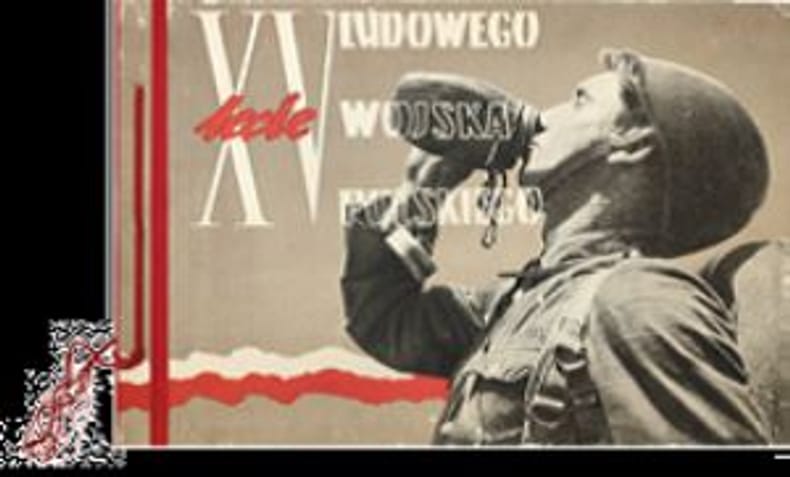
1958ref. 1049711958 Varsovie, Éditions du Ministère de la Défense, 1958, 300x448mm, 92ff. comprenant colophon, titre et faux-titre, serpentes de protection, reliure de l’éditeur dos carré avec cordelette rouge réunissant les feuillets, sous couverture photographique de Zbigniew Gamski.
ref. 187095Beijing: People's Fine Arts Press 1977. With you in charge I am at ease" - Mao anoints a successor First edition reproducing the 151 artworks selected for a spring 1977 exhibition held in Beijing to much fanfare. Mao's death in September 1976 precipitated a power struggle the faction led by Hua Guofeng eventually prevailing over a radical clique led by Jiang Qing Mao's wife. The artworks include landscapes oil paintings woodblocks sculptures propaganda posters and other media. Organizers selected works by both leading artists such as Liu Wenxi and grassroots representatives of the masses. The most widely publicized exhibit was With You in Charge I am at Ease Ni ban shi wo fang xin an oil painting by Peng Bin and Jin Shangyi that shows Mao symbolically and fictitiously handing over the reins of power to an attentive Hua Guofeng the latter sporting a Mao badge on his breast. One of a number of paintings on the theme to appear in the immediate aftermath of Hua's taking power the picture was put on the cover of the exhibition catalogue. Other exhibits depict Mao and Zhou Enlai revolutionary models and scenes of a politically and socially harmonious society. The publisher released issues for domestic and international distribution. This example is identified as the international issue in the printed colophon. Together 151 loose sheets 320 x 380 mm printed one side only and mostly in colour; 8-page contents booklet. All housed in publisher's brown card portfolio front panel with title label lettered in gilt on red background. Each sheet numbered in pencil to correspond with pencilled number in contents booklet. Signs of light handling a little finger-soiling and colour offsetting portfolio with short split along one fold: a very good copy indeed. unknown
1940ref. 1715951940. SOVIET PROPAGANDA. L'novodsto v SSSR. Flax Growing in the USSR. 88 pp. 39 ills. diagrams. Oblong folio 255 x 355 mm. in original full cloth with colored lettering and blind debossed image of sheaves of flax. Moscow: Izd. Narkomsema SSSR 1940. A surreal example of Soviet book making the subject matter of which is pure propaganda and sleep inducing accompanied by the most wonderful illustrations worthy of a livre de peintre. The book is extremely rare with no copies in OCLC. hardcover books
1940ref. 1715951940. SOVIET PROPAGANDA. L'novodsto v SSSR. Flax Growing in the USSR. 88 pp. 39 ills. diagrams. Oblong folio 255 x 355 mm. in original full cloth with colored lettering and blind debossed image of sheaves of flax. Moscow: Izd. Narkomsema SSSR 1940. A surreal example of Soviet book making the subject matter of which is pure propaganda and sleep inducing accompanied by the most wonderful illustrations worthy of a livre de peintre. The book is extremely rare with no copies in OCLC. hardcover
1943ref. 195600Shanghai: Max Noessler & Co. 1943. The frontier of the Nazi battle for hearts and minds in Asia First edition traced in only two institutional libraries of this collection of wartime propaganda cartoons produced under the auspices of Shanghai's German Information Bureau the largest Nazi propaganda organization operating outside Germany. Headquartered in a villa at 7 Great Western Road the bureau was led by Baron Jesco von Puttkamer nicknamed the "Goebbels of the Far East" a member of the Nazi Party since 1932 and a veteran military intelligence operative. Although it operated under the Reich Ministry of Public Enlightenment and Propaganda its activities were closely co-ordinated with the German diplomatic corps including ambassador Ernst Woermann a confidant of Ribbentrop and a Standartenführer in the SS. After the German surrender Puttkamer continued the distribution of anti-Allied propaganda in Shanghai and other cities and at the 1947 Ministries Trial he and Woermann received prison sentences for war crimes. Sapajou the pen name of the Russian émigré Georgii Avksent'ievich Sapojnikoff had long been a household name in Shanghai. In the 1930s he worked for the North-China Daily News turning a satirical eye to the city's expatriate lifestyle and produced cartoons critical of the Japanese invasion of China. Adjusting to Shanghai's post-Pearl Harbor reality he attacks Churchill and other Western leaders extols the benefits of Japan's East Asia Co-Prosperity Sphere and puffs the collaborationist government of Wang Jingwei. Copies are held by Cornell and the San Francisco Public Library. Landscape quarto. Cartoons throughout. Introduction and captions in English Chinese and Japanese. Original illustrated boards. Binding toned spine sometime repaired with adhesive: very good. hardcover
1945ref. 9000C1945. (ca. 31,5 x 23 cm). 2 S. (Fraktur). Original-Zeitung im kleinen Format, beidseitig bedruckt, mit Titel im oberen Bereich. Papier gebräunt und gefaltet, sonst wohlerhalten. Altersentsprechend guter Zustand.
1928Very Good Turkish, Ottoman (1500-1928) Contemporary quarter leather bdg. Handsomely bound. Six raised bands to spine, the second compartment has the title, the fifth has "issue 1-104", and the sixth has ex-owner's name of the volume, "Semseddin" lettered gilt. Original end-papers of the period. Slightly age-toned on the lower pages, fading on extremities of boards, overall a very good volume. Folio. (41 x 29 cm). In Ottoman script (Old Turkish with Arabic letters) and Turkish with Latin letters. This folio volume consists of 104 issues of the periodical, each issue has 4 pages, which has mostly color illustrated covers as well as several b/w ones. A rare togetherness of the first 104 issues of this Turkish satirical magazine, richly illustrated with thousands of attractive illustrations and caricatures, was published in Istanbul twice a week every Wednesday and Saturday with at least four, at most eight pages, during the Letter Revolution 1928, when the transition from the Arabic alphabet to new Latin letters was ensured. The collection provides an invaluable resource, reflecting the changes in society during and after the Letter Revolution in New Turkey, 1928, placing the new Latin alphabet instead of old Arabic letters and contributing to the development of reading and writing skills of the new Turkish society, as well as "creating the basis for the rapid social evolution in the young Turkish Republic Revolution" soon after the proclamation of the Republic in 1923. The newspaper had a printing house with the same name headquartered in Bab-i Ali (The Sublime Porte of Constantinople), the place where the heart of the Ottoman press was. Burhan Cahid Morkaya left Karagöz Newspaper and founded Köroglu Newspaper in 1928 and wanted the people living in Istanbul and Anatolia to be able to read and write new letters. Indeed, during the period of its publication, Köroglu Newspaper reached the most remote corners of the New Turkish Republic with its attractive cartoons covering local and mostly international subjects. In addition to this news and cartoons, Morkaya also published Turkish reading passages with Arabic letters that were transcripted into Latin letters. Therefore, he created a great positive effect that facilitated the transition to new letters during the Turkish Alphabet Revolution. Duman 1155.
1926218 pages. Second printing of the 1923 first edition. "The first book to be devoted exclusively to an occupation which is gradually becoming of overwhelming national importance." - N.Y. Times Book Review. Unmarked with moderate wear. Binding tight. Dust jacket now preserved in glossy new archival-grade Brodart cover. A quality vintage copy of this highly significant work. A wonderful addition to the bookshelf of any prominent public relations professional. Cole p.27, Larson 6, Lasswell, Casey & Smith p.32 Book
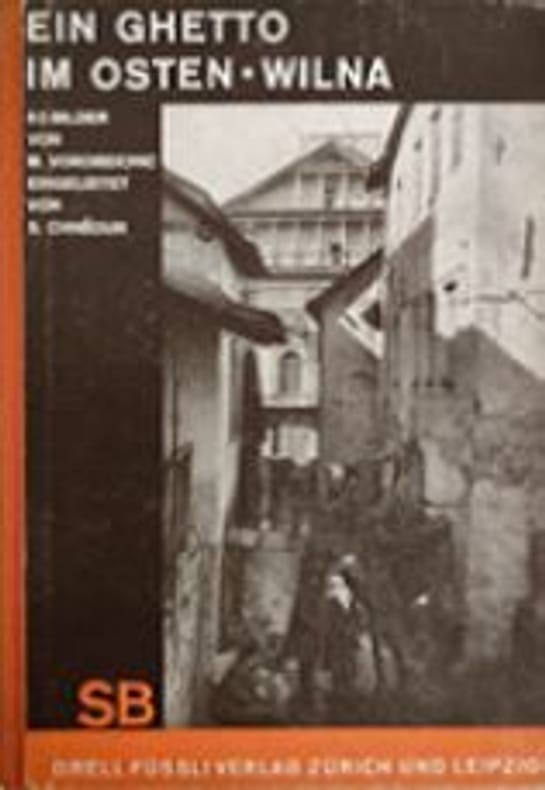
1931ref. 1049551931 Zurich et Leipzig Orell Füssli Verlag 1931 194x132mm, cartonnage d'éditeur dos toilé, plats photographiques (défauts). Texte en allemand et en hébreu, édition originale. Texte et 65 photographies, photomontages, surimpressions.Ref: Sinibaldi-Couturier 46. Parr & Badger 1, p.130. Autopsie p.326.Moï-Ver, Centre Pompidou, p.34-35;
1955ref. 53657Berlin: Verlag Junge Welt 1955. First edition. Loose leaf. Very good condition. Elephant Folio 18 x 25". 8pp 1 42 plates. Original marine blue faux leather portfolio with gilt lettering on cover. Complete set of this extraordinary publication on the history of the German workers youth movement from its founding in 1904 to October of 1954. Founded in Mannheim as the "Union of Young Workers" in 1904 the organization merged with other youth organizations over time changed its name several times e.g "Center for the Working Youth" at the SPD party convention in 1908 and triggered after the outbreak of W.W.I and with the help of Karl Liebknecht an opposition youth organization the Youth Education Association and became active internationally. This propaganda tool consists of forty-two numbered plates with modern graphic design in variant colors is illustrated with b/w photographs artwork and drawing four in color maps documents newspaper articles and charts produced to entice its use as a wall newspaper or exhibition. It was issued in East Germany during the reign of the Communist Government of East Germany. Not surprisingly the revolutionary elements and history of the organization is highlighted presenting an overview of the development of the revolutionary youth movement in Germany throughout the world wars the Weimar Republic Nazi Germany and the German Democratic Republic stressing an anti-capitalist and antifascist view. Enclosed eight-page "Methodical Instructions" for the forty-two plates of visual covering the design and preparations of an exhibition and one paragraph designated to preparations for the exhibition guides. Furthermore it highlights the main objectives of the project and proposes ways to use the material in public schools including details for the correct pedagogical use of the material. Four pages of the pamphlet are reserved for an exhaustive table on the history of the workers youth movement. One copy at Berlin Staatsbibliothek KVK. Text in German. Visual aid lightly browned. Scarce complete edition in very good condition. Verlag Junge Welt unknown books
1955ref. 53657Berlin: Verlag Junge Welt 1955. First edition. Loose leaf. Very good condition. Elephant Folio 18 x 25". 8pp 1 42 plates. Original marine blue faux leather portfolio with gilt lettering on cover. Complete set of this extraordinary publication on the history of the German workers youth movement from its founding in 1904 to October of 1954. Founded in Mannheim as the "Union of Young Workers" in 1904 the organization merged with other youth organizations over time changed its name several times e.g "Center for the Working Youth" at the SPD party convention in 1908 and triggered after the outbreak of W.W.I and with the help of Karl Liebknecht an opposition youth organization the Youth Education Association and became active internationally. This propaganda tool consists of forty-two numbered plates with modern graphic design in variant colors is illustrated with b/w photographs artwork and drawing four in color maps documents newspaper articles and charts produced to entice its use as a wall newspaper or exhibition. It was issued in East Germany during the reign of the Communist Government of East Germany. Not surprisingly the revolutionary elements and history of the organization is highlighted presenting an overview of the development of the revolutionary youth movement in Germany throughout the world wars the Weimar Republic Nazi Germany and the German Democratic Republic stressing an anti-capitalist and antifascist view. Enclosed eight-page "Methodical Instructions" for the forty-two plates of visual covering the design and preparations of an exhibition and one paragraph designated to preparations for the exhibition guides. Furthermore it highlights the main objectives of the project and proposes ways to use the material in public schools including details for the correct pedagogical use of the material. Four pages of the pamphlet are reserved for an exhaustive table on the history of the workers youth movement. One copy at Berlin Staatsbibliothek KVK. Text in German. Visual aid lightly browned. Scarce complete edition in very good condition. Verlag Junge Welt unknown
(ca. 31,5 x 23 cm). 2 S. (Fraktur). Original-Zeitung im kleinen Format, beidseitig bedruckt, mit Titel im oberen Bereich. Papier gebräunt und gefaltet, sonst wohlerhalten. Altersentsprechend guter Zustand. Sehr interessante Zeitung aus den letzten Tagen des Zweiten Weltkriegs. Aus dem Inhalt: Sowjets bei Fehrbellin geworfen / Die Schicksalsfrage / Eine Stunde mit kampfbewährten Hitlerjungen / Dem "Stalin"-Panzer überlegen / Das Bollwerk der Sechzehnjährigen / Triumph der Beharrlichkeit. Die Zeitung für die Soldaten der Wehrmacht und weitere versuchte auch in der aussichtslosesten Situation - wenige Tage vor dem Suizid Hitlers und der folgenden Kapitulation - noch zu mobilisieren. Die Rede ist hier überall von Entschlossenheit zum Kampf und von vorgeblich neuen Erfolgen in der Abwehr des Feindes. Über solche tendenziösen Meldungen geht der Text "Die Schicksalsfrage" noch hinaus. Dieser berührt sehr gut den gesteigerten Fatalismus bei Teilen der hitlertreuen deutschen Bevölkerung in den letzten Kriegsmonaten. Es heißt hier: 'Die Sirenenklänge des Agitationsjuden, wie: "es würde schon nicht so schlimm werden", wenn Deutschland die Waffen niederlegte, oder: es handele sich ja nur um einen "Krieg gegen die Nazis", verfangen schon längst nicht mehr bei dem deutschen Volk Adolf Hitlers. Auf der anderen Seite ist man ja im Gegnerlager unvorsichtig genug gewesen, besonders im letzten Jahr, die Katze vorzeitig aus dem Sack zu lassen. Sie haben ja oft und zynisch offen genug in die Welt hinausposaunt, was sie mit uns, dem deutschen Volk, im Falle eines Sieges der Alliierten - lies Weltjuden - vorhaben. Angefangen mit den hysterischen Entmannungs- und Sterilisationsplänen des Juden Kaufmann aus Neuyork, über die bolschewistischen Sibiriendeportationspläne, bis zu den Absichten, aus Deutschland eine ewige Wüste zu machen [...]." Auch ein Zeugnis des propagandistischen Eifers bis zum letzten Moment ist der kleinere Schlusstext "Triumph der Beharrlichkeit". Hier wird eingangs auf ein Zitat Friedrichs den Großen im Siebenjährigen Krieg referiert: '"Deutschland befindet sich zur Stunde in einer furchtbaren Krisis. Mir ward die Aufgabe zuteil, ganz allein für seine Freiheiten, seine Rechte und seine Religion einzustehen [...]"'. Später heißt es dann: "Was für die preußische Geschichte gegolten hat, gilt heute für die des Großdeutschen Reiches. Auch damals stand der Feind tief im Land und verwüstete Städte und Dörfer, auch jener Krieg kostete Blut und Opfer, brachte Tränen und Verzweiflung. Ueber allem aber triumphierte schließlich eine durch nichts zu erschütternde Beharrlichkeit. So und nich' anders ist es auch heute! / Daran wollen wir denken / Danach wollen wir handeln!". Auf die Propaganda-Kompanie "Eichkater" geht die Zeitung "Frontnachrichten" der Kriegsjahre zuvor zurück. Hier handelt es sich um eine Zeitung der Kompanie aus den letzten Kriegstagen. Ob diese Zeitung in weiteren Ausgaben bis Kriegsende erschien scheint fraglich. Es handelt sich nach unseren Recherchen um eine mehr als seltene Publikation der letzten Kriegstage, welche auch in Archiven so gut wie unauffindbar scheint. Äußerst seltene Archivalie und historisches Dokument aus letzten Tagen des NS-Staats!