4.185 resultados
1772In-8°, XXVIII, 100pp, 8 tavole numerate, 1 non numerata (tutte fuori testo), legatura in carta semplice, intonso In-8°, XXVIII, 100pp, 8 numbered plates, 1 plate not numbered (all inset plates), paper binding, uncut.
1958ref. 055782Cairo: The USSR Embassy Press Office in the United Arab Republic UAR 1958. 1st Edition . Hardcover. Very Good. 8vo - over 7¾ - 9¾" tall. Contemporary full green cloth in Egyptian style contemporary white endpapers gilt lettering of title on front board and gilt decorations on spine. Original pictorial cover saved inside. Roy. 8vo. 24 x 17 cm. In Arabic. 88 p. 12 b/w ills. including drawings and reproduced photographic plates. Extremely rare unrecorded first issue of this Soviet propaganda organ published in Cairo the centre of the UAR by the USSR Propaganda Press Office with a striking cover design depicting the Sputniks in space celebrating the third anniversary of the Kosmicheskaya programma SSSR. The content begins with a comparison between the Soviet and American satellites. A full-paged photograph shows the Muscovites reading newspapers about the launch of the third Soviet satellite into space. In the periodical many details such as the construction processes and technical specifications of the satellites are explained as well as a striking history of the Soviet Space Program. Relations between Russia and Egypt have a long history dating back to before the 16th century. In the 1950s Gamal Abdel Nasser's independent and anti-imperialist policy earned him enthusiastic support from the Communist government of the USSR. In 1955 Egypt made a major arm deal with the Soviet Union and from then teams of Egyptian officers were trained in Eastern Bloc countries. Czechoslovak instructors also came in 1956 to train Egyptian personnel in the use of Soviet weapons. When France attacked Egypt during the Suez Crisis the USSR threatened to use destructive weapons i.e. nuclear weapons for the defence of Egypt. The degree of the Soviet approval of the Egyptian leader's policies culminated rather controversially in the award of the highest Soviet decoration the star of the Hero of the Soviet Union with the Order of Lenin to Nasser during Nikita Khrushchev's visit to the country in 1964. Kosmicheskaya programma SSSR i.e. The Soviet Space Program was the national space program of the Union of Soviet Socialist Republics USSR active from 1955 until the dissolution of the Soviet Union in 1991. After WWII the Soviet and US space programs both utilized German technology in their early efforts. Eventually the program was managed under Sergei Korolev who led the program based on unique ideas derived by Konstantin Tsiolkovsky sometimes known as the father of theoretical astronautics. Contrary to its American European and Chinese competitors who had their programs run under a single coordinating agency the Soviet space program was divided and split among several internally competing design bureaus led by Korolev Kerimov Keldysh Yangel Glushko Chelomey Makeyev Chertok and Reshetnev. The Soviet space program served as an important marker of Soviet claims to its global superpower status. Wikipedia. As of May 2024 not in OCLC and KVK. The USSR Embassy Press Office in the United Arab Republic (UAR) hardcover
1944ref. 123391Signal 1944-1945 1 grand in 4 Pleine toile verte avec étiquette de titre en rouge 1 fort volume regroupant 15numéros se suivant de cette revue dans saversion italienne recouvrant les années 1944 et 1945 ( numéros rarissimes) jusqu'à la fin de la guerre. Reliure moderne en pleine toile verte avec étiquette de titre sur fond rouge - Importante documentation en reproduction jointe dans de nombreux numéros. Couvertures originales conservées
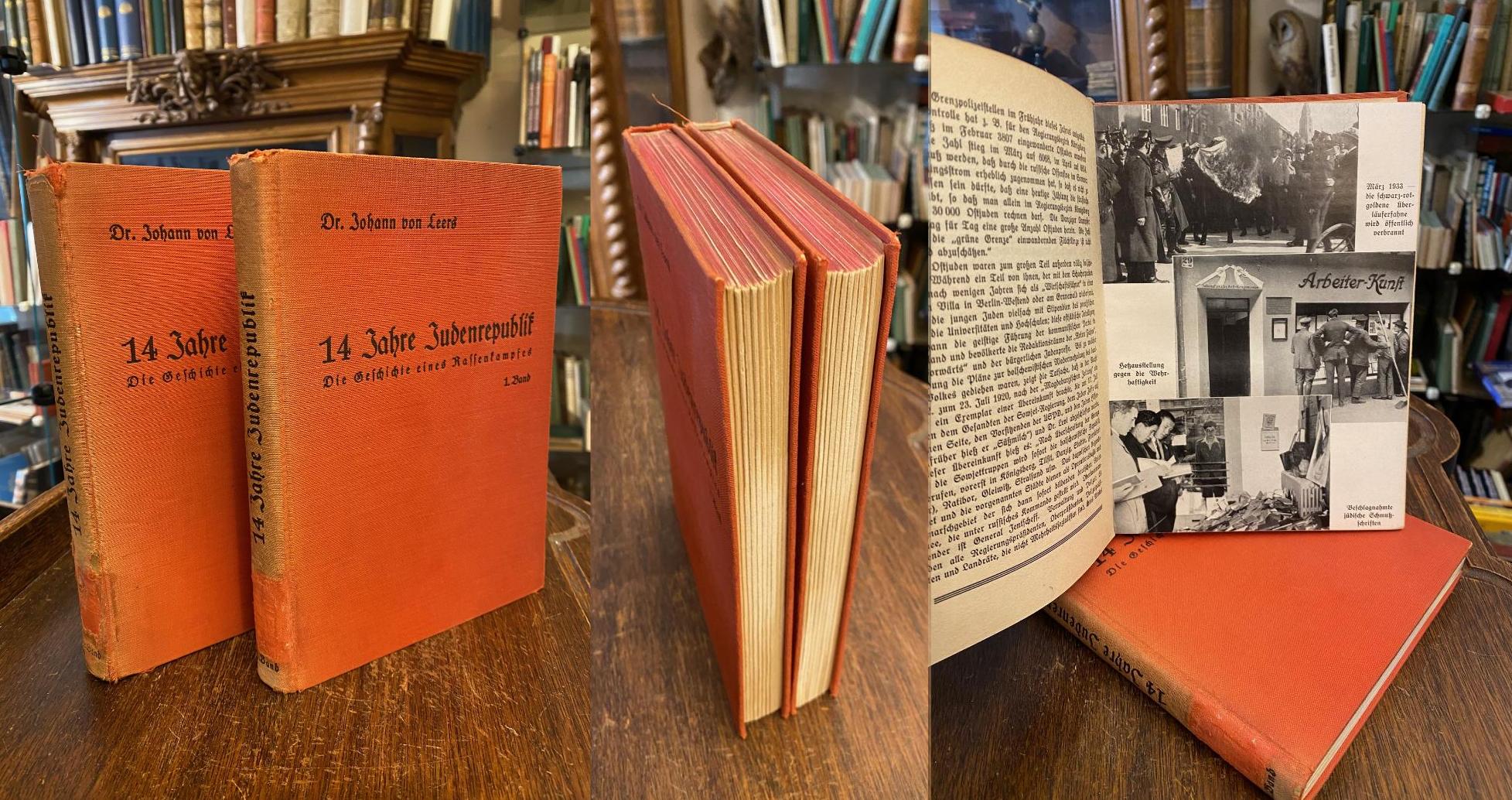
1933ref. 58726ABBerlin-Schöneberg, NS-Druck und Verlag, (1933). 8° (21x15), 165 S., 1 Bl. mit 13 fotograf Aufnahmen auf Tafeln (fortlaufend in der Paginierung; 191 S. mit 16 fotograf Aufnahmen auf Tafeln und 19 Porträtaufnahmen mit Kurzbiographien im Schlußkapitel 'Jüdischer Bolschewismus in Deutschland', einheitl rote Olnbde mit TitelPrägung, 1. Aufl. die Rücken aufgehellt, an den Rückenenden berieben und mit Schatten/Abrieb von entfernten Etiketten, sonst sauber und gut,
1987ref. 20911Editions Coloniales et Métropolitaines 1942. In-8 agrafé de 28 pages au format 31,5 x 24 cm. Couvertures illustrées en couleur. Dos carré avec petits frottis. Plats et intérieur restés frais malgré des petits frottis et infimes plis aux bors et aux coins. Mors intérieur et bord du 1er plats avec rare renforcements au scotch invisible. Couverture, dessins en couleurs, photo-montages en noir et scénario de Vincent Krassousky dit Vica. Bel état génértal. Rarissime édition originale de cette bande dessinée de propagande pro-nazie. Vica, né a Kiev, de son vrai nom Vincent Krassousky, est le fils d’un officier de l’armée du Tsar, disparu en Bulgarie. Sa mère et sa soeur sont tués par les révolutionnaires bolcheviques, et lui, s’enrôle à l’âge de 16 ans, en 1918, dans l’Armée Blanche de Wrangel, où il participe, pendant 2 années, à la guerre civile russe avant de s’exiler en France. Vica est un dessinateur au trait coloré assez proche de Calvo. Il réalise des publicités pour " Yabon " et " Banania " et publie aussi des BD dans des illustrés pour la jeunesse autorisés par l’Occupant allemand. Il fait paraître en 1942, aux éditions Dompol, deux albums archétypaux de la propagande pro-nazie : Vica au paradis de l’U.R.S.S. et Vica contre les services secrets anglais, mais c’est à la Société des éditions Coloniales et Métropolitaines, toujours en 1942, qu’il fournit le plus rare de ces trois albums de propagande : Vica défie l’Oncle Sam. BD profondément anti-américaine et antisémite, l’album propose les aventures de son héros aux États Unis pendant la guerre, à grand renfort de caricatures et de photographies truquées. Certaines sources affirment que deux officiers allemands furent adjoints à Vica pour la réalisation de ces trois albums de propagande : l’un pour la correction des textes et l’autre pour la réalisation des photo truquées. À la fin de la guerre, Vica sera jugé, et condamné, pour ces activités de propagandiste, à un an de prison ferme, et à une amende de 1000 francs, ainsi qu' à l’indignité nationale. À sa sortie de prison, il reprendra son activité de dessinateur sous le pseudonyme de Tim dans le magazine Cadet Journal, jusqu’en 1946, date à laquelle on perd sa trace.
1983Very Good Arabic Original creme bdg. HC. Folio. (32,5 x 27 cm). Texts in Arabic with a bilingual title on verso of the cover in English and Arabic. [18] p., [15] unnumbered full paged color plates of the buildings in Jeddah separately tissue papers. Signed and inscribed in Turkish by Cidde emini [i.e. The Lord Mayor of Jeddah] Mohamed Said Farsi, dated 8.5.1984 to Turkish architect Selim Sabuncuoglu as 'Sayin Selim Sabuncuoglu, en güzel temennilerimle Jedda'dan bir hatira. Jeddah emini, Sait Farisi'. Sealed "YÜTAS: Construction Production Industry and Trade Co.". Dr. Mohammed Said Farsi, (1937-2019), was a former Lord Mayor of Jeddah, and a man of such aesthetic integrity that he traveled the world to meet with sculptors, painters, and musicians before replanning the city according to his own meticulously constructed vision. (Source: The Rake). Dr. Farsi was a visionary civic leader and philanthropist who is widely considered to be the father of modern Jeddah. He presided over a five-fold increase in the city's population, led its transformation, including creating the famous Jeddah corniche - a unique public space and an open-air gallery. Dr. Farsi, a noted art lover, was also the first mayor to introduce Western art and sculpture to an Arab city. He is survived by his son Hani Farsi and former wife Naglaa Asaad. Born in Makkah in 1937, Dr. M S Farsi qualified as an architect in Alexandria and returned to Saudi Arabia in the early 1960s. He entered government service in 1963 and rose rapidly. Just two years later he was appointed to the post of Planning Officer for the Western Region of Saudi Arabia. Covering an area larger than the United Kingdom and having within its boundaries the port city of Jeddah and the Holy Cities of Makkah and Medinah, this territory was in effect Saudi Arabia's window to the world and it was under Dr. Farsi's aegis that plans for these three cities were drawn up; given the immense significance of this work, Dr. Farsi liaised with the very highest levels of government. In 1972, Dr. Farsi became Mayor of Jeddah, a city that had grown from the historic walled city of his childhood to a large modern conurbation of more than 300,000 people. Until the middle of the following decade, Dr. Farsi presided over a period of spectacular and unprecedented growth for the city, which saw its population increase five-fold. That chaos was averted in the face of such a population explosion was due in no small part to Dr. Farsi's enlightened leadership. It is remarkable that in the midst of creating much-needed infrastructure, Dr. Farsi found time to create a city that was as beautiful as it was functional; with a carefully preserved historic center, gracious boulevards, and charming parks. A collector of Islamic and Western art, Dr. Farsi's vision as a city planner was to integrate important contemporary art into public spaces, thus enriching the lives of the inhabitants and reflecting the on-going cultural significance of the city, and his mayoralty is today remembered for its artistic flowering and for being at the forefront of design. Dr. Farsi made use of local artists and materials as well as commissioning works from many great Western masters, including Henry Moore, Victor Vasarely, Alexander Calder, Arnaldo Pomodoro, Joan Miró, Cesar Baldaccini, Sylvestre Monnier, Jean Arp, and Jacques Lipchitz, among many other stellar names in the international art world. He was the first mayor to introduce Western art and sculpture to an Arab city, as well as the first to display art that depicted the physical human form. At the time he stepped down, in 1986, Jeddah boasted over 400 pieces of public art. When he retired in 1986, Dr. Farsi returned to one of his primary passions - education. Within just one year he successfully qualified for his doctorate, attaining a Ph.D. from the University of Alexandria. (Source: Pressat).
1907Very Good Turkish, Ottoman (1500-1928) Original chromo-lithograph map on cloth. 63x98 cm. In Ottoman script (Old Turkish with Arabic letters). Chipped on extremities, some wear on folds, foxing, and stains on margins and cloth with small holes. Overall a good/fair copy. First separate edition of this rare and attractive chromo-lithographic map of the Imperial Ottoman lands in Europe, as well as the Bosphorus and Crete in separate panels, drawn by Turkish infantry major El-Hac Nasrullah b. El-Hac Nâsir from Daghestan, during the last period of the rule of Sultan Abdulhamid II, with praise to the Sultan. The map gives detailed information on the lower left telegraph and postal codes of the Imperial vilayats such as Bosnia, Bulgaria, Algeria, Egypt, and Tunisia, etc. Additionally, on the lower right, demographic statistics and data of vilayats and some cities. This rare map shows the complete Ottoman Balkans according to the Ottoman administral system. West Anatolia and West Black Sea Coats on the east, Adriatic coasts on the east, and Ottoman Greece, Bulgaria, Albania, and Bulgaria are included on the map. These countries are separated by Selanik (Thessaloniki), Roumeli, Monastery, Ioannina, Kosovo, and Shkodra vilayats.
1928Fine Turkish, Ottoman (1500-1928) Original wrappers. Roy. 8vo. (23 x 16 cm). In Ottoman script (Old Turkish with Arabic letters). [iii], 182 p., richly illustrated. First and only edition of one of the earliest and extremely rare Ottoman Turkish book on electricity published after the proclamation of the Republic in Turkey. It's a complete guide to electricity including how to install power plants, generators, and their working principles, etc. One of the most important breakthroughs of the regime in the Republican period was the delivery of electricity to many cities and villages of Turkey after the proclamation of the Republic. The electricity question and energy policies were also reflected in the propaganda material of the Republican regime. After the Alphabet Revolution in 1928, after the very few electrical books written in Ottoman Turkish, many books, posters, brochures, and periodicals were published, especially in the 1930s... Hasan Enver Pasha was an Ottoman general. He was the son of Mustafa Celalettin Pasha a Polish convert to Islam and the daughter of Omer Pasha. Besides he was an avid defender of the belonging of the Turkish race to the European white races. He married Leyla Hanim, a daughter of Mehmed Ali Pasha (marshal). They had five children: Celile who became the mother of Nâzim Hikmet, Münevver who became the mother of Oktay Rifat, Mustafa Celalettin, Mehmet Ali, and Sara. In 1901, he led an expedition to deliver Islamic and pan-Islamic messages to the Muslims of China. Özege 15207.; TBTK 12692.; OCLC 850834945 (Only one copy worldwide).
1982Fine Fine English Original brown imitation leather bdg. Dust wrapper. In publisher's special slip-case. Folio. (31 x 26,5 cm). Texts in entirely English, bilingual title on the slipcase in English and Arabic. 143, [1] p., fully color and b/w photos. Signed and inscribed in Turkish by Cidde emini [i.e. The Lord Mayor of Jeddah] Mohamed Said Farsi, dated 8.5.1984 to Turkish architect Selim Sabuncuoglu as 'Sayin Selim Sabuncuoglu, en güzel temennilerimle Jedda'dan bir hatira. Jeddah emini, Sait Farisi'. Sealed "YÜTAS: Construction Production Industry and Trade Co.". Dr. Mohammed Said Farsi, (1937-2019), was a former Lord Mayor of Jeddah, and a man of such aesthetic integrity that he traveled the world to meet with sculptors, painters, and musicians before replanning the city according to his own meticulously constructed vision. (Source: The Rake). Dr. Farsi was a visionary civic leader and philanthropist who is widely considered to be the father of modern Jeddah. He presided over a five-fold increase in the city's population, led its transformation, including creating the famous Jeddah corniche - a unique public space and an open-air gallery. Dr. Farsi, a noted art lover, was also the first mayor to introduce Western art and sculpture to an Arab city. He is survived by his son Hani Farsi and former wife Naglaa Asaad. Born in Makkah in 1937, Dr. M S Farsi qualified as an architect in Alexandria and returned to Saudi Arabia in the early 1960s. He entered government service in 1963 and rose rapidly. Just two years later he was appointed to the post of Planning Officer for the Western Region of Saudi Arabia. Covering an area larger than the United Kingdom and having within its boundaries the port city of Jeddah and the Holy Cities of Makkah and Medinah, this territory was in effect Saudi Arabia's window to the world and it was under Dr. Farsi's aegis that plans for these three cities were drawn up; given the immense significance of this work, Dr. Farsi liaised with the very highest levels of government. In 1972, Dr. Farsi became Mayor of Jeddah, a city that had grown from the historic walled city of his childhood to a large modern conurbation of more than 300,000 people. Until the middle of the following decade, Dr. Farsi presided over a period of spectacular and unprecedented growth for the city, which saw its population increase five-fold. That chaos was averted in the face of such a population explosion was due in no small part to Dr. Farsi's enlightened leadership. It is remarkable that in the midst of creating much-needed infrastructure, Dr. Farsi found time to create a city that was as beautiful as it was functional; with a carefully preserved historic center, gracious boulevards, and charming parks. A collector of Islamic and Western art, Dr. Farsi's vision as a city planner was to integrate important contemporary art into public spaces, thus enriching the lives of the inhabitants and reflecting the on-going cultural significance of the city, and his mayoralty is today remembered for its artistic flowering and for being at the forefront of design. Dr. Farsi made use of local artists and materials as well as commissioning works from many great Western masters, including Henry Moore, Victor Vasarely, Alexander Calder, Arnaldo Pomodoro, Joan Miró, Cesar Baldaccini, Sylvestre Monnier, Jean Arp, and Jacques Lipchitz, among many other stellar names in the international art world. He was the first mayor to introduce Western art and sculpture to an Arab city, as well as the first to display art that depicted the physical human form. At the time he stepped down, in 1986, Jeddah boasted over 400 pieces of public art. When he retired in 1986, Dr. Farsi returned to one of his primary passions - education. Within just one year he successfully qualified for his doctorate, attaining a Ph.D. from the University of Alexandria. (Source: Pressat). Jeddah: 'Bride of the Red Sea'. This is a cosmopolitan city, ancient and modern hub, the unique seat of civilis[.]. R
1937ref. 148450Diessen, Raumbild Verlag Otto Schönstein, 1937.
1960ref. 217261Circa1960s. Collection of five colour-printed Nianhua posters each of the central images onlaid within a stiff red paper border with a thin cream paper frame worn and discoloured and at the top of each a fine aqua paper border; the sheets a little creased two images with a visible tide-mark minor edge tears not affecting the images strengthened neatly on the verso with washi one with an early paper repair to the top margin all approx. 93 x 51.5cms sheet size in good condition. Five examples of "new" Nianhua posters dating from the Great Leap Forward all featuring babies and children symbolizing happiness prosperity and the promise of a thriving future. In one a sister braids her hair whilst minding her crawling toddler brother "Sweet Heart". On the wall a poster proclaiming the industrialisation of agriculture "Agriculture is the foundation of the national economy and grain is the foundation" caption; in another five toddlers dance in a circle their flags and lanterns captioned "The Great Leap Forward" and "Long Live Mao". Ephemeral examples of folk art and the use to which it was put for political purpose. . unknown
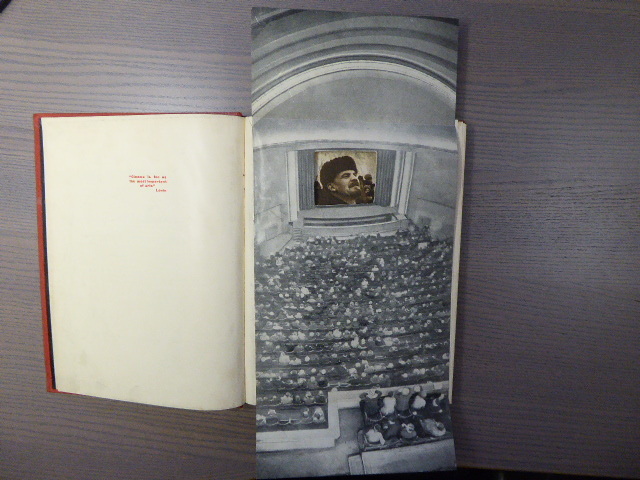
ref. 327878A. Arossev Moscou 1935 In-4 carré ( 270 X 200 mm ) de 306-XVI pages, demi-basane rouge et plats illustrés de l'éditeur. Très nombreuses photographies dans et hors-texte. Design et photographies par Alexandre RODCHENKO et Varvara STEPANOV. Texte en anglais. Bien complet de la célèbre image rempliée du public d'un cinéma devant un grand écran avec un découpage laissant apparaitre la tête de LENINE, ainsi que la fragile illustration de celluloïd légendée avec profil argenté de STALINE. Très bel exemplaire.. ' 8 .!"!>25BA:>5 :8=>. . @>AA52. $>B>3@0D88 8 >D>@< 5=85 @01>BK 5:A0=4@0 >4G5=:> 8 0@20@K !B5?0=>2>9. >A:20, 1935 3. 00=3 89A:>< O7K:5. 306 AB@., 27x20,5 c<, >@838=0 L=K9 ?> C:>60=K9 ?5@5? 5B :@0A=>3> F25B0. %>@.A>B.
1935ref. 54479[s. l.]: [s. n.] 1935. 77 S. ; 8° [Umschlagt.] Broschiert, Seiten alters- und papierbedingt gebräunt, sonst guter Zustand
1961219 pages. "When first published in 1923 this work became the first book-length discussion of the scope and function of professional public relations and of its practitioner, the counsel on public relations." - from Preface. Bernays has subsequently come to be known as the 'Father of Spin'. Light wear. Library markings upon each edge of text and title page. Pocket removal markings inside each board. Front endpaper removed. Front hinge open. Cole p.27, Larson 7, Lasswell, Casey & Smith p.32 Book
191516 pages. Features: Are Hyphenated Citizens Good for American?; Who Are Americans?; A Congressman Who is Not Afraid - Representative Joseph Taggart of Kansas Assails Harper's Weekly for its abuse of Germans; Hartelpool Well Defended; Brave American Actress - Fern Rogers; Honesty is the Best Policy (Part 2 of 2), by Aleister Crowley - a remarkably forcible exposition of the hypocrisy of his countrymen; The Greatest Secret of German Progress, by Frank Koester; The Division of the Nation's Forces, by Dr. Hanns Heinz Ewers - a keen analysis of the actual condition and strength of the armies at war; English Schemes against German and German-American Insurance Companies; American "Neutrality Notes"; England's Note - Refusal to safeguard American seagoing commerce; England Decadent - Fair-Minded Englishmen and Americans in London express their disgust; Jerome K. Jerome Protests Against the Infamous Treatment of English Citizens of German Birth; Advertising Talk - persuading neutral companies to advertise in this 'publication of class'; The Turks at the Suez Canal; Violation of Property Rights of Foreigners in France; Back cover is a full-time request for readers to convert their spare time into dollars by working for this publication; and more. Unmarked. Average wear. Binding intact. A sound copy. Magazine
1797In-8°, 30pp, una tavola ripiegata, legatura in carta semplice, intonso In-8°, 30pp, one folded plate, paper binding, uncut.
1773In-8°, XVI, 138, una tavola ripiegata, legatura in carta semplice, intonso In-8°, XVI, 138, one folded plate, paper binding, uncut.
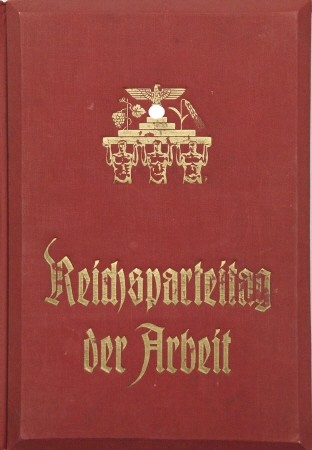
1934ref. 259329München, Zentralverlag der NSDAP, Franz Eher, 1934.
1975Very Good English Paperback. Propaganda booklet. Demy 8vo. (21 x 15 cm). Bilingual edition in English and Turkish. 114, [2] p., fully b/w color ills., and one special sticker of National Japan Floating Fair '76. Shin Sakura Maru (IMO: 7129087) is a Passenger Ship that was built in 1972. She was set up as a floating trade fair, but also doubled as a cargo ship. She was used for propaganda and the progress of the Japanese industry worldwide. This propaganda booklet is printed in Japan and was distributed by her. This is an extremely rare Turkish Edition. It includes rich color illustrations showing the social life, industry, educational system, sports, tourism, and social collaboration in Japanese country. The narrator in the text conveys Japan through the mouth of 'I'. Not in OCLC.; Not in Japanese and Turkish National Libraries. Extremely rare.
1975Very Good Turkish Paperback. Propaganda booklet. 4to. (28 x 21 cm). Edition in Turkish. [12] p., full of color ills. Shin Sakura Maru (IMO: 7129087) is a Passenger Ship that was built in 1972. She was set up as a floating trade fair, but also doubled as a cargo ship. She was used for propaganda and the progress of the Japanese industry worldwide. This propaganda booklet is printed in Japan and was distributed by her. This is an extremely rare Turkish Edition. It includes rich color illustrations showing the social life, industry, educational system, sports, tourism, and social collaboration in Japanese country. The narrator in the text conveys Japan through the mouth of 'I'. Not in OCLC.; Not in Japanese and Turkish National Libraries. Extremely rare.
Very Good Turkish Original artwork in watercolor, Indian ink, and dry paint. 11,5x9,5 cm. This rare original artwork of Mary and Jesus comes along an exceptional provenance of Turkish cartoonist Semih Balcioglu (1928-2006), with his handwritten note on verso "Cemal Nadir'in bir kompozisyonudur" [i.e. It's composed by Cemal Nadir]. Signed on right lower as "C. N". Unpublished work. Cemal Nadir was a Turkish cartoonist. He was born in Bursa, Ottoman Empire on 13 July 1902. His father Sevket was a calligrapher (Turkish: Hattat) employed in courts. After finishing high school, he began working as a sign painter in Bursa. He also created cartoons, and his first cartoon appeared in Diken (literally: "The Thorn") periodical. Although he moved to Istanbul and tried to be a full-time cartoonist, he could not make it and he returned to Bursa. The Alphabet reform of 1929 gave Cemal Nadir a second chance to show his talent. When Turkey adopted the Latin alphabet replacing the Ottoman Turkish alphabet in Arabic script, all sign boards were necessarily changed, and he worked hard to meet the demand. The same year, he moved once more to Istanbul to work for the daily Aksam. Later, he also drew for the newspaper Son Posta, as well as for satirical magazines such as Akbaba. He also contributed to Yedigün. During this period, he published the satirical magazine Amcabey. During World War II, he drew anti-Nazism cartoons in the daily Cumhuriyet. In 1946, Republican People's Party (CHP) invited him to run for a seat in the parliament. However, he refused the invitation, he said that with political affiliation he would not be able to create cartoons.
1826Very Good Turkish, Ottoman (1500-1928) Contemporary (early 19th century) quarter brown cloth with marbled boards, "Yahudi ebrûsu" end-papers. Roy. 8vo. (23 x 16 cm). In Ottoman script (Old Turkish with Arabic letters). 90 p., numbered with Arabic numeric system in pencil, around seven illustrated schemes of magical diagrams. Written on a probably 17th-18th century European paper with "Crescent" watermark, naskh script with "harakât", black and red ink. Early and a rare posthumous manuscript copy of this 18th-century Islamic majmua, containing the treatment methods and drug compositions against physical and spiritual diseases, with material and magical suggestions, copied 32 years after the author's death by a "Hafiz" with an addendum of new drugs and treatments compiled from older annotations of this work. "In the first part of the work on spiritual medicine, verses, prayers, talismans, and magic formulas in the Islamic culture like "wafqs" that are believed to be treated; in the second part, on physical medicine, drug formulas from various material objects for physiological diseases are shown." (Çagrici). Harputî was an 18th-century poet and prose from Harput (Kharberd). In the introduction to the manuscript, he stated that he is not a doctor, but that he writes practices that can heal patients due to his experiences. Despite this, the text was widely used in Ottoman medicine in the 18th and 19th centuries.
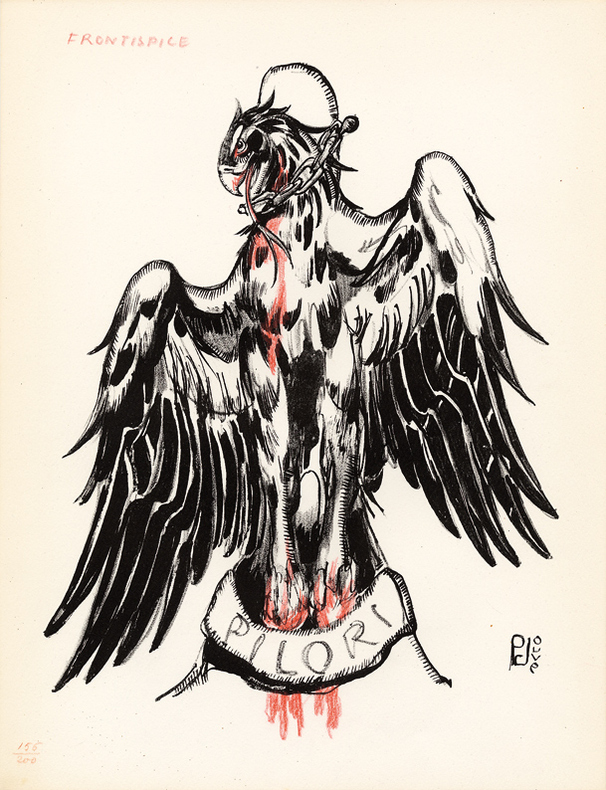
1945ref. 14742Paris, La Lithographie, 1945 ; in-folio en ff., chemise caramel à rabats illustrée_; (4) pp. (texte de Jacques-Noir, poésie de René Fauchois et table) ; frontispice, couverture et 41 planches lithographiées sur vélin fort, numérotées à la main, la plupart avec titre manuscrit et signature autographe.
1867ref. 4080S.l., s.n., s.d. ; in-16 (95 x 132 mm), 16 pp. imprimées sur papier pelure (poids : 3 grammes).