Europa VerlagAntiquariat.de
4065 resultados
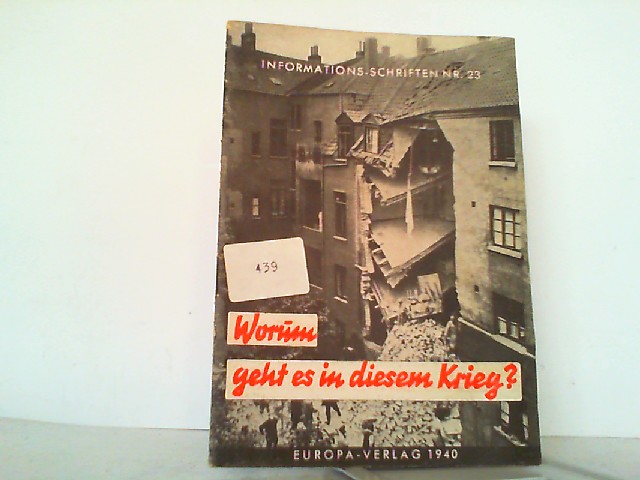
1940ref. 169709Europa Verlag, 1940.
1971ref. 1249687Berlin : Haude und Spener, 1971. 148 S. : Ill., graph. Darst., Kt. kart.
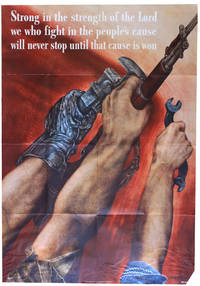
1942ref. 173221942. Stone Martin David. Strong In The Strength of the Lord We Who Fight In The People's Cause Will Never Stop Until That Cause Is Won 1942 a U.S. government wartime poster that articulates the ideological pro-America push on the American home front during World War II. Produced in the first full year of U.S. involvement following Pearl Harbor the poster advances a unified vision of civilian and military participation by aligning industrial labor military service and women's wartime work within a single visual and rhetorical program. The quotation from Vice President Henry Wallace a central political figure in wartime liberal internationalism and later the Progressive Party presidential candidate in 1948 situates the poster within federal efforts to frame the war as both a democratic and moral struggle requiring total societal commitment. Strong In The Strength of the Lord We Who Fight In The People's Cause Will Never Stop Until That Cause Is Won. Washington D.C.: U.S. Government Printing Office 1942. Poster measuring approximately 40 x 28 inches. Designed by David Stone Martin the composition presents three raised arms one female and two male each holding tools or instruments that signify industrial production and military participation. The visual program emphasizes coordinated effort across gender and occupational roles reinforcing federal messaging that positioned women as essential industrial laborers while sustaining the symbolic presence of the soldier and the worker. Issued as part of a broader federal propaganda campaign the poster would have circulated in workplaces public buildings and transportation hubs to reinforce wartime discipline production quotas and civic obligation. The poster belongs to a larger body of U.S. Office of War Information and Government Printing Office materials that sought to define the "home front" as a site of organized labor patriotic duty and ideological unity. During 1942 federal agencies intensified messaging that encouraged participation through war bond purchases factory labor and adherence to rationing and production directives. Wallace's language invoking moral purpose and collective struggle reflects the administration's effort to frame the war in universalist and populist terms linking domestic labor to global democratic outcomes. Minor bumping along the edges of the matting otherwise very good condition. unknown books
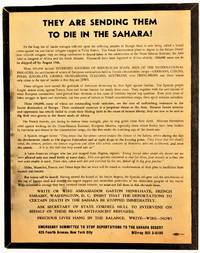
1941ref. 189981941. Broadside issued in 1941 by the Emergency Committee to Stop Deportations to the Sahara Desert articulating an urgent appeal against the forced deportation of anti-fascist refugees by the Vichy French government during the early years of the Second World War. Written by Edward K. Barsky a leading figure in the Joint Anti-Fascist Refugee Committee the document calls on American citizens to intervene diplomatically by contacting both the French Embassy in Washington D.C. and the U.S. Secretary of State. The broadside documents contemporary awareness of mass deportations and forced labor policies under the Pétain regime describing plans to remove large numbers of refugees-including veterans of the Spanish Civil War members of the International Brigades and political exiles from across Europe-to labor camps connected to the Trans-Saharan Railroad. The text situates these actions within broader patterns of repression highlighting the targeting of anti-fascist populations and the international composition of those affected. As such the document provides primary-source evidence of early wartime advocacy efforts in the United States responding to refugee persecution and authoritarian policies in Vichy-controlled territories. Single-page printed broadside. New York: Emergency Committee to Stop Deportations to the Sahara Desert 1941. Measuring approximately 10.25 x 8 inches. Printed in black text within a ruled border on brown paper. The text consists of a headline explanatory statement and direct appeal for public action including instructions to contact diplomatic officials. Light wear consistent with age; text clear and legible; overall very good condition. A scarce wartime advocacy document reflecting early American engagement with the European refugee crisis under Vichy rule. unknown books
1941ref. 189981941. Broadside issued in 1941 by the Emergency Committee to Stop Deportations to the Sahara Desert articulating an urgent appeal against the forced deportation of anti-fascist refugees by the Vichy French government during the early years of the Second World War. Written by Edward K. Barsky a leading figure in the Joint Anti-Fascist Refugee Committee the document calls on American citizens to intervene diplomatically by contacting both the French Embassy in Washington D.C. and the U.S. Secretary of State. The broadside documents contemporary awareness of mass deportations and forced labor policies under the Pétain regime describing plans to remove large numbers of refugees-including veterans of the Spanish Civil War members of the International Brigades and political exiles from across Europe-to labor camps connected to the Trans-Saharan Railroad. The text situates these actions within broader patterns of repression highlighting the targeting of anti-fascist populations and the international composition of those affected. As such the document provides primary-source evidence of early wartime advocacy efforts in the United States responding to refugee persecution and authoritarian policies in Vichy-controlled territories. Single-page printed broadside. New York: Emergency Committee to Stop Deportations to the Sahara Desert 1941. Measuring approximately 10.25 x 8 inches. Printed in black text within a ruled border on brown paper. The text consists of a headline explanatory statement and direct appeal for public action including instructions to contact diplomatic officials. Light wear consistent with age; text clear and legible; overall very good condition. A scarce wartime advocacy document reflecting early American engagement with the European refugee crisis under Vichy rule. unknown
1942ref. 173221942. Stone Martin David. Strong In The Strength of the Lord We Who Fight In The People's Cause Will Never Stop Until That Cause Is Won 1942 a U.S. government wartime poster that articulates the ideological pro-America push on the American home front during World War II. Produced in the first full year of U.S. involvement following Pearl Harbor the poster advances a unified vision of civilian and military participation by aligning industrial labor military service and women's wartime work within a single visual and rhetorical program. The quotation from Vice President Henry Wallace a central political figure in wartime liberal internationalism and later the Progressive Party presidential candidate in 1948 situates the poster within federal efforts to frame the war as both a democratic and moral struggle requiring total societal commitment. Strong In The Strength of the Lord We Who Fight In The People's Cause Will Never Stop Until That Cause Is Won. Washington D.C.: U.S. Government Printing Office 1942. Poster measuring approximately 40 x 28 inches. Designed by David Stone Martin the composition presents three raised arms one female and two male each holding tools or instruments that signify industrial production and military participation. The visual program emphasizes coordinated effort across gender and occupational roles reinforcing federal messaging that positioned women as essential industrial laborers while sustaining the symbolic presence of the soldier and the worker. Issued as part of a broader federal propaganda campaign the poster would have circulated in workplaces public buildings and transportation hubs to reinforce wartime discipline production quotas and civic obligation. The poster belongs to a larger body of U.S. Office of War Information and Government Printing Office materials that sought to define the "home front" as a site of organized labor patriotic duty and ideological unity. During 1942 federal agencies intensified messaging that encouraged participation through war bond purchases factory labor and adherence to rationing and production directives. Wallace's language invoking moral purpose and collective struggle reflects the administration's effort to frame the war in universalist and populist terms linking domestic labor to global democratic outcomes. Minor bumping along the edges of the matting otherwise very good condition. unknown
1942ref. 29163Australia 1942. Very good condition. World War II propaganda leaflet dropped on the Island of Timor part of Southeast Asia and north of Australia. Pamphlet in English is entitled "Portuguese Leaflet PG11. Timorese! This warning comes from your Australian and American Friends. The Japanese are our enemies and we will fight and pursue them until they are killed. They have been driven from New Guinea and they will be thrown out of Timor. Remember - our fast flying planes cannot distinguish friend from foe. Heed our warning. If you do not stay away from the Japanese you may be killed." One copy in English one copy in Portuguese. English copy: salmon paper 5 1/2 x 3 3/4" folded corner chip with loss not affecting text. Portuguese copy: cream paper 5 1/2 x 5 3/4" black text vgc. unknown
1967ref. 127263Stuttgart: DVA - Deutsche Verlags-Anstalt, 1967. 362 S. ; 23,5 x 15,5 cm ; Leinen.
1989ref. 6511BBHerrsching, Pawlak, 1989. 24 cm. 362 S. Or.Pp. sehr gut. Zust.
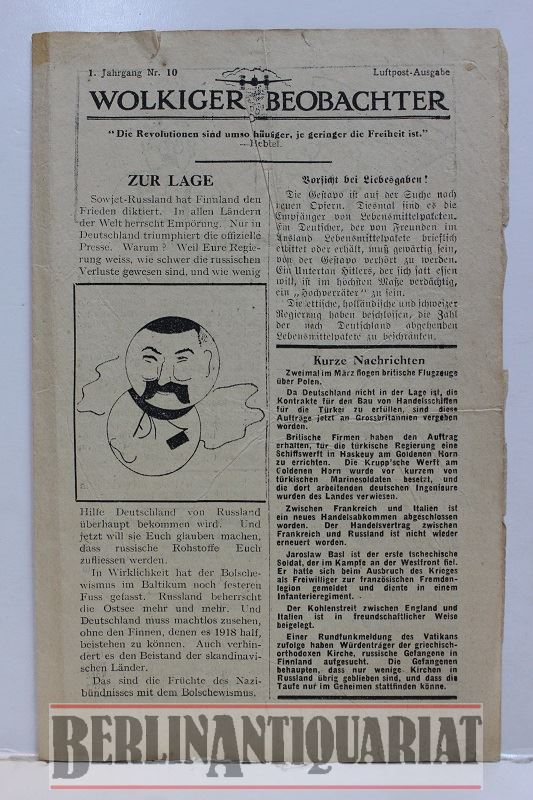
1940ref. 21572(1940). 8°. 2 Blatt. Mit leichten Gebrauchsspuren. [3 Warenabbildungen]
19818vo., First Edition; red cloth, backstrip lettered in silver, a very good, bright, clean copy in dustwrapper, the latter sunned (as usual) at backstrip. Sproat's account makes it clear that Plum is the victim of a grave injustice following his supposed treachery in WWII. Includes (for the first time) the full texts of the notorious five Berlin broadcasts.
1941ref. ZEIT1004München, Zentralverlag der NSDAP 1939 - 1941. 4°. Blätter teilweise randgebräunt, 8 Blätter mit geringem Insektenfraß außerhalb der Darstellung (am unteren Rand), einige leicht fleckig. Vorhanden sind: 08. -14.Okt. u. 03. - 30.12.1939. = 5 Bl. / Jänner - August 1940 = 23 Bl.; Folge 33 - 52 1940 = 20 Bl. / Folge 2 - 4, 6 - 31, 34 - 38, 52, 53 1941. = 36 Bl. Mit Zitaten von: Adolf Hitler, Hermann Göring, Baldur von Schirach, Carl von Clausewitz, Peter Rosegger, Walter Darré, Friedrich II., Ernst Moritz Arndt, Jean Paul u.A.
1968ref. 36006Berlin, Staatssekretatiat für westdeutsche Fragen, 1968. 3. Aufl. 79 S. 8° , Paperback , Gutes Exemplar mit geringen Gebrauchsspuren
1934ref. 059958Frankfurt a. M., Verlag Moritz Diesterweg., 1934. 80 Seiten mit einer Abbildung Wißmanns. Zustand: Seitenränder minimal gedunkelt, Broschurränder ganz minimal berieben.; 8°. OBroschur / Karton.
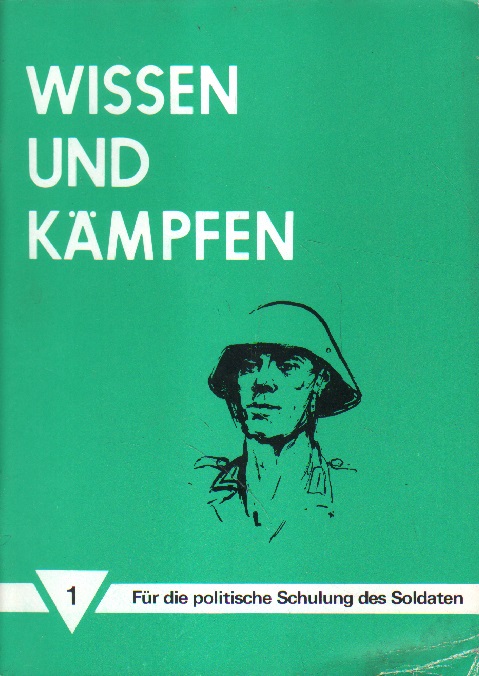
1978ref. 96007Berlin, Militärverlag der DDR, ca. 1978. 63 S. Gr.-8° Groß-Oktav, Softcover/Paperback
1983ref. 96004Berlin, Militärverlag der DDR, ca. 1983. 48 S. Gr.-8° Groß-Oktav, Softcover/Paperback
1983ref. 96005Berlin, Militärverlag der DDR, ca. 1983. 48 S. Gr.-8° Groß-Oktav, Softcover/Paperback
1981ref. 96003Berlin, Militärverlag der DDR, ca. 1981. 48 S. Gr.-8° Groß-Oktav, Softcover/Paperback
1979ref. 96011Berlin, Militärverlag der DDR, ca. 1979. 64 S. Gr.-8° Groß-Oktav, Softcover/Paperback
1980ref. 96006Berlin, Militärverlag der DDR, ca. 1980. 64 S. Gr.-8° Groß-Oktav, Softcover/Paperback
1985ref. 96010Berlin, Militärverlag der DDR, ca. 1985. 48 S. Gr.-8° Groß-Oktav, Softcover/Paperback
1983ref. 96009Berlin, Militärverlag der DDR, ca. 1983. 48 S. Gr.-8° Groß-Oktav, Softcover/Paperback
1980ref. 96008Berlin, Militärverlag der DDR, ca. 1980. 64 S. Gr.-8° Groß-Oktav, Softcover/Paperback
1940ref. 18172BBBerlin, Eher [Zweigniederlassg], 1940. 8 [Umschlagt.]. 31 S., mit Abb. Heft, Deckelillustr. gebrauchter Zustand, lin. und re. unt. Ecke beschädigt, Heftdeckel etwas lose, S. gebräunt. Kleine Kriegshefte ; Nr 1.
1935ref. 18176BBMünchen, Lehmann, 1935. 20.-24. Tsd. 194 S. Paperback, Deckelillustr. guter, altersgem. Zustand, Einband gering gebräunt u. Kanten gering berieben, Besitzereintr. a. Vortitel, 24