Canada ParlementBiblio.com

7 205 résultats
réf. 0260641952.Ghardcover. Good. Access codes and supplements are not guaranteed with used items. May be an ex-library book. hardcover
réf. 0266127150.Gpaperback. Good. Access codes and supplements are not guaranteed with used items. May be an ex-library book. paperback
réf. 50305335like new. unknown
réf. 1278824219.Gpaperback. Good. Access codes and supplements are not guaranteed with used items. May be an ex-library book. paperback
réf. 1343521831.Ghardcover. Good. Access codes and supplements are not guaranteed with used items. May be an ex-library book. hardcover
réf. 1343932750.Ghardcover. Good. Access codes and supplements are not guaranteed with used items. May be an ex-library book. hardcover
réf. 1278898115.Gpaperback. Good. Access codes and supplements are not guaranteed with used items. May be an ex-library book. paperback
réf. 1248418476.Gpaperback. Good. Access codes and supplements are not guaranteed with used items. May be an ex-library book. paperback
réf. 1175290726.Gpaperback. Good. Access codes and supplements are not guaranteed with used items. May be an ex-library book. paperback
réf. 1245614908.Gpaperback. Good. Access codes and supplements are not guaranteed with used items. May be an ex-library book. paperback
1774réf. 25494London 1774. Folio. 12 1/4 x 7 3/4 inches. 2 255-256 pp. Official British Act continuing a previous law for punishing mutiny and desertion among British forces stationed in North America. Only a handful of copies recorded in ESTC. ESTC N57431. unknown
réf. 1917566093.Gpaperback. Good. Access codes and supplements are not guaranteed with used items. May be an ex-library book. paperback
1730réf. 102277Bound volume of 89 acts folio 11 3/4" x 7" period full calf 446 pp. Various paginations actual page count is done by hand and a manuscript index at the front lists the acts and indicates the page it is on. Binding is worn backstrip is gone hinges are cracked covers almost detached and some signatures are loose some early ink notations and page numbering are on top of pages it appears there are some remnants of wax seals on the margin of the last page some soiling at endpapers normal aging and browning but internally pretty clean; despite the mentioned flaws the contents are in very good shape but the binding needs work. While this collection of Acts passed under George II and George III is not sequential a previous owner has provided a useful index as to the contents and location of various acts. The laws cover a very broad area of issues from the more mundane such as dog stealing punishments for disorderly houses and preventing abuses in making bricks and tiles to more important issues including the raising and training of the militia regulating the price of corn preservation of public highways and the punishment for selling ale and apiarist without a license. Other important acts include regulating places of entertainment regulating the trials of controverted elections establishing trade agreements in the East Indies changing some of the rules passed by Queen Elizabeth on providing relief to the poor and wildlife preservation. A fascinating glimpse at another time and issues of the day. Charles Eyre and William Strahan, Mark Baskett & Others,
1745réf. 100736Pamphlet format small folio disbound each act with its own title. One act with 2 pages separated some minor dampstaining; otherwise very good plus. The lengthiest act relating to the raising of money makes several specific references to colonial Georgia including the provisioning of the garrisons commissioning of troops of Highland Rangers with schooners and granting money to the trustees of Georgia for the improvement of the colony. Another act provides for a speedy trial for those who commit treason against the king. Also included is an act to indemnify those individuals who defended the king concerning the "Scottish Rebellion." Thomas Baskett unknown
1764réf. 100735Pamphlet format small folio disbound. Five acts lacking separate titles but complete appears to be two extra tittle pages a few tears and corner folds one act with margin tear not affecting text minor some soiling; otherwise very good. This is an interesting collection of Parliamentary Acts relating to America during the reign of George III. While most of the acts are from the colonial period there is also some Revolutionary War material. There are several acts concerning the importation of rice from South Carolina and Georgia and others that relate to importation of wheat beaver skins and tea into the colonies. Others address the quartering of troops in the colonies as well as better pay for soldiers and dealing with mutiny and desertion. Additionally several acts refer to a continuation of the right of the king to secure and detain people charged with or suspected of "high treason" and for the exchange of American prisoners brought to Great Britain. Mark Baskett; Charles Eyre and William Strahan
1831réf. 19854London 1831. FIRST PRINTING. Drop title; with a number of contemporary annotations corrections on Schedules A and B pp. 26-27. Sewn as issued preserved in a folding case. First printing of the final revisions to the Great Reform Bill. This was the second bill put up for a Parliamentary vote. The initial version of the bill March 1831 was rejected by Parliament. The Great Reform Bill of 1831 also known as the Reform Act was a significant piece of legislation in the United Kingdom aimed at addressing the deficiencies in the electoral system. Before the bill representation in Parliament was heavily skewed with many industrial cities lacking adequate representation while rural areas held disproportionate power. The bill sought to expand the electorate improve representation and reduce the influence of "rotten boroughs" which were sparsely populated constituencies that had the same voting power as more populous areas. The bill proposed to extend the franchise to more men particularly those in the burgeoning middle class and aimed to redistribute parliamentary seats to reflect population changes especially due to the industrial revolution. Although it faced fierce opposition from the House of Lords public pressure and widespread protests highlighted the demand for reform. The rejection of the initial version of the bill led to a wave of public agitation and a second attempt which was again passed by the House of Commons and rejected by the House of Lords. Ultimately this third version passed after the government threatened to create new peers to secure its approval in the House of Lords. The Great Reform Bill marked a pivotal moment in British political history laying the groundwork for future electoral reforms and increasing public participation in the democratic process. unknown
1646réf. 17558London: Printed by T.W. Thomas Warren for Ed. Edward Husband 1646. FIRST EDITION. Engraved frontispiece woodcut headpieces. Contemporary calf worn especially at spine joints somewhat tender; first blank appears to be torn out leaf with frontispiece repaired some browning and soiling mostly on edges. Overall a good copy from the library of the Earls of Macclesfield with their dated 1860 bookplate motto “Sapere aude” on the paste-down and blind embossed stamp of armorial on first three leaves. First edition. In 1640 King Charles I established the Long Parliament in order to acquire funds for the Bishop’s War against the Scots. However as soon as the Long Parliament took control they began dismantling the monarchy’s authority by removing the king’s advisors and sympathizers. The orders and ordinances collected in this copy begin at this crucial moment and cover the duration of the English Civil War from 1642 to 1646. It is therefore an excellent reference source for laws and statutes during the English Civil War. It also contains several matters of Colonial interest including An Order for advancement of the Plantations in New England; An Order to make the Earl of Warwick Governor of the Plantations in America; An Ordinance against Importation of Whale-oyl; and An additional Committee for ordering Foreign Plantations among others. Wing provides the name of the printer for this copy and lists several other volumes containing records of orders over a range of years. Printed by T.W. [Thomas Warren] for Ed. [Edward] Husband unknown
1876réf. 1402188Ordered by the House of Commons to be printed 1876. Hardcover. Quarto lvi 74 245 pages. In Fair minus condition. Spine is brown with gold print. Boards half bound with brown leather to spine and corners and green cloth to boards; tattering to spine caps and corners hinges torn their length leather dried and cracking/chipping heavily soiled. Text block has light foxing to initial and final pages two small holes in final pages. Illustrated: b&w tables some folded. Oversized books. Additional postage necessary for expedited/international orders. Economy International shipping unavailable due to size/weight restrictions. For international/expedited customers please inquire for rates. NOTE: Shelved in Locked Annex Quarto and Folio Case. 1402188. FP New Rockville Stock. Ordered by the House of Commons to be printed hardcover
1803réf. 246148United Kingdom: Houses of Parliament 1803. Book. Good. hardback. hardback foolscap Enclosure Act of Parliament dating from 1803 authorizing the enclosure of land in Gloucestershire later binding of quarter cloth and paper covered boards with paper title to upper board the first page of the Act has several ink splashes the remainder is clean and unmarked several blanks are bound at the rear. Houses of Parliament Hardcover
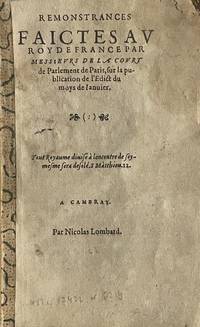
1562réf. 2557Cambray: Nicolas Lombard 1562. First edition. Papered spine. With contemporary underlines throughout and occasional marginal notes in ink. Upper outer corners stained and chipped throughout first leaves with small loss. Closed tear on the title page not affecting the text. Overall in very good condition. First edition. Papered spine. ff. 14 2 blank. Sign.: A–D4 D3–4 blank. First edition of this scarce and important document of the French Wars of Religion. A protest against the Edict of Toleration also known as the Edict of January or Saint-Germain which was issued by the French Crown on January 17 1562 after a long series of repressive measures against the Protestant Huguenots in order to restore peace in the kingdom torn by civil and religious dissensions. The registration process of the edict led to the bitterest legislative struggles of the century between the Parlement and the Crown. After a vote on 7 February the Parlement very Catholic refused to verify or publish the edict and on 12 February a remonstrance the present publication was drawn up and sent to the Court. Eventually the Parlement had to capitulate and the edict was registered on March 6 five days after the Massacre of Vassy which triggered the first of the series of eight civil wars lasting some thirsty-six years in France the Wars of Religion. The Edict of Tolerance remained a reference for the Huguenots in the later negotiations between them and the royal power and became the foundation of the subsequent toleration edicts such as the Edict of Ambroise the resolution of the first war in 1563 and the Edict of Nantes which marked the end of the period of the French Wars of Religion in 1598. Seemingly two different editions 16- and 24-leaves were published by Lombard in 1562. Due to their substantial similarities the presence or lack of the last blank leaves and the peculiar dating “mil cinq cens soixante & un” the bibliographies list these editions under at least six different entries dated 1561 or 1562 later editions also by Lombard appeared in 1565 and 1566. USTC 6319 2 copies: Nîmes - Bibliothèque Carré d’art; Paris - Bibliothèque Mazarine or 17432 1 copy: La Rochelle- Bibliothèque municipale Literature: Keller A.-C. 1952. Michel de l’Hospital and the Edict of Toleration of 1562. Bibliothèque d’Humanisme et Renaissance 142 301–310. Nicolas Lombard unknown
réf. 25420‘22 Ja’ no year. On letterhead of ‘One-Oak / 10 Redington Road / Hampstead. N.W.’ London. See the entries on Thornycroft and Allingham in the Oxford DNB. The letterhead is also of interest: 'One-Oak' is a notable example of the work of the Arts and Crafts architect A. H. Mackmurdo. 1p 12mo. On grey paper. In fair condition lightly aged and worn with traces of mount adhering to blank reverse. Folded twice. Initial ‘H’ of signature slightly smidged. Reads: ‘Dear Mrs Allingham / I have only got your note. / I enclose two cards for RA. Hoping to see you there / Yours very sincerely / Hamo Thornycroft’. See Image. ‘22 Ja’ [no year]. On letterhead of ‘One-Oak, / 10, Redington Road, / Hampstead. N.W.’ [London] unknown
réf. 2557031 January 1794. ‘No. 370.’. See his long entry in the Oxford DNB. On one side of a 12.5 x 6.5 cm piece of laid paper embossed with a tax stamp. In fair condition lightly aged and discoloured. Very neatly written and set out: ‘Jan 31 . 1794 / No. 370. / Received of Wm. Phillips / fourteen shillings for the third volume of / EPEA PTEROENTA or The Diversions / of Purley. John Horne Tooke / £2. 2. 0’. See Image 31 January 1794. ‘No. 370.’ unknown
réf. 2590717 January no year on paper watermarked ‘JOYNSON 1860’; on Berkeley Castle letterhead. See the two men’s entries in the Oxford DNB. For the context see the 1863 pamphlet ‘Clare versus the Queen’ in the slug to which John Clare 1820-1885 is described as ‘THE KING OF METAL SHIP BUILDERS’. 3pp 12mo. Bifolium. In fair condition lightly aged and worn with folds. Docketed ‘Fitzhardinge / Lord -’. Signed ‘Fitzhardinge’ sic. In a difficult hand. Begins: ‘My Dear Romaine / I have to appear as a Witness on behalf of the Admiralty in the case of “Clare’s Petition of Right to the Queen” in which I am suitor.’ He denies the claim that he has ‘infringed Patents’ with regard to ‘Gun Boats’ ‘and I do not even remember having ever seen the Man or any body on his behalf’. He asks Romaine to help him refresh his memory with regard to communications ‘in which my name appears either at White Hall or Somerset House’: ‘at present I am prepared to swear total ignorance of the Man and his Gun Boats’. He ends by giving an address to which Romaine should write if ‘any thing can be traced to me’. 17 January [no year, on paper watermarked ‘JOYNSON | 1860’]; on Berkeley Castle letterhead. unknown
réf. 25851‘Mansion House London / 20 July 1829’. An excellent slice of Georgian London history. See his entry and Hook’s in the Oxford DNB. 4pp 12mo. Fifty-five lines of text. On bifolium. In fair condition on discoloured and lightly-worn paper with closed tear at foot of gutter. Also present is a typed transcript. The letter concerns a proposed three-day ‘excursion to the Medway’. Hook has engagements that will interefere but Thompson undertakes to land him ‘safe at the Tower by seven o’clock on Saturday’. Thompson’s plan is ‘as follows the city of London Steamer leaves the Tower Stairs a little before ten oClock on Thursday with my friends & as I have official business at Woolwich I shall go on board there we stop near Southend at the boundary of the Lord Mayors jurisdiction where we dine & I shall there be joined by the Lords of the Admiralty Mr. Croker i.e. John Wilson Croker 1780-1857 etc but from there I fear they will return to town We proceed to Wrights at Rochester where we sleep Friday morning we shall visit Upnor Castle which is the boundary of my jurisdiction in the Medway & then proceed to Sheerness & view that great naval arsenal Admiral Blackwoods flag ship Vice-Admiral Sir Henry Blackwood 1770-1832 &c. at this place I give a boat to be sailed for by the Fishermen & after this engagement I return to Wrights where I entertain the Port Admiral & His Officers the Corporation of Rochester & the nobility & gentry of the neighbourhood.’ He will return to town on the Saturday by steamer. Hook now has ‘a hasty sketch’ of Thompson’s plans and he will ‘feel extremely obliged by whatever time you can give me during this cockney expedition’. ‘Mansion House [London] / 20 July 1829’. unknown
réf. 2616522 November 1861. On letterhead of 9 Great George Street Westminster S.W. London. See his entry in the Oxford DNB: ‘In the 1840s Peto had thirty-three railway contracts worth £20 million the largest number held in the kingdom; according to Brunel he was the largest contractor in the world.’ 2pp 12mo. In good condition lightly aged. Folded three times. Begins: ‘Sir Morton Peto presents his Compliments to Lady Hooker and begs to acknowledge the receipt of her not of the 9th. Inst. on his return from the Continent’. He regrets that ‘it will not be in his power to assist the Case of Dr. Fraser at the next Election of the Idiot Asylum as he has promised the whole of his votes -’. 22 November 1861. On letterhead of 9 Great George Street, Westminster S.W. [London] unknown