Victoria Parliament Legislative AssembBiblio.com
Parliamentary Papers
réf. A9781345743029Hardback. New. hardcover

The Saint Bookstore · Royaume-Uni38,29 £GB≈ 45,73 €
7 209 résultats
réf. 2557031 January 1794. ‘No. 370.’. See his long entry in the Oxford DNB. On one side of a 12.5 x 6.5 cm piece of laid paper embossed with a tax stamp. In fair condition lightly aged and discoloured. Very neatly written and set out: ‘Jan 31 . 1794 / No. 370. / Received of Wm. Phillips / fourteen shillings for the third volume of / EPEA PTEROENTA or The Diversions / of Purley. John Horne Tooke / £2. 2. 0’. See Image 31 January 1794. ‘No. 370.’ unknown
réf. 2590717 January no year on paper watermarked ‘JOYNSON 1860’; on Berkeley Castle letterhead. See the two men’s entries in the Oxford DNB. For the context see the 1863 pamphlet ‘Clare versus the Queen’ in the slug to which John Clare 1820-1885 is described as ‘THE KING OF METAL SHIP BUILDERS’. 3pp 12mo. Bifolium. In fair condition lightly aged and worn with folds. Docketed ‘Fitzhardinge / Lord -’. Signed ‘Fitzhardinge’ sic. In a difficult hand. Begins: ‘My Dear Romaine / I have to appear as a Witness on behalf of the Admiralty in the case of “Clare’s Petition of Right to the Queen” in which I am suitor.’ He denies the claim that he has ‘infringed Patents’ with regard to ‘Gun Boats’ ‘and I do not even remember having ever seen the Man or any body on his behalf’. He asks Romaine to help him refresh his memory with regard to communications ‘in which my name appears either at White Hall or Somerset House’: ‘at present I am prepared to swear total ignorance of the Man and his Gun Boats’. He ends by giving an address to which Romaine should write if ‘any thing can be traced to me’. 17 January [no year, on paper watermarked ‘JOYNSON | 1860’]; on Berkeley Castle letterhead. unknown
réf. 25851‘Mansion House London / 20 July 1829’. An excellent slice of Georgian London history. See his entry and Hook’s in the Oxford DNB. 4pp 12mo. Fifty-five lines of text. On bifolium. In fair condition on discoloured and lightly-worn paper with closed tear at foot of gutter. Also present is a typed transcript. The letter concerns a proposed three-day ‘excursion to the Medway’. Hook has engagements that will interefere but Thompson undertakes to land him ‘safe at the Tower by seven o’clock on Saturday’. Thompson’s plan is ‘as follows the city of London Steamer leaves the Tower Stairs a little before ten oClock on Thursday with my friends & as I have official business at Woolwich I shall go on board there we stop near Southend at the boundary of the Lord Mayors jurisdiction where we dine & I shall there be joined by the Lords of the Admiralty Mr. Croker i.e. John Wilson Croker 1780-1857 etc but from there I fear they will return to town We proceed to Wrights at Rochester where we sleep Friday morning we shall visit Upnor Castle which is the boundary of my jurisdiction in the Medway & then proceed to Sheerness & view that great naval arsenal Admiral Blackwoods flag ship Vice-Admiral Sir Henry Blackwood 1770-1832 &c. at this place I give a boat to be sailed for by the Fishermen & after this engagement I return to Wrights where I entertain the Port Admiral & His Officers the Corporation of Rochester & the nobility & gentry of the neighbourhood.’ He will return to town on the Saturday by steamer. Hook now has ‘a hasty sketch’ of Thompson’s plans and he will ‘feel extremely obliged by whatever time you can give me during this cockney expedition’. ‘Mansion House [London] / 20 July 1829’. unknown
réf. 2616522 November 1861. On letterhead of 9 Great George Street Westminster S.W. London. See his entry in the Oxford DNB: ‘In the 1840s Peto had thirty-three railway contracts worth £20 million the largest number held in the kingdom; according to Brunel he was the largest contractor in the world.’ 2pp 12mo. In good condition lightly aged. Folded three times. Begins: ‘Sir Morton Peto presents his Compliments to Lady Hooker and begs to acknowledge the receipt of her not of the 9th. Inst. on his return from the Continent’. He regrets that ‘it will not be in his power to assist the Case of Dr. Fraser at the next Election of the Idiot Asylum as he has promised the whole of his votes -’. 22 November 1861. On letterhead of 9 Great George Street, Westminster S.W. [London] unknown
réf. 262253 January 1851; 47 Russell Square London. See his entry in the Oxford DNB. 1p 12mo. In good condition lightly aged. Strip of glue from mount adhering to one edge of the blank reverse. Folded for postage. Addressed to ‘J M Hare Esqr’. Reads: ‘Dear Sir / I have to acknowledge the receipt of the Patent you have kindly sent me pray accept my thanks for your attention / I am dear Sir / Yrs faithfully / S. Morton Peto’. In Victorian hand at foot: ‘M P. Norwich 1851’. 3 January 1851; 47 Russell Square [London]. unknown
réf. 2614517 May 1887; on letterhead of Heythrop Hall Chipping Norton. See his brothers’ entries in the Oxford DNB. 4pp 12mo. Bifolium. Folded once. In good condition lightly aged with slight rust spotting at head of last page. Erroneous attribution to Earl Brassey in small type at the head of the first page. Addressed to ‘B. Hobbie Esq’ and signed ‘Albert Brassey’. He doubts whether you will be able to attend the public meeting at Oxford on 28 May. ‘There is no doubt that something must be done to relieve the agricultural distress but I am not at present prepared to do more than listen to the suggestions of those who are much better able than myself to propose a remedy.’ He continues: ‘As soon as the Irish troubles are disposed of our leading statemen will be more at liberty to consider other matters.’ He deeply sympathises with the object Hobbie has ‘in view’ and he feels sure that he will ‘do a great deal of good by ventilating the question at a Public Meeting’. 17 May 1887; on letterhead of Heythrop [Hall], Chipping Norton. unknown
réf. 26454Post mark: Berlin 14 June 1929; Printed heading: 50 Romney Street Westminster SW1 13 June 1929. Postcard good condition. Text: "Very many thanks for your kind congratulations - Kind regards from Elizabeth Macadam See Wikipedia etc & myself. We are in Berlin for a women's congress." Note: At this time one of the few women she was being elected to Parliament but attending the Congress fof the International Alliance of Women in Berlin. Post mark: Berlin, 14 June 1929; Printed heading: 50 Romney Street, Westminster, SW1, 13 June 1929 unknown
réf. A9781345743029Hardback. New. hardcover
1777réf. 100737Pamphlet format small folio disbound but expertly taped spine 711-780 pp. Some darkening around edges mostly title and last page very minor aging; overall in nice condition. This content focuses on a variety of local government issues during the reign of George III. Topics include the widening and lighting of streets altering or rebuilding some buildings appointment of local authorities and the regulation of carts and carriages in town. Charles Eyre and William Strahan unknown
1716réf. 100738Pamphlet format small foilio disbound 643-646 pp. Some darkening aging and minor foxing; otherwise very good. While only three pages this act focuses on the important subject of the regulation of tobacco production. It seems the primary goal was to prevent the mixing of other substances with tobacco in the product sold to the public and prevent any abuses in the making and mixing of snuff. John Baskett unknown
1968réf. 19121009-87Shannon: Irish University Press 1968. Book. Good. Hardcover. Internally in very good condition indeed page edges grubby top edge gilt; quarter leather cover has some rubbing and marking some loss to leather on front cover sticker on front cover. Facsimile reproduction. Heavy item will incur extra shipping cost outside UK. Irish University Press Hardcover
réf. 22328no place 4 February 1898 . Two pages 4to bifolium second leaf blank apart from note in another hand on verso " Mr Huskisson's of the 4th Feby 98" good condition. Text: "mr Moodie was appointed Vice Consul to the Southern States of North America upon the late Consul obtaining leave of absence for the recovery of his health. Since that period upwards of four uears the whole duties of the Office have been executed by Mr. Moodie whose zeal and attention to the Interests of the British Merchants under circumstances of considerable difficulty and embarrassment are universally acknowledged. Mr. Moodie is a British Subject and his principles and character for many uears before his appointment to the Vice Consulship are well known. Upon these points Mr. Hammond may be referred to. Mr. Miller is lately deceased and it is hoped that Mr. Moodie's past Services & the circumstances above stated may entitle him to a favourable consideration upon the present vacancy." no place, [ 4 February 1898 ] unknown
réf. 22600Headed 10 Downing Street Whitehall 6 March 1891. Three pages cr. 8vo bifolium fold marks good condition. "I have read your letter with reference to Mr Justice Stephen with care and I observe that while you throw the whole responsibility on the Government for the continuance of a condition which you describe as 'notorious' and creating 'a general dissatisfaction' you do not advance a single specific allegation as to a failure of justice on which it would be possible to take action. The only course of action open to the Government in the case of a judge whose conduct merits removal is by address to the Crown in both Houses of Parliament. The constitution has very properly made the judges absolutely independent of the Government of the day which so far as they are concerned possesses no Paternal or Disciplinary authority and any Member of Parliament is equally entitled to move an Address with any member of the Government. But this power which you possess in common with ourselves should obviously be exercised with abundant specific proof of the necessity in the public interest of that course. I am not in possession of evidence of that character on which I could feel it my duty to proceed." At this time Smith was First Lord of the Treasury and Leader of the House. [Headed] 10 Downing Street, Whitehall, 6 March 1891. unknown
réf. 22511Docketed 7 August 1812. Valediction of Letter only 19 x 9cm laid down on similar sized piece of paper from collection of similar valedictions most of which mention the Duke of York as recipient. Text: "news from Ld Wellington at which I sincerely rejoice I have the honour to be Sir with the greatest respect & attachment Yr obdt Servt J Shelley." Docketed by HRH probably or secretary Date and Sender and from a large collection of similar valedictions similarly docketed so often to the Duke of York "Royal Highness" etc that they may reveal the fate of his incoming correspondence or part of it. [Docketed ] 7 August 1812 unknown
réf. 23069No place date or obvious purpose. One page 12mo fold mark sl. crumpled mainly good condition. Signatures of Liberal MPs; James Cropper Peter McLagan Theodore Fry Thomas Burt Samuel Smith Arthur Pease James. Bryce John Roberts E Stafford Howard Thomas X. Thompson J.F. Christian James Stuart Stewart Clark Stephen Williamson. No place date, or obvious purpose. unknown
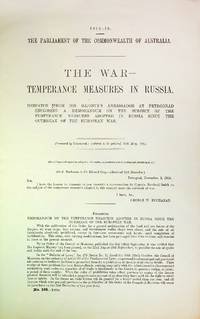
réf. 9946Melbourne 1914: Albert J Mullett Govt Printer. Pamphlet. The Parliament of the Commonwealth of Australia. The War - Temperance Measures in Russia. The Parliament of the Commonwealth of Australia The War - Temperance Measures in Russia: despatch from his Majesty's Ambassador at Petrograd enclosing a memorandum on the subject of the temperance measures adopted in Russia since the outbreak of the European War Melbourne : Albert J Mullett Government Printer for the State of Victoria. No 108 - F6748. Folio 340x210mm cream single leaf printed to both sides 2pp When World War I broke out in 1914 almost all of the participant countries including Russia restricted alcohol. Because of the policies noted here closing all liquor outlets and prohibiting the sale of alcohol until the end of the war Russia was able to put its armies in the field much quicker than Germany securing early victories on the Eastern Front. Although the Tsar had been seeking to reduce his empire's reliance on and addiction to vodka spurred on by the Government's absolute control for some centuries of vodka production and distribution for some time in September 1914 he effectively invoked prohibition; making Russia the first prohibition country in the world five years early than the USA. Some scholars now contend that this prohibition and its economic consequences was one of the main causes contributing to the Russian Revolution. Prohibition of State controlled Vodka continued until Stalin came to power in 1924. The recipient Sir Edward Grey was the British Foreign Secretary. Why he forwarded it to the Australian Parliament or why it was published in 1915 is unclear; howeverduring World War I temperance and patriotism had become firmly welded together in the public's mind due to increased activism by the temperance movement. In 1915 there was a significant debate about temperance and its importance to the war effort. Bipartisan political and religious support meant that temperance measures but not prohibition were enacted throughout Australia such as early closing hours to 'preserve the empire' and 'support the troops'. An intriguing insight into the confluence of war and prohibition. A fine copy. § Trove records 1 holding. Only 950 copies were produced. Albert J Mullett, Govt Printer unknown
réf. 18179AE's five letters on letterheads of 30 Ennismore Gardens S.W. London 3; and Spring Bank Oldham 2; four of them from between 1905 and 1907 the other undated. GHE's letter on letterhead of 35 Grosvenor Road Claughton Birkenhead; 1903. The six items totalling 9pp. are in fair condition on lightly-aged paper George H. Emmott's letter having slight wear at head. The recipient was Charles J. Holdsworth of Sunnyside Wilmslow Cheshire. AE's first letter responds briefly to Holdsworth's congratulations on Emmott's appointment as Chairman of the Ways and Means Committee; the second letter sends what 'appears to be an old scrap book of Henry King's' Holdsworth's uncle with reference to 'old Friends' books of his'; the third no more than a note states his 'only objection' as 'publication in the newspaper' ; the fourth and longest at two full 4to pages gives his views 27 April 1907 on 'Haldane's Territorial & Reserve Forces Bill': 'I do not vote on account of my official post but I do not want to pass by this communication from the Society of Friends without acknowledgment'. He is not commenting as he is 'out of political strife for the time being' but is 'tempted to say privately that I am told the number of volunteers from boys who have been in Cadet Corps is far smaller proportionately than from the general male population. The reason stated is that military training even of that imperfect kind lessens rather than increases the military spirit. I wonder if it really is so. If it is we need not fear the moral effect of military training very much. For any danger but that of the military spirit is not to be feared & the physical results are good enough.' AE's fifth letter refers Holdsworth to his brother George who with his wife will probably know 'who took most of these books'. George H. Emmott's letter dated 12 July 1903 is 3pp. 8vo and discusses AE's school days at the Quaker School in Kendal: 'I remember however that on one occasion when his half yearly report came home it contained the remark from Henry Thompson that he combined the good qualities of both his elder brothers - meaning I believe my studiousness and love of books and our brother John's love of games & outdoor exercise. I do not know how it arose but his nickname at school where he was quite a general favourite wwas "Madam" .'. AE's five letters on letterheads of 30 Ennismore Gardens, S.W. [ London ] (3); and Spring Bank, Oldham (2); four of them from be unknown
réf. 194101834. . 21pp. 4to. On six loose bifoliums. In good condition lightly aged and worn. Incomplete: paginated 23 to 32 the last a mistake for 33. The manuscript reproduces exactly with omissions the text on pp.79-94 of the publication 'Debates in the House of Commons on a Resolution Preparatory to the Introduction and in the House of Lords on the Motion for the Second Reading of the Bill for Removing the Civil Disabilities of the Jews … Reprinted from the Mirror of Parliament at the request of the Committee of the Jewish Association for obtaining Civil Rights and Privileges' London: Printed for the Proprietors of “The Mirror of Parliament” 3 Abingdon-street Westminster 1934. There are a couple of indications of a foreign origin: first the style of writing with the personal pronoun appearing throughout as a small i and the numbering having a foreign feel; second a the style of printing of a shelfmark 'Va III. - 4.' on a slip of paper on the last leaf. The shelfmark is accompanied by a circular stamp in black ink containing the acronym 'BMPF'. It may be that the manuscript was transcribed from the newspaper in order to provide an interested foreign party with an account of the debate before publication in book form. [ 1834. ] unknown
1917réf. 65026London: His Majesty's Stationery Office 1917. Presumed first edtion/first printing. Wraps. Good. No dust jacket as issued. Ink number at bottom of third page. Page 3-4 creased. 4 p. Cd. 8439. Presented to both Houses of Parliament by Command of His Majesty. January 1917. His Majesty's Stationery Office paperback
1916réf. 63488London: Harrison and Sons 1916. Presumed first edition/first printing. Wraps. Good. No dust jacket as issued. Ink notation at the bottom of page 1. i 6 p. Cd. 8352. PResented to both Houses of Parliament by Command of His Majesty. November 1916. Printed by authority of His Majesty's Stationery Office. Harrison and Sons paperback
1916réf. 64856London: Harrison and Sons 1916. Presumed first edition/first printing. Wraps. Good. No dust jacket as issued. Ink number at the bottom of third page unnumbered but just prior to page number 2. 8 p. Cd.8404. . Harrison and Sons paperback
1917réf. 65986London: His Majesty's Stationery Office 1917. Presumed first edition/first printing. Wraps. Good. 2 29 pages. Occasional footnotes. Ink notation on first page. Presented to both Houses of Parliament by Command of His Majesty. March 1917. Cd. 8477. From Wikipedia: The situation of World War I prisoners of war in Germany is an aspect of the conflict little covered by historical research. However the number of soldiers imprisoned reached a little over seven million for all the belligerents of whom around 2400000 were held by Germany. Starting in 1915 the German authorities put in place a system of camps nearly three hundred in all and did not hesitate to resort to denutrition punishments and psychological mobbing; incarceration was also combined with methodical exploitation of the prisoners. However the captivity organized by the German military authorities also contributed to creating exchanges among peoples and led a number of prisoners to reflect on their involvement in the war and relation with their homeland. Soldiers were not the only ones made prisoner during the war; civilian populations were also impacted. Historian Annette Becker has extensively studied this aspect of the war. After the invasion the German Army started by taking hostages first of all the towns' leading citizens. Several invaded countries were affected by civilian deportations: France Belgium Romania Russia etc. 100000 were deported from France and Belgium. From 1914 both male and female civilians aged 14 and over from the occupied zones were forced to work quite often on projects related to the war effort such as the rebuilding of infrastructure destroyed by fighting roads rail tracks etc. In short order the civilians began to be deported to forced labor camps. There they formed the Zivilarbeiter-Bataillone civilian workers' battalions and wore a distinctive mark: a red armband. Becker indicates that their living conditions resembled those of the prisoners - that is they were harsh. The hostages were sent to camps in Prussia or Lithuania and some of them remained prisoners until 1918. Like the military prisoners civilians were subject to exchanges and a bureau for the repatriation of civilian detainees was created at Bern in 1916. At the end of the war civilian prisoners formed an association the Union nationale des prisonniers civils de guerre. His Majesty's Stationery Office paperback
1916réf. 63494London: Harrison and Sons 1916. Presumed first edition/first printing. Wraps. Fair. No dust jacket as issued. Ink notation at the bottom of page 1. Tear noted on pages 7/8. ii 25 p. Cd. 8322. Presented to both Houses of Parliament by Command of His Majesty. August 1916. Printed under the Authority of His Majesty's Stationery Office. Harrison and Sons paperback
1916réf. 62863London: Harrison and Sons 1916. Presumed first edition/first printing. Trade paperback. Good. No dust jacket as issued. Ex-library. Librariy marking stamp at bottom of front page. This has been folded. Ink number at bottom of page 1. 2 4 p. Cd. 8260. This was printed under the Authority of His Majesty's Stationery Office. This item was presented to both Houses of Parliament by Command of His Majesty. June 1916. Harrison and Sons paperback
1916réf. 64719London: Harrison and Sons 1916. Presumed first edition/first printing. Wraps. Good. No dust jacket. Number in ink at bottom of page 3. 7 1 p. Cd. 8353. Printed under the Authority of His Majesty's Stationery Office. Harrison and Sons paperback