PAUL I, tsar of RussiaBiblio.com

605 resultados
1798ref. 132180St Petersburg: A l'Academie Imperiale des Sciences 1798. First and only edition. Single location on WorldCat at BL KVK adds a copy in the Austrian National Library lacking 2 plates; and copies in the Zentralbibliothek der Bundeswehr Düsseldorf and Universitäts- und Landesbibliothek Sachsen-Anhalt Halle. Decidedly uncommon infantry manual for the Imperial Russian Army from the brief reign of Tsar Paul I r.1796-1801. Paul had travelled extensively in Europe and had developed a taste for French and Italian architecture and Prussian military practice taking immense pleasure in rigidly drilling his private brigade of troops in the Versailles-inspired grounds of his estate at Gatchina. When he ascended the throne he attempted to remodel the army along Prussian lines introducing entirely impractical uniforms a regime of elaborate ceremonials and parades and as shown here the implementation of rigourous regulations and drill. The present manual was directly translated into French from its Prussian equivalent the words of command also being given in phonetically rendered Russian. Paul was assassinated by a group of disaffected army officers after just 4 years on the throne. Octavo 196 x 110 mm. 13 folding plates at the rear; somewhat erratically numbered no plate 1 2 plans numbered 4 but apparently complete. Recent mottled sheep-backed marbled boards by G. Gauché Paris red morocco label gilt rules to the spine. Spine lightly sunned light soiling to the title page pale toning to the text-block throughout overall very good. hardcover
1917Very Good Turkish, Ottoman (1500-1928) Original lithographed proclamation on thin paper. (40x29 cm). In Ottoman script (Old Turkish with Arabic letters). 35 lines on one page. Heavily stained paper, slightly chipped extremities, overall a good copy. Extremely rare copy of this superb lithographed propaganda proclamation by the Russian naval forces, distributed to the "libertarian Ottoman nation", probably in Ottoman cities like Sinop, Trabzon, and Constantinople, against the Germans during World War I, written on July 5, 1917, in Sevastopol. It's printed from the original manuscript copy in a primitive riq'a script, translated into Ottoman script by probably the Russian army. Although the year is written as Hijri (1333) in the document, the day and month are specified as Gregorian. Interesting propaganda text in this proclamation prepared by the Russian government during the July Days and in a very complicated period between the February Bourgeois Democratic Revolution and the iconic October Revolution in 1917, against the counter-propaganda activities of Germany (such as Tovarish) and other Allied Powers during World War I. The text, translated into Ottoman Turkish, briefly tells that "the Russian nation is freed from the captivity of the tsars and has chosen to live in peace with soldiers, workers and peasants altogether" and the Ottoman nation and army should not cooperate with Germany. The document, prepared in the days when Russia's Galician Offensive began, predicts that the Russian army will undoubtedly be victorious on this front and that later also libertarian America will join the war on the side of the Allied Powers. SUPPORT BY THE US NAVY (AMERICAN CONNECTION) The defeats and losses at the battlefronts of the First World War, not least mounting economic pressures and food shortages at home, steadily reduced the authority of the tsarist government. When Nicholas II abdicated on 15 March 1917, the creation of a provisional government failed to stabilize the situation. A wave of political activity followed across Russia. Unsurprisingly, Sevastopol did not remain immune from such developments. On 19 March elections for a soviet (council) of deputies took place in the city. At the same time, sailors' committees were formed on the ships of the Black Sea Fleet, commanded by Vice Admiral Alexander Kolchak. Alexander Vasilyevich Kolchak (1874 -1920) was an Imperial Russian admiral, military leader, and polar explorer who served in the Imperial Russian Navy and fought in the Russo-Japanese War of 1904-1905 and the First World War. During the Russian Civil War of 1917-1922, he established an anti-communist government in Siberia - later the Provisional All-Russian Government - and became recognized as the "Supreme Leader and Commander-in-Chief of All Russian Land and Naval Forces" by the other leaders of the White movement from 1918 to 1920. His government was based in Omsk, in southwestern Siberia. Bending to the demands of the crews, on 13 May Kolchak ordered the renaming of battleships with imperial names such as Imperator Alexander III, which became the Volya (Will). By the early summer, discipline within the Black Sea Fleet was fast breaking down. On 20 June a delegation from the United States navy, headed by Rear Admiral James H. Glennon, visited Sevastopol, an important port of call on a tour of naval bases to determine how best to support the Russian war effort against Germany. This American support on June 20, probably, reflects the content which included the American sympathy in the document. In this situation, this document might be prepared by Kolchak and his supporters around him. The complete English translation of the text is below: Proclamation to the Ottoman nation by the libertarian Russian navy: This dreadful warfare, which has been going on for three years has shed the blood of the nations and destroyed their properties. Is this necessary? The Russian nation is freed from the captivity of the sultans (tsars). Russ
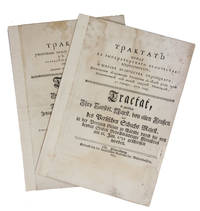
1729ref. K1VE5E3V8EEQSt. Petersburg 1729. Small folio 27.5 x 19.5 cm. Imperial Academy of Sciences Disbound. Two treaties between Russia and the Safavid Empire in Russian and German in 2 parallel columns. 10; 12 pp. Ad 1: Very rare first and only edition of the Treaty of Rasht a peace treaty between the Russian Empire and the Persian Safavid Empire concluded between the very young Tsar Peter II and Shah Ashraf who would both die a year later. After the Russian Tsar Peter the Great died in 1725 Russia faced difficulties in retaining the newly conquered lands around the Caspian Sea. The Safavids wished to push the Russians back from all Persian territory and after some minor battles they agreed to a truce in 1727 which was signed at Rasht in 1729. "The treaty incorporated a number of provisions that seemed to resolve all the outstanding issues between Russia and Persia but as a practical matter it was never put into effect. By the time the pact was signed Ashraf's regime was already on the verge of being overthrown by Nadir Quli Khan. . Having successfully disposed the Afghans i.e. Ashraf Nadir then turned his attention to the restoration of the Persian lands seized earlier by the Ottomans and the Russians" Sicker.Ad 2: Second copy located of the first and only edition of a new peace treaty between the new rulers of the Russian and the Safavid Empire concluded between Tsarina Anna and Shah Tahmasp II just a few months before the latter was deposed by Nadir Quli Khan the future Nader Shah.Upon restoring both treaties the title pages were switched; both have their spines strengthened some restorations to the fore-edge margins and some waterstains but all text is present and clearly legible; fair copies of two very rare treaties.l Ad 1: Catalogue de la section des Russica 820; WorldCat 46228166 835367631 3 copies; Ad 2: WorldCat 257721371 1 copy; cf. G. Mirfendereski A diplomatic history of the Caspian Sea 2001 pp. 14-15; M. Sicker The Islamic world in decline 2001 p. 57-58. unknown
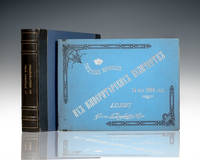
1896ref. 147804Kiev 1896. Rare portfolio of photographs by G. Lazovsky depicting the coronation of Tsar Nicholas II. Quarto original publisher's blue cloth with black and silver titles and tooling to the front panel 31 albumen prints on card mounts with the embossed blind stamp of the photographer and the mounts captioned in Cyrillic with printed slips each image 6.25 inches by 9.125 inches. The series of photographs in this album cover the coronation festivities from the 10th to the 26th of May 1896. Only two of the images are from the Coronation day itself the 12th which are of the procession as there was likely no photography in the cathedral where the coronation proper was held. Portfolio in very good condition. Photographs in near fine condition. The piece measures 10 inches by 13.75 inches. Housed in a custom half morocco clamshell box. We have never seen another set. The coronation of Tsar Nicholas II took place on May 26 1896 May 14 Old Style in the Dormition Cathedral within the Kremlin Moscow. As the last Emperor of Russia Nicholas II’s coronation was a grand and highly ritualized event symbolizing the divine right of the monarchy. The ceremony followed traditional Orthodox customs including anointment with holy oil and the placing of the Imperial Crown on his own head signifying his supreme authority. However the event was overshadowed by the Khodynka Tragedy where over a thousand people died in a stampede during public celebrations. This disaster foreshadowed the instability of his reign which ultimately ended with the fall of the Russian Empire in 1917. hardcover
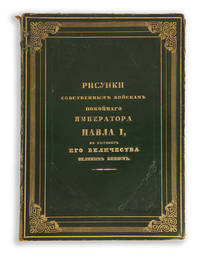
ref. 109898St. Petersburg Lithographic Department of the Military Settlement 1835. . First edition small folio 31 x 22 cm; lithographic title and 10 unnumbered coloured by contemporary hand title soiled at foot where mark of ownership erased bottom corners of leaves with very light staining pl. 7 with printed Russian caption and early manuscript German translation; contemporary green Russian morocco upper cover lettered in gilt both covers with elaborate panelling in gilt and blind flat spine in gilt panels gilt turn-ins blue endpapers gilt edges extremities rubbed tiny split in joint at head of spine a fine copy. Remarkably fine series of hand-coloured prints of military costumes after Paul I in an exceptional contemporary Russian binding. The book was printed at the personal bequest of his son Tsar Nicholas I in an incredibly small edition. The short reign of Paul I ended with his murder in 1801 and was marked by his obsession with dress uniforms. All ten of the figures in this rare suite are drawn in the same posture at attention with arms firmly clasped to sides and though this gives them a slightly doll-like quality they are painstakingly and beautifully coloured by a contemporary hand. Nicholas I viewed his father with deep reverence and also admired the pomp and order of the Imperial army this publication was an attempt to honour his father's legacy. [St. Petersburg], Lithographic Department of the Military Settlement, 1835. unknown