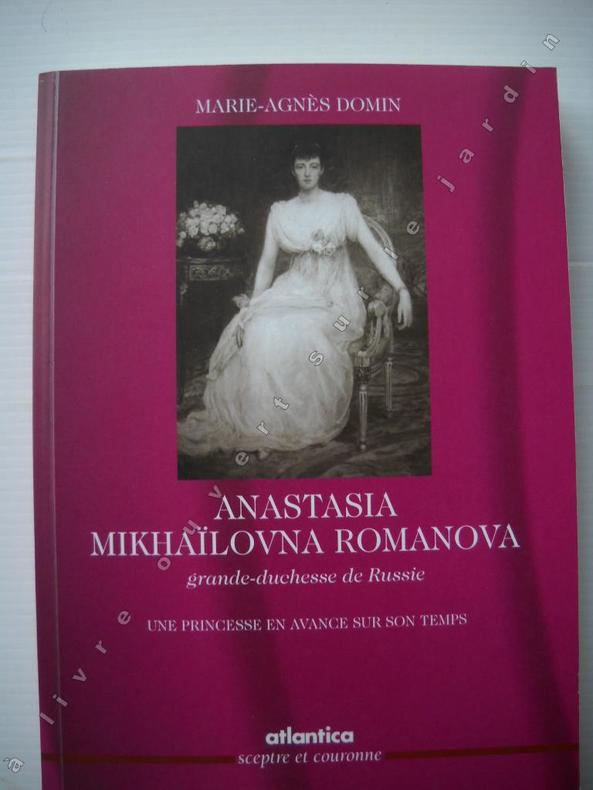
MARIE AGNES DOMINLivre Rare Book
539 Ergebnisse
Best.-Nr. 17110Broché - 15 x 21 - 215 pp - année 2002 - Editions Atlantica - généalogie -
1894Mm 155x230 Brossura editoriale di pp. 362 con tavole in bianco e nero fuori testo. La presente copia è la 19 delle 30 numerate e stampate su carta olandese. Piccole lacune al dorso ma buona copia. SPEDIZIONE IN 24 ORE DALLA CONFERMA DELL'ORDINE.
Best.-Nr. 16217Paris, Editions France-Empire, 1990 15 x 24, 271 pp., quelques illustrations en N/B, broché, très bon état.
Hardcover in-8, 467 pages, ill. h.t. n&b, carte, index, rel. cart. ed., jaq. ill. plast. Bel exemplaire. [CA29-1][CA-10]
Best.-Nr. 22360Paris, Grasset, 1934. 13 x 21, 331 pp., reliure dos cuir, tête dorée, couverture conservée, très bon état.
Best.-Nr. 61984Bruxelles, Les Editeurs d'Art Associés, 1988. 24 x 32, 334 pp., nombreuses illustrations en couleurs et en N/B, reliure d'édition pleine toile + jaquette, très bon état.
Best.-Nr. 65214Flammarion 1981 livre biographie 21*15 467 pages
1934Best.-Nr. pt1539Bernard Grasset Broché 1934 In-8 (13,5 x 21 cm), broché, couverture illustrée en noir et blanc, 328 pages, couverture sous protection plastique ; dos incurvé et plissé, coiffe de queue et bords inférieurs frottés, petite déchirure au niveau supérieur du mors postérieur, plats légèrement passés, intérieur frais, bon état général. Livraison a domicile (La Poste) ou en Mondial Relay sur simple demande.
Near fine/near fine (clean bright tight copy with no marks or inscriptions, hint of faint yellowing page edges, unclipped dj has one small crease lower edge) octavo 390pp. Historical biography.
Best.-Nr. 4246france empire 1987 - In 8 broché 370 pages
in-12°, 254 pages, frontispice, broché. Bon etat. [MA-4]
in-8°, 370 pages, broche, couverture illustree. Dedicace par l'auteur. Bon etat. [CA27/3]
1939Best.-Nr. 35091Zürich : Scientia[-Verl.], 1939. X, 403 S. : Ill. Gr. 8°. OLwd mit Goldpräg. ohne SU.
1894Milano, 1894, ottobre 28, bella copertina litografica illustrata a colori in fascicolo originale completo di pp. 8 De “La Tribuna – Supplemento illustrato della Domenica”
1983In-8°, pp. 511, una decina di tavole in b/n fuori testo, carta storico-geografica in b/n all'antiporta, tela editoriale con sovraccopertina figurata a colori e cofanetto in tela.
19381 Vol. In-16 pag. 355 12 ill. f.t Con sovracopt PROG 3447 CATT_ATT 56
1960Best.-Nr. 98376ABStuttgart, Verl. "Der Silberstreifen", 1960. 2. Deutscher Zentral-Ausgabe. Mit 1 Taf., wiederh. Schmuckbordüren auf jeder Seite u. illustr. Vorsätzen. 234, 1 S. OPbd. - Sehr gutes Ex. 2
Best.-Nr. A9781497926905Hardback. New. hardcover
1990From the Soviet government's archive a collection of pre-Revolutionary Russia photographs. Includes Index. 260 pages.
1896Milano, 1896, maggio 31, bella copertina litografica illustrata a colori in fascicolo originale completo di pp. 8 De “La Tribuna – Supplemento illustrato della Domenica”
Best.-Nr. 021158London: London: Thomas Nelson and Sons nd 12mo 119pp 8pp VG original decorative red linen boards slight lean light edgewear ffep cut out colour frontispiece illustration by Malcolm Patterson. Rare. London: Thomas Nelson and Sons nd 12mo 119pp + 8pp hardcover
Best.-Nr. 9786556374314-11-66728PONTES EDITORES. New. PONTES EDITORES unknown
Best.-Nr. 1330180283.Gpaperback. Good. Access codes and supplements are not guaranteed with used items. May be an ex-library book. paperback
1918Very Good German Original three silver gelatin and sepia-toned photographs. (23x17,5 cm & 18x12,5 cm). Mounted small papers on the front side of photos have trilingual descriptions in German, Ottoman Turkish, and Arabic. These photographs show the rare scenes from the Ukrainian front during World War I. 1-) Die Ukrainer beim Siegeln des Friedens Protokolls [i.e. The Ukrainians sealing the peace protocol]. 2-) Oberst Höfer, Kommandant der 17. Infanterie-Brigade, hat als Bataillon Kommandeur bein einem Sturm gegen die Russen, als er seinem Batallion Selbat vorausstürmte, den rechten Arm verloren [i.e. Colonel Höfer, commander of the 17th Infantry Brigade, lost his right arm as battalion commander in a rush against the Russians while charging ahead of his battalion in Selbat]. 3-) Deutsch-russischer Krakowiak an der ukrainischen Front (?) [i.e. German-Russian soldiers are dancing together on the Ukrainian front].
1917Very Good Turkish, Ottoman (1500-1928) Original lithographed proclamation on thin paper. (40x29 cm). In Ottoman script (Old Turkish with Arabic letters). 35 lines on one page. Heavily stained paper, slightly chipped extremities, overall a good copy. Extremely rare copy of this superb lithographed propaganda proclamation by the Russian naval forces, distributed to the "libertarian Ottoman nation", probably in Ottoman cities like Sinop, Trabzon, and Constantinople, against the Germans during World War I, written on July 5, 1917, in Sevastopol. It's printed from the original manuscript copy in a primitive riq'a script, translated into Ottoman script by probably the Russian army. Although the year is written as Hijri (1333) in the document, the day and month are specified as Gregorian. Interesting propaganda text in this proclamation prepared by the Russian government during the July Days and in a very complicated period between the February Bourgeois Democratic Revolution and the iconic October Revolution in 1917, against the counter-propaganda activities of Germany (such as Tovarish) and other Allied Powers during World War I. The text, translated into Ottoman Turkish, briefly tells that "the Russian nation is freed from the captivity of the tsars and has chosen to live in peace with soldiers, workers and peasants altogether" and the Ottoman nation and army should not cooperate with Germany. The document, prepared in the days when Russia's Galician Offensive began, predicts that the Russian army will undoubtedly be victorious on this front and that later also libertarian America will join the war on the side of the Allied Powers. SUPPORT BY THE US NAVY (AMERICAN CONNECTION) The defeats and losses at the battlefronts of the First World War, not least mounting economic pressures and food shortages at home, steadily reduced the authority of the tsarist government. When Nicholas II abdicated on 15 March 1917, the creation of a provisional government failed to stabilize the situation. A wave of political activity followed across Russia. Unsurprisingly, Sevastopol did not remain immune from such developments. On 19 March elections for a soviet (council) of deputies took place in the city. At the same time, sailors' committees were formed on the ships of the Black Sea Fleet, commanded by Vice Admiral Alexander Kolchak. Alexander Vasilyevich Kolchak (1874 -1920) was an Imperial Russian admiral, military leader, and polar explorer who served in the Imperial Russian Navy and fought in the Russo-Japanese War of 1904-1905 and the First World War. During the Russian Civil War of 1917-1922, he established an anti-communist government in Siberia - later the Provisional All-Russian Government - and became recognized as the "Supreme Leader and Commander-in-Chief of All Russian Land and Naval Forces" by the other leaders of the White movement from 1918 to 1920. His government was based in Omsk, in southwestern Siberia. Bending to the demands of the crews, on 13 May Kolchak ordered the renaming of battleships with imperial names such as Imperator Alexander III, which became the Volya (Will). By the early summer, discipline within the Black Sea Fleet was fast breaking down. On 20 June a delegation from the United States navy, headed by Rear Admiral James H. Glennon, visited Sevastopol, an important port of call on a tour of naval bases to determine how best to support the Russian war effort against Germany. This American support on June 20, probably, reflects the content which included the American sympathy in the document. In this situation, this document might be prepared by Kolchak and his supporters around him. The complete English translation of the text is below: Proclamation to the Ottoman nation by the libertarian Russian navy: This dreadful warfare, which has been going on for three years has shed the blood of the nations and destroyed their properties. Is this necessary? The Russian nation is freed from the captivity of the sultans (tsars). Russ


