JAHNN, Hans HennyAntiquariat.de
3 516 résultats
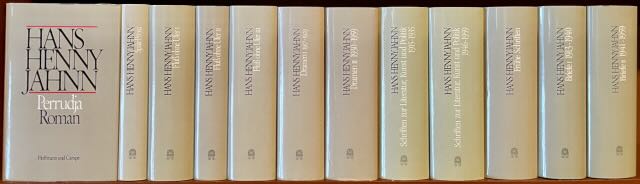
1994réf. 84265Hbg.: Hoffmann u. Campe 1985-1994. Zus. 13.736 Ss., 38 Bll. 8°. Graues Ln. mit schwarzem Rückentitel u. Umschl.
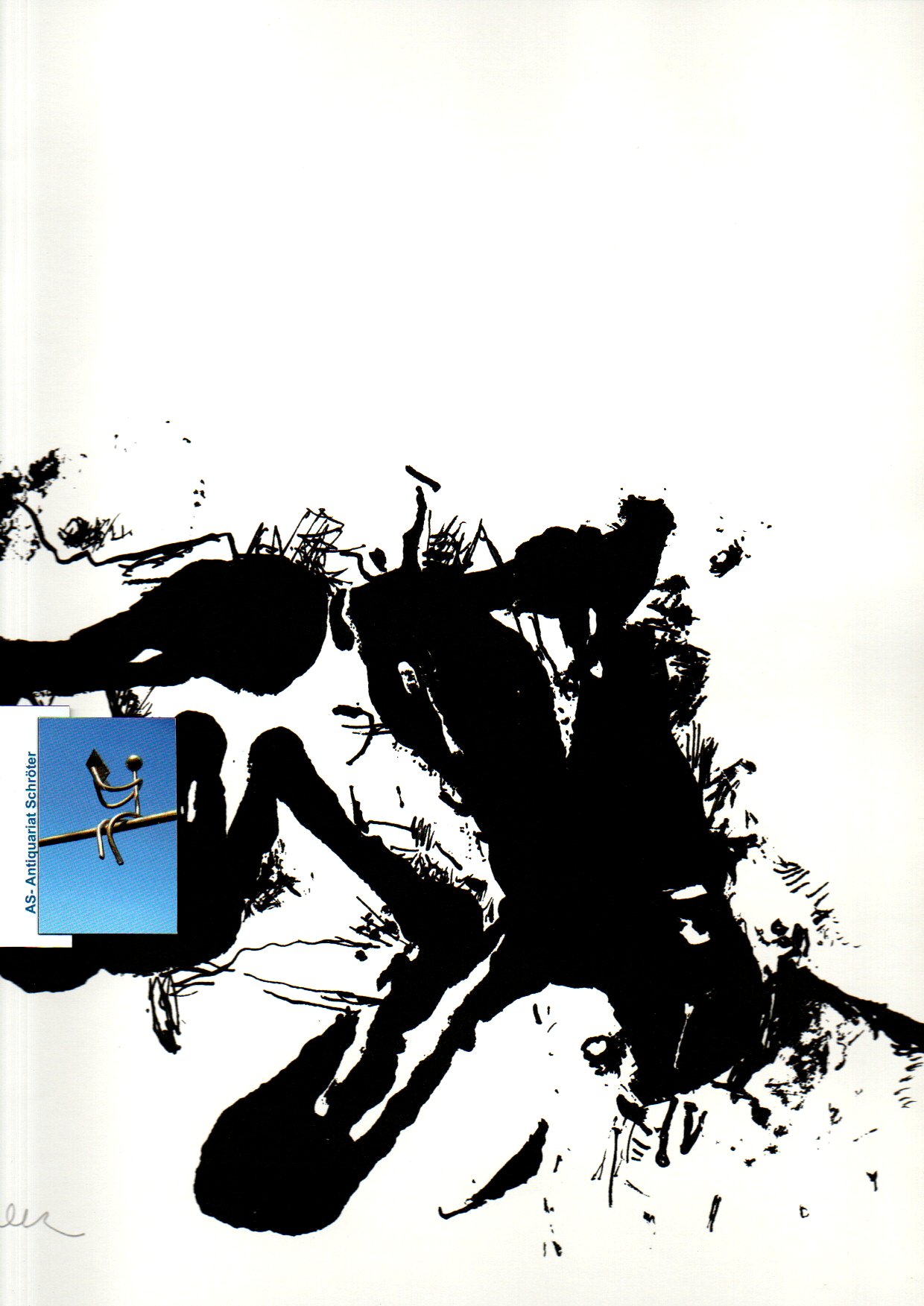
1959réf. 16461Galerie Müller, Stuttgart, 1959. Format: 34x34cm. Druck auf dünnerem, weissen Papier. Die Graphik ist ein Monatsblatt aus dem `kalender 1960 der galerie müller`. Der Kalender hatte eine Auflage von 80 signierten und nummerierten Exemplaren. Druck: Atelier für Siebdruck Haas, Stuttgart. Infos zur Galerie Müller : "Die----Galerie Müller in der Hohenheimer Straße, Stuttgart, gegründet 1958 von Hans-Jürgen Müller, einem der progressivsten Galeristen jener Zeit. Sie war stets und von Anbeginn mehr als nur Umschlagplatz zeitgenössischer Kunst: sie war Ort von Stimulans und Provokation. In den Jahren bis 1968 wurde Sie ? und damit die Stadt Stuttgart ? zum Anlaufpunkt europäischer Sammler-----1967 ist HJM Gründungsmitglied des 1. Kölner Kunstmarkts". Sehr seltene Arbeit. Good copy. Signed by the artist. Project by the famous gallery Müller in Stuttgart.
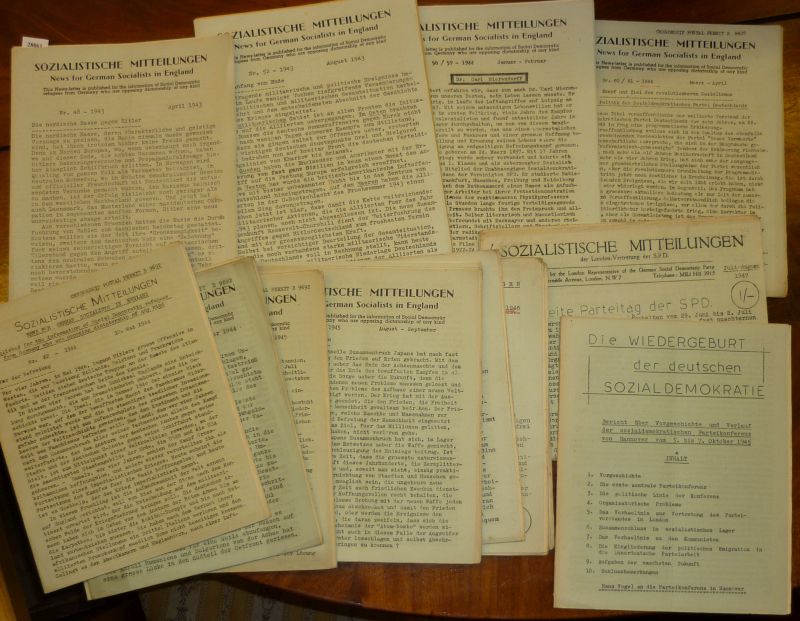
1943réf. 28061(London), Eigenverlag, 1943-1947. 4to (Nr. 101/102) u. 8vo. OBrosch. m. Deckeltitel.
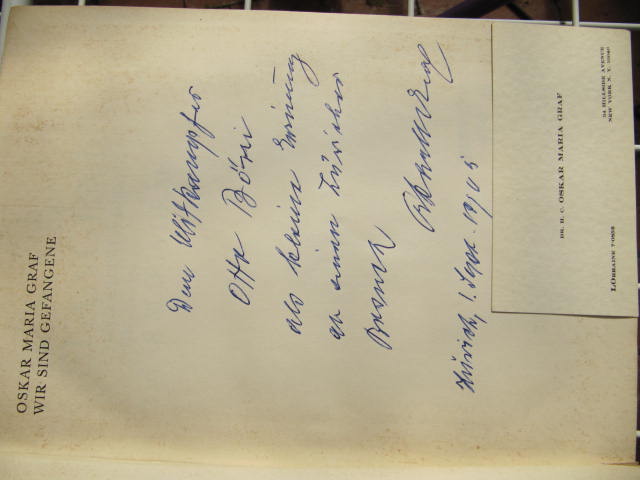
1928réf. 8485Verlag der Büchergilde Gutenberg, Berlin, 1928. 308(2) Seiten, geprägter roter OLn. Farb-Kopfschnitt. Auf dem Vorsatzblatt eine mehrzeilige Widmung von Graf: "Dem Mitkämpfer Otto Böni als kleine Erinnerung an einen Züricher Abend OskarMariaGraf, Zürich, 1. Sept. 1965". Des weiteren befinden sich eine Visitenkarte mit der New Yorker Adresse von Graf und ein Maschinenschreiben vom September 1965 ohne Namensnennung, auf dem die Schwierigkeiten einer Lesereiseorganisation beschrieben wird. Fest terminiert ist eine Signierstunde in der Buchhandlung Pinkus, Zürich. Buchausstattung Karl Koch, Hamburg. Wenige Flecken am Rand der ersten Seiten. Otto Böni (1895-1963) Das Leinen am unteren Kapital mit Fehlstelle. Gutes Exemplar. Good copy. Handsigned and dedicated by Graf. Ursprünglich 1927 im Drei Masken Verlag erschienen.
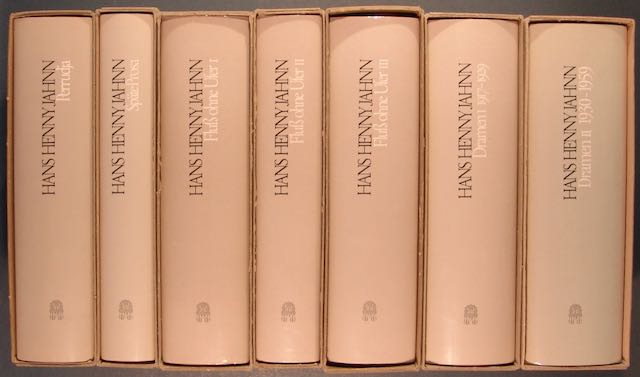
1994réf. 82748Hbg.: Hoffmann u. Campe 1985-1994. Zus. 13.736 Ss., 38 Bll. 8°. Graues Ln. mit schwarzem Rückentitel u. Umschl. in Schuber. [4 Warenabbildungen]
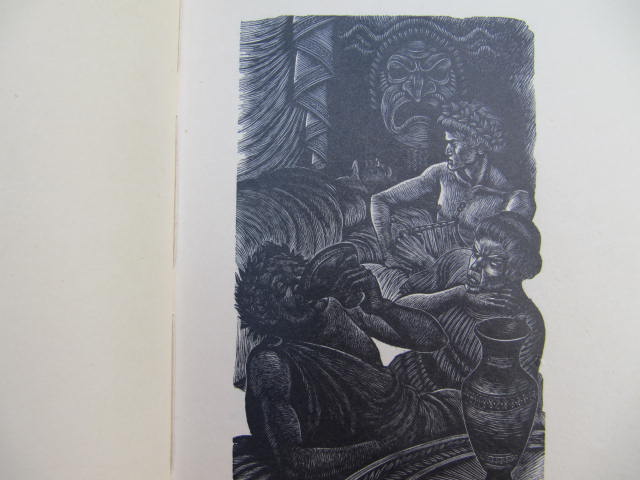
1987réf. 8490The Bear Press, Bayreuth, 1987. 64(3) S., O-Halb-Leder mit blindgeprägtem Vorderdeckel im OPapp-Schuber. Farb-Kopfschnitt, Fadenheftung. Druck in der Weiß-Kursiv auf Gekko Hodomura-Japan durch die Offizin Poeschel. Handschriftlich nummeriertes Exemplar: 90 / 150. Übertragung und Nachwort von Wolfram Benda. Spindler 73,9. Neuwertiges Exemplar. 9. Druck der Bear Press Wolfram Benda. Das Foto zeigt eine Graphik. Limited edition with three unknown graphics by Eichenberg (1901-1990).
1949réf. 1500Amsterdam, Bermann-Fischer 1949. OPp. 82 S. 8°. Mit mehrzeiliger Widmung der Verfasserin auf dem Vorsatz für ?Herrn M. Dormann mit allen guten Wünschen Nelly Sachs Stockholm d. 20.3.50. Bergsundstrand 23?. Rücken etwas gebräunt und an den Kanten berieben. Gut erhaltenes Exemplar.
1942réf. 6067ALondon, Penguin, 1942. 4°. 6 Textbl. u. 42 teils farbige Tafeln auf Albumblätter montiert. Mit 1 Originalzeichnung Szobels. Leinenband der Zeit.
1922Very Good Armenian Original fine red cloth bdg. with decorative gilt on board. Spine is repaired masterfully. Large roy. 8vo. (25 x 18 cm). In Armenian. [24], 429 p., 1 folded Armenian map of Turkey (map size: 24x33 cm), 29 unnumbered full-page b/w plates (one is folded). Armenian Golgotha is a memoir written by Grigoris Balakian about his eyewitness account of the Armenian Events. The memoir was released in two volumes. Volume 1, about his life prior to and during the Armenian Deportation, was released in 1922. Volume 2, about his life as a fugitive after the Deportation, was released in 1959. Originally published in Armenian, the memoir was later published in various languages including an English translation by Peter Balakian, Balakian's great-nephew, with Aris Sevag. Grigoris Balakian [or, Palakean, Palakian, Balakean], was a bishop of the Armenian Apostolic Church, in addition to being a survivor and memoirist of the Armenian Events in the Ottoman Empire. Grigoris Balakian was born in Tokat in the Ottoman Empire and graduated from the Sanasarian College in Erzurum. He had been studying architecture in Germany for two years and got a degree in civil engineering. He became a celibate priest ordained under the monastic name Grigoris Balakian. On 24 April 1915, he was among the group of 250 leading Armenian figures of Constantinople who were arrested and deported. One group was deported to Ayas. Balakian was deported to Çankiri, north-east of Ankara with the rest of the 190 other deportees from the capital. Only 16 of them would survive. He marched with 48 deportees from Çankiri in the direction of Deir Al-Zor in the Syrian desert. On the way, Balakian won the confidence of captain of constabulary Shukri Bey and learned about the Ottoman government's plan to exterminate the whole Armenian population. Balakian was able to flee toward Islahie. He joined a group of workers on the Bagdad-railway where Turkish deserters did forced labor alongside Armenian refugees. While Armenian workers between Marash and Bartche were being slain, Balakian fled to another construction site on the Bagdad railway. He was helped by German engineers and finally succeeded - disguised as Herr Bernstein - in escaping from Constantinople to Paris. At the 1921 trial in Berlin against Soghomon Tehlirian, the murderer of Talât Pasha, Balakian appeared as a witness for the defendant together with Johannes Lepsius. Soghomon Tehlirian was ultimately acquitted. Balakian became prelate of Manchester, London, and finally bishop of Marseille. Two churches were built under his guidance in Marseille and Nice (St. Mary, 1928) as well as a number of chapels and schools. He died in Marseille. Balakian is the granduncle of Anna Balakian, an expert on symbolism and surrealism who chaired New York University's Department of Comparative Literature, and the great-granduncle of Peter Balakian, an Armenian-American writer and winner of the 2016 Pulitzer Prize for Poetry. Balakian's memoirs in Armenian Golgotha are an important eyewitness account of the Armenian Events. He describes his experiences during the deportation. Balakian was one of the few surviving leaders of the Armenian community who gave an account of the deportation. Komitas (Gomitas) Vartapet belonged to the same group of detainees as Balakian. His information about the traumatization of the famous composer and founder of modern Armenian classical music is of eminent importance. OCLC: 1137218025. First Armenian Edition. Rare.
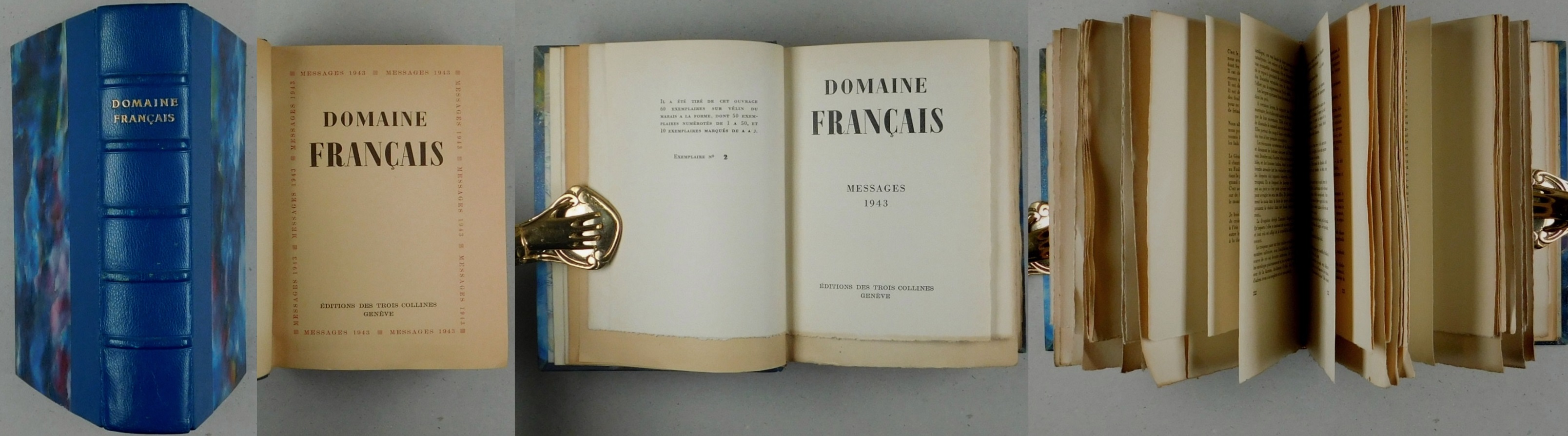
1943réf. 55113BBGenève, Éditions des Trois Collines, 1943. 8°. 445 p., 2 p. n.ch. Reliure demi maroquin bleu à 5 nerfs, titre doré, couverture conservée.
1943réf. 55113BBGenève, Éditions des Trois Collines, 1943. 8°. 445 p., 2 p. n.ch. Reliure demi maroquin bleu à 5 nerfs, titre doré, couverture conservée.
1937réf. 206596CBPrag/Zürich/Paris, 1937. 8°. 1.688 S. Hellrote Original-Broschur. Hefte 1 - 53 (cplt.). (Jedes Heft mit einer Papierspur vorn, insgesamt sehr guter Zustand).
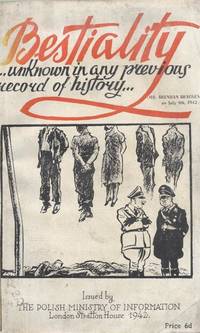
1942réf. 39727London: Stratton House 1942. with no dust jacket. First edition. Original illustrated wraps. 12mo. 56 pages. 19 cm. 'A Record of the German Barbarities in Poland in the First Six Months of 1942.' With two page map of concentration camps in Germany. Extremely detailed early report concerning Nazi atrocities executions concentration camps the extermination of the Lublin ghetto etc. Contents include: Introduction; Documents from Poland; General Sikorski's protest speech; Resolution of the Polish National Council; Press conference at the Ministry of Information; and Justice will be done: official statements and declarations. Included in in the "Documents from Poland" section is a piece on the "Destruction of the Jewish Population." "As early as 1940 the Government Delegate alerted London about the persecution of Jews in Poland. Thereupon the Polish government-in-exile sent a note on this subject to allied governments May 3 1941. Also in 1941 the Polish Ministry of Information in London published a booklet on the persecution of Jews in Poland entitled 'Bestiality Unknown in Any Previous Record of History' and based on information received from occupied Poland. In January 1942 the Ministry issued another publication 'The New German Order in Poland. ' Both publications created a stir throughout the allied world which after 1941 could no longer plead ignorance of the persecution of Jews in Poland. " "The Polish Underground State: A Guide to the Underground 1939-1945" Stefan Korbonski. The US Holocaust Museum keeps their copy in their Rare Book Room. Subjects: World War 1939-1945 - Poland. World War 1939-1945 - Atrocities. OCLC: 8022841. Staples show rust as generally found light rubbing to covers attractive and dramatic about Very Good Condition.B HOLO2-104-27C-MMACCBBE-I-'. London: Stratton House unknown
1949xvi, 319 pages. Black and white photographic plates. Maps. First reprint of the 1949 first edition. "In the great WWII Italian campaign against the German Army, the Poles played a part which gained them the admiration of their comrades and the respect of their enemies. They fought many a victorious battle alongside their Allies, but their greatest was at Monte Cassino. When the Polish standard floated proudly from the ruins of the monastery, it signalled the march to Rome." - Foreword. Hinges starting. Former military library copy with relatively few related markings to endpapers only. Somewhat above-average wear to publisher's red cloth-covered boards. A worthy copy of this proud history. ENSER p.341. Book
1965Original boards. 8vo, 1300 pages. SUBJECTS: Very Good Condition. (Neusner-4-3)
1807réf. PHO-2075Paris, L. A. Pitou, Octobre 1807. 2 vol. in-8° (204x127mm), de 312 pp. ; 404 pp. 2 gr. dépliantes en front. Basane fauve à motifs curieusement noircis laissant apparaitre le fauve par endroits, dos lisse orné, pièce de titre et de tomaison en maroquin havane, filet doré sur les coupes, tranches citron (Reliure du temps). Coins usés, légères épidermures, frottements aux charnières. De la bibliothèque de Michel Marie de POMEREU, Château du Héron, avec son ex-libris gravé. L'auteur dénonce, entre autres, les atroces conditions de détention des déportés. Usure aux coins, bon exemplaire.
1805réf. PHO-2400Paris, Chez l’auteur et chez tous les Marchands de Nouveautés, an XIII (1805). 2 vol. in-8 (19,6 × 11,8 cm) demi-basane brune à coins de parchemin vert, dos lisses ornés de motifs dorés (reliure de l’époque). Reliures légèrement frottées, légères rousseurs, petit travail de ver sans atteinte (tome 2)
1938réf. 4478Madrid, Imprenta Colectiva Torrent, 1938. 384 S., mit zahlreichen s/w-Abbildungen nach Fotografien auf Tafeln, Kartenskizzen und einem Faksimile. Original-Halbleinwand, mit Schutzumschlag, gr.8°. Deutsches Exilarchiv 5984. - Sternfeld/Tiedemann 254. Alfred Kantorowicz [1899-1979] war Mitarbeiter am Braunbuch (1933), nach dem Spanischen Bürgerkrieg floh er 1941 in die USA, nach der Rückkehr 1946 wuurde er Professor für deutsche Literatur in der DDR und Herausgeber der Werke Heinrich Manns, In Ungnade geraten, übersiedelte er 1957 min die Bundesrepublik. Der mehrfarbige Schutzumschlag in den Farben der Republik zeigt eine Karte der iberischen Halbinsel. Kommandant des Bataillons war der Schweizer Otto Brunner (1896-1973). Hardcover Schutzumschlag im Rücken eingerissen, minim fleckig. Falz gebrochen, Besitzvermerk auf fliegendem Vorsatz.
réf. 10945In 12 plein cuir fauve raciné à nerfs, pièces de titre en partie manquante, coiffes restaurées. Page de titre à la date de 1760 sans mentions de lieu ni d’éditeur. VIII, 520 pages. Deuxième édition publiée la même année que l’édition originale in 4. Il y développa le principe de la nouvelle école avec un franc parler, qui lui attira de nombreux suffrages et le fera emprisonné 5 jours au château de Vincennes, puis sera contraint à l’exil deux mois au château de Bignon. Il s’éleva notamment contre les fermiers généraux, il fit une critique sévère du régime fiscal alors en vigueur. Bon exemplaire
1924Very Good Turkish, Ottoman (1500-1928) Original autograph letter signed (ALS) by Ottoman princess 'Sükriye Serafeddin'. 17,5x14,5 cm. In Ottoman script (Turkish with Arabic letters). 1 p. [in four]. Bifolium. The letter starts with 'Huve' and it has 12 lines. She mentions a letter that was sent by this unnamed recipient to 'Serafeddin' who is probably from the Ottoman dynasty. Sükriye Sultan was an Ottoman princess, the daughter of the heir to the throne Sehzade Yusuf Izzeddin, son of Sultan Abdulaziz, and Leman Hanim. Sükriye Sultan was born on 24 February 1906 in Çamlica Palace. Her mother was Leman Hanim. She was the second child, and eldest daughter born to her father and the eldest child of her mother. She had two younger siblings, a brother, Sehzade Mehmed Nizameddin, two years younger than her, and a sister, Mihrisah Sultan, ten years younger than her. She was the granddaughter of Abdulaziz and Dürrünev Kadin.
1934réf. 12837Equinox Cooperative Press, New York, 1934. 61(1) Seiten, ca 22x15cm, Obedruckter Leineneinband, im Kolophon nummeriert (454/999) und von Thomas Mann mit Bleistift signiert. Das Rückenschild fehlt, insgesamt etwas angestaubt und leicht lichtrandig. Enthält erstmals in englischer Sprache die Kurzgeschichten: "A Gleam", "Railway Accident" und "A Weary Hour". Neunte Veröffentlichung der Equinox Cooperative Press. Minimaler Einriss am Leinen des Rückens. Ordentliches Exemplar dieser seltenen Exilk-Ausgabe. Good copy. Numbered and limited, Signed by Thomas Mann.
1937réf. 16408Edition Cosmopolites, Paris, 1937. 111(1) S., illustrierte OBroschur. Mit 7 Originallithographien von Max Beckmann auf Tafeln. Der Einband etwas verschmutzt und lichtrandig. Das Bild zeigt das Titelblatt. Sehr selten. Very rare. With 7 original graphics by Beckmann.
1960réf. 58268NP 1960. 9 x 7 1/8 inches. Black and white photograph a publicity still bears no attribution on the verso. Stravinsky is generally acknowledged as one of the most important and influential composers of the 20th century. Among his works are the ballets The Firebird 1910 and The Rite of Spring 1915 and the opera The Rake's Progress 1951 with libretto by W.H. Auden and Chester Kallman. Very good. #5145. unknown
1960réf. 58268NP 1960. 9 x 7 1/8 inches. Black and white photograph a publicity still bears no attribution on the verso. Stravinsky is generally acknowledged as one of the most important and influential composers of the 20th century. Among his works are the ballets The Firebird 1910 and The Rite of Spring 1915 and the opera The Rake's Progress 1951 with libretto by W.H. Auden and Chester Kallman. Very good. #5145. unknown books