3.518 Ergebnisse
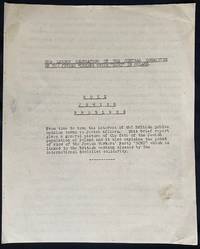
1945Best.-Nr. 43528No Place London: No Publisher London Delegation of the Bund 1945. No Date 1945 1st Edition. Original Stapled Paper Wrappers Small 4to 17 pages. Mimeograph production. Early 1945 Bundist report aimed at the British public on the impact of six years of Nazi extermination policy on Polish Jewry. "From time to time the interest of the British public opinion turns to Jewish affairs. This brief report gives a general picture of the fate of the Jewish population of Poland and it also explains the point of view of the Jewish Workers' Party 'BUND' which is linked to the British working classes' by the international Socialist solidarity" From the front cover. This early 1945 report to the British public on the destruction of and resistance by Polish Jewry lays out the brutal numbers and facts of ghettoization and then extermination as well as a detailed history of Bund-led Jewish resistance to the Nazis and to deportations to the camps. The mimeograph production and many typographical errors lend a kind of open authenticity to the document that of exiled Jewish trade unionists addressing their British comrades in England. It begins: "The Jewish nation has borne tremendous sacrifices in this war. Several million Jews have been first tortured in a sic inhuman manner and then murdered - several millions that is many times more than the losses suffered by the much more numerous communities of the British Empire and the United States put together. Polish jews sic suffered the greatest losses. There were nearly three and half millions of them living in six hundred Polish cities and towns not counting villages. First they were deported by the Germans to the few ghettos established by them in Poland. Soon afterwards the ghettos were emptied in turn and their 'deported' population was murdered in extermination camps and death chambers." The publication lists the figures for "the ten biggest ghettos of Poland" noting that "In these towns alone the Germans murdered more than one million Jews. Incidentally in all of them with the exception of Cracow Lwow and Czestowchowa 'Bund' was the dominant Jewish party. Out of the nearly three and half millions of Polish Jews there is only a small fraction left today. A small number of survivors have been saved from death by the victorious advance of the Soviet Army. The remainder of the Jews who are still alive under the German Occupation are either in concentration and forced labour comps or in hiding among the Polish population with whom they are fighting in the ranks of the underground movement. Those survivors address to us constant appeals for help and rescue." The solution at this point in the war is that "We must - and our brothers in Poland demand it - we must put such fear into the Germans that they stop the murders of Jews and all the other people whom they still hold in their weakening clutches." The authors are careful at this point to be clear that they do not see Zionism and the immigration of surviving Jews to Palestine as the goal for survivors and post-War Jewish life. They demand immediate assistance and reparations for survivors the criminalization of all antisemitic activity which "should be considered as an attack against the fundamental principles of democracy" and the reconstruction of Jewish life under Socialism in the countries where Jewish refugees now find themselves or in their countries or origin. "Immigration should be free and should not be regulated according to the nationality or religion of the emigrant. Any attempts at presenting the emigration of Jews as a separate problem and considering it as a means of solving the Jewish question always lead to anti-Jewish discrimination." .PALESTINE. does not offer a solution of the Jewish question. Even if one takes into consideration that millions of Jews have been murdered the present Jewish population of Palestine comprises at the most 5% of the number of Jews all over the world. Palestine does not solve the question of anti-semitism either. The majority of Jews will remain dispersed in many countries and in those countries the Jewish question will have to be solved on the spot and anti-semitism extirpated. Palestine is a country of the Jews living there and of the non-Jews who are her inhabitants. We believe that in the same way as we wish to see it in other countries in Palestine also the Jewish minority should build its future on a collaboration with the non-Jewish majority having at the same time a guarantee of a full equality of rights and a complete freedom of its own national and cultural development. We are not a homeless people. The home of the Jews is in the countries in which they live and with which they are linked by many ties. In the same way as for British Jews Britain is their homeland to which they are attached and which they do not want to give up and for American Jews the U.S. A. and French Jews France so for Polish Jews their homeland is Poland. The attitude towards Jews in various countries should be based on the principle that a country is a common homeland for the whole of its population irrespective of origin and religion. The fate of the Jewish population is irrevocably linked to that of the countries it inhabits. It means for the Jews in every country the necessity of fighting for the country's freedom prosperity progress and development as these are a condition of the Jews' own freedom prosperity progress and development. For us as a Labour Party of the Jewish population of Poland it means a fight for the freedom and independence of our country that if sic is of Poland and the building of her future and at the same time the future of Polish Jews on democratic and Socialist principles." The authors then outline the long history of the Bund's underground resistance work against the Nazis" including much on the Warsaw Ghetto Uprising. "In its activities which started on the first day of the occupation the 'Bund' collaborated with the Polish Workers' Underground Movement in the same way as before the war it collaborated with the Polish Socialist Party" including work within the trade union movement and among Jewish youth including 'regularly publishing our clandestine papers eight of them appearing every month.' To achieve this aim fighting detachments of the party were being developed and the whole organisation which from the very first has been proclaiming the idea of an armed struggle against the occupier began to prepare to oppose the 'deportations' to the extermination camps by an armed action. In October 1942 began the last phase of these preparations. The 'Bund' underground movement and the so-called Jewish National Committee an organisation comprising various Zionist groups got together and while preserving their political differences established a Co-ordination Committee and the joint 'Jewish Armed Resistance Organisation' Z.O.B. From that time onwards the armed struggle of the Jewish population in Poland has been led by this resistance organisation. In January 1943 the streets of the Warsaw Ghetto were the scene of the first armed engagement which lasted for several days.Space does not allow us to tell the full story of this rising which in any case had better be written in Poland and not abroad. According to our latest reports from Poland those few remaining survivors of the rising in the Warsaw Ghetto have been writing the story of the events in which they have taken part. After this rising fürther acts of Jewish armed resistance were reported from Poland;" these further acts are then listed and include: "BIALYSTOK In this city the Jews who before the war had been strongly under the influence of the 'Bund' put up a fierce resistance when the Nazis began to liquidate the ghetto in mid- August 1943. The armed rising lasted a month and was conducted with remarkable heroism. TREMBLIN sic This death camp where the Nazis had murdered hundreds of thousands of Jews was completely destroyed at the beginning of August 1943 by the Jews who were there at the time. They attacked the German guards and killed the entire Nazi unit thirty men strong. They seized the ammunition set fire to all the camp buildings and damaged electric cables. Afterwards two hundred Jews escaped to the neighbouring forest. u>SOBIBOR Heroism characterising the Tremblinka revolt marked also the rebellion of Jews at another extermination camp at Sobibor. The Jews revolted there in October 1943 and a large number of them escaped from the camp. General strike in the Lódz ghetto. In February 1943 a general strike broke out in the Lodz ghetto because of German executions. The strike was successful and the executions ceased. MAY DAY 1944 The few survivors of the 500000 Jews of the Warsaw Ghetto who had found refuge among the Polish population the 'Aryan' quarters of Warsaw have not ceased the struggle. Members of the Jewish Workers Movement in Warsaw and in other parts of Poland have even succeeded in organising this year special May Day celebrations. In Warsaw alone five armed Jewish May Day meetings took place." Additional battles between the Jewish-Polish underground and Nazi forces are described as well as underground Jewish resistance newspapers-including one still publishing several thousand copies per issue "distributed in Warsaw and in the provinces" in early 1945. "According to other reports the Jewish survivors of Warsaw organised themselves in fighting detachments. One detachment was named 'Michal Klepfisz' after the hero of the 'Bund' one of the leaders of the rising in the Warsaw ghetto.This detachment distinguished itself particularly during the severe fighting with the Germans for the Old City quarter of Warsaw. General Bor the Commander of the Warsaw uprising gave the detachment special recognition and stated that it alone had killed three hundred Germans and captured a large amount of German arms and ammunition. The other Jewish detachment was fighting under the name of 'Berek Joselewicz' well known historical figure of the Kosciuszko insurrection in Poland in 1794. This detachment took part in the siege and occupation of the main Warsaw post office building. General Bor reported that this Jewish detachment captured more than hundred Germans. 'Even now' it would be difficult to find words which would testify better to the continuity of action and of the struggle waged by the Jewish Workers' Movement irrespective of circumstences sic. After three battles in Warsaw after the slaughter of millions of Jews and the loss of the most valued comrades this movement is still fulfilling its difficult task of fighting th oppression and bringing help to the victims of the Germans." The publication gives a brief introductory history of the Bund appropriate for a British reader which events from the recent past such as: 1936. 'Bund' organised a political strike to protest against anti-Jewish riots which took place in the little town of Przytyk. Hundreds of thousands joined the strike which was supported by many Polish Socialists and by workers organised in Polish Trade Unions. 1938-39. During the municipal elections the majority of the Jewish population in the big cities and in many towns of Poland voted for 'Bund'. In Warsaw out of twenty Jewish municipal councillors 17 belonged to the 'Bund' and only three represented other parties. Finally the authors offer other details about the Bund its strength its publications and its various cultural and political activities concluding with great impact with a description of the "well known Medem Sanatorium for children at Miedzesyn near Warsaw.The sanatorium remained open until 1942 when the Germans 'deported' all the children to extermination camps. The sanatorium's staff were allowed to choose between staying at their posts or accompanying the children. They all chose the latter and together with the children left by a death-train for the notorious Treblinka Camp." OCLC: 504396338. OCLC locates only 1 copy worldwide British Library none in North America or Israel. Light wear and toning very well preserved Very Good Condition. Rare and important. PBERL-1-12-XX. No Place [London]: No Publisher [London Delegation of the Bund] unknown
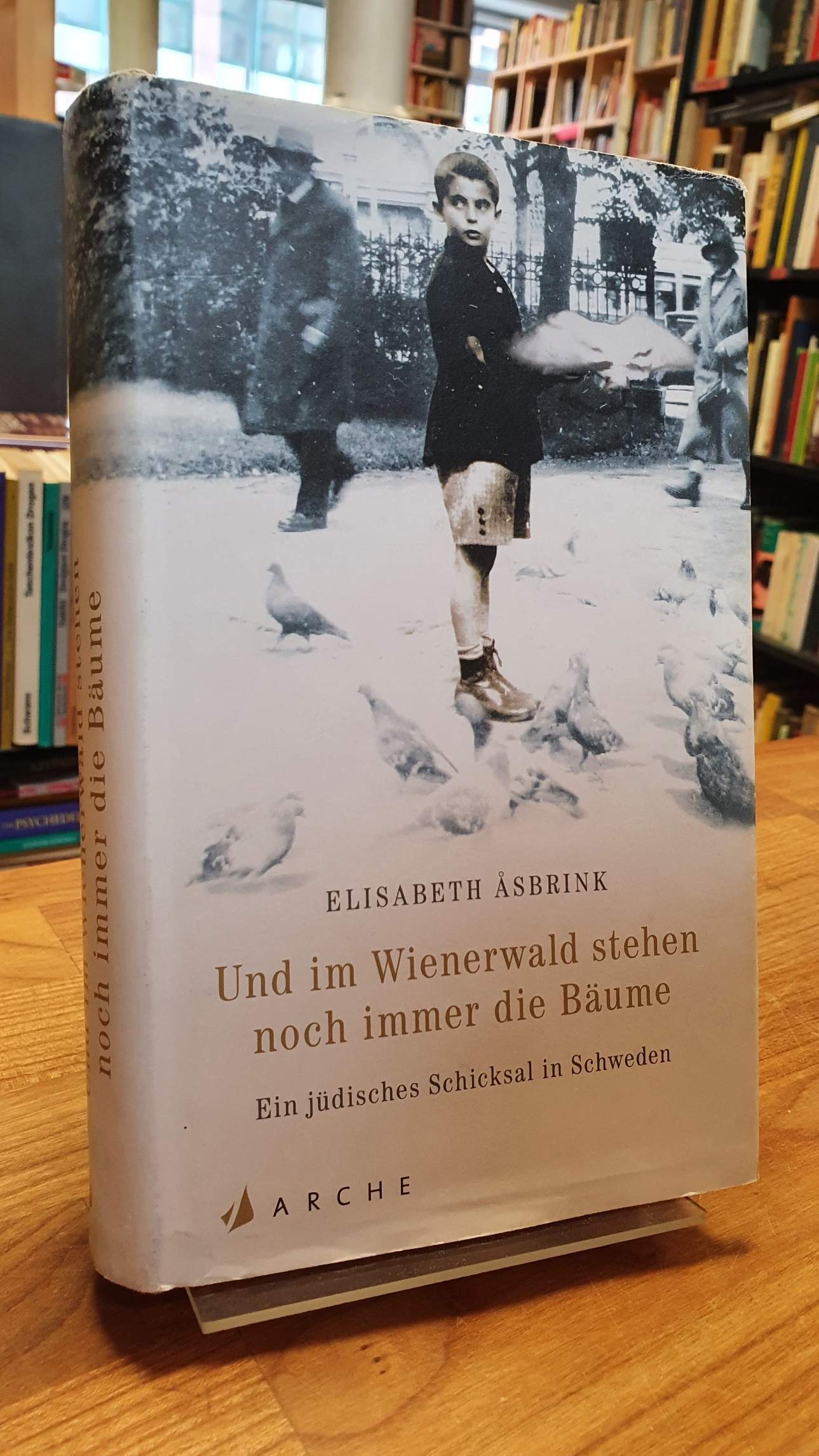
2014Best.-Nr. 11302BBZürich/Hamburg, Arche, 2014. 8°, 409 S., mit zahlreichen s/w-Abbildungen auf Tafeln, Initialen zum Kapitelanfang, original Pappband (Hardcover), illustr. original Schutzumschlag, Musterpapiervorsätze, deutsche Erstausgabe Schutzumschlag geringfügig knickspurig, sonst ein sehr gutes, sauberes Exemplar, (ca)
Best.-Nr. 80100Bruxelles, Crédit Communal de Belgique, 1985. 21 x 30, 104 pp., nombreuses illustrations en N/B, broché, très bon état.
1975Best.-Nr. 3248ABAustin, The University of Texas at Austin / Dept. of Germanic Languages, 1975. 8°. 6 Bl. (S. 531-542). OBr. (= Dimension. Contemporary German Arts and Letters / Vol. VIII, No 3, 1975).
1960Best.-Nr. 3235ABWien Köln, Amandus, (1960). 8°. 75 (1) S. OLn. OUmschl. mit bedruckter Schleife: Zur Burgtheater-Premiere des 'Galileo Galilei' von Frank G. Zwillinger bei den Bregenzer Festspielen 1960.
1980Best.-Nr. 3241ABSt. Michael, Bläschke, (1980). 8°. 84 S. 2 Bl. OEnglbr.
1980Best.-Nr. 3242ABSt. Michael, Bläschke, (1980). 8°. 75 S. 2 Bl. OEnglbr.
1976Best.-Nr. 3245ABDarmstadt, Bläschke, (1976). 8°. 119 S. OEnglbr.
1962Best.-Nr. 3246ABBayreuth, Baumann, 1962. 8°. 80 S. OHLn. OKlarsichtumschlag.
1980Best.-Nr. 3243ABSt. Michael, Bläschke, (1980). 8°. 88 S. OEnglbr.
1976Best.-Nr. 3244ABDarmstadt, Bläschke, (1976). 8°. 108 S. OEnglbr.
1963Best.-Nr. 3236ABWien, Limpert, (1963). 8°. 150 S. OLn. OUmschl. mit bedruckter Schleife: gewürdigt mit dem Theodor-Körner-Preis 1964.
1963Best.-Nr. 3239ABWien, Limpert, (1963). 8°. 136 S. OLn. OUmschl. mit bedruckter Schleife: gewürdigt mit dem Theodor-Körner-Preis 1964.
1963Best.-Nr. 3237ABWien, Limpert, (1963). 8°. 132 S. OLn. OUmschl. mit bedruckter Schleife: gewürdigt mit dem Theodor-Körner-Preis 1964.
2000Best.-Nr. 63193München : Langen Müller 2000. 383 S. ; 22 cm, mit Schutzumschlag Pp., gebundene Ausgabe, Hardcover/Pappeinband, Exemplar in gutem Erhaltungszustand
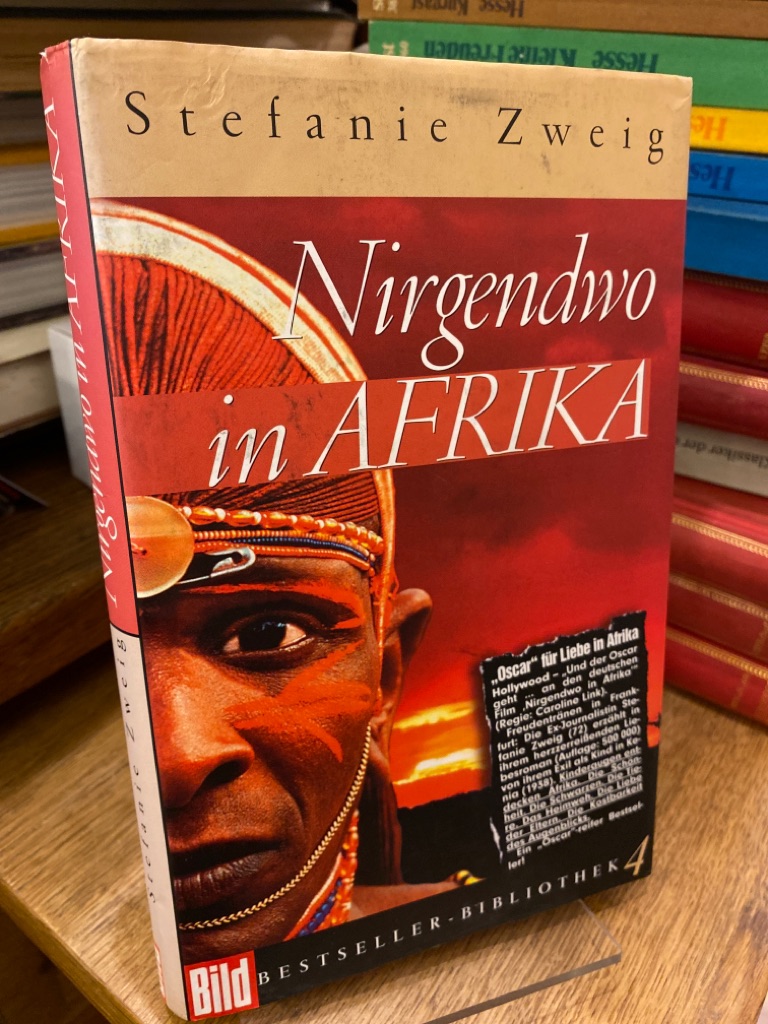
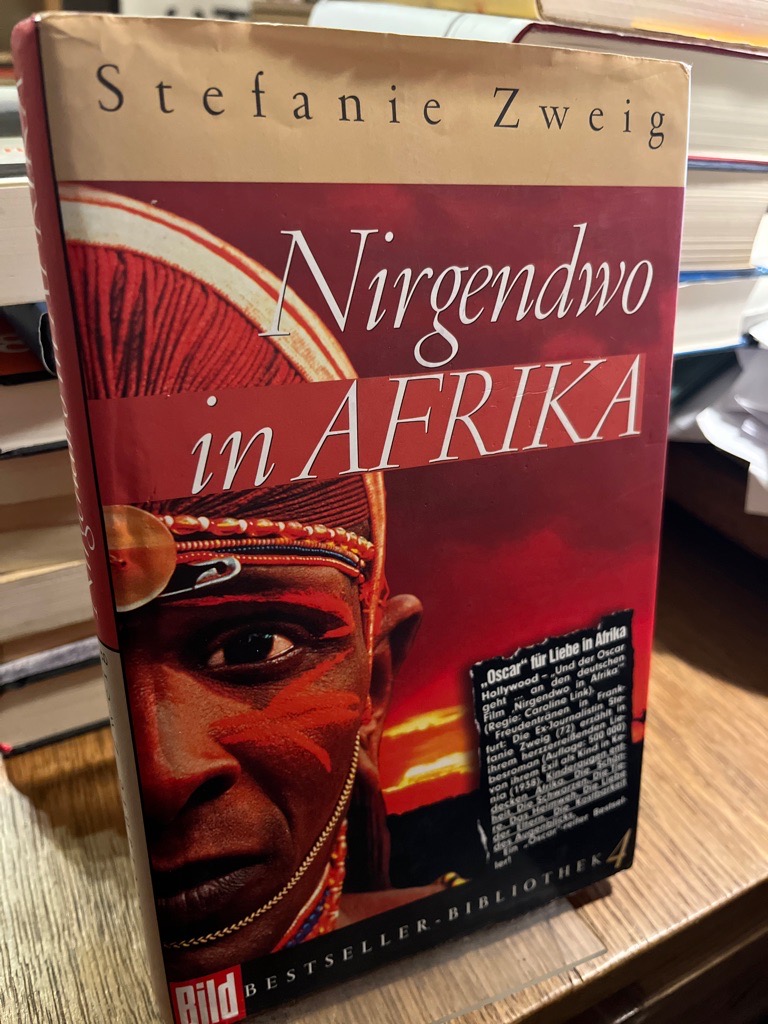
2004Best.-Nr. 116403Augsburg : Weltbild, 2004. 287 S. ; 22 cm; gebunden, Orig.-Pappband mit Original-Schutzumschlag;
2004Best.-Nr. 133474Augsburg : Weltbild, 2004. 287 S. ; 22 cm; gebunden, Orig.-Pappband mit Original-Schutzumschlag;
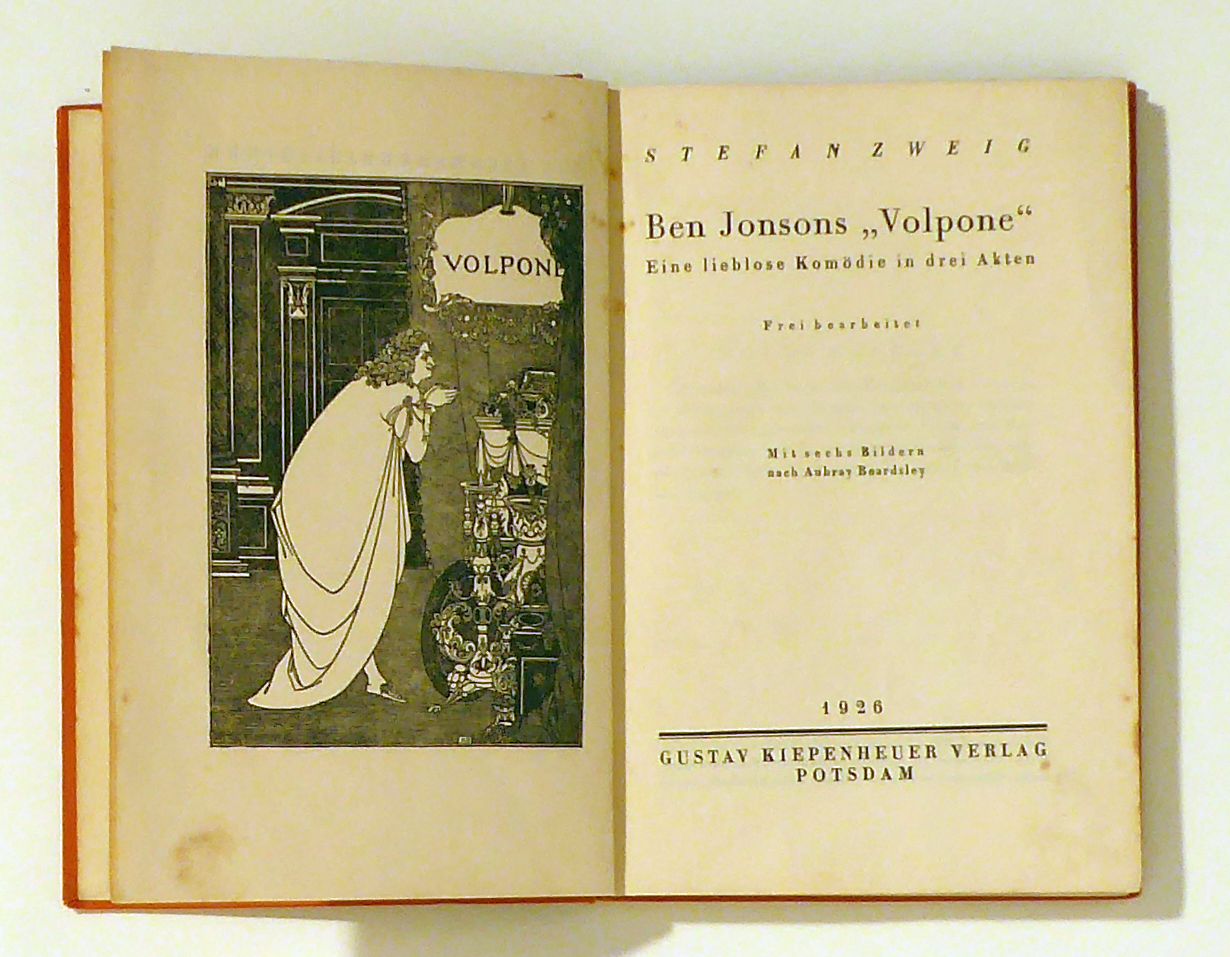
1926Best.-Nr. 22116Potsdam, Kiepenheuer, 1926. 148 S., mit 6 s/w Illustrationen, davon eine als Frontispiz nach Zeichnungen von Aubray [sic] Beardsley. Or.Lwd., 8°. Klawiter 125. - Wilpert/Gühring2, 69. Hardcover Einband etwas fleckig, Ecken bestossen. Schnitt und Seiten im weissen Rand etwas stockfleckig, abgegriffen. Die Liebhaberbibliothek
1952Best.-Nr. 213028Erinnerungen eines Europäers. Tsd. (Frankfurt), S. Fischer, 1952. 394 S., 4 Bl. Or.-Lwd.
1968Best.-Nr. 216674Erinnerungen eines Europäers. 34. Tsd. Frankfurt, G. B. Fischer, 1968. 394 S., 4 Bl. Or.-Lwd. mit Schutzumschlag; dieser mit kl. Randläsuren. - Gutes Exemplar. [2 Warenabbildungen]
1962Best.-Nr. 207541Erinnerungen eines Europäers. Frankfurt, G. B(ermann) Fischer, 1962. 394 S., 4 Bl. Or.-Lwd.; tlw. etwas verblasst, Rückenprägung beschabt. [2 Warenabbildungen]
1939Best.-Nr. 2208ABStockholm/Amsterdam, Bermann-Fischer/AdL/Querido, 1939. 8°, 398 S., 1 Bl.(= Vlgsanz.), illustr. OBrosch., RKanten etw. berieben, ger. Gebrauchssp.; gutes Expl.
1936Best.-Nr. 5376ABWien/Lpz./Zrch., Reichner, 1936. 8°, 575 (+1)S., 10 Taf., grauer OLwdbd.m. gold/blaugeprägt. TSchrift u. ROrnam., Bd. (materialbedingt) stärker gebräunt, Ex Libris; innen schönes Expl.
1935Best.-Nr. 2174ABWien, Reichner, 1935. 8°, 228 (+1)S., 1 Bl.(= Inh.) m. Abb., heller OLwdbd.m. rotgeprägt. VDeckel-Vign., Bd. etw. fleckig, Schnitt schwach stockfl.; gutes Expl.
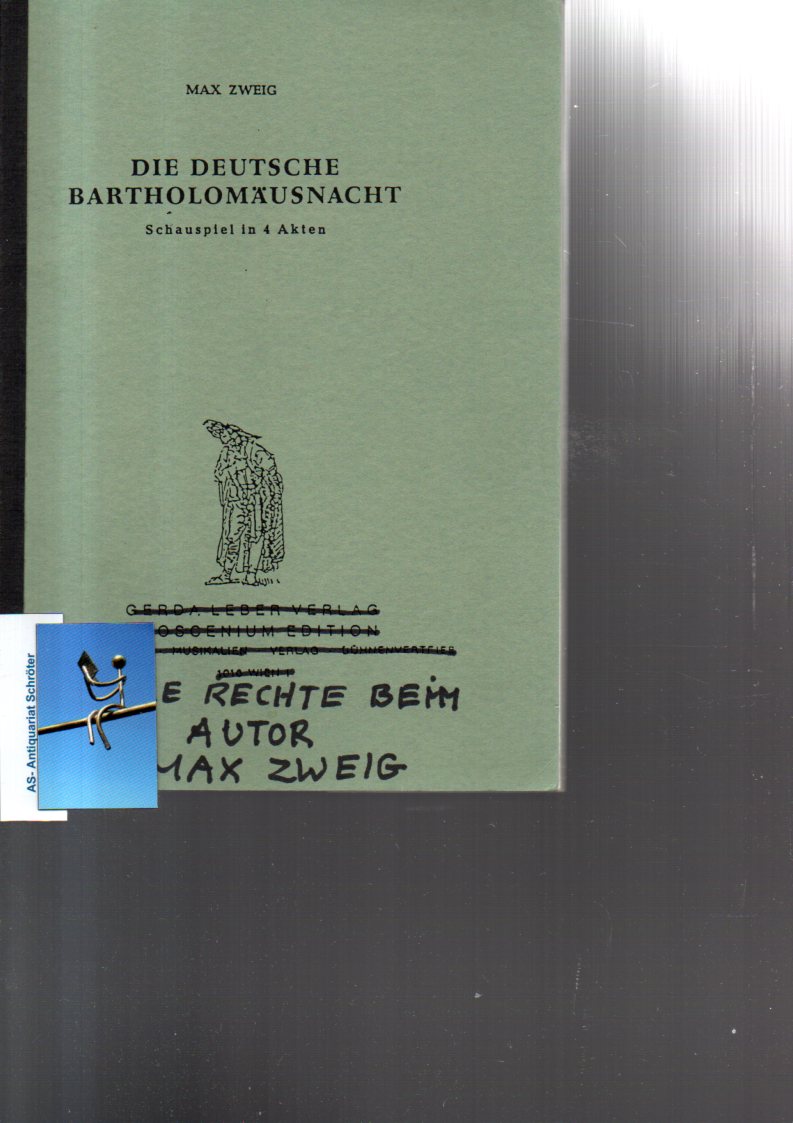
1984Best.-Nr. 14071Gerda Leber Verlag, ursprünglich, 1984. Seiten 79-148, OHalb-Leinen in Broschur, signiert und gewidmet. ("dem verehrten Herrn Prof. Joachim Günther herzlich und dankbar gewidmet. Max Zweig März 1986."). Korrektur des Impressums sowie hand- und maschinenschriftlichen Änderungen des Schlusses. Unikat. Gutes Exemplar. Selten. Very rare. Good copy, signed by the author. Das Buch stammt aus der Bibliothek eines Autographensammlers. Prof. Dr. sc.oec. Joachim Günther (* 7. Oktober 1918 in Oelsnitz/Erzgebirge; ? 5. Januar 1976) war ein deutscher Verkehrswissenschaftler sowie Professor und Rektor der Hochschule für Verkehrswesen (HfV) in Dresden. Max Zweig (geboren 22. Juni 1892 in Prossnitz, Österreich-Ungarn; gestorben 5. Januar 1992 in Jerusalem) war ein österreichisch-israelischer Dramatiker.