4 271 résultats
1980réf. 13190New York: Warner Books 1980. First Edition Third Printing. Cloth. Fine/very good. First edition of The Real War inscribed by President Richard Nixon to New York Post columnist and member of "Nixon's Enemies List" Max Lerner. Octavo 341pp. Red cloth title in silver on spine. Stated "first printing" on the copyright page but with the number line ending at 4. A fine example. In the publisher's dust jacket $12.50 retail price on front flap light shelf wear short closed tear to rear panel a very good example. Inscribed on the half title: "To Max Lerner - Who understands the Real World described in this volume - from Richard Nixon. 3-11-'82." Max Lerner 1902-1992 was a liberal syndicated columnist with the New York Post. His outspoken opinions and antiwar columns earned him a spot on "Nixon's Enemies List." By the 1980s he become more conservative expressing support for Margaret Thatcher and Ronald Reagan. Warner Books unknown books
1981réf. 13545New York: Air Cargo News Inc 1981. First Edition First Printing. Cloth. Very good. Inscribed to President Richard Nixon first edition of Great Airports: Kennedy International by Geoffrey Arend. Quarto 200pp. Black cloth title in silver on spine and front cover. No additional printings noted. Slight bow to covers otherwise solid text block. Lightly rubbed corners dust remnants to edges. Signed by the author on the front free endpaper with his personal note card laid in. Reads: "3/18/87 for President Nixon - with admiration and all good wishes - Respectfully Geoffrey Arend." It is unclear if President Nixon received this book or if it was deaccessioned from his personal library. Air Cargo News, Inc unknown books
1982réf. 11658New York: Warner Books 1982. First Edition First Printing. Hardcover. Near fine/very good. First edition of Leaders by Richard Nixon inscribed to Ambassador Lester B. Korn. Octavo 371pp. Blue hardcover black cloth spine title stamped in silver on spine. Stated "first printing" on copyright page with full number line. Faint dust along top edge of text block. In publisher's dust jacket retail price on the front flap light shelf wear and chipping along top edge a very good example. Signed on the half title: "To Lester & Carolbeth Korn With best wishes from Richard Nixon. 3-8-83." Ambassador Lester B. Korn 1936-2020 was the co-founder of Korn/Ferry International. From 1987-1988 Korn served as Ambassador to the United Nations as the United States Representative to the Economic and Social Council. Warner Books hardcover books
1970réf. 11876Washington DC: The White House 1970. Signed Proclamation. White Matte. Near fine. Executive Order appointing Bryce N. Harlow Counsellor to the President as Chairman and a Member of the Property Review Board signed by President Richard Nixon. This document was executed on April 20th 1970 at The White House an addendum to Execu. Typed on one legal size sheet of paper mounted in white matte tape on verso. Full piece measures 17.5" x 11." Executive Order No. 11508 one of 346 issued by President Richard Nixon provided for the identification of unneeded Federal real property in the United States. The study took three years and found 345 federal properties comprising 57350 acres of public land which would be transferred to state or local control. An exceptionally scarce piece from the estate of Bryce N. Harlow with no other known examples of signed Executive Orders on the public market. Bryce N. Harlow 1916 - 1987 began his career in the executive branch serving as an administrative assistant head speechwriter and deputy assistant for congressional affairs in the Eisenhower Administration. In 1960 he was a speechwriter for Vice President Nixon's unsuccessful presidential campaign. With Nixon's election In 1968 Harlow was one of the first presidential appointments of the new administration serving as a congressional liaison and later Counselor to the President. Harlow was awarded the Presidential Medal of Freedom in 1981 by President Ronald Reagan. He died in 1987. The White House unknown books
1980réf. 11781New York: Warner Books 1980. First Edition First Printing. Cloth. Near fine/near fine. First edition of The Real War by Richard Nixon inscribed to Court of Appeals Judge and Senator James L. Buckley. Octavo 341pp. Red cloth title in silver on spine. Stated "first printing" on copyright page with full number line. Illustrated endpapers with maps of the world. Ownership notation on front free endpaper. In publisher's dust jacket $12.50 retail price on front flap light shelf wear a very good example. Inscribed on a bookplate: "Richard Nixon for Jim Buckley." Senator James L. Buckley b. 1923 is the brother of conservative icon William F. Buckley Jr. Buckley served in the United States Senate from 1971-1977 representing the State of New York. He later joined the Reagan Administration in 1981. He served as Counselor of the Department of State and was later appointed to the United States Court of Appeals - District of Columbia Circuit. He is the author of four books including: If Men Were Angels: A View from the Senate 1975 Gleanings from an Unplanned Life 2006 Freedom at Risk: Reflections on Politics Liberty and the State 2010 and Saving Congress from Itself: Emancipating the States & Empowering Their People 2014. Warner Books unknown books
1990réf. 12058Yorba Linda CA: The Nixon Library 1990. Color Photograph. Framed Photograph. Near fine. Presidential group photograph at the Richard Nixon Presidential Library and Birthplace with printed signatures. Framed and matted photograph with 8.5" x 11" color image of the former Republican Presidents of the United States. Decorative wood frame beige matte with gold trim glass cover measures 17" x 14." Republican Presidential Task Force stamped in gilt along upper border. Facsimile signatures of all the former presidents and their wives. A fine piece. The Nixon Library unknown books
1969réf. 12001Washington DC: The White House 1969. Signed Photograph. Color Photograph. Very good. Signed photograph of President Richard Nixon and the full Nixon family at the White House in 1969. Framed color photograph gold leaf frame with creme matte measures 13" x 10." Impression to middle of photograph not examined outside frame. This first family portrait was taken at the White House on June 15 1969. Signed along the bottom of the matte by President Richard Nixon First Lady Pat Nixon David Eisenhower Julie Nixon Eisenhower and Tricia Nixon. Inscribed along top edge of matte by Pat Nixon: "To Judge J. Walter Yeagley With best wishes from our family." The recipient of this photograph J. Walter Yeagley 1909-1990 served on the District of Columbia Court of Appeals from 1970-1984. Before his appointment to the Court of Appeals he was Assistant Attorney General and director of the Internal Security Division of the Justice Department. In this position his work focused on citizens with suspected Communist affiliations working closely with FBI Director J. Edgar Hoover. Judge Yeagley died in 1990. The White House unknown books
1969réf. 11020Washington D.C.: The White House 1969. First Edition. Paper. Fine. Signed copy of the Inaugural Address of President Richard Nixon delivered on January 20th 1969. Octavo 8pp. Housed in blue cloth folio title on cover in gilt. Speech is printed on 8 separate loose leaf pages and resides in a cloth pocket in the folio. This copy is signed on the last page by President Richard Nixon dated 2-18-81." A fine example and a scarce signed copy of President Nixon's first inaugural address. Richard Nixon 1913-1994 was sworn in as the 37th President of the United States on January 20th 1969. The oath of office was administered by Chief Justice Earl Warren. Nixon struck a calming tone in the address urging Americans "to lower our voices.for we cannot learn from one another until we stop shouting at one another. [The White House] unknown books
1982réf. 11227New York: Warner Books 1982. First Edition First Printing. Hardcover. Near fine/near fine. First edition of Leaders by Richard Nixon inscribed to California Congressman Donald H. Clausen. Octavo 371pp. Blue hardcover black cloth spine title stamped in silver on spine. Stated "first printing" on copyright page with full number line. Light foxing along top edge of text block. In publisher's dust jacket retail price on the front flap light shelf wear but overall a near fine jacket. Includes JSA Certification and associated paperwork. Signed on the half title: "To Don Clausen With appreciation for his years of faithful service to the nation. from Richard Nixon. 11-7-82." Donald H. Clausen 1923-2015 was a member of the U.S. House of Representatives from 1963-1983 serving the north coast of California for 20 years. He was remembered as a bipartisan lawmaker who delivered major federal work projects to his district including Warm Springs Dam. He died in 2015. Warner Books hardcover books
1983réf. 11350New York: Little Brown and Company 1983. First Edition / Limited Edition. Cloth. Fine/near fine. Signed first edition of Real Peace by President Richard Nixon. Octavo 106pp. Blue cloth title in gilt on spine. Stated "First printing September 1983" on copyright page. In publisher's dust jacket light wear along bottom edge a near fine example. Includes the publisher's presentation slip offering an early copy to booksellers. This book is signed by President Richard Nixon on the front free endpaper. A scarce piece with the original distribution paperwork. This work by former President Richard Nixon contends the USSR and the United States have been engaged in WWIII since the end of WWII. Actions like allowing the Nazi regime to crush Polish resistance and other peaceful geopolitical actions have served to advance the communist agenda in all areas of the world. Little, Brown and Company unknown books
1977réf. 10614New York: Simon and Schuster 1977. First Edition. Hardcover. Very good/near fine. First edition of Special People by Julie Nixon Eisenhower signed by the author. Octavo 217pp. Yellow boards blue cloth spine title in gilt on spine. First edition first printing with full number line on copyright page. Lean to text block. In publisher's first edition dust jacket $8.95 on front flap near fine condition. Inscribed to Bonnie Swearingen from Julie Nixon Eisenhower. Includes a letter from President Nixon praising the book addressed and signed by him in 1977. From the estate of John E. Swearingen the president of Standard Oil of Indiana and one of the most influential oil executives of the 20th century. When he became CEO in 1960 he deemed Indiana Standard Oil to be a "second-rate company." Through aggressive research and oil exploration Indiana Standard quickly became one of the most profitable companies in the United States. Swearingen was vocal about his dislike for federal regulators often supporting Republicans who shared his views on limited government. In retirement he was a close friend of presidents Gerald R. Ford and Richard Nixon. Swearingen died in 2007 survived by his wife Bonnie Swearingen who passed away in 2020. Simon and Schuster hardcover books
1986réf. 10458New York: Simon and Schuster 1986. First Edition First Printing. Hardcover. Near fine/near fine. A scarce copy signed by First Lady Pat Nixon of the biography Pat Nixon: The Untold Story by her daughter Julie Nixon Eisenhower. Octavo 480pp. White cloth title on spine. The first printing with a full number line on the copyright page. In publisher's near fine dust jacket retail price on front flap faint toning to spine. Signed by Pat Nixon on Nixon Library bookplate. Simon and Schuster hardcover books
1973réf. 2166Washington DC: 1973 Inaugural Committee 1973. First Edition. Hardcover. Fine/near fine. First edition of The Inaugural Book 1973 signed by the brother of President Richard Nixon Edward Nixon. Octavo 93pp. Blue hardcover title in gilt on spine Great Seal of the United States on front cover in gilt. Stated "first edition" on title page and front cover of dust jacket. In publisher's dust jacket $7.95 on front flap small chip at top edge near fold otherwise in fine condition. Signed on front free endpaper by Edward Nixon. Edward Nixon 1930 - 2019 was the youngest brother of President Richard Nixon. He served on the inaugural committee during the 1973 election and is mentioned in this book. As the Watergate scandal evolved it was revealed that Charles "Bebe" Rebozo gave campaign contributions to Rose Mary Woods Donald Nixon and Edward Nixon. He was the longest living Nixon brother and the last surviving brother when he passed away in 2019. 1973 Inaugural Committee hardcover books
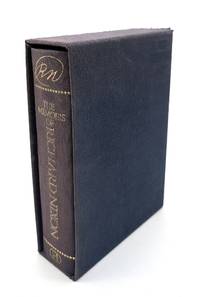
1980réf. 1606New York: Warner Books Inc 1980. First Printing / Limited Edition. Cloth. Fine. The limited edition of The Real War signed by President Richard Nixon. Octavo 12 341pp 1. Red cloth gilt lettering on spine cloth spine and covers maroon slipcase in fine condition. Stated "First Printing May 1980" on the copyright page with a full number line. All edges in silver gilt. From the deluxe limited edition signed by President Richard Nixon on limitation page. This book contends that the USSR and the United States have been engaged in WWIII since the end of WWII. Actions like allowing the Nazi regime to crush Polish resistance and other peaceful geopolitical actions have served to advance the communist agenda in all areas of the world. Please do not confuse this book with the limited edition of 2500 copies also printed by Warner Books. Warner Books, Inc unknown books
2007réf. 108855Fort Washington Md: Harmony Hall Regional Center 2007. Softcover. VG. Illus. wraps; 44 pp. with colorful illustrations. With an essay by Nixon; includes artist bio information. Accompanied a 2007 exhibition at Harmony Hall Regional Center. Harmony Hall Regional Center paperback books
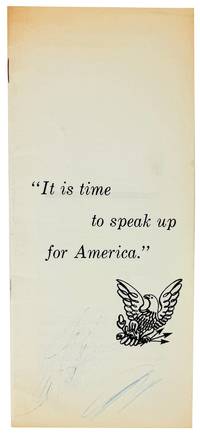
1960réf. 49519Washington DC: Republican National Committee 1960. Very Good. Washington DC: Republican National Committee 1960. First Edition. Octavo 21cm; staplebound pictorial self-wrappers; 20pp. Wrapper margins a bit toned previous owner has unfortunately used the upper cover to scribble a ballpoint pen into flowing again; About Very Good. Quite scarce pamphlet reproducing Vice President Nixon's address accepting the Republican National Committee's nomination as candidate for the Presidency. Much of the text concerns the fear of Communism the interior front wrapper reproducing the quote "When Mr. Khrushchev says that our grandchildren shall live under Communism let us say that his grandchildren will live in freedom." Nixon ultimately lost to the Kennedy/Johnson Democratic ticket. Republican National Committee unknown books
réf. 299691/1/50. “To Jack Beall with grateful appreciation for his devoted and effective work as a member of my staff and with best wishes from his friend Dick Nixon.” Uncommon as authentically signed photographs of Nixon have become scarce. <img class=""alignnone size-post-window wp-image-25018"" src=""https://cdn.raabcollection.com/wp-content/uploads/20231204144051/Folder-site-11-1600x1327.jpg"" alt="""" width=""1600"" height=""1327"" /> unknown books
réf. 261218/3/88. We obtained this letter from the Kirkpatrick family and it has never before been offered for sale The Washington Summit of 1987 was meeting between President Ronald Reagan and Soviet General Secretary Mikhail Gorbachev that took place on December 8–10. Reagan and Gorbachev discussed regional conflicts in Afghanistan Central America and Southern Africa arms control issues for chemical weapons as well as conventional weapons the status of START limitation on strategy weapons negotiations and human rights. Some progress was made in these areas. The notable accomplishment of the Washington Summit was the signing of the Intermediate-Range Nuclear Forces Treaty which banned all of the two nations' land-based ballistic missiles cruise missiles and missile launchers. By 1991 almost 2700 missiles had been eliminated. Needless to say the collegial atmosphere of the talks and the feeling that Gorbachev was a man you could work with caused great excitement in the United States after half a century of Cold War. In 1988 former President Nixon wrote a book 1999: Victory Without War which offered his comprehensive strategy for the West—a vital plan of action that would help ensure peace prosperity and freedom in the next century. In it he provided commentary and suggestions in the area of his great expertise foreign policy. He began by arguing that the United States should continue to play a central international role. He contended that world peace is inseparable from world power and that real peace is not absence of conflict but living with unending conflict the natural state of world affairs. He sought to tamp down the popularity of Gorbachev whom he saw as seeking change that would permit the Soviet Union to find hegemony. Still he cogently argued for a realistic policy toward the Soviets involving a mix of deterrence competition and negotiation. His hard-line views are on display in other areas. On nuclear armaments he endorsed Reagan's plan for laser-based weapons in space ""Star Wars"" and urged ""no first-strike vulnerability."" He advocated continued support of Nicaragua's contras covert CIA actions overseas build-up of nuclear power more U.S. cruise missiles in Europe the establishment of U.S. air bases in Saudi Arabia. He blamed Africa's poverty on the terrible governments there. He strongly opposed the adoption of protectionist trade measures against Japan. Jeane Kirkpatrick was a lifelong Democrat working in both state and national campaigns including Hubert Humphrey's 1972 presidential campaign. She grew increasingly dissatisfied however with the Democratic Party's liberal faction and in 1972 cofounded the Coalition for a Democratic Majority. Her conservative writings regarding U.S. foreign policy impressed Ronald Reagan and during his 1980 presidential campaign she was selected as his foreign policy advisor. Under President Reagan she became the first woman to serve as U.S. ambassador to the United Nations serving from 1981 to 1985. She was also given cabinet rank and was also a member of Reagan’s national security team. She remained active in politics but as a Republican. Nixon sent Kirkpatrick an advance copy of his book. Typed letter signed on his letterhead New York March 8 1988 to Kirkpatrick in which he makes it clear that he does not share the excitement about Gorbachev and still distrusts the Soviets. “The enclosed proofs of 1999: Victory Without War represent my reflections after forty years of observing and participating in U.S. foreign policy. Some of our mutual friends will consider it to be too tough on the Soviets but I thought it was essential to provide an antidote for the wave of euphoria that seems to have engulfed the West since the Washington summit. I think you may find the last chapter in which I try to look into the future past the 1988 election of particular interest.” Nixon’s distrust of Gorbachev though hardly unexpected proved baseless. Under Gorbachev’s leadership the next year the Berlin Wall came down in 1990 six republics left the Soviet Union and in 1991 the Soviet Union dissolved altogether. <img class=""alignnone wp-image-25018 size-post-window"" src=""https://cdn.raabcollection.com/wp-content/uploads/20231204144051/Folder-site-11-1600x1327.jpg"" alt="""" width=""1600"" height=""1327"" /> unknown books
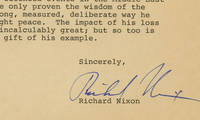
réf. 2145512/10/82. Nixon had himself played a key role in aiding the launch of the peace process mediating the Sinai I disengagement agreement between Egypt and Israel in 1974 Israel and Egypt with its Arab allies had been engaged in hostilities for three decades and this resulted in four wars in twenty four years. The hatreds in the region were fierce and the constant conflicts seemed interminable. The last of these the Yom Kippur War in October 1973 was launched by the Arabs as a surprise and they had initial successes before Israel emerged victorious. Egyptian President Anwar el-Sadat’s own brother was killed in that war. No one foresaw peace as a possibility. But President Sadat saw the wars as a disastrous drag on the Egyptian economy and knew that they stood as a barrier to its receiving aid from the United States and many NATO countries. They also tended to throw the Middle East into the arms of the Russians whom Sadat distrusted. Sadat had no intention of allowing Egypt to become a Soviet satellite. Despite friction with his Syrian allies Sadat signed the Sinai I 1974 and Sinai II 1975 disengagement agreements with Israel which stated that the conflicts between the countries ""shall not be resolved by military force but by peaceful means” and led to the partial withdrawal of Israeli forces in the Sinai the creation of a U.N. buffer zone in their place and the implementation of multiple U.S. stations in the Sinai. The also secured for Egypt large foreign assistance commitments. The first of these agreements were mediated by President Richard M. Nixon and U.S. Secretary of State Henry Kissinger and the second by President Gerald R. Ford and Kissinger who with thus played key roles in aiding the launch of the peace process. Jimmy Carter became President of the United States on January 20 1977. Israeli and Arab resistance was slowing Sadat’s hoped-for progress so on November 9 1977 Sadat made a stunning dramatic gesture one that left the world in shock: He would personally journey to Jerusalem to address the Israeli Knesset parliament to seek a permanent peace settlement between Israel and Egypt! The Israeli government led by Prime Minister Menachem Begin rose to the occasion and ignoring those who saw Sadat’s move as some kind of trick cordially invited him to address the Knesset in a message passed to Sadat via the US ambassador to Egypt. This was something of a surprise as Begin had a reputation as a hard-liner and some expected him to reject Sadat’s overture. On November 19 1977 Sadat arrived for the groundbreaking three-day visit which launched the first peace process between Israel and an Arab state. He met with Begin and spoke before Israel’s parliament as the world looked on in utter disbelief and glued to the television. The astonished approving reaction of ordinary Israelis and Egyptians who watched Sadat and Begin on live television was itself of importance. The sight of the two leaders facing each other in open honest debate changed attitudes at the street levels of both countries. Much of the change came from Sadat's choice of words. “The October War” he said “should be the last war.” The visit was however met with outrage in much of the Arab world. Despite this Sadat continued to pursue peace with Israel. However a reciprocal visit by Begin was unsuccessful and no progress was made toward peace. Then Rosalynn Carter the U.S. first lady suggested to her husband President Carter that he invite Sadat and Begin to Camp David where the relative privacy and seclusion might provide a setting for a breakthrough. Both Sadat and Begin trusted the United States to be an honest broker and the two leaders accepted Carter’s invitation. The summit began on September 5 1978 and lasted for 13 days. Carter preferred that the three men work together in private sessions in a small office at Aspen his cabin at Camp David. Carter compiled a document that encompassed a resolution of the major issues presented the proposals to each leader in separate meetings assessed their comments and redrafted the manuscript some two dozen times shuttling the manuscript back and forth for their review. The Camp David Accords signed on September 17 were the first peace agreement between the state of Israel and one of its Arab neighbors and laid the groundwork for diplomatic and commercial relations. In a ceremony at the White House on March 26 1979 Sadat and Begin signed the historic peace treaty; it was considered the diplomatic triumph of the the era. President Carter oversaw the signing and untold millions watched on television. The peace treaty formally ended the state of war that had existed between the two countries. Israel agreed to fully withdraw from Sinai and Egypt promised to establish normal diplomatic relations between the two countries and open the Suez Canal to Israeli ships which until then had been banned from the waterway. These provisions were duly carried out. Sadat was vilified for this in many Arab quarters and Egypt was expelled from the Arab League but Sadat was determined to end hostilities and move into a better future. He was well aware that his courage might well cost him his life as he received death threats and some predicted his assassination. For their achievement Sadat and Begin were jointly awarded the 1978 Nobel Prize for Peace. Then on October 6 1981 extremists assassinated Sadat in Cairo. He is widely recognized today as a martyr to peace and when we hear the phrase “blessed are the peacemakers” his image immediately springs to mind. Despite the tragedy the peace process continued without Sadat and in 1982 Egypt formally established diplomatic relations with Israel. This led to among many other benefits increased tourism in the region. Nixon who with Kissinger got this process going wrote this letter to Mrs. Sadat saying her husband is immortal. Typed letter signed on Nixon’s letterhead October 12 1982 with salutation in his hand to Sadat’s widow Jihan el-Sadat on the occasion of the honoring of President Sadat by the American Society of Travel Agents as Sadat’s efforts for peace did so much for tourism the region. He was to be awarded its 1st International Peace and Tourism Award. “I am honored to join in this tribute to Egypt’s great President and also to you his great First Lady. “Men are mortal but the spirit of a man of peace is immortal because it lives on in the millions he has inspired. President Sadat was such a man. In the year since his voice was silenced events in the Middle East have only proven the wisdom of the strong measured deliberate way he sought peace. The impact of his loss is incalculably great; but so too is the gift of his example.” Donald Reynolds was executive director of the American Tourism Society later the American Society of Travel Agents. Under his leadership ATSA facilitated travel to Russia and the newly independent republics of the USSR and later expanded its outreach to the Middle East. His efforts in Egypt brought him in contact with Mrs. Sadat and they became friends. She gave this letter to him and we obtained it from his heirs. It has never before been offered for sale. unknown books
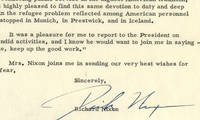
réf. 88223/1/57. On October 23 1956 a student demonstration against the Soviet-dominated regime in Hungary became the first serious challenge to Communist authority since the Soviet Union drove the Nazis out and occupied Eastern Europe at the end of World War II. The demonstrators marched to the Parliament building in Budapest where Hungarian State Security Police detained a group of them who attempted to enter the radio building to broadcast the students_ demands. The police then fired on a group of demonstrators who demanded their release and killed a student. When demonstrators wrapped the body in a flag and paraded it in central Budapest violence erupted and news of the event provoked unrest throughout the country. The pro-Soviet government collapsed and a new government disbanded the State Security Police and announced its intention to withdraw from the Soviet-run Warsaw Pact and to hold free elections. The Hungarian Revolt was one of the crucial events of the Cold War On October 31 the Moscow newspaper “Pravda” stated that the Soviet government was “prepared to enter into the appropriate negotiations with the government of the Hungarian People’s Republic and other members of the Warsaw Treaty on the question of the presence of Soviet troops on the territory of Hungary.” That same day though unwilling to appear weak to the United States Soviet leaders reversed course and decided to take military action to crush the rebellion. In the early morning hours of November 4 Soviet troops invaded Hungary. The free Hungarian government fled and by November 7 the Soviets installed János Kádár as the new Prime Minister. In six days the Soviet military completely crushed the revolution. More than 2500 Hungarians and 700 Soviet soldiers were killed. By January the new Soviet puppet government had suppressed the opposition. However meanwhile large numbers of Hungarians were fleeing the country mostly headed for Austria. This unfolding drama received hour-by-hour press coverage throughout the world with film footage appearing every evening on the news in the U.S. and elsewhere. The invasion with its graphic depiction of Soviet tanks on the city streets in Hungary clashing with demonstrators destroyed the Soviet argument that Eastern Europe was voluntarily within the Soviet sphere. It also confirmed to those in the West that there was a real Cold War at hand and that the Soviets were the aggressors as they could only hold their people by force. Strong anti-Communists like Richard M. Nixon then Vice President in the Eisenhower Administration seemed confirmed in their judgments. By the time Hungary’s borders were sealed 200000 refugees had fled the country. Of those approximately 180000 went to Austria and another 20000 went to Yugoslavia. The refugees needed care and resettlement and this required a massive effort led by the office of the United Nations High Commissioner for Refugees. 37 nations on five continents accepted refugees with the plurality - 40000 - going to the United States. Llewellyn E. Thompson was U.S. Ambassador to Austria so to him fell the main responsibility for managing the American effort to care for them and arrange their resettlement. Lewellyn Thompson was one of the most important American diplomats of the 20th Century. After two years at his post in Vienna he would become the United States Ambassador to the Soviet Union at the height of the Cold War serving two separate tours in the administrations of Presidents Dwight D. Eisenhower John F. Kennedy and Lyndon B. Johnson and then acting as advisor to Richard M. Nixon. Few Ambassadors faced as many crises as Thompson did in Moscow - the shooting down of a U.S. U-2 reconnaissance aircraft over Russia the great confrontation between the U.S. and Soviet Union over Berlin and the building of the Berlin Wall very difficult summits between Soviet Premier Khruschev and Presidents Eisenhower and Kennedy the August 1968 Soviet invasion of Czechoslovakia and tensions over the Vietnam War. But there were also steps toward better relations. At Thompson's suggestion Nikita Khrushchev became the first Soviet leader to visit the U.S. in 1959. Thompson helped arrange and was present for the 1967 summit in the U.S. between President Johnson and Premier Alexei Kosygin in Glassboro New Jersey after the Six-Day War in the Middle East exacerbated tensions. Also in 1967 the Soviet Union and U.S. agreed to begin cooperation in space with the joint Soyuz-Apollo program. The first treaty on Non-Proliferation of Nuclear Weapons was signed on July 1 1968. Thompson’s stint as Ambassador to the Soviet Union began in 1957 when President Eisenhower appointed him to the post. President Kennedy reappointed him in 1961 which was a tribute to Thompson as new presidents usually name their people to the top diplomatic posts. He ended his first tour in Moscow in 1962 when President Kennedy brought him home to Washington to become his Ambassador-at-Large as a member of the Executive Committee of the National Security Council advising the President on Soviet affairs. Shortly after returning to Washington Thompson provided President Kennedy with advice that was crucial to avoiding nuclear war during the Cuban Missile Crisis. President Johnson reappointed him to the ambassadorship to Moscow in 1967 and he served until 1969. He came out of retirement to advise President Nixon on the Strategic Arms Limitation Treaty SALT negotiations with the Soviet Union and represented the United States in the SALT talks from 1969 until his death in 1972. He thus was able to provide valuable insight into Soviet thought to four American presidents. Secretary of State William P. Rogers called him “one of the outstanding diplomats of his generation.” From December 18-24 1956 Nixon traveled to Austria to get first hand accounts from Hungarian refugees and inspect their conditions and aid requirements. Thompson aided him during that trip and Nixon was grateful. “You can be proud of the magnificent job being done under your able direction to discharge American responsibility in meeting the needs of the Hungarian refugees in Austria."" Typed Letter Signed on Office of the Vice President letthead Washington January 3 1957 to Thompson. “This is just a note to tell you how deeply I appreciated the generous hospitality which you and Mrs. Thompson extended to me and the members of my party during my recent visit to Austria. Due to your efforts and those of your staff I was able to accomplish my inspection mission in a limited period of time and I am grateful for the many courtesies which were extended to me. “You can be proud of the magnificent job being done under your able direction to discharge American responsibility in meeting the needs of the Hungarian refugees in Austria. This compliment is meant for you and your permanent staff of all nationalities and agencies as well as those who have come from other countries on short notice to meet the need for additional help the wives and families who have been working long hours as volunteers to relieve hardship and the hundreds of American and international relief agency workers. All of you have shown a wonderful spirit of dedication in rendering public service in the highest American tradition and I was highly pleased to find this same devotion to duty and deep interest in the refugee problem reflected among American personnel when we stopped in Munich in Prestwick and in Iceland. “It was a pleasure for me to report to the President on your splendid activities and I know he would want to join me in saying – “well done keep up the good work.” ""Mrs. Nixon joins me in sending our very best wishes for the New Year.” The accompanying envelope which is still present bears Nixon_s printed free frank. It was not mailed and therefore evidently was delivered by diplomatic pouch. This letter comes directly from the Thompson descendants. unknown books
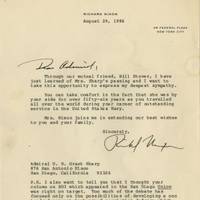
1986réf. 941029/08/1986. ""Too much of the debate has focused only on the possibilities of developing a one hundred percent leak-proof population defense which even the strongest proponents agree could not be developed until next century."" President Nixon made his mark in the area of foreign policy. Although he had made his own career as a militant opponent of Communism Nixon saw opportunities to reduce the temperature of the Cold War by improving relations with the Soviet Union. One of these was the Strategic Arms Limitation Talks negotiations which were a series of meetings beginning in Helsinki that lasted from November 17 1969 until May 1972. After a long deadlock the first results of SALT I came in May 1971 when an agreement was reached over anti-ballistic missiles systems. Further discussion brought the negotiations to an end in Moscow on May 26 1972 when Richard Nixon and Leonid Brezhnev signed both the Anti-Ballistic Missile Treaty and the Interim Agreement Between The United States of America and The Union of Soviet Socialist Republics on Certain Measures With Respect to the Limitation of Strategic Offensive Arms. These served to slow the growth in nuclear weapons and halt extensive proliferation. A premise of the Cold War mutually assured destruction meant simply that neither the US nor the USSR would attack the other because it would ensure that both would be obliterated. You could get the first shot in but unless you wiped out the entire capacity of the other side in one blow you would ensure your own demise. In 1969 Nixon announced an anti-ballistic missile defense system called Safeguard which aimed to protect the deterrent nuclear force of the United States its missile fields to maintain that deterrent capacity. This happened at the same time as the country was publicly debating the possibility of protecting entire US cities in a shield the technology of which did not exist. Safeguard never fully operated at its intended capacity and in fact was shut down soon after it launched. Ronald Reagan was not an active proponent of mutually assured destruction MAD. In 1983 he proposed the Strategic Defense Initiative SDI to use ground-based and space-based systems to protect the United States from attack by ballistic strategic nuclear weapons. The initiative focused on strategic defense rather than the prior strategic offense doctrine of MAD. It was dubbed ""Star Wars"" by critics. The goal was to neutralize the Soviets' nuclear capacity regardless of the success of ongoing negotiations. The Soviets strongly opposed the Strategic Defense Initiative as they could not afford to match the U.S. in this area and they felt that if successful the concept of mutually assured destruction would be lost and the U.S. would be in a dominant position. In November of 1985 Gorbachev and Reagan were to meet in Geneva for a major summit. Both the Soviet Union and the United States were seeking to cut the number of nuclear weapons with the Soviets seeking to halve the number of nuclear-equipped bombers and missiles and the U.S. desiring to ensure that neither side gained a first-strike advantage and to protect rights to the Strategic Defense Initiative. These ideas of arms limitations and strategic defense were the cornerstones to the Cold War negotiations between the two global powers in a bi-polar world. One of those who joined the debate was U.S. Grant Sharp a 4-star admiral who was Commander in Chief of the US Pacific Fleet and of US Pacific Command including during the Gulf of Tonkin Incident. He wrote a piece in the San Diego papers which advocated the protection of US-based counter-force assets which touched on a subject central to Nixon's presidency and close to his heart missiles that would serve as a first-strike deterrent. Typed letter signed August 29 1986 New York City to Admiral U.S. Grant Sharp. ""Through our mutual friend Bill Stover I have just learned of Mrs. Sharp's passing and I want to take this opportunity to express my deepest sympathy. You can take comfort in the fact that she was by your side for over fifty-six years as you traveled all over the world during your career of outstanding service in the United States Navy. Mrs. Nixon joins me in extending our best wishes to you and your family. Sincerely Richard Nixon. ""P.S. I also want to you that I thought your column on SDI which appeared in the San Diego Union was right on target. Too much of the debate has focused only on the possibilities of developing a one hundred percent leak-proof population defense which even the strongest proponents agree could not be developed until next century. On the other hand a defense of our counter-force missile silos which presently are vulnerable to a first strike from Soviet Union's SS-18s could be deployed in the near future. Unless the Soviet Union agrees to offensive cuts which would remove its first-strike capability we have no choice but to go forward with an SDI program which would deny them that capacity."" unknown books
1969réf. 713822/01/1969. In February 1953 Henry Cabot Lodge was named U.S. Ambassador to the United Nations by President Eisenhower with his office elevated to Cabinet level rank. The position then was high profile and Lodge often engaged in debates with the UN representatives of the Soviet Union that were broadcast or covered on television. On the front lines in the Cold War in 1959 he escorted Soviet leader Nikita Khrushchev on a highly-publicized tour of the United States. Lodge left the ambassadorship during the election of 1960 to run for Vice President on the Republican ticket headed by Richard Nixon. Nixon selected Lodge because the latter had made a name for himself at the United Nations as a foreign-policy expert. President Kennedy appointed Lodge to the position of Ambassador to South Vietnam which showed the import U.S. policymakers were coming to place on that nation. Lodge held the post from 1963 to 1964 and again from 1965 to 1967. As ambassador there Lodge supported President Johnson's decision to escalate American involvement in the Vietnam War believing that a Communist takeover in the South would be disastrous for U.S. foreign policy goals. The original appointment of “Henry Cabot Lodge of Massachusetts”_as “Ambassador to head the United States Delegation at the Paris Meetings on Vietnam.” <!--break--> President Johnson and American military leaders had long insisted that the Vietnam War was going well and that they could see the light at the end of the tunnel. But in the aftermath of the Tet Offensive in February 1968 when the Communists were able to initiate coordinated attacks on all the regional capitals throughout Vietnam even in the American compound in Saigon itself Secretary of Defense Clark Clifford issued a report to the President in mid-March that the United States could not win the war. Johnson was stunned and he in turn stunned a nationwide audience on March 311968 announcing he would cease bombing north of the 20th parallel initiate peace talks to end the war and not seek renomination or reelection in 1968. The peace talks commenced in Paris on May 10 1968 with W. Averill Harriman leading the U.S. delegation. From the outset the talks were fraught with difficulties. The U.S. insisted on mutual withdrawal of American and North Vietnamese forces which would leave the Saigon government in control. The North Vietnamese refused to negotiate anything until all bombing of North Vietnam was halted. When the U.S. finally agreed to that condition the Johnson administration was unable to persuade cajole or coerce South Vietnam and its leader President Thieu to participate unless it was recognized as a legitimate party by its foes. It was alleged at the time that both candidates in the 1968 election were using the talks as a political football with Hubert Humphrey seeking to appeal to pro-peace voters by insisting that the South Vietnamese participate and more germanely with Nixon leading the South Vietnamese to understand that his administration would give them a better deal if they would continue to delay. Formal negotiations would not begin until January 18 1969 two days before Nixon took office. In the immediate aftermath of the 1968 election it seems that Lodge was Nixon’s foremost advisor on Vietnam. He urged Nixon to appoint a man of stature to negotiate in Paris and warned him away from a trip to Saigon for strategic reasons. Nixon adopted these suggestions. In fact on January 5 1969 fifteen days before his inauguration President-elect Nixon named Lodge himself to succeed Harriman as chief U.S. negotiator at the Paris talks. This signaled that Nixon was likely to take a hard line in the talks considering Lodge’s background as a proponent of American policy in Vietnam as promulgated by President Johnson and his chief military commander Gen. William Westmoreland. Document Signed as President Washington January 22 1969 just two days after his inauguration being the original appointment of “Henry Cabot Lodge of Massachusetts”_as “Ambassador to head the United States Delegation at the Paris Meetings on Vietnam.” The wording here is highly politically indicative showing that Nixon avoided using the terms “peace”_“talks” “negotiations” or “war.” These were simply “Meetings on Vietnam” nothing more to be implied. The document is countersigned by Secretary of State William P. Rogers. On January 25 the first fully attended meeting of the formal Paris peace talks was held. Ambassador Lodge urged an immediate restoration of a genuine Demilitarized Zone as the first ""practical move toward peace."" He also suggested a mutual withdrawal of ""external"" military forces and an early release of prisoners of war. Tran Buu Kiem and Xuan Thuy heads of the National Liberation Front and North Vietnamese delegations respectively refused Lodge's proposals and condemned American ""aggression."" Meanwhile Henry Kissinger Nixon’s National Security Advisor developed a two-track policy whereunder the Paris negotiators would discuss military matters while the real political decisions would be made privately out of the public eye by the leadership in Washington and Hanoi directly. This would avoid public pressure from all directions while also preventing the junior partners on either side South Vietnam and the National Liberation Front from exercising power to preclude a deal from happening. Nixon liked the idea and determined that political negotiations would emanate from the White House. So as Lodge continued treating with the North Vietnamese in Paris starting in early August Kissinger was secretly meeting with North Vietnam’s Le Duc Tho. As the summer turned to fall however Kissinger’s approaches to Hanoi failed to elicit an acceptable response and Nixon adopted a get tough policy to force an accommodation on his terms. In early October the President told Lodge to break off the talks by staging a walk-out at the October 23 plenary session. On the appointed day Lodge insisted that the talks be adjourned which they were immediately. Lodge himself had not favored this action and he suggested that the President use him as a personal intermediary to Hanoi’s leaders who were frequently in Paris. Nixon declined. The only official public negotiations to end the Vietnam War were over never to resume. Nixon went directly to Camp David to work on a foreign policy address to the nation which he delivered on November 3. Dubbed the Silent Majority speech in it he asked the American people to support his decision to continue the war until the North Vietnamese would accept “honorable” peace terms. On November 20 1969 seeing no role remaining for a peace negotiator Lodge resigned. The war did not end until January 23 1973 four years and one day after Nixon had appointed Lodge to help end the conflict. unknown books
1990réf. 2351267New York: Simon & Schuster 1990. Limited Edition. Full-Leather. Near Fine/Fine. 9x6x1. Signed by author. Limited edition #420 of 500 copies signed by Richard Nixon and hand-numbered on limitation page. Includes publisher's slipcase. An excellent copy with a couple minor blemishes to slipcase though the texture of the leather photographs horribly. Binding tight and square pages clean bright and unmarked. 1990 Full-Leather. 384 pp. Former U.S. President Richard Nixon candidly reflects on his career and discusses such topics as the U.S.S.R. Gorbachev secrecy Watergate and more. Illustrated with black-and-white photographs throughout. Simon & Schuster hardcover books
1978réf. 71940New York: Grosset & Dunlap 1978. Limited edition First printing stated on copyright page. Hardcover. Very Good Minus. SIGNED. 1120pp. Small quarto 25 cm Blue cloth over boards stamped in gilt on the backstrip and front board. Spine sunned and spine gilt faded. Publisher's prospectus tucked in. Housed in a blue cloth covered slipcase with light dust soiling and fading and subtle fraying at the edges. Signed by Richard Nixon on a tipped-in page at the front. Grosset & Dunlap hardcover books
1992réf. 1384502New York: Simon & Schuster 1992. First Edition First Printing. Hardcover. Octavo 322 pages. In Very Good minus condition with a Very Good minus dust jacket. Spine white with blue lettering. Dust jacket protected with a mylar covering price uncut: "$25.00." General shelf wear to edges and corners of dust jacket. Moderate scuffing and staining to dust jacket. Mild staining to edges of boards. Foxing to edges of textblock. Staining to title page. Signed flat by Nixon on second free endpaper. Shelved in Case 1 1/2. 1384502. Shelved Dupont Bookstore. Simon & Schuster hardcover books