52 862 résultats
1846réf. ST19286London: Printed by Catchpool & Trent for Simpkin Marshall & Co 1846. FIRST EDITION. 320 x 255 mm. 12 1/2 x 10". xiii 3 96 pp. Publisher's original blind-decorated dun-colored cloth gilt titling to upper cover smooth spine newer endpapers. WITH 11 COLOR ENGRAVINGS after Frost by W. P. Chubb & Son printed in oil colors by George Baxter all with original tissue guards. Front free endpaper with small ink signature of John Hill. See: Francis Reid "Isaac Frost's 'Two Systems of Astronomy' 1846: Plebeian Resistance and Scriptural Astronomy" in "The British Journal for the History of Science" Vol. 38 No. 2 Jun. 2005 pp. 161-177. Cloth rather spotted corners bumped but the binding solid with no wear to joints or hinges. A few spots of foxing to title page half of the tissue guards with overall very faint foxing/browning the illustrations with minor foxing at edges and in margins but the images themselves clean and bright and all in all a really excellent copy the text wide-margined and quite clean and fresh and the plates with rich coloring. Illustrated with beautiful color plates this anti-Newtonian work promotes a view of the universe based on the backward-looking beliefs professed by a Protestant sect known as the Muggletonians. Named after co-founder Lodowicke Muggleton the Muggletonians emerged in London in 1651 based on the claims of two tailors who professed to be the "Last Witnesses" described in the Book of Revelation. Rejecting the new directions in philosophical reason Muggletonians believed in a purely scriptural interpretation of the universe. According to E. P. Thompson's 1994 "Witness Against the Beast" the Muggletonians had curious notions quite contrary to other Protestant denominations: they believed that the soul is mortal that Jesus and God are one and the same that Heaven was left without divine supervision from Jesus' death until the day of judgment that Heaven resides six miles above the Earth that God stands between five and six feet tall and other unconventional things. Although the sect initially avoided both worship and evangelizing during the 19th century some followers became more outspoken about their beliefs and even published books appealing to the general public. Our author Isaac Frost 1793-1858 was a prominent Muggletonian and successful owner of a brass foundry who along with his brother Joseph invested large sums to promote their belief system--the present work being an especially notable example. Divided into two main sections the text first describes the Newtonian system of heliocentric astronomy and then turns to Frost's scriptural interpretation and geocentric views. As Reid tells us "According to Frost Scripture clearly states that the Sun the Moon and the Stars are embedded in a firmament made of congealed water and revolve around the Earth that Heaven has a physical reality above and beyond the stars and that the planets and the Moon do not reflect the Sun's rays but are themselves independent sources of light. Our book was apparently written as a reaction against the lecturers who expressed Newtonian astronomy--which was often for them and their audiences simply shorthand for heliocentrism." The 11 plates that illustrate these extraordinary ideas are the work of George Baxter a pioneering printer who revolutionized color printing techniques by combining metal engravings with woodblock printing using oil-based inks to produce high-quality affordable prints. The plates here are appropriately ethereal and otherworldly utilizing a beautiful palette with subtle gradations and esoteric figures to create memorable pseudo-scientific imagery. Although this work appears at auction with some regularity it is almost always incomplete no doubt because the attractiveness of its plates encourages harvesting. Useful price comparisons include a complete copy said to be in fine condition selling for £7500 in 2016 and six loose prints from the book fetching £6875 in 2015. [Printed by Catchpool & Trent for] Simpkin, Marshall, & Co unknown books
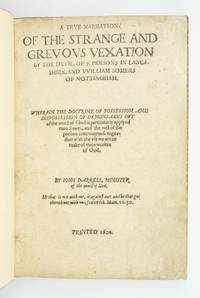
1600réf. ST21089England: Printed by the English secret press 1600. FIRST EDITION. 187 x 128 mm. 7 3/8 x 5". 4 p.l. 24 106 2 pp. Very pleasing early 20th century grained calf gilt covers with French fillet border and rosette cornerpieces raised bands spine panels with small daisy centerpiece gilt lettering densely gilt turn-ins marbled endpapers all edges gilt. STC 6288; ESTC S109297. See also Freeman "Demons Deviance and Defiance: John Darrell and the Politics of Exorcism in Late Elizabethan England" in Conformity and Orthodoxy in the English Church c. 1560-1660 ed. P. Lake and M. Questier Boydell Press 2000 pp. 34-63. Short faint scratch to front board extremities lightly rubbed text washed and pressed title and final two leaves somewhat grayed and grubby margins trimmed a bit close occasionally grazing headlines or shoulder notes but a perfectly readable copy in an attractive binding. This scarce clandestine imprint is a central publication in of one of the strangest religio-political controversies of the turn of the 17th century involving demonic possession witchcraft accusations and an anti-Puritan crusade by a Church of England bishop. Our author Puritan exorcist John Darrell ca. 1562 - ca. 1607 was educated at Cambridge and briefly dabbled in law and farming before establishing himself as a preacher and spiritual healer. In 1586 he began conducting exorcisms resulting in a level of local fame partly because some of them resulted in the convictions of witches. In the following decade he achieved national notoriety. First in March of 1597 he exorcised a group of seven demoniacs in the household of Lancashire landowner Nicholas Starkey. Then in November of the same year he conducted a dramatic public exorcism of Nottingham apprentice musician William Somers whose claim of having been magically possessed led to the arrest of 13 people on witchcraft charges. One of these individuals was the sister of a city alderman who immediately took action to protect his kinswoman. The resulting legal tangle--which included the arrest of Somers on charges of witchcraft later changed to fraud and an investigative commission led by the Archbishop of York--attracted widespread attention to Darrell's activities by both supporters and detractors. The Church of England was highly concerned about Puritan exorcisms: in the words of historian Thomas S. Freeman "exorcism magnified those aspects of Puritan worship which the ecclesiastical authorities most feared--its anti-hierarchical tendencies its strong sense of communal solidarity and its potential as a vehicle for protest." No doubt with an understanding of this threat Bishop of London Richard Bancroft and his chaplain Samuel Harsnett led a vicious campaign against Darrell publishing multiple works smearing his character and theology stripping Durrell of his license to preach and imprisoning him for more than a year. Darrell did not go quietly. Over the next four years he and his supporters penned multiple defenses of his actions and of Puritan exorcism more generally published either abroad or illegally by secret English presses. The present work is significant not only for its detailed retelling of Darrell's final two exorcisms in his own words but also because it includes Darrell's detailed "doctrine of possession" which discusses the difference between his exorcisms and those of the apostolic age an important theological clarification in the debate. STC indicates that our book was one of the works published clandestinely in England; this is backed up by the October 29 1600 Stationers' Company order to burn all copies of "mr Darrell's book lately printed concerning the casting out of Devilles" which Freeman asserts refers to the present publication. This order to be burned on top of the clandestine publication could explain the present scarcity of the work which appears on the market very infrequently. We have been able to trace just a single copy at auction this century and only five since 1964 several lacking the final errata leaf which does appear here. Printed [by the English secret press?] unknown
1600réf. ST21089England: Printed by the English secret press 1600. FIRST EDITION. 187 x 128 mm. 7 3/8 x 5". 4 p.l. 24 106 2 pp. Very pleasing early 20th century grained calf gilt covers with French fillet border and rosette cornerpieces raised bands spine panels with small daisy centerpiece gilt lettering densely gilt turn-ins marbled endpapers all edges gilt. STC 6288; ESTC S109297. See also Freeman "Demons Deviance and Defiance: John Darrell and the Politics of Exorcism in Late Elizabethan England" in Conformity and Orthodoxy in the English Church c. 1560-1660 ed. P. Lake and M. Questier Boydell Press 2000 pp. 34-63. Short faint scratch to front board extremities lightly rubbed text washed and pressed title and final two leaves somewhat grayed and grubby margins trimmed a bit close occasionally grazing headlines or shoulder notes but a perfectly readable copy in an attractive binding. This scarce clandestine imprint is a central publication in of one of the strangest religio-political controversies of the turn of the 17th century involving demonic possession witchcraft accusations and an anti-Puritan crusade by a Church of England bishop. Our author Puritan exorcist John Darrell ca. 1562 - ca. 1607 was educated at Cambridge and briefly dabbled in law and farming before establishing himself as a preacher and spiritual healer. In 1586 he began conducting exorcisms resulting in a level of local fame partly because some of them resulted in the convictions of witches. In the following decade he achieved national notoriety. First in March of 1597 he exorcised a group of seven demoniacs in the household of Lancashire landowner Nicholas Starkey. Then in November of the same year he conducted a dramatic public exorcism of Nottingham apprentice musician William Somers whose claim of having been magically possessed led to the arrest of 13 people on witchcraft charges. One of these individuals was the sister of a city alderman who immediately took action to protect his kinswoman. The resulting legal tangle--which included the arrest of Somers on charges of witchcraft later changed to fraud and an investigative commission led by the Archbishop of York--attracted widespread attention to Darrell's activities by both supporters and detractors. The Church of England was highly concerned about Puritan exorcisms: in the words of historian Thomas S. Freeman "exorcism magnified those aspects of Puritan worship which the ecclesiastical authorities most feared--its anti-hierarchical tendencies its strong sense of communal solidarity and its potential as a vehicle for protest." No doubt with an understanding of this threat Bishop of London Richard Bancroft and his chaplain Samuel Harsnett led a vicious campaign against Darrell publishing multiple works smearing his character and theology stripping Durrell of his license to preach and imprisoning him for more than a year. Darrell did not go quietly. Over the next four years he and his supporters penned multiple defenses of his actions and of Puritan exorcism more generally published either abroad or illegally by secret English presses. The present work is significant not only for its detailed retelling of Darrell's final two exorcisms in his own words but also because it includes Darrell's detailed "doctrine of possession" which discusses the difference between his exorcisms and those of the apostolic age an important theological clarification in the debate. STC indicates that our book was one of the works published clandestinely in England; this is backed up by the October 29 1600 Stationers' Company order to burn all copies of "mr Darrell's book lately printed concerning the casting out of Devilles" which Freeman asserts refers to the present publication. This order to be burned on top of the clandestine publication could explain the present scarcity of the work which appears on the market very infrequently. We have been able to trace just a single copy at auction this century and only five since 1964 several lacking the final errata leaf which does appear here. Printed [by the English secret press?] unknown books
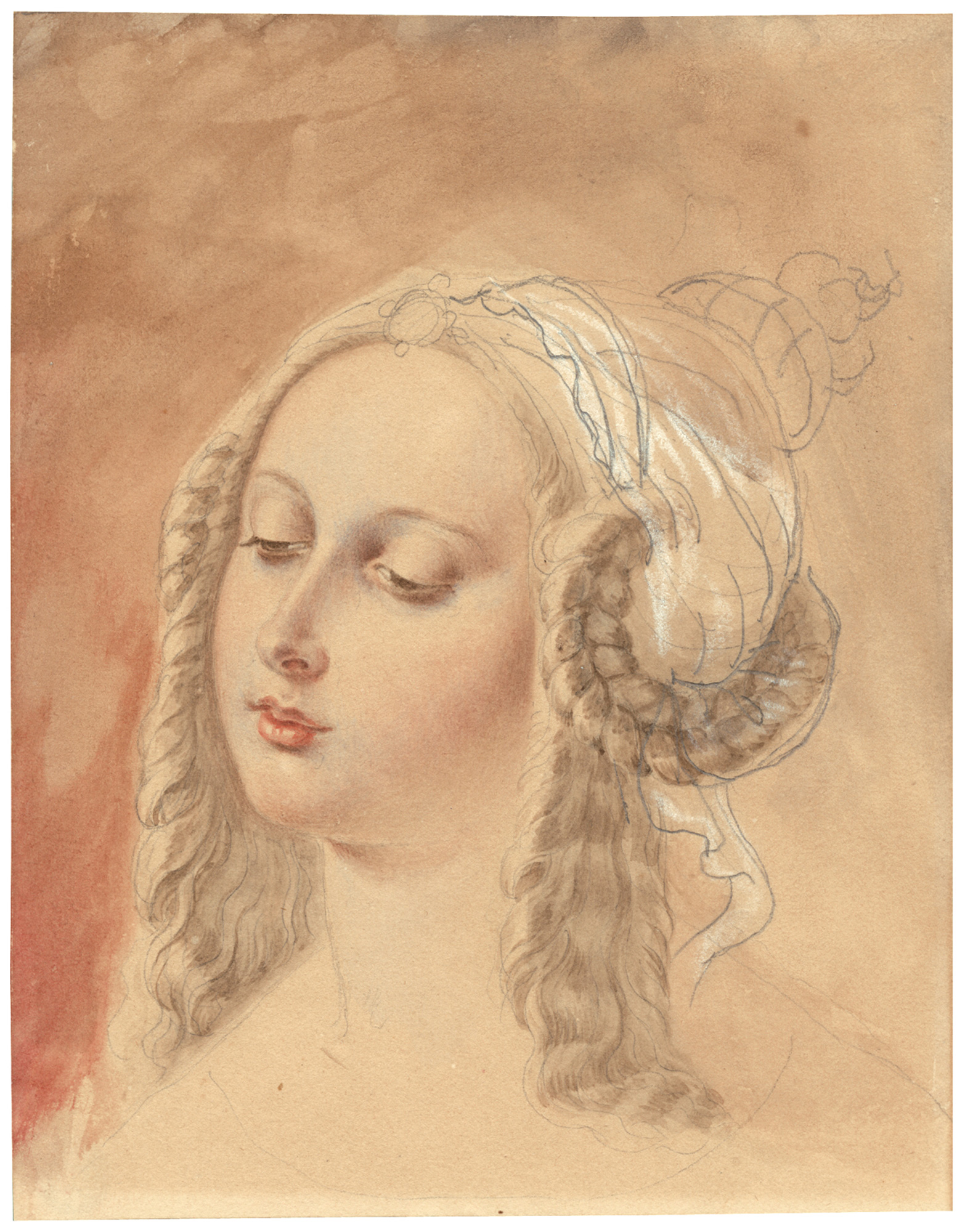
réf. 612-Eo.J. Aquarell über Bleistift, auf cremefarbenem Velin. 16,1:12,5 cm. Provenienz: C. G. Boerner, Düsseldorf, 1976, Kat. 67, Nr. 101; Sammlung MWD im Doppelkreis; Privatbesitz Rheinland. Vergleichsliteratur: Stoll, Ölbilder B, 4, S. 511/12; I. Koszinowski/V. Leuschner, Ludwig Emil Grimm. Zeichnungen und Gemälde. 2 Bde. Marburg, 1990, Bd. 1, Ö 52, Farbtaf. S. 208 u. Abb. S. 404. Bei diesem Aquarell handelt es sich um eine Vorstudie für das 1841 entstandene Gemälde ?Die Mohrentaufe? im Besitz der MHK Neue Galerie, Kassel. Das Modell für die weibliche Hauptfigur des Gemäldes war Hedwig von Münchhausen, die 1845 den österreich. Feldmarschallleutnant Otto von Scholley geheiratet hatte. Ihre Schwester Agnes von Münchhausen hatte 1837 Grimms Schwager Ludwig Hassenpflug nach dem Tode von dessen erster Frau geheiratet. Grimm hat sie auf einer weiteren - 1839 entstandenen - aquarellierten Bleistiftzeichnung porträtiert. Diese wurde bei Galerie Bassenge, Berlin, Auktion vom 1.06.2012, Nr. 6400 versteigert.
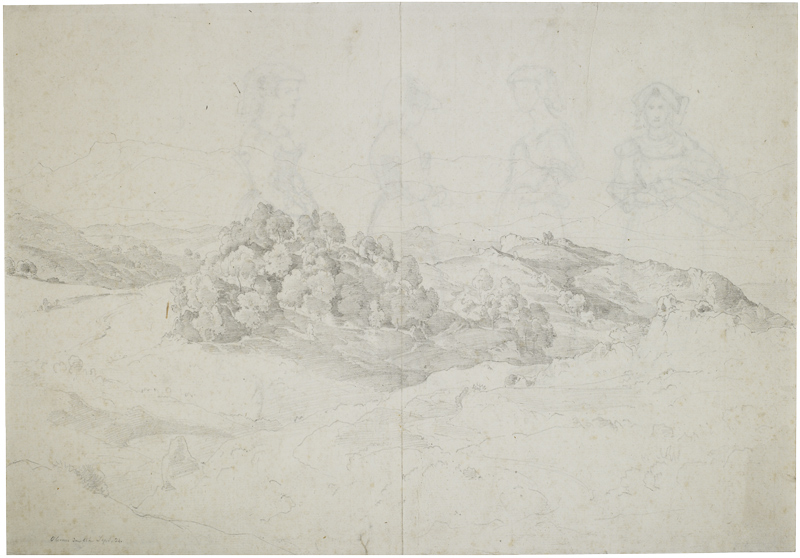
réf. 002-Io.J. Bleistift, auf Bütten mit Wasserzeichen: Vogel auf Dreiberg im Kreis, links unten bezeichnet und datiert ?Olevano den 11ten Sept. 24.?. 26,7:38,3 cm. Verso: Vier Studien einer stehenden jungen Frau. Bleistift. Die Studien auf der Rückseite der Zeichnung scheinen nach vorne durch. Horizontale Mittelfalte, vereinzelte kleine Stockflecken. In der bisher einzigen umfassenden Ausstellung der italienischen Landschaften von Heinrich Reinhold, waren 5 Zeichnungen vom Sommer 1824 zu sehen, die alle Landschaften bei Olevano darstellen (vgl. Ausst. Katalog: Heinrich Reinhold (1788-1825). Italienische Landschaften. Gera 1988, Nrn. 159-163, Abb. Ss. 243-247). Einen vergleichbaren Landschaftsausschnitt in der Serpentara mit dem kleinen Wäldchen, den wir hier vorstellen, hat Reinhold bereits 1821, von nahezu demselben Standort aus, gezeichnet (vgl. op. cit. Nr. 75, Abb. S. 161).
réf. 105420c. 1850 . Folio 52 x 35 cm; an album of 38 pencil and watercolour plates all in colour except one interior scene in pencil inscribed and dated throughout 37 mounted on paper including one advertisement by Smith's one loose 14 blank pages at rear slight browning and fading throughout decorated endpapers; bound in nineteenth century morocco backed marbled boards spine gilt ruled and lettered green morocco label gilt lettered on upper board worn at extremities frayed; overall an attractive album. An unusual and amusing album of period pencil and watercolour plates. The numerous plates depict furniture street scenes including protests with placards a variety of costumes including military uniforms theatrical and various trades all English. c. 1850 hardcover
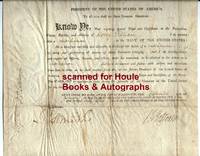
1809réf. 2221587RARE MIDSHIPMAN APPOINTMENT "Th: Jefferson" Partly-printed vellum DS as president 1 page 10" x 10 1/2" January 16 1809. President Jefferson issues a naval appointment for Henry Pilliam. In part: "That reposing special Trust and Confidence in the Patriotism Valour Fidelity and Abilities of Henry Pilliam I do appoint him a midshipman in the Navy of the United States." Neatly signed at the conclusion by President Jefferson and countersigned by Secretary pf the Navy Robert Smith. The document bears an embossed Navy Department seal to the upper left. Intersecting folds overall wrinkling and light staining otherwise fine condition. Such appointments by Thomas Jefferson are quite scarce as he and the Republican party opposed a strong navy. However as Jefferson's term neared its conclusion the naval forces were beginning to grow out of necessity in order to protect the maritime interests of the United States as merchant vessels were frequently being interfered with during their voyages on the high seas. Ultimately these disputes would culminate in the War of 1812 during President Madison's administration. A desirable and well-preserved example of a Jefferson appointment. Very good. unknown
1809réf. 2221587RARE MIDSHIPMAN APPOINTMENT "Th: Jefferson" Partly-printed vellum DS as president 1 page 10" x 10 1/2" January 16 1809. President Jefferson issues a naval appointment for Henry Pilliam. In part: "That reposing special Trust and Confidence in the Patriotism Valour Fidelity and Abilities of Henry Pilliam I do appoint him a midshipman in the Navy of the United States." Neatly signed at the conclusion by President Jefferson and countersigned by Secretary pf the Navy Robert Smith. The document bears an embossed Navy Department seal to the upper left. Intersecting folds overall wrinkling and light staining otherwise fine condition. Such appointments by Thomas Jefferson are quite scarce as he and the Republican party opposed a strong navy. However as Jefferson's term neared its conclusion the naval forces were beginning to grow out of necessity in order to protect the maritime interests of the United States as merchant vessels were frequently being interfered with during their voyages on the high seas. Ultimately these disputes would culminate in the War of 1812 during President Madison's administration. A desirable and well-preserved example of a Jefferson appointment. Very good. unknown books
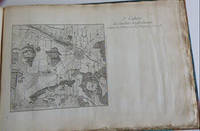
réf. 51-7064Paris: chez le Rouge 1777-1779. Oblong folio. 47 x 32cm. 98 engraved plates; some fold-outs. Later half goatskin binding.This compilation includes 4 of the 21 cahiers with 98 of the 491-493 plates in the full set. The 4 cahiers are complete in themselves: .Included are: 6e cahier. Serrail et jardins du grand seigneur includes Richard's Trianon gardens.7e cahier. Jardins anglo-chinois with Tableau de la plantation générale de tous les arbres . par Richard jardinier de la Reine et Le Rouge .8e cahier. Jardins anglo-chinois includes German and Austrian gardens.9e cahier. Jardins anglo-chinois.References: Met Museum: 46.52.21.3;SKB.3312 Brunet III.998 Jardins anglais only Guilmard 260.96; Veronique Royet Bibliothèque nationale de France Elisabetta Cereghini Odile Faliu Bernard Korzus Georges Louis Le Rouge: Les jardins anglo-chinois. Connaissance et Memoires Bibliothèque nationale de France Inventaire du fonds français; graveurs du dix-huitième siècle 15 Paris 2004 cat. no. 49-77 ill.; . Victoria and Albert Museum Department of Prints and Drawings and Department of Paintings Accessions 1953 London: HMSO 1963.Berlin Staatliche Museen Katalog der Ornamentstich-Sammlung der Staatlichen Kunstbibliothek Berlin Berlin and Leipzig 1936-39 3312. J. Dixon Hunt and M. Conan ed.s Tradition and Innovation in French Garden Art: Chapters of a New History Philadelphia: University of Philadelphia Press 2002 p. 115.OCLC Number / Unique Identifier:243866240; OCLC Number / Unique Identifier:1268266935.Other bibliographic references: • Berlin Staatliche Museen Katalog der Ornamentstich-Sammlung der Staatlichen Kunstbibliothek Berlin Berlin and Leipzig 1936-39 3312.• J. Dixon Hunt and M. Conan ed.s Tradition and Innovation in French Garden Art: Chapters of a New History Philadelphia: University of Philadelphia Press 2002 p. 115. [Paris: chez le Rouge, 1777-1779] unknown
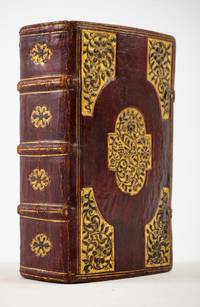
1622réf. ST20888Munich: N. Henricus 1622. First Edition in German. 160 x 100 mm. 6 1/4 x 4". 16 p.l. 699 3 pp. Translated from the Latin by Sebastian Äntzenhover. UNUSUAL AND QUITE BEAUTIFUL CONTEMPORARY GERMAN DARK RED MOROCCO GILT covers with gilt fillet border central panel with onlaid corner pieces and centerpiece of black morocco stamped in relief to an Ottoman-inspired design of flowering vines raised bands spine panels with gilt centerpiece two leather straps with silver clasps and catches all edges gilt. Title page with engraving of the Tower of Babel. Top half inch of title page cut away to remove owner inscription. VD17 12:103845E; USTC 2019170. A touch of bowing to boards spine a little crackled joints and extremities a bit rubbed occasional small round marginal marks apparently made with wax! and presumably meant to indicate textual importance other trivial imperfections but an excellent copy clean and fresh in an unrestored binding with lustrous boards glistening with gilt. This rare work on sinning through the use of wicked words is offered here in a lovely binding that is quite out of the ordinary for its time and place and that may well have a very noble provenance. "Spiritual Tongues: That is a Salutary Treatise Concerning the Poisonous Tongue of Man--How to Guard Against and Remedy It" is an examination of the sins committed through speaking written by Munich Jesuit Johannes Pelecyus 1545–1623 and first printed in Latin in 1620. Pelecyus addresses the evils of gossip slander indiscretion cursing mocking and other injurious speech. The first part of the work is a general overview of the topic from a theological standpoint while the second part is a more practical guide to types of harmful speech and specific remedies for avoiding and correcting these offenses. Pelecyus concludes with a poem "The Devil's Disease and its Remedy." The binding here is remarkable in terms of its material makeup and the conjectural origin of its design. In the first part of the 17th century morocco was not commonly used by German binders who preferred sturdier pigskin particularly for treatises like this which could be expected to see much use poisonous tongues have long been a fact of life and in need of being frequently read about. Morocco was generally reserved for presentation copies or ceremonial liturgical works. In addition to the material the decoration here is unusually lavish for a text of this sort with onlays gilt adornment and silver clasps that required time and skill from the artisan and considerable expense for the patron. Significantly the lovely relief centerpiece design on the boards here also appears on the covers of a Book of Hours originally created for Holy Roman Emperor Maximilian I 1459-1519. That volume was later acquired by another similarly named owner Duke Maximilian I of Bavaria and is now to be found in the Bavarian State Library: shelfmark BSB 2 L.impr.membr. 64. It is certainly well within the realm of possibility that our later Maximilian 1573-1651 could have owned the present poisoned tongue volume and had it dressed in its elaborate morocco attire in imitation of the original binding design on the emperor’s prayer book. Whoever was responsible for the binding they surely did extremely fine work and no doubt for an elite clientele. One other curious feature of this volume is the series of round wax dollops made in the margins which an owner the fastidious second Maximilian has used to mark passages of interest in the text. While they don't materially affect the value of the volume they are intriguing in that they inevitably call up images for us of a careful early reader systematically marking with some kind of unknown implement the parts of the text that seemed important. "Spiritual Tongues" is a rare work: USTC and OCLC find just four copies outside Germany none of them in North America and we could trace just one copy sold at auction. N. Henricus unknown
1622réf. ST20888Munich: N. Henricus 1622. First Edition in German. 160 x 100 mm. 6 1/4 x 4". 16 p.l. 699 3 pp. Translated from the Latin by Sebastian Äntzenhover. UNUSUAL AND QUITE BEAUTIFUL CONTEMPORARY GERMAN DARK RED MOROCCO GILT covers with gilt fillet border central panel with onlaid corner pieces and centerpiece of black morocco stamped in relief to an Ottoman-inspired design of flowering vines raised bands spine panels with gilt centerpiece two leather straps with silver clasps and catches all edges gilt. Title page with engraving of the Tower of Babel. Top half inch of title page cut away to remove owner inscription. VD17 12:103845E; USTC 2019170. A touch of bowing to boards spine a little crackled joints and extremities a bit rubbed occasional small round marginal marks apparently made with wax! and presumably meant to indicate textual importance other trivial imperfections but an excellent copy clean and fresh in an unrestored binding with lustrous boards glistening with gilt. This rare work on sinning through the use of wicked words is offered here in a lovely binding that is quite out of the ordinary for its time and place and that may well have a very noble provenance. "Spiritual Tongues: That is a Salutary Treatise Concerning the Poisonous Tongue of Man--How to Guard Against and Remedy It" is an examination of the sins committed through speaking written by Munich Jesuit Johannes Pelecyus 1545–1623 and first printed in Latin in 1620. Pelecyus addresses the evils of gossip slander indiscretion cursing mocking and other injurious speech. The first part of the work is a general overview of the topic from a theological standpoint while the second part is a more practical guide to types of harmful speech and specific remedies for avoiding and correcting these offenses. Pelecyus concludes with a poem "The Devil's Disease and its Remedy." The binding here is remarkable in terms of its material makeup and the conjectural origin of its design. In the first part of the 17th century morocco was not commonly used by German binders who preferred sturdier pigskin particularly for treatises like this which could be expected to see much use poisonous tongues have long been a fact of life and in need of being frequently read about. Morocco was generally reserved for presentation copies or ceremonial liturgical works. In addition to the material the decoration here is unusually lavish for a text of this sort with onlays gilt adornment and silver clasps that required time and skill from the artisan and considerable expense for the patron. Significantly the lovely relief centerpiece design on the boards here also appears on the covers of a Book of Hours originally created for Holy Roman Emperor Maximilian I 1459-1519. That volume was later acquired by another similarly named owner Duke Maximilian I of Bavaria and is now to be found in the Bavarian State Library: shelfmark BSB 2 L.impr.membr. 64. It is certainly well within the realm of possibility that our later Maximilian 1573-1651 could have owned the present poisoned tongue volume and had it dressed in its elaborate morocco attire in imitation of the original binding design on the emperor’s prayer book. Whoever was responsible for the binding they surely did extremely fine work and no doubt for an elite clientele. One other curious feature of this volume is the series of round wax dollops made in the margins which an owner the fastidious second Maximilian has used to mark passages of interest in the text. While they don't materially affect the value of the volume they are intriguing in that they inevitably call up images for us of a careful early reader systematically marking with some kind of unknown implement the parts of the text that seemed important. "Spiritual Tongues" is a rare work: USTC and OCLC find just four copies outside Germany none of them in North America and we could trace just one copy sold at auction. N. Henricus unknown books
1750- RARISSIMO PRIMO STATO DI SEI, dalla PRIMA EDIZIONE delle CARCERI - Acquaforte, bulino, tinta allo zolfo e bruniture, firmata in lastra in basso a destra. Tavola della PRIMA edizione delle 'Carceri'. Esemplare nel primo stato di sei secondo Robison. Magnifica prova, impressa su carta vergata coeva con filigrana "cerchio e giglio, margini di circa 8 mm, in ottimo stato di conservazione.Le 'Carceriì in prima edizione sono di eccezionale rarità. Secondo un censimento fatta da Andrew Robison, solo 16 esemplari completi dell'opera in prima tiratura sono noti nelle raccolte pubbliche di tutto il mondo.Senza dubbio la serie più nota e celebrata fra le opere del Piranesi. La serie è databile intorno al 1745, e comprendeva quattordici tavole, includendo il frontespizio che portava il titolo di Invenzioni Capric di Carceri all’acquaforte datte in luce da Giovanni Buzard in Roma, mercante al Corso. Una seconda stesura delle stesse, subito successiva, recava il titolo con il nome dell’editore giustamente corretto in Bouchard. E’ fuori di dubbio che l’idea, assolutamente innovativa, per la realizzazione di questa opera nasce da un collegamento molto stretto con la serie denominata Prima Parte di Architetture non solo per la vicinanza di tempo che intercorre tra i due lavori, ma proprio per il preciso intendimento ideologico che l’artista aveva in quel periodo in fatto di architettura. La serie venne ripubblicata dopo ben quindici anni, nel 1761, ampiamente riveduta e corretta. Il Piranesi non era nuovo a ripensamenti e variazioni sulle proprie opere, ma molto interessante è analizzare il motivo che lo indusse a riproporre, cambiandolo nella forma, questo importante lavoro. Le esperienze archeologiche condotte nello studio che porterà alle Antichità Romane (1756), le polemiche con architetti e le loro teorie del periodo, la consapevolezza di aver affinato ancora la propria tecnica stilistica, e il variato concetto architettonico lo indussero a mettere mano alle Carceri. E’ con questa nuova ed arricchita sapienza incisoria che l’artista va a ripescare le vecchie lastre, e dopo la rielaborazione, le ripresenta nel pieno della figura polemica e della lotta ideologica in fatto di architettura che in quegli anni conduceva. La riproposizione della serie rappresenta per il Piranesi un aspetto ben preciso, ovvero ripresentare, rinforzandolo, il messaggio polemico e di polemica architettonica già affrontato quindi anni prima. Lo scardinamento degli spazi e della prospettiva, della logica e di tutti i principi comuni affermati nei trattati, rottura totale con le leggi tradizionali e gli insegnamenti accademici dell’architettura. Due sono le tavole aggiunte nella seconda edizione, che quindi comprende il frontespizio e quindici lastre. Notevoli le differenze stilistiche tra il corpus dell’opera e le due nuove lastre, dove notevoli sono la complessità di struttura e di composizione architettonica, che dimostrano il cambiamento avvenuto in seguito allo studio archeologico dei grandi monumenti romani.Di diverso aspetto l’effetto emotivo che suscita la visione delle singole opere che compongono la serie, che con il loro aspetto malinconico costituiscono un elemento di perenne richiamo, di inesausta vitalità, e di estrema modernità. I ponti sospesi, le reti, i ballatoi, le scale e quanto altro presente nelle Carceri sono stati esame di numerosi studi, che una copiosa letteratura ha colto sin dal romanticismo, dando loro una grande popolarità, esaltandone le molteplici reazioni emozionali che le stesse conferivano. - THE VERY RARE FIRST STATE, from the FIRST EDITION of CARCERI -Etching, engraving, sulphur tint and burnishing, 1750, signed at lower right. From the Carceri set, from the first edition, first issue. Example in the first state of six described by Robison, from the contemporary roman edition.A magnific impression, printed with black ink on contemporary laid paper with "encircled fleur de lys" watermark, with small margins (about 8 mm), very good condition.The first edition of 'Carceri' is absolutely rare. According with Andrew Robison, there are only 16th complete set of the first edition and first issue preserverd in the libraries.Undoubtedly these is the best known and most celebrated series among the works by Piranesi. The series, datable around 1745, consisted of fourteen plates, with the title page bearing the title Invenzioni Capric di Carceri all’acquaforte datte in luce da Giovanni Buzard in Roma, mercante al Corso. In the second issue, immediately subsequent, the title presents the publisher’s name rightly corrected in Bouchard. There is no doubt that the innovative idea of this work comes from a very close connection with the series titled Prima Parte di Architetture not only for the proximity of the dates, but also because both the series reflect the Piranesi’s precise ideology on architecture.The series was re-published fifteen years later , in 1761. Robison 38 I/VI, Hind 12, Focillon 35.
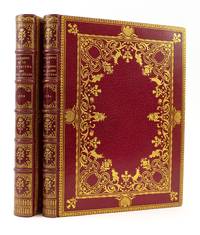
1780réf. ST17950Caprées i.e. Nancy: Chez Sabellus 1780 1784. FIRST EDITIONS FIRST PRINTINGS 11 lines on title page and long "s" in text with these Illustrations. 256 x 190 mm. 10 x 7 1/2". Two volumes. BEAUTIFUL 19TH CENTURY RED MOROCCO GILT IN THE ROCOCO STYLE BY CUZIN stamp-signed in gilt on front turn-ins covers with a gilt-ruled border featuring rocaille motifs at the sides and a floral spray at each corner elaborate inner frame of strapwork interwoven with scrolling acanthus drawer-handle tools flower garlands and several special tools including satyrs mountain goats insects and large vases of flowers raised bands compartments with gilt lettering or a central floral sprig surrounded by a frame of leaves and flowers turn-ins with intricate gilt lace roll-tooling all edges gilt. WITH A TOTAL OF 102 EROTIC PLATES by Denon each volume with a frontispiece and 50 plates plus an engraved title in volume II. Front pastedowns with ex-libris of Léon Gambetta. Cohen-de Ricci 474-75. ◆Light offsetting from illustrations paper in both volumes perhaps lightly pressed but not washed FIRST VOLUME with the faint stain from a ribbon marker now gone one plate slightly toned and with two very small repairs to margin otherwise IN FINE CONDITION; paper in volume II slightly toned and with occasional small spots and light stains but still excellent. None of this significant because THE GLORIOUS BINDINGS LUSTROUS AND UNWORN. Despite their scholarly titles which promise scenes from the private lives of the 12 Caesars and secrets from an ancient Roman cult these are among the most famous erotic books of the 18th century. In the first volume the 12 Roman emperors from Julius Caesar to Domitian are depicted engaged in a panoply of intimate acts beginning with Julius Caesar's liaison with King Nicomedes IV of Bithynia which led his enemies to dub him "Queen of Bithynia." We see what Caesar's heir Augustus was willing to do in order to succeed his great-uncle and his later sexual excesses as emperor including incest. Antony and Cleopatra are relatively demure compared to the orgies of Caligula Nero and Claudius' wife Messalina. The "Secret Cult of Roman Women" examined in the companion work is devoted to the fertility god Priapus and his phallic symbols with guest appearances by assorted satyrs nymphs and Bacchantes. The images are white-on-black to resemble sculptured wall medallions and claim to be based on ancient carvings; however Cohen-de Ricci informs us that while the text is evidence of d'Hancarville's erudition the illustrations are entirely the result of his libertine imagination. Art historian Pierre-François Hugues Baron d'Hancarville 1719-1805 established himself in the world of antiquarians when he helped William Hamilton acquire the impressive Porcinari collection of Etruscan Greek and Roman antiquities that would subsequently be purchased by the British Museum. He then supervised the production of four sumptuous volumes of engravings documenting the collection. He seems to have undertaken the present work for his own amusement. A later issue of the second title facetiously attributed publication to the Imprimerie de Vatican the Church had of course put it on the Index of Prohibited Books. According to Cohen-de Ricci this is the first and most desirable printing identifiable by 11 rather than 10 lines of text on the title page of the first work and by the use of the f-like "long s" in both volumes. The especially splendid bindings by Francisque Cuzin 1836-90 nod to the Rococo bindings of the 18th century and to the risqué subject matter with satyrs cavorting about the elegant frame. Cuzin opened his Paris workshop in 1855 and soon made his name among bibliophiles of that city with his exquisite bindings establishing what was called the "Cuzin style." Devauchelle says that this style was copied by Cuzin's colleagues but was never equalled. Cuzin was not a gilder but employed some of the best in the trade to execute his graceful designs among them Marius Michel père Wampflug Maillard and Cuzin's eventual successor Émile Mercier. Our copy was once in the library of the distinguished French statesman Léon Gambetta 1838-82 one of the founders of the Third Republic who served as president of the Chamber of Deputies. Chez Sabellus unknown
1780réf. ST17950Caprées i.e. Nancy: Chez Sabellus 1780 1784. FIRST EDITIONS FIRST PRINTINGS 11 lines on title page and long "s" in text with these Illustrations. 256 x 190 mm. 10 x 7 1/2". Two volumes. BEAUTIFUL 19TH CENTURY RED MOROCCO GILT IN THE ROCOCO STYLE BY CUZIN stamp-signed in gilt on front turn-ins covers with a gilt-ruled border featuring rocaille motifs at the sides and a floral spray at each corner elaborate inner frame of strapwork interwoven with scrolling acanthus drawer-handle tools flower garlands and several special tools including satyrs mountain goats insects and large vases of flowers raised bands compartments with gilt lettering or a central floral sprig surrounded by a frame of leaves and flowers turn-ins with intricate gilt lace roll-tooling all edges gilt. WITH A TOTAL OF 102 EROTIC PLATES by Denon each volume with a frontispiece and 50 plates plus an engraved title in volume II. Front pastedowns with ex-libris of Léon Gambetta. Cohen-de Ricci 474-75. ◆Light offsetting from illustrations paper in both volumes perhaps lightly pressed but not washed FIRST VOLUME with the faint stain from a ribbon marker now gone one plate slightly toned and with two very small repairs to margin otherwise IN FINE CONDITION; paper in volume II slightly toned and with occasional small spots and light stains but still excellent. None of this significant because THE GLORIOUS BINDINGS LUSTROUS AND UNWORN. Despite their scholarly titles which promise scenes from the private lives of the 12 Caesars and secrets from an ancient Roman cult these are among the most famous erotic books of the 18th century. In the first volume the 12 Roman emperors from Julius Caesar to Domitian are depicted engaged in a panoply of intimate acts beginning with Julius Caesar's liaison with King Nicomedes IV of Bithynia which led his enemies to dub him "Queen of Bithynia." We see what Caesar's heir Augustus was willing to do in order to succeed his great-uncle and his later sexual excesses as emperor including incest. Antony and Cleopatra are relatively demure compared to the orgies of Caligula Nero and Claudius' wife Messalina. The "Secret Cult of Roman Women" examined in the companion work is devoted to the fertility god Priapus and his phallic symbols with guest appearances by assorted satyrs nymphs and Bacchantes. The images are white-on-black to resemble sculptured wall medallions and claim to be based on ancient carvings; however Cohen-de Ricci informs us that while the text is evidence of d'Hancarville's erudition the illustrations are entirely the result of his libertine imagination. Art historian Pierre-François Hugues Baron d'Hancarville 1719-1805 established himself in the world of antiquarians when he helped William Hamilton acquire the impressive Porcinari collection of Etruscan Greek and Roman antiquities that would subsequently be purchased by the British Museum. He then supervised the production of four sumptuous volumes of engravings documenting the collection. He seems to have undertaken the present work for his own amusement. A later issue of the second title facetiously attributed publication to the Imprimerie de Vatican the Church had of course put it on the Index of Prohibited Books. According to Cohen-de Ricci this is the first and most desirable printing identifiable by 11 rather than 10 lines of text on the title page of the first work and by the use of the f-like "long s" in both volumes. The especially splendid bindings by Francisque Cuzin 1836-90 nod to the Rococo bindings of the 18th century and to the risqué subject matter with satyrs cavorting about the elegant frame. Cuzin opened his Paris workshop in 1855 and soon made his name among bibliophiles of that city with his exquisite bindings establishing what was called the "Cuzin style." Devauchelle says that this style was copied by Cuzin's colleagues but was never equalled. Cuzin was not a gilder but employed some of the best in the trade to execute his graceful designs among them Marius Michel père Wampflug Maillard and Cuzin's eventual successor Émile Mercier. Our copy was once in the library of the distinguished French statesman Léon Gambetta 1838-82 one of the founders of the Third Republic who served as president of the Chamber of Deputies. Chez Sabellus unknown books
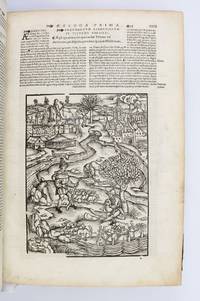
1529réf. ST20181Lugduni Lyon: Jean Crespin 1529. 326 x 215 mm. 13 x 8 1/2". 6 leaves 12-268 pp.; 1-95 1 pp.; 1-600 pp. 8 leaves. Three sections in one. Edited by Josse Badius Ascensius. Restrained 17th century mottled calf covers triple ruled in blind with oblique gilt fleurons in each corner raised bands neatly rebacked and recornered with modern deep brown morocco marbled endpapers edges sprinkled. WITH 203 TOTAL ILLUSTRATIONS comprised of 190 different woodcuts 11 of which repeat once and one repeating twice. The first title printed in black and red with an elaborate woodcut border; the second title with a fleur-de-lys device. With criblé initials throughout in three sizes many historiated. Handwritten book label of Tobias Gutberleth on title see below title additionally with ink ownership inscription of G. van Olden Junior dated 1860. Front flyleaf with pasted-in manuscript inscriptions of "Francis" and "R. E. Hattiule". Line numbers in ink in a contemporary hand through much of the volume. Mortimer 538; Renouard "Badius Ascensius" III 377; Adams V 474; Brunet V 1282; Graesse VI 336. Binding yawning a bit edges somewhat rubbed but a solidly restored and perfectly acceptable binding. Light smudges of no consequence here and there other trivial defects but internally very clean fresh and bright. This is a well-preserved copy of a 16th century printing of Virgil's "Opera" profusely illustrated with wonderfully detailed woodcuts replete with charm and drama. Initially produced in Strassburg for Johann Grüninger’s 1502 Vergil our striking set of illustrations was reused in the 1515 German translation of the Aeneid and then in Sacon’s 1517 Lyon printing which bears many similarities to the present edition. While the plates do show some of the wear expected with this level of reuse—Mortimer notes that several had split by the time of the 1517 printing—the impressions here are nevertheless quite good and the illustrations are no less compelling than befoe. The anonymous artist whom Mortimer describes as having "a skilled hand and lively imagination" has provided animated scenes that perfectly match the content of the text. They range from the charming pastoral images that accompany the Eclogues and Georgics full of cheerful farmers and leaping stags to the dramatic battle scenes of the Aeneid with their fierce heroes in full 15th century armor grotesque monsters and elaborately rendered cities engulfed by leaping flames all overlooked by the pantheon of unconcerned gods. The text here is framed by the commentary of French scholar and printer Josse Badius Ascensius as well as by the commentaries of Filippo Beroaldo Giovanni Pierio Valeriano Bolzani and others. The present copy was owned early in its history by Tobias Guberleth 1609-62 poet and head of the Leeuwarden Latin school. Jean Crespin unknown
1529réf. ST20181Lugduni Lyon: Jean Crespin 1529. 326 x 215 mm. 13 x 8 1/2". 6 leaves 12-268 pp.; 1-95 1 pp.; 1-600 pp. 8 leaves. Three sections in one. Edited by Josse Badius Ascensius. Restrained 17th century mottled calf covers triple ruled in blind with oblique gilt fleurons in each corner raised bands neatly rebacked and recornered with modern deep brown morocco marbled endpapers edges sprinkled. WITH 203 TOTAL ILLUSTRATIONS comprised of 190 different woodcuts 11 of which repeat once and one repeating twice. The first title printed in black and red with an elaborate woodcut border; the second title with a fleur-de-lys device. With criblé initials throughout in three sizes many historiated. Handwritten book label of Tobias Gutberleth on title see below title additionally with ink ownership inscription of G. van Olden Junior dated 1860. Front flyleaf with pasted-in manuscript inscriptions of "Francis" and "R. E. Hattiule". Line numbers in ink in a contemporary hand through much of the volume. Mortimer 538; Renouard "Badius Ascensius" III 377; Adams V 474; Brunet V 1282; Graesse VI 336. Binding yawning a bit edges somewhat rubbed but a solidly restored and perfectly acceptable binding. Light smudges of no consequence here and there other trivial defects but internally very clean fresh and bright. This is a well-preserved copy of a 16th century printing of Virgil's "Opera" profusely illustrated with wonderfully detailed woodcuts replete with charm and drama. Initially produced in Strassburg for Johann Grüninger’s 1502 Vergil our striking set of illustrations was reused in the 1515 German translation of the Aeneid and then in Sacon’s 1517 Lyon printing which bears many similarities to the present edition. While the plates do show some of the wear expected with this level of reuse—Mortimer notes that several had split by the time of the 1517 printing—the impressions here are nevertheless quite good and the illustrations are no less compelling than befoe. The anonymous artist whom Mortimer describes as having "a skilled hand and lively imagination" has provided animated scenes that perfectly match the content of the text. They range from the charming pastoral images that accompany the Eclogues and Georgics full of cheerful farmers and leaping stags to the dramatic battle scenes of the Aeneid with their fierce heroes in full 15th century armor grotesque monsters and elaborately rendered cities engulfed by leaping flames all overlooked by the pantheon of unconcerned gods. The text here is framed by the commentary of French scholar and printer Josse Badius Ascensius as well as by the commentaries of Filippo Beroaldo Giovanni Pierio Valeriano Bolzani and others. The present copy was owned early in its history by Tobias Guberleth 1609-62 poet and head of the Leeuwarden Latin school. Jean Crespin unknown books
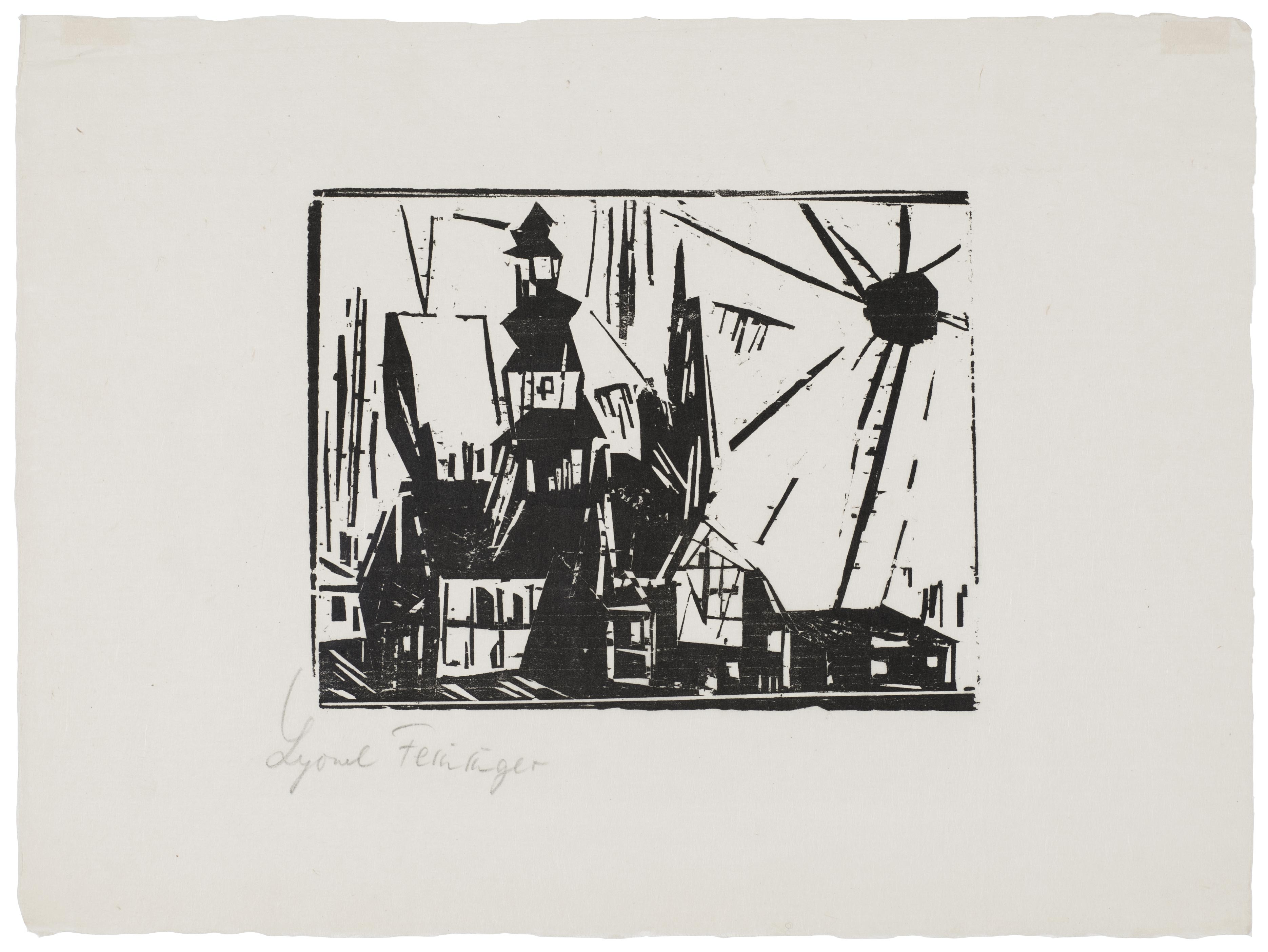
réf. EN-139o.J. Holzschnitt, 1919, auf sehr feinem cremefarbenem Japan-Bütten, mit Bleistift signiert ?Lyonel Feininger?. Darstellungsgröße 17,3:22 cm, Blattgröße 30,5:41 cm. Brillanter Druck mit dem vollen Rand. - Provenienz: Galerie Wirnitzer, Baden-Baden, Kat. Querschnitt II, 1976, Nr. 20 m. Abb; Privatsammlung, Süddeutschland. - Literatur: Prasse W 192, II (v. II); Söhn HDO 72724-1. ? Veröffentlicht unter dem Titel ?Lehnstedt? in ?Die Schaffenden?, Euphorion-Verlag, Berlin, 8. Jahrgang, 2. Mappe (1932). [2 Warenabbildungen]
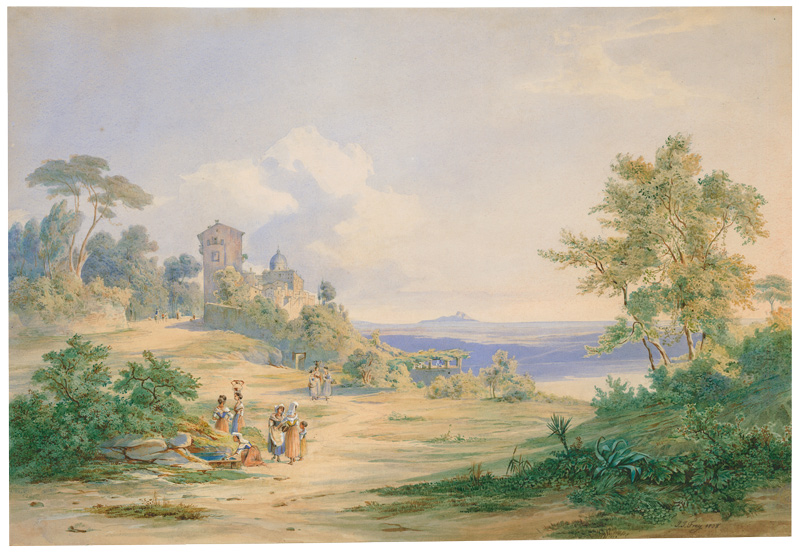
réf. 016-Io.J. Aquarell, auf cremefarbenem Velin, rechts unten signiert und datiert ?J.J. Frey Rom 1838.?, auf beigefügtem altem Untersatz vermutl. vom Künstler selbst numeriert und bezeichnet ?N 1 Castel Gandolfo bei Albano, See... Albano in der Ferne das Meer gegen Ardea zu.? . 31:45 cm.
réf. FH-340o.J. Folge von 24 Blatt Farbholzschnitten, auf Japan, sämtlich mit Bleistift signiert und bezeichnet, Darstellungsgrößen von 9,3:9,2 cm bis 14,5:15,5 cm. Werknummern.: 67, 210, 211, 212, 216, 217, 218, 219, 220, 221, 222, 225, 226, 228, 229, 230, 231, 234, 235, 236, 246, 247, 248 und 249. Literatur: Ausst. Katalog: Fürstenfeldbruck, 1999.
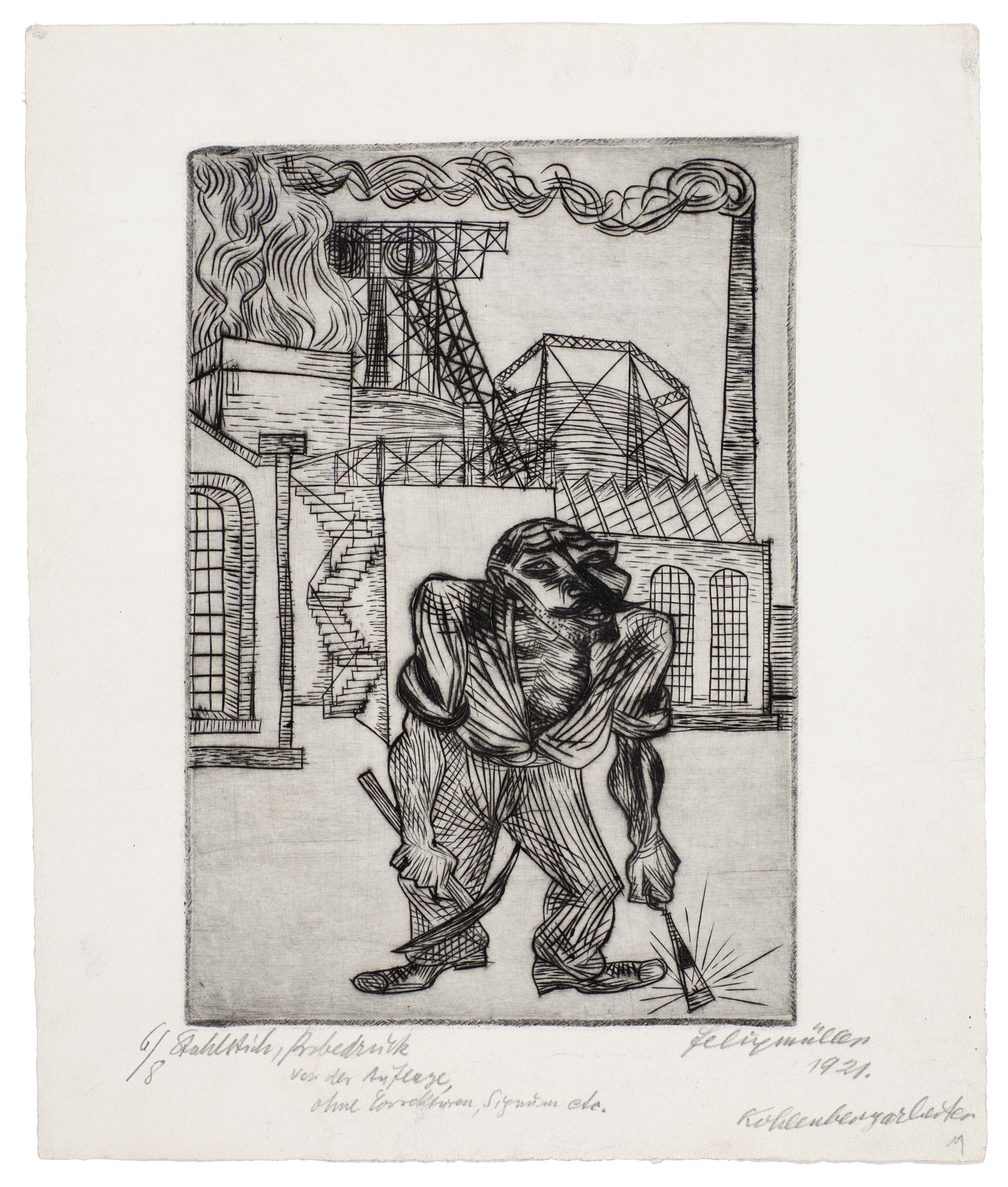
réf. EN-140o.J. Stahlstich, 1921, auf Velin, mit Bleistift nummeriert und bezeichnet ?6/8 Stahlstich, Probedruck / vor der Auflage, / ohne Correcturen, Signum etc?, signiert, datiert und betitelt ?Felixmüller / 1921. / Kohlenbergarbeiter?. Darstellungsgröße 21,5:14,9 cm, Blattgröße 27,7:23,4 cm. Prachtvoller, sehr ausgewogener Druck mit tiefen Schwärzen, deutlichem Grat, wunderbar glänzendem Plattenton und breitem Rand. Der seltene Probeabzug noch ohne das Monogramm und den zusätzlichen Schraffuren an der Gebäudewand hinter dem Arbeiter, der linken Fensterfront, sowie dem rauchenden hinteren Gebäudeteil. - Provenienz: Privatsammlung, USA. - Literatur: Söhn 257 a (von b). ? Söhn nennt ca. 10 Handabzüge auf unterschiedlichen Papieren neben der Auflage von 100 Exemplaren auf Kupferdruckpapier, gedruckt bei Walter Künzel, Dresden, als Beitrag zum ?Jahrbuch der Jungen Kunst?, 2. Jahrgang, 1921, Klinkhardt & Biermann Verlag. Abweichend zu diesen Angaben nummeriert Felixmüller unser Exemplar mit einer Auflage von 8 Probedrucken.
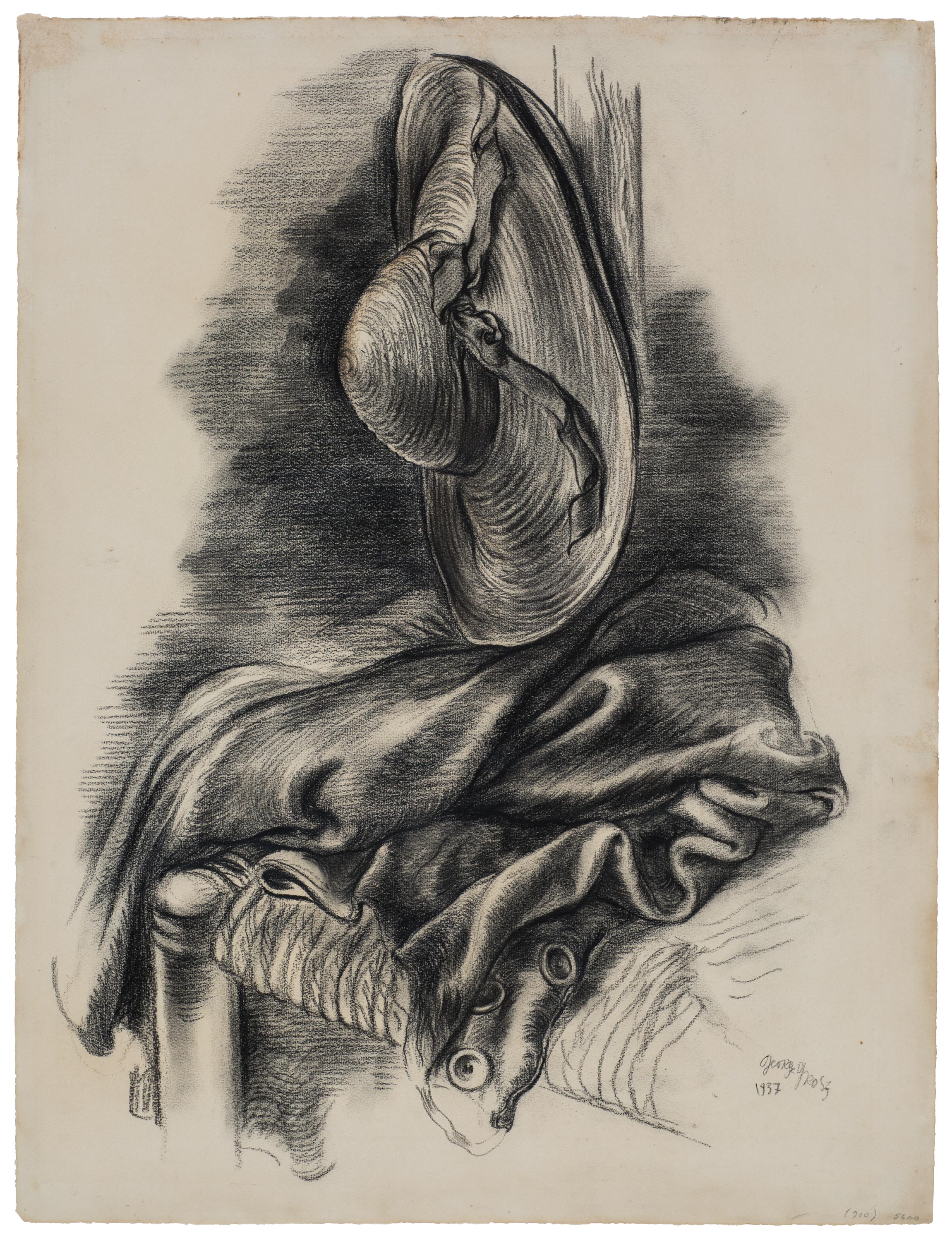
réf. EN-144o.J. Kohle, auf Bütten mit Wasserzeichen: MICHALLET FRANCE, mit Bleistift signiert und datiert ?George Grosz / 1937?. Blattgröße 63,2:48,1 cm. Zu den Rändern hin leicht fleckig. - Provenienz: Villa Grisebach, Berlin, A 254, Lot 1197, November 2015; Privatsammlung, Hessen.
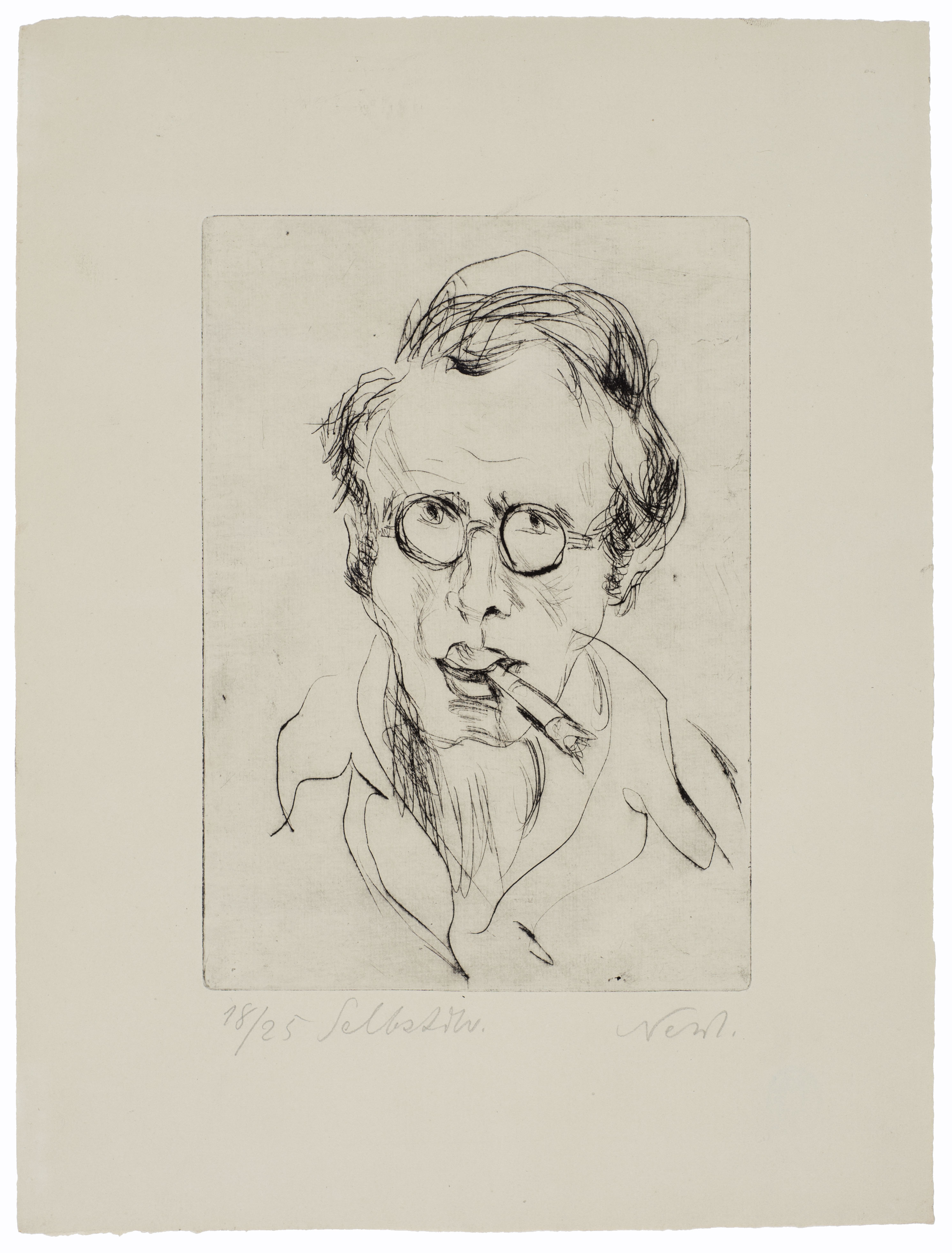
réf. EN-166o.J. Kaltnadelradierung, um 1922, auf Bütten mit Fragment des Wasserzeichens: JWZander, nummeriert und bezeichnet ?18/25 Selbstdr(uck).?, sowie signiert ?Nesch?. Darstellungsgröße 24,6:17,5 cm, Blattgröße 38,7:29,2 cm. - Provenienz: Altenburg, Staatl. Lindenmuseum, ausgesch. 76/13922 (Stempel verso). - Literatur: Ausstellungskatalog: The Graphic Art of Rolf Nesch. Detroit, The Detroit Inst. of Arts, 1969, Kat. Nr. 2.; Helliesen/Sorensen 173. - Rolf Nesch zählt neben Edvard Munch (1863-1944) zu den bedeutendsten Künstlern der Klassischen Moderne in Skandinavien. Der gebürtige Deutsche mit norwegischer Staatsbürgerschaft ist einer der Ausnahmekünstler im Bereich der Druckgraphik. [2 Warenabbildungen]
1546réf. 5968Venice: Cornelio Adelkind for Daniel Bomberg 1546. First edition. Very Good. Folio 32 cm; 93 leaves. Text in Hebrew. Title within architectural border reproduced in Amram "Makers of Hebrew Books in Italy" p. 215 also in the Jewish Museum's 1989 exhibition catalogue "Gardens and Ghettos: the Art of Jewish Life in Italy" page 50. Some section headings within ornamental borders. Bound in c19 or c20 dark red crushed morocco ruled in gilt and decorated with arabesques on both boards; spine with raised bands and compartments tooled and titled in gilt; green polished leather doublures with red crushed morocco dentelles bordered in pointillé accented with arabesques; green moiré free endleaves. Edges gilt. Binding not signed. Joints and crown adroitly reinforced with Japanese paper; corners somewhat worn down. Occasional contemporary notes in manuscript in text; brief stain on leaf mem-tet and lightly along the bottom edge of leaves nun-bet and nun-gimmel. Text otherwise pristine. Title page light possibly washed. Old library ink stamps from an institution in Warsaw on title page. Red morocco ex-libris of mining magnate and philanthropist Adolph Lewisohn 1849-1938. References: Adams T-766; BM Italian 674; Steinschneider 7304 #1; Amram 215 illustration and 222. First printed edition editio princeps of the 11th century commentary on portions of the pentateuch by the Bulgarian poet and Talmudist Tobiah ben Eliezer. Published by the house of the seminal printer of Hebrew books Daniel Bomberg under the supervision of his scholar-in-residence extraordinaire Cornelio Adelkind. Venetian law at this time limited Hebrew publishing to Gentile printers. Bomberg a protestant from Antwerp entered this lucrative market and with Adelkind's help became its prime exponent until his death in 1549. Cornelio Adelkind for Daniel Bomberg hardcover
1546réf. 5968Venice: Cornelio Adelkind for Daniel Bomberg 1546. First edition. Very Good. Folio 32 cm; 93 leaves. Text in Hebrew. Title within architectural border reproduced in Amram "Makers of Hebrew Books in Italy" p. 215 also in the Jewish Museum's 1989 exhibition catalogue "Gardens and Ghettos: the Art of Jewish Life in Italy" page 50. Some section headings within ornamental borders. Bound in c19 or c20 dark red crushed morocco ruled in gilt and decorated with arabesques on both boards; spine with raised bands and compartments tooled and titled in gilt; green polished leather doublures with red crushed morocco dentelles bordered in pointillé accented with arabesques; green moiré free endleaves. Edges gilt. Binding not signed. Joints and crown adroitly reinforced with Japanese paper; corners somewhat worn down. Occasional contemporary notes in manuscript in text; brief stain on leaf mem-tet and lightly along the bottom edge of leaves nun-bet and nun-gimmel. Text otherwise pristine. Title page light possibly washed. Old library ink stamps from an institution in Warsaw on title page. Red morocco ex-libris of mining magnate and philanthropist Adolph Lewisohn 1849-1938. References: Adams T-766; BM Italian 674; Steinschneider 7304 #1; Amram 215 illustration and 222. First printed edition editio princeps of the 11th century commentary on portions of the pentateuch by the Bulgarian poet and Talmudist Tobiah ben Eliezer. Published by the house of the seminal printer of Hebrew books Daniel Bomberg under the supervision of his scholar-in-residence extraordinaire Cornelio Adelkind. Venetian law at this time limited Hebrew publishing to Gentile printers. Bomberg a protestant from Antwerp entered this lucrative market and with Adelkind's help became its prime exponent until his death in 1549. Cornelio Adelkind for Daniel Bomberg hardcover books
réf. 1441Italy 17th Century. 127 x 98 mm. 5 x 3 ¾ inches. 16 p. including final blank. Italy 17th century. A handwritten guide to the drawing of the human head the most important element of any figure drawing and frequently the starting point for early modern drawing manuals. The manuscript appears to be unpublished and we have been unable to trace the text anywhere in the vast digitized corpus. The content is divided into five brief sections the first explaining how to draw a head in profile. Our scribe focuses on the triangle method in which the profile is anchored by three primary points: the top of the forehead cima della fronte beneath the nostrils sotto le narici and the well of the chin and the beard pozzetta del mento ò barbuccio. The author then explains how to connect these points how to form the nose place the mouth and lips draw the eye etc. Our scribe closes this section with the kind of aspirational promise endemic to manuals of this time namely that if you simple follow my instructions you’ll be able to do this easily. “without much confusion and effort” senza tante confusion et fatiche. The second section explains how to draw the head “in majesty” Della testa in scurcio by which the author appears to mean ‘head-on’ in such a way to convey power and authority he elsewhere refer to this position as prospetto e.g. on p. 9. Here the author likewise focuses on a simple method of drawing lines between different features of the face. The third section covers drawing the head in shadow Della testa in scurcio which the author admits is alquanto più difficle than the first two exercise and so he won’t be sticking to such geometrical rules. But then he goes on to provide a single very simple rule una regola facile assai namely to start with drawing rounded oval l’ovato cirolare and continues with guidelines that sound awfully geometric to us. The fourth section is on drawing a child’s head in profile la testa del fanciullo in profilo where he again starts with the triangle method adding other geometric principles and referencing the point of a compass. The fifth and final section is on drawing a child’s head in maestà wherein the author cites earlier discussion and further expounds on geometric advice. The author then closes with a general comment on the excellence and nobility of the art of drawing. The focus throughout is on lines and contours and proportions always guided by geometric rules for producing an accurate but relatively basic sketch. There is only brief passing reference to elements like “hair or other ornament according to the need and what is most pleasing” pelli or altro ornamento secondo che porfarà il bisogno e che più in piacerà. Despite the brief section on drawing the head in shadow there is nothing on rendering value or otherwise on capturing the subtleties that give a drawing depth and feeling. Like its spine title the Fairfax Murry catalogue calls this 17th-century and we tend to agree based on the script. While we haven’t traced our particular “bird” watermark Heathwood records a few similar marks used in the 17th century and Briquet finds many in the 16th especially in Italy. No less absorbing than the manuscript is a pair of 16th century Italian binding covers here preserved as doublures both heavily decorate in blind. The front doublure carries an arabesque motif and center Alexander the Great in profile. The rear appears to have been impressed with a single panel stamp also arabesque both doublures betraying the Islamic influence that characterized many Italian bindings of the period. Provenance: Lot 237 in the second Fairfax Murray sale his label on the inside rear board and perhaps then to Robert Tunstill his bookplate on the front fly-leaf. To us from a fellow ABAA bookseller who purchased it from a UK dealer in the 1990’s. Condition: Written in a cursive hand in dark brown ink on laid paper watermarked with a bird within a circle. Rebound in the late 19th century or early 20th century in cream pigskin tooled in black preserving as doublures the decorated covers of a 16h-century Italian binding described above title in gilt on spine Del disegno. Ms. Saec XVII. Following the manuscript are four additional blank leaves saved for scanning old pen trials early but the paper is different than the manuscript proper. Additionally six more modern fly leaves have been added at both front and back presumably at the time of rebind. A little loss since filled to the upper outer corner of the manuscript leaves and the four earlier blank leaves affecting just a word or two on each page; a few old pen trials over the text though it remains legible. Binding extremities lightly worn. References: Catalogue of the Second Portion of the Library of C. Fairfax Murray 1918 p. 42 no. 237 “Manuscript on paper Italian hand 16 pp. repaired white morocco extra the cover of an old stamped vellum binding used as a double. 12mo. Saec. xvii”. Alexandra Arvilla Greist Learning to Draw Drawing to Learn: Theory and Practice in Italian Printed Drawing Books 1600-1700 PhD Dissertation UPenn 2011 p. vii “Italian printed drawing books libri da disegnare comprise an important body of evidence for our knowledge of artistic training in Italy during the early modern period. . . Intended for both professional and amateur audiences these printed sources were soon copied throughout Europe where they influenced drawing education for the next 400 years”. C. M. Briquet. Les Filigranes v. 3 # 12202- 12232 similar watermarks mostly 16th century. Edward Heawood Watermarks Mainly of the 17th and 18th Centuries 1950 # 179 183 similar watermarks 17th century. Anthony Hobson Humanists and Bookbinders 1989 p. 220-21 recording a few 16th century Italian bindings with Alexander the Great plaquettes. Thanks to Patrick Olson for help with this description. unknown