49 163 résultats
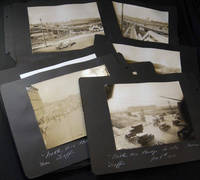
1916réf. 030035New York NY: Department of Bridges City of New York 1916. Group of photographs by Eugene de Salignac 1861 - 1943 photographer for this municipal NY department and purpotedly solely responsible for this function until his 1934 retirement; an excellent industrial photographer and the subject of a recent traveling exhibition of his works. Approx. 7" x 10 1/4" size; bound in polished red cloth gilt spine and cover titles. Light wear and soil top front corner bumped; in very good condition. Photographs. Very Good. Department of Bridges City of New York hardcover
1980réf. KOS01201158Shinshisha 1980. Soft Cover. Fine. KOS01201158 Shinshisha paperback
1980réf. KOS01205521Kamakura Bunko 1980. Soft Cover. Fine. KOS01205521 Kamakura Bunko paperback
1980réf. KOS01206752TBD 1980. Soft Cover. Fine. KOS01206752 TBD paperback
1980réf. KOS02200234TBD 1980. Soft Cover. Fine. KOS02200234 TBD paperback
1997réf. KOS02201743Art Publishing 1997. Soft Cover. Fine. KOS02201743 Art Publishing paperback
2004réf. KOS02300299Kyoto Art Center 2004. Soft Cover. Fine. KOS02300299 Kyoto Art Center paperback
1980réf. KOS02202825Art Publishing 1980. Soft Cover. Fine. KOS02202825 Art Publishing paperback
1980réf. KOS02300334Iwanami book store 1980. Soft Cover. Fine. KOS02300334 Iwanami book store paperback
réf. KOS02202573Art Publishing ï¼’ï¼ï¼ï¼™. Soft Cover. Fine. KOS02202573 Art Publishing paperback
réf. 0266268390.Gpaperback. Good. Access codes and supplements are not guaranteed with used items. May be an ex-library book. paperback
réf. 0260663824.Ghardcover. Good. Access codes and supplements are not guaranteed with used items. May be an ex-library book. hardcover
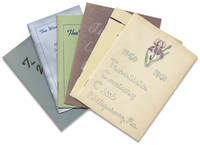
réf. 3729845Philipsburg Centre County Pennsylvania 1936–1963. 13 Booklets printed wrappers. In various formats approx. 3¼ x 4¾ inches to 6 x 4½ inches and various paginations approx. 10 to 36 pages each. Scattered ownership inscription. All in near fine condition. The Woman’s Club was organized in 1936 by consolidating three earlier women’s clubs with the oldest dating back to 1912. These yearbooks spanning from 1936 to the mid-1950s the bulk include club officers department chairmen committees member lists by-laws and the club’s program of meetings for the year. Also included are two yearbooks 1960–1962 from another Philipsburg women’s club The Twentieth Century Club organized in 1924. unknown
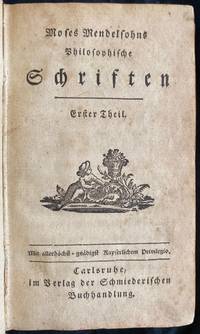
1780réf. 43258Carlsruhe: im Verlag der Schmiederischen Buchhandlung 1780. No Date 1780s. Period laquered boards with leather spine label. 12mo. XXIV 278; 283 pages. In German. Title translates as “Writings.” Includes 2 different title vignettes 1 on each title page. Goedeke IV 1 488 6. Meyer 108; Dorn 105-107; Holzmann/Bohatta Deutsches Anomymen-Lexikon IV no. 1559. Early printing of Mendelssohn’s second work in which he "began his formulation of a new psychological theory that stressed the autonomy of aesthetics logic and ethics relative to each other." Merriam-Webster's Encyclopedia of World Religions p. 710. Contents: Vol. 1. Vorrede. I. Ueber die Empfindungen. II. Gespräche; Vol. 2. I. Rhapsodie oder Zusätze zu den Briefen über die Empfindungen. II. Ueber die Hauptgrundsätze der schönen Künste und Wissenschaften. III. Ueber das Erhabene und Naive in den schönen Wissenschaften. IV. Ueber die Wahrscheinlichkeit. Also includes bibliographical references. Included within these is a series of writings on aesthetics which influenced Lessing and Schiller with Lessing noting“We have to thank him Mendelssohn for the true theory of mixed sensations.” Moses Mendelssohn Moses of Dessau; 1729–1786 was a philosopher of the German Enlightenment in the pre-Kantian period early Maskil and a renowned Jewish figure in the 18th century. Mendelssohn was fluent in German and Hebrew and learned Latin Greek English French and Italian. His early teachers were young broadly educated Jews and he met the writer and dramatist G.E. Lessing 1754 and a deep and lifelong friendship developed between them. Throughout his life he worked as a merchant while carrying out his literary activities and widespread correspondence in his free time. In 1754 Mendelssohn began to publish – at first with the assistance of Lessing – philosophical writings and later also literary reviews. He also started a few literary projects for example the short-lived periodical Kohelet Musar in order to enrich and change Jewish culture and took part in the early Haskalah. In 1763 he was awarded the first prize of the Prussian Royal Academy of Sciences for his work Abhandlung über die Evidenz in metaphysischen Wissenschaften "Treatise on Evidence in Metaphysical Knowledge". However when the academy elected him as a member in 1771 King Frederick II refused to ratify its decision. In 1769 he became embroiled in a dispute on the Jewish religion and from then on he confined most of his literary activity to the sphere of Judaism. His most notable and enduring works in this area included the translation into German and commentary on the Pentateuch Sefer Netivot ha-Shalom "Book of the Paths of Peace" 1780–83 and his Jerusalem: oder Ueber religiöse Macht und Judenthum "Jerusalem or On Religious Power and Judaism" 1783 this work the first polemical defense of Judaism in the German language and one of the pioneering works of modern Jewish philosophy. An active intermediary on behalf of his own people in difficult times and a participant in their struggle for equal rights he was at the same time a forceful defender of the Enlightenment against the opposition to it which gained strength toward the end of his life. In the midst of a literary battle against one of the leading figures of the counter-Enlightenment he died in 1786 EJ. SUBJECTS: Philosophy -- Early works to 1800. Philosophie -- Ouvrages avant 1800. Philosophy. OCLC: 1352546328. Light wear to original boards more so at spine but solid and attractive light spotting as expected About Very Good- Condition an attractive 18th Century copy. B KH-10-31. Carlsruhe: im Verlag der Schmiederischen Buchhandlung unknown
réf. 0260696978.Ghardcover. Good. Access codes and supplements are not guaranteed with used items. May be an ex-library book. hardcover
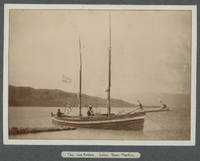
1890réf. List01108Mostly Patagonia 1890. Printing-out paper prints the images measuring 3 1/4x4 1/2 to 4 1/4x6 inches and the reverse each with a caption written on a label affixed to the mount below the prints. 4to blue pictorial cloth. 1890s. In this bound photo album forty-six photographs document a group traveling from pastoral locations in northern Argentina to breathtaking views at the southern tip of the continent. The photographs were taken by an accomplished photographer and handwritten captions in English provide brief descriptions of the locations and people documented. Apparently a member of an exploration commission the photographer and his team travel first from Bahia Brazil to Buenos Aires and La Pláta then on to the southern tip of the continent and back up the continent through remote lakes and mountains on both sides of the Chilean/Argentinian border. While the photographer’s name and nationality are not clear from the album there are two photographs with a Sr. Moreno who is likely the Argentinian explorer Francisco ‘Perito’ Moreno. The photographs of “Sr. Moreno” bear a clear resemblance to photographs of Francisco Moreno and they are taken in La Plata which is where Moreno was the first director of the natural history museum Museo de La Plata. On the album page following the one with photographs of Sr. Moreno there are photographs of the Museo de La Plata building and grounds. Museo de La Plata was established in 1884 and Moreno’s personal collection of 15000 pieces formed the core of the original collections Farro. In order to fill the exhibit rooms he sought more materials and carried out collecting campaigns in Patagonia. At times he hired naturalists to travel into remote parts of Patagonia to gather samples of flora fauna geology and artifacts of indigenous people’s culture Farro. Museo de la Plata was exhibiting anthropological remains and indigenous material culture at the same time that Argentina was expanding into indigenous territory Farro. In this way Museo de la Plata was not just a natural history museum it was also a force of colonialism. Not only was Argentina in the process of colonizing Patagonia but also it sought to claim and maintain territory in relation to Chile. A sixty year boundary controversy between Argentina and Chile resulted in the Treaty of 1881 in which the two countries agreed for the first time on the boundaries in Patagonia Perry. Even after 1881 vague language in the treaty that the boundary be “the most lofty peaks that divide the waters” extended the dispute until 1902 Perry. Because Patagonia had not been colonized extensively scientific exploration of the region was tied with nation-building and establishing these borders. In 1896 the Argentinean government appointed Moreno as the Expert Representative in the border dispute with Chile. He led commissions of naturalists and surveying engineers through the disputed border regions along the Andes Mountains Museo de La Plata n.d. Moreno’s work had parallels in Chile’s attempts to establish borders too: “Through the work of these explorers the state was able to.draw up laws and decrees regarding environmental destruction and more effectively defend its position in the limits conflict with Argentina” Etchegaray 2018. We do not know whether the exploration commission in this photo album was affiliated with Moreno the collections of Museo de la Plata or the boundary controversy. However given the route to the tip of the continent and the back up along the newly established border it seems possible that this commission could have played some role – whether directly or indirectly – in the process of exploration and nation building occurring at that time. References Etchegaray J. L. 2018. Cataloging the nation: Explorations and the incorporation of North Patagonia into the Chilean National Ordering 1856-1902 Thesis San Francisco State University. In AS36 2018 HIST .E83. http://dspace.calstate.edu/handle/10211.3/213510 Farro Máximo E. n.d. The Business of Museums: Towards a History of Collections in La Plata’s Museum 1888-1906 – World Archaeological Congress. Retrieved June 15 2021 from https://worldarch.org/world-archaeological-bulletin/the-business-of-museums-towards-a-history-of-collections-in-la-platas-museum-1888-1906/ Ryan C. 2011. Indigenous possessions: Anthropology museums and nation-making in Argentina 1862–1943 Ph.D. The University of Wisconsin - Madison. Retrieved June 15 2021 from http://www.proquest.com/pqdtglobal/docview/885379045/abstract/E55A419FE8D54C0DPQ/1 Museo de La Plata. n.d. Retrieved July 2 2021 from https://www.museo.fcnym.unlp.edu.ar/museo. unknown
1920réf. 2741c. early 1920's. Gray cardboard mount with black and white photo. Very good. 25 x 12 cm. photo 18 x 13 cm. Black and white mounted photo of women attending a National Grange festival. Beginning in the late 1800's the Grange formally known as the Patrons of Husbandry was organized to assist farmers with the multitude of difficulties they experienced primarily in rural environments. The Grange unlike many organizations allowed women to become members. This photo depicts nine women in similar dress displaying the national symbol - a sheaf of wheat. unknown
réf. 50126930like new. unknown
réf. 102335313X.Ghardcover. Good. Access codes and supplements are not guaranteed with used items. May be an ex-library book. hardcover
réf. 1330841387.Gpaperback. Good. Access codes and supplements are not guaranteed with used items. May be an ex-library book. paperback
réf. 1023014971.Gpaperback. Good. Access codes and supplements are not guaranteed with used items. May be an ex-library book. paperback
réf. 1023222914.Ghardcover. Good. Access codes and supplements are not guaranteed with used items. May be an ex-library book. hardcover
réf. 102322285X.Gpaperback. Good. Access codes and supplements are not guaranteed with used items. May be an ex-library book. paperback
réf. 1023181096.Ghardcover. Good. Access codes and supplements are not guaranteed with used items. May be an ex-library book. hardcover