Maximilien RobespierreBiblio.com

401 results
ref. 0260154598.Ghardcover. Good. Access codes and supplements are not guaranteed with used items. May be an ex-library book. hardcover
ref. 0260854999.Ghardcover. Good. Access codes and supplements are not guaranteed with used items. May be an ex-library book. hardcover
ref. 0243344163.Gpaperback. Good. Access codes and supplements are not guaranteed with used items. May be an ex-library book. paperback
ref. 127269660X.Gpaperback. Good. Access codes and supplements are not guaranteed with used items. May be an ex-library book. paperback
ref. 1023724030.Gpaperback. Good. Access codes and supplements are not guaranteed with used items. May be an ex-library book. paperback
ref. 1023718294.Ghardcover. Good. Access codes and supplements are not guaranteed with used items. May be an ex-library book. hardcover
ref. 0656639342.Ghardcover. Good. Access codes and supplements are not guaranteed with used items. May be an ex-library book. hardcover
ref. 46455772like new. unknown
ref. 3563073058.Ghardcover. Good. Access codes and supplements are not guaranteed with used items. May be an ex-library book. hardcover
ref. 0666418209.Ghardcover. Good. Access codes and supplements are not guaranteed with used items. May be an ex-library book. hardcover
ref. 0656237945.Ghardcover. Good. Access codes and supplements are not guaranteed with used items. May be an ex-library book. hardcover
ref. 0656751355.Ghardcover. Good. Access codes and supplements are not guaranteed with used items. May be an ex-library book. hardcover
ref. 0331840464.Ghardcover. Good. Access codes and supplements are not guaranteed with used items. May be an ex-library book. hardcover
ref. 0260104108.Ghardcover. Good. Access codes and supplements are not guaranteed with used items. May be an ex-library book. hardcover
ref. 0265349621.Ghardcover. Good. Access codes and supplements are not guaranteed with used items. May be an ex-library book. hardcover
ref. 0666508186.Ghardcover. Good. Access codes and supplements are not guaranteed with used items. May be an ex-library book. hardcover
ref. 1019519118.Ghardcover. Good. Access codes and supplements are not guaranteed with used items. May be an ex-library book. hardcover
ref. 0364429569.Ghardcover. Good. Access codes and supplements are not guaranteed with used items. May be an ex-library book. hardcover
1950ref. 92479Presses Universitaires de France 1950. Book. Very Good. Soft cover. French language text. Pages unmarked and uncut. Paper tanning. Light backward bend in lower corner. Smudging along lower fore edges. Binding firm. Presses Universitaires de France Paperback
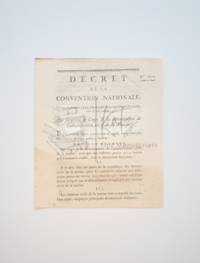
1793ref. 0010134France. Very Good. 1793. Ephemera. On offer is offer is a superb copy of the order that purged the French Navy of its officer corps in the days of the Reign of Terror in the French Revolution. This document is the order given to suppress the Navy. An excerpt of the document follows: Qui supprime le Corps et la denomination de l'administration civile de le Marine Le corps et la denomination de l'administration civile de la marine ainsi que des differens grades qui y etoient precedemment etablis font ey demeurent supprimes. Translation: iWhich abolishes the Body and the designation of the civil administration of the Navy The body and the designation of the civil administration of the navy as well as the different ranks which were previously established there are and remain suppressed. . Les dispositions ci-dessus sont communes aux ingenieurs constucteurs. : ils cesseront egalement de saire corps. Ils auront le meme uniforme que les employes aux bureaux civile de la marine avec la seule difference que les paremens de l'habit seront en velours noir mais il ne seront sous les ordres d'aucun des employes. Translation: .The above provisions are common to the construction engineers: they will also cease to be a body. They will have the same uniform as the employees of the civil offices of the navy with the only difference that the clothing will be in black velvet but they will not be under the orders of any of the employees The document was inspected by a man named Blaux and also bears a printed signature of Robespierre. The order also bears the printed signatures of Dabarade and Gohier. Dalbarade was Jean Dalbarade the Minister of the Navy and Colonies Gohier was Louis-Jerome Gohier the Minister of Justice and of course Robespierre was Maximilian Robespierre who became the embodiment of the Reign of Terror which saw an orgy of public executions numbering between 15 and 20 thousand citizens. Information on the history that informed the document is as follows. The French navy has always been affectionately known as La Royale The Royal in part because of its close relationship with the monarchy. Under Louis XVI the French Navy was rebuilt into a powerful fighting force capable of fighting and defeating the British Royal Navy. The French Navy played a decisive role in the American Revolution defeating the Royal Navy in the Battle of Chesapeake Bay. However the French Revolution was to be a disaster for the French Navy. In 1793 sailors in the Brest Squadron mutinied in a series of mutinies that became known as the Quiberon Mutinies. This occurred at the height of the Reign of Terror. Regardless of the underlying causes this gave the hardline revolutionaries the justification needed to purge the officer corps of the Navy. The French Navys officer corp was comprised of many members of the old aristocracy and was viewed with deep suspicion. The purge resulted in dozens of ships captains being driven out of the navy along with some admirals. Many were imprisoned and some sent to the guillotine. The Naval Gunnery School was also disbanded with catastrophic consequences when they had to face the Royal Navy. Since 1745 the Royal Navy required all ships to run gunnery drills daily and in action a Royal Navy ship could fire a broadside every 90 seconds which was unmatched by any other navy. For a historian this is a superb document that speaks to the heart not only of the Reign of Terror but also to the debilitating purges of the French navy at a time when they were so needed. This 4-page printed manuscript measures 8.25 inches by 7.0 inches The document is 100% complete. The paper is in very good condition. There is some slight staining on the inside right page but it does not in any way interfere with the legibility of the contents. The document is signed and countersigned with printed signature and also bears a handwritten signature confirming it is a certified copy of the original legislation. ; 8vo 8" - 9" tall; 4 pages; Signed by All Authors . unknown
1967Volume rilegato in cartoncino rigido ruvido, dalla copertina illustrata, con caratteri dorati e con titolo in oro al dorso, in tassello nero, protetto da sovraccoperta in plastica trasparente, con bandelle, dove è stampato il titolo, leggermente lesionata. Buonissimo lo stato conservativo, pagine perfettamente tenute, ossidate da tonalità seppia, bruniti i tagli, con XIII ( 13 ) tavole illustrate nel testo e XIV ( 14 ) fuori testo. Numero pagine 435. USATO
1989ill.
2018br. La tesi che questa nuova biografia sposa, ciò che la rende originale e di grande spessore storico, è il rifiuto di un certo approccio psicologizzante 'emotivo' e sensazionalista che ha caratterizzato la critica recente. L'autore ci accompagna lungo l'evoluzione dell'uomo, nel rapporto con i suoi pari e i suoi rivali, quelli che hanno condiviso con lui le stesse esperienze: un'infanzia difficile, un'adolescenza dedita allo studio, la precoce scalata sociale, mondana e letteraria. Attraverso le molteplici e successive prese di posizione politica, anche quelle considerate minoritarie, emerge l'antagonismo con i vari Danton, Marat, Sant-Just, in una perenne altalena che gli impedisce di esercitare una qualsiasi magistratura suprema. Quando infine sembra riuscire ad accedervi, viene giudicato e condannato come criminale dai suoi colleghi, il 9 Termidoro 1794. Come sappiamo, nessuna strada di Parigi porta il nome di Robespierre, passato alla storia come l'archetipo del mostro. Senza assolverlo né condannarlo Jean-Clément Martin spiega che tale reputazione fu costruita ad arte dai termidoriani, che dopo averlo sconfitto si vollero affrancare dal loro ruolo nella violenza di Stato. Il 10 e l'11 Termidoro che videro l'esecuzione di Robespierre, Couthon, Saint-Just e circa altri 100 personaggi, servono in realtà a denunciare l'"incorruttibile" come il solo responsabile del Terrore. Questa accusa ha riscritto la storia della rivoluzione ed è ancora la versione dei fatti più accreditata. L'autore smonta uno ad uno - dal punto di vista storico - i miti e la leggenda che circondano il personaggio, per ritrovare l'uomo. Una ricostruzione senza faglie, un libro che restituisce a Robespierre l'immagine dell'eminente uomo politico.
2015ill., br. Maximilien Robespierre: tiranno, fanatico, salvatore, ideologo. Considerato da alcuni il primo, sanguinario dittatore moderno, e da altri il grande martire della Rivoluzione, da tutti stimato come uomo di incredibile fermezza l'Incorruttibile -, il teorico del Terrore è una delle figure storiche più controverse della modernità, capace di polarizzare le reazioni degli studiosi e di alimentare intorno alla propria persona un mito che spesso scolora nella leggenda. Quella di un ragazzo gracile, concepito al di fuori del matrimonio e ai margini della buona società di provincia; di un giovane che legge clandestinamente Rousseau durante gli anni del collegio, e che agli ideali di fratellanza ed eguaglianza decide di consacrare tutta la propria vita; del "difensore del popolo" che nel 1789 arriva a Versailles come rappresentate del Terzo Stato; del politico che piega il proprio sentire alle contingenze caotiche della Rivoluzione. È da questi snodi cruciali che parte Peter McPhee - fra i più autorevoli storici della Francia e dell'ancien regime - per raccontare la vicenda, personale prima ancora che politica, di Robespierre, la cui ombra si staglia imponente sulle alterne vicende della Rivoluzione: passioni, limiti, desideri confluiscono in un profilo psicologico in cui, alla volontà d'acciaio e alla distaccata carica morale, si associa una purezza idealistica a cui l'inflessibilità conferisce un minaccioso ascendente, e alla quale l'inasprirsi del conflitto diede i tratti di una ferocia estrema.
2020br. In molti hanno provato a cambiare l'umanità applicando dei principi ritenuti perfetti, e "l'incorruttibile" Robespierre è uno degli esempi più celebri. In questa biografia scritta nel 1935 come un romanzo con uno stile quasi cinematografico, Friedrich Sieburg riflette le inquietudini della sua epoca, quella dei totalitarismi, a partire dalla barbarie del Terrore scaturita dall'applicazione delle dottrine illuministe. Ispirato da Rousseau, infatti, Robespierre portò in politica la logica totalitaria di un sistema universale di ispirazione religiosa, fatto di ombra e di luce: la sua "volontà generale" non era certo la volontà della maggioranza ma la volontà di coloro che sono virtuosi e in possesso della verità, i giacobini, setta eretta come nuova Chiesa nella Francia rivoluzionaria (Saint-Just, l'arcangelo della Rivoluzione, è qui dipinto come un protocomunista). E questo nonostante "l'incorruttibile" fosse un uomo piuttosto timido e cupo sin dall'infanzia, capace di umanità solo nelle tristi pareti dell'intimità domestica.