Martin Jean-ClémentMareMagnum

401 resultados
2018br. La tesi che questa nuova biografia sposa, ciò che la rende originale e di grande spessore storico, è il rifiuto di un certo approccio psicologizzante 'emotivo' e sensazionalista che ha caratterizzato la critica recente. L'autore ci accompagna lungo l'evoluzione dell'uomo, nel rapporto con i suoi pari e i suoi rivali, quelli che hanno condiviso con lui le stesse esperienze: un'infanzia difficile, un'adolescenza dedita allo studio, la precoce scalata sociale, mondana e letteraria. Attraverso le molteplici e successive prese di posizione politica, anche quelle considerate minoritarie, emerge l'antagonismo con i vari Danton, Marat, Sant-Just, in una perenne altalena che gli impedisce di esercitare una qualsiasi magistratura suprema. Quando infine sembra riuscire ad accedervi, viene giudicato e condannato come criminale dai suoi colleghi, il 9 Termidoro 1794. Come sappiamo, nessuna strada di Parigi porta il nome di Robespierre, passato alla storia come l'archetipo del mostro. Senza assolverlo né condannarlo Jean-Clément Martin spiega che tale reputazione fu costruita ad arte dai termidoriani, che dopo averlo sconfitto si vollero affrancare dal loro ruolo nella violenza di Stato. Il 10 e l'11 Termidoro che videro l'esecuzione di Robespierre, Couthon, Saint-Just e circa altri 100 personaggi, servono in realtà a denunciare l'"incorruttibile" come il solo responsabile del Terrore. Questa accusa ha riscritto la storia della rivoluzione ed è ancora la versione dei fatti più accreditata. L'autore smonta uno ad uno - dal punto di vista storico - i miti e la leggenda che circondano il personaggio, per ritrovare l'uomo. Una ricostruzione senza faglie, un libro che restituisce a Robespierre l'immagine dell'eminente uomo politico.
1963ref. 20759Berlin, Rütten & Loening, 1963. 1. Auflage. 466, (2) S., 1 Faltblatt. 8°, OLn. mit OSchU.
1980In-16 (cm. 19.60), brossura illustrata, pp. 293, (3). Minime tracce d’uso; peraltro, volume in buono stato di conservazione (good copy).
1989Trad.di Roberto Massari. 24°, pp.160, 1 tav. con ritratto, br.edit.
1977ref. 33566La Couronne Imprimerie Sopan 1977 année 1977 complète, quarante neuvième année
1956ref. 33534Nancy Imprimerie Georges Thomas 1956 4 fascicules paginés de 1 à 448 pp
1958ref. 33539Nancy Imprimerie Georges Thomas 1958 5 fascicules paginés , 90 pp environs par fascicule
1956ref. 33559Nancy Imprimerie Georges Thomas 1956 in-8° 1 fascicule paginés de 113 à 224 pp
1961ref. 33542Nancy Imprimerie Georges Thomas 1961 manque le fascicule numéro 2
1965ref. 33545Nancy Imprimerie Georges Thomas 1965 3 fascicules sur 4
1957ref. 33562Nancy Imprimerie Georges Thomas 1957 in-8° fascicules paginés de 1 à 288 , manque le fascicule 4
1989ill.
1950Mm 160x220 Seconda edizione riveduta. Collana "Biblioteca di cultura storica" - Opera nella sua brossura originale, 346 pagine ancora intonse con tavole in nero intercalate nel testo. Esemplare in ottime condizioni. SPEDIZIONE IN 24 ORE DALLA CONFERMA DELL'ORDINE.
1976Mm 120x195 "Paperbacks storici", 25 - Brossura editoriale di 242 pagine, introduzione di Georges Lefebvre, traduzione e cura di Manuela Albertone. Qualche traccia di polvere alla copertina, peraltro in perfette condizioni. SPEDIZIONE IN 24 ORE DALLA CONFERMA DELL'ORDINE.
ref. 74188Coll. "Société des études robespierristes", Paris, éd. Sociales, 20 décembre 1973, in-8, cartonnage souple, couv. ill. en noir éditeur, 284 pp., préface de Georges Lefebvre, table des matières Très belle étude sur le caractère et l'ambition de Maximilen Robespierre durant la Révolution française. Très bon état
1971Un fort volume broché de format in 8° de 366 pp.; couverture illustrée Quelques rousseurs sur les gardes; sinon bon état. Voir photo.
1968Max Gallo Maximilien Robespierre - Histoire d'une solitude. , Librairie Academique Perrin 1968, Copertina rigida in finta pelle con scritte in oro con segni d'uso ai margini; pagine integre con immagini illustrative Buono (Good) . Copertina rigida 349
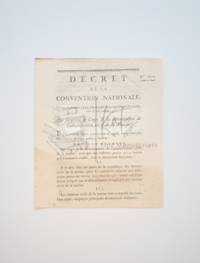
1793ref. 0010134France. Very Good. 1793. Ephemera. On offer is offer is a superb copy of the order that purged the French Navy of its officer corps in the days of the Reign of Terror in the French Revolution. This document is the order given to suppress the Navy. An excerpt of the document follows: Qui supprime le Corps et la denomination de l'administration civile de le Marine Le corps et la denomination de l'administration civile de la marine ainsi que des differens grades qui y etoient precedemment etablis font ey demeurent supprimes. Translation: iWhich abolishes the Body and the designation of the civil administration of the Navy The body and the designation of the civil administration of the navy as well as the different ranks which were previously established there are and remain suppressed. . Les dispositions ci-dessus sont communes aux ingenieurs constucteurs. : ils cesseront egalement de saire corps. Ils auront le meme uniforme que les employes aux bureaux civile de la marine avec la seule difference que les paremens de l'habit seront en velours noir mais il ne seront sous les ordres d'aucun des employes. Translation: .The above provisions are common to the construction engineers: they will also cease to be a body. They will have the same uniform as the employees of the civil offices of the navy with the only difference that the clothing will be in black velvet but they will not be under the orders of any of the employees The document was inspected by a man named Blaux and also bears a printed signature of Robespierre. The order also bears the printed signatures of Dabarade and Gohier. Dalbarade was Jean Dalbarade the Minister of the Navy and Colonies Gohier was Louis-Jerome Gohier the Minister of Justice and of course Robespierre was Maximilian Robespierre who became the embodiment of the Reign of Terror which saw an orgy of public executions numbering between 15 and 20 thousand citizens. Information on the history that informed the document is as follows. The French navy has always been affectionately known as La Royale The Royal in part because of its close relationship with the monarchy. Under Louis XVI the French Navy was rebuilt into a powerful fighting force capable of fighting and defeating the British Royal Navy. The French Navy played a decisive role in the American Revolution defeating the Royal Navy in the Battle of Chesapeake Bay. However the French Revolution was to be a disaster for the French Navy. In 1793 sailors in the Brest Squadron mutinied in a series of mutinies that became known as the Quiberon Mutinies. This occurred at the height of the Reign of Terror. Regardless of the underlying causes this gave the hardline revolutionaries the justification needed to purge the officer corps of the Navy. The French Navys officer corp was comprised of many members of the old aristocracy and was viewed with deep suspicion. The purge resulted in dozens of ships captains being driven out of the navy along with some admirals. Many were imprisoned and some sent to the guillotine. The Naval Gunnery School was also disbanded with catastrophic consequences when they had to face the Royal Navy. Since 1745 the Royal Navy required all ships to run gunnery drills daily and in action a Royal Navy ship could fire a broadside every 90 seconds which was unmatched by any other navy. For a historian this is a superb document that speaks to the heart not only of the Reign of Terror but also to the debilitating purges of the French navy at a time when they were so needed. This 4-page printed manuscript measures 8.25 inches by 7.0 inches The document is 100% complete. The paper is in very good condition. There is some slight staining on the inside right page but it does not in any way interfere with the legibility of the contents. The document is signed and countersigned with printed signature and also bears a handwritten signature confirming it is a certified copy of the original legislation. ; 8vo 8" - 9" tall; 4 pages; Signed by All Authors . unknown
ref. BN359295Hamburg Merlin 1971. Hardcover. Ausgewählte Texte. Dt. von M. Unruh. Mit einer Einl. von Carlo Schmid. 1. A. Ausgewählte Texte. Dt. von M. Unruh. Mit einer Einl. von Carlo Schmid. 1. A. Maximilien Robespierre Hamburg, Merlin 1971. hardcover
ref. 0331965887.Ghardcover. Good. Access codes and supplements are not guaranteed with used items. May be an ex-library book. hardcover
ref. 0265697751.Ghardcover. Good. Access codes and supplements are not guaranteed with used items. May be an ex-library book. hardcover
ref. 0266691153.Gpaperback. Good. Access codes and supplements are not guaranteed with used items. May be an ex-library book. paperback
ref. ria9783849144500_inpHardcover. New. New Book; Fast Shipping from UK; Not signed; Not First Edition; Cette uvre édition relié fait partie de la série TREDITION CLASSICS. La maison d'édition tredition basée à Hambourg a publié dans la série TREDITION CLASSICS des ouvrages anciens de plus de deux millénaires. Ils étaient pour la plu hardcover
2006ref. I-610-182Editions de l'Aube 2006. Paperback. Very Good. Former library book. Ammareal gives back up to 15% of this item's net price to charity organizations. Editions de l'Aube paperback
2006ref. BN554919Editions de l'Aube 2006. 2006. Softcover. Discours sur la religion la République l'esclavage Discours sur la religion la République l'esclavage Maximilien Robespierre Editions de l'Aube paperback