Honoré-Gabriel Riquetti de MIRABEAU.Livre Rare Book

1 393 résultats
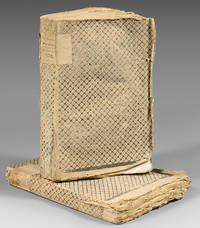
1788réf. AMO-24644 forts volumes in-4 (27 x 21,5 cm) de (10)-XLIV-522, (3)-566-(4), (3)-710-(6) et (3)-560-(1) pages. Portrait de Frédéric le Grand en frontispice du premier volume (gravé par H. Marais en 1788 d'après A. Graf). Exemplaire bien complet des 59 tableaux dépliants (ou non) qui se trouvent à leur place intercalés dans les volumes (les feuillets de placement des tableaux sont présents en tête de chaque volume). Le tome III contient un planche symbolique hors-texte gravée par Ransonnette "Grand Ordre de Monsieur" (p. 489). Cartonnage plein papier à la colle bleu à l'imitation des cartonnages de l'époque. Entièrement non rogné, cartonné sur brochure, pièces de titre imprimées sur papier (modernes), étuis cartonnés de papier à la colle (un fond d'étui fêlé, sans gravité). Ensemble en superbe état. Intérieurs généralement d'une très grande fraîcheur. Quelques cahiers légèrement teintés ou avec quelques rousseurs. Sans l'atlas in-folio vendu séparément et contenant 10 cartes sur double page, dressées par Mentelle et gravées par Pierre François Tardieu, 93 planches de tactique non signées. « Cette importante étude, fort bien documentée, sur la Prusse est le résultat d’une vaste enquête » ; « C’est une œuvre conçue par Mirabeau selon son plan, d’après sa conception de l’histoire économique et philosophique », il « fondait de grands espoirs sur cet ouvrage pour établir sa réputation d’écrivain et obtenir enfin un emploi digne de son talent, de son origine et de son ambition. » (H. Aureille, Bibliographie de Mirabeau.). On y trouve d'intéressantes informations sur l'organisation militaire de la Prusse, sa législation, son administration et son économie, ainsi qu'un certain nombre de considérations sur la population. Les données statistiques sur les habitants de la Prusse s'y trouvent en grand nombre. On y trouve également de l'économie-politique, les productions agricoles et les richesses naturelles, les manufactures, le commerce, la constitution civile et politique, les revenus et dépenses, le système militaire (tactique) et la religion. Le premier volume s'ouvre sur une délicate et reconnaissante épître "à mon père" (Mirabeau père). Mirabeau a été aidé pour cet ouvrage par Jakob Mauvillon (1743-1794), physiocrate allemand. On accusé Mirabeau de n'avoir rédigé que quelques passages et préambules de l'ouvrage, le gros du travail revenant à Mauvillon. La correspondance échangée entre Mirabeau et Mauvillon prouve le contraire. Mirabeau était non seulement à l'origine de cet important ouvrage mais encore le maître d'oeuvre et principal rédacteur (certaines études récentes présentent toutefois Mauvillon comme le nègre de Mirabeau pour cet ouvrage). Jean-Charles Laveaux (1747-1829), professeur de langue française à Bâle, puis professeur de littérature française à Stuttgart et à Berlin, à la demande de Frédéric le Grand, a participé à la documentation historique pour cette histoire de la monarchie prussienne. Provenance : Exemplaire offert par Mirabeau à Nicolas Frochot (1761-1828). Attesté par un petit billet autographe (non signé) par Nicolas Frochot et daté de Paris le 4 avril 1790 présent en tête du premier volume. Frochot y remercie M. le comte de Mirabeau de l'envoi qu'il lui a fait de son ouvrage sur la monarchie prussienne. "Comme il a été bien entendu entre nous que je ne lui vendais pas le petit Cicero de amicitiâ, et que d'ailleurs j'aurais dans ce cas un retour considérable à lui donner. J'accepte ce cadeau non comme un prix d'échange du petit traité de l'Amitié mais comme un don que je m'honorerai toujours de tenirde celle de l'auteur. (en haut du billet il est écrit de la main même de Frochot : Copie de mon billet de remerciement à M. le comte de Mirabeau). Très émouvant billet quand on sait que Nicolas Frochot s'est lié d'une réelle amitié avec Mirabeau qui fit de lui son exécuteur testamentaire. Élu député des États généraux le 25 mars 1789, il est chargé de rédiger les cahiers de doléances du tiers état de sa province, avant de siéger à la Constituante (il se lie à Mirabeau à ce moment là). Il est l'auteur du titre VII de la Constitution, publié sous le titre De la souveraineté nationale dont l'exercice n'est pas constamment délégué. D'abord administrateur de la Côte-d'Or, il est emprisonné sous la Terreur. Libéré à la suite de la chute de Robespierre, il occupe divers postes administratifs avant d'être élu député de la Côte-d'Or en décembre 1799. Quelques mois plus tard, le 22 mars 1800 (1er germinal an VIII), nommé préfet de la Seine par Bonaparte, il démissionne de son mandat de député. Il devient ainsi le premier Préfet de la Seine et de Paris (Étienne Mejan lui est adjoint comme secrétaire général de la préfecture). Il propose de nombreuses réformes à caractère social (prisons, hôpitaux, Mont-de-piété et service des enfants abandonnés), qu'il ne parvient toutefois pas à mettre totalement en application. Il réalise les premiers embellissements et aménagements de voirie décidés par Napoléon, dont la numérotation des immeubles. Il fait percer de nouvelles rues, voies, ponts et marchés. Il fait acheter des terrains, hors des limites du Paris de l'époque, qu'il fait transformer en 4 cimetières : cimetière du Père-Lachaise, cimetière de Montmartre, cimetière du Montparnasse et cimetière de Passy. Il est mis en retraite en 1812, à la suite de la Conspiration de Malet. Il est nommé comte d'Empire. Conseiller d'État honoraire sous la première Restauration, il se rallie à Napoléon qui le nomme préfet des Bouches-du-Rhône durant les Cent-Jours. Il est destitué lors de la deuxième Restauration pour être remplacé par le comte de Vaublanc. Il se retire alors définitivement de la vie publique. (source : wikipédia). Nous pensons que Nicolas Frochot a été gratifié de cette exemplaire sous forme brochée, tel que paru. Un cartonnage a sans doute été donné ensuite à cet ouvrage par Frochot. Le présent cartonnage est à l'imitation du premier. Mirabeau meurt tout juste un an après la rédaction de ce billet de remerciement (2 avril 1791). Bel exemplaire de cet important ouvrage, offert par Mirabeau à Nicolas Frochot, son ami et exécuteur testamentaire.
1791réf. 015877Paris: Lejay e poi Devaux 1791-92. .Precedée de tous les Discours et Ouvrages du meme Auteur prononcés ou publiés en Provence pendant le cours des élections. Par M. Etienne Méjan. - 5 volumi 125x21 cm in mezza pelle coeva dorso liscio ornato e dorato con tassello di titolo rosso fenditura alla cerniera del vol 1 e in coda la dizione Bibliothèque de Michel Chevalier. Ex libris di Chevalier anche all'interno di ognuno dei 5 volumi. Piatti con carta marmorizzata usure tagli gialli -Paginazioni: Vol 1: 4-396-IV pagine; ritratto di Mirabeau in antiporta. Una tavola ripiegata di tabelle fuori testo che si riferisce però al tomo 5. Vol 2: 4-514-IV pagine. Vol 3: 4-436-VII pagine. Vol 4: 4-362-II pagine. Vol 5: 538 pagine. Ricercata raccolta -sconosciuta allEinaudi e al Kress- degli interventi di Mirabeau allAssemblea Nazionale dal 1789 al 1791 pubblicata subito dopo la sua morte. Contiene numerosi pezzi di soggetto economico e finanziario per esempio: "Sur la proposition faite par M. Necker douvrir un emprunt de 30 millions"; "Sur le nouveau imprunt de 80 million proposé par M. Necker"; Discours sur la caisse descompte in polemica con Necker; Sur le papier monnoie; Motion pour létablissement dune caisse nationale; Discours sur le projet de banque nationale présenté par M. Necker; Discours sur le retour des Indes; numerosi interventi soprattutto nel IV vol. sulla emissione di assignats. Ma i discorsi potevano toccare naturalmente altri argomenti come "Sur les droits à donner aux Juifs et aux comediens" sic; "Discours sur le droit de paix et de guerre"; Eloge funebre de Franklin". Il 5° volume contiene per la prima volta in edizione completa uno dei più importanti lavori economici di M. le Observations préliminaires sur le premier rapport du comité des monnoies presentate il 12 dicembre 1790. Pp.11-224. Un errore del rilegatore ha spostato le pagg. 209-224 quaderno O dopo pag. 368. Inoltre la tabella fuori testo sui saggi delloro è stata per errore inserita allinizio del tomo 1. Proprio il saggio di Mirabeau venne poi ripreso e ripubblicato da Michel Chevalier nel suo "De la baisse probable de lor." Paris Capelle 1859 Einaudi 1050. Esemplare quindi di straordinaria provenienza. Mirabeau avait à cette date 41 ans. Il avait en finances des connaissances etendues mai sourtout dexcellents conseillers qui lui preparaient ses papiers. Ses idées en matière monétaire mériteraient une étude trés attentive: on sait che sa volumineuse Constitution monetarire a passé longtemps pour un classique de la littérature monetaire et Michel Chevalier la publiait encore en 1859: Guy Thuillier Les idées monetaires au debut de la Révolution: Mirabeau et la réforme monetaire de 1785 Roma Accademia dei Lincei 1979 pp.7. Lejay e poi Devaux unknown
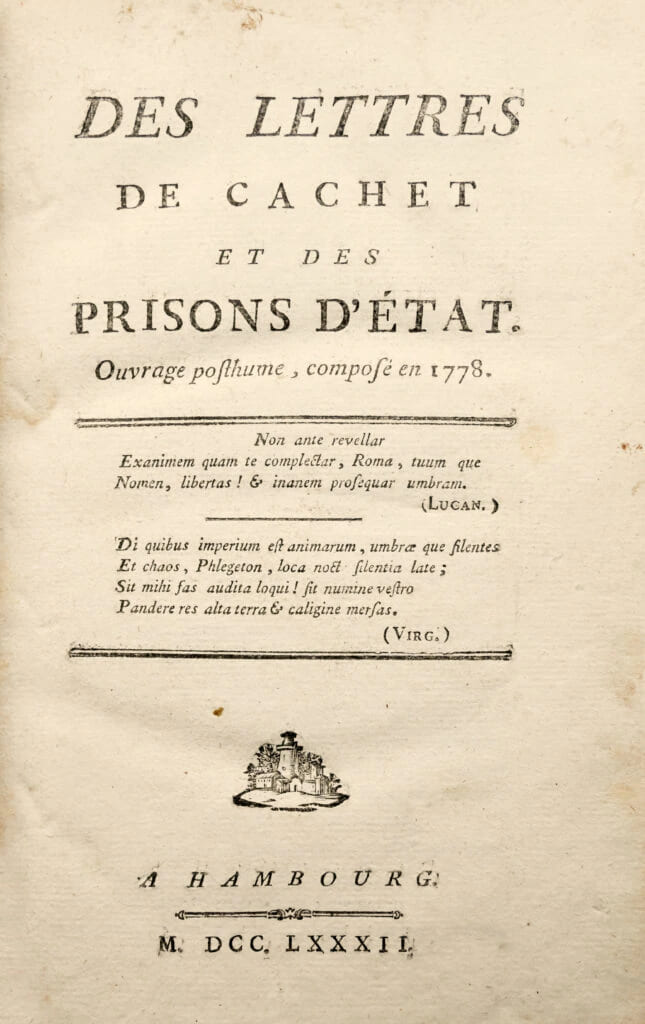
réf. LCS-A61Edition originale de ce «virulent libelle cotre l’arbitraire de la justice de son temps» écrit par Mirabeau au donjon de Vincennes. Hambourg, 1782. 2 tomes en 1 volume in-8 de xiv pp., (1) f., 366, (2) pp., 237 pp., mouillure dans la marge sup. des pp. 1 à 17 de la seconde partie. Plein veau marbré, filet à froid autour des plats, dos lisse orné, tranches rouges. Reliure de l’époque, mors et coiffes frottées. 195 x 125 mm.
1782réf. PHO-1140Dessau, Librairie des auteurs et des artistes, 1782, XII-255pp.-2ff, relié demi basane postérieure, dos à nerfs avec auteur, titre et date en pied.
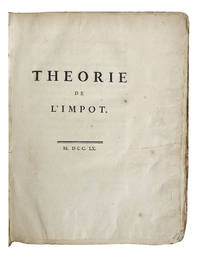
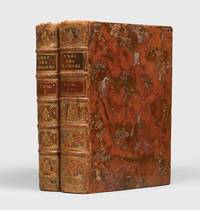
réf. 352620Théorie de l'impôt. 4to. VIII 336 pp. Publisher's original boards untrimmed. Covers somewhat foxed spine strenghtened in the time with vellum slightly worn corners worn some minor foxing few small stains in outer margins edges lightly dust-soiled. - Paris o. Dr. 1760. Very rare first edition in quarto of Mirabeau's chief work which led to the author's arrest at Vincennes. Assisted by François Quesnay Mirabeau's first book of his own after his conversion to Physiocracy offers an exposition of his economic ideas. On fiscal matters the Physiocrats famously pushed for their "single tax" l'impôt unique on landed property. The logic as laid out by Mirabeau seemed compelling. Any taxes levied throughout the economy will just passed from sector to sector until they fall upon the net product. As land is the only source of wealth then the burden of all taxes ultimately bears down on the landowner. So instead of levying a complicated collection of scattered taxes which are difficult to administer and can cause temporary distortions it is most efficient to just go to the root and tax land rents directly. This book was published the same year also in a duodecimo edition which is fare more current than the present quarto edition. - Untrimmed copy with wide margins Provenance: From the collection of Basel economics professor Edgar Salin 1892-1974 with his handwritten entry on the first flyleaf. References: Tchemerzine VIII 285; Barbier IV 702; Kress 5883; Humpert 13028; Higgs 2297; INED 3209; Goldsmith 9602. Paris 1760
réf. 246516S.l., 1758-1760 6 parties en 3 vol. in-4, première partie : V-(3)-192 pp. ; deuxième partie : (2)-266-(4) pp. ; troisième partie : (6)-263 pp. ; quatrième partie : (10)-278 pp. et 80 pp. ; cinquième partie : VIII-167 pp. ; sixième partie : (2)-279-(4) pp., planche gravée en frontispice par Fessard d'après Blakey, veau fauve, dos lisse orné, tranches rouges (reliure de l'époque). Début de fente à certains mors. Mouillure sur le frontispice du tome 1.
réf. ABAA25-33Hambourg n.n. 1782. 2 parts in 2 volumes 8vo of : I/ xiv pp. 1 l. 366 pp. 1 l. of errata; II/ 237 pp. ll. of the first quire interchanged wet stamp of a religious library repeated on the title p. 121 and on the last page of each volume. Preserved untrimmed in its "dominoté paper" wrappers title labels on spines plexiglas box. Original wrappers. 217 x 142 mm. First edition of Mirabeau's Virulent work written during his detention in the Dungeon of Vincennes and speaking out against despotism. Graesse IV 535; Einaudi 3932; Cioranescu 45191; Conlon 82; Bûcher 573. Mirabeau 1749-1791 was the son of the economist Victor Riquetti de Mirabeau. A French politician he was one of the most prominent figures of the Revolution and the most brilliant speaker of the Constituent Assembly. He had a very difficult relationship with his father and led a life of debauchery where he accumulated many debts. To get out of these debts he was locked up in prison by letters of seal at the request of his father on several occasions. Mirabeau wrote the Lettres de cachet in the dungeon of Vincennes where he remained locked up for three and a half years at the same time as the Marquis de Sade. An eloquent work in which he vigorously denounced the abuses of arbitrary power Les Lettres de cachet is a veritable indictment beginning with a history of French criminal law; Mirabeau goes on to denounce violently the organization of the prison administration at the end of the Old Régime. "Des Lettres de cachet' is not only an eloquent protest against despotism a warm advocacy in favor of individual freedom but also a real work of scholarship filled with historical examples and which implies immense reading". Barbier. "It is by history and by reason that Mirabeau fights against arbitrary detentions" P. Negrin. "Des Lettres de cachet deserves great praise. The principles of natural law the basis of all society and all civilization are exposed and developed with as much force as clarity. Mirabeau already shows himself to be a great publicist and the writer gives a foretaste of the orator". A. de Montor. "This work new denunciation of the arbitrary power plea in favor of the individual freedom defense of justice and humanity against despotism had such a repercussion at the time that Vergennes asked Prussia to stop the publication of this licentious writing to seize it and to destroy the manuscript." H. Aureole Bibliographie sur Mirabeau. A superb copy preserved as issued untimmed in its original wrappers in "dominote paper". One of the largest copies known height: 217 mm. The second volume is considered as rare because it was destroyed by the Prussian authorities at the request of the French government. Provenance: the copy comes from the library of Mr. Bidault Gentleman of the Count of Artois future Charles X. FR Hambourg s.n. 1782. 2 tomes en 2 volumes in-8 de : I/ xiv pp. 1 f. 366 pp. 1 f. d'errata ; II/ 237 pp. ff. du premier cahier intervertis cachet humide d'une bibliothèque religieuse répété sur le titre la p. 121 et en dernière page de chaque volume. Conservé non rogné dans ses brochures d'attente de papier dominoté étiquettes avec titre aux dos boite de plexiglass. Brochures de l'époque. 217 x 142 mm. Edition originale du virulent ouvrage de Mirabeau écrit pendant sa détention au donjon de Vincennes et s'élevant contre le despotisme. Graesse IV 535 ; Einaudi 3932 ; Cioranescu 45191 ; Conlon 82 ; Bûcher 573. Mirabeau 1749-1791 est le fils de l'économiste Victor Riquetti de Mirabeau. Homme politique français il est l'un des personnages les plus marquants de la Révolution et l'orateur de plus brillant de l'assemblée constituante. Il a des relations très difficiles avec son père et mène une vie de débauche où il accumule de nombreuses dettes. Pour le soustraire à ces dernières il sera enfermé par lettres de cachet en prison sur demande de son père à plusieurs reprises. Mirabeau rédigea les Lettres de cachet dans le donjon de Vincennes où il resta enfermé pendant 3 ans et demi au même moment que le Marquis de Sade. Œuvre éloquente où il flétrit énergiquement les abus du pouvoir arbitraire Les Lettres de cachet sont un véritable réquisitoire débutant par une histoire du droit pénal français ; Mirabeau poursuit par l'organisation de l'administration pénitentiaire à la fin de l'Ancien Régime qu'il dénonce violemment. " 'Des Lettres de cachet' n'est pas seulement une éloquente protestation contre le despotisme un plaidoyer chaleureux en faveur de la liberté individuelle mais encore un véritable travail d'érudition rempli d'exemples historiques et qui suppose d'immenses lectures ". Barbier. " C'est par l'histoire et par la raison que Mirabeau combat les détentions arbitraires " P. Negrin. " Des Lettres de cachet mérite de grands éloges. Les principes du droit naturel base de toute société et de toute civilisation y sont exposés et développés avec autant de force que de netteté. Mirabeau s'y montre déjà grand publiciste et l'écrivain y fait pressentir l'orateur ". A. de Montor. " Cet ouvrage nouvelle dénonciation du pouvoir arbitraire plaidoyer en faveur de la liberté individuelle défense de la justice et de l'humanité contre le despotisme eut un tel retentissement à l'époque que Vergennes demanda à la Prusse d'arrêter la publication de cet écrit licencieux de le saisir et de détruire le manuscrit… " H. Aureole Bibliographie sur Mirabeau. Superbe exemplaire conservé tel que paru à toutes marges car non rogné dans ses brochures d'attente de papier dominoté. L'un des plus grands exemplaires connus hauteur : 217 mm. Le second volume est considéré comme rare car il aurait été détruit par les autorités prussiennes à la requête du gouvernement français. Provenance : l'exemplaire provient de la bibliothèque de Mr. Bidault Gentilhomme du Comte d'Artois futur Charles X. hardcover
1763réf. LCPCECO-0008(La rarissime édition originale du monument de l'école physiocrate. Un superbe exemplaire, à très grandes marges, conservé dans sa reliure en veau strictement de l'époque) MIRABEAU Victor (Marquis DE) (1715-1789) - QUESNAY François (1694-1774). "PHILOSOPHIE RURALE OU ECONOMIE GENERALE ET POLITIQUE DE L'AGRICULTURE, REDUITE A L'ORDRE IMMUABLE DES LOIX PHISIQUES & MORALES, QUI ASSURENT LA PROSPERITE DES EMPIRES". 1763, Amsterdam, Libraires Associés. 1 volume in-4° (262x204 mm) (dimensions pages 257x192 mm) (2) ff. (faux-titre et titre), XXV, (1) pp. (préface, avertissement et table des chapitres), 412 pp. ; manquent les 3 tableaux h.t., oubliés par le relieur. ((2) ff., a-c4, d1, A-Z4, Aa-Zz4, Aaa-Eee4, Fff2) Reliure de l'époque en veau écaillé.Dos à cinq nerfs avec fleurons et décorations dorés et pièce de titre en maroquin vieux rouge. Double filet doré sur les coupes. Tranches rouges. Gardes de papier décoré et de papier blanc. Edition Originale, très rare. Quelques petits frottements à la reliure et deux petits chocs aux coins supérieurs. Quelques rares pages légèrement brunies, sinon intérieur très frais et propre. Superbe exemplaire à très grandes marges (quelques fois non rognées), peut-être un des plus grands passés sur le marché dans les derniers vingt ans. Très rare exemplaire conservé dans sa reliure strictement de l'époque, mais sans les 3 tableaux h.t., oubliés par le relieur. Cet ouvrage nait de la collaboration entre Mirabeau et Quesnay, ce dernier, médecin de Mme de Pompadour, rencontré à Versailles en juillet 1757. C'est le monument de la physiocratie et des théories sur le "Gouvernement par la Nature" ("The first of the four text-books of physiocrat orthodoxy" (Schumpeter, p. 225)). La doctrine de l'école physiocratique "est un mélange de libéralisme économique et de déspotisme éclairé". Ses principaux thèmes sont "la nature, la liberté, la terre et le déspotisme légal". Toute la richesse vient de la terre et seule la classe des agriculteurs est la vraie classe productive. Les lois de la proprieté privée et de la pleine liberté ("Laissez faire, laissez passer") doivent être réspectées, parce qu'elles sont les seules qui permettent d'atteindre la prosperité et de mantenir un ordre parfait. Provenance : Ex libris armorié du XIX siècle F.A. Garnier. (Tchémerzine, IV, 286 ; Quérard, VI, 154 ; Kress, 6120 ; INED, 3204 ; Conlon, 63:1131) (LCPCECO-0008)
réf. LCS-18316Séduisant exemplaire conservé tel que paru à toutes marges dans ses brochures d’attente, l’un des plus grands connus. Hambourg, s.n., 1782. 2 tomes en 2 volumes in-8 de : I/ xiv pp., (1) f., 366 pp., (1) f. d’errata ; II/ 237 pp., ff. du premier cahier intervertis, cachet humide d’une bibliothèque religieuse répété sur le titre, la p. 121 et en dernière page de chaque volume. Conservé non rogné dans ses brochures d’attente de papier dominoté, étiquettes avec titre aux dos, boite de plexiglass. Brochures de l’époque. 217 x 142 mm.
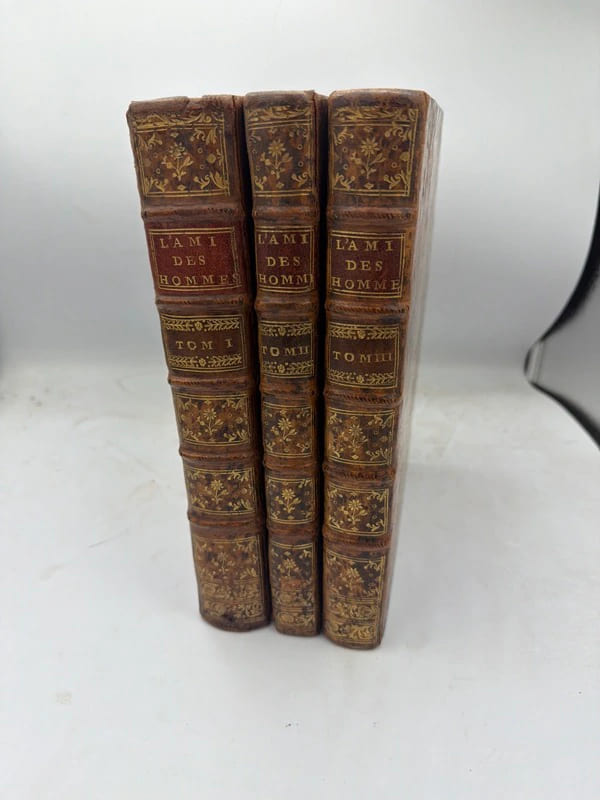
réf. LCS-18354La publication de l’Ami des hommes en 1756 valut à Mirabeau un véritable triomphe. S.l., 1759-1760. Sept parties en 7 volumes in-12 de: I/ 1 front. x pp., (3) ff. de table. 391 pp.; II/ (6) ff. et 534 pp.; III/ (6) ff. et 526 pp., déch. au coin inf. de la p. 225 sans atteinte au texte; IV/ xj-267 pp.; V/ (1) f. et 376 pp. ; VI/ xii, 298 pp. et (2) ff. table; VII/ (2) ff., 228 pp. et (1) f. de table plus 6 tableaux repliés. Les deux dernières parties sont datées de 1760. A partir de la quatrième partie, le texte se trouve ici en édition originale. Plein veau brun marbré, dos à nerfs ornés, coupes décorées, tranches rouges. Reliure de l’époque. 165 x 91 mm.
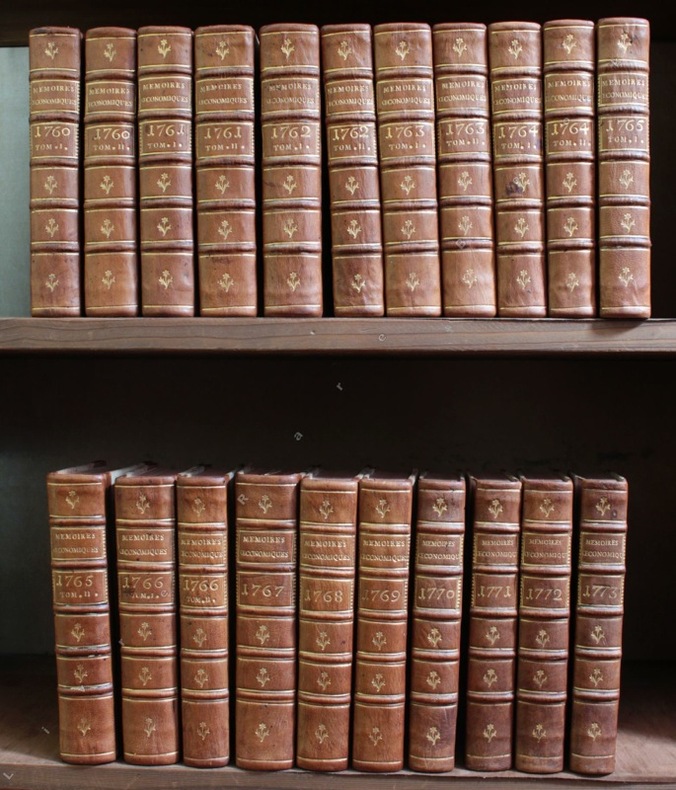
réf. 8335Zuric [puis] Berne, Heidegguer [puis] chez la Société typographique aux dépens de la Société Oeconomique, 1760 - 1773. 21 volumes in-8, demi veau fauve à coins, dos à nerfs ornés de filets et fleurons dorés, tranches teintées en rouge. Quelques rousseurs, parfois plus marquées en p. de titre, mouillure pour l'année 1771. Bel ensemble en reliure uniforme, chaque volume portant la signature de H. L. Roux en page de titre.
réf. 6142Six parts bound in two vols. Large 4to cont. polished mottled calf spines nicely gilt. Avignon 1756-1758-1760. First edition of all six parts and a fine copy of one of the great classics of political economy. This work marks the birth of the physiocratic school and contains the first appearance on a large scale of the "Tableau Economique" of Quesnay portions of Quesnay's work had been privately printed in a few copies only at the palace at Versailles in 1758 and 1759. In this work Mirabeau made the ideas of Cantillon known and the book had a very great influence in the years before the Revolution. Fine set. unknown books
réf. 6142Six parts bound in two vols. Large 4to cont. polished mottled calf spines nicely gilt. Avignon 1756-1758-1760. First edition of all six parts and a fine copy of one of the great classics of political economy. This work marks the birth of the physiocratic school and contains the first appearance on a large scale of the “Tableau Economique” of Quesnay portions of Quesnay’s work had been privately printed in a few copies only at the palace at Versailles in 1758 and 1759. In this work Mirabeau made the ideas of Cantillon known and the book had a very great influence in the years before the Revolution. Fine set. unknown
1756réf. 131625Avignon: n.p. 1756-60. The first public appearance of Quesnay's Tableau économique First edition of all six parts containing the first public appearance of Quesnay's Tableau économique. The first to follow Quesnay in the foundation of the Physiocratic circle Mirabeau was familiar with and influenced by Cantillon's theories. As well as fully articulating the principles that were to mark the school of physiocrats and expounding their implications regarding population agriculture and commerce the Ami des Hommes contained a reproduction of Quesnay's Tableau économique vol. VI previously published separately in very small numbers in 1758 and 1759. Mirabeau's reproduction made the essay obtainable thus bringing the founding document of the school of physiocrats to the attention of a wide public. "This remarkable treatise created the greatest sensation throughout the whole of Europe. It is said to have gone through forty editions and was translated into several languages. Its anonymous author soon discovered became the idol of the day and was generally referred to by the soubriquet which he had chosen for the title of his book" Palgrave II p. 775. Following the publication of the first three parts Mirabeau made the acquaintance of Quesnay who had been greatly impressed by his book. "Mirabeau now became the fervent admirer of Quesnay and between them they founded the school of the Physiocrats" ibid. In 1758 a fourth part was published in which Quesnay's influence is clearly visible. The remaining two parts were published in 1760. The final part is of particular importance as it contains the first obtainable appearance of Quesnay's Tableau économique which was previously published separately in tiny numbers in 1758 and 1759. An English translation was first published in 1766. 6 parts in 2 vols quarto 246 x 188 mm. Contemporary French mottled calf spines ruled and decorated gilt in compartments all edges red. Joints and extremities expertly restored scattered foxing to contents; a handsome copy. Einaudi 3941; Goldsmiths' 9092; Higgs 1143 1631 & 2160; INED 3194; Kress 5543 & 5736; Mattioli 2426 2428 & 2429. unknown
1760réf. 84111No place: no printer 1760 & 1761. OF REAL IMPORTANCE IN THE HISTORY OF FINANCIAL THEORY" - a BEAUTIFUL COPY First edition of both works pairing Mirabeau's Théorie de l'Impôt his spirited and able attack upon the financial administration of France especially the "fermiers généraux" whom Mirabeau regarded as parasites preying upon the vitals of the nation with Pesselier's counterattack notable for its terse affirmation of the characteristically Physiocratic doctrine that agriculture holds a privileged place in the economic system. Mirabeau's work highlights the problems and injustices of the French system of taxation and added fuel to the coming fire of the revolution. The king disapproved of the work; Mirabeau was imprisoned on 16 December 1760 but was released on Christmas Eve through the efforts of Madame de Pompadour and others under orders to leave Paris for his estate at Bignon. The work proposes a reorganization of financial administrative machinery the abolition of the "fermes" a reduction in the taxation upon salt with the object of increasing the total yield and a special tax upon tobacco farms. The domaine the post and the mint were to be further sources of revenue. Mirabeau ranks as one of the earliest important writers on taxation. Higgs notes that the book is "of real importance in the history of financial theory" The Physiocrats p. 57. Pesselier was one of the most forceful critics of the physiocrats. Of the products of the soil Pesselier here writes "Elles procurent un profit net et durable puisqu'elles sont à l'abri de l'imitation" "They provide a net and lasting profit since they are safe from imitation". Two works bound in a single vol. quarto 255 x 193 mm. Contemporary French mottled calf spine decorated gilt in compartments red morocco label marbled endpapers. Housed in a brown morocco-backed book-form case. Engraved armorial bookplate to front pastedown. Lower edge a little rubbed with corners worn very occasional spotting; very good copies. Mirabeau: Einaudi 3946; Goldsmiths' 9602; Higgs 2297; INED 3209; Kress 5883. Pesselier: Brunet I 1118; Einaudi 4409; Goldsmiths' 9695; Higgs 2534; INED 3524; Kress 5964. unknown
1763réf. 85559A Amsterdam: chez les Libraires Associés 1763. Cm. 26 pp. xxv 1 412. Con una testata in xilografia e tre tavole f.t. tableaux èconomiques. Solida ed elegante legatura coeva in piena pelle dorso a nervi con titoli in oro e ricchi fregi ai comparti. Tagli rossi e sguardie marmorizzate. Qualche brunitura marginale alle prime ed ultime carte ma complessivamente bell'esemplare genuino e marginoso in ottimo stato di conservazione. Edizione originale di grande rarità ed importanza che illustra per la prima volta in modo esauriente il pensiero della scuola fisiocratica. Opera celebrata dalle principali bibliografie. chez les Libraires Associés unknown
1789réf. 57115Paris, Chez Baudouin, Imprimeur de l'Assamblée Nationale, 1789. 8vo. Bound in an exquisite later red half morocco with gilt spine. Top edge gilt. (1) f. (title-page), 8 pp. (""Déclaration des droits de l'Homme en société""), 6 pp. (""Articles de Constitution""), (1) f. (""Réponse du Roi""), (1) f. (blank). Woodcut head-pieces. Title-page slightly bowned, otherwise in excellent condition. A truly excellent copy.
1789réf. 57115Paris Chez Baudouin Imprimeur de l'Assamblée Nationale 1789. 8vo. Bound in an exquisite later red half morocco with gilt spine. Top edge gilt. 1 f. title-page 8 pp. "Déclaration des droits de l'Homme en société" 6 pp. "Articles de Constitution" 1 f. "Réponse du Roi" 1 f. blank. Woodcut head-pieces. Title-page slightly bowned otherwise in excellent condition. A truly excellent copy. The exceedingly scarce true first printing in an incredibly rare form of off-print/separate printing of one of the most important and influential documents in the history of mankind namely the French Human Rights Declaration containing also the articles for the first French Constitution. This groundbreaking publication constitutes a monumental change in the structure of the human world providing all citizens with individual rights that we now take for granted. This monument of humanist thought appeared in the "Procès verbal de l'Assemblée Nationale" copies of which are also very difficult to obtain. There however the two parts appeared without a title-page and without the final blank which together constitute a form of wrappers for this off-print/separate printing of which only five or six other copies are known and which is present in merely one or two libraries world-wide. As far as we now only one other copy has been on the private market and that did not have the blank back wrapper. This exceedingly rare separate printing of the Human Rights Declaration with the Constitution was intended for the inner circle of those participating in its creation and was limited to a very restricted number of copies - all of which will have been owned by the creators of the Declaration. This epochal document is just as important today as it was when it was formulated during the French Revolution in 1789 and since 2003 the Declaration has been listed in the UNESCO Memory of World Register - "This fundamental legacy of the French Revolution formed the basis of the United Nations Declaration of 1948 and is of universal value". Few other documents in the history of mankind has done as much to determine the way we live and think the way Western societies are structured and governed and few other documents have had such a direct impact upon our constitutional rights and the way we view ourselves and others in society. It is here that we find the formulation of liberty and equality upon which so much of Western political and moral thought is based - that all "men are born and remain free and equal in rights" Article 1 which were specified as the rights of liberty private property the inviolability of the person and resistance to oppression Article 2; that all citizens were equal before the law and were to have the right to participate in legislation directly or indirectly Article 6; no one was to be arrested without a judicial order Article 7; Freedom of religion Article 10 and freedom of speech Article 11 were safeguarded within the bounds of public "order" and "law" etc. etc.The content of the document that were to change the Western world for good emerged largely from the ideals of the Enlightenment. "The sources of the Declaration included the major thinkers of the French Enlightenment such as Montesquieu who had urged the separation of powers and Jean-Jacques Rousseau who wrote of general will-the concept that the state represents the general will of the citizens. The idea that the individual must be safeguarded against arbitrary police or judicial action was anticipated by the 18th-century parlements as well as by writers such as Voltaire. French jurists and economists such as the physiocrats had insisted on the inviolability of private property." Encycl. Britt.The key drafts were prepared by Lafayette working at times with Thomas Jefferson. In August 1789 Honoré Mirabeau played a central role in conceptualizing and drafting the Declaration. On August 26 1789 in the midst of The French Revolution the last article of the Declaration was adopted by the National Constituent Assembly as the first step towards a constitution for France. "In 1789 the people of France brought about the abolishment of the absolute monarchy and set the stage for the establishment of the first French Republic. Just six weeks after the storming of the Bastille and barely three weeks after the abolition of feudalism the Declaration of the Rights of Man and of the Citizen French: La Déclaration des Droits de l'Homme et du Citoyen was adopted by the National Constituent Assembly as the first step toward writing a constitution for the Republic of France.The Declaration proclaims that all citizens are to be guaranteed the rights of "liberty property security and resistance to oppression." It argues that the need for law derives from the fact that ".the exercise of the natural rights of each man has only those borders which assure other members of the society the enjoyment of these same rights." Thus the Declaration sees law as an "expression of the general will" intended to promote this equality of rights and to forbid "only actions harmful to the society." www.humanrights.com. This sensational document became the crowning achievement of the French Revolution; it came to accelerate the overthrow of the "Ancien Régime" and sowed the seed of an extremely radical re-ordering of society. The Declaration interchanged the pre-revolutionary division of society -in the clergy the aristocracy and the common people- with a general equality - "All the citizens being equal in the eyes of the law are equally admissible to all public dignities places and employments according to their capacity and without distinction other than that of their virtues and of their talents" From Article VI upon which today's society is still based. It is hard to imagine a work that is more important to the foundation of the society that we live in today. unknown