Livre Rare Book
Livre Rare Book
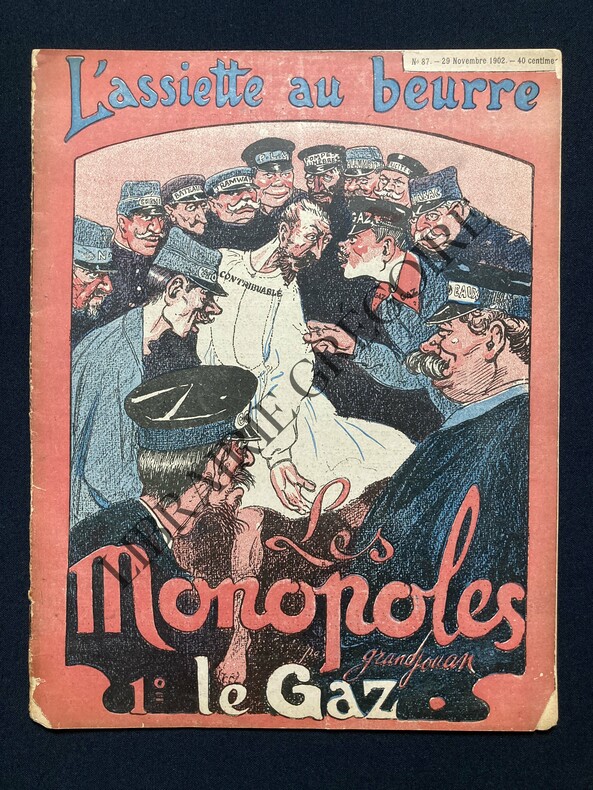
L'ASSIETTE AU BEURRE-N°87-29 NOVEMBRE 1902-LES MONOPOLES-PAR GRANDJOUAN-1° LE GAZ
1902réf. ABE-175882473154416 PAGES-31,7 CM X 24,6 CM-ETAT D'USAGE
Librairie Grégoire · Rennes, France15,00 €
360 résultats
réf. 22875En France, 1751. 70, (2) pp. 8vo. Modern boards. Conlon S51:11; not in Kress; not in Goldsmiths; not in INED (see 1094 for the work by Chauvelin). The 'Avis de l'Editeur', printed verso title-page states the first manuscript was lost and that it had been necessary to ask the author for another copy of the manuscript. The author did indeed supply another copy of the manuscript but only after he had made considerable changes in the text. This suggests that this is the first printing of the text. The Examen Impartial was written by the Abbé Louis-Philippe Chauvelin in which he argued that, although the clergy was entitled to its special prerogatives, it could not use these to claim total exemption from taxation.According to Conlon a second volume was published in 1753 entitled 'Suite des Lettres Critiques ....'. Conlon also knows of no other edition but the present one as the first publication of this text.
réf. 17357Londres, 1787. 88 pp. 8vo. Modern half morocco. Kress B.1266 (other edition); Goldsmiths 13454 (other edition); Einaudi 3412 (other edition); INED 2915 (other edition); Stourm, pp. 145-146 (other edition). One of three editions from the same year, no priority has been established. The French crown faced bankruptcy when the Controller-General, Calonne, presented a financial scheme to end the crisis. The keystone in his program was a tax to be levied on all property owners without discrimination of estate. Calonne also proposed liberating commerce in grains from all internal tariffs. When Calonne was unable to pass this in the Assembly of Notables, he was replaced by Loménie de Brienne. 'Linguet lent the support of his publicity to the Calonne property tax and published this work just after the Notables had turned down Calonne's master plan. (.....) Linguet viewed it as a means by which the government, provisioned in grains, could compete with entrepreneurs, control the market price of wheat, and in that way guarantee the lives of an impoverished and progressively more restless population of dispossessed persons. Linguet saw the unpopular tax program as a key government stratagem for warding off two spectres: bankruptcy and a people's revolution' (D. Gay Levy, The Ideas and Careers of Simon-Nicolas-Henri Linguet, p. 240). - Name on title.
réf. 17358No place, (1788). 2 works in 1 volume. 144, (2) pp.; 12 pp. 8vo. Modern boards. First work: Kress B.1266 (other edition); Goldsmiths 13454 (other edition); Einaudi 3412 (other edition); INED 2915 (other edition); Stourm, pp. 145-146 (other edition). One of three editions from the same year, no priority has been established. The French crown faced bankruptcy when the Controller-General, Calonne, presented a financial schem to end the crisis. The keystone in his program was a tax to be levied on all property owners without discrimination of estate. Calonne also proposed liberating commerce in grains from all internal tariffs. When Calonne was unable to pass this in the Assembly of Notables, he was replaced by Loménie de Brienne. 'Linguet lent the support of his publicity to the Calonne property tax and published this work just after the Notables had turned down Calonne's master plan. (.....) Linguet viewed it as a means by which the government, provisioned in grains, could compete with entrepreneurs, control the market price of wheat, and in that way guarantee the lives of an impoverished and progressively more restless population of dispossessed persons. Linguet saw the unpopular tax program as a key government stratagem for warding off two spectres: bankruptcy and a people's revolution' (D. Gay Levy, The Ideas and Careers of Simon-Nicolas-Henri Linguet, p. 240).Second work: Not in Kress; not in Goldsmiths; not in Einaudi; not in INED; not in Stourm.Calonne's reforms failed, Brienne's attempts failed, and the King gave in, recalled Jacques Necker to face the acute financial crisis, recalled the parlements and annulled all judicial reforms. Linguet answered with number 116 of his Annales again proposing fiscal reform. The parlements answered by ordering this number 116 to be lacerated and burned. The present work is Linguet's protest against these decisions by the parlement. - Inner margin of the first title and last leaf of the second work strengthened.
réf. 2510420 Mars 1745. 20 pp. 4to. Modern boards. Concerning the new taxes on merchandise and the 'centieme denier', the tax of one percent per 100 levied on all movement of property or use of buildings (immeuble). Interesting manuscript, a bit difficult to read due to the handwriting.
réf. 26200A Aix, Chez André Adibert, Imprimeur du Roi, vis-à-vis le College, 1782. Five works on one volume. 46 pp.; 46 pp.; 31, (1) pp.; 24 pp.; 9, (1) pp. Small folio. Modern boards. None of these items in Conlon. Each work has a very nice engraved head-piece, and the place, name of printer and date are printed in these head-pieces. The head-piece of the fourth work depicts a castle and a house. Deals with the right of tax collecting (tax-farming) by Chabert and the predicted amounts of money to be collected. Chabert won the right to collect the taxes among the members of the guild, and for which right he paid the guild of cobblers, but revenues fell far behind what was predicted/expected. At least one of the reasons was the emigration of vast numbers of "garçons" as a response to measures taken by the guild itself, another the departure of many cobblers after a large fleet had left Marseille. The question here is if Chabert is entitled to discounts or refunds of money he already paid to the guild and if he is to be held accountable for failing to collect the predicted/expected sums of money.The first text is preceded by a handwritten summary of the entire matter of two pages, the second piece has handwritten annotations at the end stating the Chambre de Tournelle affirmed the verdict by arret of 16 july 1782: the second piece finds the guild (the Maîtres Cordonniers) guilty.
réf. 25594No place (Paris), no date (ca 1750). 15, (1 blank) pp. 4to. Disbound. Not in Kress; not in Goldsmiths. Gives detailed instructions as to how to declare, how to handle, and how to settle the debts of communities including instructions with regards to the drafting of contracts concerning loans.
réf. 25544A Paris, Chez la veuve Saugrain et Pierre Prault, 1730. (4) pp. 4to. Folded leaf. Conlon 30:140. Original edition. Alphabetical list with addresses of the officers.
réf. 18155No place, (1764). 4 works bound in 1 volume. 22 pp.; 40 pp.; 118 pp.; (2), 66 pp. Small 8vo. Contemporary marbled calf, spine gilt with raised bands, red edges. None in Conlon. The principal object of these works is to protest against the Edicts of April 1763 and deal with taxes, weighing so heavily on the people. At head of the third piece, page 3: PRECIS de ce qui s'est passé au Parlement de Rouen depuis le 14 mars 1763, jour de sa rentrée.
réf. 17615Paris, 1649. 2 volumes in 1. 32 pp.; 32 pp. 4to. Modern boards. Moreau 652; Kress 788; Goldsmiths 1019; INED 4055; not in Einaudi. First edition of this very rare pamphlet offering thoughts on the power of the king in financial matters and on the organisation of the collecting of the taxes. 'Très remarquable pamphlet' (Moreau). See for an elaborate account of the man and his works Dictionnaire de Théologie Catholique, xii, 2e partie, col. 2042-2044. - Very rare, especially with the second part.
réf. 18316No place, 1758. (2), 251, (1) pp. 12mo. Modern half calf, marbled boards, spine with raised bands and gilt lettering. Higgs 1762; not in Kress; not in Goldsmiths; not in Einaudi; not in INED; Conlon 58:388. First edition. Concerning the rights of the Cour des Comptes in matters of taxes and expenditure of the Provence.
réf. 24695A Paris, De l'Imprimerie Royale, 1785. With three folding tables. (2), 106 pp. 4to. Modern boards. Conlon 85:615; not in Kress; not in Goldsmiths. First edition. Signed at end by Le Roy, Tillet and Desmarest.The contents can be best summarized by giving the drop-head title on page one: Rapport fait à l'Académie, Relativement à l'advis que le Parlement a demandé à cette Académie, par arrêt du 6 Septembre 1793. Sur la contestation qui s'est élevée à Rochefort, au sujet de la taxe du Pain; sur les Expériences qui ont été faites dans cette Ville à ce même sujet, en exécution d'un arrêt du Parlement du 7 Juin 1781; & sur les moyens d'établir le prix juste du Pain, proportionnément à celui du Blé, suivant la quantité de Farines différentes qu'une quantité de livres de Blé peut rendre, & suivant la quantité de Pain que ses Farines doivent donner. - Small brown spot in inner blank margin of title-page, else a fine copy.
réf. 16800A Paris, Chez la veuve Saugrain & P. Prault, 1714. 5 parts in 1. 184 pp.; 192 pp.; 140 pp.; 168 pp.; 32, (20) pp. 4to. Contemporary calf, spine gilt with raised bands, label with gilt lettering, somewhat damaged at foot of spine, lightly rubbed. Not in Kress; not in Goldsmiths; not in Gavet. - Copy from the library of Balincourt-Cabrières, with engraved bookplate, and with many contemporary marginal annotations on a number of leaves.
réf. 24311Paris, Le Normant, 1820. (4), 640, (2) pp. 8vo. Contemporary boards (slightly sunned). Goldsmiths 22857; Einaudi 4934; Masui, p. 478; not in Kress; not in Menger; Palgrave, iii, p. 345. First edition. In Palgrave's opinion, Saint-Chamans 'was the most distinguished of the upholders of the theory of the balance of trade.' The last part of the book contains numerous tables and notes.'Boutade d'un écrivain distingué, qui a dépensé au service des doctrines surannées de l'économie politique plus d'esprit qu'il n'en fallait pour faire un excellent ouvrage. C'est dans son livre que se trouve la plus habile apologie du système mercantile' (Blanqui, Histoire de l'Économie politique en Europe, vol. ii, p. 391). - Small library label on front paste-down.
réf. 17043A Londres, 1775. With 1 folding map and 4 folding tables. viii, 293, (1) pp. 8vo. Contemporary marbled calf, spine gilt in compartments, red morocco label with gilt lettering, gilt triple fillets on sides, red edges. Kress 7170; Goldsmiths 11330; Einaudi 5517; INED 4798; Higgs 6403; Peignot, Livres Condamnés, i, p. 141. First edition. Severely prosecuted attack on the Fermiers-Généraux, forbidden already in 1776. 'Diatribe sanglante contre les fermiers généraux et les abus scandaleux de leurs agents. L'auteur met en scene un malheureux dont les 'suppôts de la ferme' ont ruiné la famille et fait périr le père de chagrin' (INED). According to a manuscript note in the Kress copy: '..... l'on croit que cette sanglante diatribe des fermiers généraux a été composée, imprimée et répandue sous les auspices du ministère actuel (celui de Turgot & Malesherbes).'This, in fact, is the first edition of a work which became better known under the title "L'Ami du Peuple François, ou Mémoire adressée à Mr. Turgot, ....." published at Limoges one year later (1776). Even the motto in both works is identical: "Ni Ferme ni regie: l'une et l'autre font la perte des Etats." The present work contains the same text as the "L'Ami du Peuple" (upto page 84, and then the pages 256-269) and contains in addition much detailed information about the taxes. It was probably deemed to complex or technical and was published again in 1776 as "L'Ami du Peuple François" this time omitting the detailed information about the taxes. The work suggests Turgot to abolish the tax system in use as it is injust and odious, of relatively little profit to the king but very profitable for the taxfarmers and hard-pressing on the population. The work describes in detail the various taxes in existence, their effects, the cruel practises of the taxfarmers, the uneven division of the taxes and the disastrous effects.It is told in the form of a story: the anonymous author recounts the story of his father and his family and how they were, little by little, driven to complete ruin. His father, responsible for the collecting of taxes in his village, is thrown in jail and his possessions confiscated by the taxfarmers because of his inability to raise the requested taxes from the other taxable inhabitants of his village.
réf. 24145(Paris), Imprimerie de Bourdon, (1834). 16 pp. 8vo. Modern boards. First edition. The author, belonging to the extreme left, declares among other things: 'Ce n'est point d'une Chambre nommé par le privilège que le pays peut attendre la réforme d'un système d'impôts qui pése presque exclusivement sur les classes pauvres, à la décharge de la classe riche, de la classe opulente ....'
réf. 13370No place, (1787) (Paris, EDHIS, 1976). 31, (1) pp. 8vo. Boards. Not in INED; not in Goldsmiths; not in Kress; Conlon 87:1288. Reprint of this very rare and important little work, editon limited to 150 numbered copies and 30 not destined for the trade, and since long out-of-print. The unknown author of this tract brings up the question of the defense of the interests of the lower classes of the population, those who have no property nor any other wealth, no status, no rights and who ask only this: to have work to do, the certainty that this work will enable them to live and not to be robbed by the taxes.
réf. 17813Paris, Guillaumin et Cie., 1854. (8), 321, (1) pp. 8vo. Sewn, uncut. Einaudi 5939. First edition. The question of the nature and evolution of ground rent remained topical among French speaking economists during the 19th century. The present work is in favour of Ricardo's theory and opinion concerning the question of "rent." - The pages 209-213 contain mathematical formula. The author's name is also written as: Volkov.
réf. VLE-661P., May et Motteroz, 1891, in-8, 48 pages broché, dos abimé, petit manque angulaire au premier plat
1902réf. ABE-175882473154416 PAGES-31,7 CM X 24,6 CM-ETAT D'USAGE
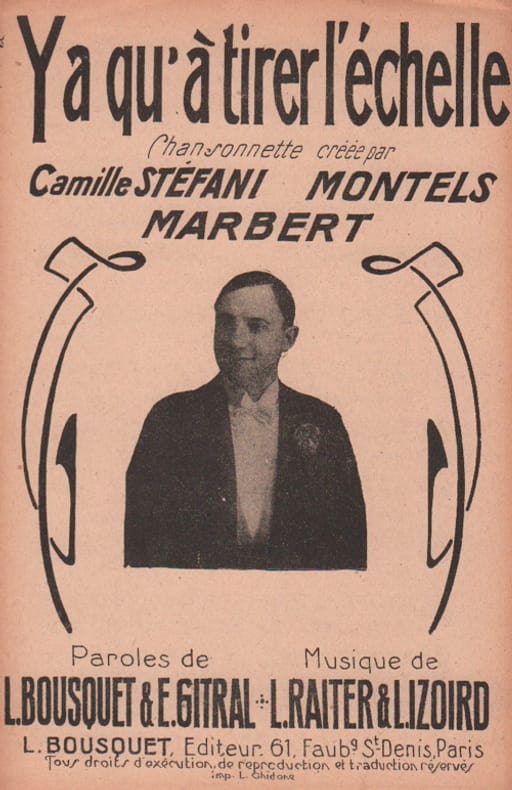
réf. 105867Bousquet
1631réf. PHO-1968Paris, chez Toussainct Quinet, 1631. In-8 (173x114mm), 7ff.-872pp.-8ff., vélin époque, manque au dos, travail de ver avec atteinte à qlqs lettres sur une trentaine de feuillets, petites rousseurs.
réf. 608Paris Librairie Alphonse Picard 1914 in 8 (24x16) 1 volume broché, 172 pages. Bon exemplaire ( Photographies sur demande / We can send pictures of this book on simple request )
réf. 2553Paris Durand Pissot 1756 in 12 1 volume reliure pleine basane fauve de l'époque, dos à nerfs orné, 368 pages, le dernier cahier est légèrement et uniformément jauni. Bon exemplaire ( Photographies sur demande / We can send pictures of this book on simple request )
réf. 14680S.l 1789 in 8 (21,5x14) 1 volume broché sous couverture muette d'attente de l'époque (papier gris), titre, 187 pages et XXIII, non rogné. Bon exemplaire ( Photographies sur demande / We can send pictures of this book on simple request )
réf. 17820Paris Honoré Champion 1906 in 8 (25x16,5) 1 volume broché, 298 pages, avec 1 carte noir et blanc. ''Contribution à l'histoire de l'impôt sous l'ancien régime''. Bon exemplaire