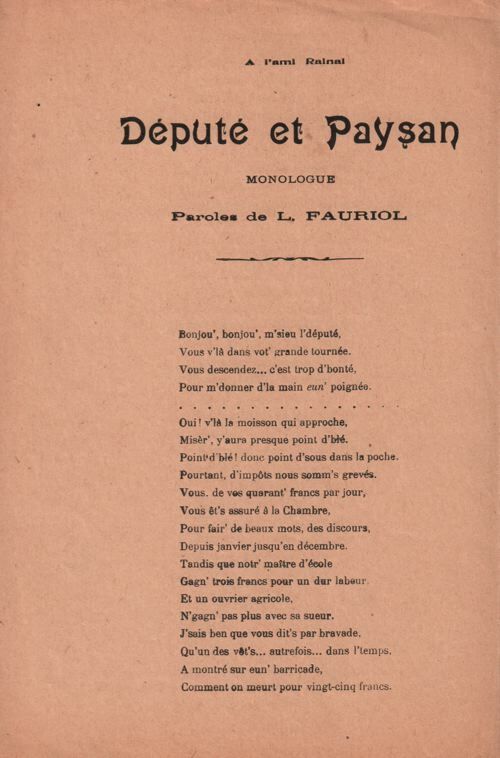
- - Fauriol LouisLivre Rare Book
360 résultats
1910réf. 69873Partitions illustrées La SOCIÉTÉ ET SES LUTTES Augor éditeur 1910 approx.
1739réf. 28067Paris: De Nully 1739. First edition. 16 617 7 pp. 1 vols. 8vo. Contemporary brown sprinkled calf gilt spine leather label marbled endpapers. Previous owner's signature on title otherwise a near fine copy. First edition. 16 617 7 pp. 1 vols. 8vo. Comprehensive treatment on the origine rationale collection and and evolution of various taxes by this "Conseiller du Roi Lieutenant Général en chef au Siège des Elections de Xaintes." Kress 4476 De Nully unknown
1734réf. 59334Leyden: apud Conradum & Georgum Wishoff 1734. First combined edition. Engraved general title by Bleyswyck additional printed title in red and black. 26 344 14 pp.; separate title page Dd4 for second title misbound at rear along with Contents leaf. Two parts with continuous pagination. 1 vols. 4to. Contemporary full mottled Dutch calf gilt spine red leather title label. Small rectangular excision from lower margin of half-title leaf. some slight darkening at edges. First combined edition. Engraved general title by Bleyswyck additional printed title in red and black. 26 344 14 pp.; separate title page Dd4 for second title misbound at rear along with Contents leaf. Two parts with continuous pagination. 1 vols. 4to. Collects two works by the prolific Dutch scholar and Roman historian Pieter Burmann. The first deals with a Roman tax called the "vectigal" which was applied to revenue "derived from public land mines salt-works. etc. and in general to rents derived from State property." - Oxford Classical Dictionary 1949. apud Conradum & Georgum Wishoff unknown
réf. 11086Paris, Chez Pierre et Thomas Charpentier; Pièce in-4° de 16 pages, sans couverture telle que parue.
réf. 17615Paris, 1649. 2 volumes in 1. 32 pp.; 32 pp. 4to. Modern boards. Moreau 652; Kress 788; Goldsmiths 1019; INED 4055; not in Einaudi. First edition of this very rare pamphlet offering thoughts on the power of the king in financial matters and on the organisation of the collecting of the taxes. 'Très remarquable pamphlet' (Moreau). See for an elaborate account of the man and his works Dictionnaire de Théologie Catholique, xii, 2e partie, col. 2042-2044. - Very rare, especially with the second part.
1840réf. 20238Boston : Commonwealth of Massachusetts 1840. Broadside. Near Fine. Single folio sheet printed recto approximately 17.5 x 13.675 inches; one horizontal and three vertical folds; near fine. Broadside. An Act passed by both the Massachusetts House of Representatives and the Senate Governing the valuing of poll and property taxes in Massachusetts. The first section tasks Assessors to submit to the Secretary of the Commonwealth's office a "true and perfect list" of all male polls age sixteen and up together with "all rateable estate both real and personal lying within their Cities Towns and Districts" with a value of more than twenty dollars. A poll tax is a tax on a person. The Act also establishes an oath which each Assessor must agree to swear by along with penalties for either refusing the oath or not abiding by its terms. Section Seven of the Act details the correct type of form on which information for listing polls and property must be recorded. Even by today's standards this form might be considered comprehensive to the point of being intrusive. To give a few examples: "Number of ounces of plate of all kinds exceeding twenty dollars in value. Number of bushels of wheat. of rye. of Indian corn. of flax. of hemp. of hops. of tons of hay. of cow rights. of horses one year old and upwards. of mules and asses. of oxen. of steers and heifers. of sheep. of swine." and much much more. It was during this decade that Henry David Thoreau was jailed for not paying his taxes ostensibly on the grounds of his objection to slavery and the Mexican war. Signed in type by Robert C. Winthrop Speaker of the Massachusetts House; Daniel P. King President of the Senate and John P. Bigelow Secretary of the Commonwealth. WorldCat records only one institutional holding AAS of a four-page pamphlet of the same title with very similar although not identical content. No broadside printings are recorded by WorldCat. Commonwealth of Massachusetts unknown
réf. 4571A Soissons, et se trouve à Paris, Chez P.G. Simon, 1764. With woodcut device on title. (2), 76 pp. 8vo. Modern marbled boards, red label with gilt lettering (Laurenchet). Kress 6201; Einaudi 3362; Higgs 3306; Mattioli 1971; INED 2877 (edition 1765); Weulersse, i, xxvii; not in Goldsmiths; Granier, Bibliographie Charitable, 1330; not in Dada. Very rare first edition. Guillaume François Le Trosne (1728-1780) joined the physiocrats in 1764, contributing articles to their journals, and writing works defending their ideas. 'He became one of the most lucid exponents of the physiocratic doctrine; his views express most clearly the evolution of the school. At first an enthusiastic, inflexible adept of the abstract physiocratic system, he nevertheless evidenced a preference for practical questions, as reflected in his La liberté du commerce des grains, toujours utile et jamais nuisible (Paris, 1765).In this work, Le Trosne condemns the vagabond as a parasite on, and an enemy of, society. 'Only in politics did he remain absolutely faithful to absolutism ..... and hostile to democracy, that 'bizarre and monstrous' government which he doubtless pictured in the form of the violent popular demonstrations against the dealer in wheat or as personified by the vagabonds who had set fire to one of the farms of the magistrate' (ESS). Discusses the current situation in France, measures, legal and otherwise, taken to combat or remedy the situation, discusses the distinction to be made between vagabonds and beggars, and discusses possible solutions, one of which is condamning vagabonds to the galleys, and ends with a project for beggars and ways to combat mendicity. 'Ils provoquent le renchérissement de la main-d'oeuvre, car leur oisiveté diminue le nombre des travailleurs; ils favorisent encore l'augmentation des tailles' (INED: They cause the increase of cost of manpower, of labour, as their idleness reduces the number of workers; they rather favor the increase of the "tailles" (a tax)" (our translation)).
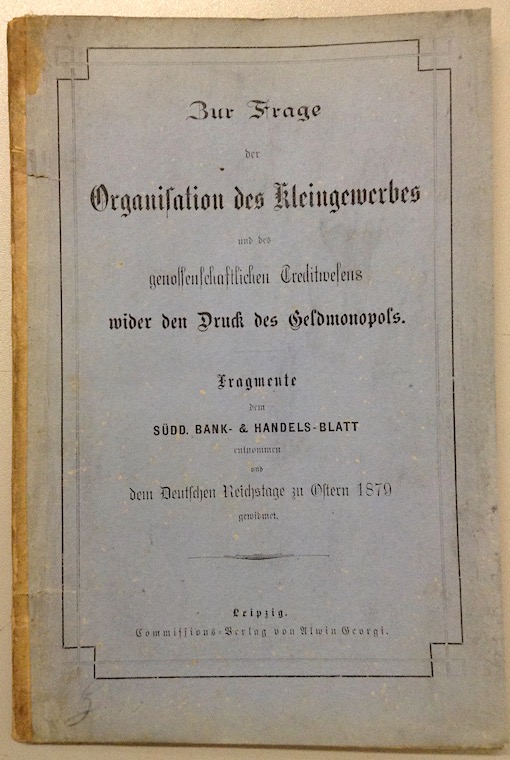
1879réf. 142338Leipzig, A. Georgi, 1879. 1 Bl., 70 S. Kartonage d. Zeit mit aufgezogenem vorderen Originalumschlag (Klammerheftung verrostet).
1728réf. 28719Paris: Chez Pierre Prault 1728. 1 vols. 8vo. Contemporary sprinkled sheep maroon morocco label. Some light rubbing of extremities short tear along lower portion of upper joint light spotting and browning else very good. 1 vols. 8vo. Goldsmith's Kress Library of Economic Literature no. 4102.7 suppl. for the 1704 edition. Goldsmith's Kress Library of Economic Literature no. 4102.7 suppl. for the 1704 edition Chez Pierre Prault unknown
réf. 18391A Paris, Chez Valleyre père, 1762. (2), x, (4), 468, (20) pp. 12mo. Contemporary marbled calf, spine gilt with raised bands, red edges, corners very lightly bumped. Kress 6021; INED 2614; Higgs 2669; not in Goldsmiths; not in Einaudi; not in Leblanc; not in Masui; not in Stammhammer, Bibliographie der Finanzwissenschaft; not in Camus; Conlon 62:879. First edition. Historical and legal treatise which studies the dîmes in relation to religion, law and the origins of the monarchy and stating that the dîmes were not, at the outset, due to the church. Edme de la Poix de Fréminville studied law. His main interests were related to feudal questions and his works were of importance. - Occasional light browning. Rare.
réf. 911TMS. Atkinson was an American industrialist and economist. He wrote "Cheap Cotton by Free Labor" "The Collection of Revenue" and "Argument for the Conditional Reform of the Legal-Tender Act". TMS. 7pg. 8 " x 11". Dec. 29 1899. Boston. A typewritten manuscript signed "Edward Atkinson" and accompanied by a slew of handwritten notes between lines and in margins. The manuscript is entitled "A Single Tax Parable. A very simple story" and reads in part: ". Away down to the West of the Indian Territory there lies a bit of land of exceedingly uniform and fertile character named 'No Man's Land' belonging to the United States. It was set apart when opened to settlement for an experiment in collecting the entire revenue due from settlers for any purpose by a 'single tax'. John Doe and Richard Roe were two New England mechanics. without the possibility of accumulating gain. They concluded to better their conditions by accepting under the Government grant each a quarter section in 'No Man's Land' on a single tax or ground rent at an assessment of two 2 per cent. making the single tax. on the whole parcel eighty dollars $80.; a seemingly high valuation but a low rate. John Doe and Richard Roe each had a thousand dollars $1000 in capital. Each built a small house putting the rest of their money into tools. Each put into wheat one hundred 100 acres. land of uniform fertility. Each kept a set of books valuing their own time. At the beginning of the second year John Doe bought a piano for the use of his daughter and bought a trotting horse and buggy for himself. Richard Roe was satisfied with a parlor organ. and put the rest of his profits into some good dairy stock. ". The manuscript continues along these lines and ends with the less frugal Doe working as an employee of the smarter Roe. There are over a handwritten hundred words and his signature appears at the end. The manuscript is in excellent condition with horizontal folds and a paper clip mark throughout unknown
réf. 18071Grenoble 1708. 49 x 36 cm. Auréole claire sur la partie centrale du document. Tampon "Extraordinaire Dauphiné". Mentions manuscrites des sommes à recouvrer signatures de Nicolas Prosper Bauyn seigneur d'Angvilliers Vial . Document fixant le montant de l'impôt montant manuscrit les dates de recouvrement. contraintes et contraventions en cas de non-paiement. unknown
réf. 18071Grenoble, 1708. 49 x 36 cm. Auréole claire sur la partie centrale du document. Tampon "Extraordinaire Dauphiné". Mentions manuscrites des sommes à recouvrer, signatures de Nicolas Prosper Bauyn seigneur d'Angvilliers, Vial, ...Document fixant le montant de l'impôt (montant manuscrit), les dates de recouvrement., contraintes et contraventions en cas de non-paiement.
réf. 16499A Londres et se vend à Paris, Chez la veuve Delormel & Fils, 1757. Together 4 works bound in 1 volume. (4), 60, 107, (1) pp.; xxiv, 224 pp.; 109, (1) pp.; 67, (1) pp. and 1 table. 8vo. Contemporary polished calf, spine richly gilt, raised bands, gilt triple fillets on sides, red label with gilt lettering, a very nice copy. First work: Kress 6086-7; Goldsmiths 9873; INED 1276; Higgs 3017. First issue of the first edition. In this vehemently written work, the fermiers-généraux were accused of corruption. It caused the author's imprisonment in the Bastille. The volume was printed by Lambert and distributed by Ormancy, who also were arrested. Four years after its publication the book was still sold secretly at high prices.Second work: Not in Kress; Conlon 75:640 (claiming two volumes).First edition.Of importance for the history of the years preceding the Revolution.Third work: Conlon 82:401.First edition.Fourth work: INED 620; Conlon 57:547.First edition.
réf. 16498A La Haye, 1764. Together 3 volumes in 1. (4), 60, 107, (1) pp.; (2), 26 pp.; 24 pp. 8vo. Contemporary marbled calf, spine gilt in compartments, red label with gilt lettering, red edges, lightly worn, some spots. First work: Kress 6086; Goldsmiths 9873; INED 1276; Higgs 3017; Conlon 63:751. First issue of the first edition. In this vehemently written work, the fermiers-généraux were accused of corruption. It caused the author's imprisonment in the Bastille. The volume was printed by Lambert and distributed by Ormancy, who also were arrested. Four years after its publication the book was still sold secretly at high prices. Second work: Not in Kress; Goldsmiths 10025; Higgs 3018; INED 4797; Conlon 63:752.First edition.According to Goldsmiths this is not by Darigrand, but a reply to Darigrand's work, INED also believes this work to be written by another, anonymous, author, Conlon lists it under Darigrand.Third work: Not in Kress; Goldsmiths 10020; Higgs 3268; INED 4778; Conlon 64:441.First edition.Loosely inserted: ARRET de la cour du parlement de Rouen, qui ordonne que la brochure intitulée: Réponse à l'auteur de l'anti-financier, fera lacerée & brulé par l'exécuteur de la Haute-Justice, au pied du grand escalier de palais; enjoint à ceux qui en auroient des exemplaires, de les apporter au Greffe de la Cour, pour y être pareillement lacérés & brulés, &c. Du 9 Avril 1764. (Drop-head title). A Rouen, Chez J.J. le Boullenger, (1764).Not in Kress; Goldsmiths 10017; Higgs 3252.
réf. LFA-126738549Un document format 380 x 355 mm, s.d. (XVIIIe siècle), bon état
réf. 17155Londres (Paris?), 1751. 3 parts in 1 volume. (6), 112 pp.; 175 pp.; 171 pp. 12mo. Contemporary marbled calf, spine gilt in compartments, gilt fillet on sides, marbled edges, spine somewhat rubbed, slightly damaged at head and foot. Stourm 81; Conlon 51:499; INED 1094 (one part only); not in Kress; not in Goldsmiths; not in Einaudi. First edition. Legal and historical work dealing with Machault's plans to tax the ecclesiastical properties. The clergy maintained that they were exempt from tax and that whatever they paid was a voluntary gift. Chauvelin maintains that the clergy can not be exempt from taxes if the king thinks he ought to ask a contribution from them. The issue was hotly debated at the time, as the long list of works cited by Stourm shows. The work was condamned, Machault's plans failed and the exempt position of the clergy was maintained upto the revolution.
réf. 18836Londres, 1775. 2 volumes in 1. (1), 155, (1) pp.; 275, (3) pp. 8vo. Contemporary marbled calf, spine gilt with raised bands, red morocco label with gilt lettering, small damage to joint at the foot of the volume. First work: Kress 7193; not in Goldsmiths; not in Einaudi; this edition not in INED; cf: Camus 1566; Peinot, Livres Condamnés, i, p. 43 (with wrong date). Third edition, published in the same year as the first edition, first edition with this title. Pierre-François Boncerf, French writer on agrarian subjects. While a clerk in the ministry of finance under Turgot he published a pamphlet, Les inconvénients des droits féodaux. According to Palgrave the work was published with the consent of Turgot. In it he attacked the contemporary system of feudal dues as ruinous to those who pay them, of little advantage to its benificiaries and contrary to the principles of freedom. The solemn condemnation of the pamphlet by the parlement of Paris, which the king vetoed, and the ensuing controversy in the press, in which Voltaire took a prominent part, established Boncerf's reputation and resulted in the translation of the work into many European languages. The pages 70-end contain the relevant texts by Montesquieu. The first edition was published anonymously, the second edition under the assumed name M. Francaleu. Second work: Higgs 6537; INED 3188 (1831 edition); Martin & Walter 24430; not in Goldsmiths (see 11518 for the second edition).First edition. Philosophical and political study on despotism and its effects it pretents to refute the theories of Rousseau while the author in reality attacks straight forward the government. Of actual value seems again his remark 'La nation finit toujours par être plus puissante que le tyran lorsque le pouvoir arbitraire parvenu à son dernier délire a dissous tous les liens de l'opinion et épuisé les ressources que la terre offre à ceux qui la cultivent en liberté. Ainsi les hommes se vengent tôt ou tard.' 'Dans cet insolent libelle, intitulé Essai sur le Despotisme, sous couleur de réfuter les théories de Jean-Jacques sur la bonté naturelle de l'homme, l'auteur s'attaquait de front aux pouvoirs' (Duc de Castries, Mirabeau, p. 105). Important work proclaiming democratic ideas and openly attacking despotism: 'Après cette vue philosophique générale, l'ouvrage s'attaquait seulement au 'despotisme d'un seul'' (Duc de Castries, op.cit)
réf. 17894A Paris, 1776. (2), 155, (1) pp. 8vo. Contemporary marbled calf, spine gilt in compartments, gilt lettering. Kress 7193; not in Goldsmiths; not in Einaudi; this edition not in INED; Camus 1566; Peinot, Livres Condamnés, i, p. 43 (with wrong date). Third edition, published in the same year as the first edition, the other two having only 48 and 72 pages respectively. Pierre-François Boncerf, French writer on agrarian subjects. While a clerk in the ministry of finance under Turgot he published a pamphlet, Les inconvénients des droits féodaux. According to Palgrave the work was published with the consent of Turgot. In it he attacked the contemporary system of feudal dues as ruinous to those who pay them, of little advantage to its benificiaries and contrary to the principles of freedom. The solemn condemnation of the pamphlet by the parlement of Paris, which the king vetoed, and the ensuing controversy in the press, in which Voltaire took a prominent part, established Boncerf's reputation and resulted in the translation of the work into many European languages. The pages 70-end contain the relevant texts by Montesquieu. The work was first published anonymously, a second edition was published with the pseudonym M. Francaleu.
réf. 27210A Bruxelles, 1779. xiv, 776, (2, errata, blank), 10 pp. 4to. Contemporary calf, spine gilt with raised bands, red label with gilt lettering, marbled edges, some minor blemishes to binding. Kress B.175; Goldsmiths 11860; Einaudi 207; INED 137; Quérard, La France Littéraire, i, p. 126; Dupin/Camus 954bis, pointing to the fact that this work is only complete with the 10 pages supplement, as is the case here; Le Bucher bibliographique, 114. Very rare only edition and suppressed by the Cour des Aides in February 1779 because it was considered contrary to the authority of the Court, it lacked respect for its decisions and it violated the confidentiality of the decisions. This precious and scarce volume, which was not available on the market and which was suppressed in 1779, contains the work of Malesherbes during his tenure in office at the Cour des Aides, that is, the work of 25 years: the reports of the sessions of the Cour des Aides and the remonstrances. It was published with tacit permission and did not contain, in the first instance, those pleas in which Malerherbes addressed the king in quite frank language. These withheld texts were shortly thereafter nevertheless printed and inserted and they form the indispensible 10 page supplement at the end of the volume.The Court des Aides was suppressed, together with the Parliaments, by Maupeou in his attempt at reform; it played, under Malesherbes, a significient role of opposition to what the Court considered to be "royal arbitrariness" and basically shared the "constitutionalist" ideology common to most members of the Grande Robe. The Court was suppressed in 1771 and re-instated in 1774: Malesherbes was recalled to Paris with the reconstituted Cour des Aides on the accession of Louis XVI; it was at this point that he spearheaded the famous 1775 Remontrances of the cour des aides, which detailed the problems facing the regime and envisioned a total overhaul of fiscal policy. Louis XVI was so impressed with the plan -and fearful for the future of his government- that Malesherbes was appointed minister of the maison du roi in 1775. He held office as a royal minister only nine months; the Court proved intransigent in its opposition to his proposals for fiscal restraint and other reforms, including curtailing the arbitrary issuance of lettres de cachet, and he soon found himself bereft of political support. He resigned together with Turgot in 1776.- Pages 71-72 bound between pages 66-67, and with the pages 71-72 bis present, 457-8 omitted in numbering, numbers 465-66 used twice, but text complete.
réf. 18132A Amsterdam (France), 1764. With engraved frontispiece. 37, (1) pp. 8vo. Modern boards. Kress S.4328; INED 4546; not in Higgs; not in Goldsmiths; not in Einaudi; Weller, Die falschen und fingierten Druckorte, ii, p. 166. First edition. Very sharp pamphlet against the fermiers généraux. The author remained unknown, but 'on avait pourtant arrêté et mis à la Bastille un nommé Darigrand auquel on attribuait l'Antifinancier, qui parait avoir été écrit par la même plume que les Antropophages; mais il fut relâché avant la mise en circulation de ce dernier libelle' (INED). - Title-page and first few leaves browned.
1956réf. 604902Rom, Associazione Bancaria Italiana, 1956. 4to. XXIII, 691; 306, 333 S. Mit zahlreichen Tafeln. Originalleinen (gebräunt u. angestaubt, Rücken unten mit Kleberesten).
1846réf. 4050Dresden, Meinhold, 1846. 4to. XIV, 206 S. Originalumschlag (verstaubt u. eingerissen, Rücken mit gr. Fehlstellen).
1873réf. 28217(Ohne Druckvermerk u. Ort. 1873). XCIX Seiten. Einfacher Papierumschlag mit handgeschriebenen Titel (Etwas fleckig) Querformat 20x25 cm
1881réf. 3309280Bern, Haller, 1881. 73 S. OBroschur (bestoßen, Stempel auf Titel).