518 resultados
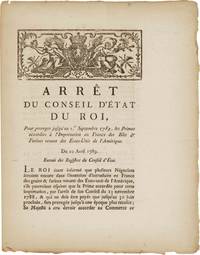
1789ref. 37445Paris: de l'Imprimerie Royale 1789. French Trade with the United States A very rare decree concerning the trade in wheat and grain between France and the United States. Echeverria and Wilkie records a single copy in a private library OCLC cites copies in Heidelberg the Library and Archives of Canada at NYPL and a copy at Yale Franklin Collection with a variant imprint. Quarto. Moderate tanning particularly at edges leaves slightly separated at fold. A very good copy. ECHEVERRIA & WILKIE 789/44A. OCLC 1426766518 45249572 variant. unknown books
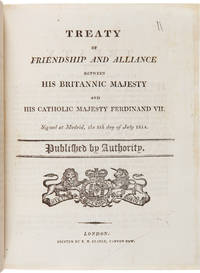
1814ref. 38942London: Printed by R.G. Clarke 1814. England Seeks a Trading Foothold in South America The final settlement between England and Spain at the end of the Napoleonic Wars. An important treaty which guarantees for England most favored nation status in the event of the commerce of Spanish America being opened to foreign trade. Includes an article of agreement regarding the injustice and inhumane nature of the traffic in slaves and a SEPARATE ARTICLE stipulating that the king of Spain not engage in any treaty with France "of the nature not known under the domination of the Family Compact." Printed in English and Spanish. Modern half morocco and marbled boards. Near fine. hardcover books
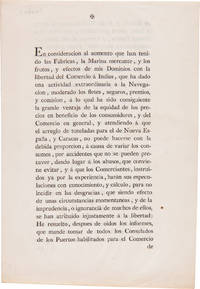
1789ref. 47977Madrid. February 28 1789. Spain Regulates Trade with the Americas This royal decree liberalized the tightly controlled trade between Spain New Spain and the Captaincy of Caracas. The Crown hoped to spur navigation and commerce and lessen the incentive for smuggling. Export duties on goods travelling to the Indies were to be slashed by ten percent but penalties against contraband would still be enforced. Two worm holes very minor soiling else fine. unknown books
1899ref. 9101Cincinnati: C.J. Krehbiel & Co 1899. Octavo in wrappers 19 x 12.5 cm. 122 pages. Thoroughly illustrated with photographs and diagrams numerous plates some folding. FIRST EDITION. The second catalogue of Cincinnati's Triumph Ice Machine Company; the first catalogue of 80 pages was issued the prior year. A detailed and technical catalogue of the refrigeration and refrigerating machinery offered by the firm. Triumph's machinery was instrumental in growing the ability of meat packers fisheries and canners to preserve foodstuffs safe for longer. Clean and sound internally. In publisher's gilt-titled textured cream-colored wrappers with the lightest toning. Near fine. OCLC locates one copy Case Western Reserve; not in Romaine. C.J. Krehbiel & Co unknown books
ref. 3384Paris: Imprimerie et Librairie Administratives de Paul Dupont 1858. . Small folio late 19th century marbled boards cloth spine slightly abraded; original blue printed wrappers bound in; blindstamp of the Boston Public Library on the first page; unopened. The July 1858 issue of "Annales du Commerce Exterieur". The immediate cause of the 1857 panic was the failure of the New York branch of the Ohio Life Insurance and Trust Co. a major financial force that collapsed following widespread embezzlement. Others causes included the removal of funds from U.S. banks by British investors which raised questions about the overall U.S. economy. The fall of grain prices which spread economic misery into rural areas. The collapse of land speculation programs that depended on new rail routes ruining thousands of investors. Investor confidence was further shaken in mid-September when 30000 pounds of gold were lost at sea in a shipment from the San Francisco Mint to eastern banks. The gold and SS Central America sank during the North Carolina Hurricane of 1857. Public confidence in the government's ability to back its paper currency with specie was shaken as well. Eventually the panic and depression spread to Europe South America and the Far East. No recovery was evident in the United States for a year and a half and the full impact did not dissipate until the Civil War. The South was hurt less than the other regions of the country and many there concluded that the superiority of their economic system had been vindicated this has been posited as a contributing factor to the secession of many of the Southern States resulting in the Civil War. Pages 57-62 outline the trade between France and the United States during the years 1856-1857 with a retrospective look at past trade. Paris: Imprimerie et Librairie Administratives de Paul Dupont, 1858. hardcover books
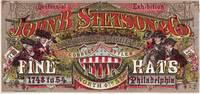
1876ref. 13129Philadelphia 1876. Chromolithographed trade card 3 x 6.5 inches. Minor wear paper and adhesive remnants on verso from removal from scrapbook or similar album. Overall very good. A bright and colorful trade card advertising one of Philadelphia's most successful businesses at the time of the 1876 Centennial Exhibition in that city. John B. Stetson 1830-1906 was the son of a successful New Jersey hatter. After being diagnosed with tuberculosis and told he didn't have long to live Stetson traveled west to Colorado for the dry mountain air. Near Pike's Peak sometime in the early 1860s Stetson invented the cowboy hat -- lightweight wide-brimmed waterproof and made out of animal felt usually beaver or rabbit skins. Because it sat easily atop the head offered good protection from the sun could be used to fan the flames of open-air fires and could even carry water Stetson's "Boss of the Plains" style became the most popular hat in the American West. Stetson returned to Philadelphia in 1865 and set up a factory that would turn out millions of hats in the next century and a half. The present trade card emanates from the 1876 Centennial Exhibition celebrating the 100th anniversary of American independence. An illustration of two women and three men show them all wearing Stetson's trademark hats; his address at the time was 1748 to 1754 North 4th Street; his factory would eventually grow to encompass over nine acres and produce over two million hats a year. By 1886 Stetson was the most prolific hat maker in the world. unknown books
1924ref. 64072New York: China Trade Bureau August 1921 to June 1924. 2 volumes large 4to lacking vol. I no. 1 and volume VI no. 6 but otherwise complete from volume I no 2 to volume VI no. 5 - 34 issues in all and contained in a library binding of blue cloth gilt-lettered spine; ex-Purdue University lightly marked. Issues range from 24 to 56 pages. Illustrated throughout. Publication was suspended during June July and August 1924 and finally folded withg the publication of volume VI no. 6 in September 1924. The China Review "is the only magazine published in the United States and edited by Chinese that deals exclusively with all phases of China political social industrial etc." Regular features include: book reviews China's Business Barometer; Finance Industry and Commerce; Foreign Press Comments; The Month in the East; Trans-Pacific Sailings; and Home and General News; together with feature articles by Nathaniel Peffer Cornelius Vanderbilt Charles Hodges Charles W. Mason Nora Waln Loretta Shaw Chungshu Kwei Dr. P. W. Kuo Genevieve Wimsatt K. H. Li Ma Soo James D. Bush and Robert Harris among others writing on various topics relating to China including Chinese Pagodas The Modern Chinese Girl The Future of American Trade in China China's Mathematics - The Oldest Approach and Development of Chinese Markets The Mongolian Situation Selling to the Chinese Millions China's Silk Industry China and the Four Power Treaty Tibet - The Closed Country The Part Birds Play in Chinese Life and many others of interesting content. China Trade Bureau, August, 1921 to June unknown books
1991ref. 164191991. Federal Trade Commission Decisions. United States Federal Trade Commission. Washington: Government Printing Office 1922-1991. Hardcover. Vols. 5 to 8 10 12 to 15 22 to 29 34 37 39 to 41 44 to 46 50 52 to 75 77 78 80 to 82 84 to 90 114. Together 63 books. Twelve 12 linear feet of shelf space. Uniformly bound in publisher's tan buckram with red green and black gilt lettered spine labels. Ex-library with stamps else very good. $595. Formed in 1914 the Federal Trade Commission has a proud history of enforcing the nation's competition and consumer protection laws that spans more than a century. unknown books
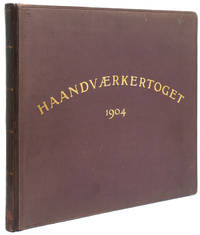
1904ref. 39516Copenhagen: forhen A. Christiansens Forlag Hermann-Petersen 1904. 50 Double-page colored plates after Rasmus Christiansen mounted on stubs. Introduction by Jul. Wulff. 1 vols. Oblong folio. Original leather-backed burgundy cloth lettered on cover in gilt. Spine repaired inner hinges strengthened. Some minor rubbing pencilled numbers in upper right margin of several plates. Very good. 50 Double-page colored plates after Rasmus Christiansen mounted on stubs. Introduction by Jul. Wulff. 1 vols. Oblong folio. DANISH TRADES FESTIVAL PARADE. In July 31/1 August 1904 a grand festival and parade was held in celebration of Danish Industry and Tradesmen. The elaborate floats representing the trades are depicted in these fine double-page colored plates including those of the printers the bakers the stroller-makers the pavers the bookbinders the furriers barrelmakers cigar and tobacco merchants bicyclewheel makers photographers metalsmiths hatmakers carriagemakers clockmakers wigmakers and many others. Under each illustration is text describing those involved. forhen A. Christiansens Forlag (Hermann-Petersen) unknown books
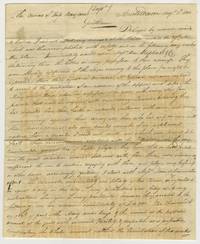
1800ref. BK0193Amsterdam Netherlands 1800. Autograph letter signed three closely written pages on a folded sheet addressed to the owners of the ship 'Mary Ann.' 7 ¼ x 9 inches. Old folds scattered soiling and minor marginal wear and losses. Good to very good. A detailed commercial letter from the American shipmaster Daniel Olney concerning the arrival of the Mary Ann at Amsterdam his negotiations with two prominent Dutch merchant houses and difficulties encountered with customs officials over contraband cargo. Olney was an experienced Providence captain who had commanded Brown Benson & Ives's ship John Jay on its 1794-95 voyage to Bombay and Canton and later commanded the firm's Ann and Hope. His subsequent involvement with the Mary Ann in the Río de la Plata is documented in surviving correspondence.1 Having arrived after delays caused by adverse weather Olney initially approached Van Staphorst & Co. one of the Amsterdam houses involved in financing the American government during the Revolution. He declined to entrust the cargo to the firm however after hearing complaints about its business practices particularly delays in selling consignments and settling accounts. Instead he contracted with Daniel Crommelin & Sons for an immediate advance of $10000 and the balance under terms providing for settlement within six weeks: "The very considerable quantities of Coffee & Sugar they have still on hand for sale and the great detention several had met with from them were inducements sufficient for me to decline engaging with them; and place my business in other hands. Accordingly yesterday I closed with Messrs. Daniel Crommelin & Sons." The letter also describes considerable difficulties with Dutch customs authorities over linens and brandy carried aboard the vessel for reexportation. Although declared on the manifest both commodities were treated as contraband delaying the discharge of the cargo and exposing the vessel to fines and duties. Olney petitioned the government at The Hague securing remission of the fine but remaining liable for a three-percent excise and the expense of an officer stationed aboard to prevent smuggling: "The Linen we have onboard has already caused some troubles & will eventually create expense this article as well as Brandy is Contraband here & altho' reported in my manifest for Exportation together with the Rice incredible to relate we are subjected to a fine for the importation & the payment of inward & outward duties." In an August 4 continuation Olney reports progress unloading the vessel discusses prospective sales of rice and exchange rates and records news received by extraordinary courier from Paris concerning preliminary peace articles between France and Austria. The report concerned the agreement signed on July 28 1800 by Talleyrand and Count Saint-Julien which the Austrian government subsequently refused to ratify. 1 Berenice A. Jacobs "The Mary Ann an Illicit Adventure" The Hispanic American Historical Review 37 no. 2 May 1957: 200-212. . unknown books
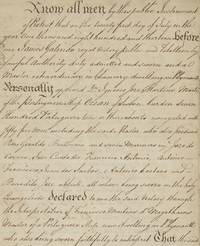
1813ref. List1947Plymouth 1813. Plymouth Devon England: 21st July 1813. Folio 7 pages 13 1/8 x 8 ¼ inches duty blindstamp small ink stamp to upper inner margin of the first page two seals to the last page signed twice by Galindo. Toned some small repaired tears using reversible archival ph-neutral paper-repair tape very good to near fine. Very Good. An interesting document of privateering in the Peninsular war this 'Public Instrument of Protest' documents a Portuguese captain and crew complaint in detail to an English notary. After sailing from Calcutta to Brazil and then from Rio to just outside of Lisbon their ship the 700-ton 'Oceano' was seized and comprehensively ransacked by a French privateer the 'Lion' out of Lorient. Most of the crew and passengers were offloaded onto a passing American vessel the 'Leda' bound for Lisbon. Meanwhile the 'Lyon' escorted her prize towards the nearest French port but before a friendly haven was reached they were both set upon by the brigantine HMS 'Achates'. The 'Lyon' escaped but the 'Ocean' was captured by Commander Morrison and the 'Achetes'. The 'Ocean' was taken to Plymouth and moored in the Hamoaze. The remaining Portuguese crew who had been forced to remain aboard the 'Ocean' by the French got a message to the 'Ocean's Master Dn. Ignacio Joze Martins and he and the boatswain made their way to Plymouth as quickly as possible. The sworn statement presented here is in English thanks to the translation given by Francisco Martins d' Magalhaens master of a Portuguese ship "now dwelling in Plymouth" The 'Oceano' sailed from Calcutta to Brazil arriving 10th February 1813. She left Rio on 4th April all was plain sailing until the afternoon of the 7th June off the Rock of Lisbon when the 'Lion' showed up first under false British colors then French. The fighting was fierce the privateer was driven off once but eventually the 'Oceano' was taken. The night of the 7th June was spent by the French 'conveying everything Moveable and Valuable from the Ocean to the Privateer'. The 'Leda' the US vessel landed the majority of the 'Ocean's crew including the Master in Lisbon on the evening of the 9th June.Monday 14th June the 'Lyon' engaged in a running battle with HMS 'Achates' and escaped but the 'Achates' did capture the 'Ocean'. Wednesday 16th June the 'Ocean' arrived in Plymouth under the watchful eye of the 'Achates'. Receiving the crew's message the Captain of the 'Ocean' left Lisbon for Falmouth and then Plymouth arriving on the 20th July. The document was dated 21st July 1813. Full transcription available. unknown books
1889ref. 8382Indianapolis Ind: J.B. Allfree Co.; Gilmore & Miller Printers 1889. Octavo cord-bound in wrappers 19.5 x 13.5 cm. 70 pages. Illustrated with steel engravings throughout and with three folding plates. All pages ruled in red. FIRST EDITION. A very attractive trade catalogue of the J.B. Alfree Company manufacturers of milling machines including the "Keystone" Four Roller Flour Mill the "Success: Bolter and Dresser the J.B. Alfree Sieve Scalper the J.B.A Purifier the "Climax" Bran Duster and more. Includes specifications and diagrams. Price list and order slip one piece for bolting cloth laid-in. Some light wear to spine of wrapper; small adhesion to front panel of illustrated chromolithograph wrapper. Still near very good or a bit better. Rare. OCLC locates no copies and only one copy of any Allfree catalogue; no Alfree listings in Romaine. J.B. Allfree Co.; Gilmore & Miller, Printers hardcover books
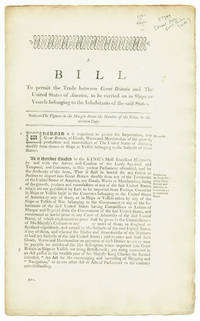
1809ref. 47399London. 1809. A Failed Opportunity to Normalize U.S.-British Trade Relations Rare printing of a British Parliamentary "slip bill" seeking to reestablish trade between Great Britain and the United States a few years before the outbreak of the War of 1812 and in the midst of great tension between the two nations. This bill was considered by Parliament in the spring of 1809 in the wake of President Jefferson's rescinding the Embargo Act and following the negotiations between U.S. Secretary of State Robert Smith and British envoy David Erskine which created a glimmer of hope that Anglo-American relations might be repaired after a period of great stress and turmoil. In March 1809 Jefferson signed the Non-Intercourse Act which rescinded the Embargo of 1807 and held out the promise of resuming trade with England and France if either of those nations ended its commercial restrictions toward the United States. The Erskine-Smith negotiations of April held out the promise of improved relations and in May the Parliament considered the present bill which permitted trade between Great Britain and the United States to be carried on in American ships. Unfortunately Prime Minister Canning disavowed the Erskine-Smith Agreement in late May and Anglo-American relations continued to deteriorate culminating in outright warfare in 1812. Slip bills are printed during the legislative process in small numbers for the use of legislators and staff. They are ephemeral items and their survival is rare. A printed note before the text of the bill reads "the figures in the margin denote the Number of the Folios in the written copy" which indicates just how early in the legislative process these bills were printed. OCLC locates only a single copy at the University of Massachusetts. Folio. Lightly tanned around the edges. Near fine. OCLC 49887290. unknown books
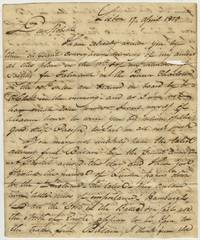
1813ref. BK0183Lisbon 1813. Autograph letter signed 3 pp. on a folded sheet with integral address panel to Messrs. Brown & Ives Providence Rhode Island and Newport "SHIP" and circular datestamps. 8 x 9 ¾ inches. Folded for mailing with considerable wear along the folds several tears and small losses including losses from opening the seal affecting scattered words. Good overall and substantially legible. A commercial letter written from Lisbon during the War of 1812 by "P. Falconer" probably the Baltimore merchant Peregrine Falconer. The identification remains somewhat tentative but the 1812 Baltimore directory lists Comegys Falconer & Co. merchants at 190 Baltimore Street while later Maryland Chancery records document the estate of Peregrine Falconer; Missouri archival records also document Falconer and Comegys and both "Perregrine" and "Perry" Falconer. Falconer was preparing to sail from Lisbon for Falmouth and writes Brown & Ives with the latest commercial and political intelligence reaching Portugal. He expected the widening European opposition to Napoleon to bring still more nations into the war then turned immediately to British policy toward American trade: "from the complexion of affairs that in the course of the Summer all the powers in Europe will be joined against France. If I am correctly informed a new duty of 6d. pr lb in addition is imposed in Britain upon American Cotton . Savannah Charleston & New York in a state of Blockade - this with the new duty has advanced the Price of Cotton .". The Russo-Prussian alliance had been concluded only weeks earlier Sweden joined the anti-Napoleonic alliance on March 24 and the coalition would continue to expand during the year. At the same time the English Parliament was debating additional duties on American cotton: on March 31 the government proposed sixpence per pound on American cotton imported in foreign vessels while Alexander Baring warned that American cotton carried by neutral ships would consequently bear a total duty of ninepence per pound. British naval pressure on the American coast was also rapidly increasing during the spring of 1813 trapping increasing amounts of American shipping in port. Falconer's letter thus records from Lisbon the immediate commercial relationship between the blockade British taxation and the price of American cotton. The war also forced Falconer to reconsider how Brown & Ives should communicate with him once he reached Britain. He gives explicit instructions intended to obscure their route: "I presume the only means of corresponding with Liverpool will be by the way of Lisbon. I have to request that you will write to me . frequently enclosing your letters under cover to Messrs. - & Brown without marking 'Via Lisbon' as letters coming from America are all opened in Britain." The remainder concerns the practical movement of merchants and shipping through the same wartime network including Falmouth and Liverpool passage arrangements vessels preparing to sail and convoying. Overall a useful merchant's-eye letter from the spring of 1813 with the blockade of American ports the British cotton duty the developing coalition against Napoleon and the routing of commercial correspondence all appearing as parts of the same Atlantic problem. . unknown books
1762ref. 10095Breslau .: G G Horn 1762. First Edition. Contemporry three quarter leather. A very good copy with some wear to the binding. 8vo. There is an elaborate eng. vignette title. A two-part analysis of coinage and monetary value. The first section deals with the origin and implementation of monetary regulation and minting of money. The second is an essay on the maintenance of exchange rates and relative values of currency in the modern era. G G Horn hardcover books
ref. 10746Illus. throughout. 202 pp. 4to four-ring binder with Posthumus logo on upper cover and spine. N.p.: 1960s or early 1970s. A delightful trade catalogue of stamps published by one of the leading fabricators of the time. Thousands of designs and samples are presented. Near fine but lacking the first two leaves 4 pp. unknown books
ref. 10745Color illus. throughout. 45 pp. 4to pictorial covers plastic spiral-bound. Amsterdam: ca. 1970s. A superbly illustrated catalogue of stamps perforators hole-punches staplers etc. and all manner of office supplies made by Posthumus B. V. the Dutch royal manufacturer of stamps. Their products are carefully arranged and photographed in this nice catalogue. Near fine. unknown books
ref. 35912TRADE CATALOGUE Portuguese Metal Household Articles. Braga: circa 1920. Oblong folio 15 x 18 1.2 inches. Wrappers. 53 plates. Scarce Portuguese trade catalogue illustrating hundreds of domestic household articles drawn to scale. Included are picture frames mirrors sculptures trays plaques medallions candlesticks vases etc. They include various styles and feature sculptures influenced by African and Asian themes and elaborate baroque and Renaissance styled pieces. Plates are sepia prints and some signed F. Gortz and M. Silva. Edges of plain wrappers sunned. unknown books
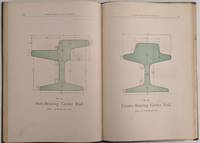
1890ref. 502San Francsico California: Pacific Rolling Mill Company 1890. 8vo. 250 x 170 mm. 10 x 7 inches. 100 pp. plus 4 leaves of ruled paper 2 with measurements in manuscript. Illustrated throughout with simple drawings of parts many stenciled with green wash; one plate folding. Bound in limp cloth covered boards title in gilt on front cover; a cloth binding shows some wear to gilt title two pencil drawings on front endpaper; other a very good sound copy. Straight forward price list of iron bar steel rail rolled and forged metal axles nuts bolts washers and dozens of other metal products. There is no introduction about the history of the firm just images of parts prices and a few lines of text describing specifications for some of the more complicated manufacture items. What distinguishes this rare trade catalogue is the design sense of many of the images and the application of stenciled color to highlight the object. The printed form of the parts are in outline and as one pages through the catalogue the images take on an abstract quality. Metal parts become contoured shapes with form being determined only by the light green wash applied to the physical part of the design. Although unintentional I am sure this late 19th century publication replete with many of the characteristics of period book design exhibits a very modernist feel one that is most unusual in publications of this nature. Although called the 7th edition this is only one of three issues of the PRMC's product guide and price list that is known. Organized in 1867 PRMC grew continuously and by 1892 was producing more than 40 thousand tons of iron and steel. "This giant enterprise is so closely identified with the manufacturing interests of the Pacific Coast that there is scarcely a manufacturing firm or corporation on the Coast that does not depend upon its output. The mills are located at Potrero Point in South San Francisco and cover an immense area" Master Hands. Romaine Guide to American Trade Catalogues p. 200 this edition and one from 1886 both known in only one copy each at California Historical Society. OCLC cites an edition from 1885 in one copy at San Francisco Public Library and this edition 1890 also in only one copy at California H. S. See: Master Hands in the Affairs of the Pacific Coast Historical Biographical and Descriptive. A Resumé of the Builders of Our Material Progress. San Francisco: Western Historical Publishing Company 1892 pp. 260. Pacific Rolling Mill Company unknown books
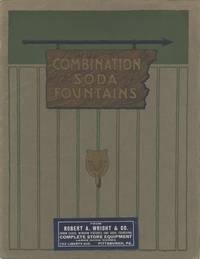
1925ref. 6884Decatur Ill.; Fort Wayne Ind: the company; The General Printing Corp 1925. Folio x cm. 24 pages. Illustrated throughout and with a color illustrated title page. Printed throughout in green and black ink. An attractively printed trade catalogue for the Combination Soda Fountain Company founded in 1898 with the introduction of the “Iceless” soda water machine. The company further expanded in 1919 with the purchase of the Wise Soda Apparatus Company of Ohio. The catalogue depicts and provides information for various scale soda water set-ups both counter and wall type as well as a few pages of smaller equipment and accessories. A bit or edgewear to the decorated stiff wrappers printed in black green brown and gold otherwise fine. With the ownership label of the Robert A. Wright & Co. “Complete Store Equipment” of Pittsburgh. No publications of the company are located by OCLC. the company; The General Printing Corp unknown books
ref. 35910TRADE CATALOGUE Portuguese Door Hardware. Braga: circa 1920's. Oblong folio 15 x 18 1.2 inches. Wrappers. 73 plates. Scarce Portuguese trade catalogue illustrating hundreds of door and furniture hardware samples drawn to scale. Included are escutcheons pulls strap hinges knobs etc. Represented are various styles from simple modern styles to elaborate baroque designs. Plates are sepia prints. Plain wrappers worn and chipped and partially missing. Plates have circular stamps. unknown books
1927ref. 250121New York: William Edwin Rudge 1927. First Edition. One of 50 copies specially bound with a double-page frontispiece color reproduction of a trade card for a Mitchell & Crosdale Philadelphia dealer in Sperm Whale Lard & Tanners Oils Candes Rice & c. of Whale killing. XLIV plates uncut. 25 pages of text. 1 vols. 4to. Bound in quarter vellum and patterned boards. Very Fine in remains of original glassine. First Edition. One of 50 copies specially bound with a double-page frontispiece color reproduction of a trade card for a Mitchell & Crosdale Philadelphia dealer in Sperm Whale Lard & Tanners Oils Candes Rice & c. of Whale killing. XLIV plates uncut. 25 pages of text. 1 vols. 4to. William Edwin Rudge unknown books
ref. 35911TRADE CATALOGUE Portuguese Door Hardware. Braga: circa 1920's. Oblong folio 15 x 18 1.2 inches. Wrappers. 127 plates. Scarce Portuguese trade catalogue illustrating hundreds of door and furniture hardware samples drawn to scale. Included are escutcheons pulls strap hinges knobs keys etc. Represented are various styles from simple modern styles to elaborate baroque designs. Plates are sepia prints. Many plates signed F. Costa. Plain wrappers worn and chipped and partially missing. Plates have rectangular stamps. unknown books
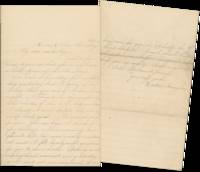
1909ref. List3421Ohio Illinois Michigan and Ontario 1909. Seventy-four letters in thirty-seven envelopes mainly dating between 1885 and 1895. With two undated and one empty envelope. Conditions vary with a few letters having damage intersecting with significant amounts of text and others Near Fine. Overall excellent. A collection of letters mainly sent between Captain William Faragher 1842–1921 and his second wife Harriet Chamberlin 1853–1920 with several from Faragher’s children from his first marriage Burton 1872–1961 and Maude 1875–1952. Most letters are from Chamberlin to Faragher with fourteen from Faragher to Chamberlin. Faragher owned and captained several merchant ships in Lake Erie and Lake St. Clair—presumably sailboats as he frequently complains of having been stuck without wind. He also describes more severe weather out on the lake writing from St. Clair Michigan: “I am anxious to get down from here but as the day advanced the wind began to frisken and it began to snow hard and as it was freezing hard it had rained then snowed and then froze hard saturday night so the poor Venture was in a sad plight but she was in a worse one when we got to where we lay run as it breezed up fresh and the wind dead ahead the water was flying over her in all directions and froze wherever it fell and besides it had turned into a blinding snow storm but we had a certain point to make . she seemed as anxious to get to a place of safety as I did and as the boys say she got there and none too soon as it has been blowing a gale ever since and snowing and freezing but we are in the lee and at a good dock and are comfortable but oh the wind is whistling through the rigging .” November 20 1887 In the 1880s steamships were increasing in popularity on the Great Lakes primarily because of sailboats’ susceptibility to both calm and weather; steamboats were bulky for their capacity and slow but more reliable whereas sailboats could carry overall more cargo.1 Generally steamers took packaged goods and passengers and sailboats mainly schooners took bulk cargo. The Great Lakes were the site of much shipping innovation; Faragher’s fleet was not yet behind the times but steam would overtake sail in the 1880s and 90s. Faragher’s cargo was mainly produce—apples and grapes—though he does mention picking up salt and other materials. His letters indicate that his business involved both shipping and mercantile aspects: he chose and bought the products shipped them to their destination and then also had to find and sell to customers. The grapes in particular seem to cause a lot of trouble: “We left Lorain Sunday morning early and had a nice trip to the Island got there at 4 PM bustled around monday morning and bought 400 baskets of grapes and had them all aboard by dark . it commenced to snow just as we got to Marine City bad bad omen for grapes but imagine my chagrin when I went up town and not a store or commission house wanted a grape folks were full of grapes and there was no sale for them and they said that I had got left and if the truth were known they were glad of it but its a cold day when I get left if trying will lit me out but one thing certain the weather and the lateness of the season were against me but you know I never cross a bridge before I get to it well we hauled up to our old Island Saturday morning and I sold out to my old friend . we had sold since 11 am 190 baskets of grapes . only half our cargo and at a good margin too. People would ask are you the man that was arrested here for selling grapes when told yes they seldom failed to buy but the strangest part was the number of ladies that came to buy”. October 28 1887 Though he does not narrate the incident in which he was arrested for grape peddling—nor does it appear to have made the paper—he later mentions yet another grape-related debacle this time at Port Huron: “Sander and I went to town to sell the grapes today . when down came a city official and wanted to know if I had a license to sell . well I couldent sell another grape without paying 5.00 a day license that was a stormer you see the whole sale men were going to drive me out of the market . but they were not as sharp as they thought they were I went and gave a bill of sale of my whole cargo to a citizen here and he appointed one of his agents to sell the grapes” September 20 1888 Faragher’s letters here do not discuss the financial state of his business but given Chamberlin’s statements it cannot have been all too positive. Chamberlin’s letters depict a woman struggling with her financial circumstances and with how the era’s expectations of her gender intersected with them. In one illustrative letter she writes: “A man drove by here Sat. asking for you. Ms. Lawler has given him her note to collect. He says the interest brings it to nearly fifty dollars. I told him I thought you could not meet it just at present but he said he must have the money and would give you just one week and if it was not paid then he would let the law settle it. Marvin and Laird are his lawyers. Mr. Laird is the one who helped get my money from father’s estate. I would not have them connected in this way about you for – O a great deal!! I have thought and planned till it seems as though my brain would burst. I have inquired about that law regarding taking any more married women as teachers. If Mr. Day would work for me it might perhaps be broken. There will be a vacancy in the Detroit building this fall. Will if I possibly can I want to commence teaching in Sept. The children would have to learn to do more about the house and with both of us earning it seems as though some of these harassing debts must be settled after a time. The frequent calls of men with bills against you have taken away all my pride and I believe I am humble enough to do most anything now.” July 11 1887 In 1887 Ohio passed the Married Women’s Property Act which allowed married women to keep their own property separate from their husbands’—in fact Chamberlin occasionally mentions “her” money in her correspondence. At the same time the state’s Board of Education was debating passing an act that would not only ban school districts from hiring married women as teachers but also fire all the married women it then employed. Newspaper reporting at the time indicates that this measure was not particularly popular not the least because married women tended to be older and more experienced with the job. Chamberlin clearly perceives her role as a wife in a rather more progressive way at one point writing to Faragher that “a true wife” is “not a doll-baby to be kept in finery” N.d. after he had taken out a loan to send her money for a new hat. Throughout their correspondence Chamberlin is perhaps surprisingly open with Faragher about her opinions particularly on his work and their financial affairs; for instance: “I should like to examine your pocket-book after that $25 tax money left it. What are you going to live on up there while you are hunting for freight Sawdust won’t put any fat on your bones. Sailing up and down past Saginaw bay won’t prolong your life or lessen your grey hairs. What are you sailing for anyway For the sake of wearing yourself out and giving employment to two or three men and keeping the Root from rusting out I guess I am naughty!” May 25 1894 She also frequently provides her opinion on whether and at what rate Faragher should sell his two other ships besides the Root the Venture and the Sassacus. She continues in the same letter: “I know I almost had a regular fight yesterday morning right there on the lounge. I wanted to do my housework and I couldn’t. I wanted to sew and I couldn’t sit up long for that. I wanted to help you and I couldn’t. I wanted to earn money and whereas I used to earn fifty-five cents for every hour I worked now I can not earn anything. Then if I could not do for self and family I wanted to make church and S.S. calls but I couldn’t walk for that.” Of course she was at that time prevented from these activities by her health not by gendered standards but she clearly had financial ambitions for herself. After her time as a regular school teacher Chamberlin taught at a Sunday school where she earned a few cents per student and in one letter reported having eighty-one students in a single session. Chamberlin also struggles with the expectations of her as step-mother to Faragher’s two children from his first marriage to Emma Humphrey 1848–1880. She writes: “I get so discouraged sometimes and it seems as though I am in the wrong place as mother. I think of Emma as my sister. I want to do as she would have me. I look upon my work as sacred. And yet sometimes I feel as though life was not worth living.” November 5 1886 She frequently describes conflict with Burt who was then in his late teens to early twenties writing that she could not “have quite the very own mother-love for him” though she is “sure that Emma was not more conscientious in her desires to do right by him than I am” May 20 1891. As it still is today the role of step-mother was a difficult and frequently demonized one with the trauma of losing a mother and wife often in conflict with the feminine duty of maintaining perfect domestic harmony. In general Chamberlin seems to have been somewhat out of step with the feminine ideal of the time even telling Faragher in a letter describing the death of an acquaintance’s baby how glad she was to not have any children of her own. Overall a look at the private lives and difficulties of a middle-class Ohio household as despite the relative prestige of its head being a captain-owner it struggled with debt. Of interest to both historians of Great Lakes trade and those of women’s roles in the late nineteenth century. 1 Dina M. Bazzill “The Missing Link Between Sail and Steam: Steambarges and the Joys of Door County Wisconsin” East Carolina University Program in Maritime Studies Research Report no. 19 2007. unknown books
1950ref. 5503N.p.: Ministerstvo Pishevoy Promishlennocti 1950. Octavo-sized accordion fold 25 x 18 cm. 24 pages. Illustrated with seventeen color plates by C.B. Popov. FIRST EDITION. A trade catalogue of Russian liquors issued by the Russian Ministry of Food. The spirits are of all types with a wide range of vodkas but also a rich variety of cordials brandies and dessert liqueurs. The handsome color plates all stand out for their single color backgrounds and the printing process would appear to have been a hybrid combining photolithography and lithography and then colored. Whatever one makes of the Soviet cultural landscape in general it did attain high standards in some fields and in a modest way this trade catalogue is a proud reflection of its aesthetic achievement. Clean and bright within. Textured wrappers with debossed copper lettering and gilt ruling; lightly soiled and with wear and some separation at spine. Good. OCLC locates no copies. Ministerstvo Pishevoy Promishlennocti unknown books