518 resultados
1884ref. 370801Boston: 33 to 51 Bowker Street and 49 & 51 Cardon Street printed by Wilson & Son University Press Cambridge 1884. 7 photogravure plates woodcut illustrations throughout text. With printed order slip tipped-in following text publisher's acknowledgment slip laid-in at front. 256pp. Roan cloth decoratively stamped in gilt and black on cover and spine; decorative blind stamping to rear board; minor edge wear mainly at head and tail of spine; illustrated throughout with black-and-white drawings and photographs. 7 photogravure plates woodcut illustrations throughout text. With printed order slip tipped-in following text publisher's acknowledgment slip laid-in at front. 256pp. A beautifully illustrated trade catalog detailing both the remarkable variety and elaborate designs of the Tufts company's commercial soda fountains. 33 to 51 Bowker Street, and 49 & 51 Cardon Street [printed by Wilson & Son, University Press, Cambridge] unknown books
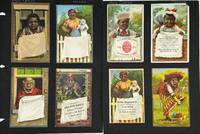
ref. 6863398 of the cards are mounted to black album paper 12 are loose all are housed in a three-ring binder. Chips to the edges of several cards but very good overall. For the lot of 110 cards unknown books
1816ref. 40803London: Printed for J. M. Richardson Cornhill Opposite the Royal Exchange 1816. 3-28pp. Light scattered foxing. Bound in modern cloth withdrawal stamp on front pastedown; inoffensive faint blindstamp on blank corner of title leaf. Else Very Good. Our collation matches that of the bibliographers. The nameless author disclaims any "intention to advocate the revival or regret the abolition of the Slave Trade. . . It is a traffic so objectionable in almost every respect that being abolished for the most part I hope never to see it revived and that every endeavour will be made to realize those advantages which the zeal of the authors of the Abolition has induced them to expect." However "The passage of the registration bill would constitute an unwarranted interference of the central power in the planters' private affairs" Ragatz. The property right of the West Indian colonists in their slaves is non-negotiable. Slaves comprise "the most valuable property of our colonists." Parliament's interference with "the private rights and private property of our colonists. . . would absolutely and tyrannically deprive the individuals whose property it is proposed to regulate and affect of those constitutional means of redress which all British subjects are entitled to." The pamphlet prints resolutions of West Indian Planters objecting to any such intrusions on their rights. The anonymous author objects to the African Institution's "representations of the miseries and hardships of slaves and in circulating ignorantly and unguardedly no doubt the most unfounded calumnies on the subject. If these gentlemen were to compare the situation of the Irish peasantry with that of our colonial slaves they would find they were comparing the extreme of wretchedness with comparative comfort." Ragatz 442. LCP Supp. 1608. Sabin 56509. OCLC records 16 locations worldwide as of March 2025. Printed for J. M. Richardson, Cornhill, Opposite the Royal Exchange unknown books
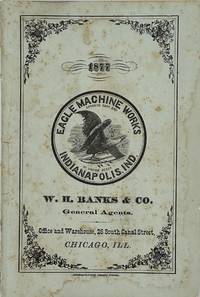
1877ref. 54690Indianapolis IN: Indianapolis Journal Co 1877. Trade catalogue. 8vo. 32 pp. 4-page inserted price list dated March 1877. Profusely illustrated with seven black and white wood-engraved plates four large black and white illustrations in text and five striking folding chromolithograph plates. Original printed green wrappers foxed. Very good. A scarce catalogue of heavy agricultural machinery with five brilliantly colored folding plates chromolithographed by Chandler Indianapolis depicting the "double canvass separator Hasselman separator oscillator thresher agricultural engine and the Eagle horse power." Romaine records nothing from this firm. OCLC locates several items from this firm but nothing before 1883. 1219. Indianapolis Journal Co unknown books
ref. 172080TRADE CATALOGUE. Katalog masných výrobku a konserv. Catalogue of meat products and conserves. 100 pp. Oblong 4to publisher's cloth. Prague : Ministerstvo potravinárského prumyslu 1953. A handsome and unusual Eastern European trade catalogue full of edible delights which were probably available more in the imagination than reality in a year when most people's savings were wiped out. OCLC lists Wellesly Stanford and the Tate. hardcover books
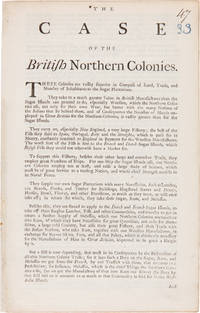
1731ref. 46721London. 1731. Limiting Sugar Trade with the French and Dutch A protest against a Bill to restrain the northern colonies from trading with the French and Dutch sugar islands. One of five editions published all rather scarce. Only four copies of this edition noted by ESTC - at the National Archives New-York Historical Society University of Michigan and the University of Minnesota. European Americana also notes Yale and JCB. Folded folio sheet. Vertical fold reinforced with tissue. Minor soiling. Very good. ESTC N15514. EUROPEAN AMERICANA 731/37. unknown books
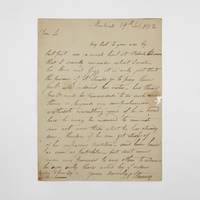
1802ref. 374694Montreal 1802. 1p. Slight loss of paper caused by removal of wax seal on right margin not affecting text. Old fold. Else fine. 1p. An excellent autograph letter signed from this prominent fur trader explorer and author of TRAVELS AND ADVENTURES IN CANADA AND THE INDIAN TERRITORIES published in 1809. Henry was sixty-three at the time this letter was written and mainly occupied with directing fur operations from Montreal. He evidently writes concerning his son's bad debts: "My last to you was by last post was so much hurt by Robert's behavior that I scarcely remember what I wrote. his Horse and Gigg it is only just that the produce of it should go to pay those Gentm who indorsed his notes - how these Gentm could be persuaded to do such a thing is beyond my comprehension without consulting you. if he is turned loose he may be induced to commit some act worse than what he has already done - therefore if he can get clear of his imposing creditors - send him here as soon as possible - but dont come under any promise to any other to whom he owes only those acted by yr orders. unknown books
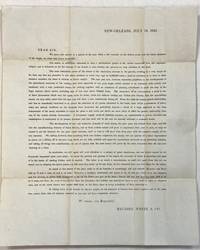
1843ref. 41470New Orleans 1843. Printed folio sheet folded to 4 pp each page 9-1/4" x 11-1/4." Printed on recto of first leaf only interior pages blank addressed in ink on last page to Captain J. Keyes Florence Alabama. Old folds address page worn. Blank hole where seal was broken no text affected. Text clean. Very Good. The head of the firm Maunsel White of New Orleans was an energetic Irish immigrant. He married the daughter of a wealthy Creole merchant allied with Andrew Jackson. Wikipedia says "White maintained a lifelong friendship with Jackson for whom he served as a cotton factor from 1826 until Jackson's death in 1845." White carefully delivers hopeful but cautious news to his clients. He celebrates "the marvellous increase in the growth" of cotton "resulting in a crop larger by far than any that has preceded it." However "the next crop will show a considerable falling off. From the onset the season opened unfavorably" because of rains and other weather problems. But "new and extensive channels of trade infused fresh vigor and life into the manufacturing districts of Great Britain." The Letter demonstrates the importance of the South's commercial connection with England. He reminds his customers of "a subject of great importance and one which cannot be too frequently impressed upon your mind; we mean the picking and ginning of the staple the necessity of which is sometimes lost sight of in the desire of sending Cotton early to market." This necessity of course would be met with slave labor. We do not locate this printed letter on OCLC as of November 2025 although OCLC records several items relating to Maunsel White: a letter from Andrew Jackson to White in 1842; the firm's business records at the University of North Carolina; and a similar letter on the cotton trade from 1841 at the Library of Congress OCLC 1284917506. unknown books
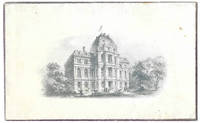
1865ref. 10246Boston: the hotel 1865. Menu printed on silk 30 x 10.5 cm. one leaf printed verso only. Illustrated with an engraving of vignettes of freight transport via ship and train. WITH: Printed envelope 8 x 13 cm. with an engraving. A handsome menu printed on silk for a banquet celebrating the Boards of Trade of the Western Cities given by the City of Boston at the Revere Hotel. Revere House was one of the city's leading hotels hosting guests that included Charles Dickens Jenny Lind and Walt Whitman. Daniel Webster addressed audience from the steps of the portico. The engraving on the envelope depicts the hotel from across Boston's Bowdoin Square. The hotel has had an additional structure added to the previously flat roof. The bill of fare for the Western Boards of Trade included Green Turtle Soup Baked Shad in a Wine Sauce Leg of Southshore Mutton in Caper Sauce Duffield's Ham Pate de Foie and much more. In remarkably fine condition with only the slightest fraying to the edges of the silk. The envelope with an engraving of the Boston's City Hall has some light soil but is near fine. the hotel hardcover books
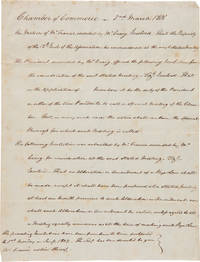
1801ref. 57454Philadelphia: Printed by Zachariah Poulson Junior February 9 1801. With a Contemporary Manuscript Document The official Articles of Association for the Philadelphia Chamber of Commerce adopted when it was founded on January 5 1801 along with a manuscript document regarding changes to those rules written shortly after. The titlepage of the ARTICLES OF ASSOCIATION exists in two states; this is the much rarer state which specifies the month and date in the imprint. The Chamber was established according to these articles "for the purpose of aiding the Trade of the City of Philadelphia by carrying into effect such Rules and Regulations as may from time to time be established with respect to our Commerce and the adjustment of Mercantile differences between each other." The Chamber of Commerce was founded exclusively for merchants with rule XV stating that "No person can become a Member of this Institution who is not a citizen of the United States and a trading merchant of the city of Philadelphia either as a ship owner importer or exporter or a marine insurance broker." This rule was reversed in 1834 when the Chamber of Commerce was absorbed into the Philadelphia Board of Trade and became open to all businessmen. The accompanying manuscript document dated March 2 1801 is addressed to Thomas Willing Francis and regards the proposed reconsideration of Rule XII which states that members may not refuse to submit their accounts to the Chamber in the case of a legal dispute as well as a handful of other motions. Thomas Willing Francis 1767-1815 was a Philadelphia native from a long line of Pennsylvania businessmen. After graduating from the University of Pennsylvania in 1814 he entered the family firm of Willing & Francis - the firm which had sent the first recorded American ship to China for the purpose of trading opium nearly a decade before. He was a founding member of the Chamber of Commerce achieved the rank of captain in the Second Philadelphia City Cavalry and served as a director of numerous other Philadelphia organizations. A significant document in the economic and civic history of Philadelphia with a rare manuscript addition from less than a month after publication and two months after the Chamber's founding. Contemporary marbled wrappers. Spine ends chipped corners a bit worn. Manuscript with some old folds and light creases. Very good. SHAW & SHOEMAKER 1148. SABIN 61974. unknown books
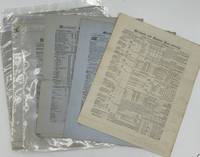
1904ref. 70360Mobile AL: Sanford & Wilson John Forsyth and others 1904. 4to. 1-4 pages each issue some issues lacking a blank integral leaf. 39 scattered issues from this period published under several variant titles by several different publishers; the largest run in the group consists of 26 issues September 1 1859 -- August 18 1860 of 31 issued during the period under the title Merchants' and Planters' Prices-Current published by John Forsyth. The balance of the group consists of five issues published 1848-1859 and ten issues published 1866-1904. Each issue includes all manner of information concerning trade from the port of Mobile during the past week especially cotton with names of ships coming and going destinations tables of goods comparisons with previous years a weekly review if the Mobile market business news notes etc. The long run from 1859 and 1860 offers an excellent view of the market on the eve of the Civil War. Several issues have letters written on the recto of an otherwise blank integral leaf. Overall a very good lot. For the 39 issues Sanford & Wilson, John Forsyth [and others] unknown books
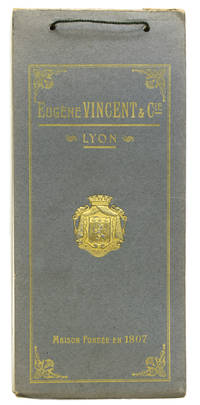
1907ref. 302671Lyon: Imprimerie Gougenheim Frères 1907. 30 numbered chromolithograph plates. Thin oblong 8vo 9-3/4 x 4-1/4 in. Printed gray wrappers stapled and with hole punches and string gold foil stamped arms on front cover. Light wear to covers. With the distribution stamp of Albert Martin 6 Rue des Tonneliers Marseille. 30 numbered chromolithograph plates. Thin oblong 8vo 9-3/4 x 4-1/4 in. A finely printed trade catalogue illustrating the liqueurs and brandies offered by the Lyon wine distributors Eugéne Vincent & Cie including Crème de Cacoa-chouva various brands of curaçao and triple sec anisette fruit brandies Peronneau absinthe and Grog Americain a bottled punch. Imprimerie Gougenheim Frères unknown books
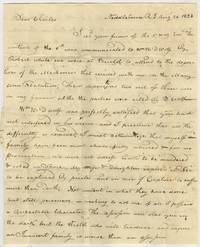
1823ref. BK0184Middletown Rhode Island 1823. Autograph letter signed three pages on a folded sheet with integral address panel to Charles E. Dudley in Albany and Newport postal markings. 7 ¾ x 9 ¾ inches. Old folds scattered staining and some marginal losses a few affecting text. Good to very good. A letter from Newport mariner John Wood concerning his acrimonious departure from the DeWolf family's Mary Ann plantation in Cuba and the ensuing legal dispute with James DeWolf and Charles Collins. Wood was almost certainly the same John Wood whose signature appears on an 1806 Newport agreement for an illegal voyage transporting enslaved Africans from Cape Coast to Havana now held by the Smithsonian's National Museum of African American History and Culture.1 By 1823 he was residing on the Mary Ann plantation one of several Cuban estates belonging to the DeWolfs among the most prominent families involved in the American slave trade. His relationship with DeWolf and Collins had evidently collapsed over his obligations on the estate resulting in what he describes as his forced departure from Cuba under apparently dangerous conditions with his family and a contentious effort to settle their accounts. Writing to his friend Charles E. Dudley then mayor of Albany and a New York state senator Wood reports that three mechanics who had resided with him on the plantation had recently given depositions in Bristol Rhode Island. Two of the three had testified in his favor though all had been called by DeWolf. Wood was particularly incensed by the circumstances surrounding his family's departure from Cuba writing: "I must acknowledge that myself & family have been most shamefully abused & for no provocation we were set adrift liable to be murdered & robbed on Shore My Wife & Daughter exposed at Sea to be captured By pirates and in case of Capture to suffer more than Death; Not content in what they have done but still persevere in wishing to rob me of all I possess a Respectable Character. The assassin will stab you in the dark but the Wretch who will traduce and injure an Innocent family is worse than an assassin." Wood goes on to describe receiving two writs from DeWolf and Collins and transcribes an August 8 letter from James DeWolf explaining his decision to pursue legal action despite their previous discussions of an amicable settlement: "Lest you should think me inconsistent in causing an action to be brought after the last conversation we had I take leave to explain my wishes to come to an amicable settlement by referring to men as we talked remains the same my object is to put the business in a legal and proper train for bringing it to a close . & to enable me to avail of the testimony of the people who were on the Estate with you." Wood expected the Rhode Island Supreme Court meeting at Bristol the following month to appoint referees to settle the accounts. The precise origin of the disagreement is not stated though the depositions of the mechanics and the references to outstanding accounts suggest a dispute over Wood's contractual obligations or activities on the plantation. Wood 1770-1826 was a Newport merchant and captain with longstanding connections to Atlantic commerce. He died at Cape Coast West Africa in 1826 three years after writing the present letter. James DeWolf 1764-1837 then serving in the United States Senate had amassed a substantial fortune through the slave trade and his Cuban plantation interests. Charles Collins his brother-in-law had served as collector of customs at Bristol from 1804 to 1820 an appointment closely connected to the family's slave-trading operations. The Mary Ann plantation is documented in the DeWolf Papers at the Rhode Island Historical Society which include inventories from 1818 and 1820 and contemporary plans of the plantation grounds. The present letter preserves Wood's account of his treatment by the DeWolf family together with his transcription of DeWolf's explanation for pursuing legal action. 1 "Agreement facilitating illegal trade of enslaved Africans" National Museum of African American History & Culture accessed October 12 2026 https://nmaahc.si.edu/object/nmaahc_2019.28.1. . unknown books
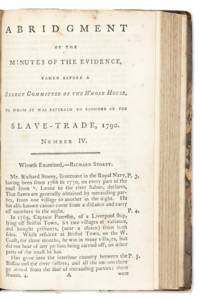
1789ref. 187101789. Committee of the Whole House of the British Parliament investigation into the Atlantic slave trade recorded in Abridgment of the Minutes of the Evidence Taken Before a Committee of the Whole House to Whom It Was Referred to Consider of the Slave Trade published 1789 to 1791 presenting one of the earliest parliamentary documentary compilations addressing the operation and human consequences of the transatlantic slave trade. The volumes preserve testimony gathered during parliamentary inquiries that examined the practices of British slave traders and the treatment of enslaved Africans transported across the Atlantic. These proceedings formed part of the political campaign in Britain that eventually culminated in the abolition of the British slave trade in 1807. The collected evidence includes statements from ship surgeons naval officers merchants and other witnesses whose accounts describe the conditions experienced by enslaved Africans during capture transport and plantation labor. Abridgment of the Minutes of the Evidence Taken Before a Committee of the Whole House To Whom It Was Referred to Consider of the Slave Trade. London: 1789-1791. First edition first printing. Four volumes bound in two books. The compilation reproduces testimony presented before Parliament concerning the organization and operation of the slave trade and includes firsthand statements describing the physical suffering and resistance of enslaved Africans during transport. Surgeon Alexander Falcon-Bridge who had firsthand experience aboard slave ships described acts of despair among captives: he "Has known several enslaved persons to refuse sustenance with a design to starve themselves. refusing to take medicines when sick because they wished to die. Many other slaves expressed the same." Another witness Royal Navy surgeon Thomas Trotter recorded the emotional trauma experienced by captives during embarkation noting that "Slaves on being brought on board showed signs of extreme distress and despair from a feeling of their situation and regret at being torn from friends and connections." The volumes therefore preserve testimony that exposed the violence and human suffering embedded within the Atlantic slave trading system. During the eighteenth century European and American traders transported millions of Africans across the Atlantic through a commercial system that relied on maritime networks linking West Africa the Caribbean and the Americas. Parliamentary investigations of the slave trade in the late eighteenth century were fueled in part by abolitionist activism and public campaigns demanding government inquiry into the practice. Publications of witness testimony such as this abridged parliamentary record circulated evidence used by reformers advocating the end of the trade. Four volumes bound in two books with folding table in the fourth volume. Octavo format. Contemporary marbled quarter calf bindings with modern bookplates on the front past down. Wear present with most spine titles lacking and foxing primarily affecting the title pages; text remains clear. Overall condition very good. unknown books
1915ref. 10258Various places 1915. Twenty-six trade cards all illustrated with portraits of the proprietors some with real photo illustrations. Various sizes largest 16.5 x 15.5 cm. some printed both sides. The businesses include restaurants cafes a grocer an oyster house a fruit house lunch counter confectionery & ice cream fish and canned goods a hotel with fishing parties a "Schlitz Forum & Cafe" a beer bottler a nurseryman wine & liquor shop a saloon a buffet and short order lunch counter a chop house a summer garden dining hall and candy shop. Boston Mass. Brooklyn N.Y. Iowa New Orleans Vermont Providence Rhode Island Springfield Ill. New Bedford Mass. Bainbridge Bradford & Walnutport Penn. Iowa Rochester Rensselaer & Syracuse N.Y. Philadelphia Two Rivers Wisc. Lake Mills Wisc. Metamora Ill. Toledo Ohio and others. Condition varies but most are very good or better. unknown books
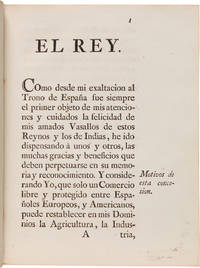
1778ref. 37240Madrid: Pedro Marin 1778. Commercial Policy in Spanish America Detailed rules and regulations governing Spain's late 18th-century commercial policy in Latin America with a preliminary section of nineteen pages providing a summary of the articles and tariffs documented in the main portion of the text. With this REGLAMENTO. the Crown terminated Cadiz and Seville's monopoly of trade with Spanish America allowing other cities of the realm to participate. In addition to much information on commerce and numerous tariffs on a large variety of Spanish and American goods several sections discuss shipping ports and other maritime activities directly related to commercial activity. The work also includes the text of concessions granted to Louisiana. Quarto. Contemporary mottled calf spine gilt extra. Light shelf wear corners rubbed. Contemporary ownership inscription on titlepage modern bookplate on front pastedown clipped booksellers' descriptions pasted to front free endpaper. Text quite clean. Very good plus. PALAU 255843. SABIN 68890. MEDINA BHA 4845. unknown books
1801ref. 56123Great Britain. ca. 1801-1807. British Essay on the Importance of American Trade During the Napoleonic Wars An interesting but unattributed and apparently unpublished manuscript essay with a caption title reading: "Loose Memo. Respectg. American Commerce." The gist of the memo is set forth in the first sentence: "The Americans are at all times the best customers of G.B. - in peace they take 1/3 of her manufactured exports - in War much more." In addition to the eager American market for British goods the author notes that British goods are often trans-shipped via America to other markets where Great Britain would not normally have access thanks to America's neutral status: ".you have only to change the name of the manufacturer & the wants of the Colonists will shut their eyes on the origin of the fabric. I have known Liverpool ware ornamented with the Portrait of Geo. III passed as German manufactures." The author notes that while the understandable economic downturn during the Revolution and for several years after the "peace of '83" resulted in some problematic credit relations between the U.S. and the British market much has changed. "The industry & the enterprise of our countrymen aided no doubt by the enjoyment of a neutral position has enabled them to throw off their dependence on the British merchant or manufacturer. They now have a sufficient capital of their own and a very important proportion of their imports are now paid for in ready money or in bills at short sight." The author explains that American merchants are able to export their surpluses of their own production and surplus British goods to the Continental market and transfer that money directly to creditors in Great Britain with an added perk: "The result of this species of trade must be ruinous to France. She is drained of her wealth to enrich & invigorate her enemy." Finally the author provides a specific example of this favored trading relationship with regard cotton. At this time the author estimates that Great Britain imports three-fifths of all cotton from the United States - some 150000 bags of cotton annually weighing 250lbs. each. The U.S. buys back nearly one-third of all cotton goods manufactured in Great Britain yielding a net profit of over £2.5 million to Great Britain. The author adds that this ratio holds for almost all raw materials produced in the United States. This essay was almost certainly written during the earlier part of the Napoleonic Wars; the author cites an 1801 speech by Lord Grenville which helps narrow the date range and it seems unlikely the Embargo Act of 1807 had been passed yet. Regardless the essay promotes Anglo-American trade and cooperation at least insofar as it enriches Britain and cripples France at a time when other forces were driving the two countries toward war. Light tanning and soiling occasional ink smudges. Very good. unknown books
1762ref. 2191Cadiz: Don Manuel Esoinosa de los Monteros 1762. Hardcover. Very Good. 4to - over 9¾ - 12" tall. 4to. 20.5 x 14 cm 158 pp. 1 f. index. With woodcut head- and tail-pieces blazon of Charles III and two Spanish galleons. Bound in mottled calf over boards spine gilt in six decorative compartments. Somewhat worn at extremities. Generally very good. First enlarged edition of an illustrated merchant's guide to the duties and tariffs levied by the Spanish crown on exports from the Americas chiefly gold and silver but also concerning timber textiles furs coffee spices and foodstuffs.After first offering a general overview of Spanish colonial commerce with Western Europe Garcia de Prado provides a wide range of practical instructions for traders negotiating the hazardous waters of colonial finance giving sample calculations for the volume of shipping containers converting currency and-crucially-providing a comprehensive alphabetical list of the royal tariffs on exports from America and the West Indies printed as a table for quick reference in terms of maravedis de plata silver coins of account and quintales approx. 46 kg. The second half of the work is concerned with trade in gold and silver explaining the six classes of government tariffs and their application to quintales of the metals in their various states acuñada labrada grana fina etc. Printed at the Royal Navy Office in Cadiz where Spanish shipping vessels would have arrived from the Americas the present work anticipates later efforts by the Spanish Bourbons-particularly Charles III and the Marquis de Esquilache-to reform the fiscal administration of its colonial properties. Garcia de Prado remarks in his introduction that a much smaller work un Quaderno with the same title was printed in 1745 and that the present work aims to augment and update the information contained therein. JCB.III.1320; Medina 3999; Palau 58415; Sabin 15037 Don Manuel Esoinosa de los Monteros hardcover books
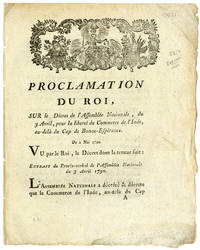
1790ref. 51521Rouen: L. Oursel 1790. With a Partially-Printed Letter Transmitting the French Revolutionary Proclamation Proclamation by the Revolutionary government of France abolishing the monopoly of the French East India Company on trade beyond the Cape of Good Hope and declaring it open to all Frenchmen. The Compagnie des Indes Orientales was established in 1664 to compete with the British and Dutch East India companies. It had considerable difficulty maintaining itself financially through its long history and it was finally liquidated in 1769. In 1785 it was reconstituted and granted a seven-year monopoly on trade beyond the Cape of Good Hope but the French Revolution and the democratic zeal that accompanied it put an end to that with the present decree. The brief proclamation is accompanied by a transmittal form from the Bureau Intermediane du Departement de Montivilliers indicating that one copy of the proclamation was sent to the recipient. Quarto on a folded folio sheet. Light wear and soiling. Very good. unknown books
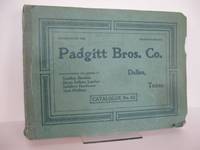
1917ref. 57734Dallas TX: printed by Egan Printing Co. for the company 1917. Trade catalogue. Oblong 4to. 526 pp. Frontispiece trademark illustration and numerous other illustrations from line drawings and photographs. Padgitt Brothers Company was established in 1869 and incorporated in 1900; the company's success "in supplying the needs of the saddlery trade of the Southwest gave them first-hand knowledge of materials and design that were recognized as standard wherever good goods are sold." Their catalogues were "a veritable encyclopedia of saddlery facts classified for your convenience . there is no reason why this book should not prove a 'silent partner' in the success of every dealer who will utilize its pages freely." The profusely illustrated catalogue with pricing information is organized into sections for saddles and varieties of tack down to spurs buckles hobbles canvas wagon covers buggy tops blankets and feedbags. The Padgitt "Bronco Brand" saddle and accessories were widely known throughout the Southwest. OCLC locates two copies of this number National Cowboy & Western Heritage Museum San Jacinto Museum of History. Owner's name on front wrapper a very good copy. Printed green wrappers original printed cloth tape spine some soiling and chipping to wrappers tape repair to verso of rear wrapper chipping to margin of final blank. #6216. (printed by Egan Printing Co., for the company) unknown books
1900ref. 263502Lyon France: J. Bouvard & Cie 20 Rue Lafont 1900. 14 thick card sheets with samples centrally mounted vertically to recto and verso some sheets quite thick to accommodate larger epaulets each with manuscript notations of name size etc. 11-3/4 x 6-3/4 inches. Black cloth album with the printed label of "J. Bouvard et Cie Fabrique de Dorures Soireries Ornaments d'Eglise" to front paste-down. Some wear commensurate with age and use spotting and thumbsoiling apparently complete with all samples backing possibly restored at an early date. 14 thick card sheets with samples centrally mounted vertically to recto and verso some sheets quite thick to accommodate larger epaulets each with manuscript notations of name size etc. 11-3/4 x 6-3/4 inches. This very unusual French sample book contains a large range of epaulets and sequin samples with a few lettering and star samples. J. Bouvard & Cie 20, Rue Lafont unknown books
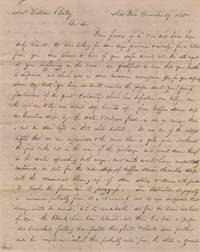
1835ref. BK0025New York City 1835. Autograph letter signed by the merchant firm Baker & Moore 4 pp. addressed to General William Battey care of Dr. Charles Luzenberg at the Franklin Infirmary on the Pontchartrain Railroad New Orleans. Stampless folded letter with red circular "NEW-YORK" December 31 datestamp and manuscript "25" rate. Appx. 1000 words. File folds; otherwise very good. A lengthy commercial letter written thirteen days after the Great Fire of New York describing the destruction of the city's mercantile district and tracing its immediate effects through insurance capital banking commodity prices and trade with New Orleans. Written by the New York firm of Baker & Moore to their associate William Battey the letter provides a near-contemporary account of the fire an assessment of the city's financial resilience and instructions for exploiting the resulting fluctuations in the markets for brandy wine raisins tobacco iron and copper. The fire began on the evening of December 16 during an extraordinary cold spell and northwest gale. Frozen hydrants wells cisterns and hoses left the city's volunteer fire companies largely unable to contain it. By the following day the fire had destroyed much of the commercial district between Wall Street and the East River including the Merchants' Exchange and hundreds of stores and warehouses. Buildings were eventually demolished with gunpowder to create firebreaks at Exchange Place and Coenties Slip. Contemporary estimates varied but approximately 674 buildings were destroyed with losses eventually placed at twenty million dollars or more.1 Baker & Moore begin by describing the extent of the burned district the severe weather and the use of explosives to arrest the flames: "Since my last you have no doubt received the paper sent you giving particulars of the great calamity which has befallen our City. On the 16th our City was about half burned up. From Coffee House Slip to Coenties Slip by the water & William Street is all in ruins. There is but one store left in that whole district. It was one of the coldest nights that we ever experienced & the wind blew a gale from Northwest. The fire broke out in the rear of the Exchange and went down through to the water spreading both ways and would have undoubtedly continued on but for the wide slips of Coffee House & Coenties Slip with the occasional blowing up of some stores & houses with powder to check the flame in its progress" The account quickly turns from the physical destruction to the distribution of its financial losses: "The destruction of property is immense probably from 10 to 15000000$ and it was supposed that many would be ruined but tis remarkable so far we have not heard of one. The Banks have been liberal and there has been a proper and benevolent feeling manifested throughout & should some further aid be brought in which probably will from the State or general government we think there may be no failures. The Insurance companies most of them are ruined and the principal loss is in Insurance capital. The loss will in some instances fall upon those who cannot well afford it. Many widows & orphans have had their all taken from them. The loss is large and New York has met with a great calamity but she is made of such materials & her facilities are so large & varied that the mercantile community will bear up under more than any other place in the Union & we think in one year's time it will be almost forgotten." The confidence expressed here correctly anticipated the city's rapid commercial recovery. Banks and government agencies extended credit and payment terms rebuilding began almost immediately and the burned district was reconstructed with new countinghouses and warehouses. The disaster also exposed the inadequacy of New York's water supply and firefighting arrangements contributing to later infrastructure and institutional reforms. Baker & Moore then apply the disaster to their own trade with New Orleans. Hundreds of warehouses and their contents had been destroyed increasing prices of imported foods wines and spirits. The firm instructs Battey to use the New York price current to obtain higher prices for their consignments: "This fire has advanced most all kinds of goods. Raisins are worth here $3-$3½. Wines such as Mess. Eastman's have advanced with us 4-6 cents. So many hundred casks destroyed must advance it and make it higher through the season. More than one half the Brandy was consumed tis now selling at $1.75 and some are asking $2. We wish what we sent you sold & this will be a favorable time to sell-show N.Y. price current-and get as good a price as you can. There will we think be no want of Brandy. Those raisins we think you had better dispose of at once. We think from N.O. current must pay something handsome for us. In regard to old Iron we find good old iron will always sell for the money for 112½ gross hundred equal to 1c per lb. Cast & wrought are same price. If you can come across a lot to do you may make it answer & pay us well. Copper if you can buy low enough may pay something. We thought hay might pay out but tis so high we cannot buy to send. We are of opinion that goods generally will be higher in consequence of this fire yet when we consign goods we wish them sold when they can to pay and we wish Eastman & Co. to sell and close up our affairs in their hands." The concluding paragraph briefly introduces events in Florida. The Second Seminole War had begun that month following mounting resistance to the forced removal of the Seminole people from Florida. Baker & Moore believed that the conflict might affect the movements of a brig expected in New Orleans: "We observe that trouble is anticipated with the Indians in Florida & if so our Brig may not get a load of them & be in N. Orleans earlier than we anticipated tis uncertain what will be the result they may detain her longer until they can get them on board." The wording appears to indicate that the vessel was expected to transport a group of Native people although the letter does not identify the brig its owners or the precise circumstances of the contemplated voyage. The recipient General William Battey was then in New Orleans apparently acting as Baker & Moore's commercial representative while also attending to his health at the Franklin Infirmary. The firm gave him considerable discretion to supervise consignments collect funds purchase goods when opportunities arose and forward current market information to New York. The address places him in the care of Dr. Charles Aloysius Luzenberg who founded the Franklin Infirmary with municipal support in 1835 and subsequently helped establish the Medical College of Louisiana the forerunner of Tulane's medical school.2 Baker & Moore appear to have been commission or importing merchants whose own affairs escaped direct damage but whose trade was immediately altered by the destruction of competing inventories. The letter thus follows the fire from the burned commercial district into the decisions of a New York firm and its representative in New Orleans. A substantial contemporary account of the Great Fire of 1835 documenting the destruction of New York's commercial center and the disaster's immediate movement through insurance banking commodity markets interregional credit and trade with New Orleans. We find no similar examples on the secondary market or in auction records. 1 Herbert Asbury "The Great Fire of 1835" The New Yorker July 26 1930. 2 Louisiana Historical Association "Luzenberg Charles Aloysius" in Dictionary of Louisiana Biography accessed August 2 2026 https://www.lahistory.org/resources/dictionary-louisiana-biography/dictionary-of-louisiana-biography-l/. . unknown books
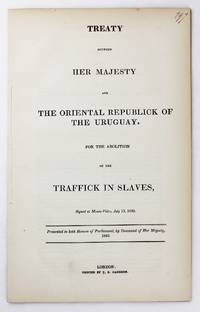
1842ref. 6316London: T.R. Harrison 1842. Near fine. 38pp. stitched. Very minor bumps to top edge of first leaf light dust-soiling to outer leaves. A very rare treaty between Queen Victoria’s Britain and the “Oriental Republick of the Uruguay” printed in both English and Spanish in two parallel columns throughout. According to the text the parties were “mutually animated by a sincere desire to co-operate for the utter extinction of the barbarous Traffick in Slaves.for the special purpose of immediately attaining this object so far as relates to the total and final abolition of the Slave Trade of the Oriental Republick of the Uruguay.” The treaty is comprised of fourteen original articles plus three annexes totaling forty-six additional articles and four additional articles at the end covering a host of issues pertaining to the suppression of the slave trade. These issues included enforcement procedures the establishment of “Mixed Courts of Justice” “Regulations in respect to treatments of liberated negroes” and much more. With regard to slaves found on international vessels the two nations hoped for “permanent good treatment and a full and complete emancipation according to the humane intentions of the Parties of the Treaty.” The present treaty was part of a larger effort by the British Crown to put an end to the transatlantic slave trade in the first half of the 19th century; at this same time Britain had reached terms on a similar treaty with the Republic of Texas and other nations. The document is signed at the end in type by J.H. Mandeville and Jose Ellauri representatives of the two countries who originally signed the treaty at Montevideo on July 13 1839; the present work was “Presented to both Houses of Parliament by Command of Her Majesty” in 1842 likely due to bureaucratic delays. Uruguay would have been an important ally for Great Britain in monitoring the seas against the transatlantic slave trade given its position opposite the South Atlantic Ocean from West Africa. OCLC records just a single physical copy of this treaty at the University of Arizona. Cundall 2854. T.R. Harrison unknown books
1920ref. 18053Frankfort NY ca1920. Leatherette string tied albums. . Very good; some wear to the leatherette bindings. Oblong 4to appx. 200 8 x 10 inch photographs. One volume with brief type written text descriptions of the machines on the verso of each photograph. A superb road construction machinery catalog illustrated with original 8 x 10 inch photographs. The catalog includes many different types of exotic equipment not normally depicted in such catalogs e.g. belt-hoists conveyors crushers roller screens scrapers etc. There are also occasional pencil notes on the verso with prices. Also included in the notes are some of the American locations where Acme equipment was in use. hardcover books
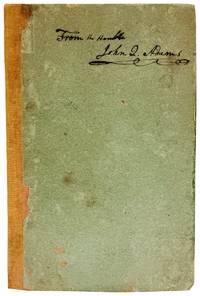
1826ref. 47522Washington DC: Gales & Seaton 1826. Very Good. Washington DC: Gales & Seaton 1826. First Edition. Octavo 22cm; original publisher's cloth over blue paper-covered boards; 77pp.; one fold-out plate. Collated complete. Boards rubbed with some spotting and dampstains; cloth on spine fraying. Front cloth joint splitting but holding; pages foxed; endpapers dampstained. Unidentified numerical ex-library stamp on top of p. 3 else free of institutional markings. Overall a Very Good copy. Inscribed on front cover: "From the Honble. John Q. Adams" who served as U.S. President at the time of publication and contributed the introductory comment published on p. 3. This inscription written on behalf of the President whose hand suffered from a tremor later in his career. Volume documenting the challenges the U.S. government faced trying to enforce an 1808 ban on the international slave trade which involved a complicated six-year-long case in which three American slave ships the Constitution the Louisa and the Merino were seized for transporting enslaved people between Havana Cuba Pensacola Florida and Mobile Alabama. More than 100 enslaved people were seized in the capture of the ships. At the conclusion of the case in 1825 only 65 of them were accounted for the others died escaped or were simply lost in the broader institution of slavery. The 65 remaining humans were sold at auction and the slave traders were not punished other than the financial loss of their ships and cargo. While the enforcement of the 1808 ban may have been a deterrent for some slave traders the National Archives estimates that 1.2 million slaves were brought into the U.S. illegally during the first half of the 19th century. Provenance: We have been unable to establish which library this came out of though we have checked each copy-specific description of the examples listed in OCLC none of which are described as being inscribed by or for Adams. The previous owner states that he purchased this copy from a Parisian dealer in the 1980s. References: "Traveling the Beaten Trail: Charles Tait's Charges to Federal Grand Juries 1822-1825" published in the Occasional Publications of the Bounds Law Library No. 8. Alabama Law Scholarly Commons 2013. National Archives and Records Administration Southeast Region Atlanta Shoemaker 27399. Gales & Seaton unknown books