518 Ergebnisse
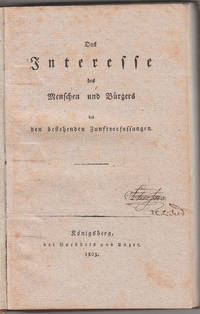
1803Best.-Nr. 10056Konigsberg: Goebbels und Unzer 1803. First Edition. Contemporary paper backed boards and label. Very good; spine label partially abraded. 8vo xvi 1 - 232 pp. Statesman statistician and economist the author had an eminent career in public policy making and teaching. He was for a time the principal advisor to Hardenberg and present at Paris for the peace conference in 1813 as well as the Congress of Vienna. He was also responsible for the complete overhaul and modernization of the Prussian satistical bureau beginning in 1810. He was the author of several books on statistics as well as economics and law. The work offered here is his first publication. It is a detailed exposition of how the social and commercial maintenance of the guild system is an obstacle to the economic progress of the state and its populace. Given the author's proximity to the center of Prussian power and government it can be read as a 'map' for the future development of the German state under Prussian leadership after unification. Palgrave II p. 318. Goebbels und Unzer hardcover books
1883Best.-Nr. 236859Kansas City Missouri: Press of Ramsey Millett & Hudson 1883. Illustrated with 2 full-page Engravings. 76 pp. 1 vols. 8vo. Original wrappers printed in red and black. Vertical crease to front wrap and a few corners previously turned down a few prices realized in pencil. Very good. Illustrated with 2 full-page Engravings. 76 pp. 1 vols. 8vo. Over sixty-five Galloway bulls and heifers on the block giving detailed pedigree. With an introduction by Matthews explaining the his interest in the breed. Not in OCLC Press of Ramsey, Millett & Hudson unknown books
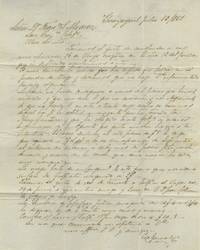
1851Best.-Nr. BK0071Guayaquil Ecuador 1851. Folded manuscript letter in Spanish with an earlier communication dated June 13 copied and headed "Duplicado" followed by a second communication dated July 18 on the same folded sheet. Integral address panel to "Sr. Dn. Fran.co S. Alvarez / San Francisco / Alta California" with oval "FORWARDED BY / ZACHRISSON NELSON & CO. / PANAMA" handstamp and large "20" due marking. 2 pp. 8 ¼ x 10 ¼ inches. Old folds with several small losses and separations along folds and margins only minimally affecting the text. A detailed commercial letter from the Guayaquil mercantile house V. Gómez & Ca. to Francisco Salvador Ãlvarez Pérez the prominent Valparaíso merchant then engaged in business in San Francisco during the opening years of the California Gold Rush. Ãlvarez belonged to one of Valparaíso's established commercial families and maintained extensive Pacific trading interests. He would shortly afterward serve as Chilean consul in San Francisco. In the letters Gómez & Co. supply Ãlvarez with current market information from Ecuador. They also apparently executed purchases on behalf of his Valparaíso interests. The first communication dated June 13 and recopied here as a duplicate reports extensively on the Guayaquil commodity market. Gómez & Co. describe the year's cacao crop as exceptionally poor discuss newly arrived cacao from Machala and the prices being asked for it and report purchases and quantities associated with Ãlvarez's business. They also give information on barley Jipijapa Panama hats exchange rates and other current prices. The July 18 continuation connects those commodity markets directly to the political crisis then unfolding between Ecuador and New Granada. Explaining why barley cannot be purchased below a previously quoted price Gómez & Ca. cite the fact that threats from New Granada had compelled the Ecuadorian government to form an army thereby taking many workers away from industry "la actitud amenazante que ha tomado la Nueva Granada y que ha obligado a este Gobierno a ordenar la formación de un Ejército que quite muchos brazos a la industria". The letter is dated July 18 1851 amid the military and political crisis of that summer and just one day after the Guayaquil garrison proclaimed José María Urbina Supreme Chief. The integral address leaf preserves the letter's route northward through Panama in the hands of Zachrisson Nelson & Co. one of the forwarding firms handling correspondence in the early California traffic. An interesting document of the commercial infrastructure connecting South America with California in 1851 with identifiable firms and recipients content regarding Gold Rush-era Pacific trade contemporary commentary on Ecuadorian mobilization and Panama forwarding marks. . unknown books
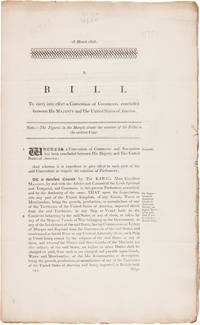
1816Best.-Nr. 39129London: Ordered by the House of Commons to be Printed March 18 1816. Trade Restored After the War of 1812 Official Parliamentary draft printing of a commercial agreement between the United Kingdom and the United States passed just over a year after the signing of the Treaty of Ghent. The convention of commerce establishes that the same import and export duties be applied to goods carried by American and British ships in direct British-American commerce. Duties on and bounties for prize ships and goods are also put on the same terms. This version of the bill would have been printed while the question was being considered by Parliament. Not in Kress or TPL and not listed on OCLC. 2pp. plus docket title printed on verso of second leaf. Folio. Early horizontal folds. Near fine. Untrimmed. unknown books
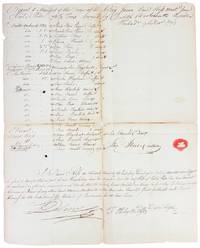
1792Best.-Nr. 31794Philadelphia: s.i. 1792. Very Good. Philadelphia: 1792-93. Single folded sheet 41.5 x 33.5cm; report in manuscript verso filled nearly to completion recto a quarter filled. Signed by Captain David Ross and two other parties; docket dated 1793 signed by Inspector Jeremiah Simmons. Stock exceedingly brittle with shallow chipping long closed tears along folds with old archival mending age-toning and light soiling as well as contemporary wax seal remnants. Overall a Very Good and legible survival. Cargo report executed in manuscript and dated November 9th 1792 listing materials shipped from Port-de-Paix Saint-Domingue modern day Haiti to Philadelphia for the firm Dutilh & Wachsmuth. The date places this report in the early days of the Haitian Revolution following the August 1791 enslaved peoples' revolt. The island was a vital source of commercial interests to Philadelphia and the burgeoning revolution was at the forefront of everyone's mind making this voyage and the survival of associated documents all the more significant. Dun cites one contemporary account "'No business is going on here' one letter told 'as every one is taken up with meetings committees and arming themselves.'" Dun p. 484. Goods delivered include wine sugar and coffee and were delivered to Dutilh and a handful of others including Captain Ross himself who received a hogshead of molasses. Ross eventually rose to the rank of Continental Navy Lieutenant during the Quasi-War with France and is remembered for commanding the privateer Belvedere guiding her back to Dover after an engagement with a French brig "leaving Belvedere with 50 round shot in her hull and her sails and rigging further shredded." References: James Alexander Dun "What Avenues of Commerce Will You Americans Not Explore! Commercial Philadelphia's Vantage onto the Early Haitian Revolution." The William and Mary Quarterly July 2005 Third Series Vol. 62 No. 3 pp. 473-504 See also the Destroyer History Foundation website. [s.i.] unknown books
1850Best.-Nr. 61392Philadelphia PA: The company 1850. Engraved broadside 14 x 12 inches text executed in several sizes and styles of lettering. Krider was a long-time Philadelphia sporting goods dealer and sportsman and the author of Krider's Sporting Anecdotes 1853. Henderson p. 158 dating the broadside "ca. 1850". Augustus Kollner has been identified as the engraver. OCLC locates four copies Clements American Antiquarian Society Hagley Museum Library of Congress. Margins a little browned several short tears into margins but a very good example of a handsome sporting exhibition broadside. #8465. The company unknown books
1880Best.-Nr. 237851880. Ceylon colonial photo archive depicting tea cultivation estate labor transportation and urban life circa 1880s to 1910s documenting the plantation economy that made the island one of Britain's principal sources of tea as British merchants shifted the enormous domestic tea market away from China and toward production within the Empire. Coffee leaf rust appeared in Ceylon in 1869 and spread rapidly through the island's coffee districts precipitating the collapse of the crop that had dominated the colonial export economy and accelerating planters' conversion of the central highlands to tea. James Taylor had established commercial tea cultivation at Loolecondera Estate near Kandy in 1867 and the new industry expanded rapidly as coffee failed; by 1900 some 380000 acres in Ceylon were planted in tea. By 1879 the results showed that in more than 70 percent of tea sold in London still came from China while by 1900 China supplied only about 10 percent and black teas from British controlled India and Ceylon constituted the bulk of the market. Photo archive of albumen and silver gelatin photographs and photographic postcards ranging from approximately 3½ x 5 to 4 x 6 inches Ceylon circa 1880s to 1910s. Tea production forms the strongest body of imagery. Women and men stand among densely planted tea bushes or work through rows of plants with women carrying the large woven baskets used to collect leaves; individual and group views are captioned "Tea plucker" "Tea picking Ceylon" "Pruning tea Kandy" and in French "Cueillette du thé à Ceylan." One Skeen & Co. Colombo card numbered 84 and captioned "Tea plucker" isolates a woman at work with a large basket strapped behind her while another shows a large group of workers seated with baskets and gathered tea in a plantation clearing. A card captioned "Estate coolies Ceylon" depicts an estate employee in European dress standing with women and a child outside a thatched dwelling preserving in its printed terminology the racial and labor classifications through which plantation workers were presented to contemporary consumers of colonial imagery. Other photographs move from plantation production into the roads vehicles and cities of colonial Ceylon: rickshaw pullers pose with European passengers and beside their vehicles; a street scene records "Native town Kandy Ceylon"; Colombo appears in views of the "Colpetty Road near Galle Face Colombo" a crowded procession captioned in French "Colombo départ des troupes Anglaises" and a civic monument among palms. Another postcard depicts "Royal visitors leaving Ceylon" while a country road scene shows pedestrians carts and roadside activity. Skeen & Co. one of the principal commercial photographic firms operating from Colombo in the late nineteenth and early twentieth centuries is identified on several cards but no single photographer can be assigned to the archive as a whole. The tea scenes record the labor at the center of one of the fastest agricultural conversions in the nineteenth century British Empire. Coffee rust Hemileia vastatrix was first observed in Ceylon in 1869 and within little more than a decade had destroyed the commercial basis of the coffee plantation system; tea already demonstrated commercially by Taylor replaced it across much of the highlands. Ceylon tea exports to Britain rose from only 282 pounds in 1875 to more than 4.3 million pounds in 1885 while the plantation landscape expanded until almost all former coffee districts had been replanted with tea during the 1890s. That expansion depended on a large year round plantation workforce much of it composed of Tamil laborers brought from southern India and on the colonial infrastructure that connected the highlands with Colombo and overseas markets. Roads and the railway between Kandy and Colombo had initially served the coffee economy and could be redirected toward tea after the blight while Colombo developed as the commercial and shipping center through which the crop entered imperial markets. The archive therefore records several stages and social spaces of the same colonial economy from plucking and pruning in the highlands to estate communities road transport Kandy and the metropolitan port city of Colombo while the postcards themselves show how plantation labor and colonial development were converted into commercial images for circulation beyond the island. Light to moderate surface wear toning occasional fading and creasing with some photographs showing age related discoloration and edge wear. Overall in good condition. A visual record of the plantation labor and colonial infrastructure behind Ceylon's transformation from a failed coffee economy into a major tea producer that helped Britain replace Chinese tea with supplies produced under imperial control. unknown books
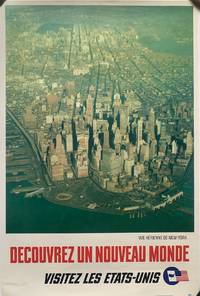
Best.-Nr. 339716Print. Color offset lithograph. Sheet measures 30" x 20". The "Decouvrez un Nouveau Monde - Visitez les Etats-Unis" poster series was produced from 1960-1963 by the United States Department of Commerce to promote American culture and travel to French-speaking audiences. This poster features an aerial view of lower Manhattan showing the Battery and many docks and piers. unknown books
1870Best.-Nr. 315110New York: George Blackie & Co 1870. Woodcut illustrations throughout. 12mo. Publishers pink pictorial wrappers. Woodcut illustrations throughout. 12mo. Includes marked playing cards gambling and magic books magic tricks novelties and all sorts of curiosities and miscellany such as "False Moustaches that cannot be detected when worn" offered by New York wholesale agents George Blackie & Co. George Blackie & Co unknown books
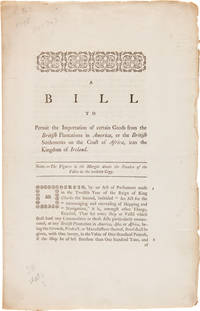
1778Best.-Nr. 39128London. 1778. The rare Parliamentary printing of a bill relating to American trade under consideration by the House of Commons. In 1660 during the reign of Charles II Parliament passed a bill "for the encouraging and encreasing of Shipping and Navigation" which granted bonding for ships and vessels transporting goods from British plantations in Africa Asia and America directly to another British plantation or to a port in England Ireland or Wales. Three years later Ireland was struck from the list. The present law passed during the American Revolution restores Ireland's bonds privileges allowing her ports to accept goods directly from the colonies in the Americas now mostly limited to Canada and the West Indies Asia and Africa. Not in Kress Goldsmiths' or TPL. OCLC locates three copies at the University of Arizona the University of Texas at Dallas and the University of Regina Saskatchewan. A rare example of a law reflecting the changes of British mercantilism at the close of the First Empire. 3pp. plus printed docket title on verso of second leaf. Bifolium. Three early horizontal folds. Very minor foxing and soiling. Near fine untrimmed. unknown books
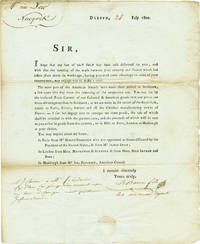
1801Best.-Nr. 44263Dieppe France. July 1801. Rebuilding Trade After the Quasi War An interesting and rare artifact of the attempt to rebuild French-American trading relations in the wake of the so-called "Quasi-War" between the two nations. The Quasi-War was an undeclared conflict between the United States and France during John Adams' administration in the late 1790s manifested mostly in naval engagements between the two nations. The war wreaked havoc on American commerce with France which only began to be rebuilt with the Convention of 1800. The present printed circular was created by "Le Baron fils" the former American consular agent in Dieppe and was apparently sent to a variety of American merchants encouraging them to once again send shipments of American goods to that French port. Not much is known of Le Baron fils though he did correspond with Benjamin Franklin and he served as the American consular agent at Dieppe for several years. This copy of Le Baron fils' circular was sent to prominent New York merchant and politician Nicholas Low and is dated in manuscript July "24." It is addressed to Low in manuscript on the fourth page and his name is also written in the upper left corner of the circular. In the printed text Le Baron fils states: "you may see by the inclosed Price Current of our Colonial & American goods not present here that our prices are more advantageous than in Bordeaux as we are more in the center of the Republick nearer to Paris Rouen Amiens and all the Chiefest manufacturing towns of France." Low is encouraged to "consign me some goods the sale of which shall be attended to with the greatest care and the proceeds of which will be sent to you either in goods from this country or in Bills on Paris London or Hamburgh at your choice." The printed text concludes by giving the names of the American consuls at Paris and Hamburg as well as two English trading houses as references to Le Baron fils' character. Le Baron fils adds in manuscript: "Mr. J. Clason & Mr. C. Codwise of yr place can give you an account upon my house in case you want quick information." Old folds some edge wear small tears at edges of fold fourth page torn from wax seal. Very good overall. unknown books
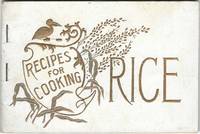
1910Best.-Nr. 6626New Orleans; New York: The Board of Trade; Printed by H. R. Elliot & Co. Printers and Embossers 1910. Stapled booklet 10.25 x 15.25 cm. 14 unnumbered leaves; printed text decorated with red borders on rectos only. Cover title: Recipes for Cooking Rice. Author information inferred from external evidence. Printer from rear panel of wrappers. ~ Evident FIRST EDITION. A promotional publication designed “to create a greater interest” in a foodstuff that had yet to become a staple in many parts of the United States. With a dozen recipes including Gumbo Soup Jambalaya Belle Calas fritters Rice Pudding Riz au Lait. ~ The phrase “Louisiana Rice Exhibit” can be found in reference to displays in the agricultural halls of world’s fairs – the World’s Columbian Exposition Chicago 1893 for instance as well as the Louisiana Purchase Exposition St. Louis 1904 – but in the event the phrase is better understood not as an installation but as a program. The New Orleans Board of Trade had indeed exploited opportunities to educate the public by such means cf A. C. Cantley “Rice Display by Louisiana at World's Fair of 1904” The Planter and Sugar Manufacturer 32 no. 7 February 13 1904 page 121 but it would have been highly unlikely for booklets such as How to Cook Rice to have been produced specifically for them without bearing any mark of the association. Moreover Louisiana Rice Exhibits so-named were also staged at parish fairs livestock shows even horse races. Their visual aspect was meant to entrance and amuse. “The New Orleans Board of Trade made a very splendid exhibit” a trade paper reported “at the National Farm and Livestock Show with a display of all the products it handles with the centerpiece a working model of a rice mill” “Current Rice News Notes” The Rice Journal and Southern Farmer 19 no. 12 December 1916 page 33. ~ Founded in 1880 the Board itself coordinated among many other activities rice shipments from mills in Louisiana and to a smaller extent from eastern Texas and Arkansas too. In this case their printing contract with H. R. Elliot & Co. places the publication later than the Chicago Exposition as this form of name was not in use until after 1900 “The Manufacturing Stationer” Walden’s Stationer and Printer 31 Spring 1909 page 16. The date of issue proposed here rests on reports that the Board of Trade distributed booklets in or perhaps slightly before 1910 a note for example from the American Poultry World recorded that recipes from the Louisiana Rice Exhibit of New Orleans had been received 1 no. 5 March 1910 pages 354-355. ~ Interior clean and bright. Stapled in ivory wrappers with gilt illustration of rice plants overseen by a pelican in honor of the Pelican State. Near fine. OCLC locates four copies; Uhler 252; New Orleans Culinary History Group page 152; not in Bitting Brown or Cagle. [The Board of Trade; Printed by] H. R. Elliot & Co., Printers and Embossers paperback books
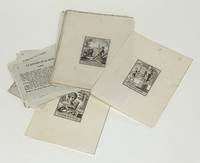
1825Best.-Nr. 6446A Paris: chez E. Jourdan quai des Augustins n. 17 1825. Sixteen numbered poems printed on trimmed laid paper the largest measuring 8 x 8.5 cm. accompanied by sixteen corresponding engraved plates sheet sizes circa 12.75 x 9.75 cm. and images 5 x 3.75 cm. The imprint is provided at the bottom edge of plates no. 6 and 14. Bonbon box trade cards to be collected by children the texts including fables and poems four apiece by La Fontaine Abbé Aubert Pierre- Louis Ginguené and Antoine Le Bailly. Near fine. Bibliographie de la France 1825 no. 825 records the following publication page 871: Dont la publication et la vente sont autorisées conformément à la loi du 25 mars 1822 art. XII et à l’ordonnance du roi du 1o mai 1822. 865. Douze Planches divers petits sujets pour bonbons. A Paris chez Jourdan quai des Augustins n. 17. chez E. Jourdan, quai des Augustins, n. 17 unknown books
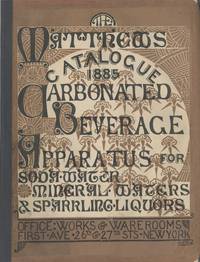
1885Best.-Nr. 4833New York: John Matthews Apparatus Co 1885. Quarto 104 pages. Fully illustrated. FIRST EDITION. A lovely trade catalogue for this important manufacturer of bottling equipment soda fountains and carbonation apparatus. The fountains get progressively larger and more elaborate. Also includes siphon boxes for home delivery of soda water. Edges of wrappers and one or two pages with repair corners bumped. Some soiling throughout. In elaborately decorated printed wrappers. Good. Rare. OCLC locates just one copy in this series; Noling page 283. John Matthews Apparatus Co unknown books
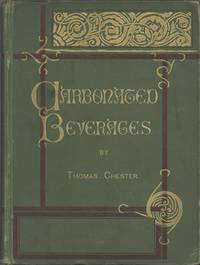
1882Best.-Nr. 6662New York: P.H. Reilly Wood-Cut and Color Printer 25 Rose Street 1882. Quarto 27 x 20.5 cm. 108 4 166 2 pages. Profusely illustrated. Text in two columns. Table of contents at rear. FIRST EDITION. An early – perhaps the first – history of carbonated beverages. Issued together with a trade catalogue for the soda water supply firm of John Matthews of New York an important manufacturer of bottling equipment soda fountains and carbonation apparatus. The fountains get progressively larger and more elaborate and with wonderful names: “The Citadel” “The Horicon” “The Adriatic” “The Fire-Eater” “The Nepenthe” and “The Snow Queen”. There I also an outdoor soda fountain “The Street Spa”. Also included are the auxiliary equipment of the carbonated water industry like siphon boxes for home delivery of soda water. The historical work and the trade catalogue were issued in celebration of the firm’s 50th Anniversary. Some pencil scribbles to a few pages. Text block shaken; free front endpaper lacking. In publisher’s brown and gilt-decorated green cloth corners rubbed and extremities a bit worn. Better than good. With the ownership signature of “Leopold F. Schmidt Deer Lodge Montana” and a more recent “Olympia Brewing Company”. Very scarce. OCLC records two copies with this pagination Loma Linda Univ. & Hagley Museum and four copies with just 108 pages presumably just the history; Noling Beverage Literature page 104 for the 108 page version. P.H. Reilly, Wood-Cut and Color Printer, 25 Rose Street hardcover books
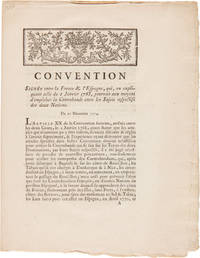
1775Best.-Nr. 14145Versailles. 1775. Further Regulation of Colonial Trade An important treaty between France and Spain with significant ramifications for their colonial holdings in America. Herein Vergennes and the Conde d'Aranda further define commercial arrangements between the two countries in an attempt to control contraband. This had special impact for the Caribbean basin where the colonies of both powers were required to ship goods through European ports. Dissatisfaction over this prohibition was a key factor in the Louisiana Rebellion of 1768. This convention was agreed to at Versailles on Dec. 27 1774. Not in Wroth. 8pp. Quarto. Printed self-wrappers. Fine. DAVENPORT 155. unknown books
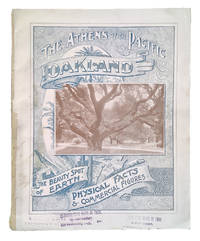
1896Best.-Nr. 002571Oakland CA: Calderwood G. W. and Loofbourow G. T. 1897 Copyrighted 1896. First Edition. Very good. First edition; 11 3/4 x 9 1/4; pp. iii-v 3 9-99 1; pink wraps printed in blue with a sepia-tone photograph; illustrated with numerous maps and b & w photographs; two stamps of the Calfironia State Board of Trade to lower margin of front wrap; small antiques shop label to front wrap verso; a thin strip of clear tape to spine cover; a few spots to margins; overall bright and well-preserved; in about very good- condition. Intented to be "mailed free to prospective home seekers on application to Secretary of Merchants' Exchange or Board of Trade Oakland Cal." the book was pronounced by then former Mayor William R. Davis to be: ".the best and most accurate presentation of our resources and local attractive features and as an advertising medium yet published in the interest of Alameda County." It began with an aptly-titled chapter - "Deadly Parallel" - listing specific statistics and numbers from August 1896 of people dying of heat-stroke in cities around the country while in Oakland the temperature is balmy 65 degrees. It proceeds to describe Alameda County and the City of Oakland their climate resources modern ammenities notable businesses often with flowery and/or bombastic statements e.g. "One does not need to sniff the odor of the Chicago River or of its immense piggeries as a New Yorker contemptuously styled its huge pork-packing establishments to realize that he is in the Garden City." Several copies at institutions most e-publications; none other in the trade as of December 2019. Calderwood, G. W. and Loofbourow, G. T. paperback books
1802Best.-Nr. 55719New York: Printed and Sold by G. F. Hopkins 1802. First American edition. Leather bound. Very good. 296pp. Octavo 22 cm In a later 3/4 leather binding with brown cloth over boards. New endsheets and flyleaves. The boards are a bit warped. Repair to title and dedication pages. With map present at the front. Wright-Howes M 133. "First crossing of the continent from ocean to ocean by a white man. The narrative portion was prepared for publication by William Combe from Makenzie's notes." - Wright-Howes p. 362. Printed and Sold by G. F. Hopkins unknown books
1873Best.-Nr. 002874Washington DC: Published by Order of the Secretary of War 1873. First Edition. Good. Six maps for: Monday February 17 1873 - 11 P. M.; Tuesday February 18 1873 - 7:35 A. M.; Tuesday February 18 1873 - 4:35 P. M.; Wednesday February 19 1873 - 7:35 A. M.; Wednesday February 19 1873 - 4:35 P. M.; Wednesday February 19 1873 - 11 P. M.; 8 3/4 x 11 1/2; relief shown by hachures and gradient tints; small reference table in the lower half of the image; edges brittle with small chips and cuts; overall in good to very good condition. A scarce collection of maps their publication began in January of 1871 with no less than 3 maps being published every day. Samuel Morse's invention of the telegraph had made it possible to easily observe gather and transmit data from different points over the entire country. A small note at the head read: "All observations made at the same moment of actual not local time." Released by the US Army's Signal Service the maps were intented to be primarily used by farmers and merchants. They were published in at least three different sizes and formats the current being one of the smaller ones. These particular maps showed precipitation and wind velocity at various elevation points. Published by Order of the Secretary of War unknown books
1833Best.-Nr. 34458v.p. including Antwerp London Havana Pensacola New York 1833. Folio. 12 3/4 x 8 inches. 21 leaves plus two additional manuscript leaves laid in. Contemporary half calf and marbled boards manuscript label on front board. Bookseller's label on front pastedown. Account book of Atlantic trading voyages. An interesting manuscript ship's log containing financial accounts for the brigs Nimrod and Jasper for an eight year period from 1826 to 1833 while they were under the command of a Captain John Hill. The two ships made numerous voyages between the United States Europe and the Caribbean. The present log book contains line accounts of expenditures for journeys from London and Marseilles to New York and Norfolk in 1827; from Antwerp to London in 1828; from Philadelphia to the West Indies in 1829; from Madeira to the Turks Islands in 1831; from the West Indies to Pensacola to Havana in 1832; from the Indies to New York in 1833; and other similar voyages. The log also contains two copies of an 1832 letter written in Havana by Hill to merchants there inquiring about the price of molasses and a list of port charges at several major way points. A fascinating artifact of trans-Atlantic trade in the 1820s and 1830s. unknown books
1920Best.-Nr. 9871Montelimar: the company 1920. Oblong album 21 x 30.5 cm. 38 pages; with 52 original labels or wrappers pasted-in each with a handwritten annotation on the leaf not the label with the name of the product including weight and price. FIRST EDITION. A handsome salesman's sample album that showing the varied offerings of the firm of Nougats Arnaud Soubeyran. Products represented include fruit nougats chocolate pistachios . all with very beautiful labels including one illustrated by Alain Saint-Ogan. The labels are striking in their design many with electric colors and colorful ribbons. "The history of this great house located in Montelimar north of Avignon begins in 1837 with a marriage between Mr. Arnaud confectioner and a Miss Soubeyran. Together they launched nougat production on a scale exceeding that of any single pastry chef. Their goal was to position their high-end confectionery by employing the best regional raw materials" company website. The firm persists and includes a Nougat Museum in the town of Montelimar. Some light dusting to some of the leaves and the labels but mostly sound and clean. The colors are unfaded. In full green alligator-patterned cloth tied on cord. Gilt titled on the front board. Some light rubbing to edges otherwise near fine. Rare. OCLC locates no copies of any publication of Arnaud Soubeyran. the company hardcover books
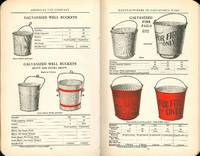
1908Best.-Nr. 3211Rome N.Y. 1908. Ten trade catalogues. Items mostly uniform in size ~ 19 x 12.5 cm. though page count does vary from 14 to 155. Each catalogue contains an index. Each catalogue is illustrated and most include select full-color images. Including the Erie Can Company’s there are four general catalogues that cover a broad range of products; three catalogues are specific to syrup cans; and the remainder feature one specific type of product or another. ~ Incorporated in 1901 the American Can Company was a member of the “Tin Can Trust” that controlled a large percentage of the tin market. In 1913 the U.S. Government sued the company on the grounds of monopoly. The individual catalogues: 1. American Can Company. American Steel Lead Kegs. New York: American Can Company circa 1908. 24 pages. Steel kegs for lead manufacturers and lead users; features product descriptions for five unique kegs and over 25 testimonials from consumers across the country. Illustrated cover. Cream wrappers with black/red text bound with red ribbon and staple. Slight discoloration and creasing otherwise very good; 2. Tin Galvanized and Japanned Ware; Catalogue No. 16. No date. 147 pages plus index. Features Canco trademarked products also manufactured by American Can Company. In total over 275 unique products featured. Gray wrappers with embossed type. Rounded edges. Slight bumping to spine otherwise fine condition; 3. Tin Galvanized and Japanned Ware; Catalogue No. 17. No date. 155 pages plus index interleaved with graph paper. Very nearly same content as #16 but this edition is interleaved with graph paper presumably for consumers to mark their notes. Bound in black vinyl with gold print. Rounded edges. “E. Hoffman” printed on the cover. Edges of cover chipping but text is in fine condition; 4. Tin Galvanized and Japanned Ware; Catalogue No. 18. No date. 123 pages interleaved with graph paper. Same as #17 with variations in featured products. Bound in blue vinyl cover has white paint stain and printed name is scratched out. Otherwise very good; 5. Druggists’ Tinware; Catalogue No. 21. No date. 98 pages. Illustrated throughout with select full-color images. Has ninety-nine unique products for druggists: arnica salve boxes cosmoline cans insect powder guns tooth powder boxes herb cans and more. Gray wrappers with green and gray text company name embossed on front cover and monogram embossed on back. Some pencil marks and slight discoloration on wrappers text in fine condition; 6. American Can Company. Syrup Cans; Catalogue 43. No date.15 pages. Illustrated throughout. Indexed catalogue of cans for syrups. Features twelve unique cans in variety of sizes and shapes. Light gray wrapper with red and black print. Interior text has some water staining; 7. American Can Company. Syrup Cans; Catalogue 45. No date.14 pages. Almost identical to #43 in form condition and content. Illustrations vary just slightly and this catalogue does not feature the “‘Chelco’” Metal Swing Seal” thus features just eleven products; 8. Syrup Cans; Catalogue 47. No date. 14 pages. Same as #45; 9. Seamless and Pieced Boxes Hinged Slip and Sliding Covers; Catalogue No. 56. No date.37 pages. Thirty-eight seamless and pieced boxes in oblong square and miscellaneous shapes with slip hinge or sliding covers. Also highlights location of manufacturer: Brooklyn Richmond Philadelphia Boston Chicago St. Louis. Gray wrappers with green and black text pencil marks on back cover; water stains throughout; 10. Erie Can Company. Illustrated Catalogue Sheet Metal Specialties including Tea Coffee and Spice Cabinets Cans and Caddies and Sample Room Goods Etc. Chicago: Erie Can Company no date. 27 pages. Features thirty-three unique products from painters pots and brush safes to display cabinets and coffee caddies. In cream wrappers with some discoloration and slight edge chipping. Text slightly discolored by staple binding. As a collection overall condition is very good. unknown books
1896Best.-Nr. 21325New York and elsewhere 1896. Folio. 14 1/2 x 12 inches. Approximately 350 larger ephemeral items and about 200 small scraps mounted on both pastedowns and recto and verso of 22 leaves. All leaves browned 3 leaves split vertically others with margins chipped some loosely inserted. Original rose-coloured glazed paper-covered boards lower cover blocked in blind and lettered 'Pat. March 76' in blind the upper cover blocked in gilt with three shaped raised panels with gilt borders enclosing chromolithographic images backstrip blocked in gilt corners rounded some fading to upper cover and backstrip inner hinges broken A spectacular album with an unusually rich assortment of advertising and trade cards including a selection chromolithographed designs of birds after Audubon. Internal evidence suggests that the album was probably assembled by a New York State resident living just south of Rochester - possibly from near Bath Cohocton or Canandaigua the patent date of the album gives a 'now earlier than' date whilst there are a number of dated items amongst the scraps the latest being 1896. Included are a large number of cards issued by local businesses as well as more national concerns like a fine series of six advertising cards for 'Wright's Indian Vegetable Pills' featuring toddlers playing baseball "Tum on ets' p'ay ball"; "See me tech it!"; "Aint dot out!"; "I'se bo'en home"; "I'se dot it!". There are also 33 'Arm & Hammer' bird cards after designs by John James Audubon 13 from the Arm & Hammer Brand / Church & Co. "Beautiful Birds of America" Collectors' Card 1st Series from 1894; the others probably from the second series. unknown books
Best.-Nr. 285901984. 1887-1984 v. 1-369 lacking 23 books see below. 1887-1984 v. 1-369 lacking 23 books see below. Interstate Commerce Commission Decisions. Reports and Decisions of the Interstate Commerce Commission of the United States. Washington: Government Printing Office. 1887-1984. Volumes 1-369 lacking 23 books: 11 97 99 100 101 103 106 108 110 114 116 119 121 125 127 130 133 135 137 141 143 149 178. Publisher's original cloth hardcover. Ex-private law firm library with property stamps. Sixty-one 61 linear feet of shelf space. Special $1200. unknown books
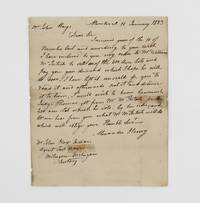
1823Best.-Nr. 374695Montreal 1823. 1p. 1p. "I received yours of the 10 of November last and according to your wish I have inclosed to you my order to Mr. William MacIntosh to sell one of the 400 acre lots and pay you your demand which I hope he will do soon. I have left it unsealed for you to read it and afterwards seal it and deliver to him. I would wish to know how much Judge Thomas got from Mr. MacIntosh for the 400 acre lot which he sold by his order and let me hear from you what Mr. MacIntosh will do . unknown books