502 résultats
1910réf. 4742Philadelphia: Bowen Dungen Co. ca 1910. Edition unknown. as issued. A very good copy; cloth speciman torn. sheet. There is a mtd. sample of cloth. An unusual speciman sheet for the millinery trade. The material was intended for use as bows sashes or trimming. Bowen Dungen Co. hardcover books
1875réf. 5042York PA: E J Evans Co. ca 1875. First Edition. As issued. Very good. 4to 4 pp. Folded sheet; printed on a thin glazed paper. A large format nursery and seed catalogue. Evans' catalog is primarily devoted to trees and berries of all kinds.The last page lists the offerings in the ornamental department. Absent from Romaine. E J Evans Co. unknown books
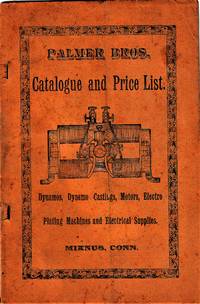
1890réf. 5424Mianus CT: Palmer Bros. ca. 1890. Edition Unknown. Original printed wrappers. Good; loose in the wrappers. 8vo 16 pp. The text is illustrated throughout as are the pictorial wrappers. A early trade catalog of dynamos motors castings and plating equipment. Unlocated. Palmer Bros. unknown books
1929réf. 4088Baltimore: Julien P Friez & Sons 1929. First Edition. Original printed wrappers. A very good copy with docketed date stamp on the frt. wrapper. 8vo. Each of the instruments is illustrated. 138 pp. An uncommon scientific instrument catalogue that contains a number of obscure and desirable instruments e.g. a "nephoscope". Each of the instruments or installation of instruments is fully described with occ. theoretical explanations. The catalogue is accompanied by a separately issued price list. The firm ran a large facility and the Belfort Observatory located at Baltimore and Central Ave. in Baltimore. An interesting catalogue. Julien P Friez & Sons unknown books
1908réf. 9111Cincinnati: Lunkenheimer Co. 1908. Edition Unknown. orig. publisher's cloth. A very good copy. 8vo. The catalog is illus. throughout. A thick catalog of metal machinery oilers valves etc. A good reference. Lunkenheimer Co. hardcover books
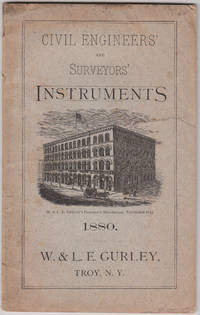
1880réf. 5842Troy NY: W & L E Gurley Co. 1880. Later Edition. Original publisher's printed wrappers. A very good copy; short tear in front wrapper no loss; some hand soiling not offensive. 8vo. There is a large fldg. frontis. and text illus. throughout. One of the company's catalogs of selected instruments that were being sold at reduced prices. There is a large folding frontispiece of a light mountain transit. The catalog is 56 pages and is represented by the firm as including the latest improvements in its line of instruments. See Romaine. W & L E Gurley Co. unknown books
1910réf. 6212New York: Earl & Wilson ca 1910. First Edition . orig. printed. wrappers. A very good copy. ob. 8vo. The catalog is illustrated throughout. A men's furnishing catalog devoted to collars and shirts. In addition to the normal illustrations the catalog contains two leaves of embossed illustrations showing how collars would look in three dimensions. Earl & Wilson unknown books
1870réf. 5448York PA: E J Evans ca. 1870. Edition Unknown. As issued - cover title. Fine. 4to 4 pp. one leaf insert on yellow paper printed recto only. The catalog is not illustrated. A handsome closely printed nursery catalog with a single sheet laid in insert printed on yellow paper listing small fruits including at least 25 grape varieties and flowering bulbs. The 4 page catalog lists vegetables. Unlocated. E J Evans unknown books
1762réf. 5497Paris: Nyon Barrois 1762. First Edition. full contemp. calf. A very good copy. 12mo. An exposition of the law as regards the maintenance of royal turnpikes and bridges in France. This entails a review of the law from the mid fifteenth century. Nyon, Barrois unknown books
1900réf. 5130Frankfort NY: Acme Machinery Co. ca 1900. Edition Unknown. orig. publisher's printed wrappers. A good copy; marginal tide mark . ob. 8vo. The catalog is illus. throughout. 64 pp. The Acme catalog of road building equipment in Spanish and obviously intended for the Latin American export market. The catalog contains all kinds of heavy equipment as well as the design for a small cement plant. Some of the large pieces are illus. with half tone photographs and cut away schematic drawings. Acme Machinery Co. unknown books
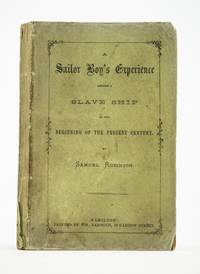
1867réf. ST20572Hamilton Scotland: W. Naismith 1867. FIRST EDITION. 168 x 106 mm. 6 1/2 x 4 1/4". vii 183 pp. In the very rare original green paper wrappers. Spine cocked wrappers somewhat soiled spine with paper beginning to lift along the bottom inch of the rear joint other minor exterior defects but the volume solid and internally in excellent condition. QUITE A GOOD COPY of a fragile inexpensively produced volume one would expect to find in shambles. Told in the form of letters drawn from the author's actual correspondence as well as his contemporary journals this first-hand account by a young sailor of the transatlantic slave trade in the years 1800-04 brings those horrific voyages vividly to life. At the same time the author writing in direct unvarnished prose makes it clear he is at least as much an observer of difficult sea life in general as he is concerned with the abolition of a great evil. In the preface Robinson 1786-1875 explains his reasons for publishing this record of his time aboard a slave ship: "I have heard so many gross misstatements respecting West Indian slavery and the horrors of the 'Middle Passage' that I formed the resolution should time be allowed me to give the result of my own experience . . . in order to disabuse the minds of many well-meaning people." He is rightly aware that some readers may be offended by unconvincing apology in an account encumbered with naïveté : "It is doubtless the opinion of many that I put myself into a wrong position and incurred blame and obloquy by entering into this obnoxious trade at all. It may be so; I will not dispute the matter. I certainly did not feel myself comfortable or at home in the service. But let it be remembered in my favour that the trade was then a lawful one; whilst at the same time I was induced to enter it by what is called an accidental circumstance . . . and an irresistible desire for a seafaring life so completely carried me away that it became a matter of perfect indifference to me where the ship went if not to the bottom provided I was aboard of her--or in what trade engaged if not a pirate." As indicated the letters originating in various ports in England West Africa and the West Indies depict a harsh life at sea for all involved but most especially for the wretches who made up the ship's cargo. An accident on board nearly cost Robinson his foot and ended his career at sea just a year before in his words "the united voice of a generous and philanthropic people" passed the Emancipation Bill into law ending British participation in the slave trade. The phrasing here makes it clear our narrator had his heart mostly in the right place. This is a very rare book which is not surprising for a pocket-sized work from a provincial press near Glasgow issued in insubstantial paper wrappers. OCLC records just two copies in libraries both in the UK while RBH and ABSA seem to list no copies at auction except the present one. W. Naismith unknown books
1930réf. 21584Basle Switzerland: J.R. Geigy S.A. 1930. Very Good . Basle Switzerland: J.R. Geigy S.A. n.d. ca. 1930. Octavo 24cm.; publisher's blue blind-embossed cloth upper cover and spine lettered in white; 455pp.; three-hundred and twelve 312 mounted cotton samples. Boards slightly warped minor shelf wear to spine ends and corners else Very Good or better internally fine and bright. One of a series of instructional catalogs issued by the Swiss dye company though the preface explains that "We cannot however strictly guarantee the statements of the tables as the requirements re. fastness etc. vary too much according to the branch of industry." The opening leaves list twelve different instructions in cotton dyeing though the bulk of the volume organized into tables separated by the dye samples. These are subdivided into various classes beginning with the "Direct Colours" and followed by "Formic" "Diazotizing" "Nitrophenyl" "Eclipse" and "Basic. J.R. Geigy S.A. unknown books
1922réf. 28893Mexico: Talleres Graficos de la Nacion 1922. First edition. Hardcover. vg. Folio. VI 108 VI unumbered pages of plates. Full spotted calf with gold lettering and borders on spine. Original wrappers bound in. Printer's device on front wrap and title page. Title-page inscribed and signed by one of the authors Vicente Galvez. Fascinating report presenting results from an expedition launched by the Geological Institute of Mexico in Baja California. This work contains numerous b/w photographic plates folding maps plans and charts some being outlined in color. Wraps and title page slightly age-toned. Very minor and sporadic foxing throughout. Text in Spanish. Binding in overall very good interior in good to very good condition. Talleres Graficos de la Nacion hardcover books
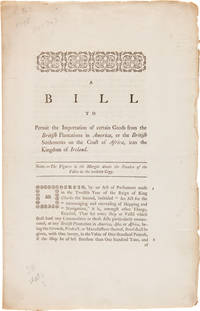
1778réf. 39128London. 1778. The rare Parliamentary printing of a bill relating to American trade under consideration by the House of Commons. In 1660 during the reign of Charles II Parliament passed a bill "for the encouraging and encreasing of Shipping and Navigation" which granted bonding for ships and vessels transporting goods from British plantations in Africa Asia and America directly to another British plantation or to a port in England Ireland or Wales. Three years later Ireland was struck from the list. The present law passed during the American Revolution restores Ireland's bonds privileges allowing her ports to accept goods directly from the colonies in the Americas now mostly limited to Canada and the West Indies Asia and Africa. Not in Kress Goldsmiths' or TPL. OCLC locates three copies at the University of Arizona the University of Texas at Dallas and the University of Regina Saskatchewan. A rare example of a law reflecting the changes of British mercantilism at the close of the First Empire. 3pp. plus printed docket title on verso of second leaf. Bifolium. Three early horizontal folds. Very minor foxing and soiling. Near fine untrimmed. unknown books
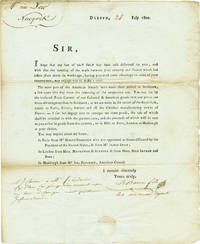
1801réf. 44263Dieppe France. July 1801. Rebuilding Trade After the Quasi War An interesting and rare artifact of the attempt to rebuild French-American trading relations in the wake of the so-called "Quasi-War" between the two nations. The Quasi-War was an undeclared conflict between the United States and France during John Adams' administration in the late 1790s manifested mostly in naval engagements between the two nations. The war wreaked havoc on American commerce with France which only began to be rebuilt with the Convention of 1800. The present printed circular was created by "Le Baron fils" the former American consular agent in Dieppe and was apparently sent to a variety of American merchants encouraging them to once again send shipments of American goods to that French port. Not much is known of Le Baron fils though he did correspond with Benjamin Franklin and he served as the American consular agent at Dieppe for several years. This copy of Le Baron fils' circular was sent to prominent New York merchant and politician Nicholas Low and is dated in manuscript July "24." It is addressed to Low in manuscript on the fourth page and his name is also written in the upper left corner of the circular. In the printed text Le Baron fils states: "you may see by the inclosed Price Current of our Colonial & American goods not present here that our prices are more advantageous than in Bordeaux as we are more in the center of the Republick nearer to Paris Rouen Amiens and all the Chiefest manufacturing towns of France." Low is encouraged to "consign me some goods the sale of which shall be attended to with the greatest care and the proceeds of which will be sent to you either in goods from this country or in Bills on Paris London or Hamburgh at your choice." The printed text concludes by giving the names of the American consuls at Paris and Hamburg as well as two English trading houses as references to Le Baron fils' character. Le Baron fils adds in manuscript: "Mr. J. Clason & Mr. C. Codwise of yr place can give you an account upon my house in case you want quick information." Old folds some edge wear small tears at edges of fold fourth page torn from wax seal. Very good overall. unknown books
1822réf. 38089Washington. 1822. This Senate documents prints the memorial from America's foremost learned society asserting that that any tax on imported books is "detrimental to the progress of knowledge" and asking that those duties be suspended. The memorials written by Peter Duponceau and R.M. Patterson review the policies of other governments toward duties on imported books providing a useful survey of the tax policies of the major European powers. OCLC and American imprints together locate only five copies at Yale the University of Virginia the New York Law Institute the Library of Congress and Princeton. Scarce. Dbd. most leaves loose. Old stain in upper half throughout. Good. AMERICAN IMPRINTS 11000. OCLC 23248452. unknown books
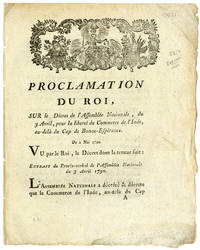
1790réf. 51521Rouen: L. Oursel 1790. With a Partially-Printed Letter Transmitting the French Revolutionary Proclamation Proclamation by the Revolutionary government of France abolishing the monopoly of the French East India Company on trade beyond the Cape of Good Hope and declaring it open to all Frenchmen. The Compagnie des Indes Orientales was established in 1664 to compete with the British and Dutch East India companies. It had considerable difficulty maintaining itself financially through its long history and it was finally liquidated in 1769. In 1785 it was reconstituted and granted a seven-year monopoly on trade beyond the Cape of Good Hope but the French Revolution and the democratic zeal that accompanied it put an end to that with the present decree. The brief proclamation is accompanied by a transmittal form from the Bureau Intermediane du Departement de Montivilliers indicating that one copy of the proclamation was sent to the recipient. Quarto on a folded folio sheet. Light wear and soiling. Very good. unknown books
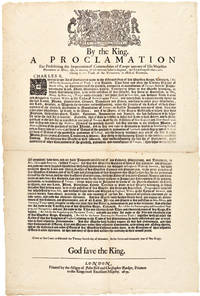
1675réf. 45901London: Printed by the Assigns of John Bill and Christopher Barker 1675. Enforcing the Triangular Trade: The Basis for the British Colonial System A rare broadside reiterating and reinforcing the decree of the English government that all foreign goods destined for British colonies must first pass through England a policy of mercantilism later termed the "triangle trade." "This program permitted the profits from colonial trade and commerce to center in England promoted British shipping and enabled the British government to support itself by taxing this trade as it flowed through England" - DAH. The English government began its mercantilist policies under the Commonwealth government in a series of "navigation acts" which regulated English trade. The first Navigation Act passed in 1651 targeted Dutch commerce. It stipulated that only English ships could carry freight into English territories and that if a ship was not English it could only carry goods from the country from whence it hailed i.e. Dutch ships could only import Dutch goods etc. Acts passed in 1660 and 1663 under the Restoration government of Charles II isolated trade even further mandating that British colonial goods only be imported to England and forbidding English trade on anything other than English vessels. This policy of trade which was continued for the next two hundred years marked the ascent of British colonial mercantilism and planted the seeds of discontent which resulted in the American Revolution one hundred years later. The present proclamation is an enforcement of the Navigation Act of 1663 An Act for the Encouragement of Trade under which "no commodities of the growth production or manufacture of Europe shall be imported into any land island plantation colony territory or place to his Majesty belonging." In other words all European trade to the American and East Indian colonies of the English had to pass through English ports en route. As the law is being disobeyed to the detriment of trade and tax revenue the proclamation extends power for enforcement to the officials of the realm. It states: ".whereas his Majesty is well informed that notwithstanding the said Act of Parliament great quantities of other commodities.have been and are daily imported into several of his colonies plantations and territories in Asia Africa and America.and that his Majesties subjects of some of his colonies and plantations have not onely sic supplied themselves with such commodities not shipped in England.but have conveyed them by land and water to other of his Majesties colonies and plantations to the great prejudice of his Majesties customs and of the trade and navigation of this kingdom." An important proclamation which illustrates the difficulty in maintaining and enforcing the laws central to the first British Empire. Old fold lines. Repaired with tissue on verso along vertical fold. A few other small tears or tissue repairs. Very good. ESTC R25339. WING C3378. GOLDSMITHS' 2112. STEELE I:3619. KRESS S1421. DAH III p.374. unknown books
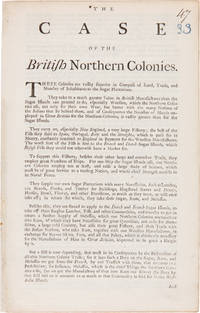
1731réf. 46721London. 1731. Limiting Sugar Trade with the French and Dutch A protest against a Bill to restrain the northern colonies from trading with the French and Dutch sugar islands. One of five editions published all rather scarce. Only four copies of this edition noted by ESTC - at the National Archives New-York Historical Society University of Michigan and the University of Minnesota. European Americana also notes Yale and JCB. Folded folio sheet. Vertical fold reinforced with tissue. Minor soiling. Very good. ESTC N15514. EUROPEAN AMERICANA 731/37. unknown books
1713réf. 68433London: Printed by John Baskett 1713. Spain Grants Britain a Monopoly on the Slave Trade in the Americas First edition in English of one of the most important documents in the history of slavery in the Americas and in the political and financial history of Europe and the Americas in the early 18th century. This copy is housed in a large sammelband containing dozens of original documents and extracts related to English-Spanish relations. Though the term "assiento" could refer to any number of Spanish contracts "the Assiento" almost always refers to the "Assiento de Negros": a monopoly contract granted by the Spanish crown between 1528 and 1779 for the sole right to import slaves from Africa into the Spanish colonies. Normally granted to individual companies the 1713 Assiento was granted directly to the British crown as part of negotiations for the Treaty of Utrecht which ended the War of Spanish Succession. In the decades following this 1713 Assiento an estimated 200000 enslaved Africans were transported across the Atlantic. The document grants sole privilege for the trade to the British crown for a period of thirty years expiring in 1743. The agreement consisting of forty-two articles allows for a maximum of 4800 slaves to be introduced to the colonies each year with a provision for increasing that annual amount each year by paying an added duty places limits on sale prices sets the cost of the duty to be paid for each enslaved person allows for the use of British or Spanish ships and mariners in the slave trade provides for the French Guinea Company's extraction from the colonies and establishes the details of precisely where British ships would be allowed to travel and trade. The British were also granted the unique privilege to send one vessel with a cargo of up to 500 tons of other trade goods to the Spanish colonies each year. While the Assiento seemed a lucrative deal most Assientists over the years saw considerable losses due to the difficulty of cross-Atlantic trade and the duties paid to the Spanish king. The real benefit to its grantees was not profits from the slave trade but rather the illegal ability to send other contraband on board their vessels to the otherwise closed-off Spanish markets in the New World. Britain was eager to get their own products overseas and to deny this revenue stream to the French who had held the Assiento since 1701 thereby preventing them from refilling their coffers too quickly and upsetting the balance of power in Europe after the costly War of the Spanish Succession. Queen Anne delegated the Assiento privilege to the South Sea Company which had recently been established to pay off Britain's considerable national debt. The privilege was largely granted to them as an encouragement to investors in order to allow the Company to achieve its original purpose more readily. Ultimately however it proved to be a costly and unprofitable endeavor for the South Sea Company who were able to import only about one-third of their allowed quota of slaves each year were frequently interrupted by war and were required to render twenty-five percent of their profits to King Philip V of Spain. The present example comes from the British Foreign Office Library inlaid and bound into a folio volume of other treaties between Great Britain and Spain arranged chronologically by treaty date. Over the course of many years the library of the Great Britain Foreign Office inlaid copies of nearly every treaty involving Great Britain to folio size and bound them together by region. The library was dispersed in the late 20th century with most of the volumes and particularly the American volumes sold by this company. Most of the other treaties with Spain within this volume are clippings or extracts from larger works or true copies in manuscript of treaties dated between the years 1176 and 1739. Included in the volume however is a separately printed English edition of the Treaty between Great Britain and Spain as part of the Treaty of Utrecht ESTC T51509. There are two issues of the Assiento treaty; this is the issue with a semicolon after "Assiento" and no punctuation after "or" on the titlepage. A crucially important document in the history of colonial trade Spanish-British relations English finances and slavery in the Americas. Folio. 19th-century half roan and marbled paper boards. Boards worn some restoration at joints. Text trimmed and inlaid into folio sheets bound in volume of treaties between Great Britain and Spain. Bookplate of the British Foreign Office Library on front pastedown. HANSON 1896. ESTC T4476. EUROPEAN AMERICANA 713/85. JCB 1III:175. SABIN 2227. SPERLING 34. hardcover books
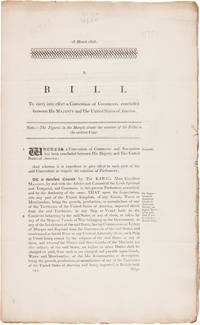
1816réf. 39129London: Ordered by the House of Commons to be Printed March 18 1816. Trade Restored After the War of 1812 Official Parliamentary draft printing of a commercial agreement between the United Kingdom and the United States passed just over a year after the signing of the Treaty of Ghent. The convention of commerce establishes that the same import and export duties be applied to goods carried by American and British ships in direct British-American commerce. Duties on and bounties for prize ships and goods are also put on the same terms. This version of the bill would have been printed while the question was being considered by Parliament. Not in Kress or TPL and not listed on OCLC. 2pp. plus docket title printed on verso of second leaf. Folio. Early horizontal folds. Near fine. Untrimmed. unknown books
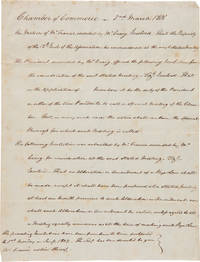
1801réf. 57454Philadelphia: Printed by Zachariah Poulson Junior February 9 1801. With a Contemporary Manuscript Document The official Articles of Association for the Philadelphia Chamber of Commerce adopted when it was founded on January 5 1801 along with a manuscript document regarding changes to those rules written shortly after. The titlepage of the ARTICLES OF ASSOCIATION exists in two states; this is the much rarer state which specifies the month and date in the imprint. The Chamber was established according to these articles "for the purpose of aiding the Trade of the City of Philadelphia by carrying into effect such Rules and Regulations as may from time to time be established with respect to our Commerce and the adjustment of Mercantile differences between each other." The Chamber of Commerce was founded exclusively for merchants with rule XV stating that "No person can become a Member of this Institution who is not a citizen of the United States and a trading merchant of the city of Philadelphia either as a ship owner importer or exporter or a marine insurance broker." This rule was reversed in 1834 when the Chamber of Commerce was absorbed into the Philadelphia Board of Trade and became open to all businessmen. The accompanying manuscript document dated March 2 1801 is addressed to Thomas Willing Francis and regards the proposed reconsideration of Rule XII which states that members may not refuse to submit their accounts to the Chamber in the case of a legal dispute as well as a handful of other motions. Thomas Willing Francis 1767-1815 was a Philadelphia native from a long line of Pennsylvania businessmen. After graduating from the University of Pennsylvania in 1814 he entered the family firm of Willing & Francis - the firm which had sent the first recorded American ship to China for the purpose of trading opium nearly a decade before. He was a founding member of the Chamber of Commerce achieved the rank of captain in the Second Philadelphia City Cavalry and served as a director of numerous other Philadelphia organizations. A significant document in the economic and civic history of Philadelphia with a rare manuscript addition from less than a month after publication and two months after the Chamber's founding. Contemporary marbled wrappers. Spine ends chipped corners a bit worn. Manuscript with some old folds and light creases. Very good. SHAW & SHOEMAKER 1148. SABIN 61974. unknown books
1825réf. 38259New York: Corrected and published by Edmund M. Blunt 1825. First edition under this title of this perennially popular and relied-upon guide for figuring the weight of packages and casks based on their depth and breadth. The work was originally published in 1816 but was found to be so full of errors that it was republished in this "corrected" edition under a new title in 1825. Blunt was also the publisher of the essential navigation guide THE AMERICAN COAST PILOT. 4196pp. plus 20pp. of advertisements. Tall narrow octavo. Contemporary calf gilt morocco label. Hinges cracked boards worn. Tanned scattered foxing. Fair. AMERICAN IMPRINTS 19773. hardcover books
1801réf. 56123Great Britain. ca. 1801-1807. British Essay on the Importance of American Trade During the Napoleonic Wars An interesting but unattributed and apparently unpublished manuscript essay with a caption title reading: "Loose Memo. Respectg. American Commerce." The gist of the memo is set forth in the first sentence: "The Americans are at all times the best customers of G.B. - in peace they take 1/3 of her manufactured exports - in War much more." In addition to the eager American market for British goods the author notes that British goods are often trans-shipped via America to other markets where Great Britain would not normally have access thanks to America's neutral status: ".you have only to change the name of the manufacturer & the wants of the Colonists will shut their eyes on the origin of the fabric. I have known Liverpool ware ornamented with the Portrait of Geo. III passed as German manufactures." The author notes that while the understandable economic downturn during the Revolution and for several years after the "peace of '83" resulted in some problematic credit relations between the U.S. and the British market much has changed. "The industry & the enterprise of our countrymen aided no doubt by the enjoyment of a neutral position has enabled them to throw off their dependence on the British merchant or manufacturer. They now have a sufficient capital of their own and a very important proportion of their imports are now paid for in ready money or in bills at short sight." The author explains that American merchants are able to export their surpluses of their own production and surplus British goods to the Continental market and transfer that money directly to creditors in Great Britain with an added perk: "The result of this species of trade must be ruinous to France. She is drained of her wealth to enrich & invigorate her enemy." Finally the author provides a specific example of this favored trading relationship with regard cotton. At this time the author estimates that Great Britain imports three-fifths of all cotton from the United States - some 150000 bags of cotton annually weighing 250lbs. each. The U.S. buys back nearly one-third of all cotton goods manufactured in Great Britain yielding a net profit of over £2.5 million to Great Britain. The author adds that this ratio holds for almost all raw materials produced in the United States. This essay was almost certainly written during the earlier part of the Napoleonic Wars; the author cites an 1801 speech by Lord Grenville which helps narrow the date range and it seems unlikely the Embargo Act of 1807 had been passed yet. Regardless the essay promotes Anglo-American trade and cooperation at least insofar as it enriches Britain and cripples France at a time when other forces were driving the two countries toward war. Light tanning and soiling occasional ink smudges. Very good. unknown books
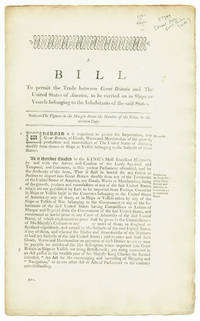
1809réf. 47399London. 1809. A Failed Opportunity to Normalize U.S.-British Trade Relations Rare printing of a British Parliamentary "slip bill" seeking to reestablish trade between Great Britain and the United States a few years before the outbreak of the War of 1812 and in the midst of great tension between the two nations. This bill was considered by Parliament in the spring of 1809 in the wake of President Jefferson's rescinding the Embargo Act and following the negotiations between U.S. Secretary of State Robert Smith and British envoy David Erskine which created a glimmer of hope that Anglo-American relations might be repaired after a period of great stress and turmoil. In March 1809 Jefferson signed the Non-Intercourse Act which rescinded the Embargo of 1807 and held out the promise of resuming trade with England and France if either of those nations ended its commercial restrictions toward the United States. The Erskine-Smith negotiations of April held out the promise of improved relations and in May the Parliament considered the present bill which permitted trade between Great Britain and the United States to be carried on in American ships. Unfortunately Prime Minister Canning disavowed the Erskine-Smith Agreement in late May and Anglo-American relations continued to deteriorate culminating in outright warfare in 1812. Slip bills are printed during the legislative process in small numbers for the use of legislators and staff. They are ephemeral items and their survival is rare. A printed note before the text of the bill reads "the figures in the margin denote the Number of the Folios in the written copy" which indicates just how early in the legislative process these bills were printed. OCLC locates only a single copy at the University of Massachusetts. Folio. Lightly tanned around the edges. Near fine. OCLC 49887290. unknown books