501 résultats
1840réf. 8144New York: John B. Rey 1840. Broadside 16.5 x 22.3 cm. printed one side only with split fountain roller rainbow. Illustrated. Date range from the range of listings in directories etc. We would be tempted to call this a trade card but for the thin stock it is printed on more fit to be pasted up than handed out. Described as a "manufacturer of cordials bitters essences syrups rock candy sweetmeats brandy fruits sweet plain and fancy chocolate prepared cocoa cocoa paste vermicelli maccaroni catsups sauces extracts etc. John B. Rey was located at 31 & 33 Burling Slip" Doggett's New-York City Directory for 1848-49 page 340; earlier listings were just "33 Burling Slip". At the time of the Directory's publication seven chocolate makers were listed. John B. Rey's operation was taking advantage of the rapid industrialization of the chocolate making process as this card depicts two pieces of large machinery - a melangeur right and a cacao press - that would have been driven by steam notice the belt drives in the image. Burling Slip was just north of South Street and the South Street Seaport with its famous fish market. Although the printer is not credited this is a noteworthy piece of promotional printing as it displays the split fountain or rainbow roller process of printing multiple colors simultaneously in this case a mirrored red green and blue. A few light creases from folding; some light soiling or foxing. Still near very good and very handsome. Rare. Unrecorded. OCLC records no copies. John B. Rey unknown books
1762réf. 10095Breslau .: G G Horn 1762. First Edition. Contemporry three quarter leather. A very good copy with some wear to the binding. 8vo. There is an elaborate eng. vignette title. A two-part analysis of coinage and monetary value. The first section deals with the origin and implementation of monetary regulation and minting of money. The second is an essay on the maintenance of exchange rates and relative values of currency in the modern era. G G Horn hardcover books
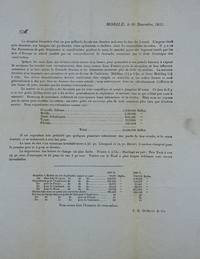
1857réf. 70300Mobile AL: J. E. DuMont & Co 1857. Printed circular letter on blue paper 11 ¼ x 9 ¼ text entirely in French. A periodic report from the company offering its assessment of the cotton market with statistics showing number of bales shipped from various ports New Orleans Mobile Atlantic States Texas and Florida and with comparisons between 1856-57 and 1857-58 through September of each year; this report notes improvements in the financial situation from its previous report translation: "as money is more abundant our banks have been able to expand their operations and thus facilitate cotton transactions" despite "frequent and considerable fluctuations in prices during the month the market having been depressed by notices from Europe." The only reference we have found for J. E. DuMont & Co. is an 1859 partnership dissolution suit filed in Mobile's Chancery Court that describes the company as a "general and commission-merchant in Mobile"; the case eventually found its way to the Alabama Supreme Court. Addressed verso of integral leaf to Messrs. J. & C. Heydecker in New York old fold lines else very good. J. E. DuMont & Co unknown books
1883réf. 36090Atlanta 1883. Broadside 5-3/8" x 8-1/2". Very Good. unknown books
1854réf. 65544Philadelphia PA: Rice & Hart Publishers No. 27 Minor Street 1854. Single sheet folded. 25 cm. 4 pp. text on 2 outer pages only. Old fold lines else very good. Text in two columns printing the notices for this publication from the National Intelligencer of Feb. 11 and the Washington Union of Feb. 4. The contents including the list of portraits and biographies in of each of the four volumes is also listed. OCLC lists two copies of this circular: NY Hist. Soc. and AAS. The "National Portrait Gallery of Distinguished Americans" was published by Rice & Hart in 1854. Rice & Hart, Publishers, No. 27 Minor Street unknown books
1928réf. m2537Clearwater Fla.: Clearwater Chamber of Commerce n.d. ca. 1928-1930. Octavo color-illustrated wrappers stapled 32 pp. Photos color illustrations. Promotional piece for the city of Clearwater. Ex-library copy; otherwise Good. Clearwater Chamber of Commerce, n.d. [ca. 1928-1930.] unknown books
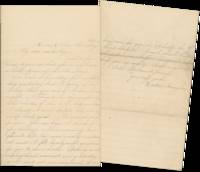
1909réf. List3421Ohio Illinois Michigan and Ontario 1909. Seventy-four letters in thirty-seven envelopes mainly dating between 1885 and 1895. With two undated and one empty envelope. Conditions vary with a few letters having damage intersecting with significant amounts of text and others Near Fine. Overall excellent. A collection of letters mainly sent between Captain William Faragher 1842–1921 and his second wife Harriet Chamberlin 1853–1920 with several from Faragher’s children from his first marriage Burton 1872–1961 and Maude 1875–1952. Most letters are from Chamberlin to Faragher with fourteen from Faragher to Chamberlin. Faragher owned and captained several merchant ships in Lake Erie and Lake St. Clair—presumably sailboats as he frequently complains of having been stuck without wind. He also describes more severe weather out on the lake writing from St. Clair Michigan: “I am anxious to get down from here but as the day advanced the wind began to frisken and it began to snow hard and as it was freezing hard it had rained then snowed and then froze hard saturday night so the poor Venture was in a sad plight but she was in a worse one when we got to where we lay run as it breezed up fresh and the wind dead ahead the water was flying over her in all directions and froze wherever it fell and besides it had turned into a blinding snow storm but we had a certain point to make . she seemed as anxious to get to a place of safety as I did and as the boys say she got there and none too soon as it has been blowing a gale ever since and snowing and freezing but we are in the lee and at a good dock and are comfortable but oh the wind is whistling through the rigging .” November 20 1887 In the 1880s steamships were increasing in popularity on the Great Lakes primarily because of sailboats’ susceptibility to both calm and weather; steamboats were bulky for their capacity and slow but more reliable whereas sailboats could carry overall more cargo.1 Generally steamers took packaged goods and passengers and sailboats mainly schooners took bulk cargo. The Great Lakes were the site of much shipping innovation; Faragher’s fleet was not yet behind the times but steam would overtake sail in the 1880s and 90s. Faragher’s cargo was mainly produce—apples and grapes—though he does mention picking up salt and other materials. His letters indicate that his business involved both shipping and mercantile aspects: he chose and bought the products shipped them to their destination and then also had to find and sell to customers. The grapes in particular seem to cause a lot of trouble: “We left Lorain Sunday morning early and had a nice trip to the Island got there at 4 PM bustled around monday morning and bought 400 baskets of grapes and had them all aboard by dark . it commenced to snow just as we got to Marine City bad bad omen for grapes but imagine my chagrin when I went up town and not a store or commission house wanted a grape folks were full of grapes and there was no sale for them and they said that I had got left and if the truth were known they were glad of it but its a cold day when I get left if trying will lit me out but one thing certain the weather and the lateness of the season were against me but you know I never cross a bridge before I get to it well we hauled up to our old Island Saturday morning and I sold out to my old friend . we had sold since 11 am 190 baskets of grapes . only half our cargo and at a good margin too. People would ask are you the man that was arrested here for selling grapes when told yes they seldom failed to buy but the strangest part was the number of ladies that came to buy”. October 28 1887 Though he does not narrate the incident in which he was arrested for grape peddling—nor does it appear to have made the paper—he later mentions yet another grape-related debacle this time at Port Huron: “Sander and I went to town to sell the grapes today . when down came a city official and wanted to know if I had a license to sell . well I couldent sell another grape without paying 5.00 a day license that was a stormer you see the whole sale men were going to drive me out of the market . but they were not as sharp as they thought they were I went and gave a bill of sale of my whole cargo to a citizen here and he appointed one of his agents to sell the grapes” September 20 1888 Faragher’s letters here do not discuss the financial state of his business but given Chamberlin’s statements it cannot have been all too positive. Chamberlin’s letters depict a woman struggling with her financial circumstances and with how the era’s expectations of her gender intersected with them. In one illustrative letter she writes: “A man drove by here Sat. asking for you. Ms. Lawler has given him her note to collect. He says the interest brings it to nearly fifty dollars. I told him I thought you could not meet it just at present but he said he must have the money and would give you just one week and if it was not paid then he would let the law settle it. Marvin and Laird are his lawyers. Mr. Laird is the one who helped get my money from father’s estate. I would not have them connected in this way about you for – O a great deal!! I have thought and planned till it seems as though my brain would burst. I have inquired about that law regarding taking any more married women as teachers. If Mr. Day would work for me it might perhaps be broken. There will be a vacancy in the Detroit building this fall. Will if I possibly can I want to commence teaching in Sept. The children would have to learn to do more about the house and with both of us earning it seems as though some of these harassing debts must be settled after a time. The frequent calls of men with bills against you have taken away all my pride and I believe I am humble enough to do most anything now.” July 11 1887 In 1887 Ohio passed the Married Women’s Property Act which allowed married women to keep their own property separate from their husbands’—in fact Chamberlin occasionally mentions “her” money in her correspondence. At the same time the state’s Board of Education was debating passing an act that would not only ban school districts from hiring married women as teachers but also fire all the married women it then employed. Newspaper reporting at the time indicates that this measure was not particularly popular not the least because married women tended to be older and more experienced with the job. Chamberlin clearly perceives her role as a wife in a rather more progressive way at one point writing to Faragher that “a true wife” is “not a doll-baby to be kept in finery” N.d. after he had taken out a loan to send her money for a new hat. Throughout their correspondence Chamberlin is perhaps surprisingly open with Faragher about her opinions particularly on his work and their financial affairs; for instance: “I should like to examine your pocket-book after that $25 tax money left it. What are you going to live on up there while you are hunting for freight Sawdust won’t put any fat on your bones. Sailing up and down past Saginaw bay won’t prolong your life or lessen your grey hairs. What are you sailing for anyway For the sake of wearing yourself out and giving employment to two or three men and keeping the Root from rusting out I guess I am naughty!” May 25 1894 She also frequently provides her opinion on whether and at what rate Faragher should sell his two other ships besides the Root the Venture and the Sassacus. She continues in the same letter: “I know I almost had a regular fight yesterday morning right there on the lounge. I wanted to do my housework and I couldn’t. I wanted to sew and I couldn’t sit up long for that. I wanted to help you and I couldn’t. I wanted to earn money and whereas I used to earn fifty-five cents for every hour I worked now I can not earn anything. Then if I could not do for self and family I wanted to make church and S.S. calls but I couldn’t walk for that.” Of course she was at that time prevented from these activities by her health not by gendered standards but she clearly had financial ambitions for herself. After her time as a regular school teacher Chamberlin taught at a Sunday school where she earned a few cents per student and in one letter reported having eighty-one students in a single session. Chamberlin also struggles with the expectations of her as step-mother to Faragher’s two children from his first marriage to Emma Humphrey 1848–1880. She writes: “I get so discouraged sometimes and it seems as though I am in the wrong place as mother. I think of Emma as my sister. I want to do as she would have me. I look upon my work as sacred. And yet sometimes I feel as though life was not worth living.” November 5 1886 She frequently describes conflict with Burt who was then in his late teens to early twenties writing that she could not “have quite the very own mother-love for him” though she is “sure that Emma was not more conscientious in her desires to do right by him than I am” May 20 1891. As it still is today the role of step-mother was a difficult and frequently demonized one with the trauma of losing a mother and wife often in conflict with the feminine duty of maintaining perfect domestic harmony. In general Chamberlin seems to have been somewhat out of step with the feminine ideal of the time even telling Faragher in a letter describing the death of an acquaintance’s baby how glad she was to not have any children of her own. Overall a look at the private lives and difficulties of a middle-class Ohio household as despite the relative prestige of its head being a captain-owner it struggled with debt. Of interest to both historians of Great Lakes trade and those of women’s roles in the late nineteenth century. 1 Dina M. Bazzill “The Missing Link Between Sail and Steam: Steambarges and the Joys of Door County Wisconsin” East Carolina University Program in Maritime Studies Research Report no. 19 2007. unknown books
1890réf. 106522Chromolithograph advertising and promotion cards various sizes from 3 ¼" x 3 ¼" to 6" x 8". Normal aging a little browning on reverse text on reverse of one card basically gone. A couple of colorful little girl and flower cards one an advertisement for Magic Yeast indicating E.W. Gillett as manufacturer. Fairly colorful lot. books
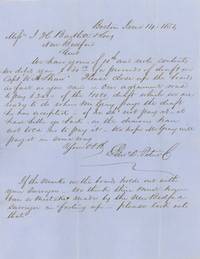
1855réf. List3333Massachusetts New York Maine Pennsylvania and others 1855. Fifty letters with four empty envelopes or covers. Forty-four letters addressed to I.H. Bartlett & Sons: two from the 1830s eight from the 1840s and thirty-four from the 1850s. With five letters addressed to Capt. John C. Blanchard 1838 1839 1844 and 1849 and one to Cumston & Hatch N.d. Overall excellent to Near Fine. Ivory Hovey Bartlett 1794–1871 was a merchant and whale oil seller based in New Bedford Massachusetts. Bartlett moved to New Bedford from Plymouth in 1819 first dealing in grain and later transitioning to general merchandise and whaling.1 Whale oil and spermaceti were widely used in lamps and as lubricant and whalebone baleen was used for structure in items like umbrellas and corsets. In the nineteenth century whaling was the basis of New Bedford’s economy—supporting shipbuilding refineries toolworks and more—making it the wealthiest city in North America at the peak of the industry in the midcentury. Whaling declined in the 1860s with the rise of petroleum which could be both used as a lubricant and distilled into kerosene for lighting. Offered here is a collection of letters mainly to Bartlett’s company I.H. Bartlett & Sons with five to Captain John C. Blanchard of Searsport Maine and one to Cumston & Hatch. The latter is unknown; Blanchard was in the cotton and sugar trades sailing between the US Europe and West Indies. Letters to Bartlett are mainly from other mercantile firms; they pay bills make purchases discuss oil prices and occasionally complain. For instance Robert Robinson of Portland Maine writes: “I have just got 4 Casks of my oil 3 of the last and 1 of the invoice of 30th ult. I cannot understand why my oil should be keep back in this way. Hyde had seven casks by yesterdays Boat the same boat which mine came by it seem’s as if the fates where against this Oil as yesterday boat did not arrive untill late yesterday afternoon and this mornings boat has arrived without the balance there must be something wrong somewhere . I must say I think such neglect should be made known but perhaps it would be better to suffer for fear of the future. I shall not be able to get off any oil untill tomorrow as the oil was not out of the boat untill this morning. it is not thirteen days since that one cask left New Bedford .”. October 13 1852 Most of Bartlett’s customers buy whale oil though beef molasses and coal are also discussed but some are interested in whalebone; as are Wright Bros & Co a Philadelphian umbrella manufacturer who write to complain about market speculation: “The fact appears to us that speculation and the calculation of holders put the price kept it so high that it considerably lessened consumption – so much so of late that some have been disposed to slide it off below New Bedford rates very quietly.” October 23 1852 The letters to all parties are generally all business except for two of the five to John Blanchard: one from his wife Caroline Houston and one from fellow Searsport captain David Nickels Jr. 1823–1888 who writes from Bangor: “I see by to day’s Mercantile gazette that you are in trouble I can sympathize with you God knows I have had a good share of it since I left the land of Gospel light and liberty as the good people say in their prayers I have been in this place fifteen days you doubtless knew I was chartered by Capt Pendleton to go from Leith to Bangor for a cargo of slates and from here to Boston I sailed from Leith on the 27th of November last for this place I got as far as the Orkney Islands on the 30th of November the wind blowing heavy from the westward and having a pilot belonging to the Orkneys on board I concluded to take the harbour of Longhope and lay till a shift of wind or till it moderated . in spite of all our endeavouring we were driven on shore broke the keel out of her filled as high as the lower deck which was on the 3d of December and on the 22d of March we left the Orkney Islands after having been near four months there When I got here I found the man who was to freight the Barque from here to Boston had neglected to place funds in the hands of the slate agent of this place consequently he refuses to put slates on board of the vessel till he receives funds from Boston .”. May 13 1849 Overall a look at the dealings of maritime merchants in the mid-nineteenth century particularly in the critical east coast whaling industry. 1 “Death of a Well-Known Merchant” The Standard-Times February 6 1871 2. unknown books
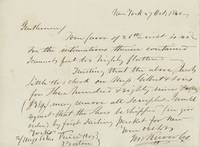
1849réf. List3334New York City 1849. Eight letters. Overall excellent. A small collection of letters to Boston-based grocers Silas Pierce & Co. sent from New York by steamboat with notes on covers or stamps reading “Boat Mail” or “Steam Boat Mail”. Five of the letters are from Wyckoff & Scrymser which was likely owned by a member or members of the prominent New York Wyckoff family the Scrymser surname first appears in the Wyckoff family history in 18411. Wyckoff & Scrimser discuss sweet and red wine prices “opperations in Trent” likely Trento Italy delayed shipments and issues with products; for instance: “The Harmony has not yet made her appearance neither the Aselia the non arrival of the latter is very perplexing but we see no remedy for it. . Annexed please find the sales of the Raisins amount Nett proceeds to your Co Nine Thousand One Hundred Seventy Four 06/100 Dollars which we hope may be found correct and satisfactory. There were a number of the parcels that were sold from the wharf but rejected which we were obliged to and store that the objections might not be known &c. The half boxes . did not have any external appearance of damage and could onky be known by opening. We rather congratulated ourselves that we have got off so well with this fruit as we had strong fears of the result.” December 29 1843 Also discussing business with Italy is a letter from Wm. A Lüs on behalf of Ferd. Baller & Co. of Messina which traded in citrus fruit: “The principal object of my friends is to introduce their Brand favorably into your market & their efforts to do this will alone be sufficient to secure you a superior article of fruit & other Goods; . they are also in the position of obtaining any other Sicilian produce at the most advantageous terms while at Messina or Palermo through their agent there.” August 30 1849 Demand for citrus products was high as it had been discovered late in the 18th century that citrus prevented and cured scurvy. Demand was so great in fact that some researchers partly credit the citrus trade with creating the Sicilian mafia.2 A letter from the Bank of Commerce in New York discusses credit and lastly Joseph Knowles possibly of the Massachusetts-based Thomas Knowles & Company sends an intriguing note: “Your favor of the 26th inst is rec’d For the intimations therein contained I cannot feel too highly flattered — Trusting that the above Jacob Little Co’s check on Messrs Gilbert & Sons for Three hundred eighty nine dollars $389 may remove all scruples – I would request that the shoes be shipped in good order by first sailing packet for New York”. October 27 1840 This is plausibly related to the investor and stock speculator Jacob Little 1794–1865 known for his short-selling tactics and generally considered as Knowles suggests unscrupulous.3 Of interest to researchers of mercantile history in the northeast and steamboat mail. 1 Mr. and Mrs. M. B. Streeter Eds. The Wyckoff Family in America: A Genealogy The Tuttle Company 1934: 310. 2 Arcangelo Dimico Alessia Isopi and Ola Olsson “Origins of the Sicilian Mafia: The Market for Lemons” The Journal of Economic History 77 no. 4 December 2017: 1083–1115. 3 “The Convertible Bonds: How Jacob Little Manipulated Matters Years Ago” The New York Times February 23 1882. unknown books
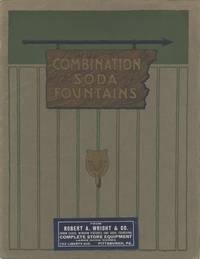
1925réf. 6884Decatur Ill.; Fort Wayne Ind: the company; The General Printing Corp 1925. Folio x cm. 24 pages. Illustrated throughout and with a color illustrated title page. Printed throughout in green and black ink. An attractively printed trade catalogue for the Combination Soda Fountain Company founded in 1898 with the introduction of the “Iceless” soda water machine. The company further expanded in 1919 with the purchase of the Wise Soda Apparatus Company of Ohio. The catalogue depicts and provides information for various scale soda water set-ups both counter and wall type as well as a few pages of smaller equipment and accessories. A bit or edgewear to the decorated stiff wrappers printed in black green brown and gold otherwise fine. With the ownership label of the Robert A. Wright & Co. “Complete Store Equipment” of Pittsburgh. No publications of the company are located by OCLC. the company; The General Printing Corp unknown books
réf. 40043COLORADO SPRINGS-MANITOU CHAMBER OF COMMERCE. COME TO COLORADO SPRINGS - MANITOU: THE PIKES PEAK REGION. Colorado Springs: The Chamber 1920s. Square 8vo. Colored illustrated wrappers. 22 pages. Scarce travel promotion for Colorado Springs and region in the 1920s. A richly illustrated many in color booklet of the sites natural wonders as well as tourist resort activities available to the automobile traveler. unknown books
1961réf. 119641Tanganyika 1961. hardcover. Illus. some color. many tables. slim 8vo cloth d.w. Tanganyika December 1961. unknown books
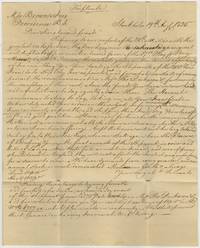
1825réf. BK0190Stockholm Sweden 1825. One large folded commercial sheet written on several panels with integral address panel to Messrs. Brown & Ives Providence Rhode Island endorsed "Pr. Brig Harvest" with Newport "SHIP" marking. Headed "Triplicate. Old folds and light handling wear very good. A commercial letter and account from the Stockholm mercantile house of Kantzow & Biel to Brown & Ives of Providence concerning the execution of a large order for Swedish iron. The firm reports that it is assembling a shipment of arranging its transport while the accounting on another portion of the same sheet records the value of the iron and related charges. The letter reports: "the contents giving us the desired opportunity of confirming you Your order for a Shipmt. of 200 Tons Iron to be ship'd & appointed and convoy which we shall of course prevail the commencement on." The letter dates from a period of rapid expansion in Swedish iron exports to the United States which had displaced Britain as Sweden's most important foreign market for bar iron. Britain had reduced its dependence on Swedish imports while American tariff legislation favored hammered iron from Sweden and Russia over British rolled iron. American demand became particularly important to the Swedish industry in the aftermath of the Napoleonic Wars. The United States purchased approximately three-fifths of Sweden's iron exports in 1822 with mainly American vessels engaged in the trade. The account also records a credit entered July 28 "By your proportion of dividend in payment from the Swedish Government". Brown & Ives had longstanding claims against Sweden arising from American property seized during the Napoleonic Wars including tobacco and rice belonging to the firm taken from the General Hamilton in 1810.1 The Swedish government finally settled the American claims in July 1825 following years of diplomatic representations concerning the confiscation and sale of American property at Stralsund. The credit recorded here appears to represent Brown & Ives's share of that indemnity entered less than two weeks after the settlement was formally concluded on July 16. The correspondence thus brings together two aspects of Swedish-American relations in the immediate postwar period: the expansion of an iron trade increasingly important to Sweden's economy and the settlement of commercial grievances dating back fifteen years. The shift reflected the changing geography of Atlantic commerce as Britain's increasingly mechanized iron industry reduced its dependence on Swedish imports while the rapidly industrializing United States emerged as Sweden's principal customer. However American iron production expanded enough to challenge Sweden's position in the American market particularly beginning in the 1830s and 1840s. 1 Calendar of the Miscellaneous Letters Received by the Department of State Government Printing Office 1897 47. . unknown books
1952réf. 80677Washington: Chamber of Commerce of the United States 1952. Pamphlet. 55p. stapled wraps 6x9 inches wraps lightly worn else very good condition. Chamber of Commerce of the United States unknown books
1762réf. 2191Cadiz: Don Manuel Esoinosa de los Monteros 1762. Hardcover. Very Good. 4to - over 9¾ - 12" tall. 4to. 20.5 x 14 cm 158 pp. 1 f. index. With woodcut head- and tail-pieces blazon of Charles III and two Spanish galleons. Bound in mottled calf over boards spine gilt in six decorative compartments. Somewhat worn at extremities. Generally very good. First enlarged edition of an illustrated merchant's guide to the duties and tariffs levied by the Spanish crown on exports from the Americas chiefly gold and silver but also concerning timber textiles furs coffee spices and foodstuffs.After first offering a general overview of Spanish colonial commerce with Western Europe Garcia de Prado provides a wide range of practical instructions for traders negotiating the hazardous waters of colonial finance giving sample calculations for the volume of shipping containers converting currency and-crucially-providing a comprehensive alphabetical list of the royal tariffs on exports from America and the West Indies printed as a table for quick reference in terms of maravedis de plata silver coins of account and quintales approx. 46 kg. The second half of the work is concerned with trade in gold and silver explaining the six classes of government tariffs and their application to quintales of the metals in their various states acuñada labrada grana fina etc. Printed at the Royal Navy Office in Cadiz where Spanish shipping vessels would have arrived from the Americas the present work anticipates later efforts by the Spanish Bourbons-particularly Charles III and the Marquis de Esquilache-to reform the fiscal administration of its colonial properties. Garcia de Prado remarks in his introduction that a much smaller work un Quaderno with the same title was printed in 1745 and that the present work aims to augment and update the information contained therein. JCB.III.1320; Medina 3999; Palau 58415; Sabin 15037 Don Manuel Esoinosa de los Monteros hardcover books
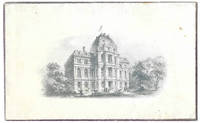
1865réf. 10246Boston: the hotel 1865. Menu printed on silk 30 x 10.5 cm. one leaf printed verso only. Illustrated with an engraving of vignettes of freight transport via ship and train. WITH: Printed envelope 8 x 13 cm. with an engraving. A handsome menu printed on silk for a banquet celebrating the Boards of Trade of the Western Cities given by the City of Boston at the Revere Hotel. Revere House was one of the city's leading hotels hosting guests that included Charles Dickens Jenny Lind and Walt Whitman. Daniel Webster addressed audience from the steps of the portico. The engraving on the envelope depicts the hotel from across Boston's Bowdoin Square. The hotel has had an additional structure added to the previously flat roof. The bill of fare for the Western Boards of Trade included Green Turtle Soup Baked Shad in a Wine Sauce Leg of Southshore Mutton in Caper Sauce Duffield's Ham Pate de Foie and much more. In remarkably fine condition with only the slightest fraying to the edges of the silk. The envelope with an engraving of the Boston's City Hall has some light soil but is near fine. the hotel hardcover books
1875réf. 21027New York City: Rogers Brothers ca1875. Edition unknown. Original publisher's stamped three-quarter leather and green cloth. Very good; contemporary annotations throughout; one leaf cut down. 4to 40 thick card-stock leaves on linen stubs meas. appx. 260 x 204 mm. Photographs are deep robust albumen prints mounted both recto and verso. The volume bears the ink stamp of Koch & Bergfeld Bremen Germany on the corner of the front pastedown. Apparently a unique first iteration of an extensive inter-business trade catalog. The Rogers Company catalog are located in OCLC in one 16 page price list without illustration. Romaine adds to this but shows nothing that approaches the kind of catalog offered here. McKinstry offers nothing from the Winterthur collection. This elaborate photographically illustrated catalog was expensive and time consuming to produce and most likely had a limited distribution to jobbers for the Rogers Co. products. Each item in this catalog has a penned or printed in the photo stock number with pricing information in dollars. The company produced all manner of "electro-silver-plated" tableware; depicted in the photographs. In addition to daily utensils and serving dishes of all kinds e.g. cut glass cruits for every form of entertainment there are elaborate decorative centerpieces for table decoration. Rogers Brothers hardcover books
1869réf. 28703Trenton N.J.: Printed at the True American Office 1869. 3.75" x 5.5". Original printed gold-colored wrappers stitched. 11 1 blank pp. Light wrapper wear Very Good. OCLC 55187463 1- Rutgers as of 3/12. Printed at the True American Office unknown books
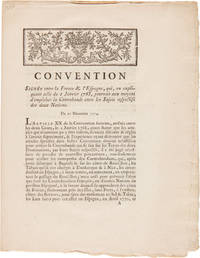
1775réf. 14145Versailles. 1775. Further Regulation of Colonial Trade An important treaty between France and Spain with significant ramifications for their colonial holdings in America. Herein Vergennes and the Conde d'Aranda further define commercial arrangements between the two countries in an attempt to control contraband. This had special impact for the Caribbean basin where the colonies of both powers were required to ship goods through European ports. Dissatisfaction over this prohibition was a key factor in the Louisiana Rebellion of 1768. This convention was agreed to at Versailles on Dec. 27 1774. Not in Wroth. 8pp. Quarto. Printed self-wrappers. Fine. DAVENPORT 155. unknown books
1960réf. 6413Cortez CO: Beaver Printing Company 1960. Single sheet 23 cm x 40 cm printed on both sides and folding to pamphlet size. 23 cm x 10 folds as issued. Better than very good. Promotional item for the southwestern Colorado town of Cortez with description of the area and amenities offered. Illustrated with a map and black and white views. "The land of contrasts. That's the area that surrounds Cortez. To the south and west of this modern city is the Colorful Desert of The Southwest. To the north and east are the Magnificent Mountains of the Centennial State. Within easy driving distance are two great National Parks and Four National Monuments. Beaver Printing Company unknown books
1930réf. 21584Basle Switzerland: J.R. Geigy S.A. 1930. Very Good . Basle Switzerland: J.R. Geigy S.A. n.d. ca. 1930. Octavo 24cm.; publisher's blue blind-embossed cloth upper cover and spine lettered in white; 455pp.; three-hundred and twelve 312 mounted cotton samples. Boards slightly warped minor shelf wear to spine ends and corners else Very Good or better internally fine and bright. One of a series of instructional catalogs issued by the Swiss dye company though the preface explains that "We cannot however strictly guarantee the statements of the tables as the requirements re. fastness etc. vary too much according to the branch of industry." The opening leaves list twelve different instructions in cotton dyeing though the bulk of the volume organized into tables separated by the dye samples. These are subdivided into various classes beginning with the "Direct Colours" and followed by "Formic" "Diazotizing" "Nitrophenyl" "Eclipse" and "Basic. J.R. Geigy S.A. unknown books
réf. 3967Phoenix:: The Board. Single sheet. 8 16 inches printed on both sides folded to 8 4 inches. Halftone on front cover; 2-inch separation in first fold. Pamphlet outlining the great success the state Board of Agriculture had had with the development of improved methods of cultivation and selective breeding of seeds Phoenix:: [The Board],. unknown books
1925réf. 6596Paris: Boulenger; Imp. G. Bolan 1925. Stapled folio 28 x 38 cm. 2 3-24 leaves of plates; with an additional eight unnumbered plates laid-in loosely at back. A handsome trade catalogue from this maker of tableware with most designs representing a form of Art Deco. The first plate is a selection of monograph styles followed by plates of silverware serving vessels and implements tea and coffee sets and decorative table pieces including centerpieces table lighting and vases. Of the loose plates four of them appear in a different style and bear the imprint "Imp. Faucheax et Fils Chelles". Some light wear and fading to gilt-printed pale blue wrappers. Internally near fine. Scarce. OCLC records one copy with this title Victoria & Albert and five copies of all Boulenger trade catalogues. Boulenger; Imp. G. Bolan unknown books
1881réf. 6797Burlington Vt: The Ferguson Manufacturing Co 1881. Cord-sewn booklet 17.5 x 13 cm. 14 pages including. Illustrated. Date from various testimonials. Trade catalogue advertising the bureau creamery with testimonials price lists and more. An advertisement for the Automatic Milk Faucet also sold by Ferguson and for Wells Richardson and Co. Perfected Butter Color. Very light edge wear otherwise fine. OCLC locates no copies. The Ferguson Manufacturing Co unknown books