503 résultats
1880réf. 237851880. Ceylon colonial photo archive depicting tea cultivation estate labor transportation and urban life circa 1880s to 1910s documenting the plantation economy that made the island one of Britain's principal sources of tea as British merchants shifted the enormous domestic tea market away from China and toward production within the Empire. Coffee leaf rust appeared in Ceylon in 1869 and spread rapidly through the island's coffee districts precipitating the collapse of the crop that had dominated the colonial export economy and accelerating planters' conversion of the central highlands to tea. James Taylor had established commercial tea cultivation at Loolecondera Estate near Kandy in 1867 and the new industry expanded rapidly as coffee failed; by 1900 some 380000 acres in Ceylon were planted in tea. By 1879 the results showed that in more than 70 percent of tea sold in London still came from China while by 1900 China supplied only about 10 percent and black teas from British controlled India and Ceylon constituted the bulk of the market. Photo archive of albumen and silver gelatin photographs and photographic postcards ranging from approximately 3½ x 5 to 4 x 6 inches Ceylon circa 1880s to 1910s. Tea production forms the strongest body of imagery. Women and men stand among densely planted tea bushes or work through rows of plants with women carrying the large woven baskets used to collect leaves; individual and group views are captioned "Tea plucker" "Tea picking Ceylon" "Pruning tea Kandy" and in French "Cueillette du thé à Ceylan." One Skeen & Co. Colombo card numbered 84 and captioned "Tea plucker" isolates a woman at work with a large basket strapped behind her while another shows a large group of workers seated with baskets and gathered tea in a plantation clearing. A card captioned "Estate coolies Ceylon" depicts an estate employee in European dress standing with women and a child outside a thatched dwelling preserving in its printed terminology the racial and labor classifications through which plantation workers were presented to contemporary consumers of colonial imagery. Other photographs move from plantation production into the roads vehicles and cities of colonial Ceylon: rickshaw pullers pose with European passengers and beside their vehicles; a street scene records "Native town Kandy Ceylon"; Colombo appears in views of the "Colpetty Road near Galle Face Colombo" a crowded procession captioned in French "Colombo départ des troupes Anglaises" and a civic monument among palms. Another postcard depicts "Royal visitors leaving Ceylon" while a country road scene shows pedestrians carts and roadside activity. Skeen & Co. one of the principal commercial photographic firms operating from Colombo in the late nineteenth and early twentieth centuries is identified on several cards but no single photographer can be assigned to the archive as a whole. The tea scenes record the labor at the center of one of the fastest agricultural conversions in the nineteenth century British Empire. Coffee rust Hemileia vastatrix was first observed in Ceylon in 1869 and within little more than a decade had destroyed the commercial basis of the coffee plantation system; tea already demonstrated commercially by Taylor replaced it across much of the highlands. Ceylon tea exports to Britain rose from only 282 pounds in 1875 to more than 4.3 million pounds in 1885 while the plantation landscape expanded until almost all former coffee districts had been replanted with tea during the 1890s. That expansion depended on a large year round plantation workforce much of it composed of Tamil laborers brought from southern India and on the colonial infrastructure that connected the highlands with Colombo and overseas markets. Roads and the railway between Kandy and Colombo had initially served the coffee economy and could be redirected toward tea after the blight while Colombo developed as the commercial and shipping center through which the crop entered imperial markets. The archive therefore records several stages and social spaces of the same colonial economy from plucking and pruning in the highlands to estate communities road transport Kandy and the metropolitan port city of Colombo while the postcards themselves show how plantation labor and colonial development were converted into commercial images for circulation beyond the island. Light to moderate surface wear toning occasional fading and creasing with some photographs showing age related discoloration and edge wear. Overall in good condition. A visual record of the plantation labor and colonial infrastructure behind Ceylon's transformation from a failed coffee economy into a major tea producer that helped Britain replace Chinese tea with supplies produced under imperial control. unknown books
1955réf. 50419Magnolia Springs AL: Melrose Boat Works 1955. Square 8vo. 27 pp. Illustrated. Includes illustrated descriptions and plans for a variety of cabin cruisers apparently the firm's specialty sailing sloops and runabouts. Not recorded on OCLC. Illustrated silver and orange wrappers stapled; poor quality paper browned but very good. Melrose Boat Works unknown books
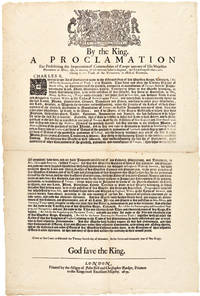
1675réf. 45901London: Printed by the Assigns of John Bill and Christopher Barker 1675. Enforcing the Triangular Trade: The Basis for the British Colonial System A rare broadside reiterating and reinforcing the decree of the English government that all foreign goods destined for British colonies must first pass through England a policy of mercantilism later termed the "triangle trade." "This program permitted the profits from colonial trade and commerce to center in England promoted British shipping and enabled the British government to support itself by taxing this trade as it flowed through England" - DAH. The English government began its mercantilist policies under the Commonwealth government in a series of "navigation acts" which regulated English trade. The first Navigation Act passed in 1651 targeted Dutch commerce. It stipulated that only English ships could carry freight into English territories and that if a ship was not English it could only carry goods from the country from whence it hailed i.e. Dutch ships could only import Dutch goods etc. Acts passed in 1660 and 1663 under the Restoration government of Charles II isolated trade even further mandating that British colonial goods only be imported to England and forbidding English trade on anything other than English vessels. This policy of trade which was continued for the next two hundred years marked the ascent of British colonial mercantilism and planted the seeds of discontent which resulted in the American Revolution one hundred years later. The present proclamation is an enforcement of the Navigation Act of 1663 An Act for the Encouragement of Trade under which "no commodities of the growth production or manufacture of Europe shall be imported into any land island plantation colony territory or place to his Majesty belonging." In other words all European trade to the American and East Indian colonies of the English had to pass through English ports en route. As the law is being disobeyed to the detriment of trade and tax revenue the proclamation extends power for enforcement to the officials of the realm. It states: ".whereas his Majesty is well informed that notwithstanding the said Act of Parliament great quantities of other commodities.have been and are daily imported into several of his colonies plantations and territories in Asia Africa and America.and that his Majesties subjects of some of his colonies and plantations have not onely sic supplied themselves with such commodities not shipped in England.but have conveyed them by land and water to other of his Majesties colonies and plantations to the great prejudice of his Majesties customs and of the trade and navigation of this kingdom." An important proclamation which illustrates the difficulty in maintaining and enforcing the laws central to the first British Empire. Old fold lines. Repaired with tissue on verso along vertical fold. A few other small tears or tissue repairs. Very good. ESTC R25339. WING C3378. GOLDSMITHS' 2112. STEELE I:3619. KRESS S1421. DAH III p.374. unknown books
1966réf. 233126New York: Trade Unionists for Peace 1966. Four-panel brochure with black and white image of a Vietnamese farmer on the cover brief essay inside “He’s a worker too” in both English and Spanish arguing that American workers should show solidarity with Vietnamese workers by opposing the war; lightly fold-creased else very good condition. Trade Unionists for Peace unknown books
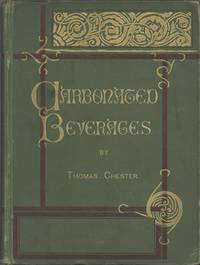
1882réf. 6662New York: P.H. Reilly Wood-Cut and Color Printer 25 Rose Street 1882. Quarto 27 x 20.5 cm. 108 4 166 2 pages. Profusely illustrated. Text in two columns. Table of contents at rear. FIRST EDITION. An early – perhaps the first – history of carbonated beverages. Issued together with a trade catalogue for the soda water supply firm of John Matthews of New York an important manufacturer of bottling equipment soda fountains and carbonation apparatus. The fountains get progressively larger and more elaborate and with wonderful names: “The Citadel” “The Horicon” “The Adriatic” “The Fire-Eater” “The Nepenthe” and “The Snow Queen”. There I also an outdoor soda fountain “The Street Spa”. Also included are the auxiliary equipment of the carbonated water industry like siphon boxes for home delivery of soda water. The historical work and the trade catalogue were issued in celebration of the firm’s 50th Anniversary. Some pencil scribbles to a few pages. Text block shaken; free front endpaper lacking. In publisher’s brown and gilt-decorated green cloth corners rubbed and extremities a bit worn. Better than good. With the ownership signature of “Leopold F. Schmidt Deer Lodge Montana” and a more recent “Olympia Brewing Company”. Very scarce. OCLC records two copies with this pagination Loma Linda Univ. & Hagley Museum and four copies with just 108 pages presumably just the history; Noling Beverage Literature page 104 for the 108 page version. P.H. Reilly, Wood-Cut and Color Printer, 25 Rose Street hardcover books
1890réf. 285639Boston: French 1890. paperback. very good. 21 post card sized plates illustrating an assortment of finished carriages broughams phaetons surreys etc. Boston: Ferd. F. French no date circa 1890. The firm was a successor to Wm. P. Sargent & Co. est. 1851. French unknown books
1896réf. List2820Sonora and Groveland CA; Portland OR; and Orange NJ 1896. 8 ½ x 13 ½ inch cash book thirty-two pages with nine loose sheets. Fine. A cash book for an unnamed business selling out of California Oregon and New Jersey in 1896. The book records total merchandise value cash and accounts liabilities individual sales and so on. The business sold a variety of items from raw cloth and furniture to food coffee and tea and soap. Most of the entries are from Sonora; located on California’s Mother Lode Sonora was by 1896 a bustling mining town. unknown books
1900réf. 5130Frankfort NY: Acme Machinery Co. ca 1900. Edition Unknown. orig. publisher's printed wrappers. A good copy; marginal tide mark . ob. 8vo. The catalog is illus. throughout. 64 pp. The Acme catalog of road building equipment in Spanish and obviously intended for the Latin American export market. The catalog contains all kinds of heavy equipment as well as the design for a small cement plant. Some of the large pieces are illus. with half tone photographs and cut away schematic drawings. Acme Machinery Co. unknown books
1910réf. 3260Sioux City IA: G.H. Jenkinson Company 1910. Oblong folio in wrappers 36 pages. Illustrated. Trade catalogue with a vast array of items for the butcher shop and home manufactured by the G.H. Jenkinson Company including platform scales meat slicers lard presses salt and pepper shakers hotel linens and candy maker supplies among many other things. Over two hundred categories of items outlined in the index. Hole punch through upper left corner for hanging. Near fine condition in publisher's green and orange printed wrappers with brick red cloth spine. OCLC locates just one copy at Iowa State Historical Society; Jenkinson does not appear in Romaine. G.H. Jenkinson Company hardcover books
1931réf. 285642Chicago: Dietzgen 1931. hardcover. very good-. Color frontispiece of Chicago factory; text illustrations. 520pp. 8vo green cloth rear cover lightly spotted. Chicago: Dietzgen. 1928. Samples of drawing & tracing papers affixed to inside front cover; price list in back envelope is missing. Dietzgen unknown books
1928réf. 285641Chicago: Dietzgen 1928. hardcover. very good. Color frontispiece of Chicago factory; text illustrations. 489pp. 8vo green cloth spine ends a bit worn. Chicago: Dietzgen. 1928. Booklet with prices insert in envelope inside back cover; samples of drawing & tracing papers affixed to inside front cover. Dietzgen unknown books
1920réf. 4801Barcelona: Orfebres de Espana Sociedad Anonima 1920. Tall brad-bound trade catalogue 23 leaves printed rectos only. Trade catalogue of flatware illustrated in various patterns. Some wear to the printed card-stock wrappers otherwise very good. Scarce. OCLC locates no copies. Orfebres de Espana, Sociedad Anonima unknown books
1892réf. 285644Brooklyn: E.W. Bliss 1892. hardcover. very good-. Frontispiece pictures of the factory and of international medals won. Many full page & half page illustrations. 389pp. small 8vo flexible blue cloth back cover gently creased; small hole in spine light damp-stains on the bottom margins of a few pages. Brooklyn: E.W. Bliss 1892. Ninth edition. Bliss was the premier manufacturer of heavy industrial sheet metal. E.W. Bliss unknown books
1877réf. 8323Chicago Il: National Live-Stock Journal Print 1877. Octavo sewn in wrappers 22.7 x 15 cm. 36 pages. Illustrated with six lithographic plates. FIRST EDITION. Joint public auction of short horns with attractive lithographs engraved "on stone by J.R. Page by Clay & Richmond Co. Buffalo N.Y." Text block sound; dampstain to edges of most plates. Wrappers separated and chipped at edges. Still overall near very good. Marginal pencil annotations throughout; auction winners names and prices have been written in for each lot. OCLC locates just one copy UMichigan Clements. National Live-Stock Journal Print unknown books
1883réf. 236859Kansas City Missouri: Press of Ramsey Millett & Hudson 1883. Illustrated with 2 full-page Engravings. 76 pp. 1 vols. 8vo. Original wrappers printed in red and black. Vertical crease to front wrap and a few corners previously turned down a few prices realized in pencil. Very good. Illustrated with 2 full-page Engravings. 76 pp. 1 vols. 8vo. Over sixty-five Galloway bulls and heifers on the block giving detailed pedigree. With an introduction by Matthews explaining the his interest in the breed. Not in OCLC Press of Ramsey, Millett & Hudson unknown books
1892réf. 504Chicago Ill. U. S. A.: Thomas Kane & Company 1892. Oblong 8vo. 195 x 270 mm. 7 ½ x 11 inches. 43 pp. Illustrated throughout with lithographs many full-page images of launches and boating equipment. Bound in original green paper wrappers title on front cover vignette of a sailing launch on the back cover. Very good copy. Well-illustrated catalogue of launches and boiler engines produced in Racine Wisconsin by the Thomas Kane & Company who maintained a salesroom in Chicago. The company won a first prize for their steam boat launches sail boats and row boats at the Columbian Exposition in Chicago in 1893. This catalogue issued the previous year illustrates many of the launches and boats that were part of the exposition and competition. Romaine Guide to American Trade Catalogues p. 66 listing catalogues for the years 1880 1885 and 1893. Outing an Illustrated Monthly Magazine of Sport Travel and Recreation. New York Vol. XXIV 1894 p. lxix. OCLC cites copies at Harvard and SMU. Thomas Kane & Company unknown books
1909réf. 284947Kalamazoo: Wm. E. Hill 1909. paperback. good. Illustrated 242pp. black printed wrappers worn with chipped spine. Kalamazoo: Wm. E. Hill & Co. 1909. Wm. E. Hill unknown books
1910réf. 10052Milwaukee: H.C. Schranck Co 1910. Oblong octavo 22.5 x 29 cm. 61 pages numbered 969-1030. Illustrated. FIRST EDITION. Trade catalogue for H.C. Schrank Co. of Milwaukee a manufacturer and distributor of equipment and supplies for bottlers. The catalogue covers a wide range of equipment from carbonating machines to fillers and bottlers crowning and filling machines cappers water stills and labeling machines. Supplies include wooden boxes for bottles siphon bottles and siphon-related parts bottle brushes faucets taps jars and pots for flavors and syrups copper measures and graduating cups corks and caps aprons boots and finger protectors and much more. Sample labels printed in three colors occupy the center portion of the catalogue. Internally with some light stains and rubbing to edges. Attractively re-bound with new endpapers and the original printed cover inlaid into the new marbled boards. Overall very good. Unrecorded. OCLC locates no copies; not in Romaine or Noling. H.C. Schranck Co hardcover books
1912réf. dacs1345Gainesville: A Pepper Production 1912. 16mo stiff green printed wrappers stapled 16 pp. Photos. Fine. A Pepper Production, [1912]. unknown books
1971réf. 85213Manila: Bureau of Printing 1971. Hardcover. Good. 3 vols. frontises each section separately numbered. Contemporary blue boards with original wrappers for the various parts bound in. 29 cm. Corners bumped. Advance Report No. 48 is not present -- we don't know which Province is missing in this set. We assume that these volumes were compiled from separately issued Advance Reports. Bureau of Printing hardcover books
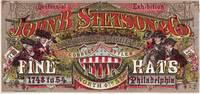
1876réf. 13129Philadelphia 1876. Chromolithographed trade card 3 x 6.5 inches. Minor wear paper and adhesive remnants on verso from removal from scrapbook or similar album. Overall very good. A bright and colorful trade card advertising one of Philadelphia's most successful businesses at the time of the 1876 Centennial Exhibition in that city. John B. Stetson 1830-1906 was the son of a successful New Jersey hatter. After being diagnosed with tuberculosis and told he didn't have long to live Stetson traveled west to Colorado for the dry mountain air. Near Pike's Peak sometime in the early 1860s Stetson invented the cowboy hat -- lightweight wide-brimmed waterproof and made out of animal felt usually beaver or rabbit skins. Because it sat easily atop the head offered good protection from the sun could be used to fan the flames of open-air fires and could even carry water Stetson's "Boss of the Plains" style became the most popular hat in the American West. Stetson returned to Philadelphia in 1865 and set up a factory that would turn out millions of hats in the next century and a half. The present trade card emanates from the 1876 Centennial Exhibition celebrating the 100th anniversary of American independence. An illustration of two women and three men show them all wearing Stetson's trademark hats; his address at the time was 1748 to 1754 North 4th Street; his factory would eventually grow to encompass over nine acres and produce over two million hats a year. By 1886 Stetson was the most prolific hat maker in the world. unknown books
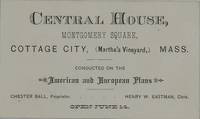
1880réf. 70726Martha's Vineyard MA 1880. 6 x 9.5 cm. printed in black in various sizes and styles of type on white stiff card stock. unknown books
1949réf. NF3712CHAOS IN THE GOVERNMENT-AND WHAT TO DO ABOUT IT Chamber of Commerce of the United States 1949 first edition vg or better in yellow wraps. A summary based on the findings of the Hoover Commission. Chamber of Commerce of the United States paperback books
1924réf. 64072New York: China Trade Bureau August 1921 to June 1924. 2 volumes large 4to lacking vol. I no. 1 and volume VI no. 6 but otherwise complete from volume I no 2 to volume VI no. 5 - 34 issues in all and contained in a library binding of blue cloth gilt-lettered spine; ex-Purdue University lightly marked. Issues range from 24 to 56 pages. Illustrated throughout. Publication was suspended during June July and August 1924 and finally folded withg the publication of volume VI no. 6 in September 1924. The China Review "is the only magazine published in the United States and edited by Chinese that deals exclusively with all phases of China political social industrial etc." Regular features include: book reviews China's Business Barometer; Finance Industry and Commerce; Foreign Press Comments; The Month in the East; Trans-Pacific Sailings; and Home and General News; together with feature articles by Nathaniel Peffer Cornelius Vanderbilt Charles Hodges Charles W. Mason Nora Waln Loretta Shaw Chungshu Kwei Dr. P. W. Kuo Genevieve Wimsatt K. H. Li Ma Soo James D. Bush and Robert Harris among others writing on various topics relating to China including Chinese Pagodas The Modern Chinese Girl The Future of American Trade in China China's Mathematics - The Oldest Approach and Development of Chinese Markets The Mongolian Situation Selling to the Chinese Millions China's Silk Industry China and the Four Power Treaty Tibet - The Closed Country The Part Birds Play in Chinese Life and many others of interesting content. China Trade Bureau, August, 1921 to June unknown books
1920réf. 6138San Francisco: Danner & Baker Inc 1920. Oblong stapled booklet 23 x 27 cm. 80 pages. Illustrated. FIRST EDITION of this number. A trade catalogue of glassware porcelain and Satsuma pottery from this long running San Francisco dealer in crockery and glassware. Near fine in green- and gilt-titled tan wrappers. Previous owner’s inscription to the from wrapper panel. OCLC locates one record for Catalogue no. 4 but the location is lacking; one copy each of Catalogues no. 3 & 5. Danner & Baker, Inc unknown books