(KANSAS / SLAVERY)Biblio.com

1.838 Ergebnisse
1857Best.-Nr. 40445Boston: John Wilson and Son 1857. Paperback. Small 4to. Self-cover. 12pp. Very good. Outer wrappers only faintly age toned. Clean attractive first edition of this lengthy diatribe against President James Buchanan's handling of the slavery issue in Kansas which they considered weak and ineffective followed by his reply and their response to it. "They fervently hope "that you may yet see that in this respect one false principle if adhered to must prove a principle of weakness and decay -- a sure prelude to the end of all our greatness happiness and glory -- a death-spot in the tree of liberty whose leaves like those of the tree of life are for the healing of the nations." Signed in type at the conclusion by these Connecticut congressmen in order: Nathaniel W. Taylor Theodore D. Woolsey Henry Dutton Charles L. English John H. Brockway Eli W. Blake Benjamin Stilliman Jr. Thomas A. Thacher J.A. Davenport Worthington Hooker Philos Blake Amos Townsend James Brewster Eli Ives S.G. Hubbard John A. Blake William H. Russell A.N. Skinner Charles Robinson Joel Hawes G.A. Calhoun Leonard Bacon H.C. Kingsley Benjamin Stilliman Sr. Charles Ives Josiah W. Gibbs James F. Babcock and Alfred Walker. OCLC cites 20 copies. SABIN 52997. John Wilson and Son paperback
Best.-Nr. DADAX0077532147New unknown
Best.-Nr. DADAX0521115256New unknown
Best.-Nr. DADAX0190655267New unknown
Second Edition, with additions, 12mo, [5], 6-100pp., folding engraved map of the town of Leicester, 5 nineteenth-century mounted actual photographs tipped-in, and 6 engraved plates tipped, modern cloth, uncut, spine faded. Susanna Watts was born in Leicester and was dedicated to bringing about the immediate abolition of slavery. She started one of the first fair trade campaigns, wrote hymns and pamphlets and even locked horns with William Wilberforce. When her father died, her wealthy family's finances became tight and she had to find a way to support herself and her mother. At the age of 15 or 16 she began writing to earn money, and as well as penning the first guide to Leicester, she wrote poetry to promote the emancipation of slaves. To be a young woman and a published author in the late 18th Century would not have been an easy task, so the fact that she prevailed shows how passionate Susanna was in her desire to make her antislavery views known. "They dared to stand up in front of all these men and say what they thought was right ? two women from the provincial town of Leicester." According to Shirley Aucott, a local historian and author, Susanna worked on a periodical called 'The Hummingbird', which brought together different ideas on the antislavery moment, and she organised what must have been one of the first fair trade campaigns! She visited local households and shops to persuade them not to use sugar produced in the Caribbean, claiming that, "abstinence from sugar would sign the death warrant of West Indian slavery."
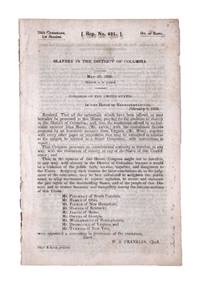
1836Best.-Nr. 346520Washington D.C. 1836. 24th Congress 1st Session House Rep. No. 691. 24pp. 8vo. Disbound. 24th Congress 1st Session House Rep. No. 691. 24pp. 8vo. Many of the early anti-slavery efforts focussed on the abolition of slavery in the District of Columbia as Congress had full control over the laws within the District thus obviating any argument over state's rights. Until "retroceded" back to Virginia in 1846 the city of Alexandria and its notorious slave market was considered part of the District of Columbia making slavery in the District of particular importance. Inundated with petitions calling for the abolition of slavery in the District in 1836 Congress passed the so-called Pinckney Resolution which asserted that Congress "ought not" to consider slavery in the District and created a gag rule whereby all petitions memorials or other resolutions on the subject would be automatically tabled. unknown
1836Best.-Nr. 346520Washington D.C. 1836. 24th Congress 1st Session House Rep. No. 691. 24pp. 8vo. Disbound. 24th Congress 1st Session House Rep. No. 691. 24pp. 8vo. Many of the early anti-slavery efforts focussed on the abolition of slavery in the District of Columbia as Congress had full control over the laws within the District thus obviating any argument over state's rights. Until "retroceded" back to Virginia in 1846 the city of Alexandria and its notorious slave market was considered part of the District of Columbia making slavery in the District of particular importance. Inundated with petitions calling for the abolition of slavery in the District in 1836 Congress passed the so-called Pinckney Resolution which asserted that Congress "ought not" to consider slavery in the District and created a gag rule whereby all petitions memorials or other resolutions on the subject would be automatically tabled. unknown books
1855Best.-Nr. 62372Boston: Bela Marsh 1855. Second printing. Frontispiece portrait. 122 pp. 1 vols. Small 8vo. Brown cloth stamped in blind and gilt. Upper half of spine shaky else a nice tight copy. Second printing. Frontispiece portrait. 122 pp. 1 vols. Small 8vo. The author was convicted of aiding slaves to escape from Washinton D.C.--Blockson. Sabin 20912 Blockson 9838 for first ed. Bela Marsh unknown
1855Best.-Nr. 62372Boston: Bela Marsh 1855. Second printing. Frontispiece portrait. 122 pp. 1 vols. Small 8vo. Brown cloth stamped in blind and gilt. Upper half of spine shaky else a nice tight copy. Second printing. Frontispiece portrait. 122 pp. 1 vols. Small 8vo. The author was convicted of aiding slaves to escape from Washinton D.C.--Blockson. Sabin 20912 Blockson 9838 for first ed. Bela Marsh unknown books
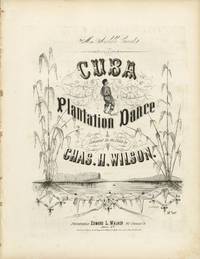
1855Best.-Nr. List3682Philadelphia: Edward L. Walker 142 Chestnut St. above 6th 1855. Folio sheet music pictorial lithographed cover approximately 13.5 × 10.5 inches. Light edge wear and minor toning; very good with a strong impression of the cover illustration. An antebellum piano dance reflecting the plantation imagery that circulated widely in mid-nineteenth-century American popular music. “Cuba Plantation Dance” was composed by Chas. H. Wilson a little-documented composer whose name appears chiefly in connection with this work and issued in Philadelphia during the early 1850s by Edward L. Walker the predecessor firm to the major publishing house Lee & Walker. A copy is recorded in the Levy Collection at Johns Hopkins which dates the publication to 1855. The cover presents a stylized plantation landscape framed by tall stalks of sugar cane with a small central vignette of a dancing Black figure. The use of Cuban plantation imagery reflects contemporary American fascination with the Caribbean sugar economy and with plantation life beyond the United States. During the 1850s Cuba was one of the largest slave societies in the Atlantic world. By the midcentury the island’s sugar plantations relied on hundreds of thousands of enslaved Africans and the enslaved population of Cuba was estimated at roughly 400000 people in the 1840s–1850s working primarily in the rapidly expanding sugar industry. Although Spain formally agreed to end the Atlantic slave trade in 1820 illegal importations of enslaved Africans into Cuba continued for decades supplying labor for the island’s plantations well into the 1850s. American publishers frequently borrowed such imagery for plantation-themed dance music marketed to the parlor trade. Pieces labeled “plantation dances” or “Ethiopian dances” formed part of the broader culture of minstrel and plantation entertainment. The title page bears a dedication to “Miss Arabelle Conrad” typical of mid-century sheet music addressed to amateur pianists. Along with the aforementioned copy in the Levy collection we find copies at Michigan and Temple. Edward L. Walker, 142 Chestnut St., above 6th unknown
1855Best.-Nr. List3682Philadelphia: Edward L. Walker 142 Chestnut St. above 6th 1855. Folio sheet music pictorial lithographed cover approximately 13.5 × 10.5 inches. Light edge wear and minor toning; very good with a strong impression of the cover illustration. An antebellum piano dance reflecting the plantation imagery that circulated widely in mid-nineteenth-century American popular music. “Cuba Plantation Dance” was composed by Chas. H. Wilson a little-documented composer whose name appears chiefly in connection with this work and issued in Philadelphia during the early 1850s by Edward L. Walker the predecessor firm to the major publishing house Lee & Walker. A copy is recorded in the Levy Collection at Johns Hopkins which dates the publication to 1855. The cover presents a stylized plantation landscape framed by tall stalks of sugar cane with a small central vignette of a dancing Black figure. The use of Cuban plantation imagery reflects contemporary American fascination with the Caribbean sugar economy and with plantation life beyond the United States. During the 1850s Cuba was one of the largest slave societies in the Atlantic world. By the midcentury the island’s sugar plantations relied on hundreds of thousands of enslaved Africans and the enslaved population of Cuba was estimated at roughly 400000 people in the 1840s–1850s working primarily in the rapidly expanding sugar industry. Although Spain formally agreed to end the Atlantic slave trade in 1820 illegal importations of enslaved Africans into Cuba continued for decades supplying labor for the island’s plantations well into the 1850s. American publishers frequently borrowed such imagery for plantation-themed dance music marketed to the parlor trade. Pieces labeled “plantation dances” or “Ethiopian dances” formed part of the broader culture of minstrel and plantation entertainment. The title page bears a dedication to “Miss Arabelle Conrad” typical of mid-century sheet music addressed to amateur pianists. Along with the aforementioned copy in the Levy collection we find copies at Michigan and Temple. Edward L. Walker, 142 Chestnut St., above 6th unknown books
1851Best.-Nr. 106835Pamphlet 8vo wrappers 36 pp. Archival tape repair to back of front cover slight edgeware normal aging and browning; otherwise very good. Follows the general tone of a good deal of the abolitionist literature of the period. However while the author acknowledges the critical importance of slavery to America he suggests the issue needs to be debated with "calmness and candor" interestingly he indicates that the climate for these discussions appears to be improving. Charles C. Little and James Brown,
1851Best.-Nr. 106835Pamphlet 8vo wrappers 36 pp. Archival tape repair to back of front cover slight edgeware normal aging and browning; otherwise very good. Follows the general tone of a good deal of the abolitionist literature of the period. However while the author acknowledges the critical importance of slavery to America he suggests the issue needs to be debated with "calmness and candor" interestingly he indicates that the climate for these discussions appears to be improving. Charles C. Little and James Brown, books
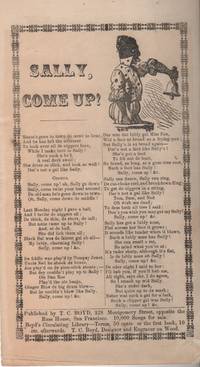
1860Best.-Nr. 43380San Francisco: T.C. Boyd 1860. Near fine. Racist slavery-era broadside printed and designed by one T.C. . Boyd featuring a drawing and lyrics to a ballad which begins: "Massa's gone to town de news to hear / And he has left the overseer / To look over all de nrs here / While I make love to Sally!" Boyd notes he had 10000 such sheets for sale at his shop. Broadside 8.5" by 4.5". Printed from type and wood engraving. Very near fine with trivial crease to edges. T.C. Boyd unknown
1860Best.-Nr. 43380San Francisco: T.C. Boyd 1860. Near fine. Racist slavery-era broadside printed and designed by one T.C. . Boyd featuring a drawing and lyrics to a ballad which begins: "Massa's gone to town de news to hear / And he has left the overseer / To look over all de nrs here / While I make love to Sally!" Boyd notes he had 10000 such sheets for sale at his shop. Broadside 8.5" by 4.5". Printed from type and wood engraving. Very near fine with trivial crease to edges. T.C. Boyd unknown books
1785Best.-Nr. 13753A Londres, s.é., 1785. 2 vol. au format in-12 étroit (166 x 98 mm) de 154 et 158 pp. Reliures uniformes de l'époque de pleine basane marbrée havane, plats jansénistes, dos lisses ornés d'un double filet d'encadrement doré, triples filets dorés, larges fleurons dorés, semis de points dorés, pièces de titre de maroquin vieux-rouge, titre doré, tomaison dorée, filet doré sur les coupes, toutes tranches rouges.
Best.-Nr. 13160Paris. Chez Maradan. Sans date [1800]. Grand in-8° broché, couverture muette en papier du temps. 269 pages + 26 pages de tableaux. E.O. Tache pâle (peu gênante) courant sur la marge des dix premières pages ; à part cela, aucun défaut.
Best.-Nr. ORD-698Ouvrage traduit de l'anglais par Hippolyte Vattemare et contenant 56 gravures et 2 cartes. Hachette. 1875. Grand in-8 dos chagrin rouge orné, tranches dorées, portrait de l'auteur en frontispice, 439pp. gravures h.-t. et 2 cartes couleurs dont une dépliante (Bassin du Nil et Carte de l'Albert Nyanza). Reliure lgt épidermée mais bon état intérieur pratiquement sans rousseurs.|Autre exemplaire mêmes caractéristiques, dos basane noire, 5 nerfs, tranches mouchetées, Lycée Henri IV sur le 1°plat, rousseurs en début d'ouvrage, mais bon exemplaire, même prix.
Best.-Nr. 057470Paris Librairie de L. Hachette et Cie 1875 in 8 (24x16,5) 1 volume reliure demi chagrin rouge de l'époque, dos à nerfs orné de caisson dorés à fleuron central, plats de percaline rouge ornés d'un encadrement à froid, tranches dorées, portrait gravé en frontispice, III et 436 pages. Ouvrage illustré de 56 gravures et de 2 cartes en couleurs dont une dépliante en couleurs in fine (fine restauration ancienne d'une déchirure sans manque au papier de soie, au verso de la carte), des rousseurs éparses sur les premières et les dernières pages. Ouvrage traduit de l'anglais avec l'autorisation de l'auteur par Hippolyte Vattemare. Sir Samuel White Baker, Londres 1821 - Newton Abbot 1893, explorateur anglais. Bon exemplaire, reliure fraîche ( Photographies sur demande / We can send pictures of this book on simple request )
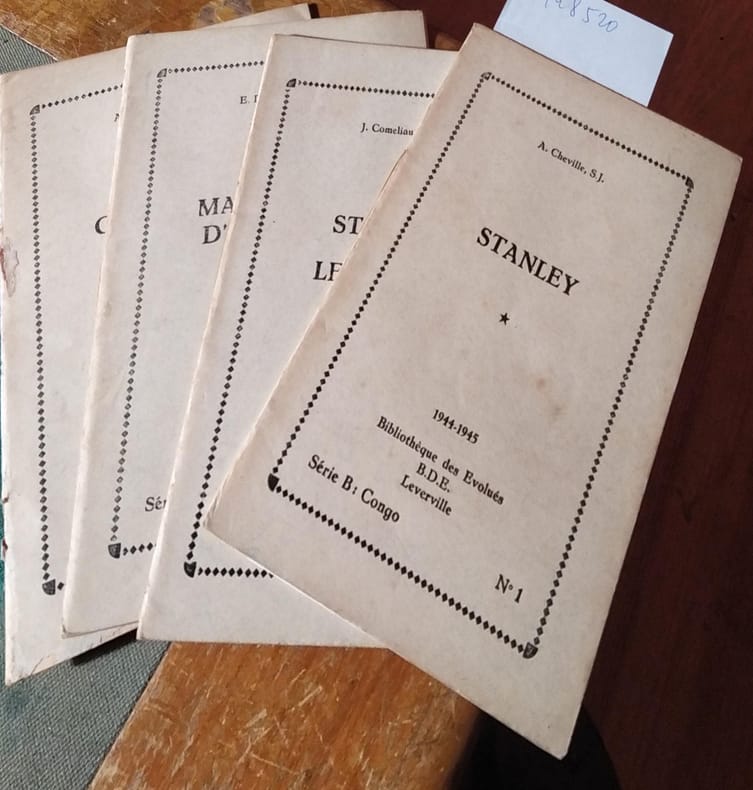
1945Best.-Nr. 148520Couverture souple. 4 brochures de 32 pages. 12 x 17 cm.
Best.-Nr. 15147In-8, broché, couverture de papier moderne, 15 p. Paris, Baudouin, 1789.
In-8, broché, couverture de papier moderne, 15 p. Edition originale. Le député de la Guadeloupe soumet son projet de création d'un Comité colonial composé de députés des colonies, de colons et de négociants blancs, afin d'élaborer une constitution coloniale spécifique. Par la suite, Curt émigra en Angleterre. Il y négocia le traité de Whitehall (1793) entre les Anglais et les grands planteurs français des Antilles pour permettre à ces derniers de combattre les troupes révolutionnaires et de s'opposer à l'émancipation des Noirs. (cf. Pluchon, "Histoire de la colonisation française", p. 813). (Martin & Walter, 911. Sabin, 18017). Bon exemplaire, très frais.
Best.-Nr. 5924In 8 broché,faux-titre,portrait de l’auteur,titre,carte sur double page,501 pages,18 gravures d’après les dessins de RIOU,3 gravures de THIRIAT d’après les photographies,hors-texte.5 cartes ou plans.Paris Librairie Hachette & Cie 1889.Rousseurs éparses,plus concentrées à certaines pages. Une restauration dans la partie en marge extérieure du premier,plat de couverture ainsi qu’un petit manque en pied,réparé,sinon bon exemplaire à grandes marges
Best.-Nr. 6717P., Delay, 1846. In 8 broché, 114 pp. (manque second plat, trace de brûlure au bas).
Best.-Nr. 13981722Paris: Pillet, 1820 in-8, [2]-157-[3] pages, 2 portraits frontispice dessinés et gravés par Ambroise Tardieu, planche hors texte avec fac similé d'un autographe de P. J. Dumont. Demi reliure postérieure chagrin vert, dos à 5 nerfs, fleurons et filets dorés, couv. conservées (la couverture porte l'année 1819), légère mouillure sur qq pages, cachet d'un ancien propriétaire sur la page de titre, bel exemplaire. Dumont, marin dans la marine française, fut fait prisonnier par des pirates Arabes d'Algérie en 1782 et demeura esclave 34 ans.